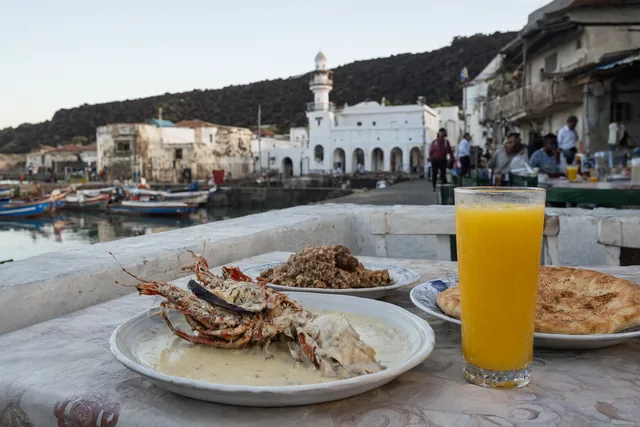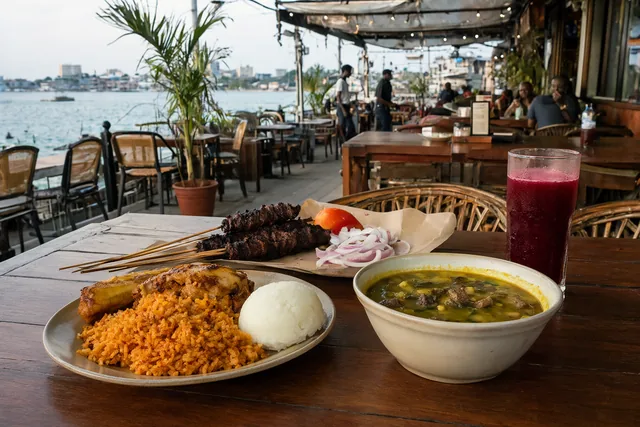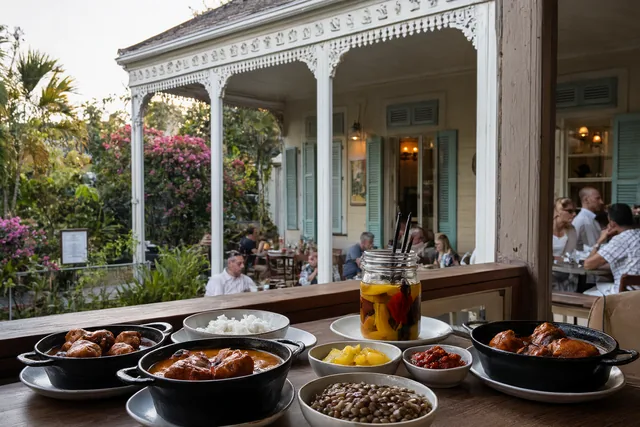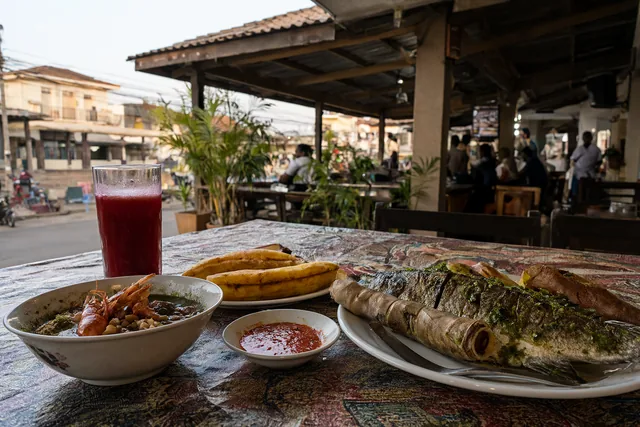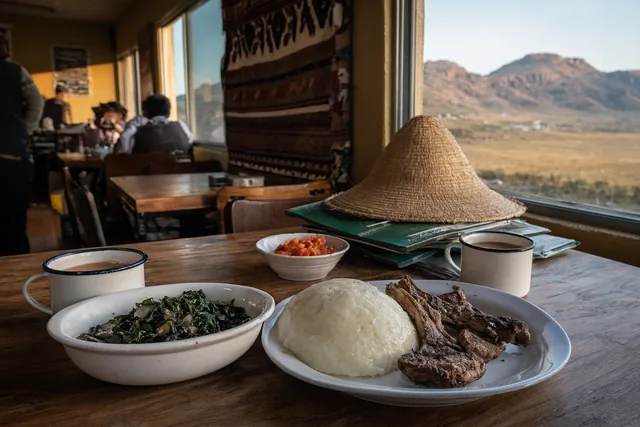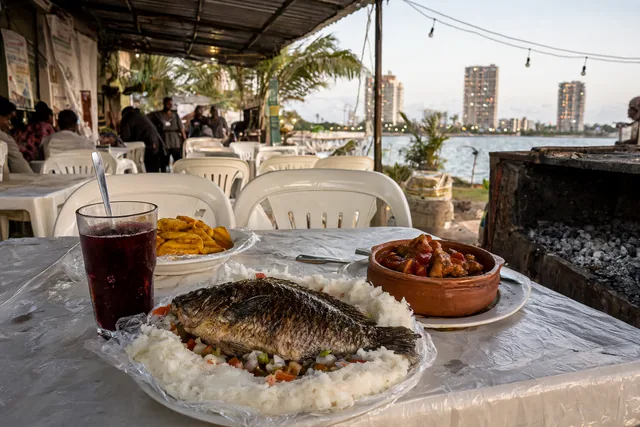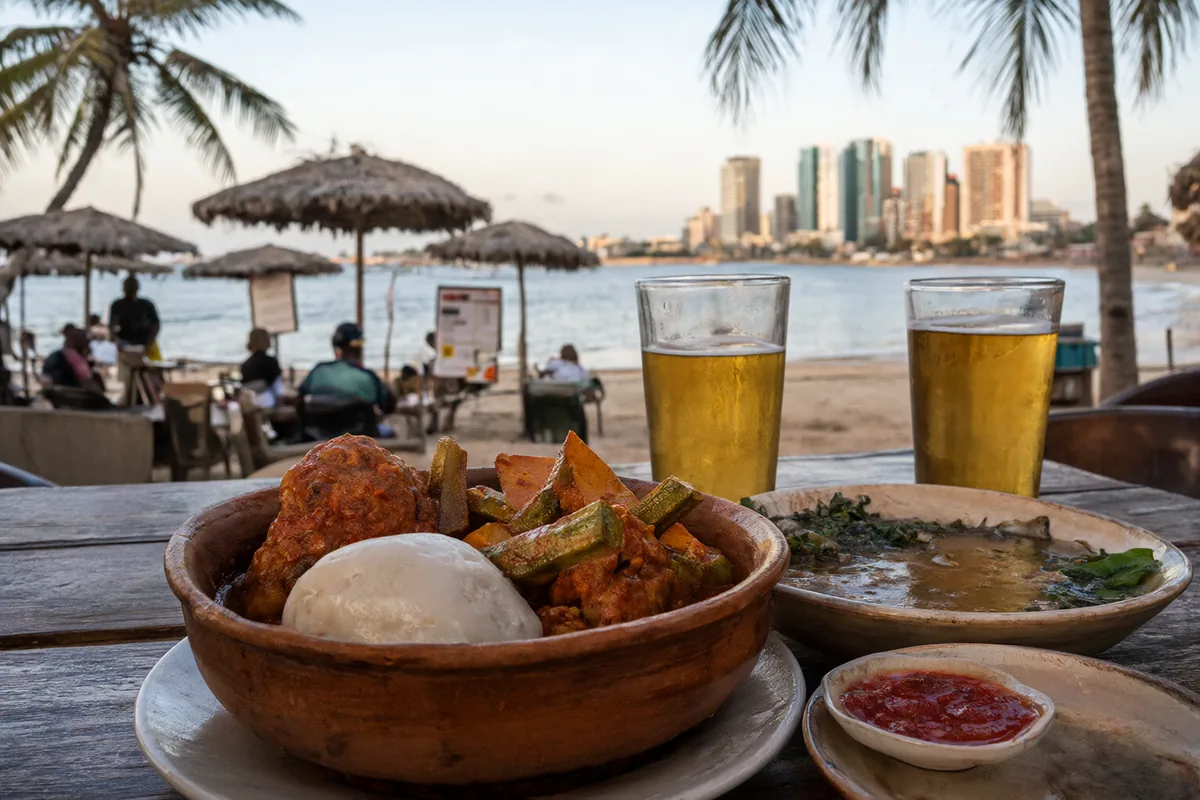
Angola's food is bold, rich and deeply rooted: chicken stewed in red palm oil, fish dried and fresh cooked together in a single pot, peanuts ground into sauces, and funge, the smooth cassava porridge eaten with almost everything. Five centuries of contact with Portugal and Brazil added grills, stews and sweets, and a long Atlantic coast supplies superb fish and seafood. This Angola food guide covers the dishes to know, how to read a Portuguese menu, tipping and paying in kwanza, and where to eat in Luanda, Benguela, Lobito, Lubango, Namibe and Huambo.
What to eat in Angola: 12 dishes to know
Angolan cooking is built on palm oil, peanuts, cassava, beans, fish and chilli, with regional differences between the north, the coast and the southern highlands. These are the dishes to look out for.
- Muamba de galinha (everywhere): the national dish, chicken stewed in a deep red sauce of palm oil, garlic, okra and squash, often with chilli. Served with funge, rice or beans.
- Funge (everywhere): a smooth, sticky porridge eaten with stews. In the north and Luanda it is made from cassava flour (funge de bombó); in the south and centre it is usually made from maize (funge de milho, also called pirão).
- Calulu (Luanda and the coast): a stew of dried and fresh fish cooked with tomato, onion, okra, sweet potato leaves and palm oil, a classic of the Luanda region. There is also a meat version.
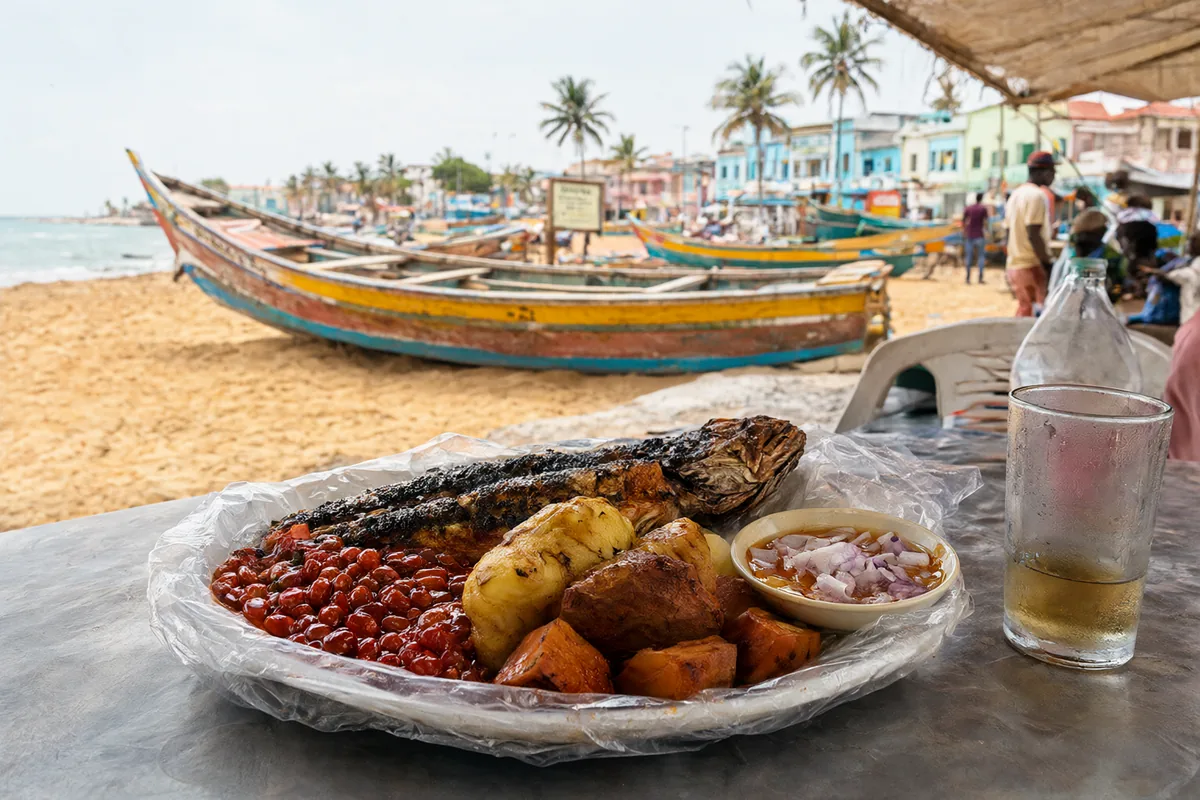
- Mufete (Luanda): grilled whole fish served with beans cooked in palm oil, boiled plantain, sweet potato and cassava, and a raw onion sauce. The traditional Sunday lunch on the Ilha de Luanda.
- Moamba de ginguba (everywhere): chicken or fish in a thick peanut sauce. Ginguba is the Angolan word for peanut.
- Kizaca (the north and Luanda): cassava leaves pounded and cooked with peanuts or palm oil, often with dried fish, served as a side or main.
- Feijão de óleo de palma (everywhere): beans slow-cooked in palm oil, a rich side dish that goes with grilled fish and mufete.
- Galinha de cabidela (everywhere): chicken stewed in a sauce thickened with its own blood and vinegar, a Portuguese-rooted dish with an Angolan accent.
- Caldeirada de cabrito (everywhere): a hearty goat stew with potatoes and tomato, cooked for celebrations, including Independence Day on 11 November.
- Muzongué (Luanda): a fish broth with palm oil, onion and sweet potato, famously eaten on the morning after a big night out.
- Gindungo and kitaba (everywhere): gindungo is the hot chilli, and the sauce made from it, set on every table; kitaba is a snack of roasted peanuts ground with chilli.
- Cocada amarela and doce de ginguba (everywhere): yellow coconut pudding made with egg yolks, sugar and cinnamon, and peanut brittle, the two best-known Angolan sweets.
How to read a Portuguese menu in Angola
Portuguese is Angola's official language and the language of every menu. English is spoken in some upmarket hotels and restaurants in Luanda, but rarely elsewhere. Kimbundu, Umbundu, Kikongo and other national languages are widely spoken, and some dish names come from them. Restaurants usually split the menu into Portuguese-style dishes and comida tradicional (traditional food). These are the words that matter.
| Portuguese | Meaning |
|---|---|
| Entradas | Starters |
| Pratos principais | Main courses |
| Comida tradicional / pratos típicos | Traditional Angolan dishes |
| Peixe / marisco | Fish / seafood |
| Peixe seco | Dried fish, used in calulu and kizaca |
| Galinha / frango | Chicken (galinha often means a free-range bird) |
| Carne de vaca / cabrito / porco | Beef / goat / pork |
| Grelhado / frito / guisado | Grilled / fried / stewed |
| Óleo de palma / dendém | Red palm oil |
| Ginguba | Peanuts |
| Gindungo | Chilli, or chilli sauce |
| Acompanhamentos | Sides: funge, arroz (rice), batata frita (chips), banana-pão (plantain) |
| Sobremesas | Desserts |
| Taxa de serviço | Service charge |
Lobster, prawns and large fish are often priced "por kg" or listed with no price, and Luanda restaurant bills can be high. Ask the price and the weight before ordering seafood. swap.menu flags priced-by-weight items, explains dishes such as calulu and kizaca and converts every kwanza price to your home currency.
Tipping, tax and paying the bill in Angola
Tipping (gorjeta) is customary in Angolan restaurants that serve visitors, and about 10 percent is normal for good service when no service charge is shown. Some restaurants add a taxa de serviço (service charge) of around 10 percent, so check the bill. At street stalls and small eateries, rounding up is enough. IVA (VAT) is usually included in menu prices. Our guide to tax and service charges on menus explains how service and tax lines work around the world.
The currency is the kwanza (AOA), written Kz on menus. Angolans pay with domestic bank cards on the national network, and foreign Visa and Mastercard cards work at some hotels, upmarket restaurants and supermarkets in Luanda, but not reliably, and many ATMs reject foreign cards. Bring enough cash in US dollars or euros to exchange at banks or official exchange offices, and keep small kwanza notes for taxis, markets and street food. When a card machine offers to charge you in your home currency, decline and pay in kwanza: our guide to paying in local currency explains why.
Lunch is the main meal for many Angolans, from about 12:30pm to 3pm, and long weekend lunches on the beach can run all afternoon. Dinner starts around 7:30pm or 8pm, later at weekends in Luanda, where restaurants and bars stay busy late on Friday and Saturday nights.
Where to eat in Angola, city by city
Angola is a big country, and most visitors see Luanda and one or two cities on the coast or in the southern highlands. Jump to a city:
Where to eat in Luanda
Luanda, the capital, is a huge, fast-growing city on a bay of the Atlantic, and one of the most expensive cities in Africa to eat out in, though local food is far cheaper than the hotel restaurants. The Ilha de Luanda, the long sandspit that curves around the bay, is the heart of eating out: beach restaurants and bars line the shore, serving grilled fish, mufete, calulu, muamba and seafood, with cold beer and music. On Sunday afternoons, Luanda families pack the Ilha for long lunches, and it is the best time to try mufete.
The rebuilt waterfront promenade of the Marginal (Avenida 4 de Fevereiro) and the old downtown Baixa, below the Fortress of São Miguel, have cafés, Portuguese-style restaurants and bakeries. In the south of the city, the newer district of Talatona has malls, hotels and restaurants serving Angolan, Portuguese, Brazilian and international food. Across the bay, the Mussulo peninsula, reached by boat, has beach restaurants for weekend lunches. Throughout Luanda you will see zungueiras, women street vendors carrying fruit, bread, roasted peanuts and grilled fish on their heads.
Where to eat in Benguela
Benguela, on the coast about 500 kilometres south of Luanda by road, is one of Angola's oldest cities, known as the "city of the red acacias" for the flowering trees that line its streets. It is smaller, calmer and cheaper than Luanda, with colonial buildings in pastel colours and a long seafront. Praia Morena, the city beach, has restaurants and beach bars serving grilled fish, prawns, mufete and calulu, with fishing boats pulled up on the sand.
The coast south of Benguela has beautiful bays, such as Baía Azul and Caota, with a few beach restaurants and weekend crowds from Benguela and Lobito. The city's markets sell fresh fish, dried fish, cassava, beans and fruit, and small restaurants serve muamba, funge and grilled chicken at lunchtime. Seafood in Benguela is excellent value compared with Luanda, so this is the place for a long fish lunch.
Where to eat in Lobito
Lobito, half an hour north of Benguela, is a port city built around a sheltered bay, and the Atlantic end of the Benguela Railway, which runs inland towards the copper belt of central Africa. The Restinga, a narrow sandspit that encloses the bay, is Lobito's best place to eat: a palm-lined strip of seafood restaurants, bars and beaches, with grilled fish, lobster, prawns and calulu, and views over the water.
Lobito's bay is known for flamingos, which gather in the shallows, and evenings on the Restinga are relaxed, with locals drinking beer and eating grilled fish at sunset. The town centre has markets, bakeries and simple restaurants serving Angolan dishes, and many visitors base themselves in Benguela and come to Lobito for an evening meal.
Where to eat in Lubango
Lubango, in the southern highlands at around 1,700 metres, is cool, green and very different from the coast, with a big statue of Christ overlooking the city, the dramatic switchbacks of the Serra da Leba road and the cliffs of the Tundavala Gap nearby. The surrounding Huíla plateau is cattle and farming country, and Lubango's food leans towards meat: grilled beef, goat stew, chicken and funge de milho made from maize, with vegetables and fruit grown in the highlands.
Lubango has a pleasant city centre with cafés, bakeries and Portuguese-style restaurants, plus grills and local eateries serving traditional plates. Markets sell maize flour, beans, potatoes and seasonal fruit, and in the south you may find kissângua, a lightly fermented maize drink. Lubango is the base for trips down the Serra da Leba to the coast at Namibe, a spectacular drive.
Where to eat in Namibe
Namibe province, in the far south west, is where the Namib Desert meets the Atlantic, and its main town, Moçâmedes (long known as Namibe), is a quiet fishing and port town. The cold Benguela current makes these waters rich in fish, and the seafront restaurants serve grilled fish, octopus, prawns and lobster, while fishermen dry fish on racks along the shore, which is sold across the country as peixe seco for calulu and kizaca.
The desert inland is home to the strange Welwitschia mirabilis plant and to Iona National Park, and travellers heading into the desert should bring all their food and water from town. Moçâmedes has a market, bakeries and simple restaurants, and the nearby fishing town of Tômbwa has more seafood. The food in Namibe is simple, but the fish is about as fresh as it gets.
Where to eat in Huambo
Huambo, on the central plateau, was planned in the colonial era as a garden city and is the heartland of the Ovimbundu people, Angola's largest ethnic group. It is a farming region, cooler than the coast, and the food reflects it: funge de milho (pirão), beans, sweet potatoes, chicken and goat stews, and fresh vegetables and fruit from the surrounding farms. Huambo's markets are the place to see the produce of the plateau.
The city has been extensively rebuilt in recent decades and has a small number of hotels, cafés and restaurants serving Angolan and Portuguese dishes, plus street food stalls selling grilled meat and corn in the evening. Few foreign tourists visit Huambo, so restaurants are aimed at locals and business travellers, and prices are lower than in Luanda. The highlands around the city are good for walking, and a long lunch of goat stew and funge is a fine way to end a day there.
Vegetarian, vegan and allergy tips
Angola is a meat and fish country, and vegetarians need to ask carefully. Beans in palm oil, funge, rice, plantain, sweet potato and cassava make a filling meal, and kizaca can be made without fish, but many vegetable dishes are cooked with dried fish or meat stock. The Portuguese word is vegetariano (or vegetariana for a woman); add "sem carne, sem peixe, sem peixe seco" (no meat, no fish, no dried fish) to be clear. Upmarket restaurants in Luanda have more vegetarian choice.
Peanuts (ginguba) are the main hidden allergen: they are ground into moamba, kizaca, kitaba and sweets. Shellfish appear in coastal stews and sauces, and red palm oil is used in many traditional dishes. Our guide to eating abroad with food allergies explains how to make an allergy clear when you do not speak Portuguese.
Useful Portuguese phrases for ordering
Bom dia / Boa tarde / Boa noite "Good morning / Good afternoon / Good evening", the polite greeting as you sit down
Uma mesa para dois, por favor "A table for two, please"
Qual é o prato do dia? "What is the dish of the day?"
Quero provar comida tradicional "I would like to try traditional food"
Sem gindungo, por favor "Without chilli, please"
Sou alérgico / alérgica a ginguba "I am allergic to peanuts" (alérgico for a man, alérgica for a woman)
A conta, por favor "The bill, please"
Obrigado / Obrigada, está bué bom! "Thank you, it is really good!"; bué is everyday Angolan slang for "very" or "a lot"
How swap.menu helps you eat in Angola
Angolan menus are in Portuguese, with traditional dishes named in Portuguese, Kimbundu and Umbundu, and very few have an English version. Photograph the menu with swap.menu and every dish appears in your language with the original name beside it and a short explanation, so you know that muamba is a palm oil stew, that funge de bombó is cassava porridge, and that cabidela is cooked with blood before you order it. Every price is converted from kwanza to your home currency, which matters in a city as expensive as Luanda.
Tap the dishes you want, add a note such as "no peanuts" or "chilli on the side", typed or spoken, and swap.menu translates your order into Portuguese. Show the waiter your phone, or let them scan the QR code and read your order on their own screen. Try it on a sample menu with the free demo, or see travel pass prices.
Off to Angola? Your first 3 menu scans are free, and a travel pass starts from $4.99 with nothing that renews.
Start free with 3 scansAngola food FAQ
Do you tip in restaurants in Angola?
Yes, about 10 percent is normal in restaurants that serve visitors when no service charge has been added. Some restaurants add a taxa de serviço, so check the bill before tipping.
What is the national dish of Angola?
Muamba de galinha, chicken stewed in red palm oil with okra and squash, is usually called the national dish. It is served with funge, the smooth porridge made from cassava or maize flour.
Is it expensive to eat out in Angola?
Luanda is one of the most expensive cities in Africa for restaurants, especially hotels and seafood places. Local eateries, street food and restaurants in Benguela, Lubango and Huambo are much cheaper.
Is tap water safe to drink in Angola?
No, visitors should not drink tap water in Angola. Drink bottled water, avoid ice at small eateries and be careful with raw salads.
What time do people eat dinner in Angola?
Dinner usually starts around 7:30pm or 8pm, later at weekends in Luanda. Lunch is the main meal for many people and can stretch through the afternoon on weekends.
How can I read a menu in Angola if I do not speak Portuguese?
Learn a few key words such as peixe (fish), galinha (chicken), grelhado (grilled) and funge, or photograph the menu with swap.menu. It translates every dish, converts kwanza to your currency, flags prices by weight and translates your order into Portuguese.
Travelling further in southern and central Africa? Read our food guides for nearby countries:
- Namibia food guide
- Zambia food guide
- Republic of the Congo food guide
- São Tomé and Príncipe food guide
- Mozambique food guide
- Portugal food guide
Or browse every travel food guide.