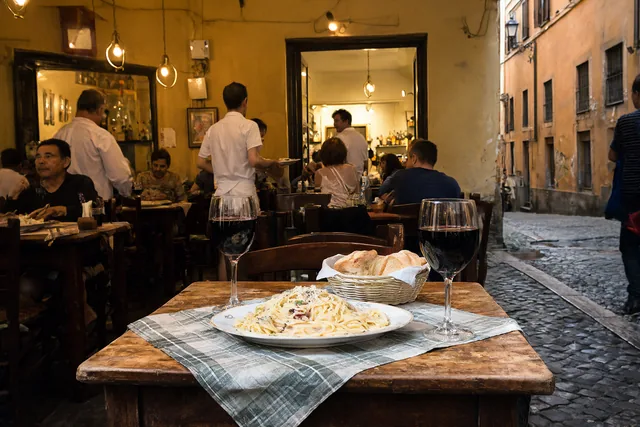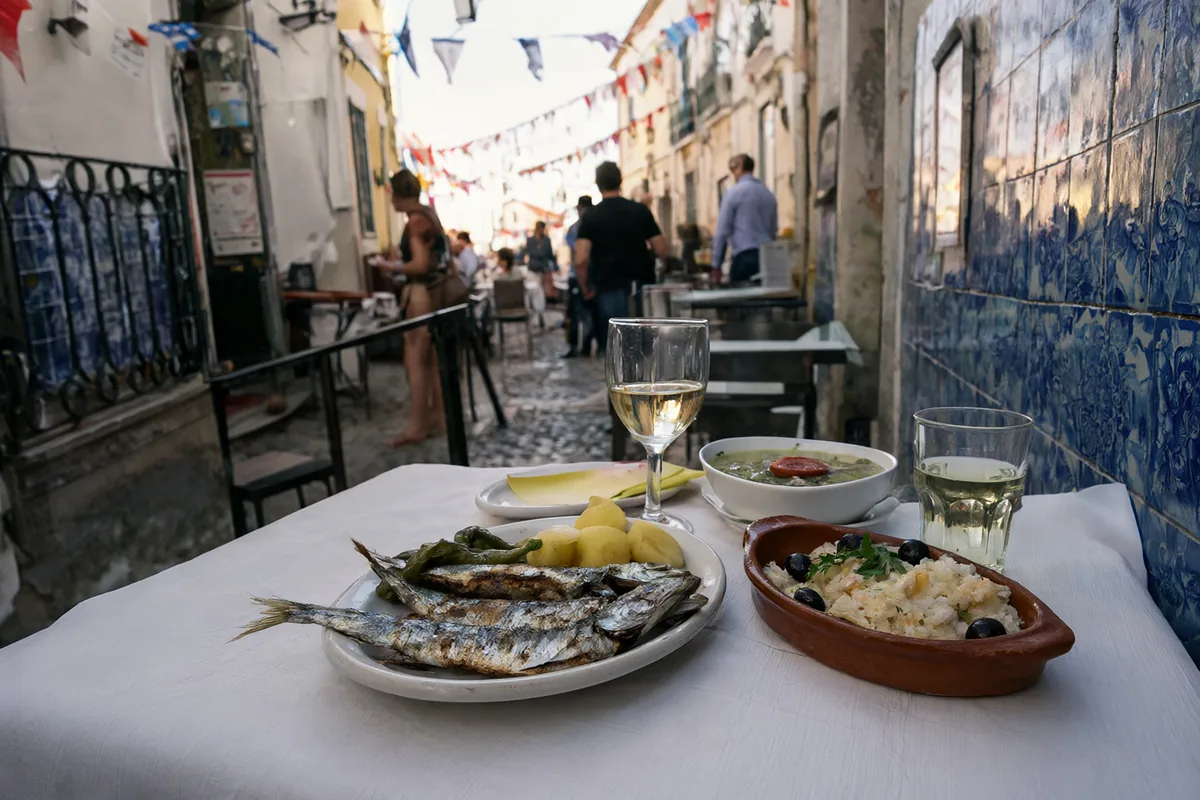
Portugal is one of the best-value places to eat in western Europe, and its food is honest, generous and built around the sea. This Portugal food guide covers the dishes to know, how to read a Portuguese menu, what the couvert on your table costs and whether to tip, then goes city by city through where to eat in Lisbon, Porto, the Algarve, Coimbra, Évora, Braga and the island of Madeira. Expect grilled fish, salt cod in a hundred forms, roast pork, custard tarts and very good wine at fair prices. The cooking changes as you travel: richer in the north, built on bread, pork and olive oil in the Alentejo, and all about seafood along the southern coast.
What to eat in Portugal: 12 dishes to know
These are the dishes worth ordering, with the region they belong to. Portions are big, so sharing is normal.
- Bacalhau (everywhere): dried salt cod, soaked and cooked in countless ways. Try bacalhau à Brás (shredded with egg, onion and thin fried potatoes) and bacalhau com natas (baked with cream).
- Sardinhas assadas (Lisbon and the coast): whole sardines grilled over charcoal, best in summer and eaten on a slice of bread.
- Pastel de nata (Lisbon and everywhere): a custard tart in crisp puff pastry, best warm with cinnamon and icing sugar.
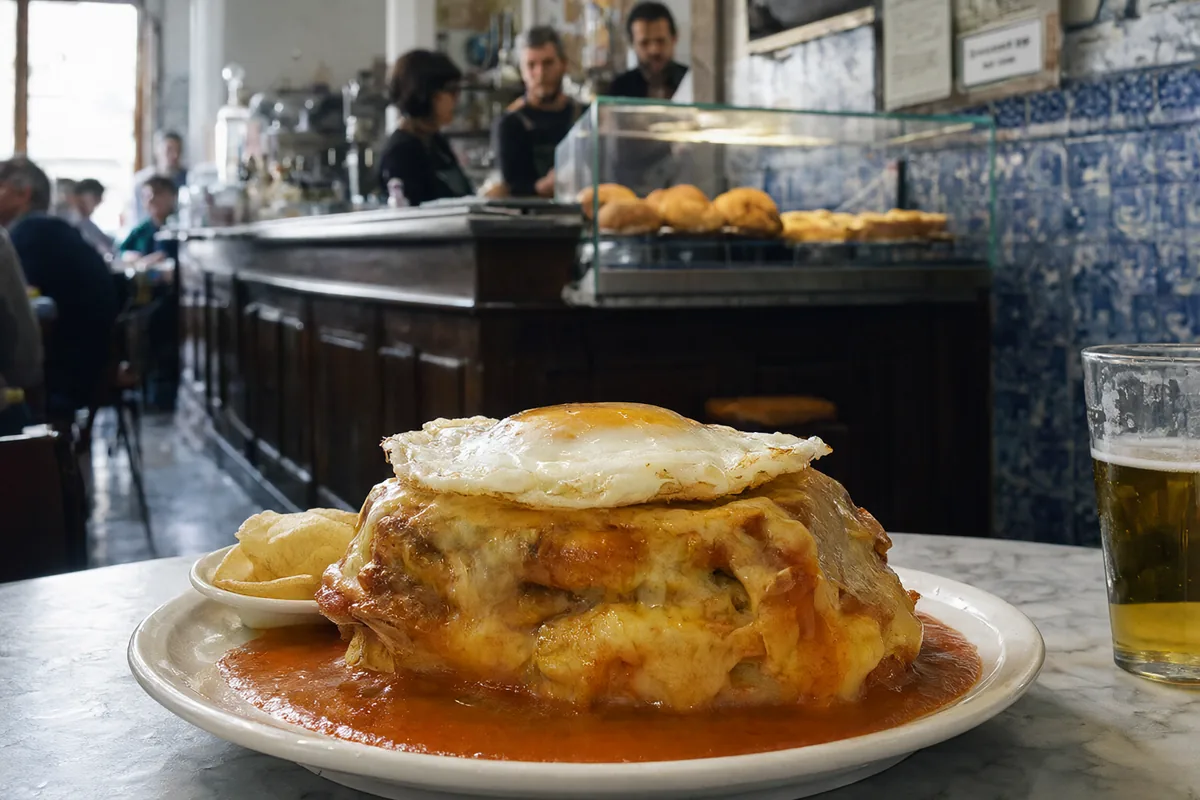
- Francesinha (Porto): a sandwich of steak, ham and sausage under melted cheese and a beer and tomato sauce, usually with chips. Not light.
- Bifana (everywhere): thin pork steak marinated in garlic and wine, served in a soft roll with mustard.
- Caldo verde (north): a soup of potato and finely shredded kale with a slice of chouriço.
- Polvo à lagareiro (everywhere): tender roasted octopus drenched in olive oil and garlic, with small crushed potatoes.
- Arroz de marisco (coast): a soupy seafood rice, cooked to order for two or more.
- Cataplana (Algarve): a seafood or pork and clam stew cooked in a hinged copper pan of the same name.
- Leitão (Bairrada, near Coimbra): suckling pig roasted until the skin crackles, with a peppery sauce.
- Amêijoas à Bulhão Pato (Lisbon): clams in olive oil, garlic, white wine and coriander.
- Queijo da Serra (Serra da Estrela): a soft sheep's milk cheese so runny in season that you scoop it with a spoon.
How to read a Portuguese menu
Portuguese menus are usually short and grouped by fish and meat. The best-value lunch is the prato do dia, the dish of the day, often served with a soup and a drink. Many restaurants also offer a meia dose, a half portion, which in Portugal is often enough for one hungry person, while a full dose can feed two.
| Portuguese | Meaning |
|---|---|
| Couvert | Bread, olives, butter or cheese placed on the table, charged if you eat it |
| Entradas / petiscos | Starters / small plates to share |
| Sopa | Soup, often the cheapest thing on the menu and very good |
| Peixe / marisco | Fish / shellfish |
| Carne | Meat |
| Porco / vaca / vitela / borrego / frango | Pork / beef / veal / lamb / chicken |
| Grelhado / assado / frito / cozido | Grilled / roasted / fried / boiled |
| Prato do dia | Dish of the day |
| Dose / meia dose | Full portion / half portion |
| Preço por kg / ao peso | Price per kilo / by weight, common for fresh fish and seafood |
| Sobremesa | Dessert |
| Vinho da casa | House wine |
| Bica (Lisbon) / cimbalino (Porto) | A short espresso |
| Galão | Milky coffee in a tall glass |
Fresh fish and seafood in Portugal are often priced per kilo, so the fish you choose from the ice is weighed before it goes on the grill. Ask how much your fish weighs, or what it will cost, before you agree. swap.menu flags priced-by-weight items when it reads the menu and shows the couvert as its own line, so you know what you are paying for.
The couvert, tipping and paying the bill
The couvert is the plate of bread, butter, olives, perhaps a little cheese or sardine pâté, that arrives as soon as you sit down. It is not free. Each item is charged if you touch it, and you are entitled to send it back if you do not want it, so just say "não, obrigado". Portuguese restaurants do not normally add a service charge, and IVA, the Portuguese VAT, is included in menu prices. Our guide to tax and service charges on menus explains how these lines work elsewhere.
Tipping is modest and optional. Locals leave small change after a coffee or a cheap lunch and around 5 to 10 percent after a good dinner. In a tasca, a simple family restaurant, rounding up is perfectly normal.
Prices are in euros (€). Cards are widely accepted in cities, but some small tascas and cafés are cash only or set a minimum for cards, so carry some coins and notes. Cash machines are labelled Multibanco. If a card machine or cash machine offers to convert to your home currency, decline and pay in euros: our guide to paying in local currency explains why.
Lunch runs from about 12:30pm to 3pm and is a proper meal for many Portuguese workers. Dinner starts around 7:30pm to 8pm and runs to about 10pm, later in summer and in Lisbon. Cafés and pastry shops (pastelarias) are open all day for coffee, cakes and savoury snacks.
Where to eat in Portugal, city by city
Portugal is small, but each region has its own cooking, from Porto's tripe and francesinhas to the slow pork dishes of the Alentejo. Jump to a destination:
Where to eat in Lisbon
Lisbon is a city of small places: the tasca with paper tablecloths and a handwritten menu, the marisqueira (seafood house) where you order prawns, clams and crab by weight, and the pastelaria for a pastel de nata and a bica. Lisbon dishes include grilled sardines, amêijoas à Bulhão Pato, bacalhau à Brás, the prego (a steak roll) and the bifana. In Belém, near the Jerónimos Monastery, the custard tarts are called pastéis de Belém, and the queue moves quickly.
The old neighbourhoods of Alfama and Mouraria are full of tascas, and in June, during the festivals of Santo António, their streets fill with sardine grills. Bairro Alto is for drinks and late, cheap food; Príncipe Real and Campo de Ourique are calmer and more local. The Mercado da Ribeira at Cais do Sodré has a large food hall with stalls from many Lisbon kitchens. Try a shot of ginjinha, sour cherry liqueur, from one of the tiny bars near Rossio square.
Where to eat in Porto
Porto's food is heartier than Lisbon's. The city's people are nicknamed tripeiros, tripe eaters, after tripas à moda do Porto, a stew of tripe and white beans. Its modern classic is the francesinha, best shared or eaten after a long walk up Porto's hills, and the sandes de pernil, a roll of slow-roasted pork leg, sometimes with cheese from the Serra da Estrela. Coffee in Porto is a cimbalino, and the local drink is, of course, port, tasted in the wine lodges across the river in Vila Nova de Gaia.
The renovated Mercado do Bolhão is the city's central market, with produce stalls and small places to eat. The riverfront Ribeira is beautiful but touristy, so head uphill to the streets around Rua das Flores, Bolhão and Cedofeita for better value. For grilled fish, take the metro or a bus to Matosinhos, a fishing town on the coast north of Porto whose restaurants grill sardines, sea bass and squid on charcoal outside on the pavement. Order a vinho verde, the young, fresh wine of the north, to go with it.
Where to eat in the Algarve
The Algarve, Portugal's southern coast, is best known for beaches, but its food is excellent once you leave the resort strips. The signature dish is cataplana, clams, fish or pork cooked with tomato, onion and peppers in the sealed copper pan. Grilled sardines are a summer institution in Portimão, and the town of Guia is known for frango da Guia, chicken grilled with piri-piri. Look also for conquilhas (tiny clams), grilled octopus and carapaus (horse mackerel).
The Olhão market, two red-brick halls on the waterfront, is the best fish market in the region, busiest on Saturday mornings. Tavira and Lagos have old town centres with good family restaurants, and the hill town of Monchique makes medronho, a strong spirit distilled from strawberry tree fruit. Algarve sweets are made with almonds, figs and carob. A practical tip: restaurants in the Algarve facing the beach charge for the view, so walk a street back for a better meal.
Where to eat in Coimbra
Coimbra is Portugal's old university city, full of students and cheap, filling food. The most famous dish of the area is leitão à Bairrada, roast suckling pig, and the town of Mealhada, a short drive north of Coimbra, is lined with restaurants that do nothing else. It is eaten with crisps, salad, orange slices and a bottle of sparkling Bairrada wine. Coimbra's other classic is chanfana, goat slowly stewed in red wine in a clay pot.
The lower town, the Baixa, has the most tascas, many serving a cheap prato do dia to students and office workers. The Mercado Municipal D. Pedro V is the place for produce and pastries. For something sweet, try pastéis de Tentúgal, thin, flaky pastry filled with egg cream, from a village nearby, and arrufadas, soft sweet bread rolls. Coimbra is also the home of its own style of fado, sung by men in student capes.
Where to eat in Évora
Évora, a walled city in the heart of the Alentejo, is the place to taste Portugal's rural interior. Alentejo cooking is built on bread, olive oil, pork and herbs. Order carne de porco à alentejana, pork and clams with fried potatoes, açorda alentejana, a bread and garlic soup with coriander and a poached egg, migas (fried bread with pork), and anything made with porco preto, the black Iberian pig, such as secretos and plumas, prized cuts grilled pink.
The Alentejo is also one of Portugal's main wine regions, and Évora has wine bars and a regional wine route that makes a good day trip. The old town inside the walls, around Praça do Giraldo, has the restaurants, many of them small and family run. In summer, try gaspacho alentejano, a chunkier cold soup than the Spanish one, and finish with sericaia, a baked egg pudding served with a candied plum from Elvas.
Where to eat in Braga
Braga, in the green Minho region of the far north, is one of Portugal's oldest cities and an easy day trip from Porto. Minho food is rich and rustic: bacalhau à moda de Braga, salt cod fried and served with onions and fried potatoes, rojões à minhota, chunks of fried pork with potatoes and blood sausage, and papas de sarrabulho, a thick, spiced pork and bread porridge eaten in winter. The local drink is vinho verde, often served in small white bowls in old taverns.
The historic centre around the cathedral is compact and full of cafés and traditional restaurants. For dessert, order pudim Abade de Priscos, a silky caramel pudding made with egg yolks, port and, traditionally, a little bacon. Braga's bakeries sell frigideiras, small savoury pastries, and the city's religious festivals, especially at Easter and the São João festival in June, bring food stalls into the streets.
Where to eat in Madeira
The island of Madeira, far out in the Atlantic, has its own food. The classic is espetada, chunks of beef rubbed with garlic and salt, skewered on a bay laurel stick and grilled over wood, served hanging from a hook above the table. With it comes bolo do caco, a round flatbread cooked on a stone slab and spread with garlic butter. Madeira's oddest pairing is espada com banana, fillets of black scabbardfish, a deep-sea fish with a fearsome look, fried and served with banana.
In Funchal, the capital, the Mercado dos Lavradores sells tropical fruit and has a fish hall where the scabbardfish are laid out every morning. The old town, the Zona Velha, around Rua de Santa Maria, is the place for dinner. Order grilled lapas (limpets) with garlic butter and lemon, and drink poncha, made with sugar cane spirit, honey and lemon, which is the local speciality in the fishing village of Câmara de Lobos. Madeira wine, sweet or dry, is the island's famous export.
Vegetarian, vegan and allergy tips
Traditional Portuguese food is heavy on meat and fish, and vegetarian options can be thin outside Lisbon and Porto. Watch for chouriço in soups such as caldo verde, pork fat in beans and rice, and fish in many "vegetable" dishes. Even a vegetable soup may be made with meat stock. The word is vegetariano (or vegetariana), and vegano for vegan. Lisbon and Porto now have plenty of vegetarian and vegan restaurants, and the cheese, bread, olives and soups are always good fallbacks.
EU rules require restaurants to tell you about the 14 major allergens, so you can always ask. Portuguese sweets are built on eggs, sugar and almonds, so nut allergies need care at pastry shops. Gluten-free (sem glúten) awareness is growing in the cities. Our guide to eating abroad with food allergies explains how to explain an allergy clearly in another language.
Useful Portuguese phrases for ordering
Bom dia / Boa tarde / Boa noite "Good morning / Good afternoon / Good evening"
Uma mesa para dois, por favor "A table for two, please"
O que recomenda? "What do you recommend?"
Queria isto, por favor "I would like this, please" (pointing)
Não queremos o couvert, obrigado "We do not want the couvert, thank you"
Sou alérgico / alérgica a... "I am allergic to..." (alérgico for a man, alérgica for a woman)
A conta, por favor "The bill, please"
Obrigado / Obrigada, estava delicioso "Thank you, it was delicious" (obrigado if you are a man, obrigada if you are a woman)
How swap.menu helps you eat in Portugal
The best tascas in Portugal often have a handwritten menu or a sheet of paper taped to the window, in Portuguese only. Photograph it with swap.menu and every dish appears in your language with the Portuguese name beside it and a short explanation, so you know that cabidela is chicken or rice cooked in blood, that percebes are goose barnacles and that caracóis are snails. Every price is converted from euros to your home currency, and we flag the couvert and any fish sold by the kilo.
Tap the dishes you want, add a note such as "half portion", "no pork" or "gluten-free", typed or spoken, and swap.menu translates your order into Portuguese. Show the waiter your phone, or let them scan the QR code and read your order on their own screen. You can try it right now on a sample menu with the free demo, or see travel pass prices.
Off to Portugal? Your first 3 menu scans are free, and a travel pass starts from $4.99 with nothing that renews.
Start free with 3 scansPortugal food FAQ
Do you tip in restaurants in Portugal?
Tipping is optional in Portugal and service charges are rare. Locals leave small change after a coffee or a cheap meal and around 5 to 10 percent after a good dinner. Nobody expects a large tip.
Is the couvert free in Portugal?
No. The bread, olives, butter and other small items placed on your table are charged if you eat them. You can politely send them back when they arrive, and you will not pay for them.
What food is Portugal most famous for?
Bacalhau (salt cod), grilled sardines, pastel de nata custard tarts, the francesinha sandwich from Porto, octopus, seafood rice and roast suckling pig. Port and vinho verde are the best-known drinks.
Is it expensive to eat out in Portugal?
Portugal is one of the cheapest countries in western Europe for eating out. A prato do dia at lunch is good value, and half portions keep costs down. Seafood priced by weight and restaurants in prime tourist areas are where bills climb.
What time do people eat dinner in Portugal?
Dinner usually starts around 7:30 to 8pm and runs until about 10pm, a little later in Lisbon and in summer. Lunch is between about 12:30 and 3pm. Pastry shops and cafés serve snacks all day.
How can I read a Portuguese menu if I do not speak Portuguese?
Learn a few words such as peixe (fish), carne (meat), dose and meia dose, or photograph the menu with swap.menu. It translates every dish into your language, explains what it is, converts prices from euros to your currency and translates your order into Portuguese for the waiter.
Travelling further in Europe? Read our food guides for nearby countries:
Or browse every travel food guide.