Ireland's food has quietly become some of the best in Europe, built on grass-fed beef and lamb, Atlantic seafood, butter, farmhouse cheese and very good bread. This Ireland food guide covers the dishes to know, the Irish menu words and pub customs that puzzle visitors, how tipping and the early bird menu work, then goes town by town through where to eat in Dublin, Cork, Galway, Limerick, Waterford, Kinsale and Dingle. The pub is the centre of Irish social life and often the best place for a simple, honest lunch, but the coast is where Irish food really shines.
What to eat in Ireland: 12 dishes to know
These are the dishes worth ordering, with the place they are most associated with. Many are pub classics you will find all over the country.
- Full Irish breakfast (everywhere): rashers (back bacon), sausages, eggs, black and white pudding, grilled tomato, mushrooms, and often baked beans, with toast or soda bread. The black pudding from Clonakilty in West Cork is the best known.
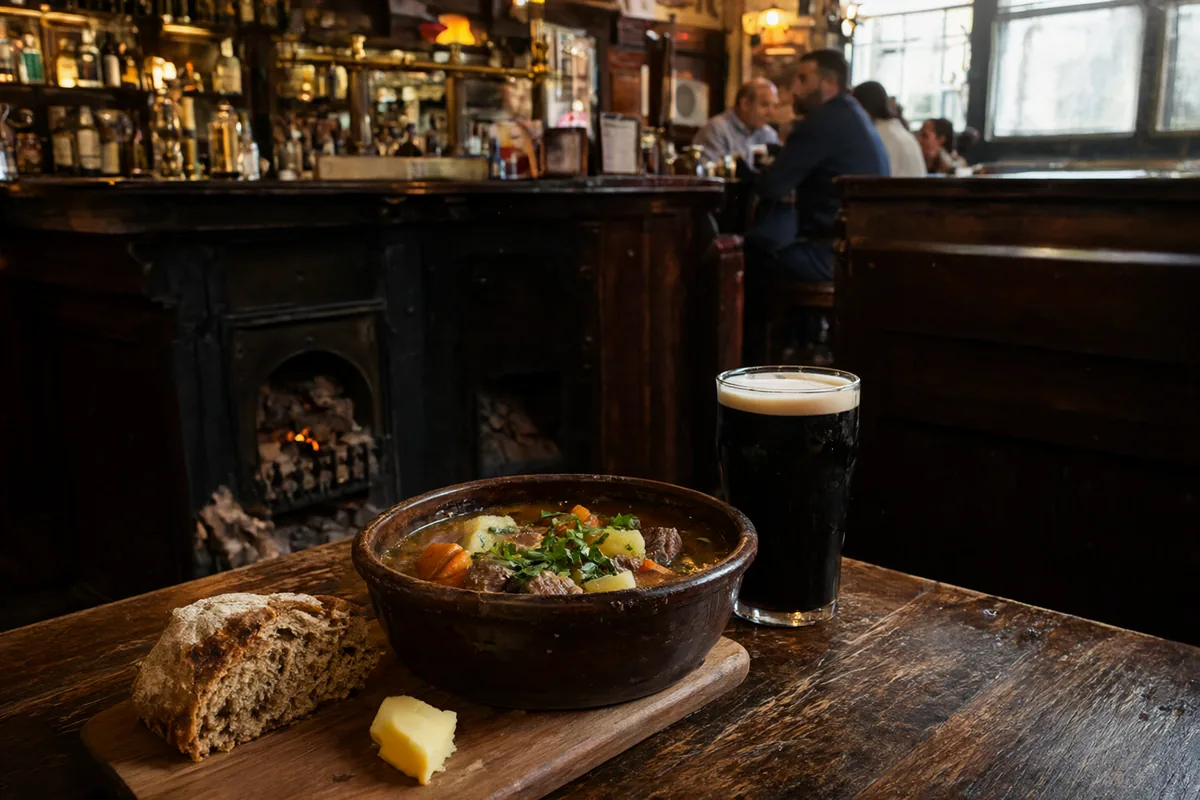
- Irish stew (everywhere): lamb or mutton slowly cooked with potatoes, onions and carrots. Some versions use beef and stout.
- Bacon and cabbage (everywhere): boiled bacon joint with cabbage, potatoes and a white parsley sauce, a traditional family dinner.
- Boxty (the north midlands and northwest): a potato pancake made with grated raw and mashed potato, now served with fillings in restaurants.
- Colcannon and champ (everywhere): mashed potato with cabbage or kale (colcannon) or with spring onions (champ), with a pool of butter in the middle.
- Dublin coddle (Dublin): sausages, rashers, potatoes and onions simmered slowly in a pot, a working-class Dublin dish.
- Brown bread (everywhere): brown soda bread made with wholemeal flour and buttermilk, served with soup, seafood and salmon.
- Seafood chowder (the coast): a creamy soup of fish, smoked fish and shellfish, almost always with brown bread.
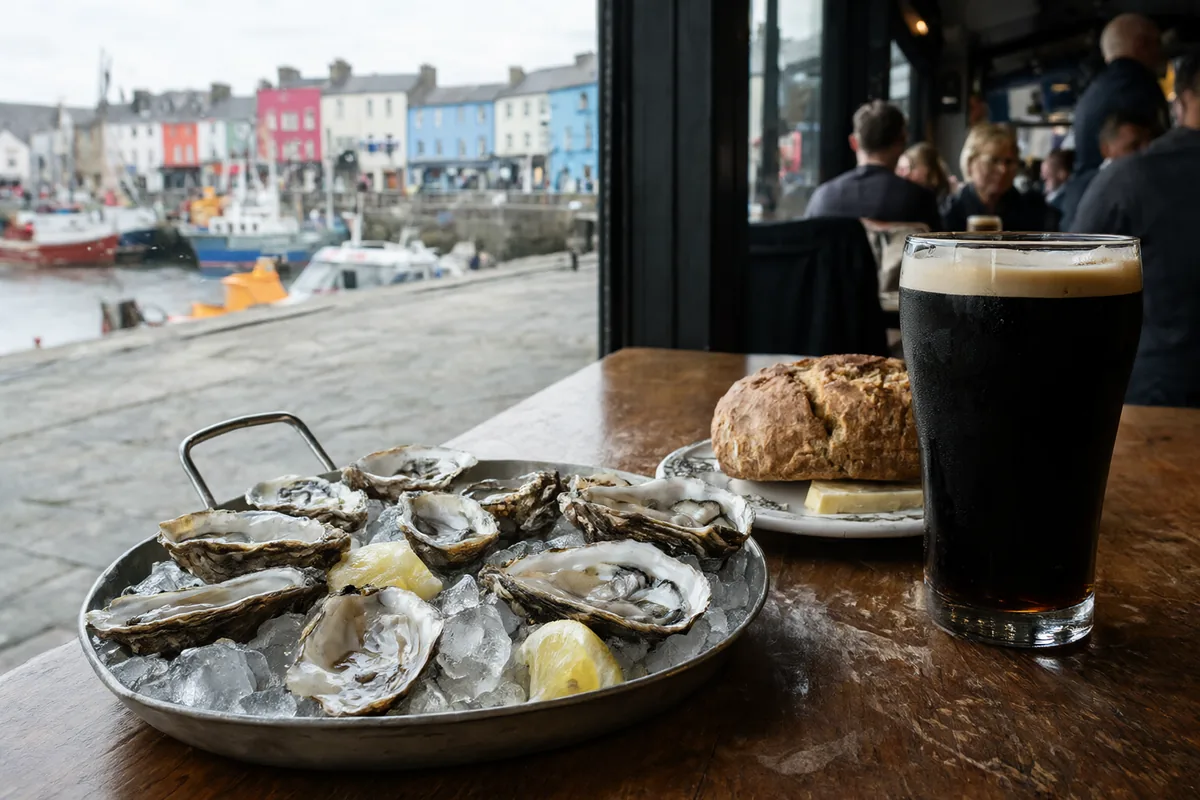
- Oysters (Galway and the west): native oysters are in season from September, and rock oysters all year, with a pint of stout.
- Smoked salmon (everywhere): Irish smoked salmon, often from the west coast, on brown bread with lemon.
- Spice bag (Dublin and everywhere): a takeaway bag of crispy chicken, chips, peppers and onion in a salty, spicy seasoning, sold by Chinese takeaways.
- Irish coffee (Limerick): hot coffee, Irish whiskey and brown sugar under a layer of lightly whipped cream, invented at Foynes, near Limerick, in the 1940s.
How to read a menu in Ireland
Irish menus are in English, sometimes with Irish (Gaelic) names alongside, especially in the Gaeltacht areas of the west. The structure is familiar, but Ireland has its own food words, some shared with the UK and some purely Irish. Many restaurants offer an early bird menu, a cheaper set menu served in the early evening, usually before about 7pm, and it is one of the best-value ways to eat well.
| On the menu | What it means |
|---|---|
| Starter / main / dessert | First course / main course / sweet course |
| Early bird | Cheaper set menu served early in the evening |
| Chips / crisps | Thick-cut hot chips / potato chips from a packet |
| Chipper | Fish and chip shop; in Dublin a "one and one" is fish and chips |
| Rasher | A slice of back bacon |
| Black pudding / white pudding | Blood sausage / an oatmeal and pork sausage without blood |
| Brown bread / soda bread | Bread raised with bread soda and buttermilk instead of yeast |
| Carvery | A lunch of roast meats carved to order with vegetables and potatoes, in pubs and hotels |
| Toastie | A toasted sandwich, the classic pub snack, usually ham and cheese |
| Curry chips / taco fries | Chips with curry sauce / chips with spiced mince and cheese, late-night takeaway food |
| Boxty / colcannon / champ | Potato pancake / mash with cabbage / mash with spring onion |
| Pint / glass | A pint (568 ml) / a half pint |
| Stout / red ale | Dark, creamy-headed beer / amber malty beer |
| Minerals | Soft drinks, an older but still common Irish word |
Ask for "a glass" in an Irish pub and you will get a half pint of beer, not a glass of wine. Ask for "a pint" and the barman will assume stout. If an Irish menu or chalkboard leaves you guessing, swap.menu explains each dish and term in plain language, and reads it in your own language if English is not your first.
Tipping, service charges and paying the bill
In Irish restaurants with table service, a tip of around 10 to 15 percent is normal for good service. Some restaurants add a service charge, most often for groups of six or more, and if it is on the bill you do not need to tip again. Since 2022, Irish law has required businesses to pass card tips on to staff and to display how tips and service charges are shared. Our guide to tax and service charges on menus explains how these lines work in other countries.
In a pub you order and pay at the bar, and you do not tip for drinks. For pub food, some places bring it to your table after you order at the bar and others have table service, so look for a sign or ask. Cafés may have a tip jar, which is optional. VAT is included in menu prices.
The Republic of Ireland uses the euro (€). Northern Ireland, which is part of the United Kingdom, uses the pound sterling, so check which side of the border you are on. Contactless card payment is accepted almost everywhere, including small pubs and market stalls. If a card machine offers to charge you in your home currency, choose euros: our guide to paying in local currency explains why.
Lunch is from about 12:30pm to 2:30pm and dinner from about 6pm to 9:30pm. Pub kitchens often stop serving food by 8pm or 9pm, especially in small towns and on Sundays. Tap water from the public supply is safe to drink and free in restaurants if you ask.
Where to eat in Ireland, town by town
Ireland is small, and the best food is spread around the coast as much as in the cities. Jump to a town or city:
Where to eat in Dublin
Dublin has the widest choice of food in Ireland, from old pubs to modern Irish restaurants and Asian cooking along its north-side streets. For local dishes, look for coddle, Irish stew and seafood chowder in the older pubs, a "one and one" from a chipper, and, late at night, a spice bag. Dublin Bay prawns (langoustines) and fresh fish come into the fishing village of Howth, at the end of the DART train line, where the pier is lined with fish shops and seafood restaurants.
Temple Bar is the famous pub district, but it is busy and expensive, and most Dubliners drink elsewhere. Head instead to Camden Street and Wexford Street for restaurants and bars, the pedestrianised Capel Street and Parnell Street for Asian food, and Stoneybatter and the Liberties for local pubs and cafés. The street traders of Moore Street have sold fruit and vegetables in Dublin for generations. Many Dublin restaurants offer an early bird menu, which is the best way to try a good restaurant on a budget.
Where to eat in Cork
Cork calls itself Ireland's food capital, and it has a fair claim. The heart of it is the English Market, a covered market trading since the 18th century, with butchers, fishmongers, cheese stalls, bakers and a café upstairs. This is the place to find Cork's old specialities: drisheen, a soft blood sausage traditionally served with tripe, crubeens (pig's trotters) and spiced beef, a cured and spiced beef sold especially at Christmas. Cork also brews its own stouts, and locals will tell you to drink them instead of the Dublin one.
The streets around the market, Oliver Plunkett Street and Princes Street, are full of cafés and restaurants, and the Victorian Quarter around MacCurtain Street, north of the river, has many of the city's newer places. County Cork is dairy and farmhouse cheese country, and West Cork, around Clonakilty, Skibbereen and Bantry, is full of producers, farmers' markets and black pudding. Kinsale, the seafood town south of Cork, has its own section below.
Where to eat in Galway
Galway is the capital of the west and the place for oysters. Native flat oysters from Galway Bay and nearby Clarenbridge are in season from September, when the city holds its international oyster and seafood festival, and Pacific rock oysters are served all year. Order them with brown bread and a pint of stout, the classic combination. Galway restaurants also serve excellent mussels, crab, chowder and fish from the Atlantic, and lamb from the hills of Connemara, west of the city.
The Latin Quarter, the old centre around Quay Street and Shop Street, is pedestrianised and packed with pubs, cafés and restaurants, many with live traditional music in the evening. The Galway Market by St Nicholas' Collegiate Church runs on Saturdays, with extra days in summer, and is the place to eat crêpes, curries and oysters from the stalls. For a walk and fish and chips, head along the seafront promenade at Salthill. Galway is also the jumping-off point for the Aran Islands, famous for their knitwear and fresh seafood.
Where to eat in Limerick
Limerick, on the River Shannon, is a no-nonsense city with a strong local food tradition. Its old speciality is packet and tripe, packet being Limerick's name for blood sausage, and the city was once famous across Europe for Limerick ham. The most famous drink from the area is Irish coffee, first served to transatlantic passengers at the flying boat terminal at Foynes, west of the city, in the 1940s. It is worth ordering one there, or anywhere in County Limerick, where they take it seriously.
The Milk Market, a covered market under a large canopy, has traded since the 19th century and is busiest on weekends, with farmers, bakers and street food stalls. The Georgian streets around O'Connell Street hold most of the city's restaurants, and the riverside near King John's Castle is pleasant for a drink. Limerick is a rugby city, and on match days the pubs fill up, so book a table if you want to eat.
Where to eat in Waterford
Waterford is Ireland's oldest city, founded by the Vikings, and it has one food that is entirely its own: the blaa, a soft, square, floury white bread roll with protected status. Waterford people eat it for breakfast filled with butter or a rasher, or at lunchtime with a fried egg or sausage. Bakeries in the city have made blaas for centuries, and you should try one warm in the morning from a local bakery or café.
The old centre, known as the Viking Triangle, has cafés and restaurants among its museums, and the quays along the River Suir have pubs and seafood. Waterford is also the start of the Waterford Greenway, a long cycling and walking path along an old railway line to the harbour town of Dungarvan, where the seafood restaurants are a good reason to make the trip. The Copper Coast west of Waterford has small fishing villages and coves with fish and chip shops.
Where to eat in Kinsale
Kinsale, a small harbour town in County Cork, has had a reputation as one of Ireland's food towns for decades, and its narrow streets of brightly painted houses hold a remarkable number of restaurants for its size. Seafood is the reason to come: scallops, crab, mussels, oysters, hake and monkfish landed nearby, served in everything from smart dining rooms to fish and chip shops on the harbour. Chowder with brown bread in a Kinsale pub is the classic lunch.
Kinsale is small enough to walk in an afternoon, so stroll the harbour and the streets around the market square, look at the menus and choose. The town is busy in summer and at weekends, so book dinner ahead. Walk off lunch along the harbour to Charles Fort, a 17th-century star fort, or drive out to the Old Head of Kinsale. Kinsale is about half an hour from Cork, so it is easy to visit both.
Where to eat in Dingle
Dingle, on the Dingle Peninsula in County Kerry, is a fishing town with a busy harbour, colourful streets and a big appetite for food and music. The fishing fleet supplies the town's restaurants with crab claws, langoustines, mackerel and hake, and Kerry lamb from the surrounding hills is on most menus. Fish and chips by the pier is the cheap and cheerful option, and many restaurants serve a seafood platter with brown bread. Look for traditional mutton pies, a Kerry speciality.
Dingle is in a Gaeltacht, an area where Irish is the community language, and signs and some menus use Irish names: the town itself is An Daingean. Its pubs are famous: several were once shops as well as bars, and a few still sell hardware or shoes beside the pints. Most host traditional music sessions in the evening. The Slea Head Drive around the peninsula has cafés and seafood stops with views of the Blasket Islands.
Vegetarian, vegan and allergy tips
Vegetarians and vegans will find options in every Irish city, and most menus mark vegetarian (V) and vegan (VG) dishes. In small towns and traditional pubs, choices can be limited to a vegetable soup, a toastie or a pasta dish. Watch for hidden meat: vegetable soups are often made with chicken stock, chips may be cooked in beef dripping in traditional chippers, gravy usually contains meat stock and the breakfast puddings are pork. Some stouts are now vegan, but ask. The word is simply vegetarian.
EU rules require restaurants to tell you about the 14 major allergens, and staff routinely ask about allergies when you order. Irish food uses a lot of butter, cream and dairy, and gluten is in brown bread, batter and stout. Coeliac disease is common in Ireland and well understood, so gluten-free options are widely available. Our guide to eating abroad with food allergies has more tips.
Pub phrases and Irish words for ordering
In an Irish pub, you go to the bar to order and pay for drinks, and often for food too. Stout takes a couple of minutes to pour properly, in two stages, so do not take your pint before the barman hands it over. In a group, people take turns buying a round for everyone.
A pint of stout, please Or "a glass" for a half pint
Are you still doing food? Ask in the evening: pub kitchens often close early
Is there an early bird? Asks for the cheaper early-evening set menu
A one and one, please Fish and chips, in a Dublin chipper
Could we get the bill, please? The bill, not the check
What's the craic? "What's happening?" or "How are you?", a friendly Irish greeting
Sláinte "Cheers" in Irish, said "slawn-cha" when you raise a glass
Go raibh maith agat "Thank you" in Irish, roughly "guh rev mah agut"
How swap.menu helps you eat in Ireland
An Irish menu is in English, but it can still be a puzzle. Visitors meet drisheen, crubeens, coddle, boxty and a "white pudding" that is a breakfast sausage, and chalkboards in the west may mix in Irish words. Photograph the menu with swap.menu and every dish is explained in plain language, so you know that crubeens are pig's trotters and that a blaa is a bread roll. Every price is converted from euros to your home currency, and any service charge is shown as its own line.
If English is not your first language, swap.menu translates the menu into any of 29 languages, with the English name kept beside each dish so you can point to it at the bar. Your scanned menus are saved, so you can find that chowder again later in the trip. You can try it right now on a sample menu with the free demo, or see travel pass prices.
Off to Ireland? Your first 3 menu scans are free, and a travel pass starts from $4.99 with nothing that renews.
Start free with 3 scansIreland food FAQ
Do you tip in restaurants in Ireland?
Yes, around 10 to 15 percent is normal in restaurants with table service. If a service charge is already on the bill, there is no need to tip again. You do not tip for drinks bought at a pub bar.
What food is Ireland most famous for?
The full Irish breakfast, Irish stew, bacon and cabbage, soda bread, seafood chowder, oysters, smoked salmon, potato dishes like boxty and colcannon, and stout. Irish butter, cheese, beef and lamb are also highly regarded.
Is it expensive to eat out in Ireland?
Eating out in Ireland is fairly expensive by European standards, especially in Dublin. Early bird menus, pub lunches, carveries, markets and chippers are the best value. Prices are generally lower outside Dublin.
What time do people eat dinner in Ireland?
Most people eat dinner between 6pm and 8:30pm, and restaurant kitchens usually take their last orders around 9pm to 9:30pm. Pub kitchens often close earlier, especially in small towns.
Is tap water safe to drink in Ireland?
Yes, tap water from the public supply is safe to drink in Ireland, and restaurants will give you a jug of tap water for free if you ask. Very occasionally a local area has a temporary boil water notice, which is announced locally.
How can swap.menu help with Irish menus?
Photograph any menu and swap.menu explains unfamiliar dishes such as drisheen, coddle or boxty, converts prices from euros to your currency and shows any service charge. It can also translate the whole menu into your own language if English is not your first.
Travelling further in Europe? Read our food guides for nearby countries:
Or browse every travel food guide.