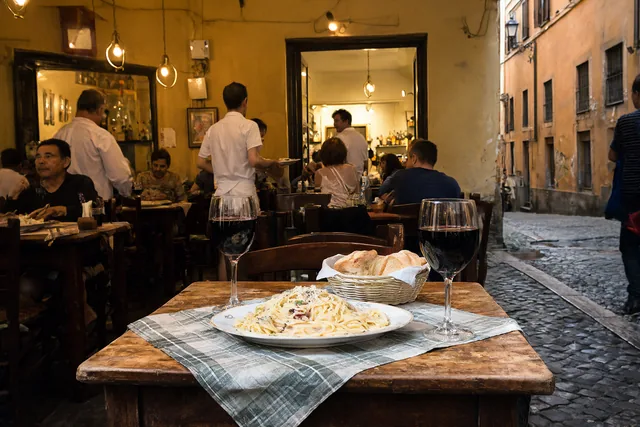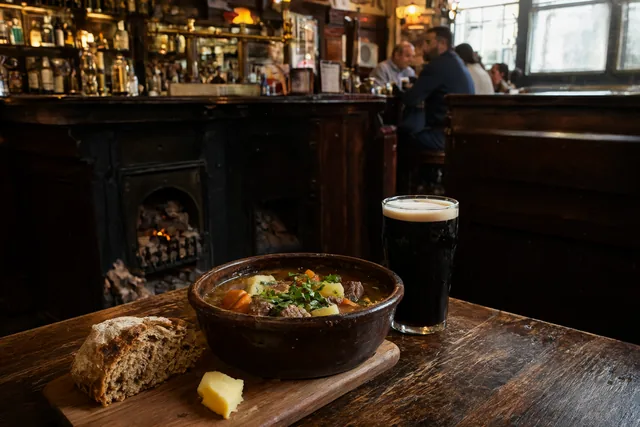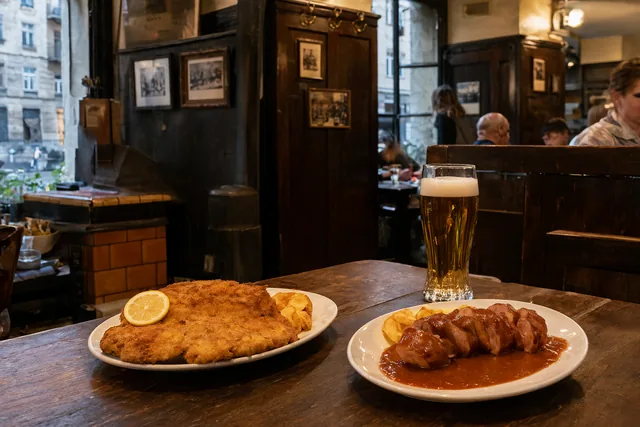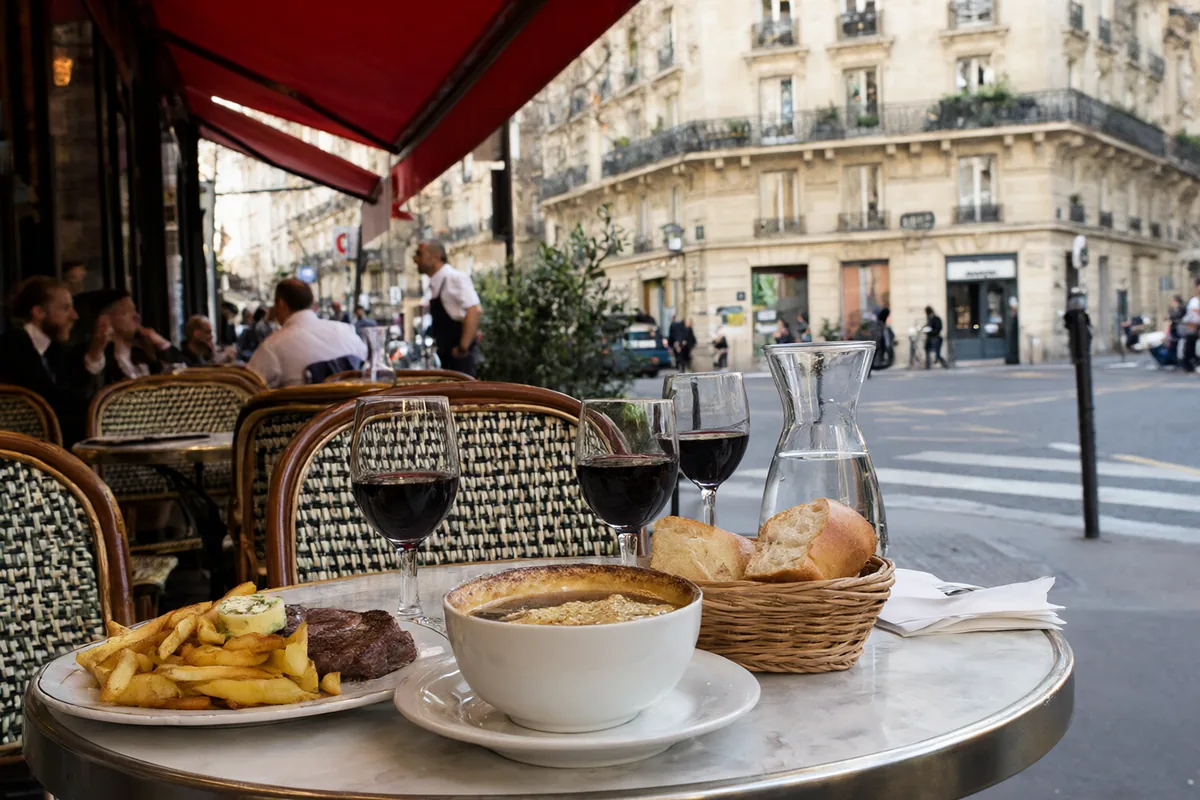
France built the vocabulary the rest of the world uses for eating out: restaurant, menu, chef, bistro, à la carte. This France food guide covers the dishes to know, how a French menu works (and why the "entrée" is not your main course), what "service compris" means for tipping, then goes city by city through where to eat in Paris, Lyon, Marseille, Bordeaux, Nice, Strasbourg and Toulouse. French cooking is as regional as Italian: butter and cream in the north, olive oil and garlic in Provence, duck fat in the southwest, sauerkraut and beer in Alsace. Eat the food of the place you are in and France is hard to get wrong.
What to eat in France: 12 dishes to know
These are the dishes worth ordering, with the region they come from. Many of them are bistro classics you can find in Paris, but they taste best at home.
- Croissant and baguette (everywhere): buy them from a boulangerie, not a supermarket. A "croissant au beurre" is made with butter; the straight one is usually made with margarine. The baguette tradition is the better loaf.
- Steak frites (everywhere): a bistro steak, often entrecôte (rib-eye) or bavette (flank), with chips. It comes rarer than most visitors expect.
- Boeuf bourguignon (Burgundy): beef braised slowly in red wine with lardons, mushrooms and small onions.
- Coq au vin (Burgundy and beyond): chicken (traditionally rooster) braised in wine, the cousin of boeuf bourguignon.
- Cassoulet (Languedoc): white beans baked with duck confit, Toulouse sausage and pork, a hearty winter dish fought over by Toulouse, Carcassonne and Castelnaudary.
- Bouillabaisse (Marseille): a saffron-coloured fish stew of several rockfish, served in two stages with croutons and rouille, a garlic and chilli mayonnaise.
- Choucroute garnie (Alsace): sauerkraut cooked in white wine and piled with sausages, smoked pork and potatoes.
- Galettes and crêpes (Brittany): savoury buckwheat galettes, classically with ham, cheese and egg (complète), then sweet wheat crêpes, with a bowl of dry cider.
- Soupe à l'oignon gratinée (Paris): onion soup under a lid of toasted bread and melted cheese, once the late-night meal of market workers at Les Halles.
- Confit de canard (southwest): duck legs cooked slowly in their own fat, then crisped and served with potatoes fried in duck fat (pommes sarladaises).
- Ratatouille (Provence): a summer stew of aubergine, courgette, peppers and tomato in olive oil.
- Fromage (everywhere): France has hundreds of cheeses, from Camembert and Comté to Roquefort. In a restaurant the cheese course comes after the main and before dessert.
How to read a French menu
The single most useful thing to know is that a French menu is not the whole list of dishes. That list is la carte. "Le menu" or a formule is a set meal at a fixed price, usually two or three courses, and it is almost always the best value in the restaurant, especially at lunch. Many bistros write their dishes on an ardoise, a chalkboard, which changes daily.
| French | Meaning |
|---|---|
| Entrée | Starter (not the main course, as it is in North America) |
| Plat (principal) | Main course |
| Fromage / dessert | Cheese course / dessert |
| Menu / formule | Set meal at a fixed price, e.g. entrée + plat or plat + dessert |
| À la carte | Ordered dish by dish from the full list |
| Plat du jour | Dish of the day |
| Fait maison | Homemade (an official label with a small saucepan logo) |
| Boeuf / porc / veau / agneau / volaille | Beef / pork / veal / lamb / poultry |
| Poisson / fruits de mer | Fish / seafood |
| Bleu / saignant / à point / bien cuit | Very rare / rare / medium rare to medium / well done |
| Rôti / grillé / poêlé / gratiné | Roasted / grilled / pan-fried / browned with cheese or breadcrumbs |
| Carafe d'eau | Jug of tap water, free |
| Vin au verre / en pichet | Wine by the glass / house wine in a small jug |
| Service compris / prix nets | Service included / prices are final |
French steak runs rare. "À point" in France is closer to medium rare elsewhere, so if you want it cooked through ask for "bien cuit" and expect a raised eyebrow. Watch for andouillette too: it looks like an ordinary sausage on the menu but is made of pork intestines and has a strong smell. swap.menu explains dishes like these when it translates the menu, so nothing on the plate is a surprise.
Service compris, tipping and paying the bill
In France, menu prices must include service and tax. That is what service compris means: the 15 percent or so for service is already built into the price of each dish, and so is TVA, the French VAT. The total on the menu is what you pay. There is normally no cover charge, and bread and tap water come free with a meal. Our guide to tax and service charges on menus explains how these lines work in other countries.
Tipping is therefore optional. French diners leave small change at a café and a few euros after a good restaurant meal, and around 5 to 10 percent is generous for excellent service. Card machines often do not have a tip option, so leave coins or a note on the saucer if you want to. Nobody will be offended if you leave nothing at a counter or a casual crêperie.
Prices are in euros (€). Cards, and especially contactless payment, are accepted almost everywhere, though some small bakeries and cafés set a minimum amount for cards. The waiter usually brings the card machine to the table. If it offers to charge you in your home currency, decline and pay in euros: our guide to paying in local currency explains why.
Meal times are firm. Lunch is served roughly from noon to 2pm and dinner from about 7:30pm to 10pm, and outside those hours many kitchens are closed. Brasseries and cafés are the exception and usually serve food all afternoon. You will not get the bill until you ask for it: lingering is normal, and rushing you out would be rude.
Where to eat in France, city by city
Every French city has its own dishes, its own markets and its own type of restaurant, from the Lyon bouchon to the Alsatian winstub. Jump to a city:
Where to eat in Paris
Paris has food from every French region and most of the world, and the trick is to eat where Parisians do. The classic bistro is small, loud and has a chalkboard of dishes like oeufs mayonnaise, steak frites, duck confit and crème caramel. The brasserie is bigger, serves all day and is the place for oysters, choucroute and onion soup. A good Paris lunch is a weekday formule at a neighbourhood bistro, which costs far less than the same cooking at dinner.
For neighbourhoods, try the Marais, including the falafel shops on rue des Rosiers and the Marché des Enfants Rouges, the oldest covered market in Paris; the market streets of rue Mouffetard, rue Cler and rue Montorgueil; Belleville and the 13th arrondissement for Chinese and Vietnamese food; and the streets around Canal Saint-Martin and rue du Faubourg Saint-Denis for younger, cheaper places. Avoid sitting down within sight of Notre-Dame or the Eiffel Tower if you can walk ten minutes first. For a picnic, buy bread, cheese and ham from a market and eat by the Seine.
Where to eat in Lyon
Many French people would name Lyon as the country's food capital. Its signature restaurant is the bouchon, a small, cluttered place with checked tablecloths serving rich Lyonnais cooking: quenelles de brochet (pike dumplings in a creamy crayfish sauce), saucisson brioché (sausage baked in brioche), salade lyonnaise with lardons and a poached egg, tablier de sapeur (breaded tripe) and cervelle de canut, a herby fresh cheese dip whose name means "silk weaver's brain". Wine comes in a pot lyonnais, a heavy-bottomed 46 cl bottle.
The old town, Vieux Lyon, has plenty of bouchons, but quality varies, so look for menus written in French first and a dining room of locals. The Presqu'île between the two rivers has more, around rue Mercière and the streets near the Hôtel de Ville. The covered market Les Halles de Lyon Paul Bocuse is the place for oysters and a glass of white wine on a weekend morning, and the outdoor market on boulevard de la Croix-Rousse is where Lyon does its shopping. Finish with a slice of pink tarte aux pralines.
Where to eat in Marseille
Marseille is France's oldest city and a Mediterranean port with strong North African, Armenian, Italian and Comorian communities, and its food reflects all of them. The headline dish is bouillabaisse. A real one is expensive, often has to be ordered in advance and is served in two parts: first the broth with croutons and rouille, then the fish, filleted at the table. A cheap bouillabaisse on a harbour-front menu is usually a fish soup with a famous name.
The fishermen still sell their catch every morning on the quay of the Vieux-Port. For everyday eating, the Noailles district behind La Canebière is a warren of spice shops, North African bakeries and grocery stalls, and Le Panier, the old quarter above the port, has small restaurants and cafés. Try panisse (chickpea fritters), pieds paquets (lamb tripe parcels), the orange-blossom biscuits called navettes, and a pizza, which Marseille has made in wood-fired ovens for generations. In the early evening, Marseille drinks pastis, the aniseed spirit diluted with water.
Where to eat in Bordeaux
Bordeaux is a wine city first, and the food is built to go with it. The local dish is entrecôte à la bordelaise, rib steak with a red wine and shallot sauce, sometimes grilled over vine cuttings. Oysters come from the Arcachon Basin an hour away, and in winter you may find lamproie à la bordelaise, lamprey stewed in red wine. For something sweet, the city's pastry is the canelé, a small fluted cake with a dark caramelised crust and a soft custardy centre, flavoured with rum and vanilla.
The Marché des Capucins is Bordeaux's main market, and on weekend mornings locals eat oysters and drink white wine at its counters. The old Saint-Pierre quarter is full of restaurants and wine bars, and the former merchants' district of Chartrons has a Sunday market by the river, antique shops and relaxed bistros. A bar à vin in Bordeaux is the easiest way to try the region's wines by the glass without buying a bottle, and many serve boards of cheese and charcuterie.
Where to eat in Nice
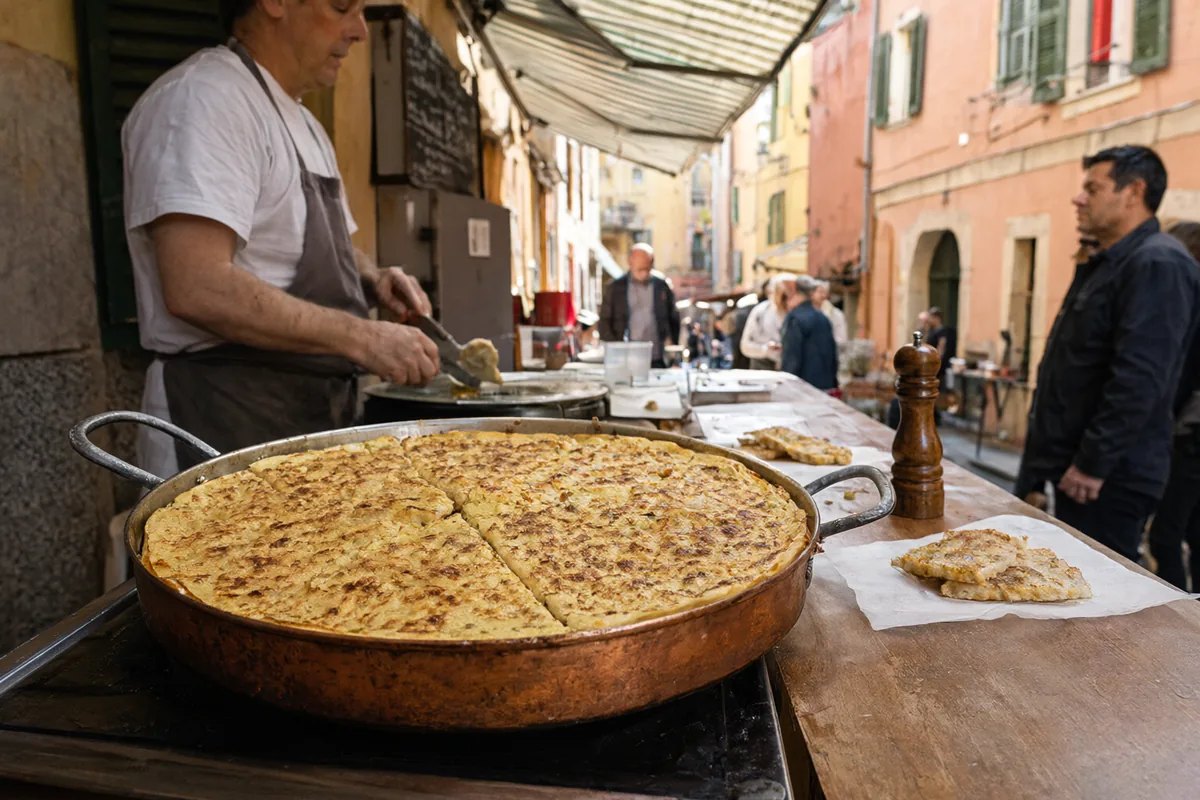
Nice was part of the Kingdom of Sardinia until 1860, and its cooking still sits halfway between Provence and Liguria. The street food to try is socca, a thin chickpea pancake baked in a huge round pan in a very hot oven, then cut into rough pieces and eaten hot with black pepper. Alongside it you will find pissaladière (onion tart with anchovies and olives), pan bagnat (a round bun filled with tuna, egg and vegetables, the salad niçoise as a sandwich), petits farcis (stuffed vegetables) and the surprisingly sweet tourte de blettes, a chard tart with raisins and pine nuts.
Start at the Cours Saleya market in the old town, Vieux Nice, which sells flowers and produce most mornings. The narrow streets around it hold the best socca and small family restaurants, while the restaurants along the Promenade des Anglais are mostly about the view. A true salade niçoise in Nice has raw vegetables, tuna or anchovies, eggs and olives, but no potatoes and no green beans, and locals will tell you so.
Where to eat in Strasbourg
Strasbourg is the capital of Alsace, a region that has been both French and German, and its food is somewhere in between. Eat in a winstub, a cosy wood-panelled tavern, and order choucroute garnie, baeckeoffe (meat and potatoes baked in white wine in a sealed clay dish), or tarte flambée (flammekueche), a thin crisp base covered with crème fraîche, onions and bacon, baked in a wood oven and shared at the table. Alsace makes white wines like Riesling and Gewurztraminer, and more beer than any other French region.
The half-timbered quarter of Petite France is the postcard view and has the most tourist-oriented restaurants, so look a few streets away around the cathedral and the Krutenau district for better value. Bakeries sell kougelhopf, a tall ring-shaped yeast cake with raisins and almonds, and pretzels. From late November to Christmas, Strasbourg's Christmas market is one of the oldest in Europe, with mulled wine (vin chaud) and spiced bredele biscuits.
Where to eat in Toulouse
Toulouse is the gateway to the southwest, the land of duck, goose and cassoulet. The Toulouse version includes the city's own sausage, the coarse, garlicky saucisse de Toulouse, alongside duck confit and white beans. Elsewhere on Toulouse menus you will find magret de canard (seared duck breast, served pink), foie gras, and aligot, mashed potato beaten with cheese until it stretches, from the nearby Aubrac.
The Marché Victor Hugo is the city's great covered market, and the small restaurants on its upper floor serve good-value lunches cooked from the stalls below. The Marché des Carmes is smaller and just as local. The pink-brick streets of the centre around Place du Capitole and the Saint-Cyprien district across the Garonne are where to eat in the evening. Toulouse is also known for violets, sold as crystallised sweets, and for its lively student bar scene.
Vegetarian, vegan and allergy tips
France is better for vegetarians than its reputation suggests, especially in Paris and the big cities, but traditional bistro menus lean heavily on meat. Watch for lardons in salads and quiches, meat or chicken stock (bouillon or fond) in soups and sauces, and gelatine in desserts. The words to know are végétarien (or végétarienne) and végan. Crêperies, Lebanese and North African restaurants, and markets are reliable fallbacks. Vegans should expect butter and cream in almost everything French.
EU rules require restaurants to tell you whether a dish contains any of the 14 major allergens, so you can always ask. Nuts appear in pastries, praline and frangipane, and eggs are in many sauces such as béarnaise and hollandaise. "Sans gluten" (gluten-free) options are now common in cities, though bread is central to every French meal. Our guide to eating abroad with food allergies explains how to explain an allergy clearly in another language.
Useful French phrases for ordering
Bonjour / Bonsoir "Good day / Good evening". Always say it when you walk in; skipping it is considered rude in France
Une table pour deux, s'il vous plaît "A table for two, please"
Qu'est-ce que vous me conseillez ? "What do you recommend?"
Je voudrais ceci "I would like this" (pointing)
Je suis allergique à... "I am allergic to..."
Une carafe d'eau, s'il vous plaît "A jug of tap water, please"
L'addition, s'il vous plaît "The bill, please"
C'était délicieux, merci "It was delicious, thank you"
How swap.menu helps you eat in France
The best bistros in France write the day's dishes on a chalkboard in French, often in looping handwriting, and the waiter recites the rest. Photograph the board or the menu with swap.menu and every dish appears in your language with the French name beside it and a short explanation, so you know that ris de veau is veal sweetbreads, that tête de veau is exactly what it sounds like, and that a formule is a set meal. Every price is converted from euros to your home currency, and we show what the set menu includes.
Tap the dishes you want, add a note such as "no pork", "well done, please" or "gluten-free", typed or spoken, and swap.menu translates your order into French. Show the waiter your phone, or let them scan the QR code and read your order on their own screen. You can try it right now on a sample menu with the free demo, or see travel pass prices.
Off to France? Your first 3 menu scans are free, and a travel pass starts from $4.99 with nothing that renews.
Start free with 3 scansFrance food FAQ
Do you tip in restaurants in France?
Tipping is optional in France because service is included in menu prices by law, which is what "service compris" means. Locals leave small change at cafés and a few euros after a good meal. Around 5 to 10 percent is generous for excellent service.
What food is France most famous for?
Bread and pastries such as the baguette and croissant, cheese, wine, and regional dishes like boeuf bourguignon, coq au vin, cassoulet, bouillabaisse, choucroute and crêpes. Steak frites and duck confit are bistro classics found all over the country.
What time do French people eat dinner?
Dinner usually starts between 7:30 and 8:30pm, and kitchens often stop taking orders around 10pm. Lunch runs from about noon to 2pm. Many restaurants close in the afternoon, but brasseries and cafés usually serve food all day.
Is tap water safe to drink in France?
Yes, tap water is safe throughout France. In restaurants you can ask for a "carafe d'eau", a jug of tap water, which is free. Bottled water is only served if you order it.
Which French city is best for food?
Lyon is often called the food capital of France for its bouchons and rich traditional cooking. Paris has the widest choice, Marseille is the place for bouillabaisse, Bordeaux for wine and Strasbourg for Alsatian cooking. Each city in this guide has its own section on where to eat.
How can I read a French menu if I do not speak French?
Learn that the entrée is the starter, the plat is the main and a menu or formule is a set meal, or photograph the menu with swap.menu. It translates every dish into your language, explains what it is, converts prices from euros to your currency and translates your order into French for the waiter.
Travelling further in Europe? Read our food guides for neighbouring countries:
- Italy food guide
- Spain food guide
- Switzerland food guide
- Belgium food guide
- Luxembourg food guide
- Germany food guide
Or browse every travel food guide.