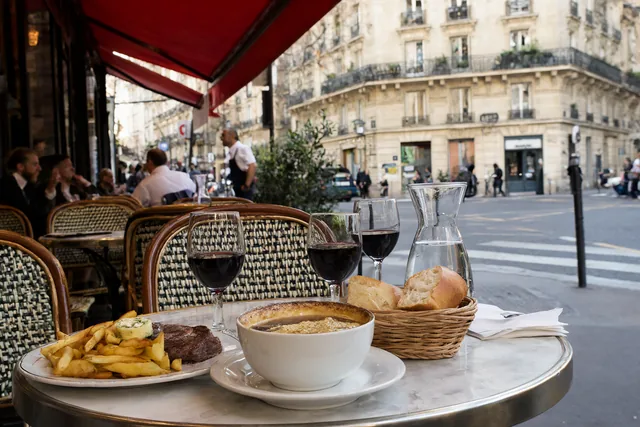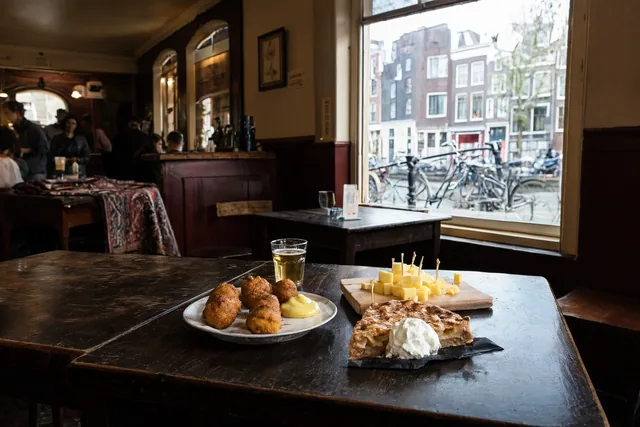
British food has shaken off its bad reputation, and the UK is now one of the easiest and most varied places in Europe to eat out. This United Kingdom food guide covers the dishes to know, the menu words that confuse visitors (chips, crisps, pudding, tea), how ordering at the bar in a pub works, what to do about service charges and tips, then goes city by city through where to eat in London, Edinburgh, Glasgow, Cardiff, Manchester, Birmingham, Bristol and Belfast. England, Scotland, Wales and Northern Ireland each have their own dishes.
What to eat in the UK: 12 dishes to know
These are the dishes worth ordering, with the part of the UK they come from. Most pubs serve several of them, but they are best where they belong.
- Full breakfast (everywhere): eggs, bacon, sausages, baked beans, grilled tomato, mushrooms and toast. Scotland adds haggis and tattie scones, Wales laverbread and cockles, and Northern Ireland soda and potato breads in the Ulster fry.
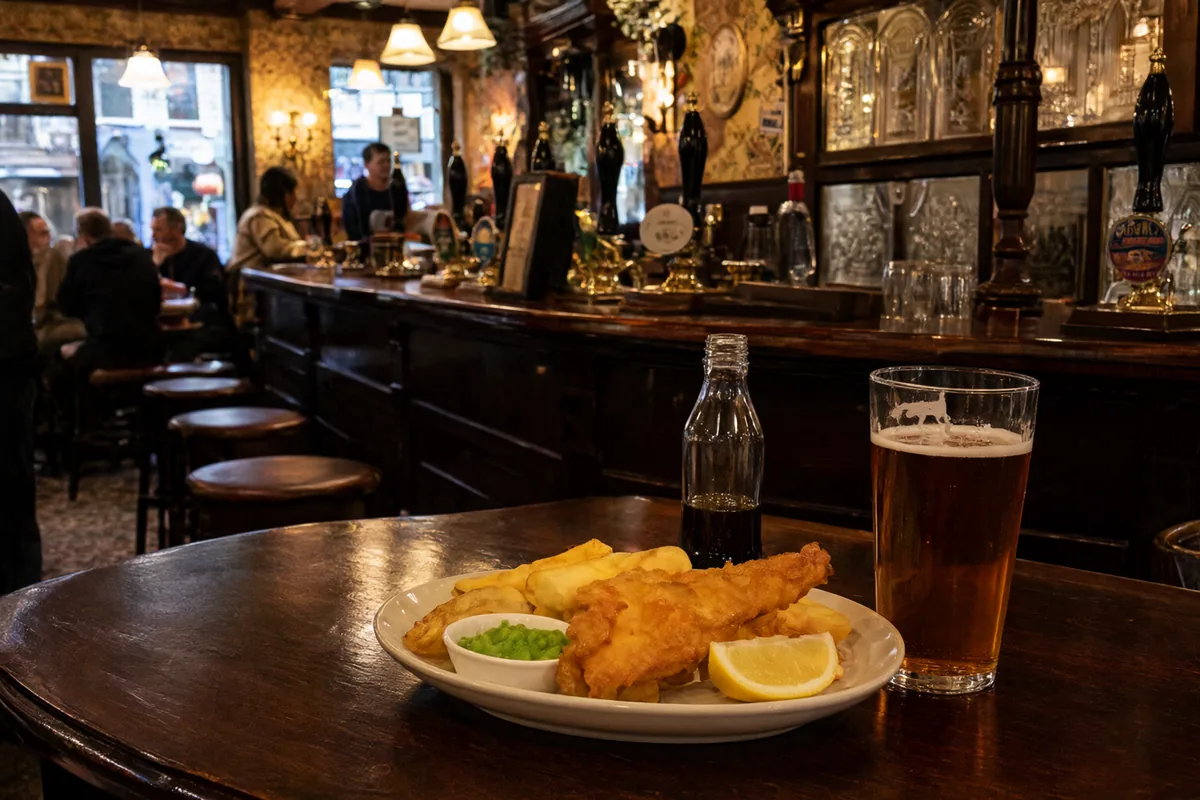
- Fish and chips (everywhere, best on the coast): cod or haddock in batter with thick-cut chips, salt and malt vinegar, from a chip shop ("chippy").
- Sunday roast (everywhere): roast beef, lamb, pork or chicken with roast potatoes, vegetables, gravy and a Yorkshire pudding, a puffed batter cup. Served in pubs on Sunday, often from midday to late afternoon.
- Pie and mash (London and everywhere): a meat pie with mashed potato, and in London's old East End shops a green parsley sauce called "liquor".
- Curry (everywhere): the British curry house is an institution. Chicken tikka masala is claimed by Glasgow and the balti by Birmingham.
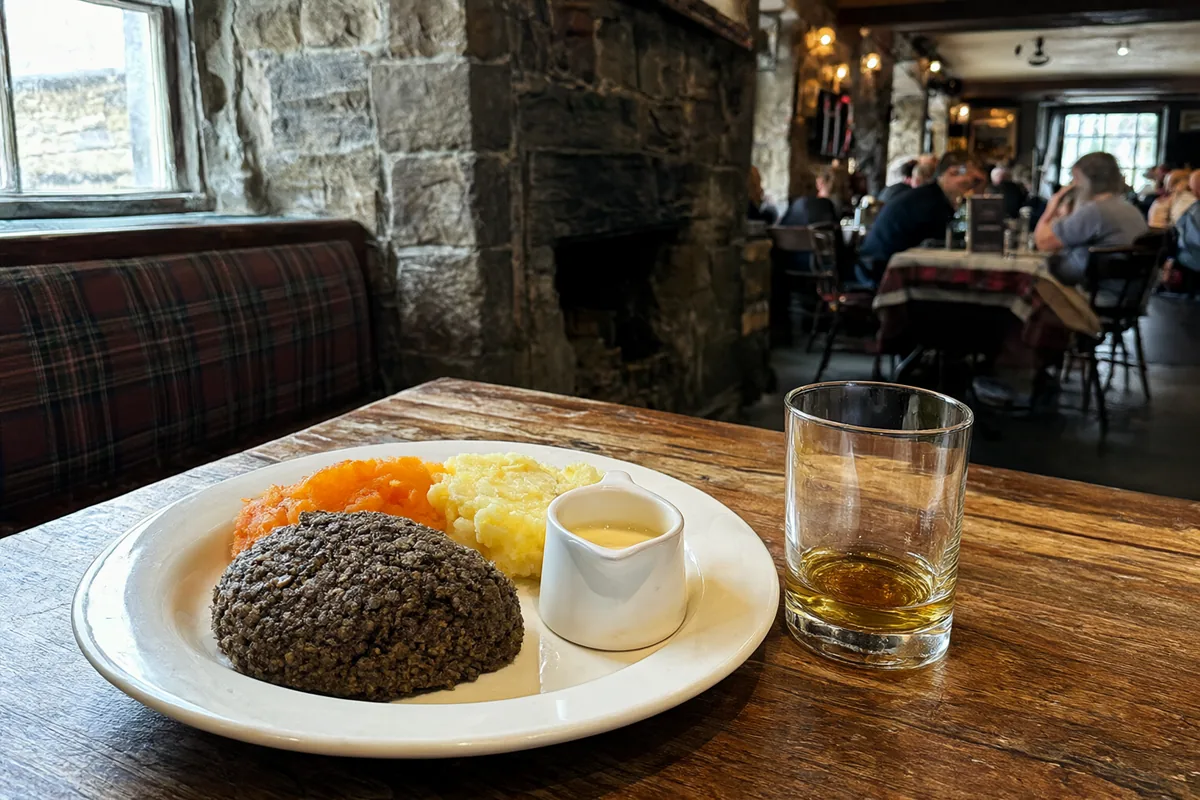
- Haggis, neeps and tatties (Scotland): a spiced sheep's offal and oatmeal pudding with mashed swede and potato, often with a whisky sauce.
- Welsh rarebit and cawl (Wales): rarebit is a rich cheese sauce on toast; cawl is a lamb and vegetable broth.
- Cornish pasty (Cornwall): a crimped pastry of beef, potato, swede and onion, designed as a miner's lunch.
- Cream tea (Devon, Cornwall and everywhere): scones with clotted cream and jam, and a pot of tea. Devon puts cream first, Cornwall jam first.
- Bangers and mash (everywhere): sausages on mashed potato with onion gravy, a pub staple.
- Scotch egg (everywhere): a boiled egg wrapped in sausage meat, breaded and fried. The best pub versions have a soft yolk.
- Sticky toffee pudding (Lake District and everywhere): a soft date sponge in hot toffee sauce, with custard, cream or ice cream.
How to read a menu in the United Kingdom
British menus are in English, but British English. Visitors from North America, Australia and elsewhere regularly order the wrong thing because a word means something different here.
| On the menu | What it means |
|---|---|
| Starter / main / pudding | First course / main course / dessert (any dessert, not only a pudding) |
| Chips / fries / crisps | Thick-cut hot chips / thin chips / potato chips from a packet |
| Jacket potato | A baked potato with a filling such as cheese, beans or tuna |
| Black pudding / white pudding | Blood sausage / an oatmeal and pork sausage without blood. Both savoury |
| Yorkshire pudding | A savoury baked batter cup served with roast beef and gravy |
| Banger | Sausage |
| Mushy peas | Dried marrowfat peas cooked to a thick green mash, served with fish and chips |
| Ploughman's | A cold lunch plate of cheese, bread, pickle, apple and salad |
| Gammon | A thick ham steak, often served with egg or pineapple and chips |
| Scampi | Breaded and fried langoustine tails, usually with chips and tartare sauce |
| Roll / bap / barm / batch | A bread roll; the name changes depending on where in the country you are |
| Courgette / aubergine / rocket / coriander | Zucchini / eggplant / arugula / cilantro |
| Pint / half | A pint (568 ml) or half pint of beer or cider |
| Bitter / real ale / lager | Amber cask beer served at cellar temperature / cask-conditioned beer / cold, pale fizzy beer |
"Tea" can mean a hot drink, an afternoon meal of sandwiches and cakes, or, in much of northern England and Scotland, your evening meal. In Scotland, a "fish supper" is fish and chips at any time of day. If a British menu leaves you guessing, swap.menu explains each dish and term in plain language, and reads it in your own language if English is not your first.
Tipping, service charges and paying the bill
In UK restaurants with table service, many places add a discretionary service charge to the bill, often 12.5 percent in London and around 10 to 12.5 percent elsewhere. It is optional: you can ask for it to be removed if the service was poor, but most people pay it. If no service charge is added, a tip of around 10 percent is normal for good service. Do not tip twice. Since October 2024 the law in Great Britain has required employers to pass all tips and service charges on to staff in full. Our guide to tax and service charges on menus explains how these lines appear around the world.
In a pub, you do not tip for drinks bought at the bar. The traditional gesture is to offer the bar staff "one for yourself", the price of a drink, if you are buying a big round. VAT, the UK sales tax, is always included in menu prices.
The currency is the pound sterling (£), divided into 100 pence. Contactless card payment is accepted almost everywhere, including pubs, markets and buses, and some places no longer take cash at all. Banks in Scotland and Northern Ireland print their own pound notes, which are valid across the UK, although shops in England sometimes hesitate over them. If a card machine offers to charge you in your home currency, choose pounds: our guide to paying in local currency explains why.
The British eat earlier than southern Europeans. Lunch is around noon to 2pm and dinner from about 6pm to 9pm. Many pub kitchens stop serving food at 9pm, and on Sunday some serve only a roast. Tap water is safe everywhere, and in Great Britain licensed premises must provide free drinking water on request.
Where to eat in the UK, city by city
Each city in the UK has its own dishes and its own way of eating out, from the curry houses of Glasgow and Birmingham to the covered markets of Cardiff and Belfast. Jump to a city:
Where to eat in London
London is one of the great food cities of the world, with the cooking of almost every country on earth. The British classics are best in a good pub: a Sunday roast, a pie, fish and chips or a Scotch egg with a pint. London restaurants are expensive at dinner, so look for set lunch menus, which can cost a fraction of the evening price for the same cooking.
Borough Market by London Bridge has been a food market for centuries and is the place to graze on cheese, oysters, sandwiches and hot food, best on a weekday morning before the crowds. For South Asian food, go to Brick Lane for curry houses and 24-hour bagel shops, Tooting or Southall. Chinatown around Gerrard Street is in the West End, Kingsland Road in Hackney is lined with Vietnamese restaurants, and Edgware Road is London's Middle Eastern street.
Where to eat in Edinburgh
Edinburgh is the place to try Scottish food at its best. Order haggis, neeps and tatties, Cullen skink (a creamy soup of smoked haddock, potato and onion), Scottish salmon, smoked or fresh, and beef and lamb from the Highlands. For dessert, cranachan mixes whipped cream, raspberries, toasted oats, honey and whisky. Bakeries sell Scotch pies (small mutton pies) and buttery shortbread, and sweet shops sell tablet, a crumbly fudge-like sweet that is much sweeter than fudge.
The Royal Mile and the Old Town have many tourist-priced restaurants, so walk down to the Grassmarket, or further to Leith, the old port, where The Shore is lined with seafood restaurants and pubs. Stockbridge has a Sunday market and good neighbourhood places, and the Edinburgh Farmers' Market on Castle Terrace runs on Saturday mornings below the castle. In August, when the festivals take over Edinburgh, book every meal ahead.
Where to eat in Glasgow
Glasgow is Scotland's biggest city and has a strong claim to be the curry capital of Britain: it is one of the cities that claims to have invented chicken tikka masala, and the curry houses here are serious. It also eats some of the most comforting food in the UK: the square sausage (Lorne sausage) in a morning roll with brown sauce, tattie scones, a fish supper from the chippy and a munchy box, a takeaway pizza box crammed with kebab meat, pakora and chips, eaten late at night.
Finnieston, along Argyle Street, has become Glasgow's main restaurant strip, with seafood, small plates and cocktail bars. The West End, around Byres Road and the cobbled Ashton Lane near the university, is busy and studenty, and the Merchant City in the centre has bars and restaurants in old warehouse buildings.
Where to eat in Cardiff
Cardiff, the capital of Wales, is the place to try Welsh food. The Victorian Cardiff Market sells Welsh cakes, flat currant cakes cooked on a griddle called a bakestone and dusted with sugar, along with bara brith (a spiced fruit loaf), Caerphilly cheese and cockles. A Welsh breakfast may include laverbread, a purée of seaweed fried with oatmeal, and cockles from Penclawdd on the Gower. Look also for cawl, Welsh rarebit and Glamorgan sausages, a vegetarian sausage of cheese, leek and breadcrumbs.
Many signs and menus in Cardiff are bilingual, in Welsh and English: croeso means welcome and diolch means thank you. The city centre's Victorian and Edwardian arcades hold small cafés and delis, and Caroline Street, known as Chippy Lane, is where Cardiff goes for chips after a night out. Cardiff Bay has waterfront restaurants, and Canton, along Cowbridge Road East, is the best area for independent and international food.
Where to eat in Manchester
Manchester's food reflects its industrial past and its many communities. The northern classics are here: Lancashire hotpot (lamb and onion stew under sliced potato), black pudding from nearby Bury, Eccles cakes (flaky pastry filled with currants) and pie, chips and gravy. Manchester's Chinatown is one of the largest in the UK, and the Curry Mile on Wilmslow Road in Rusholme is now as famous for Middle Eastern grills and late-night desserts as for curry.
The Northern Quarter is the centre of Manchester's café and bar scene, with independent restaurants in old textile warehouses. Neighbouring Ancoats, once a mill district, has some of the city's most interesting restaurants and bakeries. Manchester's restaurants fill up on match days, so check the football fixtures before you travel.
Where to eat in Birmingham
Birmingham is the home of the balti, a fast-cooked curry served sizzling in the thin steel bowl it was cooked in, eaten with a huge naan. It was developed by the city's Pakistani and Kashmiri cooks, and the best place to try it is the Balti Triangle, the restaurants around Ladypool Road, Stoney Lane and Stratford Road in Sparkbrook and Balsall Heath. Many traditional balti houses are unlicensed and allow you to bring your own drinks.
The nearby Black Country has its own food: faggots and peas (offal meatballs in gravy), grey peas and bacon, and pork scratchings, the crunchy fried pork rind sold behind every pub bar. In the city centre, Digbeth is the place for street food, breweries and independent restaurants in old industrial buildings, the Jewellery Quarter has bars and restaurants in red-brick workshops, and the Bull Ring markets next to the shopping centre are among the oldest in Birmingham.
Where to eat in Bristol
Bristol is the capital of the West Country, England's cider and cheese country. Order a pint of local cider, from clear and sparkling to cloudy, strong scrumpy, and a ploughman's with mature Cheddar, a cheese named after a village just south of Bristol. Bristol has a strong Caribbean community, so jerk chicken, curry goat and rice and peas are part of the city's food too, especially around St Pauls.
St Nicholas Market in the old city centre, with its covered Glass Arcade, has street food stalls serving lunch to office workers every weekday. Wapping Wharf by the harbour has small restaurants built from shipping containers, Gloucester Road is a long strip of independent shops, cafés and bakeries, and Stokes Croft is the place for cheap eats, street art and late bars.
Where to eat in Belfast
Belfast, the capital of Northern Ireland, is the home of the Ulster fry: bacon, sausages, egg, black and white pudding, and two breads you will not find elsewhere in the UK, the triangular soda farl and the flat potato bread, both fried. Look also for champ (mashed potato with spring onions and butter), the pastie supper from the chippy (a battered pork and onion patty with chips) and fifteens, a no-bake traybake of biscuits, marshmallows and glacé cherries. Stout is the pub drink of choice.
St George's Market, a Victorian market hall, is the place to go on Friday, Saturday and Sunday mornings, with local produce, seafood, hot food and live music. The Cathedral Quarter has the city's best concentration of pubs and restaurants, and the Lisburn Road in south Belfast is lined with cafés and brunch spots. Belfast uses the pound sterling, like the rest of the UK, while the Republic of Ireland across the border uses the euro.
Vegetarian, vegan and allergy tips
The UK is one of the easiest countries in the world for vegetarians and vegans. Most menus mark vegetarian (V) and vegan (VG) dishes, and every city has vegetarian restaurants and plant-based versions of pub classics, from vegan fish and chips to nut roasts at Sunday lunch. Watch for hidden animal products: chips may be fried in beef dripping in traditional chip shops, gravy is usually made with meat stock, and many desserts use gelatine.
UK law requires restaurants to give information about the 14 major allergens, and staff are trained to ask about allergies when you order. Food wrapped on the premises, such as sandwiches in a café, must be labelled with full ingredients and allergens. Nuts appear in satay, pesto and many desserts, and gluten-free options are very common. Our guide to eating abroad with food allergies has more tips for explaining an allergy clearly.
Pub and café phrases: ordering like a local
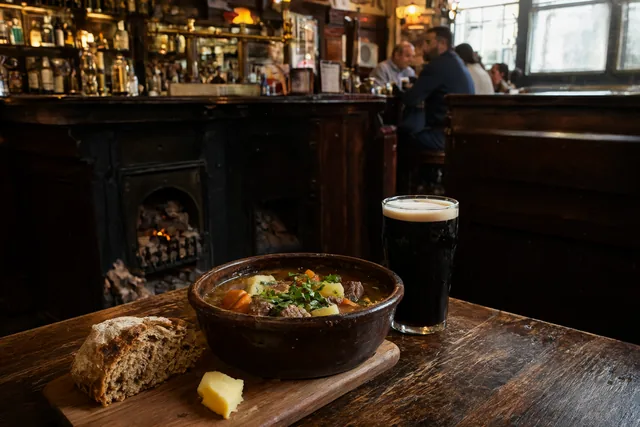
In most pubs there is no table service: find a table, note its number, then order and pay for both food and drinks at the bar. Drinks are poured straight away and food is brought to your table. Do not wave money at the bar staff; just wait your turn.
A pint of bitter, please Or "a half of lager" or "a pint of cider". Beer comes by the pint or half pint
Are you still doing food? Ask this in the evening: many pub kitchens close around 9pm
Can I order food for table 12? How you order food at the bar in a pub
Could we get a jug of tap water, please? Tap water is free and safe to drink
It's my round In a group, people take turns to buy drinks for everyone
Could we get the bill, please? In the UK it is the "bill", not the "check"
Cheers / Ta "Cheers" is a toast but also means thanks; "ta" is a casual thank you
Diolch "Thank you" in Welsh, appreciated in Wales
How swap.menu helps you eat in the UK
A British menu is in English, but that does not mean everyone can read it. Visitors from the US are surprised by a pudding that is a sausage, and visitors from everywhere else meet spotted dick, bubble and squeak, faggots and toad in the hole and wonder what they are. Photograph the menu with swap.menu and every dish is explained in plain language, so you know that toad in the hole is sausages baked in Yorkshire pudding batter and that bubble and squeak is fried leftover potato and cabbage. Every price is converted from pounds to your home currency, and the optional service charge is shown as its own line.
If English is not your first language, swap.menu translates the menu into any of 29 languages, with the English name kept beside each dish so you can point to it. Your scanned menus are saved, so you can look back at the pub or market stall you liked. You can try it right now on a sample menu with the free demo, or see travel pass prices.
Off to the United Kingdom? Your first 3 menu scans are free, and a travel pass starts from $4.99 with nothing that renews.
Start free with 3 scansUnited Kingdom food FAQ
Do you tip in restaurants in the UK?
Many UK restaurants add an optional service charge, often 12.5 percent in London. If it is on the bill there is no need to tip again. If not, around 10 percent for good table service is normal, and you do not tip for drinks at a pub bar.
How do you order food in a British pub?
In most pubs you find a table, note its number, then go to the bar to order and pay for food and drinks. The food is brought to your table. Some gastropubs offer table service, and staff will tell you if they do.
What food is the UK most famous for?
Fish and chips, the full English breakfast, the Sunday roast with Yorkshire pudding, pies, afternoon tea with scones and clotted cream, and curry. Scotland is known for haggis and salmon, Wales for Welsh cakes and rarebit, and Northern Ireland for the Ulster fry.
Is it expensive to eat out in the UK?
Eating out in the UK, especially in London, is expensive compared with much of Europe. Set lunch menus, pub meals, markets, chip shops and curry houses offer much better value than dinner at a restaurant. Cities outside London are generally cheaper.
Is tap water safe to drink in the UK?
Yes, tap water is safe to drink throughout the UK. Restaurants and pubs will give you a jug or glass of tap water for free if you ask. Bottled water is only charged when you order it.
How can swap.menu help with British menus?
Photograph any menu and swap.menu explains unfamiliar dishes such as black pudding, spotted dick or bubble and squeak, converts prices from pounds to your currency and shows the service charge. It can also translate the whole menu into your own language if English is not your first.
Travelling further in Europe? Read our food guides for nearby countries:
- Ireland food guide
- France food guide
- Belgium food guide
- Netherlands food guide
- Iceland food guide
- India food guide
Or browse every travel food guide.