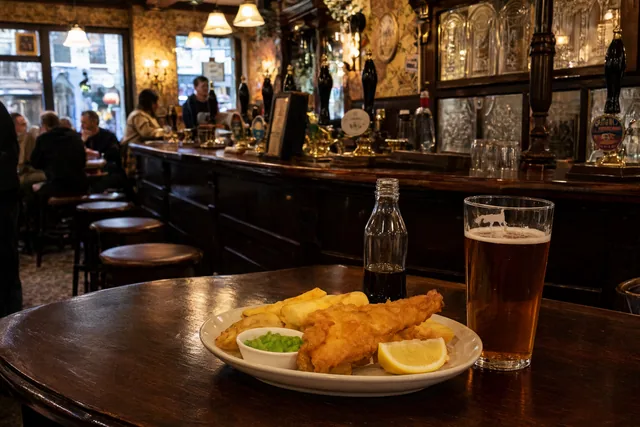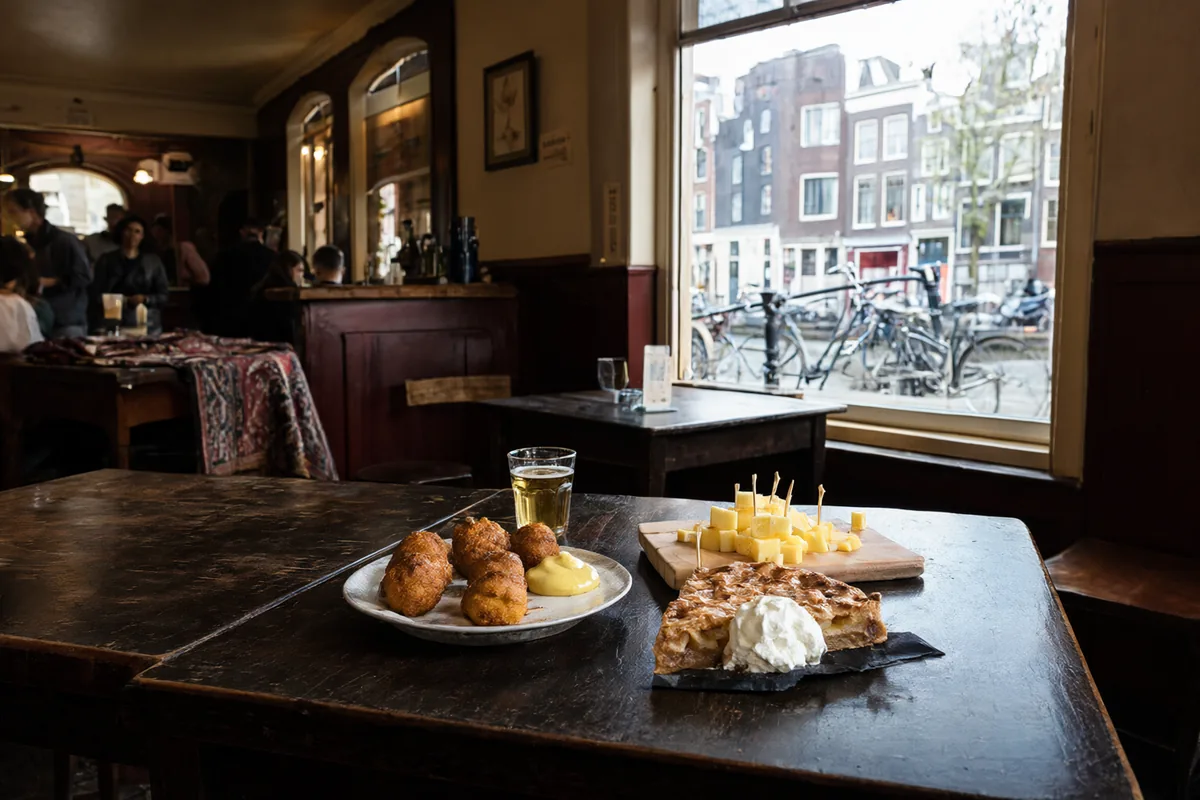
The Netherlands is not famous for fine dining, but it is one of the best countries in Europe for snacking: raw herring from a street stall, hot bitterballen with a beer, fresh stroopwafels from the market and chips with far too much mayonnaise. This Netherlands food guide covers the dishes to know, how to read a Dutch menu, how tipping and paying work (including why your credit card might not), then goes city by city through where to eat in Amsterdam, Rotterdam, The Hague, Utrecht, Leiden, Maastricht and Groningen. Thanks to centuries of trade and empire, Indonesian and Surinamese food is as much a part of Dutch eating as cheese and stamppot.
What to eat in the Netherlands: 12 dishes to know
These are the dishes and snacks worth trying, with the season or place they belong to. Many are street food, eaten standing up.
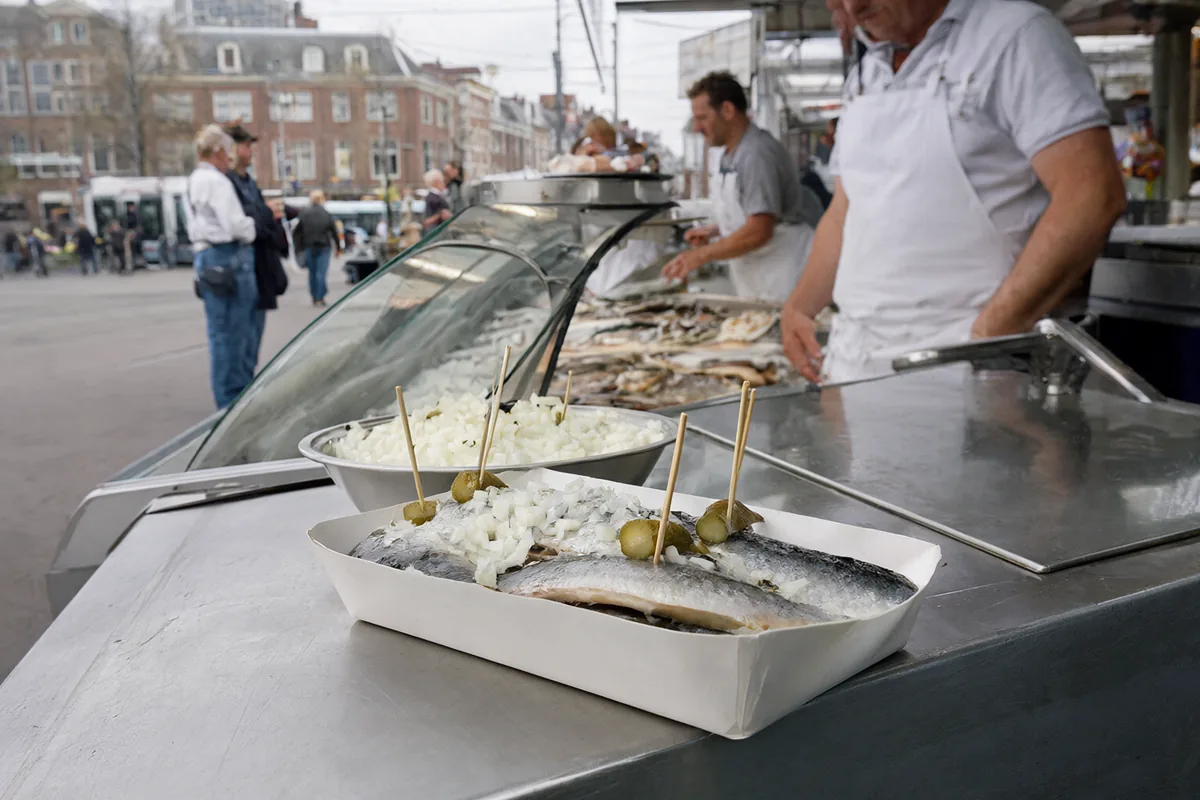
- Hollandse Nieuwe haring (everywhere, from June): young, lightly salted raw herring, eaten with chopped onion and pickles, or held by the tail and lowered into your mouth. Ask for it on a bun (broodje haring) if you prefer.
- Bitterballen (everywhere): small, crisp, deep-fried balls of thick beef ragout, served with mustard as a bar snack. Wait before biting; the inside is very hot.
- Kroket (everywhere): a larger croquette of the same ragout, eaten on a bread roll with mustard, often bought from a wall of coin-operated hatches called an automatiek.
- Stroopwafel (Gouda and everywhere): two thin waffles stuck together with caramel syrup. Buy them freshly made at a market.
- Poffertjes (everywhere): tiny, fluffy pancakes cooked in a special pan and served with butter and icing sugar.
- Stamppot (everywhere, winter): mashed potato mixed with kale (boerenkool), sauerkraut or carrots and onion (hutspot), served with a smoked sausage called rookworst.
- Erwtensoep (everywhere, winter): a pea soup so thick a spoon should stand up in it, with sausage and bacon. Also called snert.
- Kibbeling (coast and markets): chunks of battered fried white fish with a garlic or tartare sauce.
- Patat or friet (everywhere): thick chips in a paper cone with mayonnaise. Patatje oorlog ("war chips") comes with mayonnaise, peanut sauce and raw onion.
- Pannenkoeken (everywhere): large, thin pancakes, sweet or savoury, often with bacon and apple or cheese, a popular lunch.
- Rijsttafel (Amsterdam and The Hague): the Dutch colonial "rice table", a feast of many small Indonesian dishes around rice, from rendang to satay.
- Appeltaart (everywhere): deep apple pie with cinnamon and a lattice top, served with whipped cream (slagroom).
How to read a Dutch menu
Most Dutch people speak excellent English, and city-centre restaurants often have English menus, but neighbourhood cafés, markets and snack bars are usually Dutch only. Lunch in the Netherlands is light, often a sandwich (broodje), a toasted sandwich (tosti) or soup, and the main hot meal comes at dinner. In a bar, the snacks are listed as borrelhapjes or bittergarnituur.
| Dutch | Meaning |
|---|---|
| Voorgerechten | Starters |
| Hoofdgerechten | Main courses |
| Bijgerechten | Side dishes |
| Nagerechten | Desserts |
| Dagschotel / dagmenu | Dish of the day / set menu of the day |
| Vlees / vis / kip | Meat / fish / chicken |
| Varkensvlees / rundvlees / lamsvlees | Pork / beef / lamb |
| Gebakken / gegrild / gestoofd | Fried or baked / grilled / stewed |
| Broodje | Filled bread roll or sandwich |
| Uitsmijter | Fried eggs on bread with ham or cheese, a classic lunch |
| Tosti | Toasted sandwich, usually ham and cheese |
| Borrelhapjes / bittergarnituur | Bar snacks: bitterballen, cheese, sausage |
| Van de tap / huiswijn | On tap / house wine |
| Kraanwater | Tap water |
The uitsmijter means "bouncer", and hagelslag, which you will see at breakfast, is chocolate sprinkles eaten on buttered bread. Dutch menus are full of names like these that give nothing away. swap.menu explains each dish when it translates the menu, so you know what you are ordering.
Tipping, paying by card and meal times
Service is included in Dutch menu prices, and so is BTW, the Dutch VAT. There is no cover charge. Tipping is appreciated but modest: round up, or leave around 5 to 10 percent for good table service. Many card machines now suggest a tip on screen, but you can skip it. At a bar or snack stand, tipping is not expected. Our guide to tax and service charges on menus explains how these lines appear around the world.
Prices are in euros (€). The Netherlands is close to cashless. Paying by card is called pinnen, and some cafés and shops are "pin only" and no longer accept cash at all. Debit cards and contactless phone payments work almost everywhere, and credit cards are now widely accepted in restaurants, but a few smaller places still take only debit cards, so carry a debit card as well. If a card machine offers to charge you in your home currency, choose euros: our guide to paying in local currency explains why.
The Dutch eat early. Lunch is from about noon to 1:30pm and dinner from about 6pm to 8pm. Many restaurant kitchens close by 10pm, and in smaller towns earlier. Tap water is excellent everywhere; you can ask for kraanwater, though some restaurants charge a small amount for it.
Where to eat in the Netherlands, city by city
The Netherlands is small enough to visit several cities in a week, and each has its own markets, snacks and food traditions. Jump to a city:
Where to eat in Amsterdam
Amsterdam's best food experiences are simple ones. Eat raw herring from a stall by a canal, order bitterballen with a beer in a brown café (bruin café), one of the old, dark, wood-panelled pubs of the Jordaan, and taste jenever, Dutch gin, in a proeflokaal, a traditional tasting room where the first sip is taken bent over the brimming glass on the bar. Apple pie with whipped cream is the classic afternoon order. Around New Year, stalls sell oliebollen, deep-fried dough balls with raisins dusted in icing sugar.
The Albert Cuyp Market in De Pijp is Amsterdam's biggest street market and the place for fresh stroopwafels, herring and Surinamese snacks, and De Pijp itself is full of restaurants of every kind. The Noordermarkt in the Jordaan holds an organic farmers' market on Saturdays, and the Foodhallen in Oud-West is a food hall in a former tram depot. For a rijsttafel or a Surinamese roti, Amsterdam has plenty of both. The area around Damrak and the Red Light District has the most tourist-oriented food in the city; walk ten minutes in almost any direction to do better.
Where to eat in Rotterdam
Rotterdam, rebuilt after the Second World War, is the Netherlands' most modern city and one of its most multicultural, with large Surinamese, Cape Verdean, Turkish, Moroccan and Antillean communities. Its own contribution to Dutch snack food is the kapsalon, a takeaway tray of chips topped with döner or shawarma meat, melted cheese, salad and garlic sauce, invented in Rotterdam and named after the Dutch word for a hairdresser's salon.
The Markthal, a huge horseshoe-shaped market hall with apartments built into its arch and a vast painted ceiling, is full of food stalls and restaurants, and the outdoor Binnenrotte market next door runs on Tuesdays and Saturdays. Katendrecht, the old sailors' district across the river, has become a restaurant and bar neighbourhood, Delfshaven is the historic harbour with old pubs, and West-Kruiskade is the street for Surinamese, Chinese and other Asian food. Rotterdam is a good city for brunch and cafés.
Where to eat in The Hague
The Hague is the seat of the Dutch government and the country's capital of Indonesian food, thanks to the many families who came from the former Dutch East Indies after Indonesian independence. Small Indonesian takeaway shops called toko sell rendang, satay, nasi and spiced snacks, and sit-down restaurants serve the full rijsttafel. Every year the city hosts the Tong Tong Fair, a large festival of Indo culture and food. Our Indonesia food guide explains the dishes in their homeland.
The Haagse Markt is one of the largest outdoor markets in Europe, with produce, fish and street food from across the world. The Hague has a small Chinatown around Wagenstraat, and the old streets of the Denneweg and the Zeeheldenkwartier are lined with restaurants. On the coast, Scheveningen is the place for herring, kibbeling and fried fish on the seafront, and in June the harbour celebrates the arrival of the new season's herring with a festival called Vlaggetjesdag.
Where to eat in Utrecht
Utrecht has one of the most unusual dining settings in the country. Along its main canal, the Oudegracht, the old wharves sit at water level below the street, and the cellars built into them now hold cafés and restaurants with terraces right on the water. On a summer evening, eating on the wharf here is one of the best things you can do in the Netherlands. The streets around the cathedral tower, the Domtoren, are full of cafés and bars, and as a big university city, Utrecht has plenty of cheap food.
The Vredenburg market in the centre runs on Wednesdays, Fridays and Saturdays, with cheese, fish and stroopwafel stalls. For international food, walk to the Lombok neighbourhood west of the station, where Kanaalstraat is lined with Turkish, Moroccan and Middle Eastern bakeries, grocers and grills. Utrecht is only about half an hour from Amsterdam by train, an easy day trip with a better ratio of locals to tourists.
Where to eat in Leiden
Leiden, the oldest university town in the Netherlands, has canals, students and a cheese of its own: Leidse kaas, a firm, low-fat cheese flavoured with cumin seeds. The best farmhouse versions carry an emblem of two crossed keys from the city's coat of arms. On 3 October each year, Leiden celebrates the end of the Spanish siege of 1574, and the whole city eats hutspot, mashed potato with carrot and onion, and herring with white bread, the food said to have been handed out to the starving citizens when the siege ended.
The Saturday market along the Nieuwe Rijn canal and around the Botermarkt is one of the most attractive in the country, with cheese, fish, bread and stroopwafels. The streets around the Pieterskerk and the Breestraat have cafés and restaurants, and in summer many restaurants set out tables on boats and canal terraces. Leiden is a short train ride from The Hague and Amsterdam.
Where to eat in Maastricht
Maastricht, in the far south between Belgium and Germany, eats very differently from the rest of the Netherlands. The people of Limburg call their approach to life Burgundian: long lunches, rich food, good wine and Belgian-style beer. The signature dish is zuurvlees, a sweet and sour stew of beef, traditionally horse meat, with apple syrup and spices, served with chips and mayonnaise. The pastry is vlaai, a yeast-dough tart filled with cherries, apricots, plums or rice pudding, sold by the slice in every bakery.
The Vrijthof, the main square, is lined with café terraces, and the narrow streets around it and the Wyck district across the River Maas have many of Maastricht's restaurants. The market on the Markt square runs on Wednesdays and Fridays and is worth visiting for local cheese, Limburg syrup (stroop) and fish. In spring, Limburg white asparagus appears on every menu, and in February carnival takes over the whole city for several days.
Where to eat in Groningen
Groningen, the main city of the north, is a lively student town with a strong local food identity. Order mosterdsoep, a creamy mustard soup with bacon, the region's best-known dish. Groningen also makes metworst, a dried smoked sausage, Groninger koek, a dark spiced rye cake eaten with butter, and the eierbal, a hard-boiled egg wrapped in ragout, breaded and deep-fried, found at snack bars.
The Grote Markt and the Vismarkt host the city market on Tuesdays, Fridays and Saturdays, with fish, cheese and street food stalls. The streets around the Martinitoren and the Folkingestraat, a street of independent shops and cafés, are good for lunch, and the bar streets of Groningen stay open late, as you would expect in a city where a large share of the population are students. Prices here are generally lower than in Amsterdam.
Vegetarian, vegan and allergy tips
The Netherlands is very good for vegetarians and vegans, especially in the cities, and supermarkets and snack bars sell vegetarian versions of almost every Dutch classic, including vegetarian bitterballen and kroketten. Watch for hidden meat in traditional food: pea soup and stamppot nearly always come with sausage or bacon, and Indonesian dishes often use shrimp paste. The words are vegetarisch and veganistisch (or simply vegan).
EU rules require restaurants to tell you about the 14 major allergens if you ask. Peanuts are common in Dutch and Indonesian food, especially in satésaus (peanut sauce) on chips and satay, so take care with nut allergies at snack bars. Gluten-free is glutenvrij. Our guide to eating abroad with food allergies explains how to explain an allergy clearly in another language.
Useful Dutch phrases for ordering
Goedemiddag / Goedenavond "Good afternoon / Good evening". A simple "hallo" is also fine
Een tafel voor twee, alstublieft "A table for two, please"
Wat raadt u aan? "What do you recommend?"
Ik wil graag dit "I would like this" (pointing)
Ik ben allergisch voor... "I am allergic to..."
Mag ik een glas kraanwater? "May I have a glass of tap water?"
Mag ik afrekenen? "May I pay?", the usual way to ask for the bill
Dank u wel, het was heerlijk "Thank you, it was delicious"
How swap.menu helps you eat in the Netherlands
English is widely spoken in the Netherlands, but the menu at a neighbourhood café, a market stall or a snack bar is usually in Dutch only, and many dish names give nothing away. Photograph it with swap.menu and every dish appears in your language with the Dutch name beside it and a short explanation, so you know that a frikandel is a skinless minced meat sausage, that zuurvlees may be horse meat and that a broodje gezond is a "healthy" sandwich of cheese, ham and salad. Every price is converted from euros to your home currency.
Tap the dishes you want, add a note such as "no peanut sauce", "vegetarian" or "gluten-free", typed or spoken, and swap.menu translates your order into Dutch. Show the server your phone, or let them scan the QR code and read your order on their own screen. You can try it right now on a sample menu with the free demo, or see travel pass prices.
Off to the Netherlands? Your first 3 menu scans are free, and a travel pass starts from $4.99 with nothing that renews.
Start free with 3 scansNetherlands food FAQ
Do you tip in restaurants in the Netherlands?
Tipping is optional in the Netherlands because service is included in menu prices. Rounding up or leaving around 5 to 10 percent for good table service is common. Tips are not expected at bars or snack stands.
What food is the Netherlands famous for?
Raw herring, cheeses such as Gouda and Edam, stroopwafels, bitterballen, kroketten, poffertjes, stamppot, pea soup, chips with mayonnaise and apple pie. Indonesian rijsttafel and Surinamese food are also very popular.
Can I pay with a credit card in the Netherlands?
Most restaurants and many shops now accept credit cards, and contactless payment is everywhere. A few smaller places accept only debit cards, and some are card only and refuse cash. Carrying a debit card as well as a credit card avoids problems.
What time do people eat dinner in the Netherlands?
The Dutch eat dinner early, usually between 6pm and 8pm. Lunch is a light meal between noon and 1:30pm. Restaurant kitchens often close by 10pm.
Is tap water safe to drink in the Netherlands?
Yes, Dutch tap water is safe and of very high quality. You can ask for kraanwater in restaurants, though some charge a small amount for it.
How can I read a Dutch menu if I do not speak Dutch?
Many city restaurants have English menus, but cafés, markets and snack bars often do not. Photograph the menu with swap.menu: it translates every dish into your language, explains what it is, converts prices from euros to your currency and translates your order into Dutch.
Travelling further in Europe? Read our food guides for neighbouring countries:
- Belgium food guide
- Germany food guide
- Luxembourg food guide
- Denmark food guide
- United Kingdom food guide
- Indonesia food guide
Or browse every travel food guide.