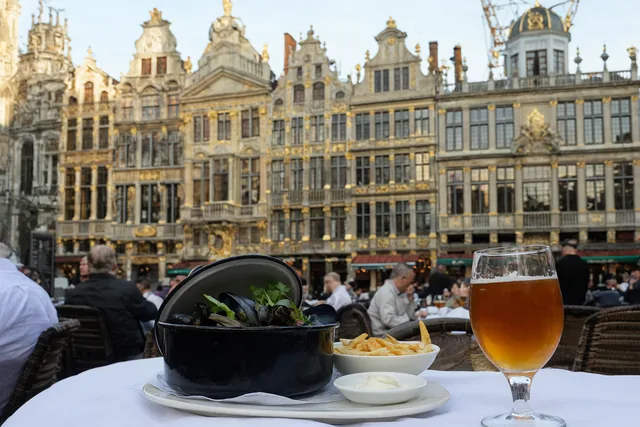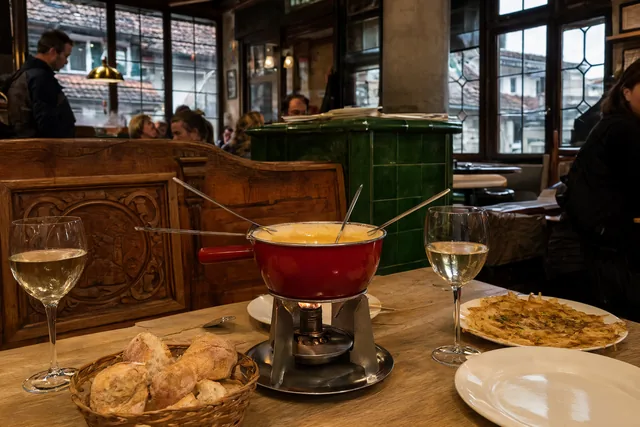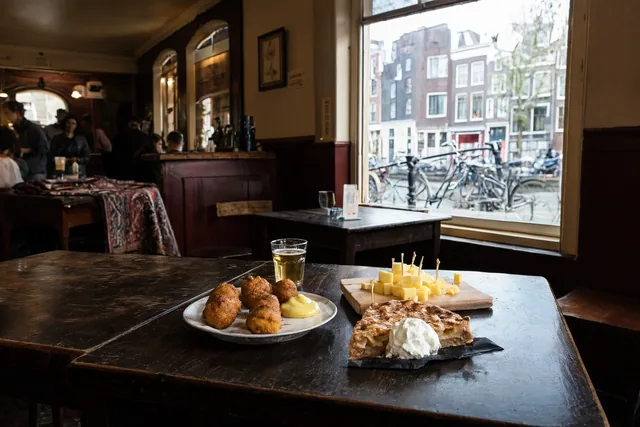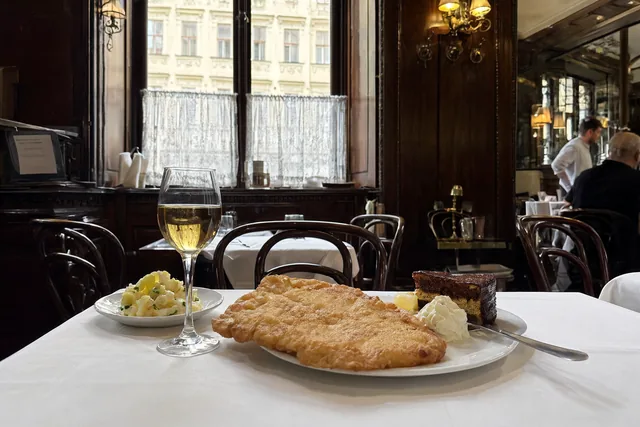
Luxembourg is one of the smallest countries in Europe, but it eats well: French-style restaurants, German-style portions, Belgian beer, Portuguese and Italian home cooking from its large immigrant communities, and a wine region along the Moselle that few visitors know about. This Luxembourg food guide covers the national dishes to know, how to read a menu that might be in French, German or Luxembourgish, how tipping and paying work, then goes through where to eat in Luxembourg City, the Moselle Valley, Esch-sur-Alzette, Vianden and Echternach. The country is small enough to cross in under two hours, and public transport is free, so you can eat your way around all of it from one base.
What to eat in Luxembourg: 12 dishes to know
These are the Luxembourgish dishes worth ordering, under their Luxembourgish names, which is how they usually appear even on French menus.
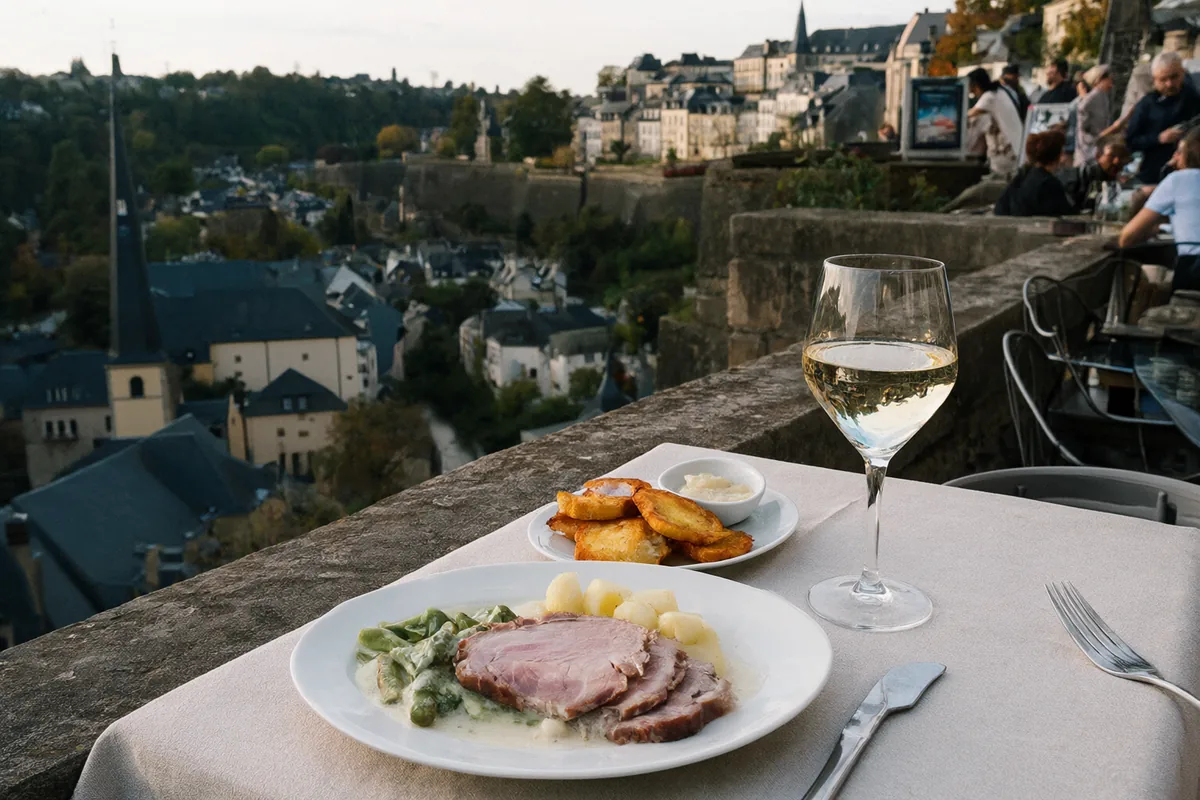
- Judd mat Gaardebounen (everywhere): the national dish, smoked collar of pork with broad beans in a creamy sauce and boiled potatoes, best in summer when the beans are fresh.
- Bouneschlupp (everywhere): a thick green bean soup with potatoes, onions and bacon, often with a sausage in it.
- Gromperekichelcher (fairs and markets): crisp, flat potato fritters with onion and parsley, eaten hot with apple sauce from stalls at fairs and Christmas markets.
- Kniddelen (everywhere): soft flour dumplings served with bacon and cream, or sweet with apple sauce.
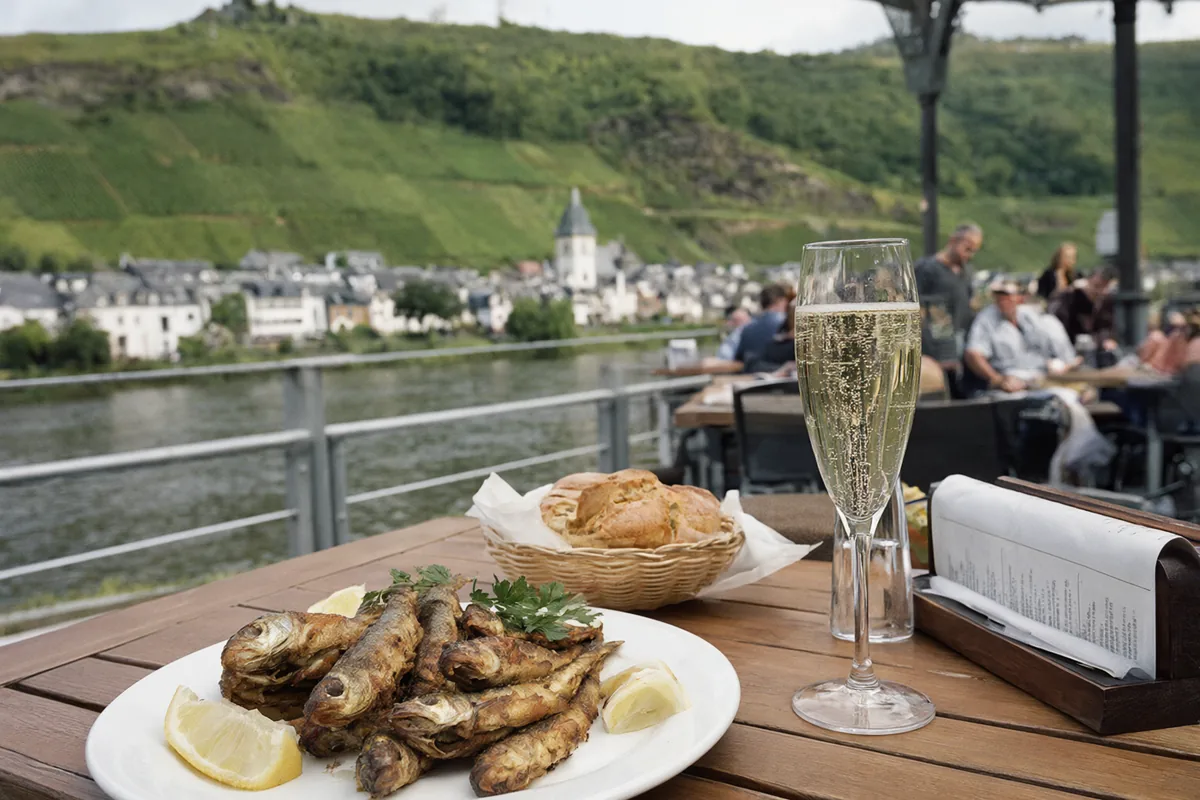
- Friture de la Moselle (Moselle Valley): small river fish, fried whole and eaten with lemon and a glass of Moselle white wine.
- Rieslingspaschtéit (everywhere): a pastry pie filled with pork and veal set in Riesling jelly, sold by the slice in bakeries and served cold with salad.
- Bouchée à la reine (everywhere): a puff pastry case filled with chicken, mushrooms and cream sauce, called Paschtéit in Luxembourgish and one of the most popular restaurant dishes in the country.
- Kachkéis (everywhere): a soft, runny cooked cheese spread eaten on bread, often with mustard.
- Träipen (winter): black pudding, fried and served with apple sauce and mashed potato, traditional on Christmas Eve.
- Éisleker ham (the Ardennes): smoked raw ham from the north of the country, with protected status, served thinly sliced.
- Grillwurscht (markets and fairs): the Luxembourg grilled sausage, served in a roll with mustard from stalls at every market and festival.
- Quetschentaart (late summer): a tart of Luxembourg damson plums, sold in bakeries in August and September.
How to read a menu in Luxembourg
Luxembourg has three official languages. Luxembourgish is the everyday language of locals, but most restaurant menus are written in French, some in German, and many offer English too. Much of the restaurant workforce commutes from France, Belgium and Germany, so French is usually the safest language for ordering. At lunch, nearly every restaurant offers a plat du jour, a dish of the day for office workers, and it is the best value way to eat in an expensive country.
| French | German | Meaning |
|---|---|---|
| Entrées | Vorspeisen | Starters |
| Plats principaux | Hauptgerichte | Main courses |
| Desserts | Nachspeisen | Desserts |
| Plat du jour | Tagesgericht | Dish of the day, usually at lunch |
| Menu du jour / formule | Tagesmenü | Set menu of the day |
| Porc / boeuf / veau | Schwein / Rind / Kalb | Pork / beef / veal |
| Poulet / gibier | Hähnchen / Wild | Chicken / game |
| Poisson / truite | Fisch / Forelle | Fish / trout |
| Pommes de terre / frites | Kartoffeln / Pommes | Potatoes / chips |
| Fromage | Käse | Cheese |
| Fait maison | Hausgemacht | Homemade |
| Vin au verre | Offener Wein | Wine by the glass |
| Crémant | Crémant | Sparkling wine made in the traditional method |
| Carafe d'eau | Leitungswasser | Tap water |
You will often see the same dish under a Luxembourgish name in one restaurant and a French one in the next: Paschtéit and bouchée à la reine, or Gromperekichelcher and galettes de pommes de terre. swap.menu reads menus in French, German and Luxembourgish and explains every dish in your language.
Tipping, paying and meal times
Service is included in Luxembourg menu prices (service compris), and so is TVA, the Luxembourg VAT. There is usually no cover charge. Tipping is optional: locals round up or leave a few euros, and around 5 to 10 percent is generous for good service. Our guide to tax and service charges on menus explains how these lines work around the world.
Prices are in euros (€), and Luxembourg is one of the more expensive countries in Europe to eat out in, especially in the capital. Cards and contactless payment are accepted almost everywhere, including small cafés and market stalls. If a card machine offers to charge you in your home currency, choose euros: our guide to paying in local currency explains why.
Lunch is the busy service in Luxembourg City, from about noon to 2pm, when offices empty into restaurants for the plat du jour. Dinner runs from about 7pm to 10pm. Many restaurants close on Sunday evening or one weekday, and some close for a few weeks in summer, so check before you travel. Tap water is safe to drink, but restaurants usually offer bottled water first. All public transport in Luxembourg, buses, trains and trams, has been free since 2020, which makes day trips to the Moselle for wine very easy.
Where to eat in Luxembourg, town by town
Luxembourg is small, but its regions are distinct: the capital, the wine villages of the Moselle, the industrial south, and the wooded hills of the Ardennes and the Mullerthal. Jump to a destination:
Where to eat in Luxembourg City
Luxembourg City is built on cliffs above two river valleys, and where you eat depends on which level you are on. The Ville Haute, the old town on the plateau, has the café terraces of the Place d'Armes and smart restaurants, and the Wednesday and Saturday morning market on Place Guillaume II, known locally as the Knuedler. Down in the valley, the old quarters of the Grund and Clausen have pubs and restaurants in stone houses by the river, and the converted brewery buildings at Clausen are one of the city's nightlife centres. A lift and steep stairways connect the levels.
For Luxembourgish cooking, order Judd mat Gaardebounen, Bouneschlupp or bouchée à la reine in a traditional brasserie, and try Rieslingspaschtéit from a bakery. Luxembourg City also has a strong pastry and cake tradition, and a coffee with a slice of cake in a tea room is an afternoon ritual. Around the Gare district near the station, Portuguese restaurants and cafés serve the community that makes up a large part of the country's population, at lower prices than the old town. In late August and early September, the Schueberfouer, a funfair held since the 14th century, fills the Glacis with fried fish, Gromperekichelcher and sausage stalls, and in December the Christmas markets do the same.
Where to eat in the Moselle Valley
The Moselle Valley runs along Luxembourg's eastern border with Germany, and its steep vineyards produce crisp white wines: Riesling, Pinot gris, Auxerrois, Rivaner and the old local grape Elbling, plus Crémant de Luxembourg, the country's traditional-method sparkling wine. Many wineries and cooperatives have tasting rooms, and a wine trail links the villages. The dish to eat here is friture de la Moselle, small fried river fish eaten with your fingers, alongside Rieslingspaschtéit and pork dishes cooked in wine.
The riverside town of Remich has a promenade lined with restaurants and terraces and boat trips on the Moselle. Grevenmacher holds a grape and wine festival in September, and small villages such as Wormeldange, Ehnen and Schengen, where the Schengen Agreement was signed, have winery restaurants and wine taverns. In autumn, look for Fiederwäissen, young, partly fermented wine, sold for a few weeks after the harvest. The Moselle is under an hour from Luxembourg City by free bus or train.
Where to eat in Esch-sur-Alzette
Esch-sur-Alzette, Luxembourg's second city, lies in the south, in the iron ore country known as the Minett for its red earth. A century of steelmaking drew workers from Italy and Portugal, and Esch-sur-Alzette is the place to eat the food of those communities: family-run Italian pizzerias and trattorias, and Portuguese restaurants serving grilled fish, bacalhau and francesinha, often at better prices than in the capital. The pedestrian Rue de l'Alzette, the main shopping street, is lined with cafés and brasseries.
The former steelworks at Belval, on the edge of Esch, have been turned into a new district around preserved blast furnaces, with a university, offices and plenty of new restaurants and bars for students and workers. Esch was a European Capital of Culture in 2022, and its cultural venues and food scene have grown since. It is a short, free train ride from Luxembourg City and easily combined with a visit to the industrial heritage sites of the south.
Where to eat in Vianden
Vianden, a small town in a steep wooded valley of the Ardennes (the Éislek in Luxembourgish), is dominated by its hilltop castle, one of the largest in the region. Ardennes cooking is country food: smoked Éisleker ham, river trout, Kniddelen, and in autumn and winter, game dishes such as civet de marcassin (young wild boar stewed in red wine) and venison with red cabbage, chestnuts and cranberries. Hotels and family restaurants along the main street and the River Our serve these dishes on terraces with views of the castle.
On the second Sunday of October, Vianden holds its walnut market (Nëssmoort), when the streets fill with stalls selling walnuts, walnut bread, walnut cake, walnut liqueur and walnut everything. A chairlift climbs from the town to a viewpoint with a café. The Ardennes are a hiking region, and many walkers end the day with a beer and a plate of ham and bread. Vianden is quiet in winter, when some restaurants close, so check opening days outside the summer season.
Where to eat in Echternach
Echternach, on the River Sûre by the German border, is the oldest town in Luxembourg, built around an abbey founded in the 7th century. It is the gateway to the Mullerthal, nicknamed "Little Switzerland" for its sandstone gorges, mossy forests and the long-distance Mullerthal Trail. The cafés and restaurants around the market square and its medieval town hall serve Luxembourgish classics, trout, pastries and ice cream to walkers and day-trippers, and many country inns in the surrounding villages specialise in game and local pork.
Echternach is known for its dancing procession, held every Whit Tuesday and listed by UNESCO, when thousands of people dance through the streets to honour Saint Willibrord; book ahead if you visit then. The town's bakeries sell local pastries and fruit tarts, and the lake just outside town is a popular place for a picnic. From Echternach, the Moselle wine villages are a short drive south, so you can pair a morning hike with an afternoon of wine tasting.
Vegetarian, vegan and allergy tips
Traditional Luxembourgish food is built around pork, and bacon appears in soups, beans and dumplings. Watch for Bouneschlupp and other soups made with bacon or meat stock, and broad beans served with pork. Luxembourg City has a good choice of vegetarian and vegan restaurants and international food, and Italian restaurants are easy everywhere. The words are végétarien in French and vegetarisch in German, and vegan in both.
EU rules require restaurants to tell you about the 14 major allergens if you ask, and many menus mark them. Walnuts appear in many Ardennes dishes and cakes, and cream and butter are in most sauces. Gluten-free is sans gluten or glutenfrei. Our guide to eating abroad with food allergies explains how to explain an allergy clearly in another language.
Useful Luxembourgish and French phrases for ordering
A few words of Luxembourgish are always appreciated, but you can order in French almost everywhere.
Moien "Hello", the everyday Luxembourgish greeting at any time of day
Une table pour deux, s'il vous plaît "A table for two, please" (French)
Ech hätt gär... "I would like..." (Luxembourgish)
Je voudrais le plat du jour "I would like the dish of the day" (French)
Je suis allergique à... "I am allergic to..." (French)
L'addition, s'il vous plaît "The bill, please" (French)
Merci villmools "Thank you very much" (Luxembourgish)
Äddi "Goodbye" (Luxembourgish)
How swap.menu helps you eat in Luxembourg
A Luxembourg menu can switch between French, German and Luxembourgish on the same page, with dishes like Judd mat Gaardebounen or Träipen that no phrasebook covers. Photograph it with swap.menu and every dish appears in your language with the original name beside it and a short explanation, so you know that Judd is smoked pork collar, that Kachkéis is a cooked cheese spread and that Träipen is black pudding. Every price is converted from euros to your home currency, which helps in one of Europe's pricier countries.
Tap the dishes you want, add a note such as "no pork", "vegetarian" or "gluten-free", typed or spoken, and swap.menu translates your order into French or German. Show the waiter your phone, or let them scan the QR code and read your order on their own screen. You can try it right now on a sample menu with the free demo, or see travel pass prices.
Off to Luxembourg? Your first 3 menu scans are free, and a travel pass starts from $4.99 with nothing that renews.
Start free with 3 scansLuxembourg food FAQ
Do you tip in restaurants in Luxembourg?
Tipping is optional in Luxembourg because service is included in menu prices. Rounding up or leaving a few euros is common, and around 5 to 10 percent is generous for good service.
What is the national dish of Luxembourg?
Judd mat Gaardebounen, smoked collar of pork with broad beans in a cream sauce and potatoes. Other classic dishes include Bouneschlupp (green bean soup), Gromperekichelcher (potato fritters), Kniddelen (dumplings) and friture de la Moselle.
Is it expensive to eat out in Luxembourg?
Yes, Luxembourg is one of the more expensive countries in Europe for eating out, especially in the capital. The weekday plat du jour at lunch is the best value, and Portuguese and Italian restaurants are often cheaper than traditional ones.
What language are menus in Luxembourg?
Most menus are in French, some are in German, and many restaurants also offer English. Luxembourgish dish names often appear even on French menus. French is the most useful language for ordering.
What wine is Luxembourg known for?
Luxembourg's Moselle Valley produces mainly white wines such as Riesling, Pinot gris, Auxerrois and Elbling, as well as Crémant de Luxembourg, a traditional-method sparkling wine. Most of it is drunk locally, so it is rarely seen abroad.
How can I read a menu in Luxembourg if I do not speak French or German?
Many restaurants have an English menu, but traditional places and bakeries often do not. Photograph the menu with swap.menu: it translates every dish into your language, explains Luxembourgish dishes, converts prices from euros to your currency and translates your order into French or German.
Travelling further in Europe? Read our food guides for neighbouring countries:
Or browse every travel food guide.