Austria eats like the old capital of an empire: Hungarian goulash, Bohemian dumplings, Italian-influenced veal, Alpine cheese and some of the finest cakes in the world, all washed down with white wine from vineyards on the edge of Vienna. This Austria food guide covers the dishes to know, the Austrian menu words that differ from standard German, how coffee houses, tipping and paying work, then goes city by city through where to eat in Vienna, Salzburg, Innsbruck, Graz, Linz and the Wachau Valley. Each region has its own specialities, from the pumpkin seed oil of Styria to the cheese dumplings of Tyrol and the apricots of the Danube.
What to eat in Austria: 12 dishes to know
These are the dishes worth ordering, with the region they belong to. Austrian sweets and cakes, known as Mehlspeisen, deserve a meal of their own.
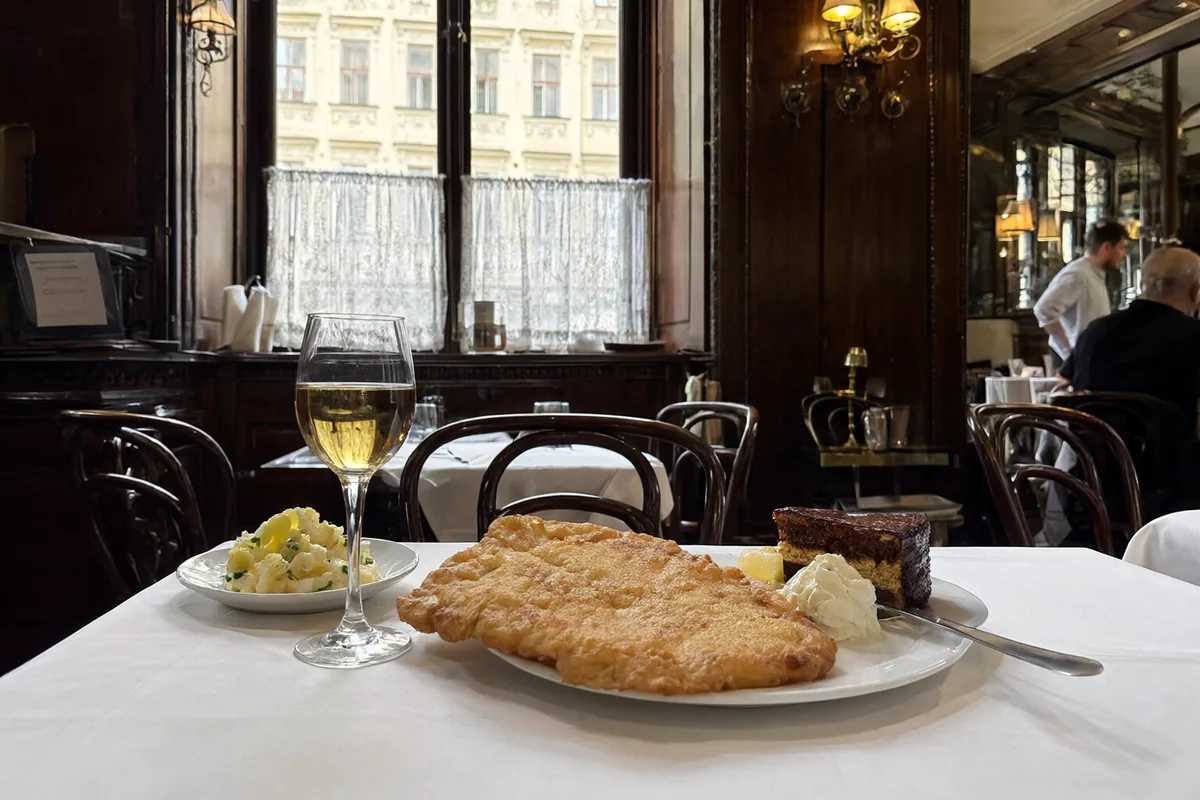
- Wiener Schnitzel (Vienna and everywhere): a thin veal escalope, breaded and fried until the crumb puffs up, served with lemon and potato salad or parsley potatoes. A pork version must be called "Schnitzel Wiener Art".
- Tafelspitz (Vienna): boiled beef simmered in broth, served with apple and horseradish sauce, chive sauce and fried potatoes. The broth is often served first as a soup.
- Gulasch (everywhere): a paprika beef stew inherited from Hungary, served with a bread roll or dumpling. Fiakergulasch comes with a fried egg, sausage and pickle.
- Backhendl (Styria and Vienna): breaded fried chicken, often served with potato and lamb's lettuce salad dressed with pumpkin seed oil.
- Käsespätzle and Kasnocken (Tyrol, Vorarlberg and Salzburg): small egg dumplings baked with strong mountain cheese and topped with fried onions.
- Tiroler Gröstl (Tyrol): fried potatoes, onions and pieces of pork or beef, topped with a fried egg.
- Knödel (everywhere): dumplings of every kind, from savoury Speckknödel (bacon) to sweet Germknödel (a yeast dumpling filled with plum jam) and Marillenknödel (apricot dumplings).
- Kaiserschmarrn (everywhere): a thick, fluffy pancake torn into pieces, caramelised, dusted with icing sugar and served with plum compote.
- Apfelstrudel (everywhere): paper-thin pastry rolled around spiced apples and raisins, served warm with cream or vanilla sauce.
- Sachertorte (Vienna): a dense chocolate cake with a thin layer of apricot jam and dark chocolate glaze, with unsweetened whipped cream.
- Würstel (Vienna and everywhere): sausages from a street stand, above all the Käsekrainer, a smoked sausage with pockets of melted cheese inside.
- Kürbiskernöl (Styria): dark green pumpkin seed oil with a nutty taste, poured over salads, soups and even vanilla ice cream.
How to read an Austrian menu
Austrians speak German, but Austrian German has its own food vocabulary, and even German visitors get confused. Menus run from soups (Suppen) and starters to mains (Hauptspeisen) and sweets (Mehlspeisen). At lunch, look for the Mittagsmenü, a set lunch with soup and a main, which is the best value meal of the day.
| Austrian German | Meaning |
|---|---|
| Hauptspeisen | Main courses |
| Mehlspeisen | Desserts, cakes and sweet dishes |
| Mittagsmenü / Tagesteller | Set lunch / dish of the day |
| Schwein / Rind / Kalb | Pork / beef / veal |
| Hendl | Chicken |
| Erdäpfel | Potatoes (Kartoffeln in Germany) |
| Paradeiser | Tomatoes |
| Karfiol / Fisolen | Cauliflower / green beans |
| Schlagobers / Obers | Whipped cream / cream |
| Topfen | Quark, a fresh curd cheese used in strudels and dumplings |
| Marillen | Apricots |
| Faschiertes | Minced meat |
| Semmel / Gebäck | Bread roll / bread items, often charged per piece |
| G'spritzter | White wine with soda water, a summer favourite |
The bread basket on an Austrian table is not always free: rolls and slices are often counted and added to the bill, and some restaurants charge a Gedeck (cover) for bread and spreads. A Wiener Schnitzel should be veal, so check whether the menu says "vom Kalb" or "vom Schwein". swap.menu flags cover charges and explains every Austrian dish and word when it translates the menu.
Coffee houses, tipping and paying the bill
Service is included in Austrian menu prices, and so is VAT (MwSt). Tipping is still normal: round up or add around 5 to 10 percent for good service. As in Germany, you do not leave the tip on the table. Tell the server the total you want to pay, tip included, or say "stimmt so" or "passt so" (keep the change). Our guide to tax and service charges on menus explains how cover charges and service lines work around the world.
The Viennese coffee house (Kaffeehaus) is a world of its own, recognised by UNESCO as part of Austria's cultural heritage. You can sit for hours over a single coffee, read the newspapers provided and nobody will hurry you. Coffee comes with a small glass of water, refilled for free. Order a Melange (similar to a cappuccino), a kleiner Brauner (espresso with a little milk) or an Einspänner (black coffee in a glass topped with whipped cream). Wave to the waiter, who may take a while, and pay at the table.
Prices are in euros (€). Austrians have traditionally preferred cash, and although cards are now accepted in most restaurants, some small taverns, wine taverns, sausage stands and mountain huts still take cash only. Carry some notes. If a card machine offers to charge you in your home currency, choose euros: our guide to paying in local currency explains why.
Lunch is from about 11:30am to 2pm and dinner from about 6pm to 9pm. Many restaurants close one or two days a week, and some close on Sundays. Tap water is excellent; Vienna's comes from springs in the Alps. You can ask for Leitungswasser in any restaurant.
Where to eat in Austria, city by city
Each Austrian region has its own kind of tavern, from the Viennese Beisl to the Styrian Buschenschank and the mountain huts of Tyrol. Jump to a destination:
Where to eat in Vienna
Vienna is one of the great food cities of central Europe and has its own cuisine, Wiener Küche. Eat it in a Beisl, a traditional neighbourhood tavern with wood panelling and simple tables, where the menu runs to Wiener Schnitzel, Tafelspitz, goulash, Zwiebelrostbraten (roast beef with crispy onions) and Beuschel (a ragout of lung and heart). For lunch on the go, a Würstelstand, a sausage stand, serves Käsekrainer and Burenwurst with mustard and a bread roll, late into the night. In the afternoon, eat cake in a coffee house or a Konditorei.
The Naschmarkt, Vienna's most famous market, has produce stalls, delis and many small restaurants, with a flea market on Saturdays. The Brunnenmarkt in Ottakring is a long, cheaper street market with Turkish and Balkan food, and the Karmelitermarkt in Leopoldstadt has a farmers' market on Saturday mornings. Vienna is unusual among capital cities in having its own vineyards, and its wine taverns, the Heurigen, serve young wine and cold buffets on the city's edge. Grinzing is the most famous and the most touristy; locals prefer Nussdorf, Neustift am Walde and Stammersdorf. Order a Gemischter Satz, Vienna's field-blend white wine.
Where to eat in Salzburg
Salzburg is Mozart's birthplace, and its most famous sweets are named after him: the Mozartkugel, a ball of pistachio marzipan and nougat coated in chocolate. The city's grand dessert is the Salzburger Nockerl, a sweet soufflé baked in three golden peaks to represent the hills around the city, made to order for two and served warm with berry sauce. For savoury food, order Kasnocken, cheese dumplings from the Pinzgau region, and the Bosna, a spiced sausage in a toasted roll with onions and curry powder, a Salzburg street-food favourite.
The Getreidegasse and the old town are crowded with visitors, so explore the Steingasse and the streets on the right bank of the Salzach for quieter places. The market on Universitätsplatz, called the Grünmarkt and held every day except Sunday, and the Thursday morning Schranne market around St Andrew's Church are good for picnic food. Salzburg has a strong beer culture, with old beer halls and beer gardens in the Mülln district. During the Salzburg Festival in July and August, book restaurants well ahead.
Where to eat in Innsbruck
Innsbruck, the capital of Tyrol, sits in a valley ringed by mountains, and its food is built for skiers and hikers. Order Tiroler Gröstl, Speckknödel in broth, Kaspressknödel (flat fried cheese dumplings, served in soup or with salad), Schlutzkrapfen (half-moon pasta filled with spinach and quark, with brown butter and parmesan) and a plate of smoked Tiroler Speck with bread and horseradish. Kiachl, a fried yeast dough eaten with sauerkraut or cranberry jam, is sold at markets and festivals.
The old town around the Golden Roof has traditional inns, and the Markthalle by the River Inn sells Tyrolean cheese, Speck and bread. The real Innsbruck experience is a meal at a mountain hut (Hütte or Alm): take the cable car from the city centre up the Nordkette, or hike up to one of the huts on the slopes, and eat Kaiserschmarrn on a terrace above the city. In winter, Innsbruck's Christmas markets fill the old town with mulled wine and roasted chestnuts.
Where to eat in Graz
Graz, the capital of Styria, calls itself Austria's culinary capital, and it has a good case. Styria is the green heart of Austria, and its farmers' markets supply restaurants with some of the best produce in the country. The famous product is Kürbiskernöl, dark green pumpkin seed oil, drizzled over a salad of Käferbohnen (large scarlet runner beans) and onions, over potato salad or over vanilla ice cream. Order Backhendl, Steirisches Wurzelfleisch (boiled pork with root vegetables and horseradish) and Verhackert, a spread of minced cured bacon, on dark bread.
The farmers' markets on Kaiser-Josef-Platz and Lendplatz run every morning except Sunday and are among the best in Austria. The Lend district across the River Mur is the most creative area to eat and drink, and the old town has courtyards full of restaurants. South of Graz, the wine roads of South Styria are lined with Buschenschanken, family wine taverns that serve their own Sauvignon blanc and other white wines with cold platters of ham, cheese, spreads and bread. In West Styria, try Schilcher, a tart local rosé.
Where to eat in Linz
Linz, on the Danube in Upper Austria, gave its name to the Linzer Torte, a tart of spiced nut pastry filled with redcurrant jam under a lattice top, one of the oldest named cake recipes in the world. Bakeries also sell Linzer Augen, jam-filled biscuits with a hole in the top. Upper Austrian cooking is farmhouse food: Bratl in der Rein (roast pork with crackling cooked in a roasting pan), Mühlviertler Knödel and Innviertler Speckknödel (dumplings from the regions north and west of Linz), and Most, a dry cider or perry made from local apples and pears.
The Hauptplatz, one of the largest town squares in Austria, and the old town streets around it have traditional inns and cafés. The Südbahnhofmarkt is the city's main market for produce and quick lunches. Take the old mountain tram up the Pöstlingberg for views and a coffee and cake, and look for Mostschänken, farm taverns in the surrounding countryside that serve their own cider with cold platters. Linz is about halfway between Salzburg and Vienna, an easy stop on the train.
Where to eat in the Wachau Valley
The Wachau, the stretch of the Danube between Melk and Krems, is a UNESCO-listed valley of terraced vineyards, apricot orchards, castles and wine villages, about an hour from Vienna. It produces some of Austria's finest white wines, Grüner Veltliner and Riesling, classified by ripeness as Steinfeder (light), Federspiel (medium) and Smaragd (rich). The other local treasure is the Wachauer Marille, an apricot with protected status, harvested in July and turned into Marillenknödel, jam, cakes and apricot brandy.
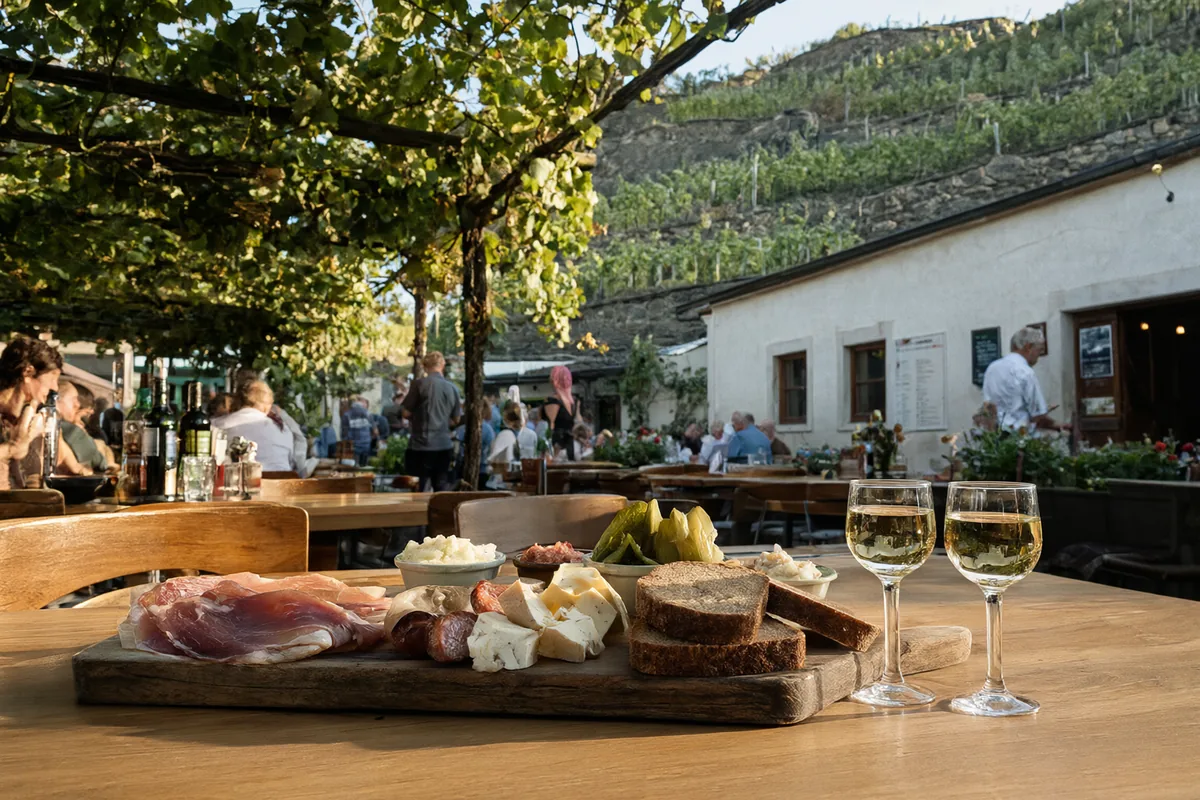
Eat at a Heuriger, a winemaker's own tavern, open only on certain weeks of the year and marked by a bunch of pine branches hung over the door when it is open. They serve the house wines with a Brettljause, a wooden board of ham, sausage, cheese, spreads and bread. The villages of Dürnstein, Weißenkirchen and Spitz have the most choice, and the riverside cycle path along the Danube makes it easy to visit several in a day. Melk's great Baroque abbey and the old town of Krems bookend the valley.
Vegetarian, vegan and allergy tips
Austrian cooking is meat-heavy, but vegetarians do well with Käsespätzle, cheese dumplings, Eierschwammerl (chanterelle mushrooms) in summer and autumn, and the long list of sweet dishes that count as a full meal, such as Kaiserschmarrn or Germknödel. Watch for bacon in dumplings and salads, beef broth in soups (even "vegetable" ones) and lard in some pastries. Vienna and Graz have many vegetarian and vegan restaurants. The words are vegetarisch and vegan.
EU rules require restaurants to tell you about the 14 major allergens, and Austrian menus often show them as letter codes, from A for gluten to R for molluscs. Nuts are in Linzer Torte, many cakes and strudels, and eggs and dairy are in most desserts. Gluten-free is glutenfrei. Our guide to eating abroad with food allergies explains how to explain an allergy clearly in another language.
Useful Austrian German phrases for ordering
Grüß Gott / Servus "Hello". Grüß Gott is polite and standard; Servus is friendly and informal
Einen Tisch für zwei, bitte "A table for two, please"
Was empfehlen Sie? "What do you recommend?"
Ich hätte gern das "I would like this" (pointing)
Ich bin allergisch gegen... "I am allergic to..."
Eine Melange und ein Stück Sachertorte, bitte "A Melange coffee and a slice of Sachertorte, please"
Zahlen, bitte "I'd like to pay, please", the usual way to ask for the bill
Passt so, danke "Keep the change, thank you", said when you hand over the money
How swap.menu helps you eat in Austria
An Austrian menu can confuse even German speakers, with words like Erdäpfel, Paradeiser, Fisolen and Kren (horseradish), and dishes like Beuschel or Blunzngröstl that give nothing away. Photograph it with swap.menu and every dish appears in your language with the Austrian name beside it and a short explanation, so you know that Beuschel is a ragout of lung and heart and that Blunzn is black pudding. Every price is converted from euros to your home currency, and allergen codes and any cover charge are explained.
Tap the dishes you want, add a note such as "no pork", "vegetarian" or "gluten-free", typed or spoken, and swap.menu translates your order into German. Show the waiter your phone, or let them scan the QR code and read your order on their own screen. You can try it right now on a sample menu with the free demo, or see travel pass prices.
Off to Austria? Your first 3 menu scans are free, and a travel pass starts from $4.99 with nothing that renews.
Start free with 3 scansAustria food FAQ
Do you tip in restaurants in Austria?
Yes, tipping is normal in Austria even though service is included. Round up or add around 5 to 10 percent for good service. Tell the server the total you want to pay rather than leaving money on the table.
What food is Austria famous for?
Wiener Schnitzel, Tafelspitz, goulash, dumplings, Käsespätzle, Apfelstrudel, Kaiserschmarrn and Sachertorte. Austria is also known for its coffee houses, its white wines such as Grüner Veltliner, and Styrian pumpkin seed oil.
Is bread free in Austrian restaurants?
Not always. Bread rolls in the basket are often counted and charged per piece, and some restaurants add a small cover charge called a Gedeck. If you do not want the bread, you can send it back.
What time do people eat dinner in Austria?
Austrians usually eat dinner between 6pm and 8pm, and many kitchens close by 9pm or 10pm. Lunch is from about 11:30am to 2pm, and coffee and cake is a popular mid-afternoon break.
Is tap water safe to drink in Austria?
Yes, Austrian tap water is excellent, and Vienna's comes directly from springs in the Alps. You can ask for Leitungswasser in restaurants, and coffee houses serve a glass of water with every coffee.
How can I read an Austrian menu if I do not speak German?
Learn a few Austrian food words, or photograph the menu with swap.menu. It translates every dish into your language, explains what it is, converts prices from euros to your currency and translates your order into German for the waiter.
Travelling further in Europe? Read our food guides for neighbouring countries:
- Italy food guide
- Germany food guide
- Switzerland food guide
- Hungary food guide
- Czech Republic food guide
- Slovenia food guide
Or browse every travel food guide.