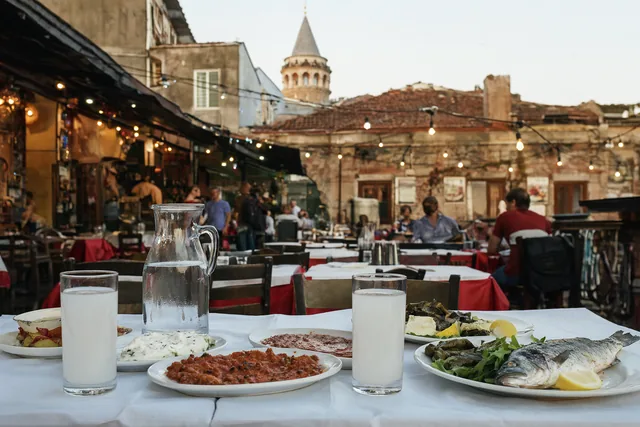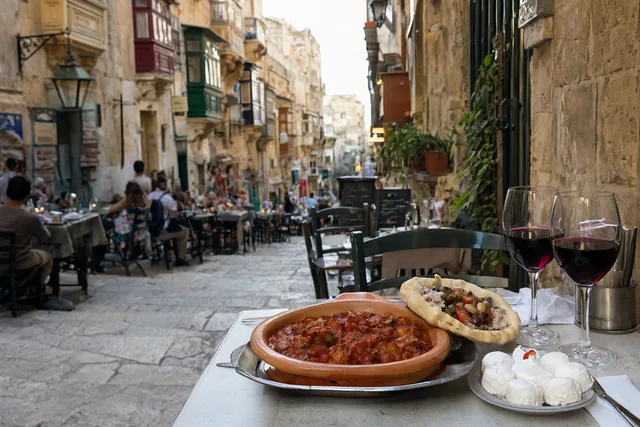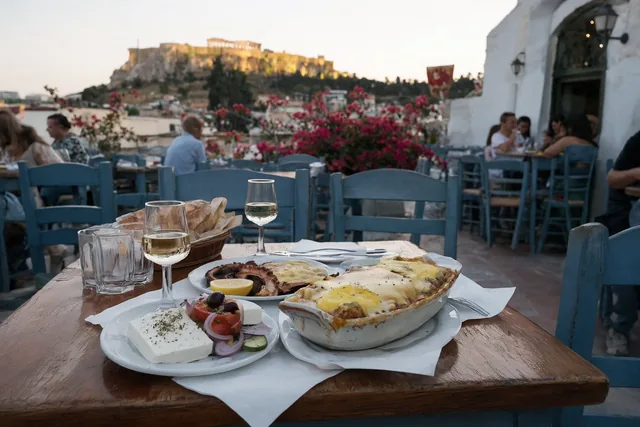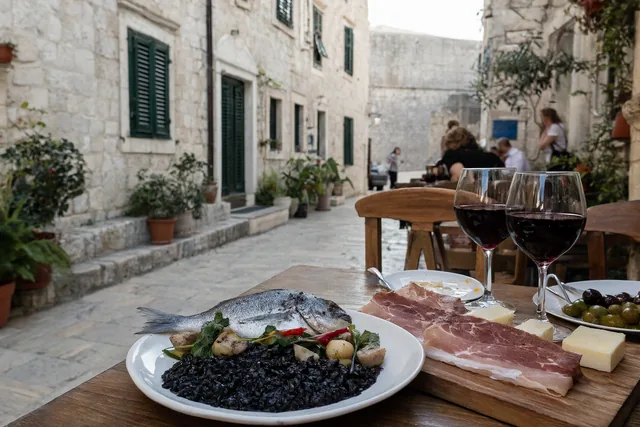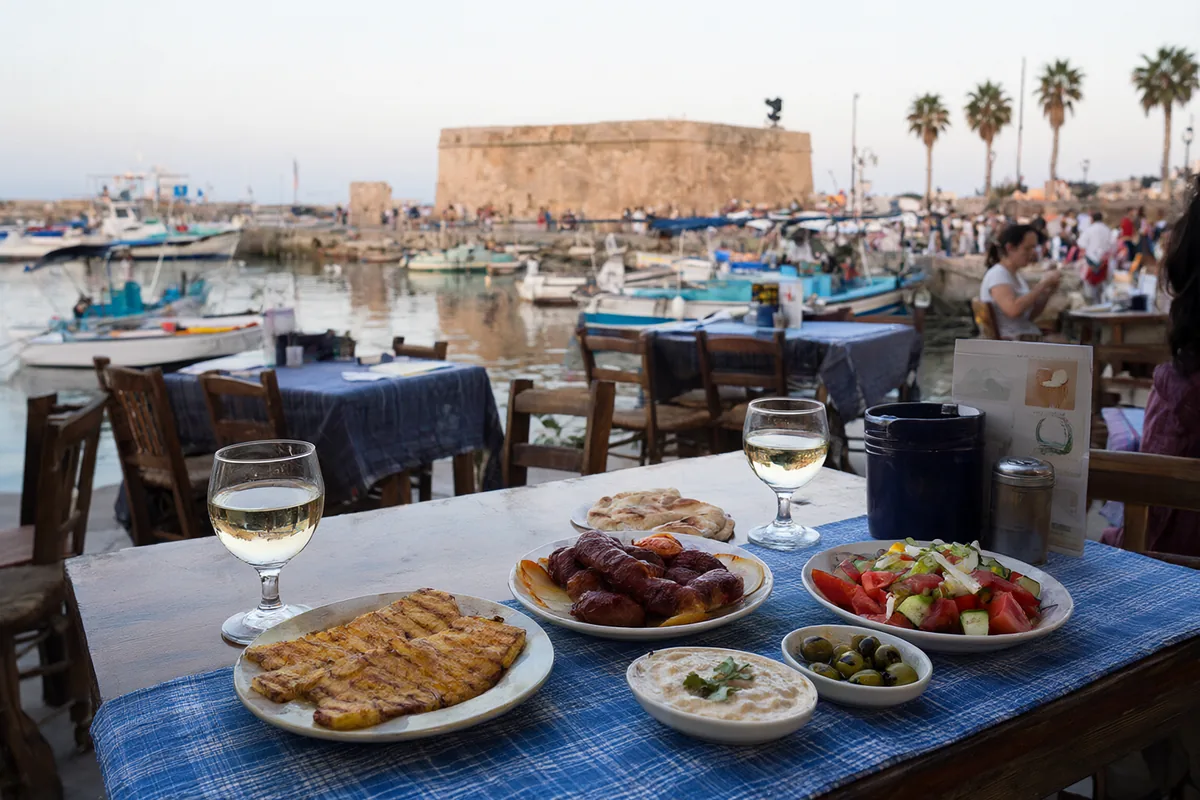
Cyprus sits between Greece, Turkey and the Middle East, and its food takes something from all three: Greek-style tavernas, charcoal grills, tahini, coriander, cured pork and, above all, halloumi. The best way to eat here is the meze, a long parade of small plates that can run to twenty dishes or more. This Cyprus food guide covers what to eat, how a meze works, the menu words to know, tipping and paying, then goes town by town through where to eat in Nicosia, Limassol, Larnaca, Paphos, the Troodos Mountains and Ayia Napa. Village tavernas are often the best restaurants on the island, so plan at least one long lunch inland.
What to eat in Cyprus: 12 dishes to know
These are the dishes that define Cypriot cooking. Most of them will turn up on a meze, so ordering one is the easiest way to try them all.
- Halloumi (everywhere): the island's springy sheep and goat's milk cheese, eaten grilled, fried, fresh with watermelon in summer, or in a sandwich with lountza.
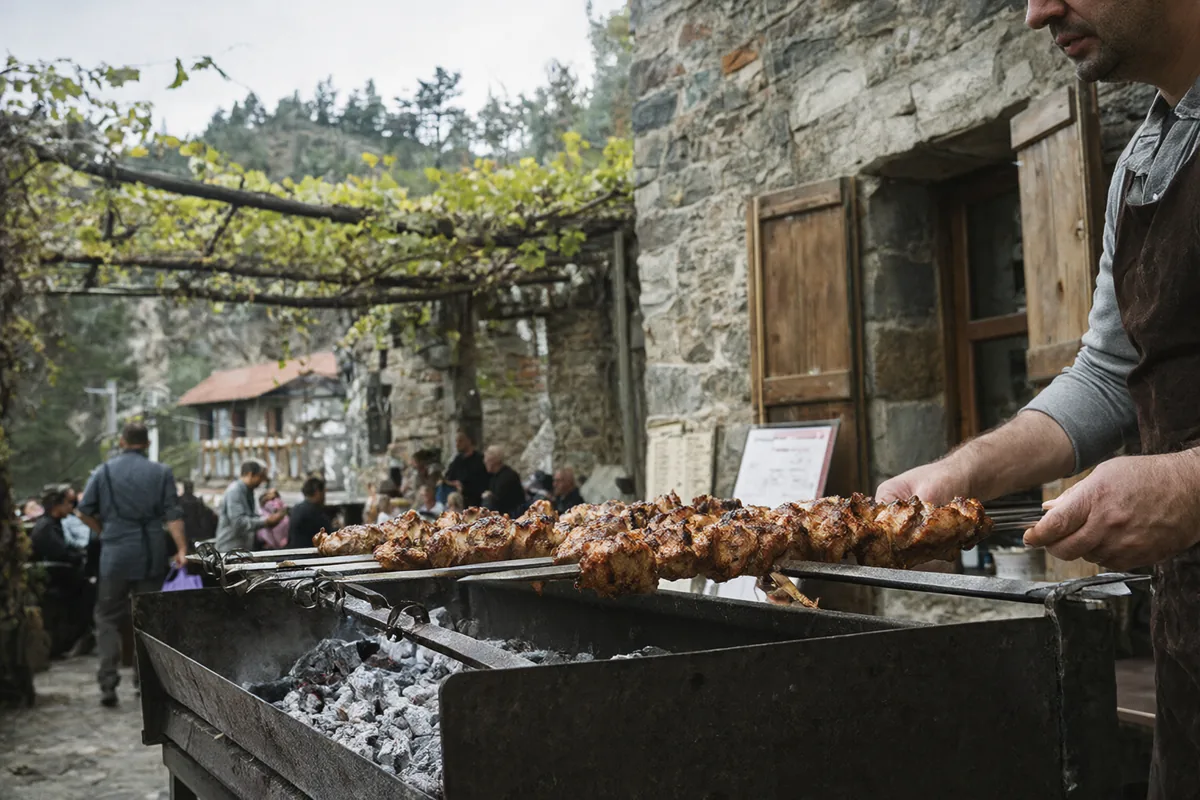
- Souvla (everywhere): large chunks of pork, lamb or chicken roasted slowly on long skewers over charcoal, the classic Sunday family meal.
- Sheftalia (everywhere): small sausages of minced pork, onion and parsley wrapped in caul fat and grilled, served in pita with salad.
- Kleftiko (everywhere): lamb or goat baked for hours with bay leaves in a sealed clay oven until it falls off the bone.
- Afelia (everywhere): pork marinated in red wine and crushed coriander seeds, then braised. Often served with pourgouri, bulgur wheat pilaf.
- Koupepia (everywhere): vine leaves stuffed with rice and minced meat, cooked in a lemony tomato broth.
- Lountza and loukaniko (Pitsilia and the mountains): smoked pork loin and coriander-scented sausages cured in red wine.
- Kolokasi (everywhere, winter): taro root stewed with pork or chicken, celery and tomato, a dish unique to Cyprus in the Greek-speaking world.
- Louvi (everywhere): black-eyed beans with wild greens or courgettes, dressed with olive oil and lemon.
- Makaronia tou fournou (everywhere): the Cypriot baked pasta, layers of macaroni, minced meat and béchamel, flavoured with halloumi and mint.
- Tahini and talattouri (everywhere): sesame paste dip, and the Cypriot yoghurt and cucumber dip with dried mint.
- Loukoumades and soutzoukos (everywhere): fried honey dough balls, and strings of almonds dipped in thickened grape must.
To drink, try Commandaria, a sweet dessert wine from the villages above Limassol, made for centuries; zivania, a strong clear grape spirit; and a brandy sour, the island's own cocktail of Cypriot brandy, lemon squash and bitters. Cypriot coffee is boiled in a small pot and served with a glass of water; order it sketos (no sugar), metrios (medium) or glykys (sweet).
How to read a Greek menu in Cyprus
In the Republic of Cyprus, menus are almost always printed in Greek and English, so you will rarely be completely lost. The trouble is that many dish names are Cypriot and appear untranslated in both versions. In the north of the island, under Turkish Cypriot administration, menus are in Turkish and dishes overlap heavily with those on our Turkey food guide. These are the words worth knowing on a Greek-language menu.
| Greek | Romanised | Meaning |
|---|---|---|
| Μεζέδες | Mezedes | Meze: a set of many small plates, priced per person |
| Ψαρομεζέδες | Psaromezedes | Fish meze |
| Ορεκτικά | Orektika | Starters |
| Κυρίως πιάτα | Kyrios piata | Main courses |
| Σχάρας / Σούβλας | Scharas / Souvlas | From the grill / from the spit |
| Του φούρνου | Tou fournou | Baked in the oven |
| Χαλλούμι | Halloumi | Halloumi cheese |
| Σιεφταλιά | Sheftalia | Caul-wrapped pork sausage |
| Λούντζα | Lountza | Smoked pork loin |
| Τσακιστές | Tsakistes | Cracked green olives with coriander seed, garlic and lemon |
| Χοιρινό / Αρνί / Κοτόπουλο | Chirino / Arni / Kotopoulo | Pork / lamb / chicken |
| Γλυκά | Glyka | Sweets and desserts |
| Νηστίσιμο | Nistisimo | Suitable for Orthodox fasting: no meat, dairy or eggs |
A meze is priced per person and usually needs a minimum of two people. Once you order it, plates keep arriving in waves: dips and salads first, then hot starters, then grilled meat or fish, often fifteen to thirty dishes in all. Pace yourself, because the best plates tend to come last. swap.menu explains each meze item when it reads the menu, and shows the per-person price in your currency.
Tipping, service charges and paying the bill
Menu prices in Cyprus include VAT, so the figure you see is what you pay. Some restaurants add a service charge to the bill, often 10 percent, and others do not; check the bottom of the bill or the menu. If service is already included, there is no need to add more. Our guide to tax and service charges on menus explains how these lines work around the world.
If no service charge is added, tipping around 10 percent for good service at a sit-down meal is normal, and rounding up is enough at cafés and kebab shops. Cash left on the table is the easiest way. Many tavernas bring bread, olives and sometimes a small plate of dips without asking, and some charge for them, so check the bill if it matters to you.
The Republic of Cyprus uses the euro (€). Cards are accepted in most restaurants in towns, though village tavernas, kiosks and market stalls may prefer cash. In the north, the Turkish lira is the main currency, though euros are often accepted at a less favourable rate. When a card machine offers to charge you in your home currency, decline and pay in the local currency: our guide to paying in local currency explains why.
Lunch runs from about 1pm to 3pm and dinner from around 8pm, later in the heat of summer, when many Cypriots eat outside until midnight. Sunday lunch is the big family meal, and village tavernas fill up with souvla and meze. Seaside restaurants in the resorts tend to open earlier in the evening for visitors.
Where to eat in Cyprus, town by town
Cyprus is small enough to drive across in a couple of hours, so you can base yourself on the coast and still eat in the mountains. Jump to a destination:
Where to eat in Nicosia
Nicosia, the capital, is inland and less touristy than the coastal towns, which makes it one of the best places to eat like a Cypriot. The old town inside the Venetian walls is the place to start. Around Ledra Street and the restored Laiki Geitonia quarter you will find tavernas serving meze, souvlaki shops and traditional coffee houses where older men play backgammon. Away from the pedestrian streets, the quieter lanes of the old town have small places cooking home-style dishes such as kolokasi, louvi and afelia at lunchtime.
Nicosia is a divided city, and you can walk across the Ledra Street crossing point into the northern half with your passport. On the other side, around the old caravanserai of the Büyük Han, the food is Turkish Cypriot: kebabs, lahmacun, şeftali kebabı (the same caul-fat sausage as sheftalia) and sweet pastries. Back in the south, the newer areas of Nicosia outside the walls have the city's modern restaurants and bars, where young Nicosians eat late. Nicosia gets very hot in summer, and evening meals outdoors are the norm.
Where to eat in Limassol
Limassol is the island's liveliest city and its most international food town. The old town around the medieval castle has been restored, and the lanes between the castle and Saripolou Square, by the old market hall, are packed with tavernas, meze places and bars. The seafront promenade and the marina have more polished, pricier restaurants. For a classic Limassol evening, order a meze in the old town and walk along the sea afterwards.
Limassol is also the base for the island's wine country. The villages in the hills behind the city, such as Omodos, are known for their wineries and tavernas, and the area is the home of Commandaria, the sweet wine made from sun-dried grapes. Local grapes worth trying are the white Xynisteri and the red Maratheftiko. Limassol holds a wine festival in late summer and a carnival before Lent, both with plenty of food. Fish tavernas east and west of the city along the coast are good for a lunch of grilled fish and calamari.
Where to eat in Larnaca
Larnaca, home to the island's main airport, is often the first and last stop for visitors, and it is a pleasant place to eat. The palm-lined seafront known as Finikoudes is full of cafés and restaurants, best for a coffee or a drink. For fish, walk south along the coast towards the old fort and the Piale Pasha seafront, where fish tavernas sit by the water and serve fish meze, grilled octopus and whole fish priced by the kilo.
The streets behind the seafront around the church of Agios Lazaros have older, cheaper places serving souvlaki, sheftalia and home cooking. Larnaca's district also takes in Lefkara, a hill village famous for lace and silverwork, where cafés serve Cypriot coffee and loukoumi. On the coast east of Larnaca, small fishing harbours have simple tavernas that cook whatever the boats bring in. If you have an early flight, a final souvlaki in Larnaca is the traditional send-off.
Where to eat in Paphos
Paphos, in the west, is split between Kato Paphos, the harbour and resort area by the medieval fort, and the old town on the hill above. The harbour restaurants in Kato Paphos have the views and serve plenty of fish and meze, but quality varies, so look for places busy with Cypriot families. The old town of Paphos, around the restored municipal market, has a more local feel, with small tavernas, coffee shops and stalls selling herbs, honey and halloumi.
Just east of Paphos, the village of Geroskipou is famous for loukoumi, the soft jelly sweet known elsewhere as Turkish delight, which has protected status here. The hills north of Paphos have small wineries and villages with tavernas serving kleftiko from wood ovens, and the Akamas peninsula has fish tavernas on quiet bays. Paphos is a good base for a day in the western Troodos, where village lunches are long and cheap.
Where to eat in the Troodos Mountains
The Troodos Mountains, in the centre of the island, are where Cypriot village cooking is at its best. This is cured meat country: the Pitsilia area produces lountza, loukaniko and chiromeri (wine-cured smoked ham), and village tavernas grill them alongside halloumi. Mountain streams supply farmed trout, which tavernas serve grilled with lemon. Order a meze and expect a long, generous lunch with village bread, tahini, salads, grilled meats and seasonal greens.
The villages worth eating in include Kakopetria, with its old stone houses by the river, Platres, the old mountain resort, and Omodos, on the Limassol side, with its wineries. Agros is known for rose water and rose products, and many villages distil their own zivania. The mountains are noticeably cooler than the coast, which makes them a popular escape for Cypriots on summer weekends; book ahead for Sunday lunch in the Troodos.
Where to eat in Ayia Napa
Ayia Napa, in the south-east, is best known for beaches and nightlife, and its main strip serves mostly international food to visitors. The better meals in Ayia Napa are at the harbour, where fish tavernas sell the morning catch, and in the villages inland. The surrounding area is known as the Kokkinochoria, the "red villages", after the red soil that grows the island's famous potatoes, and you will see them fried, roasted or in stews on local menus.
Nearby Protaras and the fishing shelter at Potamos Liopetriou, a small river harbour with fish tavernas, are good for a quieter seafood lunch. Ask for a fish meze, which typically includes taramosalata, octopus, calamari, prawns and several kinds of grilled fish. Ayia Napa is busiest from June to September, and many restaurants close or cut their hours in winter.
Vegetarian, vegan and allergy tips
Cyprus is fairly easy for vegetarians. Dips, salads, halloumi, louvi, grilled vegetables, fried courgettes, mushrooms and village bread make up a good share of any meze, and many tavernas offer a vegetarian meze on request. The word for vegetarian is chortofagos, written χορτοφάγος. Watch for pork, which is the most common meat on the island and appears in many stews, for minced meat in koupepia and stuffed vegetables, and for meat stock in soups. Traditional halloumi is usually made with animal rennet, so strict vegetarians should ask.
Vegans can look for nistisimo dishes, made for Orthodox fasting periods with no meat, dairy or eggs, though they may include seafood. Common allergens include sesame in tahini, which is served with almost every meal, nuts in pastries and soutzoukos, and dairy in halloumi, talattouri and many baked dishes. Our guide to eating abroad with food allergies explains how to make an allergy clear when you do not speak the language.
Useful Greek phrases for ordering
English is widely spoken in Cyprus, but a few words of Greek go a long way in the villages.
Γεια σας Yia sas: "Hello", the polite greeting as you walk in
Ένα τραπέζι για δύο, παρακαλώ Ena trapezi gia dyo, parakalo: "A table for two, please"
Μεζέδες για δύο, παρακαλώ Mezedes gia dyo, parakalo: "Meze for two, please"
Τι μας προτείνετε; Ti mas proteinete?: "What do you recommend?"
Θα ήθελα αυτό Tha ithela afto: "I would like this" (pointing)
Είμαι αλλεργικός / αλλεργική σε... Eimai allergikos / allergiki se...: "I am allergic to..." (allergikos for a man, allergiki for a woman)
Τον λογαριασμό, παρακαλώ Ton logariasmo, parakalo: "The bill, please"
Ευχαριστώ, ήταν πολύ νόστιμο Efcharisto, itan poly nostimo: "Thank you, it was delicious"
How swap.menu helps you eat in Cyprus
Even when a Cypriot menu has an English column, it often just transliterates the Greek, so "afelia", "koupepia" and "kolokasi" tell you nothing about what will arrive. Photograph the menu with swap.menu and every dish appears in your language with the Greek name beside it and a short explanation, so you know that afelia is pork braised in wine and coriander and that chiromeri is a wine-cured smoked ham. Every price is converted from euros to your home currency, or from Turkish lira if you cross to the north, and we point out any service charge on the menu.
Tap the dishes you want, add a note such as "no pork" or "vegetarian meze, please", typed or spoken, and swap.menu translates your order into Greek. Show the waiter your phone, or let them scan the QR code and read your order on their own screen. You can try it right now on a sample menu with the free demo, or see travel pass prices.
Off to Cyprus? Your first 3 menu scans are free, and a travel pass starts from $4.99 with nothing that renews.
Start free with 3 scansCyprus food FAQ
Do you tip in restaurants in Cyprus?
Tipping around 10 percent is normal for good service at a sit-down meal in Cyprus, unless a service charge has already been added to the bill. Check the bill first. At cafés and takeaway places, rounding up is enough.
What is a Cypriot meze?
A meze is a set meal of many small dishes, priced per person and usually for a minimum of two. Dips, salads and cheese come first, followed by hot dishes and then grilled meat or fish. A full meze can include fifteen to thirty plates, so it is best ordered hungry.
What food is Cyprus most famous for?
Halloumi is the island's best-known food, followed by souvla, sheftalia, kleftiko, afelia and the meze itself. Cyprus is also known for Commandaria sweet wine, zivania spirit, loukoumi from Geroskipou and cured meats such as lountza.
Is it expensive to eat out in Cyprus?
Eating out in Cyprus is generally cheaper than in northern Europe but similar to other Mediterranean holiday destinations. Souvlaki and sheftalia in pita are inexpensive, a meze is good value for the amount of food, and seafront restaurants in resorts charge the most.
Is tap water safe to drink in Cyprus?
Tap water in Cyprus is treated and generally considered safe, but much of it is desalinated and many residents prefer bottled water for drinking. Restaurants usually serve bottled water. Ask at your accommodation about the local supply.
How can I understand a menu in Cyprus?
Most menus in the south are in Greek and English, but Cypriot dish names are often left untranslated. Learn a few names such as sheftalia, afelia and koupepia, or photograph the menu with swap.menu, which explains every dish in your language, converts prices to your currency and translates your order into Greek.
Travelling further around the eastern Mediterranean? Read our food guides for nearby countries:
Or browse every travel food guide.