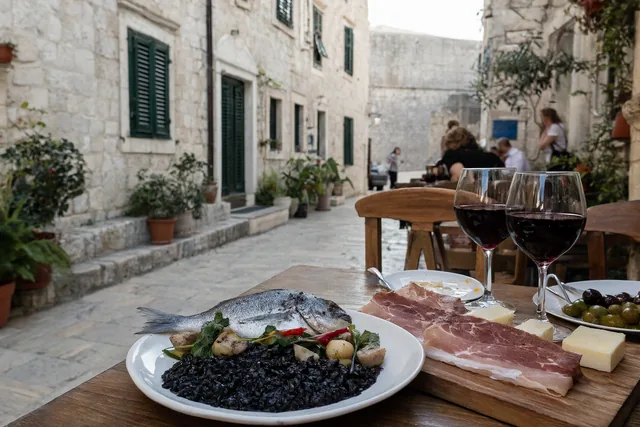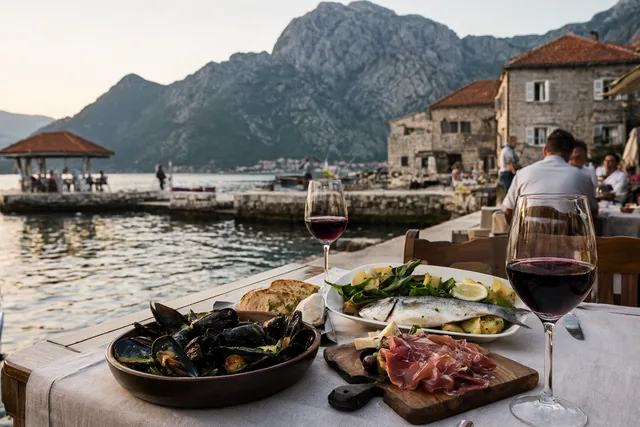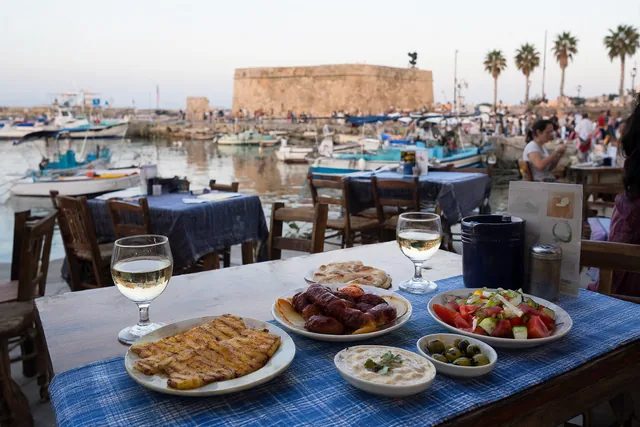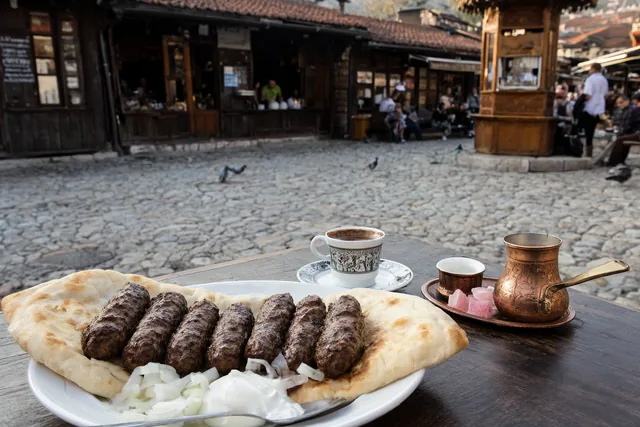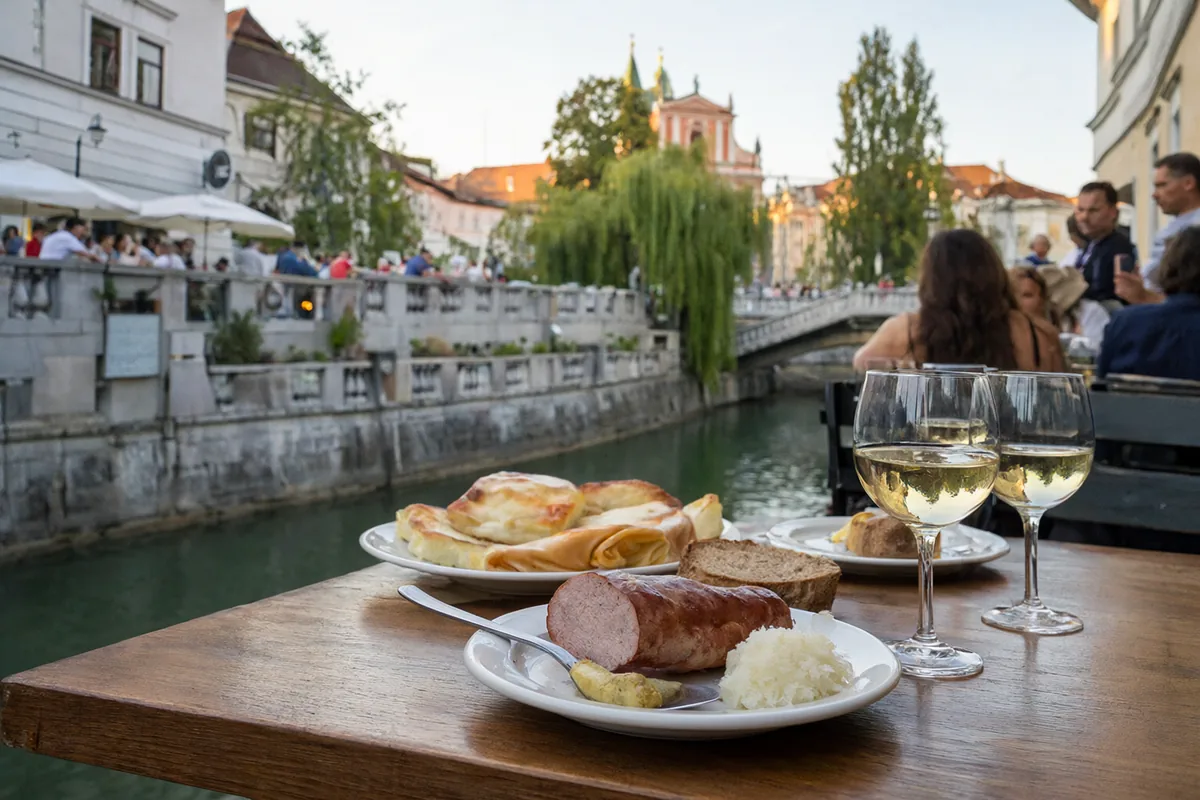
Slovenia is small, green and easy to travel, and in a single week you can eat Alpine dairy and buckwheat, Hungarian-style stews from the eastern plains, Austrian pastries and Venetian seafood on a short stretch of Adriatic coast. The country takes its farm-to-table food and its wine seriously, and some of the best meals are at a family gostilna or a wine farm rather than in town. This Slovenia food guide covers the dishes to know, how to read a Slovenian menu, tipping and paying, then goes town by town through where to eat in Ljubljana, Bled, Piran, Maribor, Ptuj, the Karst and the Vipava Valley.
What to eat in Slovenia: 12 dishes to know
These are the dishes worth ordering, with the region each one comes from. Several have protected status in the European Union, and you will see them on menus across the country.
- Kranjska klobasa (Carniola, everywhere): the Carniolan sausage, a smoked pork sausage with garlic and pepper, served with mustard, freshly grated horseradish and bread.
- Štruklji (everywhere): rolled dumplings of dough filled with cottage cheese, tarragon, walnuts or apple, boiled or baked, sweet or savoury.
- Idrijski žlikrofi (Idrija): small potato-filled dumplings shaped like little hats, served with a lamb sauce or with butter and breadcrumbs.
- Ajdovi žganci (Alpine regions): buckwheat spoonbread, crumbly and rustic, topped with pork cracklings (ocvirki) and served with sauerkraut or milk.
- Jota (Karst and the coast): a thick soup of beans, sauerkraut or sour turnip, potatoes and often smoked pork.
- Ričet (everywhere): a barley and bean stew, often with smoked meat, a winter staple.
- Bograč (Prekmurje): a paprika stew of several meats and potatoes, cooked in a kettle, close to Hungarian goulash.
- Kraški pršut (Karst): dry-cured ham, dried by the cold bora wind, served in thin slices with olives and cheese.
- Soča trout (Soča valley): the marble trout and other trout from the emerald Soča and mountain rivers, grilled or pan-fried.
- Potica (everywhere): a rolled yeast cake with a spiral of walnut, tarragon, poppy seed or other filling, a feast-day essential.
- Prekmurska gibanica (Prekmurje): a layered cake of poppy seed, cottage cheese, walnut and apple between thin pastry.
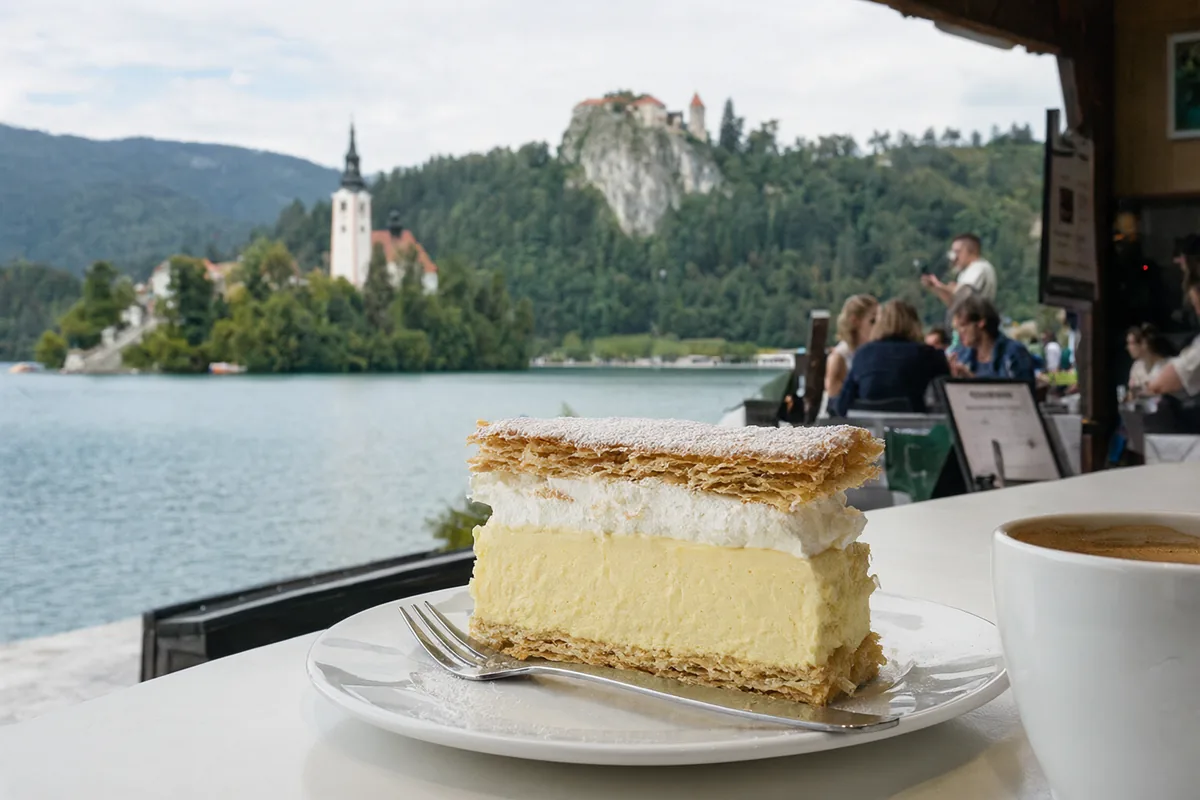
- Kremna rezina (Bled): the Bled cream cake, a tall square of vanilla custard and whipped cream between puff pastry.
Slovenia makes excellent wine. Look for Teran, a deep red from the Karst, Rebula (Ribolla) from Goriška Brda, Zelen and Pinela from the Vipava Valley, Šipon from the north-east, and Cviček, a light red blend from Dolenjska. Styrian pumpkin seed oil (bučno olje), dark green and nutty, is drizzled on salads and even ice cream.
How to read a Slovenian menu
Restaurants in Ljubljana, Bled and Piran nearly always have an English menu, and most Slovenians speak good English. Village gostilnas and farm restaurants may have Slovenian only, or a spoken list of the day's dishes. Slovenian uses the Latin alphabet with three extra letters: č is "ch", š is "sh" and ž is like the "s" in "measure". These are the words you will see most often.
| Slovenian | Meaning |
|---|---|
| Predjedi | Starters |
| Juhe / enolončnice | Soups / one-pot stews |
| Glavne jedi | Main courses |
| Priloge | Side dishes, often ordered separately |
| Sladice | Desserts |
| Dnevno kosilo / malica | Daily set lunch, usually soup, main and salad at a fixed price |
| Meso / ribe | Meat / fish |
| Svinjina / govedina / teletina / jagnjetina | Pork / beef / veal / lamb |
| Postrv | Trout |
| Na žaru / ocvrto | Grilled / fried, usually breaded |
| Domače | Homemade |
| Hišno vino / odprto vino | House wine / wine by the glass, often priced per decilitre (dl) |
| Brezmesno | Meatless |
| Gostilna / turistična kmetija | Traditional inn / tourist farm serving its own produce |
Wine by the glass in Slovenia is often listed per decilitre (1 dl) rather than per glass, and a standard pour may be 1 or 2 dl, so the listed price may be for half of what you expect. swap.menu reads the menu, explains the measure, and converts each price into your home currency.
Tipping, the daily lunch and paying the bill
Menu prices in Slovenia include VAT, and cover charges and service charges are rare. Bread is sometimes charged separately and should be listed on the menu. Our guide to tax and service charges on menus explains how these lines work around the world.
Tipping is not compulsory in Slovenia. Locals usually round up, and around 10 percent is a generous tip for good service at a sit-down meal. Tell the waiter the total you want to pay when you hand over cash or a card, as tips are not always possible on card machines.
Slovenia uses the euro (€). Cards are accepted almost everywhere, though some farm restaurants, mountain huts, market stalls and small bakeries prefer cash. If a card machine offers to charge you in your home currency, decline and pay in euros: our guide to paying in local currency explains why that conversion costs you more.
Lunch is traditionally the main meal of the day in Slovenia, eaten from about 12pm to 2pm, and many restaurants offer a good-value dnevno kosilo (daily lunch) on weekdays. Dinner starts from about 6:30pm to 7pm, earlier than in southern Europe, and kitchens in smaller towns may close by 10pm. Some village gostilnas close one or two days a week, often Monday or Tuesday.
Where to eat in Slovenia, town by town
Slovenia is compact enough that you can be in the Alps, on the coast or in wine country within an hour or two of Ljubljana. Jump to a destination:
Where to eat in Ljubljana
Ljubljana, the capital, is a small, walkable city, and most of its eating happens along the banks of the Ljubljanica river, which is lined with café and restaurant terraces. The Central Market, designed by the architect Jože Plečnik, stretches along the river below the cathedral, with open-air stalls for fruit, vegetables, honey and flowers and covered halls for meat, cheese and fish. Arrive in the morning, then eat a kranjska klobasa with mustard and horseradish from a nearby stand.
From spring to autumn, Ljubljana's Odprta kuhna (Open Kitchen) takes over a square by the market on Fridays, with cooks from restaurants around the country selling small dishes from stalls. It is the best single place to sample Slovenian food. The old town streets below the castle have traditional gostilnas serving štruklji, žlikrofi and roast meats, and Ljubljana has a strong burek habit, eaten late at night after a few drinks. For lunch, look for a dnevno kosilo sign, the fixed-price daily menu that office workers eat.
Where to eat in Bled
Bled is Slovenia's most famous postcard, a lake with a church on an island and a castle on a cliff, and it has one dish everyone must try: the kremna rezina, or Bled cream cake. Cafés around the lake serve it with views of the island, and it has been made in Bled since the 1950s. For a meal in Bled, order trout from the mountain rivers, ajdovi žganci with cracklings, and Alpine cheese, and look for gostilnas in the villages around the lake rather than on the busiest stretch of shore.
A short drive away, Lake Bohinj is quieter and more rural, and its dairy farms produce Bohinj cheeses, including mohant, a soft, pungent cheese with protected status. In September, Bohinj celebrates cows returning from the summer pastures. The nearby town of Radovljica has a pretty old town, a beekeeping museum and a tradition of decorated honey bread. Mountain huts in the Julian Alps serve simple hearty food such as jota, sausages and strudel to hikers.
Where to eat in Piran
Piran, on Slovenia's short Adriatic coast, is a Venetian-built town of narrow lanes on a small peninsula, and its food is Mediterranean: fish, squid, olive oil and pasta. The town is bilingual, and Italian is spoken alongside Slovenian; for the cooking across the border, see our Italy food guide and Croatia food guide. Fish restaurants in Piran line the seafront around the tip of the peninsula, known as the Punta, and the lanes behind Tartini Square have smaller, cheaper places. Order grilled fish, fried calamari, njoki with scampi and seafood risotto.
Just south of Piran, the Sečovlje salt pans have produced sea salt for centuries using traditional methods, and Piran salt and solni cvet (fleur de sel) make good gifts. The hills behind the coast grow olives and the red wine Refošk, and farm tastings are easy to arrange. The neighbouring towns of Izola, a working fishing port, and Koper, with its market, are good alternatives to Piran when it is busy in summer.
Where to eat in Maribor
Maribor, Slovenia's second city, sits on the Drava river in the north-east, surrounded by vineyards. In the riverside Lent district grows what is recognised as the oldest living grapevine in the world, more than 400 years old, and the house beside it offers tastings of local wines. The Štajerska (Styria) region around Maribor is the country's largest wine area, known for white wines such as Šipon, Laški Rizling and Sauvignon Blanc.
Maribor's food is hearty and continental: roast pork, bograč, buckwheat, and salads dressed with dark green pumpkin seed oil. The Pohorje hills above the city have ski slopes and mountain inns, known for the pohorska omleta, a sweet soufflé omelette with cranberries and cream. The wine roads around Maribor and the Jeruzalem hills to the east have tourist farms and wine cellars serving cold meats, cheese and local wine. Lent hosts a large summer festival with music and food stalls.
Where to eat in Ptuj
Ptuj, south of Maribor, is often called Slovenia's oldest town, with a castle above red roofs and the Drava river. It is best known for Kurentovanje, a carnival before Lent where people dress as kurenti, shaggy sheepskin figures, and for its wine cellars, among the oldest in Slovenia. The surrounding Haloze hills produce white wines, and the town's gostilnas serve roast meats, štruklji and local cheese.
East of Ptuj lies Prekmurje, the flat region along the Hungarian border, which gives Slovenia some of its most distinctive dishes: prekmurska gibanica, the layered cake, bograč, buckwheat dishes and pumpkin seed oil. Ptuj is a good base for exploring both areas, and its old town has cafés where you can try gibanica with coffee. Many wine farms in this part of Slovenia welcome visitors for tastings with a plate of cold meats, cheese and bread.
Where to eat in the Karst
The Karst (Kras), the limestone plateau between Ljubljana and the coast, has red soil, stone villages and the cold bora wind, which dries the region's famous Kraški pršut. It is also the home of Teran, a deep, acidic red wine made from the Refošk grape grown on the red earth. Order pršut, jota, and lamb or game, and drink Teran with all of it.
The Karst's best-known food tradition is the osmica, a temporary farm tavern where a family opens its doors for a few days to sell its own wine, pršut, sausages, cheese and eggs. Osmice are signposted with a bunch of leaves or branches hung at the roadside, and they appear at different farms through the year. The village of Štanjel is a beautiful stone village with a few restaurants, and the Lipica stud farm, home of the Lipizzaner horses, is nearby. The Karst is also close to the Škocjan and Postojna caves.
Where to eat in the Vipava Valley
The Vipava Valley, west of Ljubljana, is one of Slovenia's most rewarding food destinations: a green valley of vineyards, orchards and stone villages, with a Mediterranean climate and the strong bora wind. The valley grows native white grapes, Zelen and Pinela, and family wineries welcome visitors for tastings. The area has also become known for creative modern cooking based on local produce, as well as traditional gostilnas and tourist farms.
Order local pršut and cheese, frtalja (a herb omelette), and lamb or game, and in season the valley's cherries, peaches and figs. Villages such as Goče, with its old stone wine cellars, and the hilltop village of Vipavski Križ are worth a visit. Osmice also open here. The Vipava Valley is less than an hour from Ljubljana and easily combined with the Karst, Goriška Brda and the coast.
Vegetarian, vegan and allergy tips
Slovenia is reasonably easy for vegetarians, especially in Ljubljana, which has many vegetarian and vegan restaurants. Traditional food relies on pork, though. Watch for ocvirki (pork cracklings) on žganci, štruklji and potatoes, smoked pork in jota and ričet, and lard in some pastries; on farms you may be served zaseka, a spread of minced cured pork fat, with bread. The word for vegetarian is vegetarijanec for a man and vegetarijanka for a woman, and brez mesa means "without meat".
Vegans should know that štruklji, gibanica and most cakes contain cottage cheese, cream and eggs. Common allergens include walnuts in potica and other cakes, poppy seed in gibanica, pumpkin seed oil on salads, and buckwheat, which is common in the Alpine regions and in some breads. Our guide to eating abroad with food allergies explains how to make an allergy clear when you do not speak the language.
Useful Slovenian phrases for ordering
Dober dan / Dober večer "Good day / Good evening", the polite greeting as you walk in
Mizo za dva, prosim "A table for two, please"
Kaj priporočate? "What do you recommend?"
Rad / rada bi to "I would like this" (rad for a man, rada for a woman)
Brez mesa, prosim "Without meat, please"
Alergičen / alergična sem na... "I am allergic to..." (alergičen for a man, alergična for a woman)
Račun, prosim "The bill, please"
Hvala, bilo je odlično "Thank you, it was excellent"
How swap.menu helps you eat in Slovenia
The best food in Slovenia is often at a village gostilna, a tourist farm or an osmica, where the menu is short, written in Slovenian, or read out at the table. Photograph it with swap.menu and every dish appears in your language with the Slovenian name beside it and a short explanation, so you know that žganci z ocvirki is buckwheat spoonbread with pork cracklings, and that zaseka is cured pork fat, before you order. Every price is converted from euros to your home currency, and we explain menu measures such as wine by the decilitre.
Tap the dishes you want, add a note such as "no pork" or "nut allergy", typed or spoken, and swap.menu translates your order into Slovenian. Show the waiter your phone, or let them scan the QR code and read your order on their own screen. You can try it right now on a sample menu with the free demo, or see travel pass prices.
Off to Slovenia? Your first 3 menu scans are free, and a travel pass starts from $4.99 with nothing that renews.
Start free with 3 scansSlovenia food FAQ
Do you tip in restaurants in Slovenia?
Tipping is not compulsory in Slovenia. Locals usually round up the bill, and around 10 percent is a generous tip for good service. Service and cover charges are rare.
What food is Slovenia famous for?
Slovenia is known for Carniolan sausage (kranjska klobasa), štruklji, idrijski žlikrofi, potica, prekmurska gibanica, the Bled cream cake and Karst prosciutto. It is also known for its wines, such as Teran and Rebula, and for pumpkin seed oil.
Is it expensive to eat out in Slovenia?
Eating out in Slovenia is generally cheaper than in neighbouring Italy and Austria. The weekday daily lunch menu is very good value, and village gostilnas and tourist farms are reasonably priced. Restaurants in Ljubljana's centre, Bled and Piran cost more.
Is tap water safe to drink in Slovenia?
Yes, tap water in Slovenia is safe and of very high quality, much of it from mountain springs. You can drink it anywhere, including from public fountains in Ljubljana.
What is an osmica in Slovenia?
An osmica is a temporary farm tavern, found mainly in the Karst and the Vipava Valley, where a family sells its own wine, cured meats, cheese and eggs for a few days at a time. They are marked by bunches of leaves or branches hung by the road and are a cheap, sociable way to eat local food.
How can I read a Slovenian menu if I do not speak Slovenian?
Most restaurants in towns have an English menu, but village gostilnas and farms often do not. Learn a few words such as glavne jedi (main courses) and dnevno kosilo (daily lunch), or photograph the menu with swap.menu, which translates every dish, explains it and converts prices to your currency.
Travelling further in Europe? Read our food guides for neighbouring countries:
- Italy food guide
- Croatia food guide
- Austria food guide
- Hungary food guide
- Bosnia and Herzegovina food guide
Or browse every travel food guide.