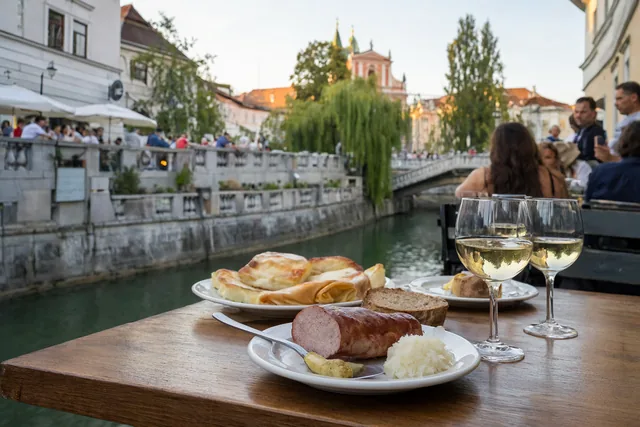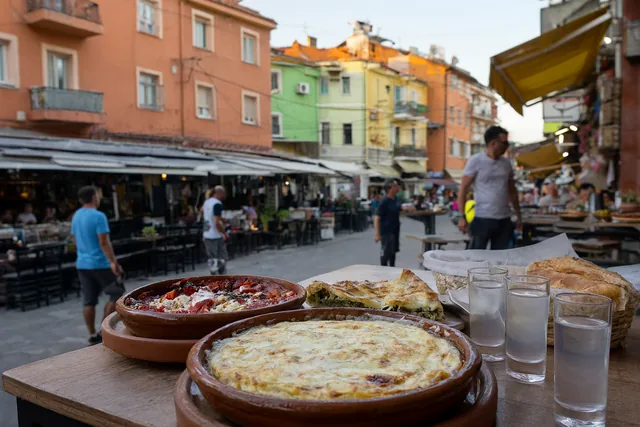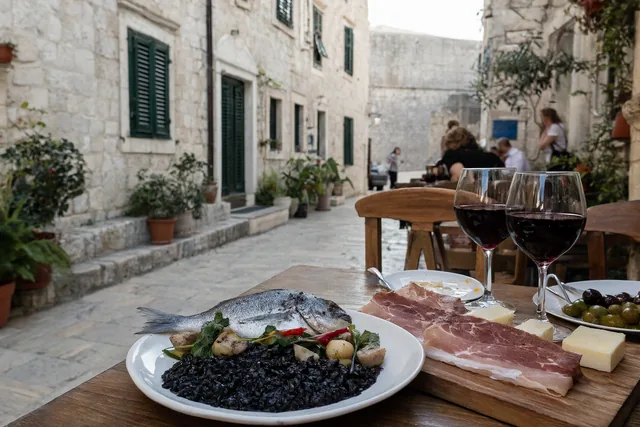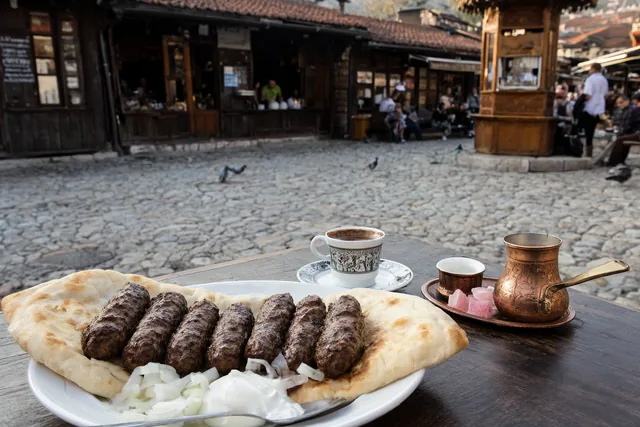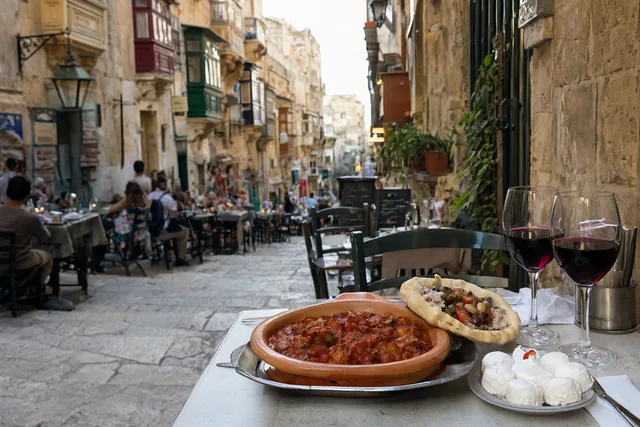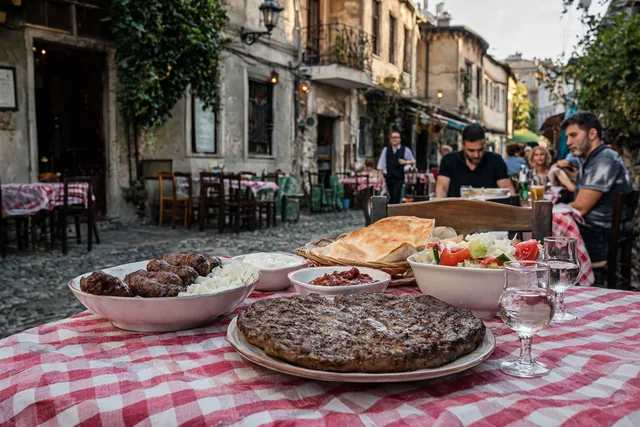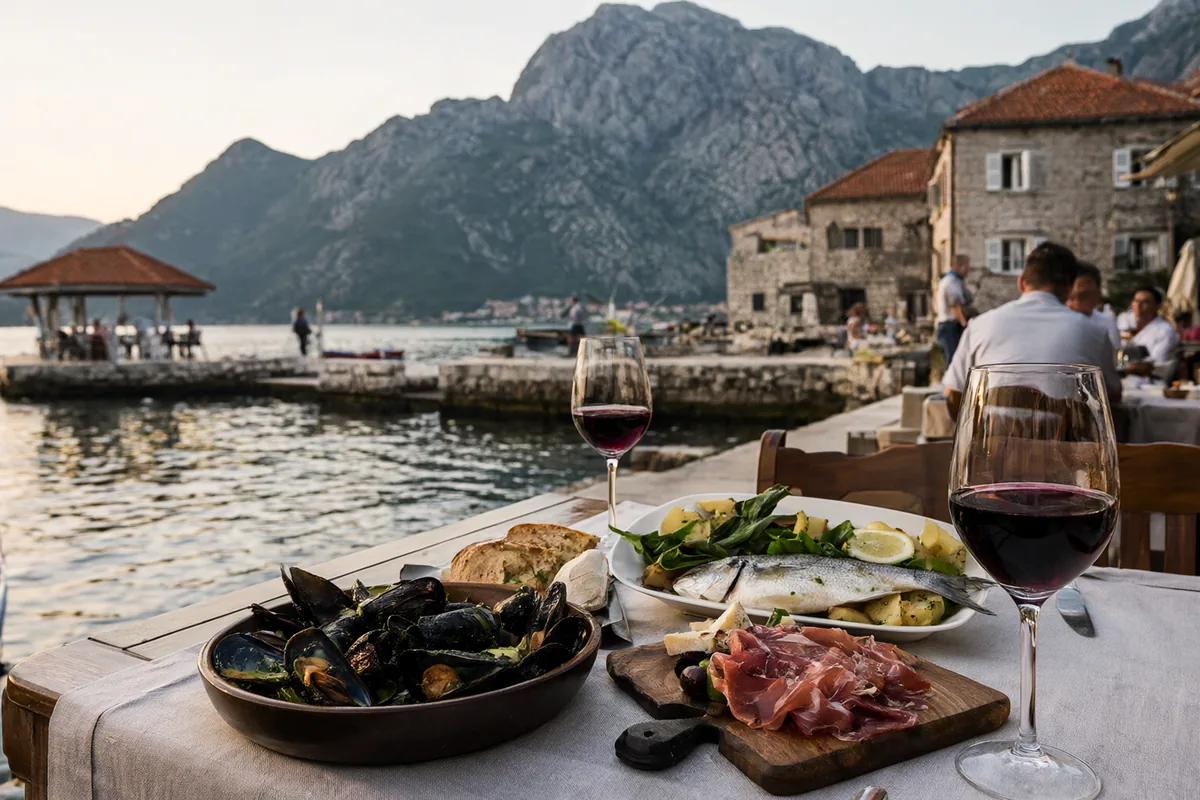
Montenegro packs two very different kitchens into a small country. On the Adriatic coast and around the Bay of Kotor, the food is Mediterranean, shaped by centuries of Venetian rule: grilled fish, mussels, black risotto and olive oil. A short drive inland, up the mountain roads, it turns hearty and pastoral, with smoked ham, cheese, cornmeal, lamb cooked under a metal bell and thick clotted cream. This Montenegro food guide covers the dishes to know, how to read a Montenegrin menu, tipping and paying, then goes town by town through where to eat in Kotor, Budva, Herceg Novi, Podgorica, Cetinje, Lake Skadar, Ulcinj and Žabljak.
What to eat in Montenegro: 12 dishes to know
These are the dishes worth ordering, with the area each one belongs to. Order seafood on the coast and mountain food inland, and you will rarely go wrong.
- Njeguški pršut (Njeguši): dry-cured ham from the mountain village of Njeguši, smoked over beech wood and dried in the mountain air, served in thin slices with cheese and olives.
- Njeguški sir (Njeguši): a hard, salty cheese from the same village, the natural partner to the pršut.
- Njeguški odrezak (everywhere): the Njeguši steak, a veal or pork escalope rolled around pršut and cheese, breaded and fried.
- Buzara (coast): mussels or scampi cooked in white wine, garlic, parsley and breadcrumbs, sometimes with tomato, best mopped up with bread.
- Crni rižot (coast): black risotto made with cuttlefish or squid and their ink.
- Grilled fish (coast): whole Adriatic fish such as sea bream and sea bass, grilled with olive oil and served with Swiss chard and potatoes.
- Ispod sača (everywhere): lamb, veal or potatoes slow-cooked under a domed metal or clay lid covered in hot embers. It usually needs ordering in advance.
- Kačamak (mountains): a heavy, comforting mix of cornmeal and potato cooked with cheese and served with kajmak and sour milk.
- Cicvara (mountains): cornmeal cooked in fresh cheese or cream until the butterfat separates, eaten hot with bread.
- Jagnjetina u mlijeku (north): lamb cooked slowly in milk, a speciality of the northern mountains.
- Skadar lake fish (Lake Skadar): carp baked with prunes and apples, eel, and smoked bleak (ukljeva), a small lake fish.
- Priganice (everywhere): small fried dough puffs served with honey, cheese or jam, for breakfast or dessert.
To drink, try Vranac, Montenegro's own deep red wine grape, and Krstač, a local white. Homemade grape brandy, loza (a type of rakija), is offered to guests as a welcome and after meals.
How to read a Montenegrin menu
Montenegrin is very close to Serbian, Croatian and Bosnian, and can be written in both the Latin and Cyrillic alphabets. Menus on the coast are almost always in the Latin alphabet and usually translated into English, while some inland places have Montenegrin only, occasionally in Cyrillic. In Ulcinj you will also see Albanian. These are the words you will see most often.
| Montenegrin | Meaning |
|---|---|
| Hladna / topla predjela | Cold / hot starters |
| Čorbe / supe | Thick soups / clear soups |
| Glavna jela | Main courses |
| Jela sa roštilja | Dishes from the grill |
| Ispod sača | Cooked under the bell, usually ordered a few hours ahead |
| Riba / plodovi mora | Fish / seafood |
| Teletina / jagnjetina / svinjetina | Veal / lamb / pork |
| Kajmak | Clotted cream, salty and rich, served with bread and grilled meat |
| Domaće | Homemade |
| Prilozi | Side dishes, often ordered separately |
| Salate | Salads |
| Kućno vino | House wine, often sold by the litre or half litre |
| Kg / po kilogramu | Price per kilo, common for fresh fish and shellfish |
| Poslastice | Desserts |
On the coast, fresh fish is usually priced per kilo, and the waiter may bring a tray of whole fish to choose from. Ask the weight and the total price before it is cooked, because a large fish can cost far more than a main course. swap.menu flags per-kilo prices when it reads the menu and converts them into your home currency.
Tipping, cover charges and paying the bill
Menu prices in Montenegro include VAT. Some coastal restaurants charge a small cover charge for bread, and it should appear on the menu; service charges are rare. Our guide to tax and service charges on menus explains how these lines work around the world.
Tipping is customary but not compulsory. Around 10 percent is normal for good service at a sit-down restaurant, and rounding up is enough at cafés and bars. Leave the tip in cash, as card machines often have no tip option. You should receive a fiscal receipt with every bill.
Montenegro uses the euro (€), even though it is not a member of the European Union or the eurozone. Cards are widely accepted in restaurants and hotels in coastal towns and Podgorica, but cash is still important in villages, mountain areas, markets, bakeries and small family restaurants. When a card machine offers to charge you in your home currency, decline and pay in euros: our guide to paying in local currency explains why.
Lunch is the main meal for many families and runs from about 1pm to 4pm, and dinner starts from around 8pm, later on summer evenings on the coast. Coffee culture is strong, and an afternoon at a café terrace is a national habit. Many coastal restaurants open only from about May to October, so the choice narrows in winter.
Where to eat in Montenegro, town by town
Distances in Montenegro are short, but mountain roads are slow, so plan meals around your route. Jump to a destination:
Where to eat in Kotor
Kotor sits at the end of the Bay of Kotor (Boka Kotorska), a fjord-like inlet surrounded by steep mountains, and its walled old town is the most visited place in Montenegro. Inside the walls, restaurants on the main squares cater to cruise passengers, so walk into the smaller lanes or head out along the bay. The green market just outside the old town walls sells fruit, vegetables, cheese, pršut, honey and olive oil, and the fish counters there are a good guide to what is in season.
The bay itself is the reason to eat in Kotor. Mussels are farmed in its calm waters, and restaurants serve them na buzaru, alongside grilled fish, black risotto and seafood pasta. The villages along the bay, especially Dobrota, Prčanj and Perast, have waterside restaurants where you can eat with your feet almost in the water. Kotor is busiest when cruise ships are in, so plan lunch away from the old town on those days and come back in the evening.
Where to eat in Budva
Budva is the centre of Montenegro's beach tourism, with a small walled old town, a long seafront promenade and a strip of hotels and clubs. Restaurants along the beach in Budva serve pizza, pasta and grilled meat to a holiday crowd, and the best food is generally in the old town lanes, in quieter coves and in the hills behind the coast. Order grilled fish, buzara, black risotto, and a plate of pršut and cheese with a glass of Vranac.
Along the Budva Riviera, the small fishing village of Pržno and the area around the island of Sveti Stefan have seafood restaurants in a calmer setting. The villages in the hills behind Budva, where olive groves and stone houses survive, have family konobas serving meat cooked ispod sača, homemade cheese and local wine. In summer, book ahead for dinner in Budva, and walk a few minutes away from the main promenade for better prices.
Where to eat in Herceg Novi
Herceg Novi, at the entrance to the Bay of Kotor near the Croatian border, is a town of stairs, gardens and sea views, quieter and more local than Kotor or Budva. Its old town above the harbour has cafés and small restaurants, and the long waterfront promenade towards Igalo is lined with places serving grilled fish and seafood. Herceg Novi is known for its mild climate and flowers, and its mimosa festival in late winter brings food and music to the streets.
Order seafood in Herceg Novi, especially mussels from the bay, and look for fritule, small fried doughnuts, at cafés and festivals. Boats from the harbour run to the beaches of the Luštica peninsula, where simple beach restaurants grill fish. Herceg Novi is also an easy day trip from Dubrovnik, and our Croatia food guide covers the other side of the border.
Where to eat in Podgorica
Podgorica, the capital, is a modern city that few visitors stay in, but it is the best place in Montenegro to eat like a local. Its food is less touristy and cheaper than on the coast, with grill houses serving ćevapi and pljeskavica, bakeries selling burek in the morning, and restaurants cooking mountain dishes such as kačamak and lamb. The area around Njegoševa and Bokeška streets is full of cafés and bars, and the old Ottoman quarter of Stara Varoš has a few traditional places.
Podgorica is surrounded by vineyards, including one of the largest single vineyards in Europe on the plain south of the city, and it is the heart of Vranac production. Wineries around the city and in the nearby Crmnica area offer tastings. The city's green markets sell local cheese, kajmak, smoked meats and fruit. Podgorica is very hot in summer, and locals eat late outdoors.
Where to eat in Cetinje and Njeguši
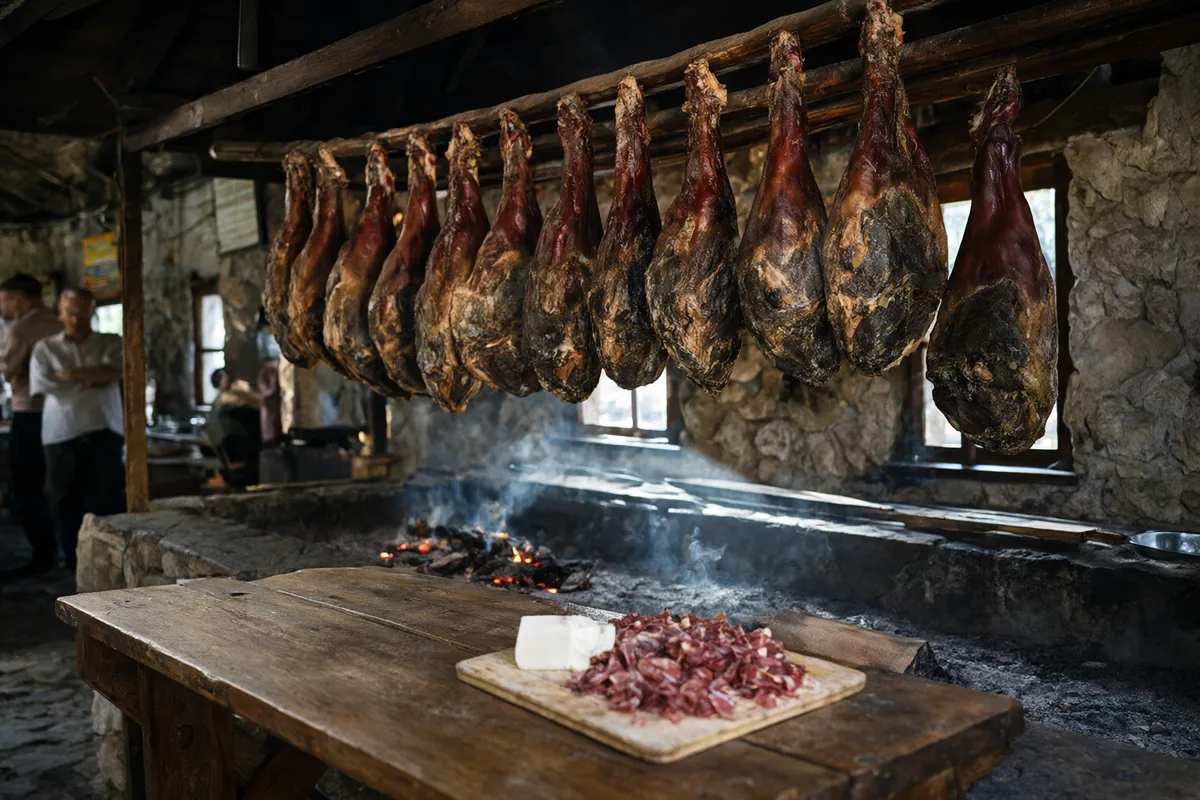
Cetinje, the old royal capital, sits in a high valley below Mount Lovćen, and it is the gateway to Montenegro's most famous food village. Njeguši, on the old mountain road that zigzags up from Kotor, is where Njeguški pršut and Njeguški sir are made. Family smokehouses hang hams over beech wood fires, and the roadside taverns in the village serve plates of pršut, cheese, olives and bread with a glass of loza or Vranac. Many sell whole hams and cheese to take away.
In Cetinje itself, the restaurants along the main street and around the old palaces serve mountain food: lamb, veal, kačamak, kajmak and Njeguški odrezak, the steak rolled with pršut and cheese. The Lovćen national park, between Cetinje and Njeguši, has a few mountain restaurants with views across the Bay of Kotor. The drive from Kotor to Njeguši and Cetinje, with its twenty-five hairpin bends, is one of the classic Montenegro day trips, and lunch in Njeguši is the reason to stop.
Where to eat at Lake Skadar
Lake Skadar, the largest lake in the Balkans, straddles the border with Albania and is a national park full of birds, water lilies and fishing villages. Its food is freshwater fish: carp, traditionally baked with prunes, apples and onions; eel, grilled or smoked; and ukljeva, small bleak fish that are smoked or fried whole. The village of Virpazar, where most boat trips leave from, has several restaurants serving lake fish, and the old riverside town of Rijeka Crnojevića is quieter.
The hills around Lake Skadar, in the Crmnica area, are one of Montenegro's main wine regions, with family wineries making Vranac and the older local red Kratošija. Many offer tastings with homemade cheese, pršut and figs. A boat trip on the lake followed by a fish lunch and a winery visit makes an easy day from Podgorica, Budva or Bar.
Where to eat in Ulcinj
Ulcinj, in the far south near the Albanian border, is Montenegro's most southerly town and has a majority Albanian population, which shows in its food, its mosques and its language. The old town sits on a rocky headland above the sea, with restaurants and terraces looking over the water. Ulcinj is known for its ancient olive groves, especially at Valdanos, and its olive oil appears on every table.
The classic Ulcinj food trip is to Ada Bojana, a river island at the mouth of the Bojana river on the Albanian border, where fish restaurants on wooden stilts over the river serve fish soup, grilled fish, shellfish and eel. South-east of Ulcinj lies Velika plaža, the long sandy beach, with simple beach restaurants. Because of its Albanian influence, you will find dishes such as byrek and Albanian-style grilled meats in Ulcinj; our Albania food guide covers the cooking across the border.
Where to eat in Žabljak
Žabljak is a mountain town in Durmitor National Park, in the north of Montenegro, surrounded by glacial lakes, high peaks and the deep Tara river canyon. This is where to eat Montenegrin mountain food at its most traditional: kačamak and cicvara with kajmak and sour milk, lamb cooked in milk, lamb and veal ispod sača, homemade cheese, river trout, and priganice with honey and jam. Portions are huge, designed for shepherds and hikers.
Restaurants in Žabljak serve this food year round, and in the surrounding countryside many eco villages (etno sela), groups of wooden cabins with restaurants, serve home cooking with local produce. Local honey, berries and wild mushrooms are sold at stalls along the roads in summer. Žabljak is also a ski resort in winter, when the hearty food makes even more sense.
Vegetarian, vegan and allergy tips
Montenegro is harder for vegetarians than most of the Mediterranean, especially inland, where meals centre on meat. On the coast, pasta, risotto, pizza, salads, grilled vegetables and cheese are easy to find. The word for vegetarian is vegetarijanac for a man and vegetarijanka for a woman, and bez mesa means "without meat". Watch for meat broth in čorba soups, pršut in salads and starters, and lard in pastries. Mountain dishes like kačamak are vegetarian but very heavy on cheese and kajmak.
Vegans can ask for posno, food suitable for Orthodox fasting, which contains no meat, dairy or eggs, though it may include fish. Common allergens include dairy in almost every inland dish, shellfish in coastal sauces and risottos, walnuts in cakes, and wheat in bread, pastries and breadcrumbed dishes. Our guide to eating abroad with food allergies explains how to make an allergy clear when you do not speak the language.
Useful Montenegrin phrases for ordering
Dobar dan / Dobro veče "Good day / Good evening", the polite greeting as you walk in
Sto za dvoje, molim "A table for two, please"
Šta preporučujete? "What do you recommend?"
Želio / željela bih ovo "I would like this" (želio for a man, željela for a woman)
Bez mesa, molim "Without meat, please"
Alergičan / alergična sam na... "I am allergic to..." (alergičan for a man, alergična for a woman)
Račun, molim "The bill, please"
Hvala, bilo je odlično "Thank you, it was excellent"
How swap.menu helps you eat in Montenegro
Coastal menus in Montenegro are often translated, but the translations can be puzzling, and inland restaurants may have a short list in Montenegrin only. Photograph the menu with swap.menu and every dish appears in your language with the Montenegrin name beside it and a short explanation, so you know that cicvara is cornmeal cooked in cheese and that ispod sača means a dish slow-cooked under embers that may need ordering hours in advance. Every price is converted from euros to your home currency, and we flag per-kilo fish prices and any cover charge.
Tap the dishes you want, add a note such as "no meat" or "no shellfish", typed or spoken, and swap.menu translates your order into Montenegrin. Show the waiter your phone, or let them scan the QR code and read your order on their own screen. You can try it right now on a sample menu with the free demo, or see travel pass prices.
Off to Montenegro? Your first 3 menu scans are free, and a travel pass starts from $4.99 with nothing that renews.
Start free with 3 scansMontenegro food FAQ
Do you tip in restaurants in Montenegro?
Tipping is customary in Montenegro, and around 10 percent is normal for good service at a sit-down restaurant. Rounding up is enough at cafés and bars. Leave the tip in cash, as card machines often cannot add one.
What food is Montenegro famous for?
Montenegro is best known for Njeguši prosciutto and cheese, buzara mussels and grilled fish on the coast, lamb and veal cooked under the bell, kačamak and cicvara in the mountains, and fish from Lake Skadar. Vranac is its signature red wine.
Is it expensive to eat out in Montenegro?
Eating out in Montenegro is cheaper than in Croatia or western Europe, especially inland and in Podgorica. Restaurants in Kotor's old town, Budva and Sveti Stefan charge more in summer, and fresh fish sold by the kilo can be expensive. Bakeries and grill houses are very cheap.
Is tap water safe to drink in Montenegro?
Tap water is generally safe to drink in Montenegrin towns, and mountain spring water is excellent. Supply and taste can vary on the coast in high summer, so many residents there drink bottled water. Ask your host about the local supply.
What time do people eat dinner in Montenegro?
Dinner in Montenegro usually starts from around 8pm, and later on summer evenings on the coast. Lunch, often the main meal, is eaten from about 1pm to 4pm. Coastal restaurants catering to visitors serve all day in summer.
How can I read a Montenegrin menu if I do not speak the language?
Learn a few words such as riba (fish), domaće (homemade) and ispod sača (cooked under the bell), or photograph the menu with swap.menu. It translates every dish into your language, explains what it is, converts prices to your currency and translates your order back into Montenegrin for the waiter.
Travelling further in the Balkans? Read our food guides for neighbouring countries:
- Croatia food guide
- Bosnia and Herzegovina food guide
- Serbia food guide
- Albania food guide
- North Macedonia food guide
Or browse every travel food guide.