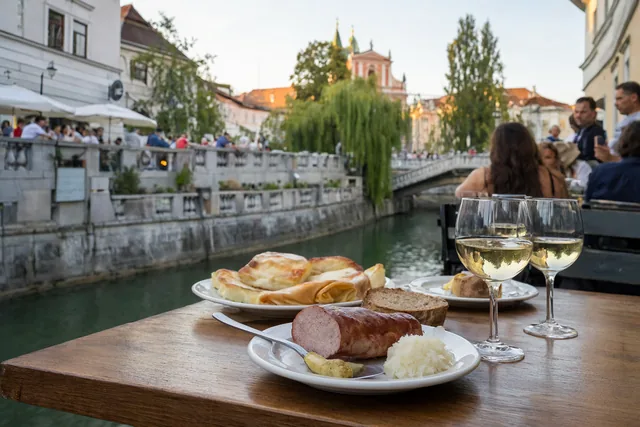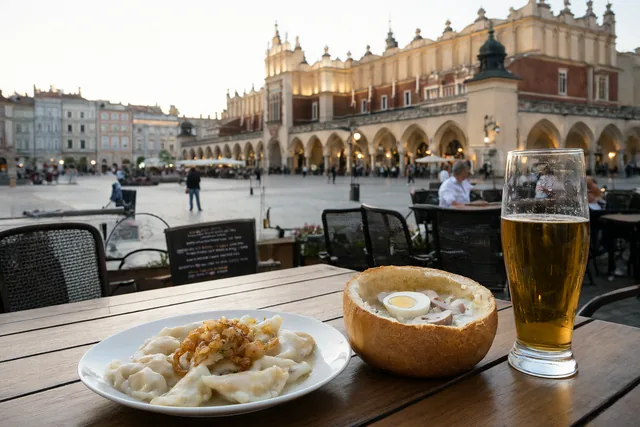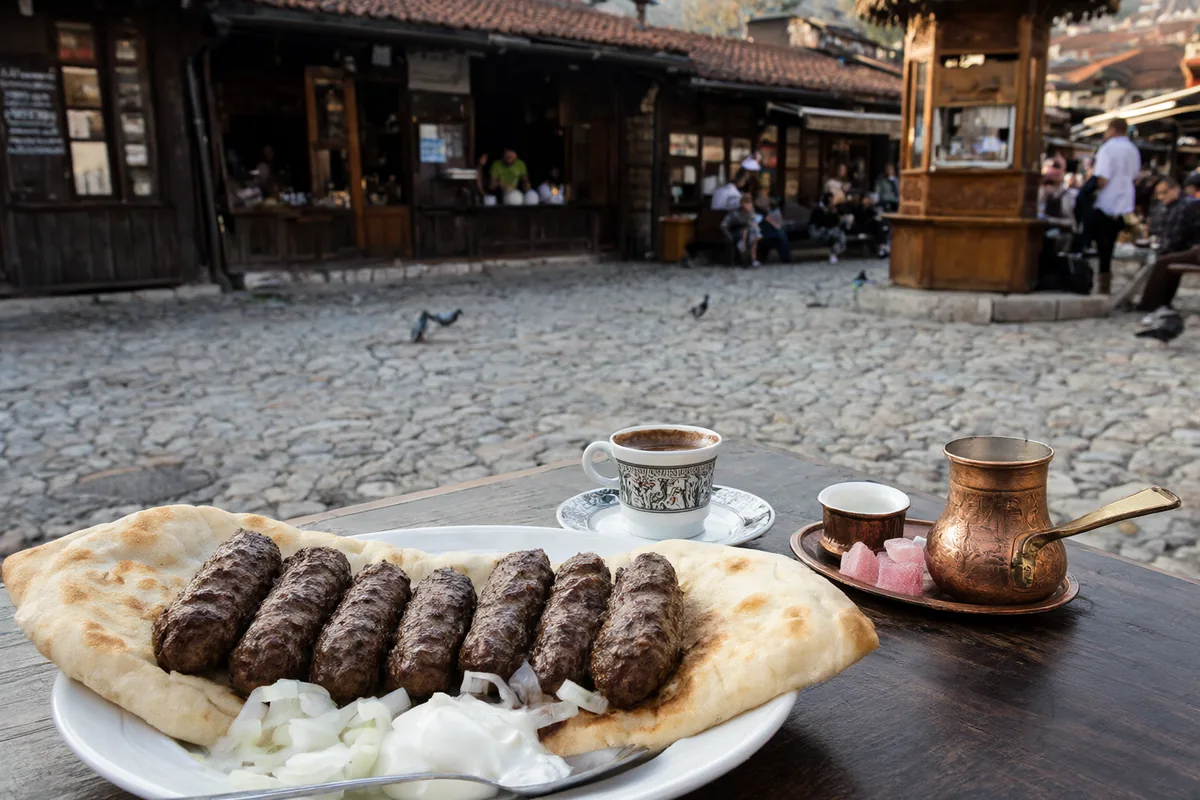
Bosnia and Herzegovina sits where Ottoman and central European food cultures meet, and you can taste both in a single day: grilled ćevapi and flaky pies in the old bazaar for lunch, a coffee ritual in a copper pot in the afternoon, and Herzegovinian wine with trout or lamb in the evening. Portions are generous and prices are low. This Bosnia and Herzegovina food guide covers the dishes to know, how to read a menu written in either the Latin or Cyrillic alphabet, tipping and paying in convertible marks, then goes city by city through where to eat in Sarajevo, Mostar, Banja Luka, Trebinje, Travnik, Jajce and Bihać.
What to eat in Bosnia and Herzegovina: 12 dishes to know
These are the dishes worth ordering, with the city or region each one is most associated with. Many are made in specialist places: a ćevabdžinica for ćevapi, a buregdžinica for pies and an aščinica for slow-cooked home dishes.
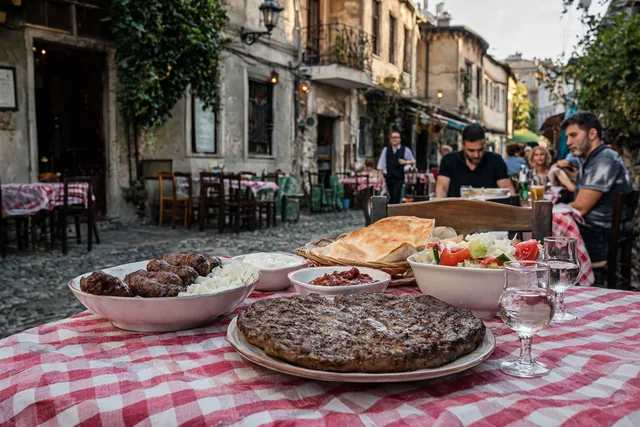
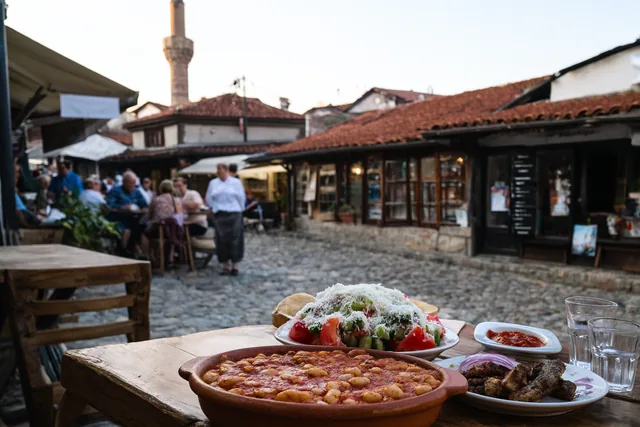
- Ćevapi (Sarajevo, everywhere): small grilled fingers of minced beef or lamb, served in a soft flatbread called somun with chopped raw onion and often kajmak. Order five (pola porcije) or ten (porcija).
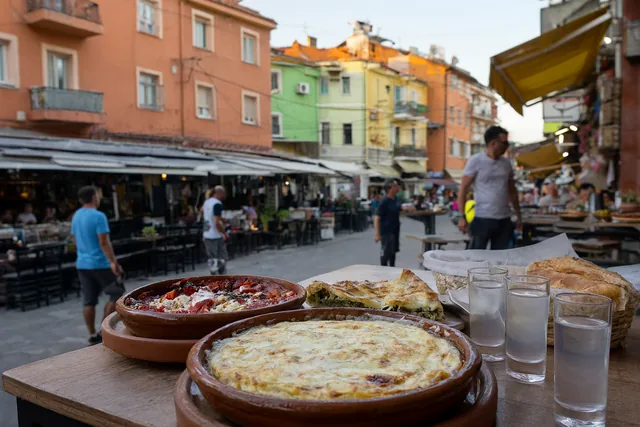
- Burek (everywhere): a spiral of thin filo pastry filled with minced meat. In Bosnia only the meat version is called burek.
- Pita (everywhere): the same spiral pie with other fillings: sirnica (cheese), zeljanica (spinach and cheese) and krompiruša (potato).
- Begova čorba (Sarajevo): "the bey's soup", a creamy chicken and vegetable soup thickened with egg and okra.
- Bosanski lonac (everywhere): the "Bosnian pot", a slow-cooked stew of meat and vegetables layered in a clay pot.
- Klepe (Sarajevo): small meat dumplings served with garlic yoghurt and butter, a cousin of Turkish mantı.
- Sogan dolma (Sarajevo): onions stuffed with minced meat and rice and baked, one of the classic dishes in an aščinica.
- Sarma and japrak (everywhere): cabbage or vine leaves stuffed with meat and rice, slowly simmered.
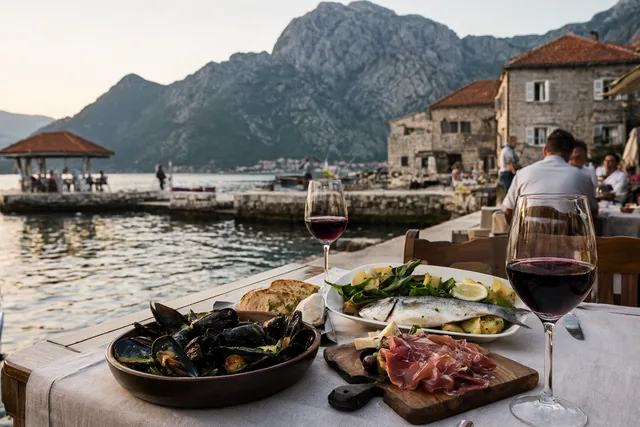
- Pastrmka (Herzegovina and the rivers): trout from the Neretva, Una, Pliva and Buna rivers, grilled or fried.
- Herzegovinian pršut and cheese (Herzegovina): dry-cured ham and sir iz mijeha, a cheese matured in a sheepskin sack.
- Tufahija (Sarajevo): a whole apple poached in syrup, stuffed with walnuts and topped with whipped cream.
- Baklava and hurmašice (everywhere): walnut baklava, and finger-shaped cakes soaked in syrup, sold in slastičarnice (pastry shops).
Coffee is a ritual. Bosnian coffee (bosanska kahva) comes in a small copper pot called a džezva, with a small cup, sugar cubes and a piece of rahat lokum (Turkish delight), and it is meant to be drunk slowly. Herzegovina makes wine from the white Žilavka and the red Blatina and Vranac.
How to read a menu in Bosnia and Herzegovina
Bosnian, Croatian and Serbian are all official and very close to each other. Most menus in Sarajevo, Mostar and the Federation use the Latin alphabet, while menus in Republika Srpska, including Banja Luka and Trebinje, may be in Cyrillic, or in both. Tourist areas usually have English menus too. These are the words you will see most often, in both alphabets.
| Latin | Cyrillic | Meaning |
|---|---|---|
| Predjela | Предјела | Starters |
| Čorbe / supe | Чорбе / супе | Thick soups / clear soups |
| Glavna jela | Главна јела | Main courses |
| Bosanska jela | Босанска јела | Traditional Bosnian dishes |
| Gotova jela | Готова јела | Ready-cooked dishes, served from pots at lunchtime |
| Jela s roštilja | Јела с роштиља | Dishes from the grill |
| Ispod sača | Испод сача | Cooked under a domed lid covered in embers |
| Teletina / janjetina / piletina | Телетина / јањетина / пилетина | Veal / lamb / chicken |
| Riba / pastrmka | Риба / пастрмка | Fish / trout |
| Kajmak | Кајмак | Clotted cream, salty and rich |
| Domaće | Домаће | Homemade |
| Porcija / pola porcije | Порција / пола порције | Portion / half portion |
| Kolači | Колачи | Cakes and desserts |
In a ćevabdžinica the menu is often just a list of portion sizes, such as "5 ćevapa" or "10 ćevapa", with or without kajmak and onion. Kajmak is usually an extra charge. swap.menu reads menus in Latin or Cyrillic, explains each item and converts the price from convertible marks into your home currency.
Tipping, convertible marks and paying the bill
Menu prices in Bosnia and Herzegovina include VAT, and service charges and cover charges are rare. Our guide to tax and service charges on menus explains how these lines work around the world.
Tipping is not compulsory. Locals usually round up the bill, and around 10 percent is a generous tip at a sit-down restaurant. In ćevabdžinicas, bakeries and cafés, rounding up to the nearest mark is plenty. Leave tips in cash.
The currency is the convertible mark (konvertibilna marka, written KM, code BAM), which is pegged to the euro. Some places in Mostar and other tourist areas accept euros, usually at a rounded rate, but you will get better value paying in marks. Cards are accepted in many restaurants and hotels in Sarajevo, Mostar and Banja Luka, but traditional eateries, bakeries and markets often take cash only. If a card machine offers to charge you in your home currency, decline and pay in marks: our guide to paying in local currency explains why.
Lunch is the main meal for many families and is eaten from about 12pm to 3pm, which is when aščinicas are at their best. Dinner is usually from 7pm to 10pm. Many traditional places in Sarajevo, including most ćevabdžinicas and buregdžinicas, do not serve alcohol. During Ramadan, restaurants in Sarajevo and other Muslim-majority areas fill up at sunset for iftar.
Where to eat in Bosnia and Herzegovina, city by city
Every town in Bosnia and Herzegovina claims its own ćevapi and its own way with pies, trout or cheese. Jump to a city:
Where to eat in Sarajevo
Sarajevo is the best place in the country to eat, and the old bazaar, Baščaršija, is the place to start. Its narrow lanes of wooden shops are lined with ćevabdžinicas grilling ćevapi over charcoal, buregdžinicas baking pies in round trays, and cafés serving Bosnian coffee. Ask locals for their favourite ćevapi and you will get a different answer from each, which is part of the fun. Drink from the Sebilj, the wooden fountain in the main square: local legend says anyone who does will return to Sarajevo.
For slow-cooked Bosnian food, look for an aščinica, a simple canteen where pots of begova čorba, sogan dolma, bosanski lonac, stuffed peppers and stews are displayed at the counter at lunchtime. Point at what you want. The Markale market on the pedestrian street Mula Mustafe Bašeskije sells fruit, vegetables and cheese, and the covered city market nearby sells meat, kajmak and dried beef (suho meso). In the evening, the streets around Ferhadija have cafés and bars, and restaurants on the hills of Bistrik and Vratnik have views over the city. Finish with tufahija or baklava in a slastičarnica.
Where to eat in Mostar
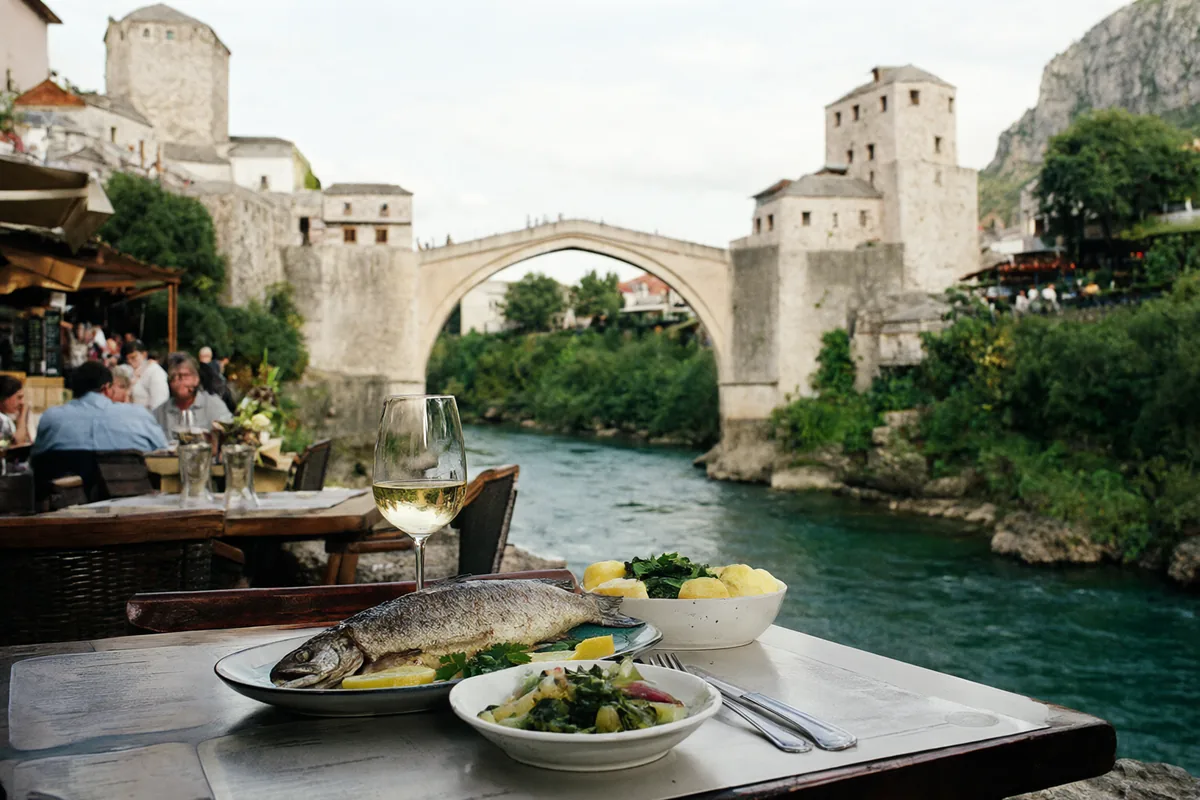
Mostar, the main city of Herzegovina, is famous for its Ottoman-era Old Bridge (Stari Most) over the green Neretva river. The restaurants with terraces facing the bridge serve grilled trout, ćevapi, stuffed vegetables and mixed grills, and while prices are higher than elsewhere in town, the view is worth one meal. The cobbled bazaar street of Kujundžiluk leads to the bridge, lined with shops, cafés and small eateries. Walk a few minutes from the old town for cheaper ćevapi and burek where locals eat.
Herzegovina is wine country, and Mostar is the place to try Žilavka, a crisp white, and Blatina, a local red. Herzegovinian pršut, sir iz mijeha and figs make a good starter plate. A short drive south, the village of Blagaj has riverside restaurants serving trout at the source of the Buna river beside an old dervish house. The fortified village of Počitelj is another popular stop. Mostar gets very hot in summer, so eat outside in the evenings.
Where to eat in Banja Luka
Banja Luka is the largest city in Republika Srpska and has a relaxed, green feel, with tree-lined streets and the Vrbas river running through the centre. Its local speciality is Banja Luka ćevapi, made differently from Sarajevo's: the meat is shaped into fingers that are grilled joined together and served as a block of four inside a somun. Locals are proud of them, and the grill houses in the centre of Banja Luka serve them from morning onwards.
The city is also the home of trapist cheese, a semi-hard cheese first made by Trappist monks at a monastery in Banja Luka and now eaten across the former Yugoslavia. Restaurants along the Vrbas, near the old Kastel fortress, serve river fish, grilled meats and local dishes, and the pedestrian street Gospodska has cafés and bars. Menus in Banja Luka are often written in Cyrillic, so the table above is useful here. The Vrbas canyon south of the city is popular for rafting, with riverside restaurants.
Where to eat in Trebinje
Trebinje, in the far south of Herzegovina, is only about half an hour's drive from Dubrovnik, but prices are much lower and the town has a slow, Mediterranean pace. The old town by the Trebišnjica river has a square shaded by huge plane trees, where a market sells local cheese, honey, dried figs, pršut and wine. Cafés and restaurants around the square and along the river serve grilled meat, trout, Herzegovinian pršut and cheese.
The hills around Trebinje are planted with vineyards, and the Tvrdoš monastery just outside town has a long wine-making tradition and a wine cellar. Several family wineries in the area offer tastings of Vranac and Žilavka. For a day trip from Dubrovnik, Trebinje makes an excellent lunch stop, and our Croatia food guide covers the coast. Menus here may be in Cyrillic as well as Latin.
Where to eat in Travnik
Travnik, in central Bosnia, was the seat of the Ottoman viziers and is the birthplace of the writer Ivo Andrić. In food terms, it is known for two things: Travnik ćevapi, which locals insist are the best in the country, and Travnik cheese (travnički sir), a white, brined cheese made from sheep's milk on the nearby Vlašić mountain. Order both, and add lamb from Vlašić, which is also highly regarded.
The area around Plava Voda, a cold spring below the old fortress, has restaurants and cafés by the running water, and it is the most pleasant place to eat in Travnik. The town's main street has ćevabdžinicas and pastry shops, and the colourful Painted Mosque is nearby. Travnik is an easy stop on the road between Sarajevo and Jajce.
Where to eat in Jajce
Jajce is a small historic town built around a waterfall where the Pliva river drops into the Vrbas, right in the town centre. Its food is simple and local: river trout, grilled meats, ćevapi, pies and homemade cheese. Restaurants near the waterfall and in the old town serve these with views of the falls and the fortress above.
A short walk or drive upstream, the Pliva lakes are lined with a row of old wooden watermills, and lakeside restaurants serve fresh trout. The lakeside restaurants are busy with Bosnian families at weekends, especially in summer, when tables spill out onto the grass by the water. Jajce is a good stop for lunch on the road between Sarajevo, Travnik and Banja Luka, and the old town has cafés for Bosnian coffee and cake after a walk up to the fortress. Look for the local bakeries for burek and pita in the morning, and for homemade rakija, usually plum brandy, which is offered to guests across central Bosnia.
Where to eat in Bihać
Bihać, in the far north-west, sits on the clear, green Una river and is the gateway to Una National Park. Its food revolves around the river: trout and other river fish are grilled or fried in restaurants along the banks, and riverside terraces are the best places to eat in Bihać. Grilled meats, ćevapi and pies are found everywhere, and the region produces cheese and honey.
Inside Una National Park, the Štrbački buk waterfall and the area around Martin Brod are popular for day trips, rafting and kayaking, and simple restaurants near the river serve fish and grilled meat. In the centre of Bihać, the old Captain's Tower stands by the river, and the cafés and restaurants nearby are a good place to sit by the water in the evening. Order trout with boiled potatoes and Swiss chard, a plate of local cheese, and a pie for the road. Bihać is close to the Croatian border and to Plitvice Lakes, so it is often combined with a trip through Croatia, and it makes a good first or last meal in the country.
Vegetarian, vegan and allergy tips
Bosnian food is very meat-focused, but vegetarians can manage. Sirnica, zeljanica and krompiruša pies, beans (grah), stuffed peppers without meat, salads and grilled vegetables are widely available. The word for vegetarian is vegetarijanac for a man and vegetarijanka for a woman, and bez mesa means "without meat". Watch for meat broth in soups and beans, minced meat in most stuffed vegetables, and dried beef added to bean dishes. In Muslim-majority areas, pork is rarely served; in other areas it is common.
Vegans can ask for posno, food suitable for religious fasting, which contains no meat or dairy. Common allergens include dairy in kajmak, pies and soups, walnuts in baklava, tufahija and other desserts, egg in begova čorba, and wheat in somun, pies and dumplings. Our guide to eating abroad with food allergies explains how to make an allergy clear when you do not speak the language.
Useful Bosnian phrases for ordering
Dobar dan / Dobro veče "Good day / Good evening", the polite greeting as you walk in
Sto za dvoje, molim "A table for two, please"
Šta preporučujete? "What do you recommend?"
Želio / željela bih ovo "I would like this" (želio for a man, željela for a woman)
Deset ćevapa sa lukom i kajmakom "Ten ćevapi with onion and kajmak"
Alergičan / alergična sam na... "I am allergic to..." (alergičan for a man, alergična for a woman)
Račun, molim "The bill, please"
Hvala, bilo je odlično "Thank you, it was excellent"
How swap.menu helps you eat in Bosnia and Herzegovina
Menus in Bosnia and Herzegovina can be in Bosnian, Croatian or Serbian, in Latin or Cyrillic, and the dish names rarely explain themselves. Photograph the menu with swap.menu and every dish appears in your language with the local name beside it and a short explanation, so you know that begova čorba is a creamy chicken and okra soup and that sogan dolma are stuffed onions, before you order. Every price is converted from convertible marks to your home currency.
Tap the dishes you want, add a note such as "no meat" or "no nuts", typed or spoken, and swap.menu translates your order into the local language. Show the waiter your phone, or let them scan the QR code and read your order on their own screen. You can try it right now on a sample menu with the free demo, or see travel pass prices.
Off to Bosnia and Herzegovina? Your first 3 menu scans are free, and a travel pass starts from $4.99 with nothing that renews.
Start free with 3 scansBosnia and Herzegovina food FAQ
Do you tip in restaurants in Bosnia and Herzegovina?
Tipping is not compulsory in Bosnia and Herzegovina. Locals usually round up the bill, and around 10 percent is a generous tip at a sit-down restaurant. At ćevabdžinicas and cafés, rounding up is enough.
What food is Bosnia and Herzegovina famous for?
The country is best known for ćevapi, burek and other pies, begova čorba, bosanski lonac, stuffed vegetables, baklava and Bosnian coffee. Herzegovina adds trout, pršut, cheese and wines such as Žilavka and Blatina.
Is it expensive to eat out in Bosnia and Herzegovina?
No, it is one of the cheapest countries in Europe for eating out. A portion of ćevapi or a slice of burek costs very little, and a full meal at a traditional restaurant is good value. Restaurants facing the Old Bridge in Mostar are the main exception.
Is tap water safe to drink in Bosnia and Herzegovina?
Tap water is generally safe to drink in Sarajevo and the larger towns, and Sarajevo has public drinking fountains throughout the old town. In rural areas, ask locally, or drink bottled water, which is cheap.
Do restaurants in Sarajevo serve alcohol?
Many traditional places in Sarajevo, including most ćevabdžinicas, buregdžinicas and aščinicas, do not serve alcohol. Plenty of other restaurants and bars do, including places serving local beer and Herzegovinian wine.
How can I read a menu in Bosnia and Herzegovina?
Menus may be in the Latin or Cyrillic alphabet. Learn a few words such as čorba (soup), roštilj (grill) and domaće (homemade), or photograph the menu with swap.menu, which translates every dish into your language, explains it, converts prices from marks and translates your order for the waiter.
Travelling further in the Balkans? Read our food guides for neighbouring countries:
Or browse every travel food guide.