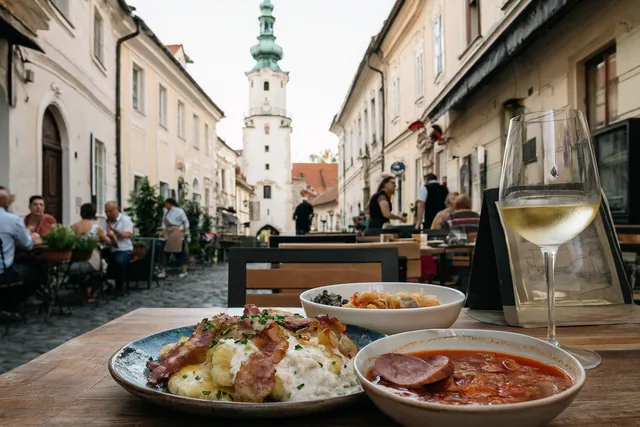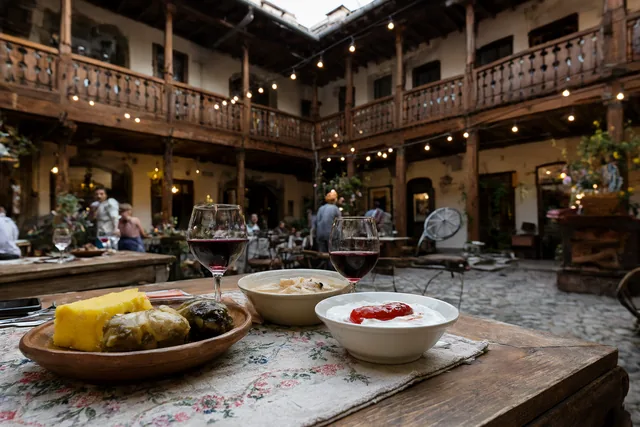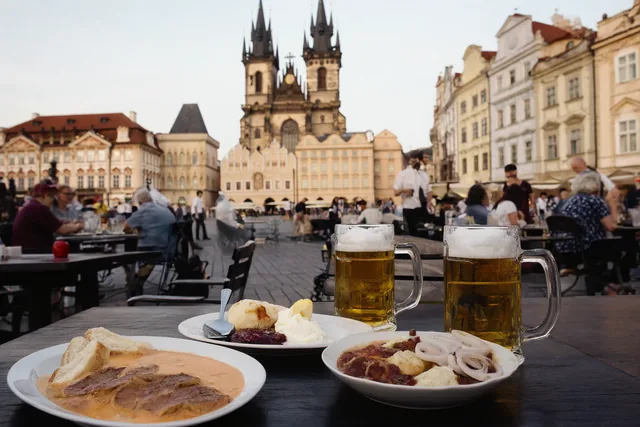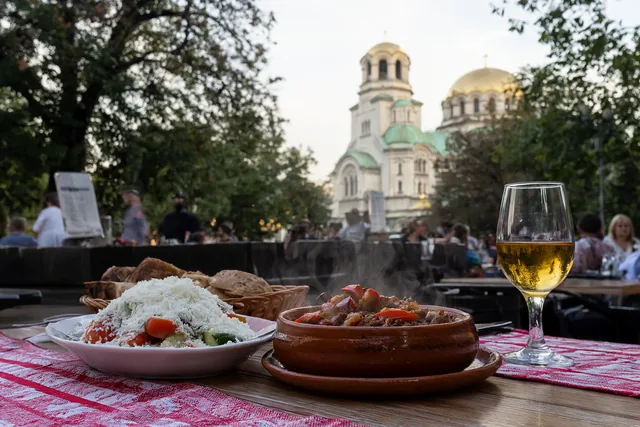
Hungarian food is defined by paprika, sour cream, slow-cooked stews and some of the best pastries in Europe, all washed down with excellent wine and fruit brandy. This Hungary food guide covers the dishes to order, how to read a Hungarian menu, the service charge you will often see on a Budapest bill and whether to tip on top, then goes city by city through where to eat in Budapest, around Lake Balaton, in the wine towns of Eger and Tokaj, and in Pécs, Szeged and Debrecen. The first thing to know: what the rest of the world calls goulash, Hungarians call pörkölt.
What to eat in Hungary: 12 dishes to know
These are the dishes you will meet across the country, from grand Budapest restaurants to roadside inns. Paprika runs through most of them, sweet more often than hot.
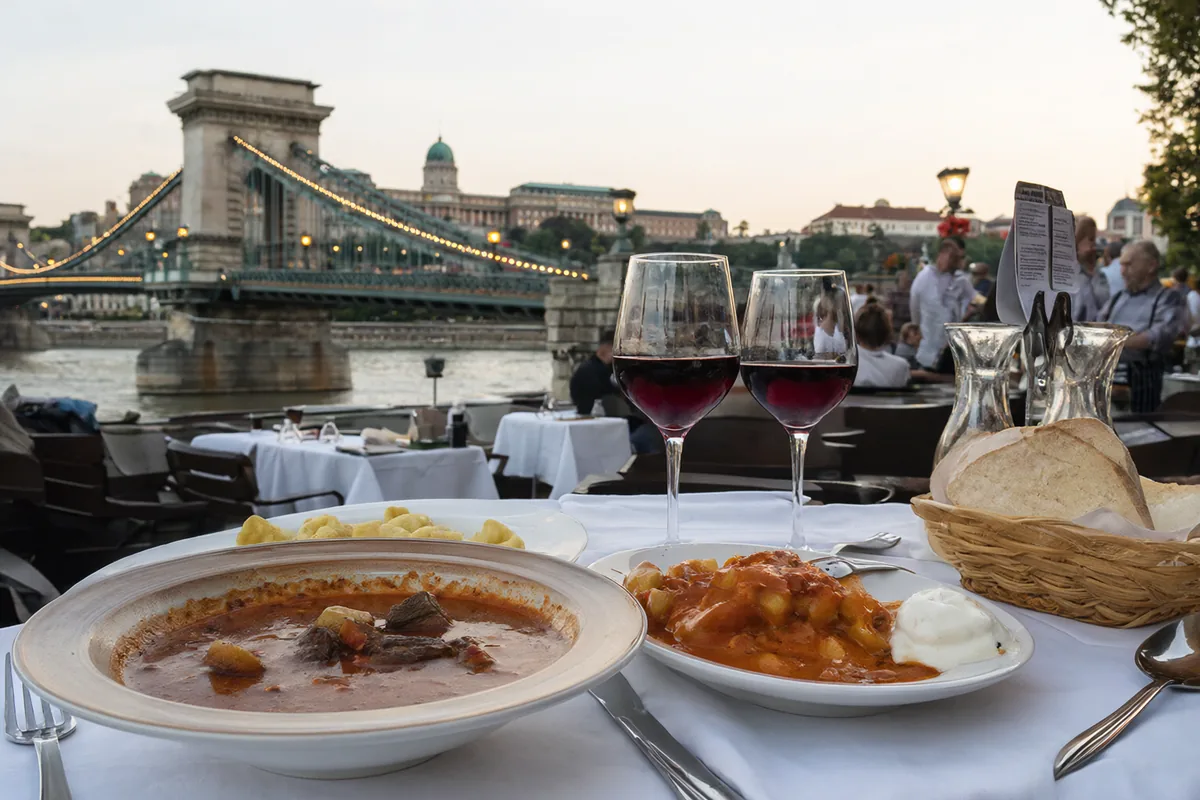
- Gulyásleves (everywhere): goulash soup, a herdsman's dish of beef, paprika, onion, potato and carrot, often with tiny pinched noodles called csipetke. In Hungary goulash is a soup.
- Pörkölt (everywhere): a thick paprika and onion stew of beef, pork or veal, served with nokedli (small egg dumplings) and pickles. This is what most foreigners mean by goulash.
- Csirkepaprikás (everywhere): chicken paprikash, chicken simmered in paprika sauce finished with sour cream, served with nokedli.
- Halászlé (Szeged and the rivers): fisherman's soup, a fiery red broth of river fish, usually carp, cooked with plenty of paprika.
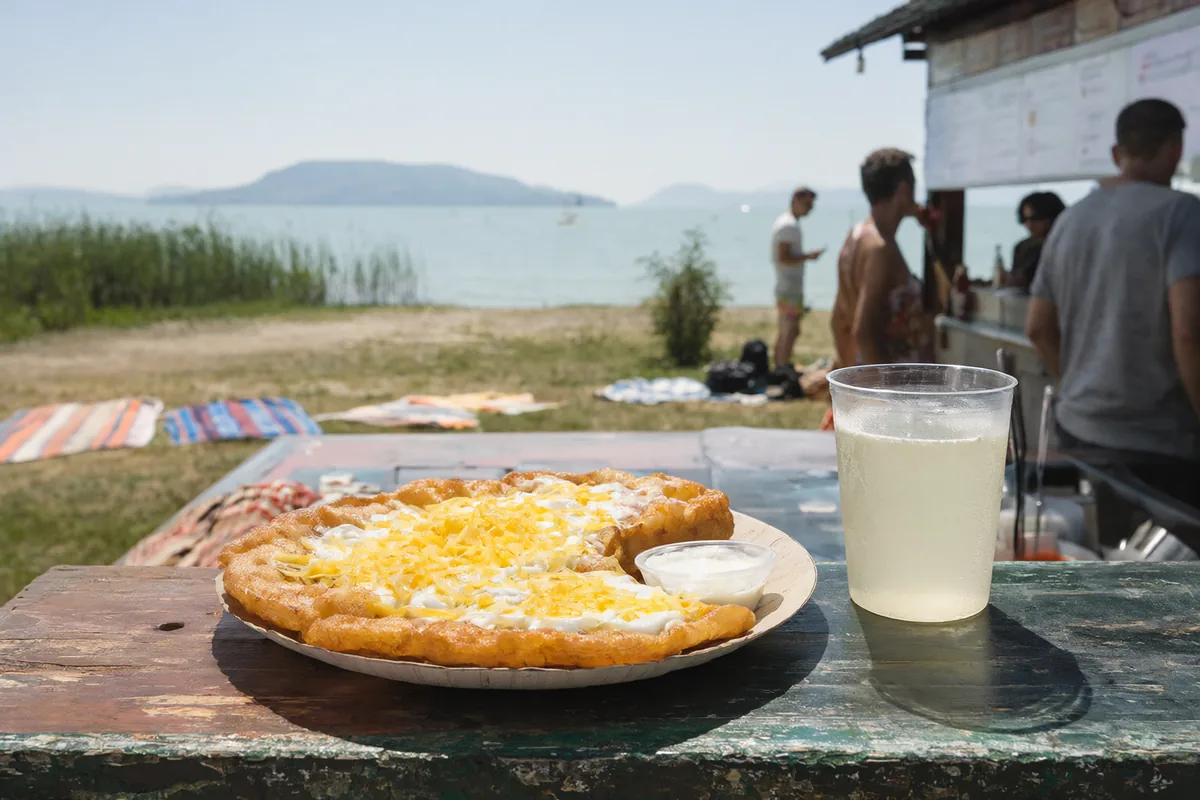
- Lángos (everywhere): deep-fried dough topped with garlic, sour cream and grated cheese, sold at markets and beach stalls.
- Töltött káposzta (everywhere): cabbage leaves stuffed with pork and rice, cooked on a bed of sauerkraut and topped with sour cream.
- Főzelék (everywhere): a thick vegetable stew, of lentils, peas, potato or squash, topped with a fried egg, meatballs or sausage. Classic everyday lunch food.
- Túrós csusza (everywhere): pasta with cottage cheese, sour cream and crisp bacon.
- Hortobágyi palacsinta (eastern Hungary): savoury pancakes filled with meat stew and baked in a creamy paprika sauce.
- Kürtőskalács (everywhere): chimney cake, a spiral of sweet dough baked on a spit over coals and rolled in sugar, cinnamon or walnuts.
- Dobos torta and somlói galuska (everywhere): the first is a layered sponge with chocolate buttercream and a hard caramel top; the second is sponge with walnuts, rum, chocolate sauce and whipped cream.
- Pálinka (everywhere): strong fruit brandy made from apricot, plum, pear or cherry, drunk as a short shot before or after a meal.
How to read a Hungarian menu
Hungarian is unlike its neighbours' languages, and almost no word on the menu will look familiar. Menus follow a standard order: starters, soups, mains, sides and desserts. As in much of central Europe, sides are often priced separately, and pickled vegetables (savanyúság) appear as a side salad. These are the words you will see most.
| Hungarian | Meaning |
|---|---|
| Előételek | Starters |
| Levesek | Soups |
| Főételek | Main courses |
| Köretek | Sides, ordered separately: potatoes, rice, nokedli |
| Savanyúság | Pickles: cucumber, cabbage, peppers, served as a side |
| Desszertek / édességek | Desserts / sweets |
| Sertés / marha / borjú / csirke | Pork / beef / veal / chicken |
| Hal / ponty / harcsa / fogas | Fish / carp / catfish / pike-perch |
| Rántott / sült / főtt | Breaded and fried / roasted / boiled |
| Pörkölt / paprikás | Paprika stew / paprika stew finished with sour cream |
| Csípős | Spicy hot |
| Napi menü | Set lunch of the day, usually soup and a main |
| Szervizdíj | Service charge |
| Vegetáriánus | Vegetarian |
Many Budapest restaurants print a line at the bottom of the menu adding a szervizdíj (service charge), often 10 to 15 percent, to every bill. It is easy to miss and easy to tip on top of by mistake. swap.menu picks out service charge lines when it reads the menu and shows you what the final total will be in your own currency.
Service charges, tipping and paying the bill
Hungary has two systems, and you need to know which one you are in. Many restaurants, especially in central Budapest, add a service charge (szervizdíj) to the bill, usually 10 to 15 percent, and it must be stated on the menu. If it is there, you do not need to tip, although some waiters will hand you the card machine without mentioning it. Where there is no service charge, tip about 10 percent for good service. Our guide to tax and service charges on menus explains how these lines work around the world. VAT is already included in menu prices.
The traditional way to tip is to tell the waiter the total you want to pay as you hand over your money, rather than leaving it on the table. As in some neighbouring countries, saying köszönöm ("thank you") as you hand over cash can be taken to mean "keep the change", so wait for your change first if you want it back.
Prices are in Hungarian forint (Ft, code HUF). Some tourist-facing places accept euros, but at a poor rate, so pay in forint. Cards and contactless payments are accepted almost everywhere in Budapest and in most restaurants elsewhere, but keep a little cash for markets and wine cellars. When a card machine or cash machine offers to charge you in your home currency, say no: our guide to paying in local currency explains why.
Lunch is traditionally the main meal, served from about noon to 2pm, and many restaurants offer a cheap napi menü on weekdays. Dinner runs from about 6pm to 10pm in Budapest, earlier in smaller towns.
Where to eat in Hungary, city by city
Budapest has the most choice, but Hungary's wine regions and river towns are where many of its classic dishes come from. Jump to a place:
Where to eat in Budapest
Budapest is two cities joined by bridges: hilly Buda on the west bank of the Danube and flat Pest on the east, where most of the eating happens. Start at the Great Market Hall (Nagy Vásárcsarnok), a vast 19th century iron and glass hall at the Pest end of Liberty Bridge, with paprika, salami and pickles downstairs and lángos and stew counters upstairs. For everyday Budapest food, look for an étkezde or főzelékfaló, small lunch canteens serving főzelék, soups and stews for very little, and the market hall on Hold utca near Parliament, which has lunch counters inside.
The old Jewish Quarter in District VII is Budapest's nightlife centre, famous for its romkocsma (ruin bars), set up in derelict buildings and courtyards, and for streets such as Kazinczy utca full of bars and street food. Try flódni here, a Jewish layered cake of apple, walnut, poppy seed and plum. Budapest's grand coffee houses and cukrászda (pastry shops) are an institution: order dobos torta or Esterházy torta with coffee. Restaurants on Váci utca, the main tourist shopping street, are best avoided; check the menu for the service charge line before you sit down anywhere central.
Where to eat at Lake Balaton
Lake Balaton is the largest lake in central Europe and Hungary's summer playground. The classic Balaton meal is eaten at a strand (beach) snack bar: lángos with sour cream and cheese, fried fish and a cold beer or fröccs, a wine and soda water spritzer that Hungarians order by ratio, from kisfröccs (half and half) to hosszúlépés (more soda). Fish to look for are fogas, the lake's prized pike-perch, and keszeg, small bream fried crisp and eaten whole.
The north shore is wine country. The volcanic hills of Badacsony produce mineral whites from Olaszrizling and the local Kéknyelű grape, and there are wine terraces with views over the water. The Tihany peninsula, with its abbey and lavender fields, and the spa town of Balatonfüred have the widest choice of restaurants on the north shore, while the south shore around Siófok is louder and aimed at a party crowd. Many Balaton restaurants and beach bars open only from around June to August, so outside summer stick to the larger towns.
Where to eat in Eger
Eger is a baroque town in the hills of northern Hungary, known for its castle and for its wine. Its most famous red is Egri Bikavér, "Bull's Blood of Eger", a blend of several grapes, and its white counterpart is Egri Csillag, "Star of Eger". Just outside the centre, the Szépasszony-völgy (Valley of the Beautiful Women) is a horseshoe of dozens of small cellars dug into the soft rock, where winemakers pour tastings straight from the barrel, often with plates of bread, cheese, sausage and pickles.
In the old town, restaurants around Dobó István tér and the cathedral serve classic Hungarian cooking at lower prices than Budapest: goulash soup, pörkölt, stuffed cabbage and game in autumn. Eger also has thermal baths, which make a good pairing with a lazy lunch. The cellars in the valley keep their own hours and some close early in winter, so go in the afternoon and early evening for the best choice.
Where to eat in Tokaj
Tokaj, in the north-east, is a UNESCO-listed wine region whose sweet wines have been famous for centuries. Tokaji aszú is made from grapes shrivelled by noble rot, mostly Furmint and Hárslevelű, and it ranges from honeyed and rich to tangy and bright. The region also makes excellent dry Furmint. The wine villages of Tokaj, Tarcal, Mád and Tállya are dotted with cellars carved deep into the volcanic hills, their walls furred with a dark, harmless mould that thrives in the humid air.
Many Tokaj wineries offer tastings, often with local cheese and cured meats, and several have restaurants that pair regional dishes with their wines. Book ahead, especially for weekend visits, as smaller cellars may only open by appointment. Food in the region is rustic and good value: river fish, game, pork dishes and pastries, and the town of Tokaj itself has a handful of restaurants by the meeting point of the Tisza and Bodrog rivers.
Where to eat in Pécs
Pécs, in the far south, is a warm, relaxed university city with a Mediterranean feel, a Turkish-era mosque on its main square and a UNESCO-listed early Christian necropolis. It was a European Capital of Culture in 2010, and the restored Zsolnay Cultural Quarter, around the old porcelain factory, has cafés and restaurants. The pedestrian Király utca is lined with terraces and is the place to sit with a glass of wine on a summer evening.
The surrounding Baranya county has German, Croatian and Serbian communities, and their influence shows up in the cooking. Pécs is also the gateway to the Villány wine region, about 40 minutes south, Hungary's best-known area for full-bodied reds such as Cabernet Franc and Portugieser, with a village main street of wine cellars and wine bars. Prices in Pécs are lower than in Budapest, and the weekday lunch menus are very good value.
Where to eat in Szeged
Szeged sits on the Tisza river near the Serbian border and is one of the sunniest cities in Hungary. It is the home of Szegedi halászlé, the fisherman's soup, made here with a thick, strained broth of several river fish, coloured deep red with local paprika. Szeged is one of the country's two great paprika towns, with Kalocsa, and its paprika powder is protected as a regional product. The city is also known for winter salami (téliszalámi), a dry, mould-ripened salami.
The riverside is the place to order halászlé, at csárdák (traditional inns) and fish restaurants along the Tisza. In the centre, the streets around Klauzál tér and Kárász utca have cafés and pastry shops, and in summer the Szeged Open-Air Festival is held in front of the twin-towered cathedral on Dóm tér. With a large student population, Szeged prices are low and lunch menus easy to find.
Where to eat in Debrecen
Debrecen is Hungary's second city, on the edge of the Great Plain in the east. It gave its name to debreceni kolbász, a smoked paprika sausage served grilled or sliced into lecsó, a pepper and tomato stew. The city centre around the yellow Great Reformed Church and the main street, Piac utca, has restaurants, cafés and pastry shops, and every August the Flower Carnival brings parades and food stalls.
West of Debrecen, Hortobágy National Park is Hungary's great puszta, an open grassland where herders still keep Hungarian grey cattle, curly-horned racka sheep and horses. The traditional roadside inns here serve the dishes the plain is known for: hortobágyi palacsinta, gulyásleves cooked in a kettle, and grey cattle beef in stews. Hortobágy is an easy half-day trip by car from Debrecen and pairs well with a lunch stop.
Vegetarian, vegan and allergy tips
Traditional Hungarian food is heavy on pork, lard and sour cream, but vegetarians have more options than you might expect. Főzelék (vegetable stew), lecsó without sausage, mushroom paprikash, fried cheese, lángos and sweet dishes such as túrós palacsinta (sweet cheese pancakes) and mákos tészta (pasta with poppy seeds and sugar) are common. The word for vegetarian is vegetáriánus and for vegan vegán. Watch for lard (zsír) used in cooking, bacon (szalonna) in pasta and vegetable dishes, and meat toppings (feltét) placed on főzelék.
Sour cream and cottage cheese appear in a huge number of dishes and desserts, so vegans should ask. Walnuts and poppy seeds fill many pastries, and gluten-free (gluténmentes) options are marked in many Budapest restaurants but less often elsewhere. Our guide to eating abroad with food allergies explains how to explain an allergy clearly when you do not speak the language.
Useful Hungarian phrases for ordering
Jó napot kívánok "Good day", the polite greeting to staff (Jó estét in the evening)
Egy asztalt szeretnék két főre "I would like a table for two"
Mit ajánl? "What do you recommend?"
Ezt kérem "This one, please" (pointing)
Nem csípős, kérem "Not spicy, please"
Allergiás vagyok... "I am allergic to..." (Hungarian adds an ending to the food word, so pointing at it on your phone helps)
Fizetni szeretnék "I would like to pay"
Egészségedre! "Cheers!" (to your health). Many Hungarians still avoid clinking beer glasses, a custom said to date from 1849, though wine and pálinka glasses are clinked
How swap.menu helps you eat in Hungary
Hungarian is one of the hardest European languages to guess at, and outside the tourist streets many menus, especially daily lunch boards, are in Hungarian only. Photograph the menu with swap.menu and every dish appears in your language with the Hungarian name beside it and a short explanation, so you know that pacalpörkölt is tripe stew and vadas is beef in a creamy, slightly sweet vegetable sauce before you order. Every price is converted from forint to your home currency, and the service charge line is pointed out so you do not tip twice.
Tap the dishes you want, add a note such as "no bacon" or "not spicy, please", typed or spoken, and swap.menu translates your order into Hungarian. Show the waiter your phone, or let them scan the QR code and read your order on their own screen. You can try it right now on a sample menu with the free demo, or see travel pass prices.
Off to Hungary? Your first 3 menu scans are free, and a travel pass starts from $4.99 with nothing that renews.
Start free with 3 scansHungary food FAQ
Do you tip in restaurants in Hungary?
Check the bill first. Many restaurants, especially in Budapest, add a service charge of 10 to 15 percent, and if it is there you do not need to tip. Where there is no service charge, about 10 percent is normal for good service.
What food is Hungary famous for?
Goulash soup, pörkölt (paprika stew), chicken paprikash, fisherman's soup, stuffed cabbage and lángos are the best-known dishes. Hungary is also famous for paprika, salami, pastries such as dobos torta, Tokaji sweet wine and pálinka fruit brandy.
Is Budapest expensive to eat out?
Budapest is cheaper than most western European capitals, especially if you eat the weekday set lunch or at small canteens. Restaurants on the main tourist streets and near the Danube are more expensive, and many add a service charge.
Which city in Hungary is best for food?
Budapest has the widest choice, from market halls to fine dining. For wine and regional cooking, Eger, Tokaj and Villány near Pécs are excellent, and Szeged is the place for fisherman's soup.
Is tap water safe to drink in Hungary?
Yes, tap water is safe to drink across Hungary. Restaurants usually sell bottled water, but many will bring tap water (csapvíz) if you ask.
How can I read a Hungarian menu if I do not speak Hungarian?
Learn a few words such as levesek (soups), főételek (mains) and szervizdíj (service charge), or photograph the menu with swap.menu. It translates every dish into your language, explains what it is, converts prices from forint to your currency and translates your order back into Hungarian for the waiter.
Travelling further in Europe? Read our food guides for neighbouring countries:
- Austria food guide
- Slovakia food guide
- Romania food guide
- Serbia food guide
- Croatia food guide
- Slovenia food guide
Or browse every travel food guide.