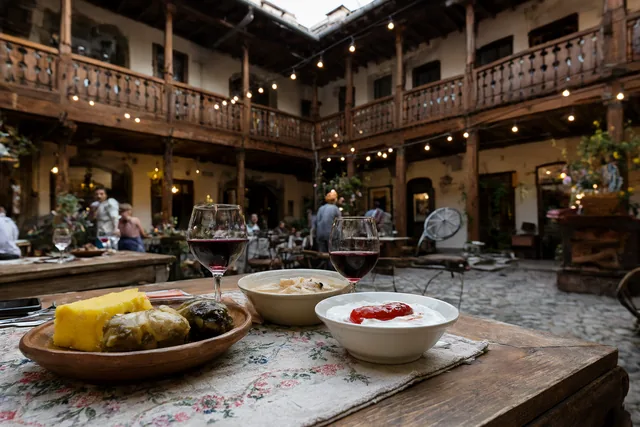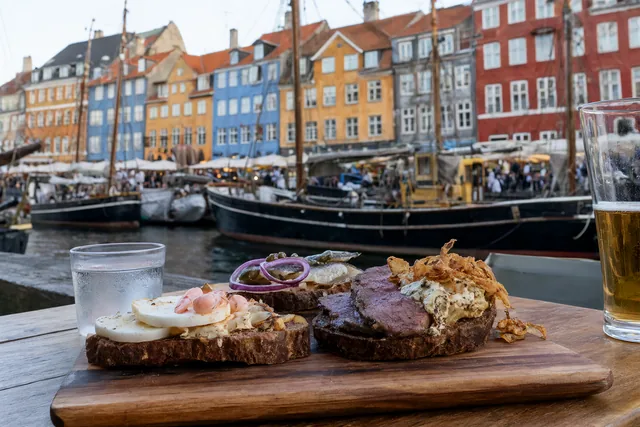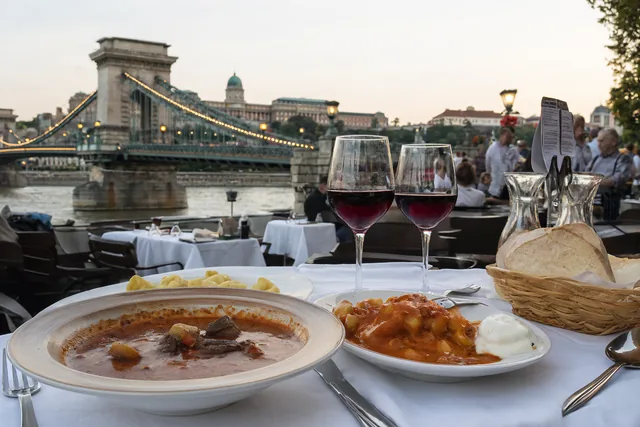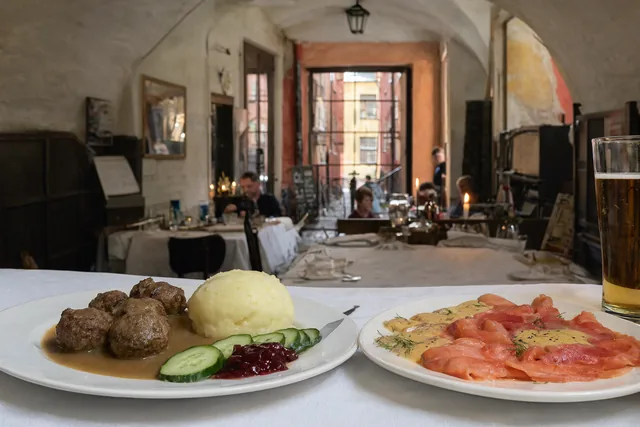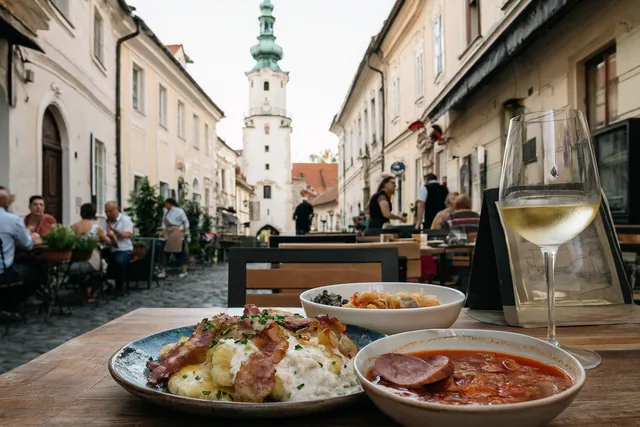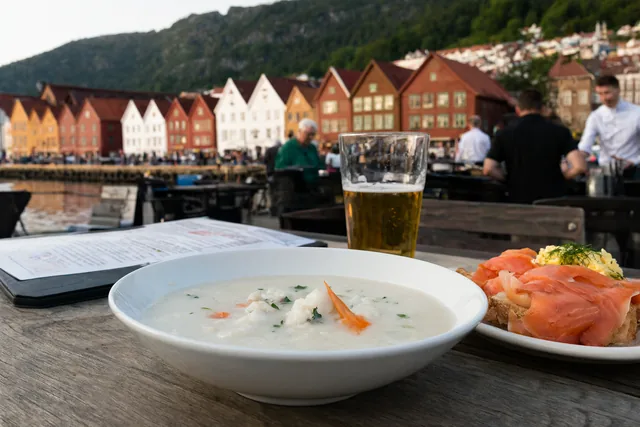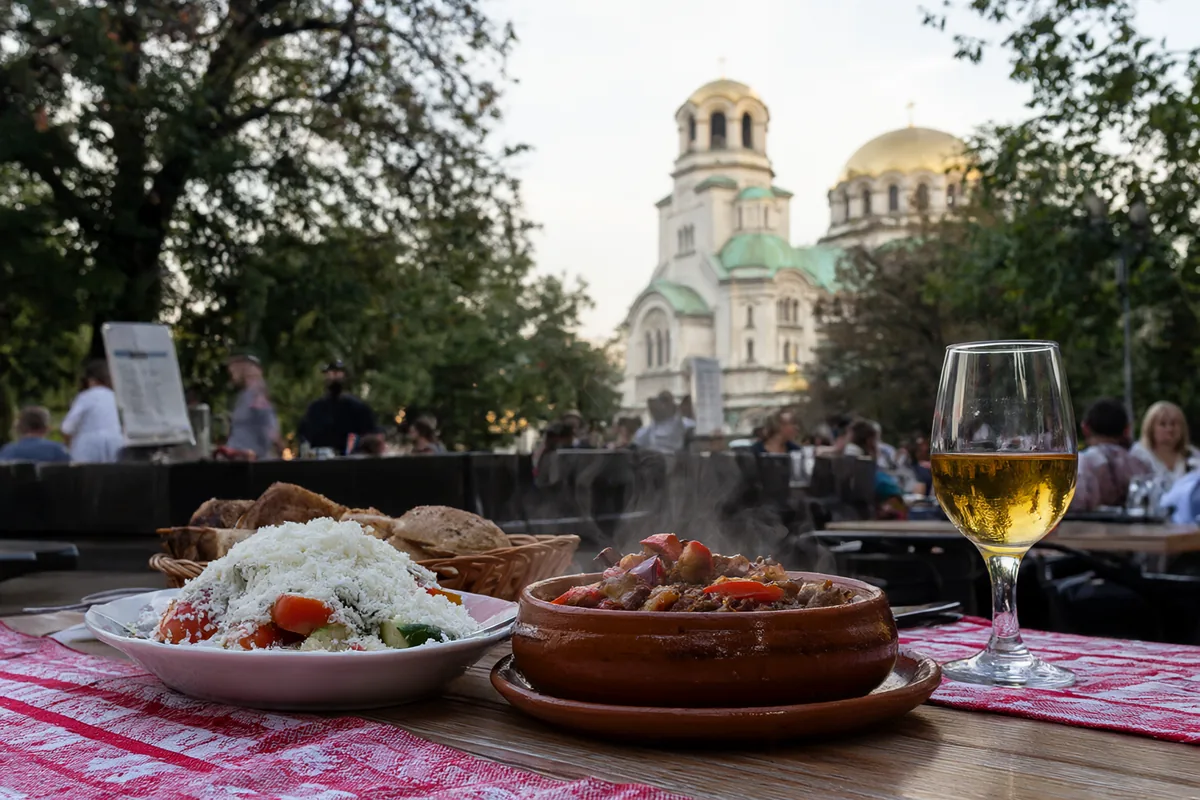
Bulgarian food is simple, fresh and very good value: salads of sun-ripened tomatoes and white cheese, grilled meats, stews baked in clay pots, flaky pastries and the yoghurt the country is famous for. This Bulgaria food guide covers the dishes to order, how to read a Bulgarian menu written in Cyrillic, tipping and paying, then goes town by town through where to eat in Sofia, Plovdiv, Veliko Tarnovo, Varna, Burgas, Bansko and the wine town of Melnik. A Bulgarian meal starts the same way almost everywhere: a salad and a small glass of rakia, ordered before anything else.
What to eat in Bulgaria: 12 dishes to know
Bulgarian cooking shares a lot with Greece, Turkey and the rest of the Balkans, but it has its own versions and its own names. These are the dishes to look for, with the Cyrillic name you will see on the menu.
- Shopska salata (шопска салата): tomato, cucumber, peppers and onion under a snowy layer of grated white cheese. The national salad.
- Tarator (таратор): a cold soup of yoghurt, cucumber, dill, garlic and walnuts, essential in summer.
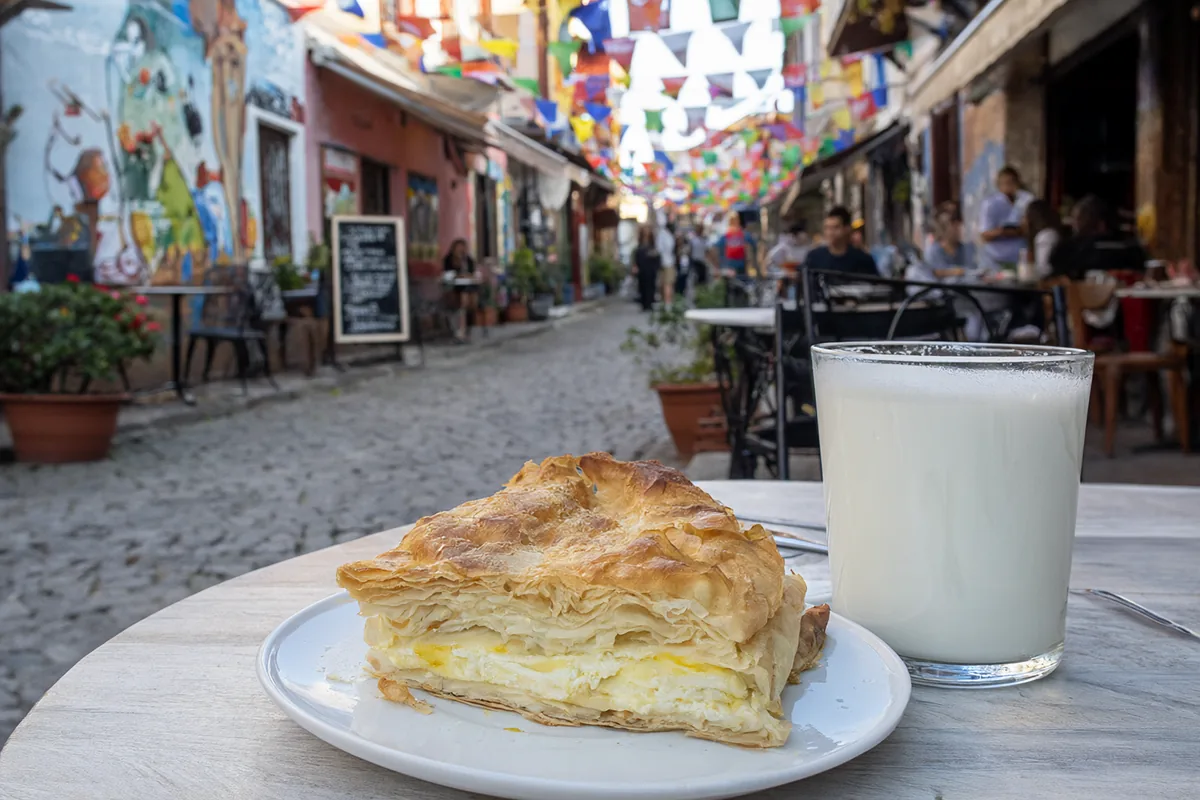
- Banitsa (баница): layers of filo pastry baked with eggs and white cheese, the classic breakfast, eaten with yoghurt drink or boza.
- Kebapche and kyufte (кебапче, кюфте): grilled minced meat, the first shaped into a long sausage, the second into a flat patty, seasoned with cumin and savory.
- Kavarma (кавърма): pork or chicken stewed with onion, peppers, mushrooms and wine, served bubbling in a clay pot.
- Gyuvech (гювеч): a stew of vegetables, often with meat, baked slowly in an earthenware dish. Kapama is the richer mountain version.
- Musaka (мусака): Bulgarian moussaka is made with potato rather than aubergine, minced meat and a yoghurt and egg topping.
- Sarmi (сарми): cabbage or vine leaves rolled around rice, with or without minced meat.
- Chushki byurek (чушки бюрек): roasted peppers stuffed with white cheese and egg, breaded and fried.
- Lyutenitsa (лютеница): a relish of roasted red peppers and tomato, spread on bread or served with grilled meat.
- Kiselo mlyako (кисело мляко): Bulgarian yoghurt, thick and sour, made with the bacterium named after the country. Often served with honey and walnuts.
- Rakia (ракия): grape or plum brandy, drunk slowly and cold with the salad at the start of the meal, not as a shot.
How to read a Bulgarian menu
Bulgarian is written in the Cyrillic alphabet, so menus can look impenetrable at first, though many restaurants in Sofia and the resorts add English. Menus follow a standard order: salads first, then starters and soups, then grilled meats and mains. Bulgarian menus almost always list the weight of each portion in grams, and grilled meats and fish are sometimes priced per 100 g. Here are the words to know.
| Bulgarian | Romanised | Meaning |
|---|---|---|
| Салати | Salati | Salads, ordered first, often with rakia |
| Предястия | Predyastiya | Starters |
| Супи | Supi | Soups |
| Основни ястия | Osnovni yastiya | Main courses |
| Скара | Skara | Grill: kebapche, kyufte, pork steaks, sausages |
| Гарнитури | Garnituri | Sides, ordered separately: chips, rice, salad |
| Десерти | Deserti | Desserts |
| Свинско / пилешко / телешко / агнешко | Svinsko / pileshko / teleshko / agneshko | Pork / chicken / veal or beef / lamb |
| Риба | Riba | Fish |
| Сирене / кашкавал | Sirene / kashkaval | White brined cheese / yellow cheese |
| Печено / пържено / на скара | Pecheno / parzheno / na skara | Roasted / fried / grilled |
| Хляб | Hlyab | Bread, often charged separately |
| Обедно меню | Obedno menyu | Weekday set lunch |
| Вегетарианско | Vegetariansko | Vegetarian |
When a Bulgarian menu lists fish as "100 г" next to the price, it is the price per 100 grams, not per plate, and a whole grilled sea bass can weigh several times that. Ask how heavy the fish is before it is cooked. swap.menu reads the Cyrillic, converts the price and flags per-weight items so you know what the plate will cost.
Tipping, the euro and paying the bill
Tipping is expected in Bulgarian restaurants, and around 10 percent is normal for good table service. In cafés and casual places, rounding up is enough. Service charges are uncommon, though a few places in the resorts add one; if it is on the bill, you do not need to tip on top. Our guide to tax and service charges on menus explains how these lines work around the world. VAT is already included in menu prices. Bread is often charged separately, and it will appear on the bill even if you did not ask for it.
Bulgaria adopted the euro (€) on 1 January 2026, replacing the lev (лв.). You may still see older menus, price lists or signs with prices in leva, so check which currency a figure is in. Cards and contactless payments are accepted in most restaurants in Sofia, Plovdiv and the coastal resorts, but village taverns and market stalls often prefer cash. When a card machine or cash machine offers to charge you in your home currency, decline and pay in euros. Our guide to paying in local currency explains why that choice costs you money.
Lunch is usually eaten between about noon and 2pm, and dinner from about 7pm to 10pm, later in summer on the coast. A Bulgarian dinner is unhurried: the salad and rakia can last half an hour before mains are even ordered. One more thing to know: many Bulgarians nod their head to mean "no" and shake it to mean "yes", so listen for da (yes) and ne (no) rather than watching for gestures.
Where to eat in Bulgaria, town by town
From the capital to the mountains and the Black Sea, the dishes stay familiar but the setting changes a great deal. Jump to a town:
Where to eat in Sofia
Sofia has the most varied food in Bulgaria, from traditional mehanas (taverns with wooden beams and folk decor) to modern Bulgarian restaurants, wine bars and international cooking. Vitosha Boulevard, the main pedestrian street, is lined with cafés and terraces with views of Vitosha mountain, but it is priced for visitors. For better value, explore the streets around Oborishte and the Doctor's Garden, and Tsar Ivan Shishman street, which has small cafés, wine bars and bistros.
The Central Market Hall (Tsentralni Hali), a 1911 building in the centre, has food stalls and produce, and the open-air Women's Market (Zhenski Pazar) nearby is the city's biggest and busiest market for fruit, vegetables, cheese and spices. Sofia's bakeries sell banitsa from early morning, and it is the standard Sofia breakfast with a cup of ayran (salted yoghurt drink) or boza, a thick, slightly fermented grain drink. Near the Central Mineral Baths, locals fill bottles at public taps of warm mineral spring water, and Sofia's tap water, piped from the mountains, is excellent too.
Where to eat in Plovdiv
Plovdiv is one of the oldest continuously inhabited cities in Europe, with a Roman theatre in the middle of town and an Old Town of colourful 19th century National Revival houses on its hills. It was a European Capital of Culture in 2019, and the Kapana district, a maze of narrow streets just off the main pedestrian street whose name means "the trap", was transformed into Plovdiv's favourite place to eat and drink, with cafés, craft beer bars, wine bars and small restaurants.
Plovdiv sits in the Thracian Valley, Bulgaria's most important farming and wine region, and its markets overflow with tomatoes, peppers and fruit in summer. Look for wine made from Mavrud, a deep, dark red grape grown around Plovdiv and nearby Asenovgrad. In the Old Town, a few restaurants are set in National Revival houses with courtyards, and the main pedestrian street, known locally as Glavnata, is good for a coffee and an evening walk. Plovdiv prices are lower than in Sofia.
Where to eat in Veliko Tarnovo
Veliko Tarnovo was the capital of the medieval Bulgarian Empire, and its houses cling to the steep slopes above a loop of the Yantra river, facing the walls of the Tsarevets fortress. The restaurants with terraces over the gorge are what most visitors come for, and on summer evenings the views of the river and the floodlit fortress make even simple dishes feel special. Order kavarma, gyuvech, grilled meats and shopska salata, with a glass of rakia.
The cobbled Samovodska Charshia, the old craftsmen's street, has workshops, sweet shops and cafés, and the village of Arbanasi, on the plateau above Veliko Tarnovo, has traditional mehanas in old stone houses. As a university town, Veliko Tarnovo has plenty of cheap places to eat away from the view terraces. The fortress sound and light show runs on some evenings, so check the schedule and book a table with a view if you want to watch it with dinner.
Where to eat in Varna
Varna is Bulgaria's biggest Black Sea city and its unofficial summer capital. The Sea Garden, a long park along the coast, leads down to beach bars and restaurants that fill from June to September. This is the place for Black Sea fish: tsatsa (цаца), tiny sprats fried crisp and eaten whole with lemon, safrid (horse mackerel), and in autumn lufer (bluefish). Mussels (midi) from local farms are served steamed, fried, or as a pilaf.
In the city centre, the streets around the cathedral and the pedestrian boulevard leading to the sea have cafés and restaurants that are open all year, while many beach places close in winter. Varna also makes a good base for exploring the northern coast, including the wine estates of the region and the cliffs at Cape Kaliakra. For the best value, eat where locals do in the centre rather than at beach bars in the big resorts north of the city.
Where to eat in Burgas
Burgas is the main city of the southern Black Sea coast, with its own Sea Garden, a long beach and lakes full of birdlife. It is a working port city, less touristy than the resorts around it, and its fish restaurants near the harbour serve the day's catch, grilled or fried. Order fried sprats, grilled horse mackerel, fish soup (riblya chorba) and mussels, with a Bulgarian white wine from the coastal vineyards.
Two of the best stops on the coast are close to Burgas. Sozopol, 30 minutes south, has an old town of wooden houses on a rocky peninsula with fish taverns overlooking the sea, and Nessebar, to the north, is a UNESCO-listed old town of Byzantine churches on a small island linked to the mainland. Both are busy in July and August, so book or eat early. Restaurants in the old towns charge more than those in Burgas itself.
Where to eat in Bansko
Bansko is Bulgaria's best-known ski resort, at the foot of the Pirin mountains, with an old town of stone houses and cobbled streets. It is famous for its mehanas, cosy taverns with open fires, wooden beams and, on many evenings, live folk music. The dish to order is banska kapama (банска капама), a rich mix of pork, chicken, sausage, sauerkraut and rice, slow-cooked for hours in a clay pot sealed with dough, often reserved for winter and served for two or more.
Bansko food is mountain food: grilled meats, sausages, potatoes, beans in clay pots and plenty of cheese, served with local red wine or rakia. In the ski season the mehanas are busy and lively; in summer, hikers and families fill the town, and prices drop. The old town around the church of the Holy Trinity has the most traditional taverns, while the newer streets near the gondola have more modern restaurants and bars.
Where to eat in Melnik
Melnik, in the far south-west near the Greek border, is often called Bulgaria's smallest town, a single street of white houses with wooden balconies set among tall sandstone pyramids. It is a wine town above all. The local grape, Shiroka Melnishka Loza (broad-leaved Melnik vine), makes a full-bodied red, and wine cellars cut into the sandstone hillside offer tastings straight from the barrel.
Melnik has a handful of family restaurants and mehanas serving grilled meats, kavarma, salads and local cheese, often on terraces under vines. It is popular as a weekend escape from Sofia, so the town can be quiet midweek and busy on Saturdays. Combine your visit with the Rozhen Monastery, a short drive or a beautiful walk into the hills, and allow time for a long, relaxed lunch.
Vegetarian, vegan and allergy tips
Bulgaria is easier for vegetarians than many Balkan countries. Salads, tarator, banitsa, chushki byurek, vegetable gyuvech, stuffed peppers with rice and beans, and endless dips such as lyutenitsa and snezhanka (yoghurt and cucumber) give you plenty of choice. The word for vegetarian is вегетарианско (vegetariansko) and for vegan веган (vegan). Watch for hidden meat: bean soup (bob chorba) and some vegetable stews are cooked with sausage or meat stock, and lard may be used in pastries in villages.
Vegans will find it harder, because white cheese and yoghurt appear in or on almost everything, including salads. Walnuts are common in tarator and desserts, and sesame appears in breads and halva. The Orthodox fasting tradition means some restaurants mark dishes as постно (postno, Lenten), made without animal products. Our guide to eating abroad with food allergies explains how to explain an allergy clearly when you do not speak the language.
Useful Bulgarian phrases for ordering
Добър ден Dobar den: "Good day", the polite greeting to staff (Добър вечер, dobar vecher, in the evening)
Маса за двама, моля Masa za dvama, molya: "A table for two, please"
Какво ще ни препоръчате? Kakvo shte ni preporachate?: "What do you recommend?"
Ще взема това Shte vzema tova: "I will have this" (pointing)
Без месо, моля Bez meso, molya: "Without meat, please"
Алергичен / алергична съм към... Alergichen / alergichna sam kam...: "I am allergic to..." (alergichen for a man, alergichna for a woman)
Сметката, моля Smetkata, molya: "The bill, please"
Наздраве! Nazdrave!: "Cheers!" Look people in the eye as you clink glasses
How swap.menu helps you eat in Bulgaria
Outside central Sofia and the beach resorts, many Bulgarian menus are in Cyrillic only, and the mehanas with the best home cooking rarely have an English version. Photograph the menu with swap.menu and every dish appears in your language with the Bulgarian name beside it and a short explanation, so you know that шкембе чорба (shkembe chorba) is tripe soup with garlic and vinegar, and that капама is a slow-cooked meat and sauerkraut pot, before you order. Every price is converted from euros to your home currency, older prices in leva are recognised, and we flag dishes priced per 100 g and bread charged separately.
Tap the dishes you want, add a note such as "no cheese on the salad" or "no meat stock", typed or spoken, and swap.menu translates your order into Bulgarian. Show the waiter your phone, or let them scan the QR code and read your order on their own screen. You can try it right now on a sample menu with the free demo, or see travel pass prices.
Off to Bulgaria? Your first 3 menu scans are free, and a travel pass starts from $4.99 with nothing that renews.
Start free with 3 scansBulgaria food FAQ
Do you tip in restaurants in Bulgaria?
Yes, about 10 percent is normal for good service in a sit-down restaurant, and rounding up is enough in cafés. Service charges are uncommon, but if one is on the bill you do not need to tip on top.
What food is Bulgaria famous for?
Shopska salad, banitsa (cheese pastry), tarator (cold yoghurt soup), kebapche and kyufte (grilled minced meat), kavarma and gyuvech (clay pot stews) and Bulgarian yoghurt are the best known. Rakia, the fruit brandy served with salad, is the national drink.
Is Bulgaria expensive to eat out?
Bulgaria is one of the cheapest countries in the EU for eating out. Even in Sofia and the coastal resorts a full meal with wine costs much less than in western Europe, though prices at beach bars and on Vitosha Boulevard are higher.
What currency does Bulgaria use?
Bulgaria has used the euro since 1 January 2026, when it replaced the Bulgarian lev. You may still see older signs or menus with prices in leva, so check which currency a price refers to.
Is tap water safe to drink in Bulgaria?
Tap water in Sofia and most cities is safe to drink, and Sofia's water from the mountains is particularly good. In some smaller towns and on the coast in summer, many people prefer bottled water.
How can I read a Bulgarian menu in Cyrillic?
Learn a few words such as салати (salads), скара (grill) and основни ястия (mains), or photograph the menu with swap.menu. It reads the Cyrillic, translates every dish into your language, explains what it is, converts prices to your currency and translates your order back into Bulgarian for the waiter.
Travelling further in Europe? Read our food guides for neighbouring countries:
Or browse every travel food guide.