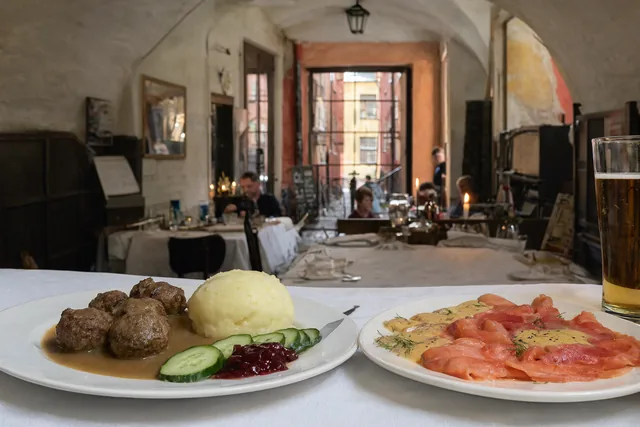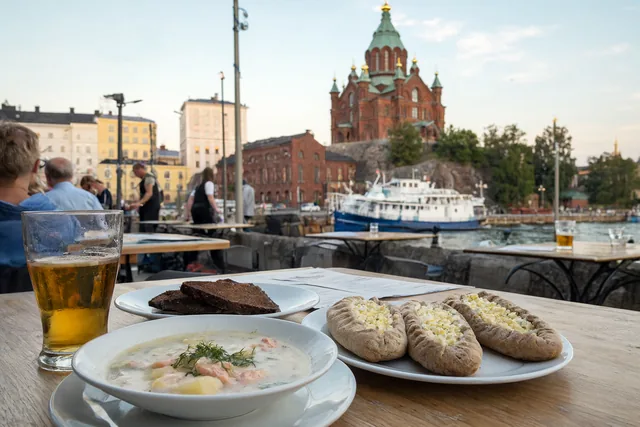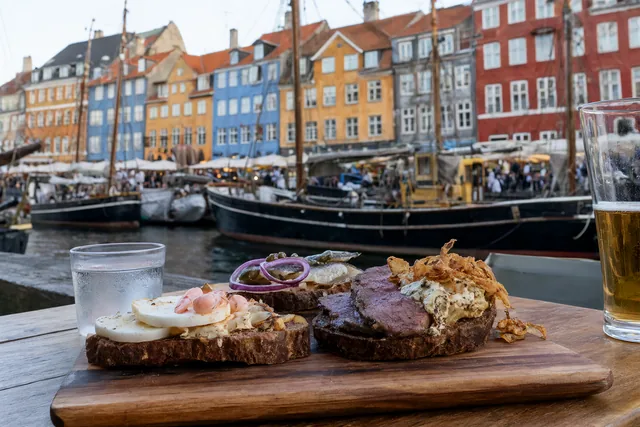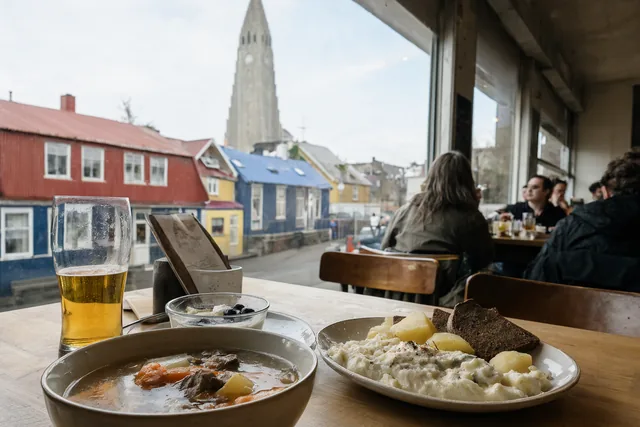
Norway has some of the best seafood in the world, pulled from cold, clean water along one of the longest coastlines in Europe, and a food culture shaped by preserving it: drying, salting, smoking and curing. This Norway food guide covers the dishes to order, how to read a Norwegian menu, tipping and how to handle the prices, then goes city by city through where to eat in Oslo, Bergen, Trondheim, Stavanger, Ålesund and Tromsø, and in the fishing villages of Lofoten. Eating out in Norway is expensive, so it pays to know where the good value is.
What to eat in Norway: 12 dishes to know
Norwegian food is built on fish, lamb, game, potatoes and dairy, and much of it is seasonal. These are the dishes to look for, with the region or season they belong to.
- Laks (everywhere): salmon, served smoked (røkt laks), cured with dill (gravlaks) or pan-fried. Norway is the world's biggest salmon producer.
- Skrei (January to April): migrating Arctic cod caught in winter off Lofoten and northern Norway, prized for its firm white flesh. Often served as mølje, poached cod with its liver and roe.
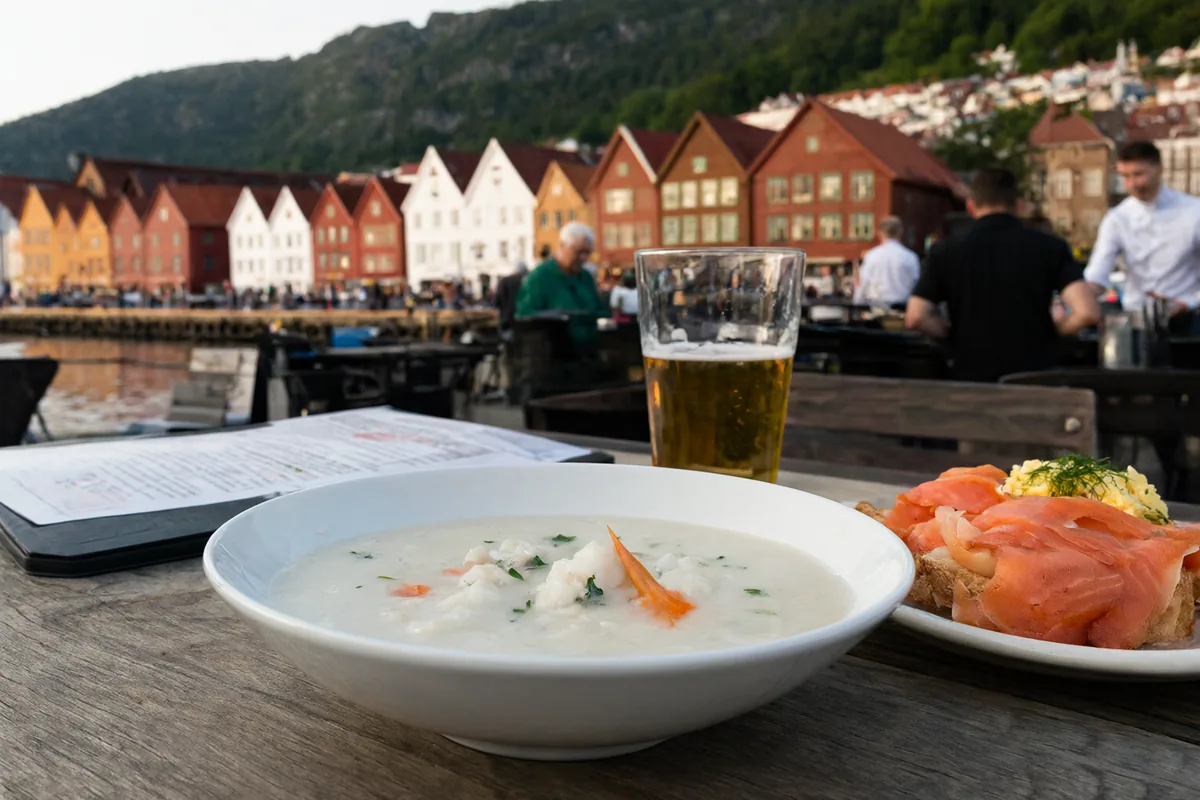
- Bergensk fiskesuppe (Bergen): a creamy, lightly sweet fish soup with white fish, vegetables and sometimes shrimp.
- Fårikål (autumn): mutton or lamb stewed slowly with cabbage and whole black pepper, Norway's national dish.
- Kjøttkaker (everywhere): seasoned meat cakes in brown gravy, with boiled potatoes, mashed peas and lingonberry jam.
- Fiskekaker (everywhere): soft fish cakes, eaten in bread or with potatoes and white sauce.
- Bacalao (Ålesund and the west coast): a stew of klippfisk (dried salt cod) with tomato, potato, onion and olive oil, a dish Norway adopted from its trade with Spain and Portugal.
- Tørrfisk (Lofoten): stockfish, cod dried in the open air on wooden racks, eaten as a snack or soaked and cooked.
- Reinsdyr and elg (the north and the mountains): reindeer and elk. Finnbiff is thinly sliced reindeer sautéed with mushrooms and cream.
- Kongekrabbe (Finnmark and Tromsø): red king crab from the Barents Sea, served simply boiled with bread and butter.
- Brunost (everywhere): sweet, caramel-coloured brown cheese made from whey, sliced thin with a cheese slicer onto bread or heart-shaped waffles (vafler).
- Pinnekjøtt and lutefisk (Christmas): salted, dried lamb ribs steamed over birch sticks, and dried cod soaked in lye until it turns jelly-like. Both appear on menus from November.
How to read a Norwegian menu
Most restaurants in Norwegian cities have an English menu, but cafés, lunch places and country inns often do not. Dinner menus usually offer a few starters and mains, and many restaurants also offer a set menu of three to five courses. At lunch, look for dagens rett, the dish of the day, often the cheapest hot meal on offer. Here are the words you will see most.
| Norwegian | Meaning |
|---|---|
| Forrett | Starter |
| Hovedrett | Main course |
| Dessert | Dessert |
| Lunsj / middag | Lunch / dinner |
| Dagens rett / dagens suppe | Dish of the day / soup of the day |
| Fisk / laks / torsk | Fish / salmon / cod |
| Reker / krabbe / blåskjell | Shrimp / crab / mussels |
| Svin / storfe / lam | Pork / beef / lamb |
| Reinsdyr / elg / vilt | Reindeer / elk (moose) / game |
| Poteter | Potatoes |
| Stekt / kokt / røkt / grillet | Fried / boiled / smoked / grilled |
| Smørbrød | Open sandwich |
| Springvann | Tap water |
| Vegetar / vegansk / glutenfri | Vegetarian / vegan / gluten-free |
At seafood stalls and fish restaurants, king crab, lobster and shellfish are often priced per kilo or per 100 g, which makes the number on the board look much smaller than the bill. Ask how much your portion weighs before you order. swap.menu flags priced-by-weight items and converts every price from Norwegian kroner to your home currency, so a crab lunch holds no surprises.
Tipping, prices and paying the bill
Service is included in Norwegian restaurant prices, and staff are paid a good wage, so tipping is optional. At dinner, Norwegians may round up or leave 5 to 10 percent for good service, and card machines often show a tip screen, but there is no obligation, and tipping is not expected at lunch or in cafés. Our guide to tax and service charges on menus explains how this compares with countries where service is added on top. VAT (mva) is included in menu prices.
Prices are in Norwegian kroner (kr, code NOK); Norway is not in the EU and does not use the euro. Cards and phone payments are accepted almost everywhere, and many Norwegians never carry cash. When a card machine offers to charge you in your home currency, decline and pay in kroner: our guide to paying in local currency explains why that choice costs you money.
Norway is expensive, and alcohol especially so. Wine and spirits are sold in shops only by the state monopoly, Vinmonopolet, and supermarkets can sell beer only until 8pm on weekdays and 6pm on Saturdays, with no sales on Sundays. To save money, eat your main meal at lunch, look for dagens rett, buy from bakeries and fish counters, and drink tap water, which restaurants usually provide free.
Norwegians eat early. Many people eat a packed lunch (matpakke) around 11am to noon, and the family dinner (middag) is often at 4pm to 6pm. Restaurants serve dinner from about 5pm, and outside Oslo and Bergen many kitchens close by 9pm or 10pm.
Where to eat in Norway, city by city
Norway's cities are spread along a long coast, and the food changes from the farmland of the south to the Arctic north. Jump to a destination:
Where to eat in Oslo
Oslo has the widest choice of food in Norway, from New Nordic tasting menus to cheap multicultural cafés. Mathallen, a food hall in a converted industrial building at Vulkan, by the Akerselva river, has stalls selling Norwegian cheese, cured meats, fish and bread, plus small restaurants and bars, and is a good place for an affordable lunch. Next door, Grünerløkka is Oslo's liveliest neighbourhood for cafés, bars and casual restaurants, especially around Olaf Ryes plass.
The waterfront at Aker Brygge and Tjuvholmen has terraces facing the Oslofjord and is lovely on a summer evening, though prices are high. For cheaper food, head to Grønland and Tøyen, east of the centre, where Oslo's immigrant communities run kebab shops, Pakistani, Turkish and Somali restaurants and grocers. Oslo takes coffee seriously, with many specialty roasters and cafés, and a coffee and a cinnamon bun or a waffle with brown cheese is the cheapest way to sit down in the city.
Where to eat in Bergen
Bergen, on the west coast between the mountains and the sea, was named a UNESCO City of Gastronomy in 2015, and seafood is its pride. The Fish Market (Fisketorget) at the head of the harbour has traded since the Middle Ages; today it has outdoor stalls in summer and an indoor hall year round, selling shrimp, crab, salmon, fish soup and fish cakes, with tables to eat at. It is aimed at visitors and prices are high, so check the price per kilo and what is included before you order.
Across the harbour, Bryggen, the row of colourful wooden Hanseatic warehouses listed by UNESCO, has restaurants in its old buildings and passages. Order Bergensk fiskesuppe, fish cakes and, in autumn, raspeballer, large potato dumplings served with salted meat, often on Thursdays. Bergen's bakeries are known for skillingsboller, large cinnamon buns. Bergen is famous for rain, so plan for cosy cafés, and take the Fløibanen funicular up the mountain for the view when the clouds lift.
Where to eat in Trondheim
Trondheim is a university city on a fjord in central Norway, built around the great medieval Nidaros Cathedral. The surrounding Trøndelag region, a fertile farming and fishing area, was named a European Region of Gastronomy in 2022, and Trondheim restaurants have built close links with local farms, dairies and fishermen. The local dish is sodd, a clear meat soup with small meatballs and cubes of meat, traditionally served at celebrations.
The old district of Bakklandet, across the Old Town Bridge, is a cluster of colourful wooden houses with cafés and small restaurants, and is the best place in Trondheim for coffee and cake. The harbour area of Solsiden, in converted shipyard buildings, has restaurants and bars along the water. Trondheim is also a good place to try local cheeses and cured meats from Trøndelag farms, often sold at the weekend market in the main square.
Where to eat in Stavanger
Stavanger, on the south-west coast, is Norway's oil capital, and its wealth shows in a strong restaurant scene for a city of its size. The farmland of Jæren to the south supplies lamb, dairy and vegetables, and the sea supplies everything else. Every summer Stavanger hosts Gladmat, one of the largest food festivals in Scandinavia, when the harbour fills with food stalls and local producers.
The old town, Gamle Stavanger, is a quiet neighbourhood of white wooden houses on cobbled lanes, and the brightly painted Øvre Holmegate street nearby is lined with cafés and bars. Restaurants around the inner harbour, Vågen, serve seafood with views of the boats. Stavanger is the base for the hike to Pulpit Rock (Preikestolen) and for fjord cruises, so many visitors eat early and come back hungry; book dinner on summer evenings.
Where to eat in Ålesund
Ålesund is a fishing port on a string of islands on the west coast, rebuilt in an elegant Art Nouveau style after a fire destroyed the town in 1904. It is the heart of Norway's klippfisk trade: cod salted and dried on the rocks, exported for centuries to Spain, Portugal and Brazil. The dish to order is bacalao, a stew of klippfisk with tomato, potato, peppers and olive oil, which Norwegians took home from their trading partners and made their own.
Restaurants line the Brosundet canal through the centre, and many serve the day's catch, from cod and halibut to monkfish. For the best view of Ålesund, climb the steps up Mount Aksla, then come back down for dinner. Ålesund is also the gateway to the Geirangerfjord, so in summer the town is busy with cruise passengers during the day and quieter in the evening.
Where to eat in Tromsø
Tromsø is the biggest city in Arctic Norway, famous for the northern lights in winter and the midnight sun in summer. Its restaurants specialise in Arctic produce: king crab, Arctic char (røye), skrei in winter, reindeer and cloudberries. Many offer an Arctic menu that combines several of these, and king crab safaris from nearby fjords end with a crab feast. Some restaurants also serve whale meat, which Norway still hunts; if you would rather avoid it, look for hval on the menu.
The centre of Tromsø is compact, with restaurants and bars along Storgata, the main street, and around the harbour. Tromsø is home to one of the world's northernmost breweries, and its historic beer hall is a local institution. In the dark winter months, many visitors spend their evenings on northern lights tours, so restaurants often serve dinner early or late around tour times. Prices are similar to Oslo.
Where to eat in Lofoten
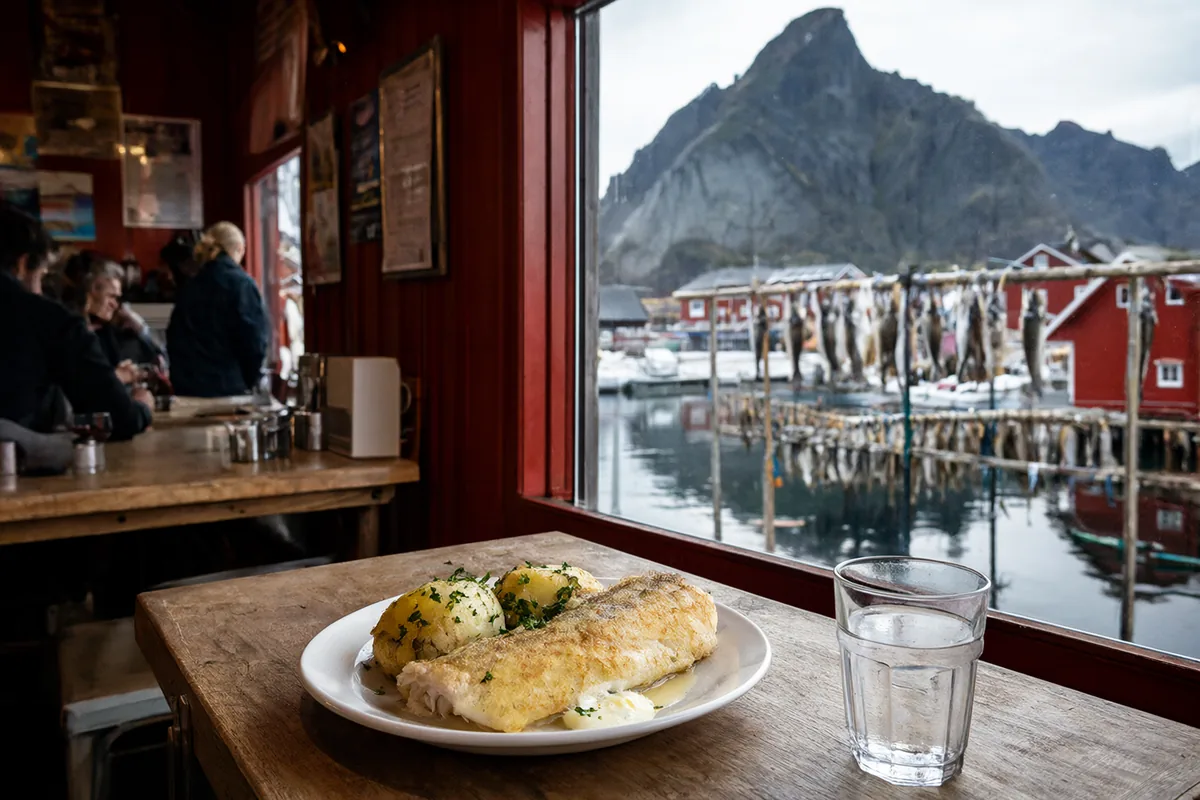
The Lofoten islands, above the Arctic Circle, are a chain of jagged mountains rising straight from the sea, with fishing villages tucked into the bays. Lofoten has been the centre of Norway's winter cod fishery for a thousand years, and from February to May the villages are lined with wooden racks of cod drying in the wind to make tørrfisk (stockfish), a protected regional product. Order fresh cod, fish cakes, fried torsketunger (cod tongues, traditionally cut by local children in winter for pocket money) and Lofoten lamb.
Many restaurants are in rorbuer, red wooden fishermen's cabins on stilts over the water, in villages such as Reine, Henningsvær, Svolvær and Å, which also has a stockfish museum. Lofoten is busiest in summer, under the midnight sun, and in late winter for the skrei season; in between, some restaurants close. Supermarkets are limited in smaller villages, so plan your meals, and book dinner in July and August.
Vegetarian, vegan and allergy tips
Traditional Norwegian food is heavy on fish, meat and dairy, but Oslo, Bergen and the other cities have plenty of vegetarian and vegan restaurants, and most menus include at least one vegetarian main. The word for vegetarian is vegetar or vegetarisk, and for vegan vegansk. In smaller towns and rural inns, the choice can be limited to a vegetable soup or a pasta. Watch for fish stock in soups and sauces, and for pork fat in some traditional dishes.
Dairy is everywhere in Norwegian cooking, from cream sauces to brown cheese, but lactose-free (laktosefri) and gluten-free (glutenfri) options are widely understood and often marked on menus. Shellfish allergy sufferers should ask about fish soups and sauces, which often include shrimp or shellfish stock. Our guide to eating abroad with food allergies explains how to explain an allergy clearly when you do not speak the language.
Useful Norwegian phrases for ordering
Hei "Hello", used everywhere, at any time of day
Et bord til to, takk "A table for two, please"
Hva anbefaler du? "What do you recommend?"
Jeg tar denne "I will have this one" (pointing)
Jeg er allergisk mot... "I am allergic to..."
Kan vi få regningen? "Can we have the bill?"
Skål! "Cheers!" Look your companions in the eye
Takk for maten "Thanks for the food", said at the end of a meal
How swap.menu helps you eat in Norway
Norwegians speak excellent English, but many lunch places, cafés and village restaurants list their dishes in Norwegian only, and traditional dish names give little away. Photograph the menu with swap.menu and every dish appears in your language with the Norwegian name beside it and a short explanation, so you know that smalahove is a whole salted, smoked sheep's head, and that rømmegrøt is a sour cream porridge with butter, cinnamon and sugar, before you order. Every price is converted from Norwegian kroner to your home currency, which matters in one of the most expensive countries in Europe.
Tap the dishes you want, add a note such as "no shellfish" or "lactose-free, please", typed or spoken, and swap.menu translates your order into Norwegian. Show the waiter your phone, or let them scan the QR code and read your order on their own screen. You can try it right now on a sample menu with the free demo, or see travel pass prices.
Off to Norway? Your first 3 menu scans are free, and a travel pass starts from $4.99 with nothing that renews.
Start free with 3 scansNorway food FAQ
Do you tip in restaurants in Norway?
Tipping is optional in Norway because service is included in menu prices. Rounding up or leaving 5 to 10 percent for good service at dinner is appreciated, but it is not expected, and nobody tips at lunch counters or cafés.
What food is Norway famous for?
Salmon, cod (especially winter skrei), stockfish, king crab, fårikål (mutton and cabbage stew), brown cheese and waffles are the best known. Bergen fish soup and bacalao from Ålesund are famous regional dishes.
Is Norway expensive to eat out?
Yes, Norway is one of the most expensive countries in the world for eating out, and alcohol is particularly expensive. Lunch deals, bakeries, food halls and fish counters are the best ways to eat well for less.
Is tap water safe to drink in Norway?
Yes, Norwegian tap water is clean and safe to drink everywhere. Restaurants usually bring tap water (springvann) free of charge if you ask.
What time do Norwegians eat dinner?
Norwegians eat early, often at 4pm to 6pm at home. Restaurants serve dinner from about 5pm, and many kitchens outside the big cities close by 9pm or 10pm.
How can I read a Norwegian menu if I do not speak Norwegian?
Learn a few words such as forrett (starter), hovedrett (main) and dagens rett (dish of the day), or photograph the menu with swap.menu. It translates every dish into your language, explains what it is, converts prices from kroner to your currency and translates your order back into Norwegian for the waiter.
Travelling further in Europe? Read our food guides for neighbouring countries:
- Sweden food guide
- Denmark food guide
- Finland food guide
- Iceland food guide
- United Kingdom food guide
Or browse every travel food guide.