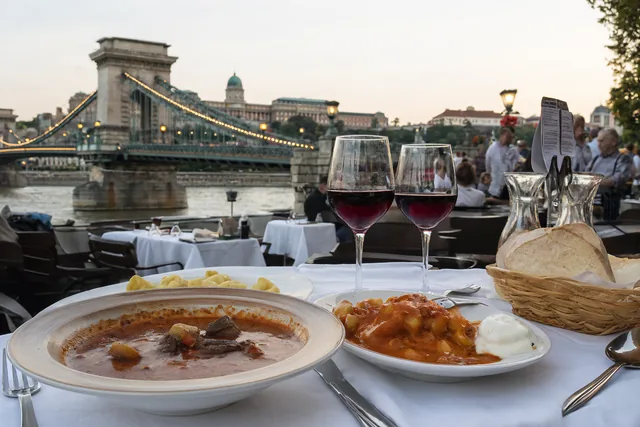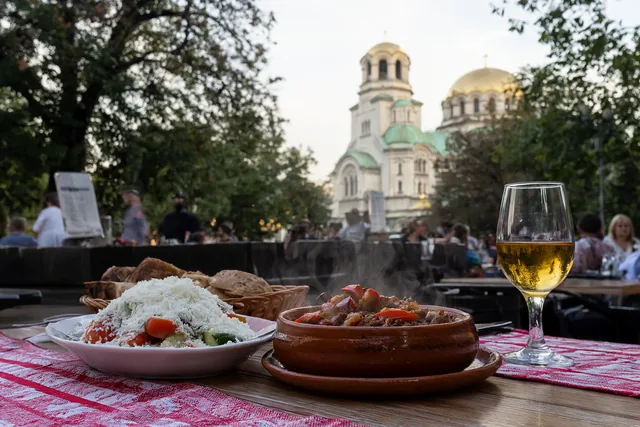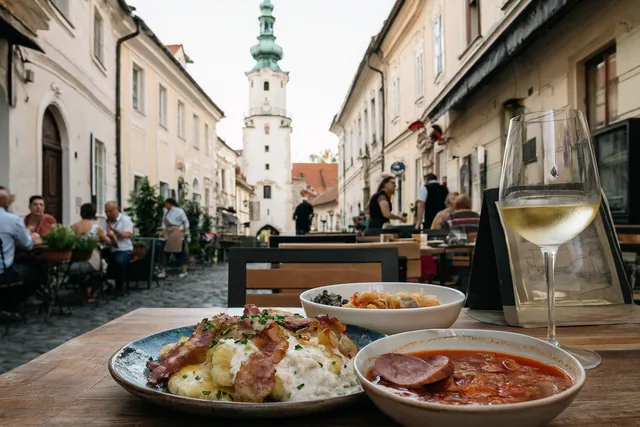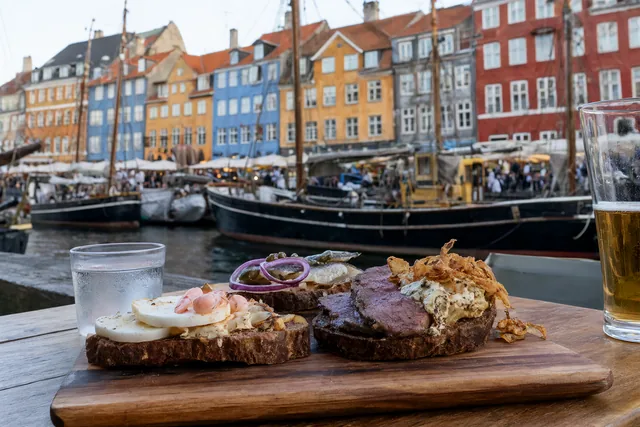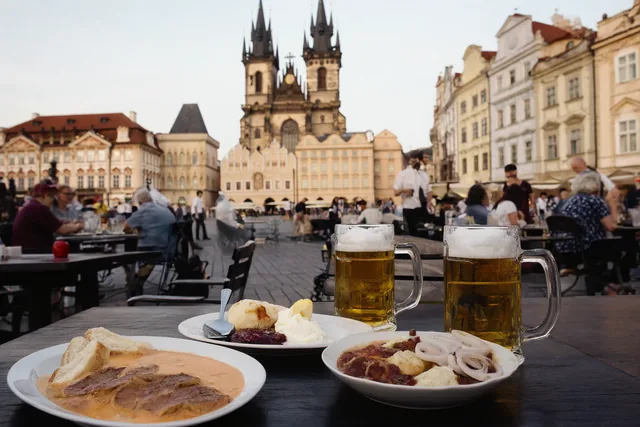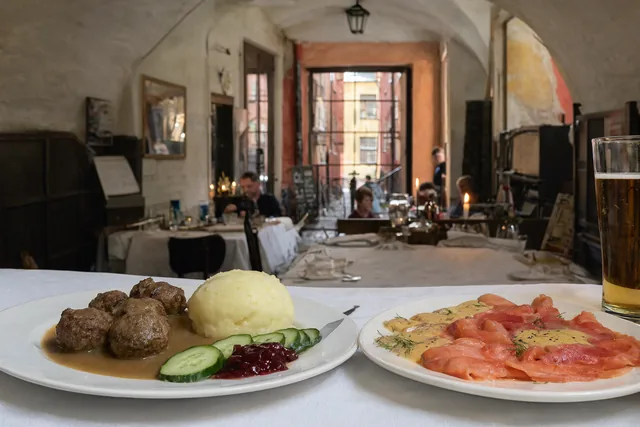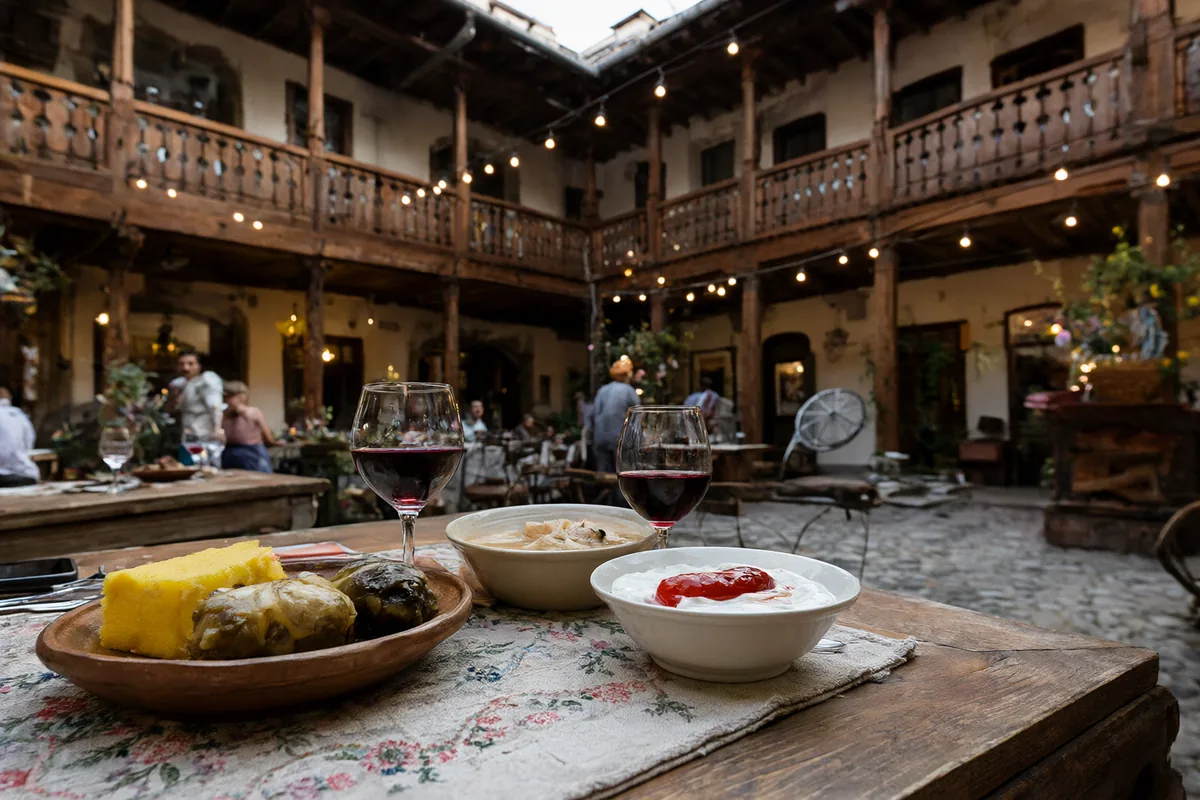
Romanian food is generous country cooking: sour soups, cabbage rolls, grilled meats, polenta with cheese and sour cream, and fruit brandy poured as a welcome. This Romania food guide covers the dishes to order, how to read a Romanian menu, tipping and paying, then goes city by city through where to eat in Bucharest, Brașov, Sibiu, Cluj-Napoca, Timișoara and Iași, and out to the fish kitchens of the Danube Delta. Romania sits where Balkan, Hungarian, Saxon German, Turkish and Slavic traditions meet, and the cooking changes noticeably as you cross from one region to the next.
What to eat in Romania: 12 dishes to know
These are the dishes you will see across the country, with the region they come from where it matters. Almost every meal starts with a soup.
- Sarmale (everywhere): cabbage or vine leaves rolled around minced pork and rice, slow-cooked, served with mămăligă, sour cream and a hot pepper. The national dish.
- Mici or mititei (everywhere): small skinless grilled rolls of minced meat with garlic and herbs, eaten with mustard, bread and a cold beer.
- Ciorbă de burtă (everywhere): tripe soup soured with vinegar and enriched with sour cream, egg yolk and garlic. Far better than it sounds.
- Ciorbă de perișoare (everywhere): a sour soup with small meatballs, vegetables and lovage.
- Ciorbă rădăuțeană (Bucovina): a creamy, garlicky sour chicken soup from the north.
- Mămăligă (everywhere): cornmeal polenta, served as a side or as a dish in its own right with cheese and sour cream. Baked balls of it stuffed with cheese are called bulz.
- Tochitură (everywhere): a pan stew of pork and sausage, served with mămăligă, a fried egg and salty white cheese.
- Varză a la Cluj (Cluj and Transylvania): layered sauerkraut, minced meat and rice baked with sour cream.
- Zacuscă and salată de vinete (everywhere): roasted aubergine and pepper spread, and a smoky aubergine dip with onion, both eaten on bread.
- Papanași (everywhere): fried cheese doughnuts topped with sour cream and sour cherry or blueberry jam. The essential Romanian dessert.
- Cozonac and covrigi (everywhere): sweet bread swirled with walnuts and cocoa, eaten at Easter and Christmas, and the thin, salted pretzel rings sold from street windows all day.
- Țuică and pălincă (everywhere): plum brandy, often homemade, served in small glasses. Pălincă is the stronger, double-distilled Transylvanian version.
How to read a Romanian menu
Romanian is a Latin language, so speakers of Italian, Spanish or French will recognise a surprising number of words. Menus follow the order of soups and starters, mains, sides and desserts, and sides (garnituri) are usually ordered and priced separately. Romanian menus almost always list the portion weight (gramaj) in grams next to each dish, which helps you judge how much food is coming.
| Romanian | Meaning |
|---|---|
| Aperitive / gustări | Starters / small plates |
| Ciorbe și supe | Sour soups and soups |
| Feluri principale | Main courses |
| Garnituri | Sides, ordered separately: potatoes, rice, mămăligă |
| Salate | Salads, often pickles or simple tomato and cucumber |
| Deserturi | Desserts |
| Porc / vită / pui / miel | Pork / beef / chicken / lamb |
| Pește / crap / păstrăv | Fish / carp / trout |
| La grătar / prăjit / la cuptor | Grilled / fried / baked |
| Smântână / brânză | Sour cream / cheese |
| De post | Lenten, made without animal products for Orthodox fasting days, usually vegan |
| Meniul zilei | Menu of the day, a weekday set lunch |
| Apă plată / apă minerală | Still water / sparkling mineral water |
| Preț / 100 g | Price per 100 grams, common for fish and grilled meat |
Fish and grilled meat in Romanian restaurants are often priced per 100 g, and the number on the menu is not the price of your plate. Ask how heavy the piece is before it is cooked. swap.menu reads the gramaj and per-100 g prices on the menu and converts them for you, so the bill does not surprise you.
Tipping, service and paying the bill
Tipping (bacșiș) is expected in Romanian restaurants, and about 10 percent is the normal amount for good table service. Service charges are rarely added, though some places include one for large groups; check the bill, and if service is already included, there is no need to tip on top. Our guide to tax and service charges on menus explains how these lines work. VAT is already included in menu prices.
Many card machines in Romania cannot add a tip, so most people pay the bill by card and leave the tip in cash on the table or hand it to the waiter. Carry some small notes for this.
Prices are in Romanian lei (the leu, plural lei, code RON), not euros. Cards and contactless payments are widely accepted in cities, but markets, village guesthouses and roadside stalls often want cash. When a card machine or cash machine offers to charge you in your home currency, decline and pay in lei. Our guide to paying in local currency explains why that choice costs you money.
Lunch is usually eaten between about 1pm and 3pm and is often the main meal, while dinner runs from about 7pm to 10pm, later in summer and in Bucharest. Many restaurants serve all day without closing between services.
Where to eat in Romania, city by city
Wallachia in the south, Transylvania in the centre, Moldavia in the east and Banat in the west each have their own cooking. Jump to a place:
Where to eat in Bucharest
Bucharest is a big, sprawling capital, and its food scene ranges from grand Belle Époque beer halls to cheap street windows selling covrigi and shaorma (Romanian shawarma, the default late-night meal). The Old Town (Centrul Vechi), around Lipscani street, is packed with bars and restaurants and is where most visitors start; it is lively at night, but the food is often aimed at tourists. A few historic inns from the 19th century, built around courtyards with wooden galleries, survive near the Old Town and are worth a visit for traditional dishes in a grand setting.
For a taste of everyday Bucharest, go to Piața Obor, the city's largest market, where the grill stalls selling mici, sausages and beer draw crowds at weekends. The smaller Piața Amzei near the centre has produce and food stalls. The residential neighbourhoods of Floreasca, Dorobanți and Cotroceni have Bucharest's more modern restaurants and cafés, and Calea Victoriei, the old main avenue, is lined with cafés and pastry shops. On weekdays, look for the meniul zilei in office districts, a set lunch of soup and a main at a low fixed price.
Where to eat in Brașov
Brașov is a medieval Transylvanian city at the foot of the Carpathians, founded by Saxon Germans, and its old town is one of the prettiest in Romania. The main square, Piața Sfatului (Council Square), and the pedestrian Strada Republicii are lined with terraces, and the Gothic Black Church looms over the rooftops. Order bean soup with smoked pork (ciorbă de fasole cu afumătură) served inside a round bread loaf, sarmale, mountain trout and grilled sausages, and look for stalls selling kürtőskalács (chimney cake), a Transylvanian Hungarian sweet sold all over the region.
Brașov is the base for visiting Bran Castle, the fortified Saxon churches of the surrounding villages and the mountain resort of Poiana Brașov, and the restaurants of Brașov reflect the busy tourist trade. Prices on the main square are higher than in the side streets, so walk a few minutes into the old Schei quarter or along the lanes off Republicii for better value. Mountain cheeses such as brânză de burduf, a sharp sheep's cheese packed in fir bark, are sold at local markets.
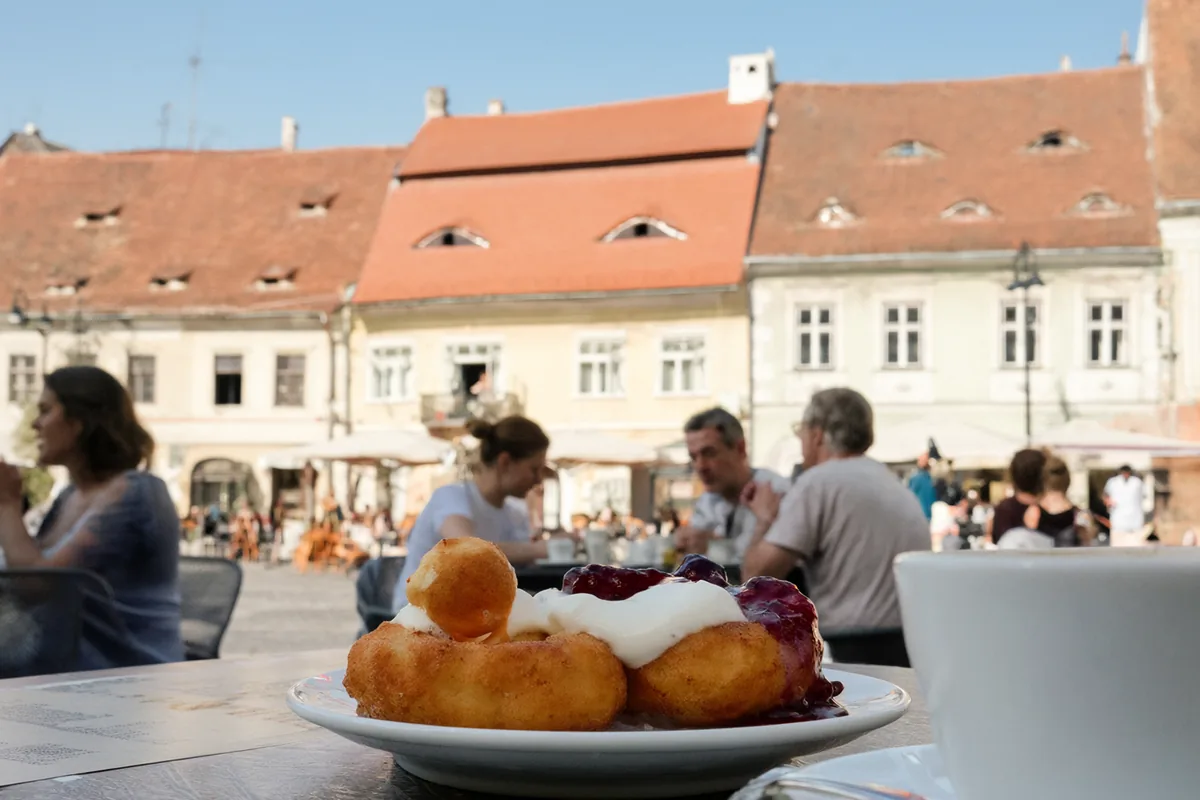
Where to eat in Sibiu
Sibiu is a Saxon city in southern Transylvania, famous for the roof windows on its old houses that look like half-closed eyes. It was a European Capital of Culture in 2007, and Sibiu county was named a European Region of Gastronomy in 2019 for its village cooking and producers. The two main squares, Piața Mare and Piața Mică, connected by the Bridge of Lies, are full of terraces, and Sibiu's restaurants serve both Romanian classics and Saxon dishes such as stuffed cabbage and stews.
The villages of Mărginimea Sibiului, just west of the city, are shepherding country, and their sheep's cheeses, smoked meats and lamb appear on menus across the region. Sibiu salami (salam de Sibiu), a dry, mould-ripened salami, is protected as a regional product. Sibiu also hosts many summer festivals, and the Christmas market on Piața Mare in December is one of the best in Romania, with mulled wine, sausages and chimney cakes.
Where to eat in Cluj-Napoca
Cluj-Napoca is the unofficial capital of Transylvania, a big university city with a fast-growing tech industry and a young, lively feel. It has a large Hungarian community, and many menus include Hungarian dishes alongside Romanian ones. The local signature is varză a la Cluj, layered cabbage with minced meat and rice, baked with sour cream. Cluj also has some of Romania's best specialty coffee bars, craft beer bars and modern Romanian restaurants.
The centre of Cluj-Napoca is Piața Unirii, with the Gothic St Michael's Church, and the streets around it, including the pedestrian Strada Potaissa and the lanes towards Piața Muzeului, are full of restaurants and bars. With so many students, lunch menus are cheap and easy to find. In August, the Untold music festival fills the city, and accommodation and restaurant tables are hard to come by, so book ahead if your trip overlaps.
Where to eat in Timișoara
Timișoara is the main city of the Banat region in western Romania, close to the Hungarian and Serbian borders. It has long been one of the most multicultural cities in the country, with Romanian, Hungarian, Serbian and German communities, and its cooking blends all of them: paprika stews, schnitzels, strudels, and Serbian-style grilled meats. Timișoara was a European Capital of Culture in 2023, and the restoration that came with it brightened its baroque and Secession-era centre.
The two main squares, Piața Unirii and Piața Victoriei, are connected by streets of cafés and restaurants, and the riverside along the Bega canal has bars and terraces that fill on summer evenings. Timișoara was one of the first cities in Europe to light its streets with electricity, in 1884, and it still has a reputation for coffee houses and pastry shops. Prices are lower than in Bucharest and Cluj.
Where to eat in Iași
Iași, in the north-east, is the historic capital of Moldavia and one of Romania's great university and cultural cities, home to the vast neo-Gothic Palace of Culture. Moldavian cooking is famous within Romania for its pastries and sweets. Look for plăcinte (filled pastries) of cheese, pumpkin or cabbage, and poale-n brâu, sweet cheese pastries with corners folded into the middle. Iași restaurants also serve the classic sour soups, sarmale and meatballs (chiftele).
Iași is the gateway to the Cotnari wine region, known for sweet and dry whites such as Grasă de Cotnari, Fetească Albă and Tămâioasă Românească, and to the painted monasteries of Bucovina further north, home of ciorbă rădăuțeană. In the centre of Iași, the boulevard leading to the Palace of Culture and the area around Copou Park have cafés and restaurants, and prices are among the lowest of any big Romanian city.
Where to eat in the Danube Delta
The Danube Delta, where the river meets the Black Sea, is a vast UNESCO-listed wetland of channels, reed beds and lakes, reached by boat from the town of Tulcea. Fish is what you eat here. Order borș pescăresc, a fisherman's soup soured with fermented bran, saramură de crap, carp grilled and then soaked in a hot brine with garlic and peppers, plachie, fish baked with onions and tomatoes, and crisp fish cakes, all with mămăligă on the side.
Most visitors stay in guesthouses (pensiuni) in delta villages such as Crișan, Mila 23 and Sulina, and meals are usually included and cooked by the owners with the day's catch. Some villages are home to the Lipovans, Russian Old Believers who settled here centuries ago and are renowned fishermen. Restaurants in the delta are few, so check that meals are included when you book, and bring cash, as card machines are rare.
Vegetarian, vegan and allergy tips
Romanian food is meat-heavy, but there is one big advantage for vegans: the Orthodox fasting tradition. Dishes labelled de post are made without meat, dairy or eggs for fasting periods such as Lent and the weeks before Christmas, and many restaurants and bakeries offer them year round, including sarmale de post filled with rice and mushrooms. Some fasting days permit fish, so check if you do not eat it. The word for vegetarian is vegetarian, and for vegan vegan. Zacuscă, aubergine salad, bean stew (fasole bătută, a garlicky bean purée) and mămăligă with cheese are reliable choices.
Watch for hidden meat: many soups use meat or bone stock, beans are often cooked with smoked pork, and lard (untură) is used in country cooking. Sour cream is served with almost everything. Walnuts fill many cakes and cozonac. Our guide to eating abroad with food allergies explains how to explain an allergy clearly when you do not speak the language.
Useful Romanian phrases for ordering
Bună ziua "Good day", the polite greeting to staff (Bună seara in the evening)
O masă pentru două persoane, vă rog "A table for two, please"
Ce ne recomandați? "What do you recommend?"
Aș dori asta "I would like this" (pointing)
Sunt alergic / alergică la... "I am allergic to..." (alergic for a man, alergică for a woman)
Nota, vă rog "The bill, please"
Noroc! "Cheers!" (literally "luck")
Mulțumesc, a fost delicios "Thank you, it was delicious". You will also hear staff say Poftă bună, "enjoy your meal"
How swap.menu helps you eat in Romania
Restaurants in Romania's cities often have an English menu, but the market canteens, mountain guesthouses and village inns where the best home cooking is served usually do not. Photograph the menu with swap.menu and every dish appears in your language with the Romanian name beside it and a short explanation, so you know that piftie is pork in aspic and drob is a lamb offal terrine eaten at Easter before you order. Every price is converted from lei to your home currency, and we read the gramaj and per-100 g prices so you know the real cost of the fish.
Tap the dishes you want, add a note such as "de post, please" or "no sour cream", typed or spoken, and swap.menu translates your order into Romanian. Show the waiter your phone, or let them scan the QR code and read your order on their own screen. You can try it right now on a sample menu with the free demo, or see travel pass prices.
Off to Romania? Your first 3 menu scans are free, and a travel pass starts from $4.99 with nothing that renews.
Start free with 3 scansRomania food FAQ
Do you tip in restaurants in Romania?
Yes, about 10 percent is normal for good service in a sit-down restaurant. Many card machines cannot add a tip, so most people leave it in cash. If a service charge is already on the bill, you do not need to add more.
What food is Romania famous for?
Sarmale (cabbage rolls), mici (grilled minced meat rolls), sour soups such as ciorbă de burtă, mămăligă (polenta) with cheese and sour cream, and papanași (cheese doughnuts with jam) are the best known. Romania is also known for plum brandy and its Fetească wines.
Is Romania expensive to eat out?
Romania is one of the better value countries in the EU for eating out. Weekday set lunches are cheap, and even mid-range restaurants in Bucharest and Cluj cost less than in western Europe. Tourist squares charge more.
Which city in Romania is best for food?
Bucharest has the most choice, Cluj-Napoca has the most modern food and coffee scene, and Sibiu is excellent for Transylvanian village produce. The Danube Delta is the place for fish dishes.
Is tap water safe to drink in Romania?
Tap water in the big cities is treated and generally considered safe, but most Romanians drink bottled water, and restaurants serve bottled still (apă plată) or sparkling (apă minerală). In rural areas and the Danube Delta, stick to bottled water.
How can I read a Romanian menu if I do not speak Romanian?
Learn a few words such as ciorbe (sour soups), feluri principale (mains) and garnituri (sides), or photograph the menu with swap.menu. It translates every dish into your language, explains what it is, converts prices from lei to your currency and translates your order back into Romanian for the waiter.
Travelling further in Europe? Read our food guides for neighbouring countries:
Or browse every travel food guide.