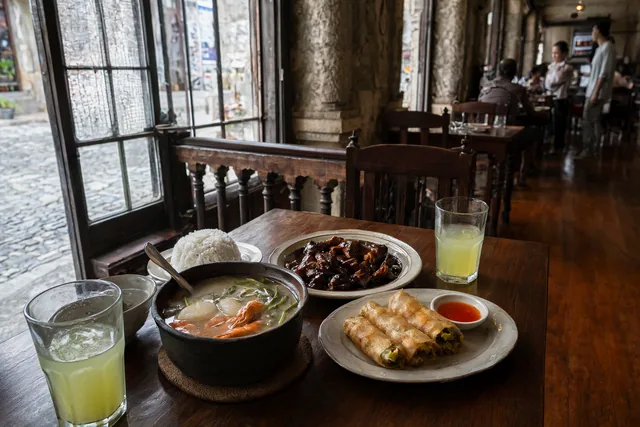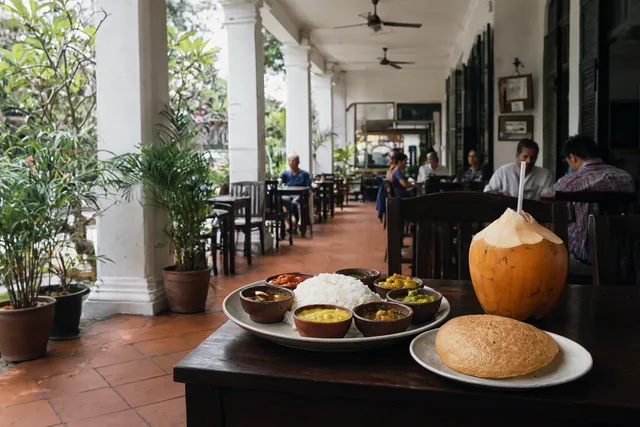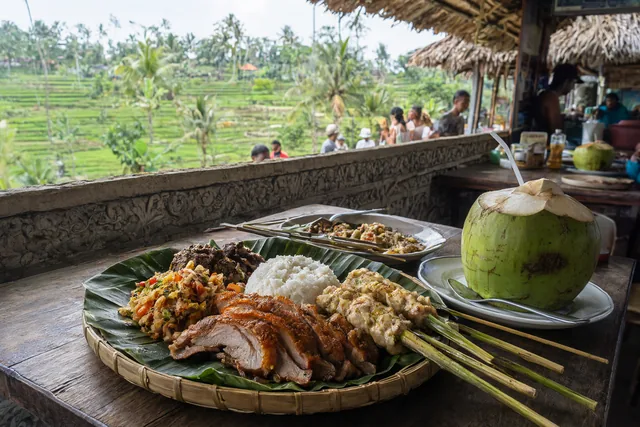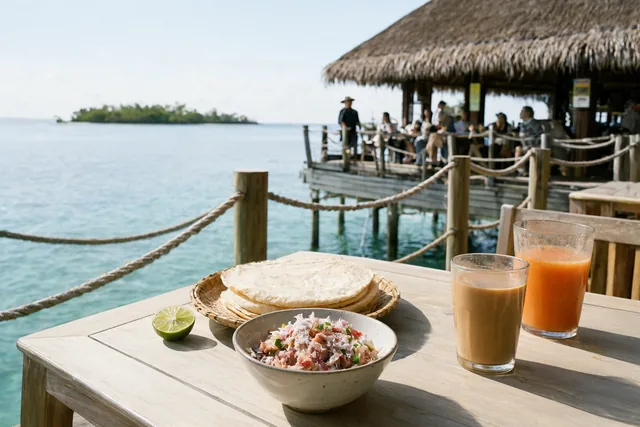
India is not one cuisine but dozens, and the difference between a Punjabi dinner in Delhi and a banana-leaf lunch in Chennai is bigger than the difference between France and Germany. This India food guide covers the dishes to know, how to read a menu written in Hindi or in English with Hindi dish names, whether to tip and what the GST line on your bill means, then goes city by city through where to eat in Delhi, Mumbai, Kolkata, Chennai, Hyderabad, Lucknow, Jaipur and Goa.
What to eat in India: 12 dishes to know
These are the dishes worth seeking out, with the city or region they come from.
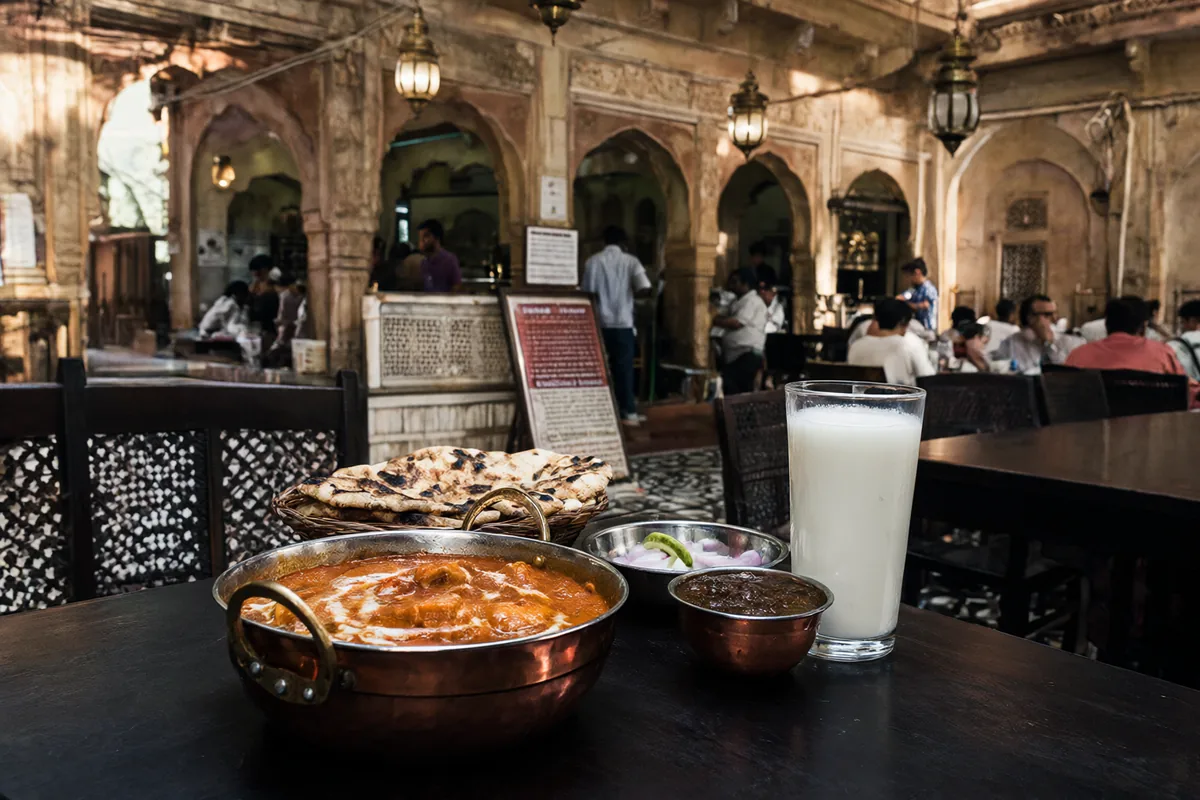
- Murgh makhani (Delhi): butter chicken, tandoori chicken simmered in a mild tomato, butter and cream sauce. Its vegetarian partner is dal makhani, black lentils cooked slowly with butter.
- Biryani (Hyderabad, Lucknow, Kolkata): rice and meat layered and sealed in a pot to cook in its own steam (dum).
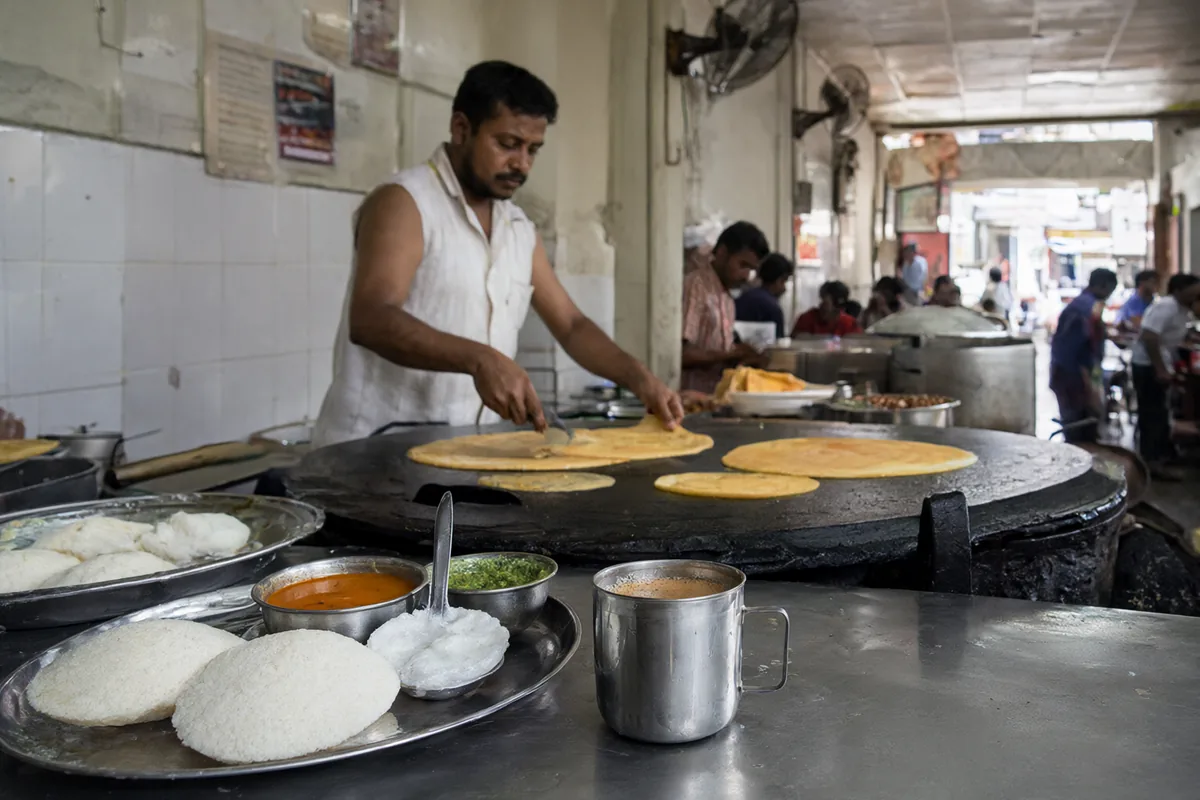
- Masala dosa (South India): a thin, crisp fermented rice and lentil crêpe rolled around spiced potato, served with sambar (lentil and vegetable stew) and coconut chutney.
- Idli and vada (Tamil Nadu): steamed rice cakes and savoury lentil doughnuts, the standard South Indian breakfast.
- Chole bhature (Delhi and Punjab): spiced chickpea curry with a puffed, deep-fried bread.
- Vada pav (Mumbai): a spiced potato fritter in a soft bread roll with chutneys, the city's cheapest and most loved snack.
- Pav bhaji (Mumbai): a buttery mashed vegetable curry cooked on a huge griddle, eaten with toasted bread rolls.
- Thali (everywhere): a steel platter with small bowls of dal, vegetables, curd, pickle, rice and bread. In Gujarati and Rajasthani restaurants it is usually refilled until you stop the waiter.
- Rogan josh (Kashmir): lamb or goat braised with Kashmiri chilli, which gives colour more than heat.
- Machher jhol (Kolkata): a light Bengali fish curry, best eaten with plain rice. Shorshe ilish, hilsa fish in mustard sauce, is the prized version.
- Pork vindaloo (Goa): a sour, garlicky pork curry with vinegar and chilli, descended from a Portuguese dish. Real vindaloo is tangy first and hot second.
- Chaat (North India): a family of street snacks built from crisp fried dough, potato, chickpeas, yoghurt and sweet and sour chutneys. Pani puri (also called golgappa or phuchka) are hollow shells filled with spiced water and eaten in one bite.
How to read a Hindi menu
Most restaurant menus in Indian cities are printed in English, but the dish names are Hindi, Urdu or a regional language in Latin letters, so "palak paneer" means nothing unless you know the words. Street stalls, small local eateries (often called "hotels" in the south) and menus outside the big cities may be written only in Devanagari script or in a regional script such as Tamil, Bengali or Kannada. These are the Hindi words that turn up again and again.
| Hindi | Romanised | Meaning |
|---|---|---|
| शाकाहारी | shakahari | Vegetarian (often shown as "veg", with a green dot) |
| मांसाहारी | mansahari | Non-vegetarian ("non-veg", with a red or brown dot). Eggs count as non-veg |
| मुर्ग / मुर्गा | murgh / murga | Chicken |
| गोश्त | gosht | Meat, usually goat. On Indian menus "mutton" almost always means goat |
| मछली | machhli | Fish |
| अंडा | anda | Egg |
| पनीर | paneer | Fresh, firm cheese that does not melt |
| दाल | dal | Lentils, or a lentil curry |
| आलू / पालक / गोभी | aloo / palak / gobi | Potato / spinach / cauliflower |
| सब्ज़ी | sabzi | A vegetable dish |
| रोटी | roti | Flatbread (naan, paratha, kulcha and puri are other breads) |
| तंदूरी | tandoori | Cooked in a tandoor, a clay oven |
| थाली | thali | A set platter of several dishes |
| तीखा | teekha | Spicy hot |
A few menu habits are worth knowing. Dishes are often grouped as "veg" and "non-veg" rather than by course. "Gravy" means a dish with sauce and "dry" means without. "Half" and "full" refer to portion size, and a full plate in a local restaurant is often enough for two. In the south, "meals" on a board means an unlimited set lunch, and "tiffin" means a light meal such as dosa or idli.
Packaged food in India carries a green square with a green dot for vegetarian and a brown or red one for non-vegetarian, and many restaurants use the same symbols on their menus. swap.menu reads those symbols along with the dish names, so you can tell at a glance whether "chicken 65" or "Manchurian" is the one you want.
Tipping, service charge, GST and paying
Tipping is customary in sit-down restaurants in India but not compulsory. Around 10 percent is normal when service is good and no service charge has been added. Street stalls do not expect tips. Under national consumer guidelines, restaurants are not allowed to add a service charge automatically or make it compulsory. Some still print one on the bill, and you are entitled to ask for it to be removed.
GST, the goods and services tax, is added to restaurant bills, usually at 5 percent in standalone restaurants and at a higher rate in some hotel restaurants. Menus normally show prices before tax, often with a note such as "taxes extra". Our guide to tax and service charges on menus explains how these lines work around the world.
The currency is the Indian rupee (₹, INR). Cards work in mid-range and upmarket restaurants, hotels and malls in the cities. Most Indians pay small amounts by scanning a QR code with a UPI payment app, which is often tied to an Indian bank account, so keep cash for street food, rickshaws and small shops,. If a card machine offers to charge you in your home currency, choose rupees: our guide to paying in local currency explains why.
Lunch is usually 1pm to 3pm and dinner runs late, from about 8pm to 10:30pm, with many families eating later still. A few states, including Gujarat and Bihar, prohibit alcohol, and "dry days" apply on some national holidays and during elections. Elsewhere, beer and spirits are sold only in licensed bars and restaurants, so many local eateries serve none.
Where to eat in India, city by city
Each Indian city has its own dishes, its own breakfast and its own street snack that people will cross town for. Jump to a city:
Where to eat in Delhi
Delhi is the home of Punjabi restaurant cooking as the world knows it: tandoori chicken, butter chicken, dal makhani and naan all took their modern form here. The best place to start is Old Delhi. Around Chandni Chowk you can eat jalebi (fried syrupy spirals) fresh from the pan, plates of chaat and the stuffed, fried breads of Paranthe Wali Gali, a narrow lane devoted to parathas. Near the Jama Masjid, the streets around Matia Mahal are lined with kebab grills and pots of nihari, a slow-cooked meat stew eaten early in the morning.
In New Delhi, Bengali Market is known for sweets and chaat, Khan Market and Hauz Khas have modern restaurants and bars, and Dilli Haat, an open-air crafts market, has food stalls from different states. Majnu ka Tilla, the Tibetan settlement in north Delhi, is the place for momos and thukpa.
Where to eat in Mumbai
Mumbai eats on the move. The essential Mumbai street foods are vada pav, pav bhaji and bhel puri (puffed rice with chutneys, onion and sev), and the evening crowds at Girgaum Chowpatty and Juhu Beach are where locals go to eat them. The city's old Irani cafés, mostly in Fort, Colaba and Byculla, serve bun maska (buttered bun) with sweet chai, keema pav (spiced mince with bread) and Parsi dishes such as dhansak, lentils cooked with meat and vegetables.
Mumbai is on the coast, and its Konkan and Malvani seafood is outstanding: try bombil fry (the fish known in English as Bombay duck, served crisp), surmai (kingfish) curry and Koliwada prawns, spiced and deep-fried. Mohammed Ali Road is famous for kebabs and sweets, and during Ramadan its night food stalls draw people from across the city. Bandra is the place for cafés and bars, and Crawford Market for fruit and spices.
Where to eat in Kolkata
Bengali food is built around fish, rice and mustard, and Kolkata is where to taste it properly. Order machher jhol, shorshe ilish (hilsa in mustard, best in the monsoon season), chingri malai curry (prawns in coconut milk) and kosha mangsho, a dark, slow-fried goat curry eaten with luchi, small puffed breads. A Bengali meal starts with something bitter and ends with something sweet.
Kolkata is also the sweet capital of India. Look for rosogolla (spongy cheese balls in syrup), sandesh (pressed cheese sweets) and mishti doi, sweetened yoghurt set in a clay pot. For street food, the kathi roll, a paratha wrapped around kebab and egg, is a Kolkata invention found around Park Street and New Market, and phuchka (the local pani puri) and jhalmuri (spiced puffed rice) are sold everywhere. Kolkata also has India's oldest Chinese community: try Indian-Chinese food in Tangra, or the early-morning Chinese breakfast of dumplings and buns at Tiretta Bazaar, which is over by about 8am.
Where to eat in Chennai
Chennai is the capital of Tamil food and of the South Indian breakfast. In the old neighbourhoods of Mylapore and T. Nagar, vegetarian eateries serve idli, vada, pongal (rice and lentils with pepper and ghee) and dosa from early morning, with strong filter coffee. At lunch, look for a board saying "meals": an unlimited set of rice, sambar, rasam (a thin peppery broth), vegetables, curd and pickle, often served on a banana leaf. Eat with your right hand.
For meat, Chennai is the place to try Chettinad cooking from the region south of the city, known for chicken and goat curries heavy with black pepper, fennel and dried chilli. In the evening, the beachfront at Marina Beach and Besant Nagar has stalls selling sundal (spiced chickpeas) and fried fish, and around Sowcarpet in the north of the city you will find North Indian and Marwari snacks. Chennai is hot all year, so tender coconut water from street carts is the best drink in town.
Where to eat in Hyderabad
Hyderabad is synonymous with biryani. The Hyderabadi version is cooked kachchi style, with raw marinated meat and par-cooked rice sealed together in the pot, and it comes with mirchi ka salan (a chilli and peanut curry) and raita. Other Hyderabadi dishes to order are pathar ka gosht (meat cooked on a hot stone), double ka meetha (a bread pudding) and qubani ka meetha, stewed apricots with cream.
The old city around the Charminar is where to eat traditional Hyderabadi food and to drink Irani chai, a thick, sweet tea served with crumbly Osmania biscuits in old cafés. During Ramadan, the city is famous for haleem, a slow-cooked porridge of wheat, lentils and meat sold from huge pots in the evenings. Hyderabad sits in Telangana, next to Andhra Pradesh, and the local Telugu "meals" are among the spiciest in India: look out for gongura, a sour sorrel chutney.
Where to eat in Lucknow
Lucknow is the home of Awadhi cuisine, the refined court cooking of the old nawabs, and it is the place to eat kebabs. The galouti kebab is minced so finely it melts on the tongue, and it is traditionally eaten with a small paratha. The kakori kebab is a soft skewered kebab, and nihari kulcha (slow-cooked meat stew with a leavened bread) is the classic breakfast. Lucknowi biryani is milder than the Hyderabadi version, and sheermal is a saffron-tinted sweet bread.
The old city around Chowk and Akbari Gate is the heart of Lucknow's meat cooking, while Aminabad is a crowded market area with kebab shops, sweets and kulfi, a dense frozen dessert. Hazratganj has the city's best-known chaat, including basket chaat served in a fried potato nest. In winter, look for makhan malai, a frothy saffron cream set overnight and sold only in the cold early mornings.
Where to eat in Jaipur
Rajasthani food was shaped by the desert: dried beans, lentils, millet, ghee and dishes that keep well. In Jaipur, order dal baati churma (baked wheat balls dunked in ghee, with dal and a sweet crumble), gatte ki sabzi (gram flour dumplings in a yoghurt curry), ker sangri (desert berries and beans) and, for meat eaters, laal maas, a fiery red goat curry. A Rajasthani thali brings most of these together on one tray.
For snacks, pyaaz kachori (a flaky pastry stuffed with spiced onion) and mirchi vada (a stuffed, battered chilli) are Jaipur's breakfast staples, best eaten with chai. The old Pink City bazaars, especially Johari Bazaar, are full of sweet shops, and in the monsoon season they sell ghewar, a honeycomb-like disc soaked in syrup. MI Road is known for lassi served in clay cups (kulhad). Many restaurants in Jaipur's old city have rooftop terraces facing Nahargarh Fort.
Where to eat in Goa
Goa was a Portuguese colony until 1961, and its food shows it. Catholic Goan dishes include pork vindaloo, sorpotel (a spiced pork and offal stew), chouriço (spicy Goan sausage, often in a bread roll), xacuti (chicken in a roasted coconut and spice sauce) and cafreal (chicken in a green herb masala). Poi is the local bread, and bebinca, a layered coconut and egg cake, is the classic dessert. The everyday Goan meal, for Hindus and Catholics alike, is fish curry rice, a tangy coconut fish curry with red rice.
The famous Goa beach shacks open for the dry season, roughly from late in the year until the monsoon, and serve grilled fish, prawns and beer with your feet in the sand. For more traditional Goan food, head inland or to Panaji, where the old Latin quarter of Fontainhas has small family restaurants, or to the Friday market in Mapusa for sausages, spices and fruit. Goa has some of the lowest alcohol prices in India: try feni, a spirit made from cashew fruit or coconut sap.
Vegetarian, vegan and allergy tips
India is the easiest country in the world for vegetarians. A large share of the population does not eat meat, many restaurants are "pure veg" (no meat, fish or egg), and every menu marks dishes as veg or non-veg. The Hindi word is shakahari. Some restaurants also offer Jain food, which leaves out onion, garlic and root vegetables. Vegans have a harder time, because ghee (clarified butter), paneer, cream, curd and milk run through North Indian cooking. South Indian food, which uses coconut and oil more often, is easier, but always ask about ghee.
For allergies, the hidden ingredients to watch are cashew and almond paste, used to thicken creamy gravies such as korma and butter chicken; peanuts, common in Maharashtrian and Gujarati snacks and in poha; mustard, in Bengali cooking and in tempering oil; and gluten, since asafoetida (hing), used in many dals, is often mixed with wheat flour. Our guide to eating abroad with food allergies explains how to describe an allergy clearly when you do not share a language.
Useful Hindi phrases for ordering
A few words of Hindi are welcomed across the north. In the south, English is the safer choice.
नमस्ते Namaste: "Hello", often said with palms pressed together
मेन्यू दिखाइए Menu dikhaiye: "Please show me the menu"
मुझे यह चाहिए Mujhe yah chahiye: "I would like this" (pointing)
मिर्च कम डालिए Mirch kam daliye: "Please use less chilli"
मैं शाकाहारी हूँ Main shakahari hoon: "I am vegetarian"
मुझे मूँगफली से एलर्जी है Mujhe moongphali se allergy hai: "I am allergic to peanuts"
बिल लाइए Bill laaiye: "Please bring the bill"
बहुत स्वादिष्ट था Bahut swadisht tha: "It was delicious"
How swap.menu helps you eat in India
Even when an Indian menu is in English, it can run to 200 dishes with names like dum aloo, kadai paneer, chicken 65 and gobi Manchurian that explain nothing. Photograph it with swap.menu and each dish appears in your language with a short description, so you know that rajma is a kidney bean curry and that keema is minced meat before you order. It reads Devanagari and other Indian scripts, so it also works on the handwritten boards at small eateries. Every price is converted from rupees to your home currency, and we flag "taxes extra", GST and any service charge so you know what the total will be.
Tap the dishes you want, add a note such as "no peanuts", "not too spicy" or "no ghee, please", typed or spoken, and swap.menu translates your order into Hindi. Show the waiter your phone, or let them scan the QR code and read your order on their own screen. You can try it now on a sample menu with the free demo, or see travel pass prices.
Off to India? Your first 3 menu scans are free, and a travel pass starts from $4.99 with nothing that renews.
Start free with 3 scansIndia food FAQ
Do you tip in restaurants in India?
Tipping is customary in sit-down restaurants but not required. Around 10 percent is normal for good service if no service charge has been added. Street stalls and small cafés do not expect tips, though rounding up is appreciated.
What food is India most famous for?
Butter chicken, biryani, masala dosa, tandoori dishes, dal, samosas and street snacks such as chaat and pani puri are the best known. Indian food is very regional, so each city in this guide has its own dishes worth ordering.
Is tap water safe to drink in India?
No. Drink bottled or properly filtered water, and check that the seal on bottled water is intact. Ice and fresh juices are usually safe in good restaurants and hotels but are best avoided at street stalls.
Is it expensive to eat out in India?
Eating out in India is very cheap by Western standards. Street food and simple local restaurants cost very little, a full thali is good value almost everywhere, and only upmarket hotel restaurants approach international prices.
Which city in India is best for food?
Delhi is best for Punjabi and Mughlai food and street snacks, Lucknow and Hyderabad for kebabs and biryani, Kolkata for fish and sweets, Mumbai for street food and seafood, and Chennai for South Indian vegetarian cooking. Each has its own section in this guide.
How can I read an Indian menu if I do not know the dish names?
Learn a few key words such as murgh, gosht, paneer, dal and sabzi, and check the veg and non-veg symbols. Or photograph the menu with swap.menu, which explains every dish in your language, converts rupee prices to your currency and translates your order into Hindi.
Travelling further in Asia? Read our food guides for nearby countries:
- Sri Lanka food guide
- Nepal food guide
- Bhutan food guide
- Maldives food guide
- Malaysia food guide
- United Arab Emirates food guide
Or browse every travel food guide.