Bhutan has one of the most distinctive cuisines in the Himalaya: chillies treated as a vegetable rather than a spice, soft farmhouse cheese melted into almost everything, nutty red rice from the Paro valley and buckwheat dishes from the high valleys of the centre. This Bhutan food guide covers the dishes to know, the food words you will see on Bhutanese menus, tipping and the rules on alcohol and meat, then goes valley by valley through where to eat in Thimphu, Paro, Haa, Punakha, Phobjikha and Bumthang. Many visitors eat mostly in hotels, where the chilli is toned down, so knowing what to ask for makes a real difference.
What to eat in Bhutan: 12 dishes to know
Bhutanese food is built on rice, chillies, cheese, vegetables and, for those who eat it, pork, beef, chicken and yak. A meal is usually a mound of rice with two or three curries and a chilli relish on the side. These are the dishes to look for.
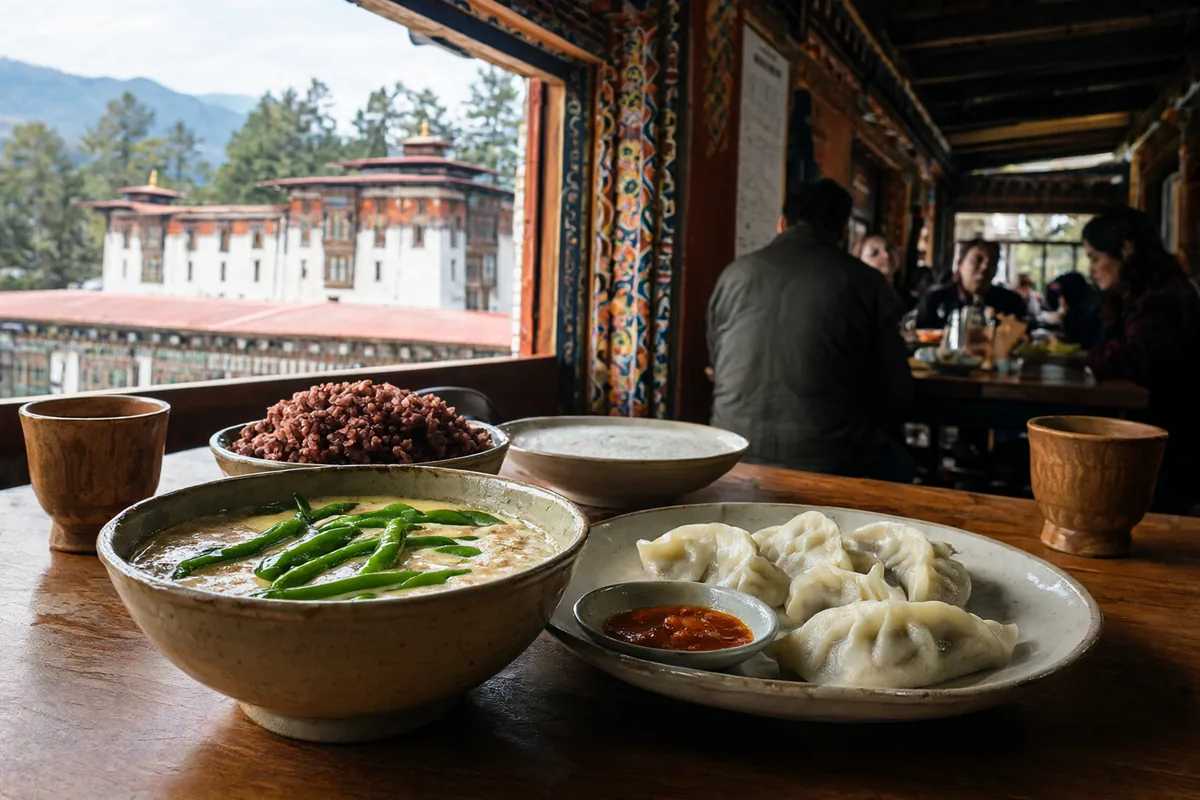
- Ema datshi (everywhere): the national dish, green or red chillies cooked in a sauce of melted local cheese, often with onion and tomato. It is genuinely hot, and Bhutanese eat it with almost every meal.
- Kewa datshi (everywhere): sliced potatoes in the same cheese sauce, with fewer chillies. A good starting point for visitors.
- Shamu datshi (everywhere): mushrooms cooked in cheese sauce. In summer, look for wild mushrooms gathered in the forests.
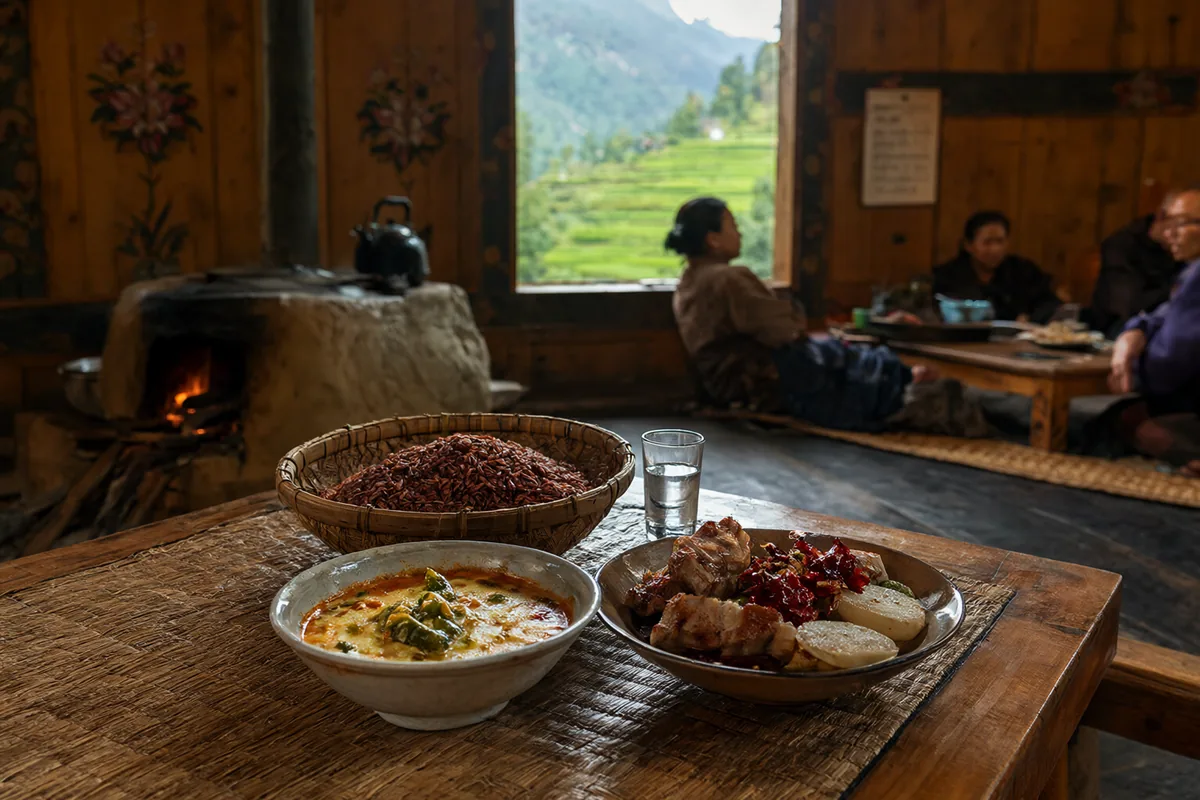
- Red rice (Paro and everywhere): a short-grain, slightly nutty red rice grown in the Paro valley and other western valleys, cooked soft and slightly sticky.
- Phaksha paa (everywhere): pork, often fatty belly, cooked with chillies and radish or bok choy. Phaksha sikam is dried pork belly, chewy and rich.
- Shakam paa (everywhere): dried beef cooked with chillies and sometimes radish, a winter favourite.
- Jasha maru (everywhere): spicy minced chicken stew with tomato, garlic, ginger and chilli, served with rice.
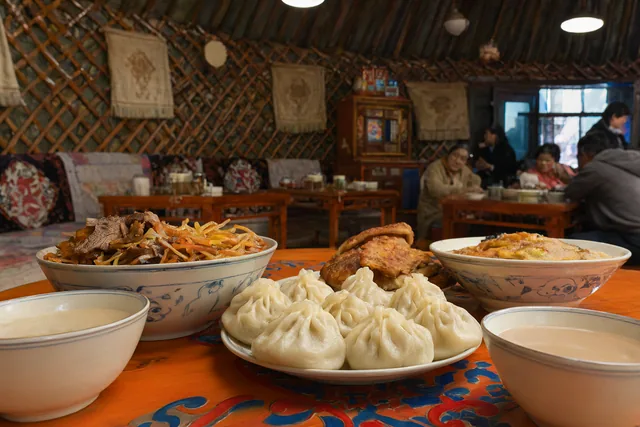
- Momo (everywhere): steamed dumplings filled with pork, beef, cheese or vegetables, of Tibetan origin, served with a chilli sauce.
- Hoentay (Haa): buckwheat dumplings filled with turnip leaves, cheese and spices, steamed or fried, a speciality of the Haa valley.
- Puta (Bumthang): buckwheat noodles, served with butter, chilli and Sichuan pepper.
- Khuli (Bumthang): buckwheat pancakes, eaten with ema datshi or butter.
- Ezay (everywhere): a fresh relish of chopped chilli, onion, tomato and cheese, served on the side of almost every meal.
To drink, try suja, tea churned with butter and salt, offered in homes and at monasteries, and ngaja, sweet milk tea, which is what most people drink in cafés. Ara is a home-distilled spirit made from rice, maize or millet, often warmed with butter and egg in winter. With tea, you may be served zao, crisp toasted rice, sprinkled over the cup or eaten by the handful.
How to read a menu in Bhutan
Bhutan's national language is Dzongkha, written in a script related to Tibetan, but English is used in schools and government and is widely spoken. Restaurant menus are almost always in English, but dishes are listed by their Bhutanese names. Learn these words and you can read almost any menu in the country.
| Bhutanese word | Meaning |
|---|---|
| Ema | Chilli |
| Datshi | Soft local cheese, and dishes cooked in a cheese sauce |
| Kewa | Potato |
| Shamu | Mushroom |
| Phaksha | Pork |
| Shakam | Dried beef |
| Jasha | Chicken |
| Nya | Fish |
| Paa | Meat cooked in a chilli sauce |
| Maru | A spicy stew of minced meat, as in jasha maru |
| Hogay | Salad, usually cucumber with chilli and cheese |
| Chum | Rice, red or white |
| Suja / ngaja | Butter tea / sweet milk tea |
| Ara | Local spirit |
Bhutanese menus are in English, but they still raise questions: how hot is "ema datshi" here, is the momo filling pork or beef, and what is the Indian dish next to it? Photograph the menu with swap.menu to get a plain explanation of every dish in your own language, prices converted from ngultrum, and a note on which dishes are built on chilli. It is especially useful if English is not your first language.
Tipping, paying and the rules on alcohol
Tipping is not a tradition in Bhutan, and small restaurants and cafés do not expect it, though leaving a little for good service is appreciated. Hotel restaurants and some larger restaurants add a service charge and tax to the bill as separate lines, so read the bottom of the bill. On tours, it is normal to tip your guide and driver at the end of the trip. Our guide to tax and service charges on menus explains how these lines work.
The currency is the ngultrum (BTN, Nu), which is pegged at par to the Indian rupee, and Indian rupees in small notes are widely accepted. Cards are accepted in many hotels and some shops and restaurants in Thimphu and Paro, but cash is needed almost everywhere else, and ATMs can be unreliable outside the main towns. If a card machine offers to charge you in your home currency, choose ngultrum: our guide to paying in local currency explains why.
Tuesday is a dry day in Bhutan: bars are closed and alcohol is not sold, though hotels may serve guests. Because of Buddhist beliefs, Bhutanese avoid slaughtering animals, so much of the meat is brought in from India, and meat shops close during some holy months of the Buddhist calendar. Many visitors travel with a licensed tour operator, and meals are often included at hotels, where food is cooked mild. Ask your guide to take you to local restaurants and order "Bhutanese style". Lunch is from about noon, dinner from around 7pm, and towns are quiet by 10pm.
Where to eat in Bhutan, valley by valley
Bhutan has few cities, so travel here moves from valley to valley over high mountain passes, with long lunches at roadside restaurants along the way. Each valley has its own crops and specialities. Jump to a destination:
Where to eat in Thimphu
Thimphu, the capital, has the widest choice of restaurants in Bhutan, from Bhutanese canteens to cafés, Indian and Nepali restaurants and a few smarter dining rooms. The Centenary Farmers' Market, a two-storey market by the Wang Chhu river, is the best food sight in the country: stalls piled with fresh and dried chillies, rounds of datshi cheese, strings of rock-hard dried yak cheese (chugo), red rice, ferns, mushrooms and betel nut. It is busiest from Friday to Sunday, when farmers come in from the valleys.
The main street, Norzin Lam, and the streets around the clock tower square hold most of Thimphu's restaurants and cafés, many on the first floor above shops. Thimphu residents eat ema datshi, momos and red rice for lunch in simple places for very little, and the capital is also where you will find the few restaurants cooking modern Bhutanese food. Thimphu has no traffic lights, just a policeman directing traffic at the main junction, and it is an easy town to explore on foot between meals.
Where to eat in Paro
Paro, home to the international airport and the cliffside monastery of Taktsang, the Tiger's Nest, is the valley where most trips begin and end. Its broad valley floor is covered in fields of the red rice for which Paro is famous. The small town centre has a main street of painted wooden buildings with cafés, restaurants and craft shops, and a weekend market selling vegetables, chillies and cheese.
The best meal in Paro is often at a farmhouse. Many traditional three-storey farmhouses in the valley welcome visitors for lunch or dinner, cooked on a wood stove: red rice, ema datshi, phaksha paa, vegetables from the garden and a cup of ara. Some also offer a dotsho, a traditional hot stone bath, heated with river stones, which makes a good end to the Tiger's Nest hike. Ask your guide in Paro to arrange it a day ahead.
Where to eat in Haa
Haa, west of Paro over the Chele La pass, one of the highest road passes in the country, is a quiet valley that opened to tourists only in the early 2000s. It is the home of hoentay, the buckwheat dumplings filled with turnip leaves and cheese, and buckwheat and barley are the staple crops here rather than rice. Hoentay are especially made for the Lomba festival, the Haa new year in winter.
Haa has very few restaurants, and most visitors eat at farmhouse homestays, where hosts cook hoentay, buckwheat pancakes and local vegetables. In July, the Haa Summer Festival celebrates nomadic culture, with local food stalls, yak dairy and home-made ara. The drive from Paro over Chele La takes a couple of hours, so it is often done as a long day trip with lunch in Haa.
Where to eat in Punakha
Punakha, lower and warmer than Thimphu, sits where two rivers meet below Punakha Dzong, one of the most beautiful buildings in the Himalaya. The valley is terraced with rice paddies, and in spring and summer it is green and lush, with fruit and vegetables that do not grow in the colder valleys. Most visitors eat at their hotel, but the roadside restaurants at Lobesa and along the drive in are good for a local lunch of red rice, ema datshi and jasha maru.
The short walk through rice fields to Chimi Lhakhang, the fertility temple near Lobesa, passes village cafés and farmhouses, some serving simple lunches to walkers. Punakha's warmer climate means chillies dry on roofs across the valley in autumn, a sight in itself. On the drive from Thimphu, the cafés at the Dochu La pass serve tea and snacks with a view of the Himalaya on clear days.
Where to eat in Phobjikha
Phobjikha is a wide glacial valley in central Bhutan, home to Gangtey Monastery and, from about November to February, to the rare black-necked cranes that winter in its marshes. It is a farming valley, and its main crop is potatoes, which appear in kewa datshi and other dishes on almost every table. The valley is high and cold, and the food reflects it: soups, cheese, buckwheat and warming butter tea.
There are very few restaurants in Phobjikha. Visitors eat at their lodge or hotel, or at farmhouse homestays, which are the best way to taste local cooking. If you stay in a homestay in Phobjikha, you may get to help cook, and you will eat what the family eats, usually rice, potatoes, cheese and chillies with a little meat. Bring warm clothes, as the evenings are cold for most of the year.
Where to eat in Bumthang
Bumthang, in central Bhutan, is a group of four high valleys known as the spiritual heartland of the country, with some of its oldest temples. Bumthang is too high for much rice, so buckwheat is the staple, and this is the place to eat puta, buckwheat noodles, and khuli, buckwheat pancakes. Since the 1960s, Swiss development projects have also left Bumthang with a tradition of Swiss-style cheese, along with apple juice, honey and a wheat beer brewed in the valley.
The main town, Jakar, has a short main street of shops, cafés and simple restaurants, and the hotels around the valley serve Bhutanese buffets. Ask for puta and khuli in advance, as they are not always on the menu. Bumthang is a long drive from Thimphu, often split over two days, so plan for roadside lunches at Trongsa or the passes along the way.
Vegetarian, vegan and allergy tips
Bhutan is one of the easier countries in the Himalaya for vegetarians. Many Bhutanese avoid meat for religious reasons, at least on holy days, and vegetable dishes such as ema datshi, kewa datshi, shamu datshi, vegetable momos and hogay salads are on every menu. Vegans have a harder time, because cheese is in most dishes, butter is in tea and buckwheat dishes, and dried fish or meat sometimes flavours vegetable curries. "Vegetarian" is widely understood, and you can simply ask for dishes "without cheese".
The biggest concern for most visitors is the chilli. Hotels tone it down, but local restaurants and farmhouses do not, so ask for less chilli if you need it. Cheese is used in almost everything, which matters for anyone avoiding dairy, and buckwheat dishes are naturally gluten-free unless mixed with wheat flour. Water should be bottled or boiled. Our guide to eating abroad with food allergies explains how to communicate an allergy clearly.
Useful phrases for ordering in Bhutan
Kuzuzangpo la "Hello", the polite Dzongkha greeting; adding "la" shows respect
Kadrinchhe la "Thank you" in Dzongkha
Meshu meshu "No, no": the polite refusal Bhutanese make before accepting food or drink from a host. Expect to be offered again.
Tashi delek "Good luck" or "cheers", used in greetings and toasts
Bhutanese style, please In English: ask for this when you want dishes cooked the way locals eat them, chilli and all
Less ema, please "Less chilli, please"; staff in any restaurant will understand
I am vegetarian, no meat or dried fish Worth spelling out, as dried fish or meat can flavour vegetable dishes
How swap.menu helps you eat in Bhutan
Bhutanese menus are usually in English, but the dish names are not: shakam ema datshi, nakey datshi and sikam paa do not explain themselves. Photograph the menu with swap.menu and every dish gets a plain explanation, so you know that nakey is fiddlehead fern in cheese sauce and sikam is dried pork belly before you order, with prices converted from ngultrum to your home currency and any tax or service line pointed out. For visitors whose first language is not English, the whole menu appears in their own language, in any of 29 languages.
Tap the dishes you want, add a note such as "less chilli" or "no meat", typed or spoken, and swap.menu prepares the order to show your server. You can also save the menus of places you liked to remember what you ate. Try it on a sample menu with the free demo, or see travel pass prices.
Off to Bhutan? Your first 3 menu scans are free, and a travel pass starts from $4.99 with nothing that renews.
Start free with 3 scansBhutan food FAQ
Do you tip in restaurants in Bhutan?
Tipping is not a tradition in Bhutan, and local restaurants do not expect it. Hotel restaurants may add a service charge and tax to the bill. On tours, visitors usually tip their guide and driver at the end of the trip.
What food is Bhutan famous for?
Ema datshi, chillies cooked in cheese, is the national dish. Bhutan is also known for red rice from the Paro valley, buckwheat noodles and pancakes from Bumthang, hoentay dumplings from Haa, and butter tea.
Is Bhutanese food very spicy?
Yes, traditional Bhutanese food is among the spiciest in Asia, because chillies are cooked as a vegetable rather than used as a seasoning. Hotels usually cook a milder version for visitors, and you can ask any restaurant for less chilli.
Is tap water safe to drink in Bhutan?
No, visitors should not drink tap water in Bhutan. Drink bottled or boiled and filtered water, which hotels, guides and restaurants provide.
Can you drink alcohol in Bhutan?
Yes, alcohol is legal and local beer, whisky and the home-made spirit ara are widely drunk. Tuesday is a dry day, when bars are closed and alcohol is not sold, though hotels may still serve their guests.
Are menus in Bhutan in English?
Most restaurant menus in Bhutan are written in English, but dishes are listed by their Bhutanese names. Learning words such as ema (chilli), datshi (cheese) and phaksha (pork) helps, and swap.menu explains every dish and converts ngultrum prices.
Travelling further in the Himalaya and South Asia? Read our food guides for nearby countries:
Or browse every travel food guide.