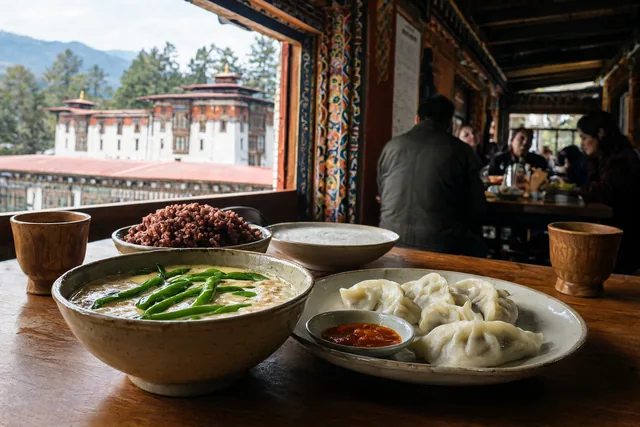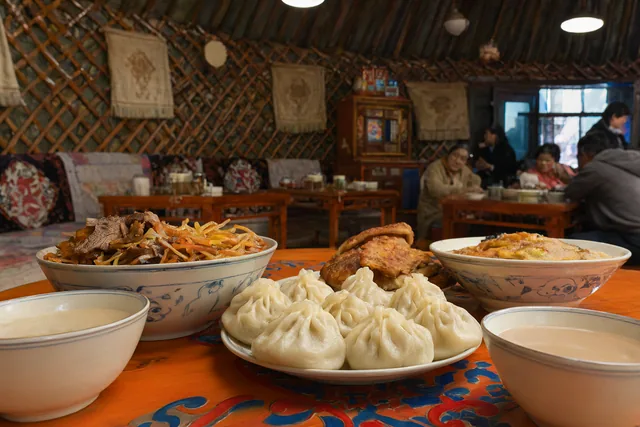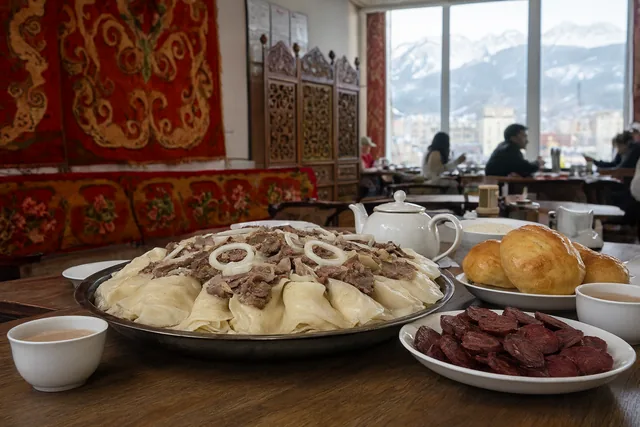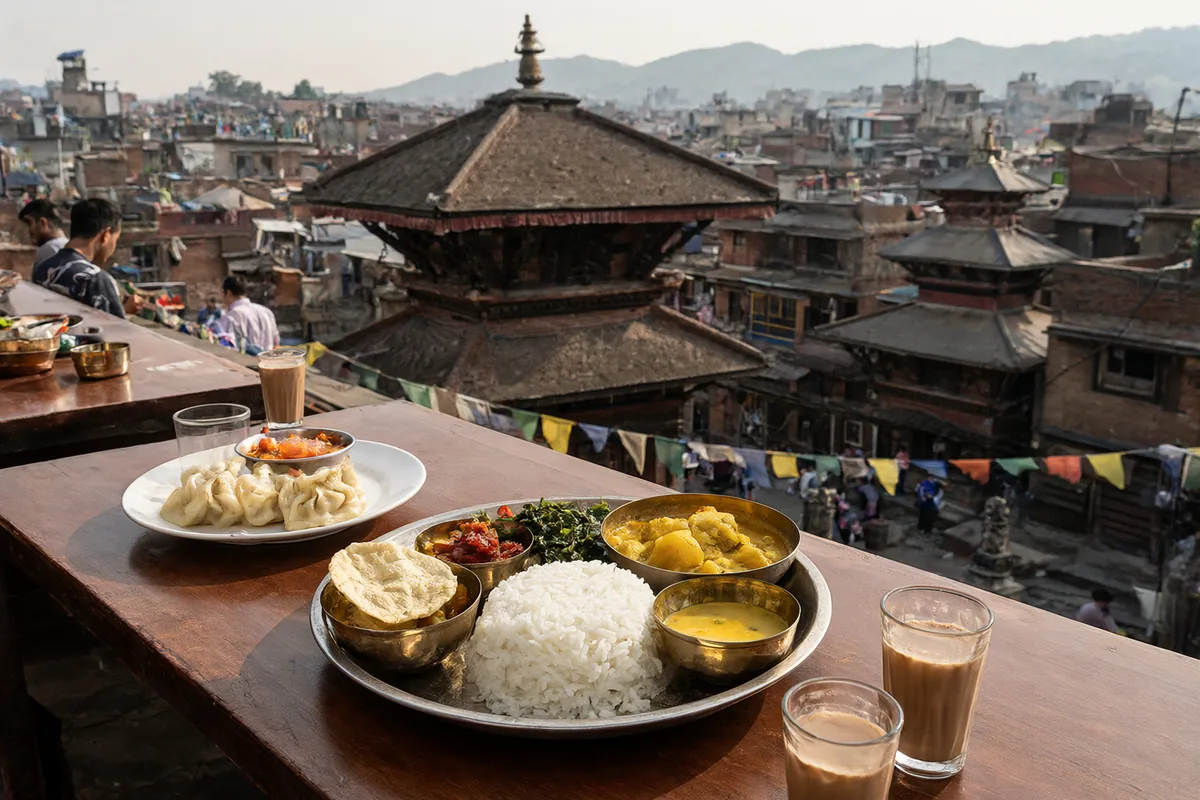
Nepali food is better and more varied than its reputation as trekking fuel suggests. Dal bhat, the lentil and rice meal eaten twice a day, is the backbone, but the Newar people of the Kathmandu Valley have one of the richest food cultures in South Asia, Tibetan and Thakali cooking shape the mountains, and momos are an obsession everywhere. This Nepal food guide covers the dishes to know, how to read a Nepali menu, service charge and VAT, then goes place by place through where to eat in Kathmandu, Patan, Bhaktapur, Bandipur, Pokhara, Chitwan and the teahouses of the Everest and Annapurna treks.
What to eat in Nepal: 12 dishes to know
Nepal's food changes with altitude and community, from the Terai plains near India to the high Himalaya. These are the dishes to look for, with the region or people they belong to where it matters.
- Dal bhat (everywhere): rice (bhat) with lentil soup (dal), a vegetable curry (tarkari), greens (saag), pickle (achar) and sometimes meat, served on a round plate. Refills of rice, dal and curry are usually free, so eat until you say "enough".
- Momo (everywhere): dumplings filled with buffalo, chicken, pork or vegetables, served steamed, fried or jhol, in a thin spiced soup, with a tomato and sesame dipping sauce. Originally Tibetan and Newari, now Nepal's favourite snack.
- Samay baji (Newar, Kathmandu Valley): a ceremonial platter of beaten rice, spiced grilled buffalo, black soybeans, boiled egg, ginger, garlic, greens and pickles.
- Choila (Newar): buffalo or chicken grilled over flame, then mixed with mustard oil, chilli, garlic and fenugreek, eaten with beaten rice.
- Bara (Newar): a thick savoury pancake of ground black lentils, plain or topped with egg or minced meat. Also called wo.
- Chatamari (Newar): a thin rice-flour crepe topped with minced meat, egg or vegetables, sometimes sold as "Newari pizza".
- Yomari (Newar): a steamed rice-flour dumpling filled with molasses and sesame, shaped like a fig, made for the Yomari Punhi festival in winter.
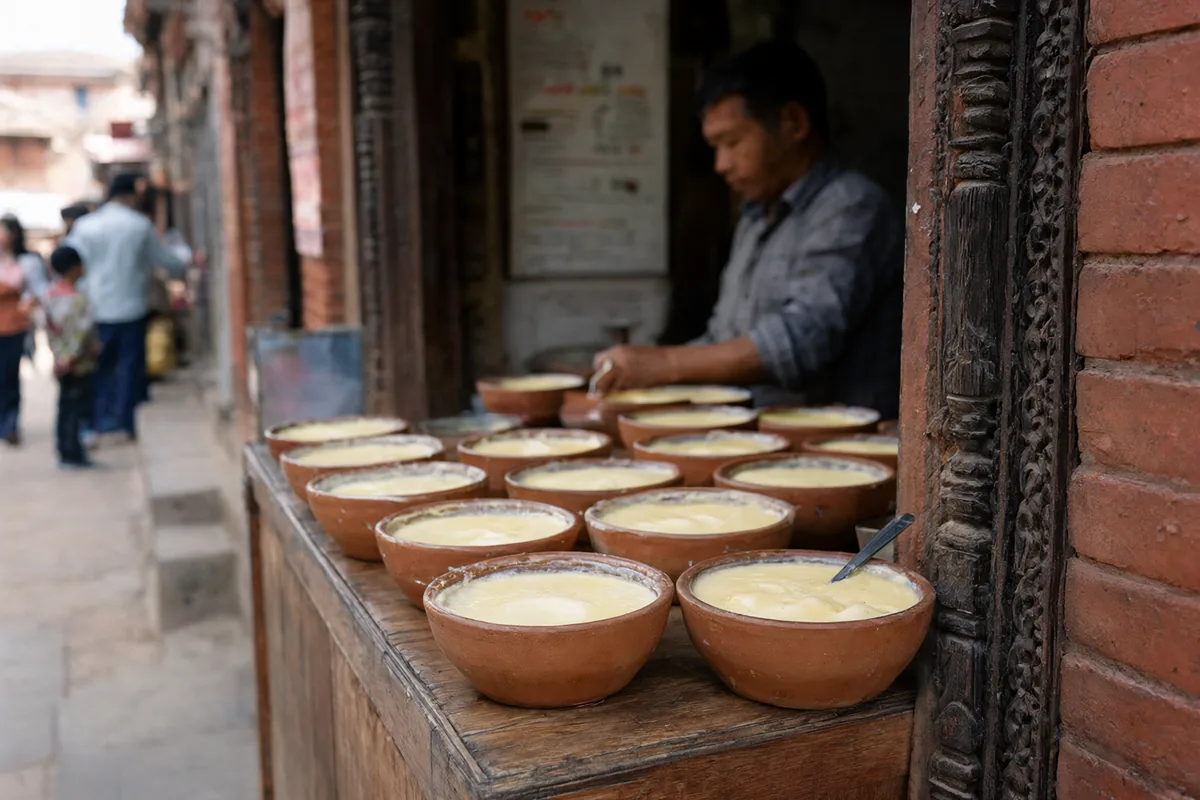
- Juju dhau (Bhaktapur): "king of curds", a thick, sweet, creamy yoghurt set in clay pots, the speciality of Bhaktapur.
- Thakali khana (Mustang, Pokhara and everywhere): the Thakali people's version of dal bhat, with black lentils, ghee, fermented greens, buckwheat or rice, and some of the best dal in the country.
- Sel roti (everywhere, especially at festivals): a ring-shaped, slightly sweet fried rice-flour bread, made for Dashain and Tihar in autumn and sold at breakfast stalls.
- Thukpa (the mountains and Tibetan areas): a Tibetan noodle soup with vegetables and meat, the warming standby of the trekking trails.
- Gundruk (hills): fermented, dried leafy greens, cooked into a sour soup or pickle, eaten with dal bhat.
To drink, chiya, sweet milk tea boiled with spices, is served everywhere in small glasses. Lassi, a yoghurt drink, is popular in the Terai and Kathmandu. Local spirits include raksi, distilled from rice or millet, and in the east, tongba, warm fermented millet sipped through a bamboo straw from a wooden pot. Look out for Nepal's local spices too: timur, a tingling relative of Sichuan pepper, and jimbu, a dried Himalayan herb fried in ghee to flavour dal.
How to read a Nepali menu
Nepali is written in the Devanagari script, the same as Hindi. Restaurants in Thamel, Lakeside Pokhara and on the trekking trails have menus in English, but local eateries, Newari snack houses (khaja ghar) and roadside restaurants often have Nepali only, or a board on the wall. These are the words to recognise.
| Nepali | Romanised | Meaning |
|---|---|---|
| दाल भात | dal bhat | Lentil soup and rice, the national meal |
| मोमो | momo | Dumplings |
| तरकारी | tarkari | Vegetable curry |
| अचार | achar | Pickle or relish |
| साग | saag | Leafy greens |
| मासु | masu | Meat |
| कुखुरा | kukhura | Chicken |
| खसी | khasi | Goat, often listed as "mutton" |
| राँगो | rango | Buffalo, written "buff" on English menus |
| माछा | machha | Fish |
| दही | dahi | Yoghurt |
| चिया | chiya | Spiced milk tea |
| पिरो | piro | Spicy, hot |
| शाकाहारी | shakahari | Vegetarian |
"Buff" on a Nepali menu means water buffalo, not beef, which most Hindus do not eat. Prices on tourist menus often exclude service charge and VAT, which are added at the end. swap.menu explains every dish in your language, reads Devanagari boards in local eateries, and flags the service and VAT lines so you know the real price in your own currency before you order.
Service charge, VAT and paying the bill
Many restaurants in Kathmandu, Pokhara and other tourist areas add a 10 percent service charge and 13 percent VAT to the menu prices, usually noted at the bottom of the menu, so a meal can cost noticeably more than the prices listed. Our guide to tax and service charges on menus explains how these "plus plus" lines work. If service is already charged, no tip is expected, though rounding up is kind. In local eateries without a service charge, a small tip is appreciated but not required. On treks, tipping guides and porters at the end is customary and an important part of their income.
The currency is the Nepalese rupee (NPR, Rs). Cards are accepted in many hotels, trekking agencies and larger restaurants in Thamel and Lakeside, sometimes with a surcharge, but cash is king almost everywhere else, including on the trails, where ATMs are rare or non-existent. Carry enough cash before you start a trek. If a card machine offers to charge you in your home currency, choose rupees: our guide to paying in local currency explains why.
Nepalis traditionally eat dal bhat twice a day, in the late morning, around 10am, and in the evening around 7pm, with a light snack (khaja) such as tea and momos in the afternoon. Tourist restaurants keep more familiar hours. Eat with your right hand if you eat by hand, and avoid touching shared food with a spoon that has been in your mouth, as food that has touched a mouth is considered impure (jutho).
Where to eat in Nepal, city by city
Most visitors spend time in the Kathmandu Valley, with its three royal cities, before heading to Pokhara, Chitwan or the mountains. Each stop has its own food. Jump to a destination:
Where to eat in Kathmandu
Thamel is Kathmandu's traveller district, packed with restaurants serving everything from dal bhat and momos to pizza, bakery cakes and Korean barbecue. It is easy and comfortable, but walk south into the old city to eat like Kathmandu residents do. The bazaar streets of Asan and Indra Chowk are lined with spice sellers, sweet shops and tiny snack stalls selling sel roti, samosas and momos, and the streets around Kathmandu Durbar Square and Freak Street have Newari khaja ghar, snack houses serving bara, choila, beaten rice and local rice wine.
At Boudhanath, the great white stupa at the centre of Kathmandu's Tibetan community, rooftop cafés around the stupa serve thukpa, momos, Tibetan bread and butter tea, and the lanes behind have simple Tibetan canteens. For a full Newari meal with a view, the hill town of Kirtipur, on the south-western edge of Kathmandu, has restaurants serving samay baji and other Newari feast dishes. Look for momo shops wherever you see a queue: Kathmandu's best momos are often in the plainest places.
Where to eat in Patan
Patan, also called Lalitpur, is a separate city across the Bagmati river from Kathmandu, with the finest of the valley's Durbar Squares and a long history of Newar craftsmanship. Restaurants and rooftop cafés around Patan Durbar Square look straight onto the temples, and the old streets and courtyards behind hold Newari restaurants and khaja ghar serving bara, chatamari, choila, kwati (a soup of sprouted beans) and samay baji, along with small glasses of rice wine.
Jhamsikhel, a residential area of Patan, has become one of the valley's main dining areas, with cafés, bakeries and restaurants popular with expats and Nepali families. In the south of Patan, around Jawalakhel, the Tibetan community runs simple restaurants serving momos and thukpa. Patan is quieter and more relaxed than Thamel, and a good place to spend an afternoon eating your way around the courtyards.
Where to eat in Bhaktapur
Bhaktapur, the best preserved of the three old royal cities, is a car-free maze of brick squares, temples and carved wooden windows, about an hour from Kathmandu. Its famous dish is juju dhau, the "king of curds", sold in clay bowls from shops all over town. Order it plain, and eat it on the spot; the clay bowl draws out moisture and the curd is set thick and creamy. Shops around Taumadhi Square, with its five-tiered Nyatapola temple, and Durbar Square sell it fresh.
Rooftop restaurants around Bhaktapur's squares serve Newari food and Nepali sets with views over the temples, and small local eateries in the back streets sell bara, momos and chiya. Bhaktapur charges foreign visitors an entry fee to the old city, so it is worth spending a full day and eating several meals here. If you can visit during Bisket Jatra, the Newar new year festival in April, you will see the town at its most festive.
Where to eat in Bandipur
Bandipur is a hilltop town on a ridge roughly halfway between Kathmandu and Pokhara, an old Newar trading post with a car-free main bazaar of 18th and 19th-century brick houses and wide views of the Himalaya on clear mornings. Cafés and guesthouse restaurants put tables out on the main street, which is a lovely place to sit over chiya or a dal bhat set and watch the town go about its day.
Bandipur's restaurants are small and mostly attached to guesthouses, serving Nepali sets, Newari snacks, momos and simple Western dishes. Food here is home-style and unhurried, and many visitors stay a night to see sunrise over the mountains. Bandipur is a quiet place in the evenings, so eat dinner early and do not expect much choice after 9pm.
Where to eat in Pokhara
Pokhara is Nepal's second tourist hub, a relaxed lakeside city below the Annapurna range and the base for many treks. Lakeside, along the shore of Phewa Lake, is lined with restaurants, bakeries, cafés and bars serving travellers, with tables facing the water and, on clear days, the peak of Machhapuchhre. Fried fish from the lake and Thakali khana, the Thakali dal bhat set with black lentils, ghee and pickles, are the local dishes to look for, and Pokhara has several excellent Thakali kitchens.
The Old Bazaar, north of Lakeside, is the original trading town, with temples, Newari houses and local eateries that see few visitors. Pokhara restaurants are cheaper and more casual than in Kathmandu. Before or after a trek, look for apple products from Marpha, a Thakali village on the Annapurna Circuit famous for apples, apple brandy and apple pie.
Where to eat in Chitwan
Chitwan National Park, in the hot lowlands of the Terai, is where visitors go for rhino and jungle safaris, and the village of Sauraha on the edge of the park is where most stay and eat. The local people are the Tharu, whose cooking is different from the hills: look for dhikri, steamed rice-flour dumplings, ghonghi, river snails cooked in a spiced sauce, and fish from the rivers, served at Tharu homestays and some restaurants in Sauraha.
Restaurants along the river in Sauraha serve Nepali sets, Indian dishes and Western food, and the riverside is the place to be at sunset. Chitwan is close to the Indian border and the food reflects it, with more spice, roti and lassi than in the hills. Many visitors on safari packages eat at their lodge, but a Tharu village meal is worth arranging if you can.
Where to eat on the Everest and Annapurna treks
On the main trekking routes, you eat at teahouses, family-run lodges with a dining room around a stove. Menus are long and surprisingly similar from lodge to lodge, with dal bhat, fried rice, noodles, momos, thukpa, pasta, pizza, Tibetan bread and porridge. On popular routes, prices are agreed locally and rise with altitude, since everything is carried up by porters or animals. The best value and most energy is in dal bhat, which comes with free refills, hence the trekkers' saying "dal bhat power, 24 hour".
In the Everest region, try shyakpa, a Sherpa stew of meat, potatoes and hand-torn noodles, yak cheese, and the bakeries of Namche Bazaar. Many trekkers avoid meat at high altitude, because animals are not slaughtered in the Khumbu for religious reasons and meat is carried up from lower valleys. Garlic soup is ordered for altitude, though its effect is folk wisdom rather than medicine. Lodges expect you to eat where you sleep, as rooms are priced cheaply on that basis. Use the purified water refill stations along the trails rather than buying plastic bottles.
Vegetarian, vegan and allergy tips
Nepal is one of the easiest countries in Asia for vegetarians. Many Nepalis are vegetarian, dal bhat is meat-free unless you order a meat curry, and every menu has vegetable momos, curries and thukpa. Vegans need to watch for ghee (clarified butter), used generously in dal and Thakali cooking, yoghurt in sauces and drinks, and butter in Tibetan tea. Non-vegetarian Newari dishes are built on buffalo, and dried fish appears in some hill and Terai dishes. The word to use is शाकाहारी (shakahari), vegetarian.
For allergies, peanuts and sesame appear in momo sauces and pickles, and mustard oil is the main cooking oil in many homes. Wheat is in momos, noodles, roti and Tibetan bread, while rice-based dishes like dal bhat, chatamari and dhikri are naturally gluten-free. To say "I am allergic to peanuts", try मलाई बदाम एलर्जी छ (malai badam allergy chha). Our guide to eating abroad with food allergies explains how to communicate an allergy clearly. Drink only purified or bottled water.
Useful Nepali phrases for ordering
नमस्ते Namaste: "Hello", said with palms pressed together
के राम्रो छ? Ke ramro chha?: "What is good?", the natural way to ask for a recommendation
यो दिनुहोस् Yo dinuhos: "Please give me this" (pointing)
पिरो कम Piro kam: "Less spicy"
म मासु खान्नँ Ma masu khanna: "I don't eat meat"
पुग्यो Pugyo: "Enough", to stop the free refills of dal bhat
बिल दिनुहोस् Bill dinuhos: "The bill, please"
धन्यवाद, मीठो छ Dhanyabad, mitho chha: "Thank you, it is delicious"
How swap.menu helps you eat in Nepal
Tourist menus in Nepal are in English, but local eateries and Newari khaja ghar often have a Devanagari board on the wall, and even English menus list dishes like sukuti, aloo tama and kachila without explanation. Photograph the menu with swap.menu and every dish appears in your language with the Nepali name beside it and a short explanation, so you know that sukuti is spiced dried meat, aloo tama is a sour potato and bamboo shoot curry, and kachila is raw minced buffalo before you order. Every price is converted from rupees to your home currency, and the 10 percent service charge and 13 percent VAT lines are pointed out, so the final bill holds no surprises.
Tap the dishes you want, add a note such as "less spicy" or "no ghee, please", typed or spoken, and swap.menu translates your order into Nepali. Show the waiter your phone, or let them scan the QR code and read the order on their own screen. Try it on a sample menu with the free demo, or see travel pass prices.
Off to Nepal? Your first 3 menu scans are free, and a travel pass starts from $4.99 with nothing that renews.
Start free with 3 scansNepal food FAQ
Do you tip in restaurants in Nepal?
Many tourist restaurants add a 10 percent service charge, so an extra tip is not expected, though rounding up is kind. In local eateries a small tip is appreciated. On treks, tipping guides and porters at the end is customary.
What food is Nepal famous for?
Dal bhat, the rice and lentil meal eaten twice a day, and momos, dumplings served steamed, fried or in soup. Nepal is also known for Newari food such as samay baji and bara, Thakali dal bhat sets, sel roti and juju dhau, the king curd of Bhaktapur.
What does "buff" mean on a Nepali menu?
Buff means water buffalo meat. Most Hindus in Nepal do not eat beef, so buffalo is used instead in momos, choila and other dishes, especially in Newari cooking in the Kathmandu Valley.
Is tap water safe to drink in Nepal?
No, tap water is not safe to drink in Nepal. Drink purified or bottled water, use the refill stations on trekking routes, and be careful with ice and raw salads in places you are unsure about.
What time do people eat in Nepal?
Nepalis traditionally eat dal bhat twice a day, in the late morning around 10am and in the evening around 7pm, with tea and a snack in the afternoon. Tourist restaurants serve meals at more familiar times.
How can I read a Nepali menu if I cannot read Devanagari?
Most tourist menus are in English, but local eateries often use Devanagari. Learn a few words such as momo, masu (meat) and shakahari (vegetarian), or photograph the menu with swap.menu, which translates every dish, explains it, flags the service charge and VAT and converts rupee prices.
Travelling further in South Asia and the Himalaya? Read our food guides for nearby countries:
Or browse every travel food guide.