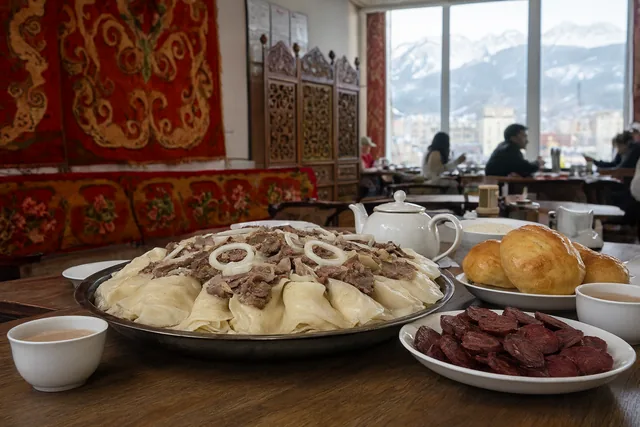
Mongolian food is the food of herders who move with their animals across one of the emptiest landscapes on earth: mutton, beef, goat, horse and camel, flour, and a remarkable range of dairy, from salty milk tea to dried curds and fermented mare's milk. This Mongolia food guide covers the dishes to know, how to read a Mongolian menu, tipping and etiquette in a nomad's ger, then goes destination by destination through where to eat in Ulaanbaatar, Terelj, Kharkhorin, the Gobi Desert, Lake Khövsgöl and Ölgii. Outside the capital, food is simple and hearty, and the meals you eat in herders' gers are often the most memorable of the trip.
What to eat in Mongolia: 12 dishes to know
Mongolians divide their food into "red foods", meat, eaten mostly in winter, and "white foods", dairy, which dominate in summer when the animals are milked. These are the dishes and drinks you will meet.
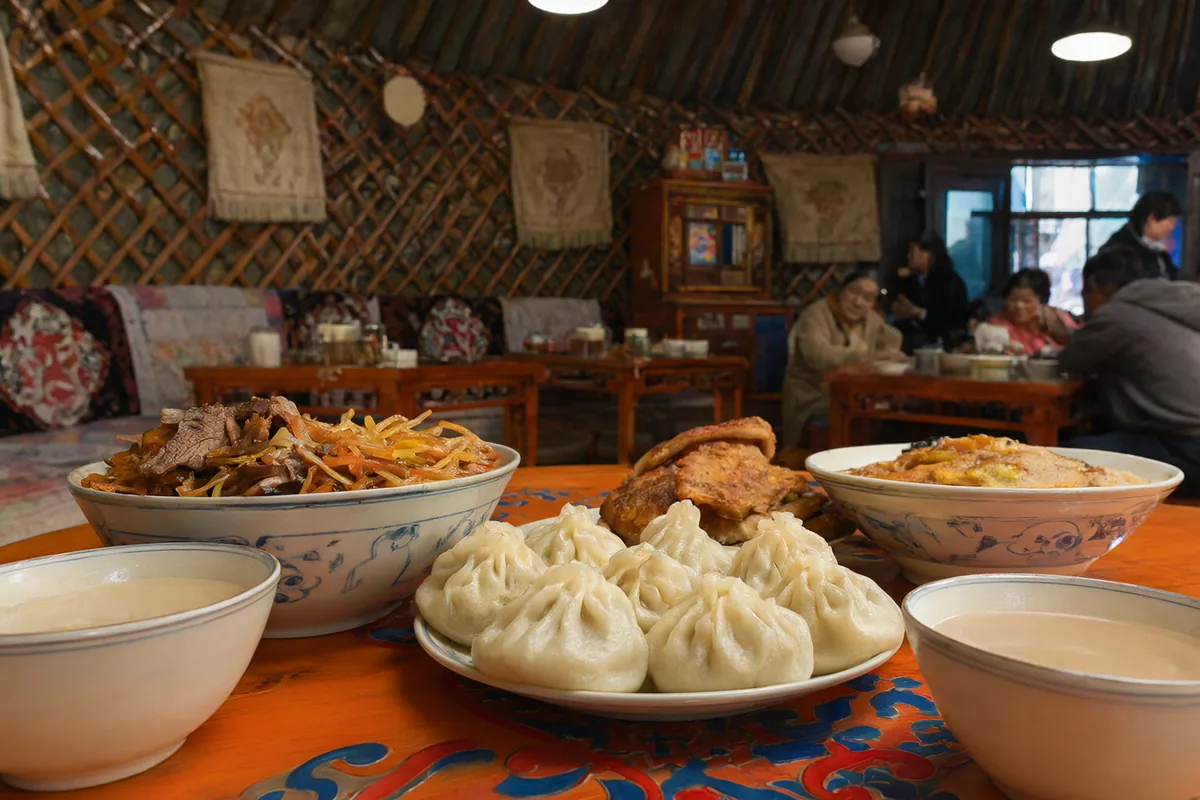
- Buuz (everywhere): steamed dumplings filled with minced mutton or beef, onion and garlic, pinched closed with a small hole at the top. At the lunar new year, Tsagaan Sar, families make them by the thousand.
- Khuushuur (everywhere): flat, fried pastries filled with minced mutton, crisp outside and juicy inside. They are the classic food of the Naadam festival in July.
- Tsuivan (everywhere): home-made flat noodles steamed and fried with strips of mutton, carrot, cabbage and onion. A staple of roadside canteens.
- Bansh (everywhere): small dumplings, boiled in soup or even in milk tea (banshtai tsai).
- Guriltai shul (everywhere): noodle soup with mutton and a few vegetables, the everyday lunch of the countryside.
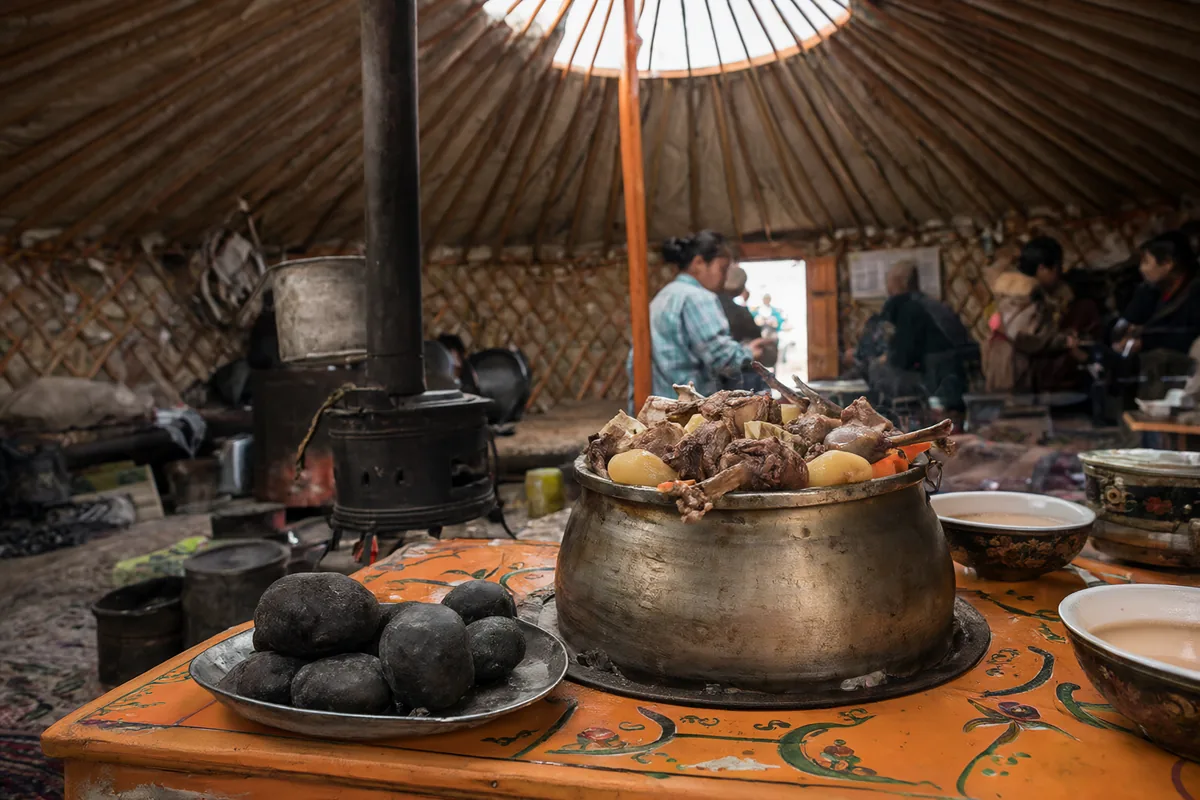
- Khorkhog (the countryside): mutton cooked with vegetables and hot river stones in a sealed metal milk churn. The greasy hot stones are passed from hand to hand afterwards, which is said to be good for health.
- Boodog (the countryside): a whole goat cooked from the inside by filling its skin with hot stones, then sealed and roasted. Marmot is cooked the same way, but marmots can carry plague, and health authorities warn against eating them.
- Süütei tsai (everywhere): milk tea, made with green tea, milk, water and salt. It is offered as soon as you enter any ger, and refusing it entirely is impolite.
- Airag (summer): fermented mare's milk, sour, fizzy and mildly alcoholic, made in a leather bag or barrel and stirred hundreds of times a day.
- Aaruul (everywhere): dried curds, rock hard, sour or slightly sweet, made in the sun on the roofs of gers.
- Öröm (summer): thick clotted cream skimmed from boiled milk, spread on bread or biscuits with sugar.
- Borts (the countryside): wind-dried strips of beef, light and long-lasting, ground into soups and stews in winter.
In the Gobi, camel herders make khoormog, fermented camel's milk. Mongolia is also a vodka country, and you may be offered a small bowl at a ger: the custom is to dip your ring finger in, flick drops to the sky, the air and the earth, then drink or touch it to your lips. Yoghurt (tarag) and fresh cheese (byaslag) are excellent in summer.
How to read a Mongolian menu
Mongolian is written in the Cyrillic alphabet, with two extra letters, ө and ү. The traditional vertical Mongolian script appears on monuments, signs and some official documents, but menus use Cyrillic. In Ulaanbaatar many restaurants have English menus, but canteens (guanz) and countryside cafés usually do not. These are the words to look for.
| Mongolian | Romanised | Meaning |
|---|---|---|
| Цэс | tses | Menu |
| Бууз | buuz | Steamed meat dumplings |
| Хуушуур | khuushuur | Fried meat pastries |
| Цуйван | tsuivan | Fried noodles with meat |
| Банш | bansh | Small boiled dumplings |
| Шөл | shöl | Soup |
| Мах | makh | Meat (хонины khoniny, mutton; үхрийн ükhriin, beef; адууны aduuny, horse) |
| Тахиа | takhia | Chicken |
| Загас | zagas | Fish |
| Ногоо | nogoo | Vegetables |
| Сүүтэй цай | süütei tsai | Salty milk tea |
| Айраг | airag | Fermented mare's milk |
| Цагаан хоол | tsagaan khool | Vegetarian food (not the same as цагаан идээ, tsagaan idee, dairy food) |
| Тооцоо | tootsoo | The bill |
Guanz canteens usually have a short Cyrillic menu on the wall and no English at all, and the difference between мах (meat) and махгүй (without meat) is easy to miss. Photograph the board with swap.menu and every dish is read from the Cyrillic, explained in your language and priced in your own currency, so you can order tsuivan or a vegetable soup with confidence.
Tipping, ger etiquette and paying the bill
Tipping is not a Mongolian tradition, but in Ulaanbaatar restaurants that serve visitors, leaving around 10 percent for good service is appreciated, and some places add a service charge, shown on the bill. Canteens do not expect tips. On organised tours, it is normal to tip your guide, driver and cook at the end. Prices include VAT. Our guide to tax and service charges on menus explains how these lines appear elsewhere.
The currency is the tögrög (MNT, ₮). Cards are widely accepted in Ulaanbaatar restaurants, hotels and supermarkets, but in the countryside, cash is essential, and ATMs are only found in provincial centres. If a card terminal offers to charge you in your home currency, choose tögrög: our guide to paying in local currency explains why.
Lunch is the main meal for many Mongolians, and Ulaanbaatar cafés offer cheap set lunches (өдрийн хоол, ödriin khool) on weekdays. Dinner is from about 6pm to 9pm. When visiting a ger, accept tea, food or airag with your right hand, or with the right hand supported by the left at the elbow, and at least taste what you are offered. Do not step on the threshold, and move around the inside of the ger clockwise.
Where to eat in Mongolia, from the city to the steppe
Ulaanbaatar has nearly half the country's population and almost all of its restaurants. Elsewhere, you will eat at ger camps, guesthouses, roadside canteens and with herding families. Jump to a destination:
Where to eat in Ulaanbaatar
Ulaanbaatar is where you can try every Mongolian dish in comfort, and where you can also eat almost anything else. Traditional restaurants in the centre, around Sükhbaatar Square and along Peace Avenue, serve buuz, khuushuur, tsuivan, mutton soups and milk tea, some in dining rooms decorated with painted wooden furniture and felt. For a cheap, local lunch, look for a small canteen or café advertising a set lunch, where the day's soup and a main come with tea for very little.
Ulaanbaatar has a large Korean community and Korean influence, and Korean restaurants are everywhere, so our guide to reading a Korean menu is useful here too. Hot pot restaurants, Russian cafés and Japanese restaurants are also popular, and the area around Seoul Street has plenty of bars and restaurants. Ulaanbaatar also has a surprising number of vegetarian restaurants, linked to the revival of Buddhism. For produce, the Mercury market sells meat, dairy, vegetables and imported goods, and the food hall in the State Department Store is a good place for aaruul and other dairy snacks to take on a road trip.
Where to eat in Terelj
Gorkhi-Terelj National Park, about one and a half to two hours from Ulaanbaatar, is the most visited countryside area in Mongolia, with granite rock formations, forested hills and river valleys dotted with ger camps. Most visitors eat at their camp, where meals tend to be a mix of Mongolian and Western dishes, often buffet style. Ask your camp in advance to prepare khorkhog, the hot stone mutton dish, which is usually made for a group and worth the wait.
Many trips to Terelj include a visit to a herding family, who will offer milk tea, aaruul, öröm on bread and, in summer, airag. On the way, the giant equestrian statue of Chinggis Khaan at Tsonjin Boldog has a café and restaurant. Terelj is cold at night even in summer, so a bowl of mutton noodle soup in the evening is welcome.
Where to eat in Kharkhorin
Kharkhorin, about seven hours' drive west of Ulaanbaatar, stands near the site of Karakorum, the 13th-century capital of the Mongol Empire, and is home to Erdene Zuu, the country's oldest surviving Buddhist monastery. It sits at the edge of the Orkhon Valley, a UNESCO-listed landscape of grassland, rivers and nomad camps. Kharkhorin town has a few simple canteens and cafés serving buuz, tsuivan, khuushuur and soups at low prices, plus shops for supplies.
Most visitors stay and eat at ger camps around Kharkhorin. In summer, the Orkhon Valley is one of the best places to taste fresh airag, made by the families who graze their horses there, and to see dairy being made. Order a guriltai shul at a roadside guanz on the drive and you will be eating exactly what Mongolian drivers eat.
Where to eat in the Gobi Desert
The Gobi, in the south, covers a vast area of gravel plains, mountains and sand dunes such as Khongoryn Els, and the regional centre, Dalanzadgad, is the base for most trips. Food in the Gobi is the simplest in Mongolia. Ger camps serve set meals, and herding families offer camel's milk tea, khoormog, fermented camel's milk, and dried curds. Goat and mutton are the main meats, and vegetables are scarce away from town.
Dalanzadgad has canteens, a market and shops for supplies, so stock up on water, fruit, bread and snacks there before heading into the desert. Distances in the Gobi are long and roads are rough, so meals depend on your driver and camp. If you are on a tour, let the company know any dietary needs well in advance.
Where to eat at Lake Khövsgöl
Lake Khövsgöl, in the far north near the Russian border, is a deep, clear mountain lake surrounded by forest, often called the "blue pearl" of Mongolia. Visitors fly or drive to Mörön, then travel to Khatgal, the village at the southern tip of the lake, which has guesthouses, cafés and ger camps. Food here is Mongolian country cooking, with yak dairy, yoghurt and öröm in summer, mutton soups and dumplings.
In late summer the forests around Lake Khövsgöl produce wild berries and pine nuts, which locals sell by the roadside. Ger camps around the lake serve set meals, and a few guesthouses in Khatgal cook to order. Weather changes fast at Lake Khövsgöl, and the season for most camps runs only from June to September.
Where to eat in Ölgii
Ölgii, in the Altai mountains of the far west, is the capital of Bayan-Ölgii province, where most people are ethnic Kazakhs and Muslims. The food here is Kazakh rather than Mongolian: beshbarmak, boiled meat on noodle sheets, horse meat sausage, fried dough called baursak, Kazakh-style milk tea and dried curds. Restaurants and canteens in Ölgii town serve these alongside Mongolian dishes, and the market is the place for dried meat, cheese and supplies.
Ölgii is best known for its eagle hunters and the Golden Eagle Festival held each autumn, when the town fills with visitors and families host meals in their homes and gers. Book accommodation and meals early if you are visiting for the festival, and carry cash, as cards are rarely accepted in Ölgii.
Vegetarian, vegan and allergy tips
In the countryside, Mongolia is very hard for vegetarians and almost impossible for vegans. Meat is in almost every dish, soups are made with mutton broth, and dairy is the main alternative. Ulaanbaatar is much easier: the city has many vegetarian restaurants, often signed цагаан хоол (tsagaan khool, vegetarian food), and international restaurants have choices. If you are touring, tell your company well in advance and bring snacks. The phrase to know is би мах иддэггүй (bi makh iddeggüi), "I don't eat meat".
Dairy is everywhere, including in tea, and many people with lactose intolerance find fermented products like airag and tarag still upset them. Wheat is in noodles, dumplings and pastries, so gluten-free eating outside the capital means relying on meat, dairy and rice. Water should be boiled or bottled. Our guide to eating abroad with food allergies explains how to communicate an allergy clearly when you do not speak the language.
Useful Mongolian phrases for ordering
Сайн байна уу? Sain baina uu?: "Hello", literally "Are you well?"
Юу санал болгох вэ? Yuu sanal bolgokh ve?: "What do you recommend?"
Үүнийг авъя Üüniig av'ya: "I'll have this" (pointing)
Би мах иддэггүй Bi makh iddeggüi: "I don't eat meat"
Би самарт харшилтай Bi samart kharshiltai: "I am allergic to nuts"
Тооцоо бодоорой Tootsoo bodooroi: "The bill, please"
Баярлалаа, их амттай байна Bayarlalaa, ikh amttai baina: "Thank you, it is very tasty"
Эрүүл мэндийн төлөө! Erüül mendiin tölöö!: "Cheers!", literally "to health"
How swap.menu helps you eat in Mongolia
Outside central Ulaanbaatar, menus are in Mongolian Cyrillic, often handwritten on a board, and dish names like шарсан будаа (sharsan budaa) or хуурга (khuurga) mean nothing to most visitors. Photograph the menu with swap.menu and every dish appears in your language with the Mongolian name beside it and a short explanation, so you know that sharsan budaa is fried rice and khuurga is a stir-fry of meat and vegetables. Every price is converted from tögrög to your home currency.
Tap the dishes you want, add a note such as "no meat" or "no onion, please", typed or spoken, and swap.menu translates your order into Mongolian. Show the server your phone, or let them scan the QR code and read your order on their own screen. Try it on a sample menu with the free demo, or see travel pass prices.
Off to Mongolia? Your first 3 menu scans are free, and a travel pass starts from $4.99 with nothing that renews.
Start free with 3 scansMongolia food FAQ
Do you tip in restaurants in Mongolia?
Tipping is not traditional in Mongolia, but around 10 percent is appreciated in Ulaanbaatar restaurants that serve visitors. Check the bill for a service charge first. On tours, tipping the guide, driver and cook at the end is normal.
What food is Mongolia famous for?
Buuz steamed dumplings, khuushuur fried meat pastries, tsuivan noodles and khorkhog, mutton cooked with hot stones. Mongolia is also known for its dairy, including salty milk tea, dried curds called aaruul and airag, fermented mare's milk.
What is airag and is it safe to drink?
Airag is fermented mare's milk, sour, slightly fizzy and mildly alcoholic, made by herding families in summer. It is widely drunk and part of Mongolian hospitality, but it can upset stomachs that are not used to it, so start with a small amount.
Is tap water safe to drink in Mongolia?
It is best not to drink tap water in Mongolia. Drink bottled or boiled water, which is easy to find in Ulaanbaatar and provided at ger camps and on tours.
Is it easy to be vegetarian in Mongolia?
Ulaanbaatar has many vegetarian restaurants, so it is easy in the capital. In the countryside, meat and dairy dominate almost every meal, so vegetarians should tell their tour company in advance and carry snacks.
How can I read a Mongolian menu if I cannot read Cyrillic?
Learn a few words such as бууз (buuz), мах (meat) and тооцоо (bill), or photograph the menu with swap.menu. It reads the Mongolian Cyrillic, translates every dish into your language, explains what it is, converts tögrög prices and translates your order back into Mongolian.
Travelling further in Asia? Read our food guides for nearby countries:
Or browse every travel food guide.