Taiwan is one of the best places in Asia to eat on a budget, and one of the easiest. The food is a mix of Hokkien Chinese cooking brought by early settlers, the regional Chinese cuisines that arrived after 1949, Japanese influence from the colonial era and Indigenous ingredients from the mountains and east coast. This Taiwan food guide covers the dishes to know, how to read a menu and the tick-box order sheets used in small restaurants, how night markets and paying work, and then goes city by city through where to eat in Taipei, Tainan, Taichung, Kaohsiung, Chiayi, Hualien and Jiufen. The single best tip: eat most of your dinners at night markets, a little at a time.
What to eat in Taiwan: 12 dishes to know
These are the dishes Taiwan is proud of, with the city they are most associated with where relevant.
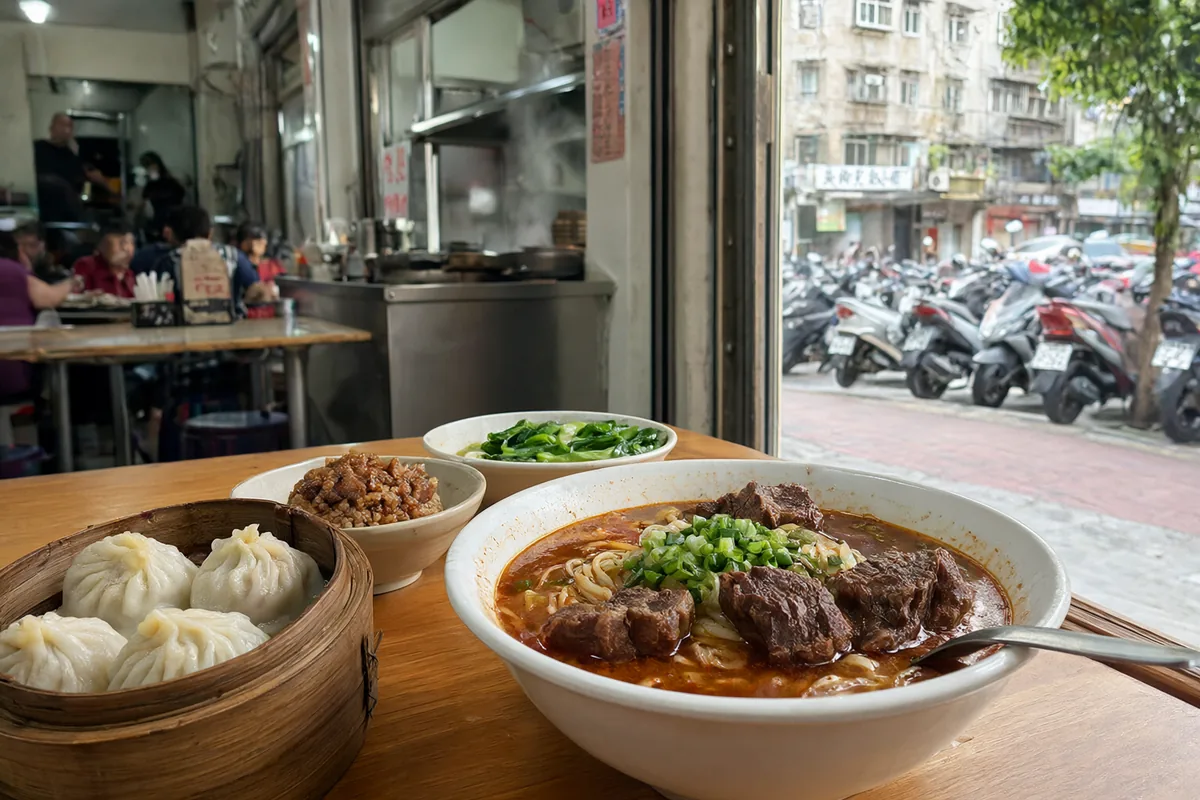
- Beef noodle soup (niúròu miàn): chunks of braised beef shank and tendon in a rich, often spicy, red-braised broth with thick wheat noodles. The unofficial national dish.
- Braised pork rice (lǔròu fàn): finely chopped pork belly stewed in soy sauce and spices, spooned over a bowl of rice. Cheap, small and eaten everywhere.
- Xiaolongbao (Taipei): steamed soup dumplings with pleated tops. Taipei's versions have become famous worldwide.
- Gua bao: a soft steamed bun folded around braised pork belly, pickled mustard greens, coriander and crushed sweet peanuts.
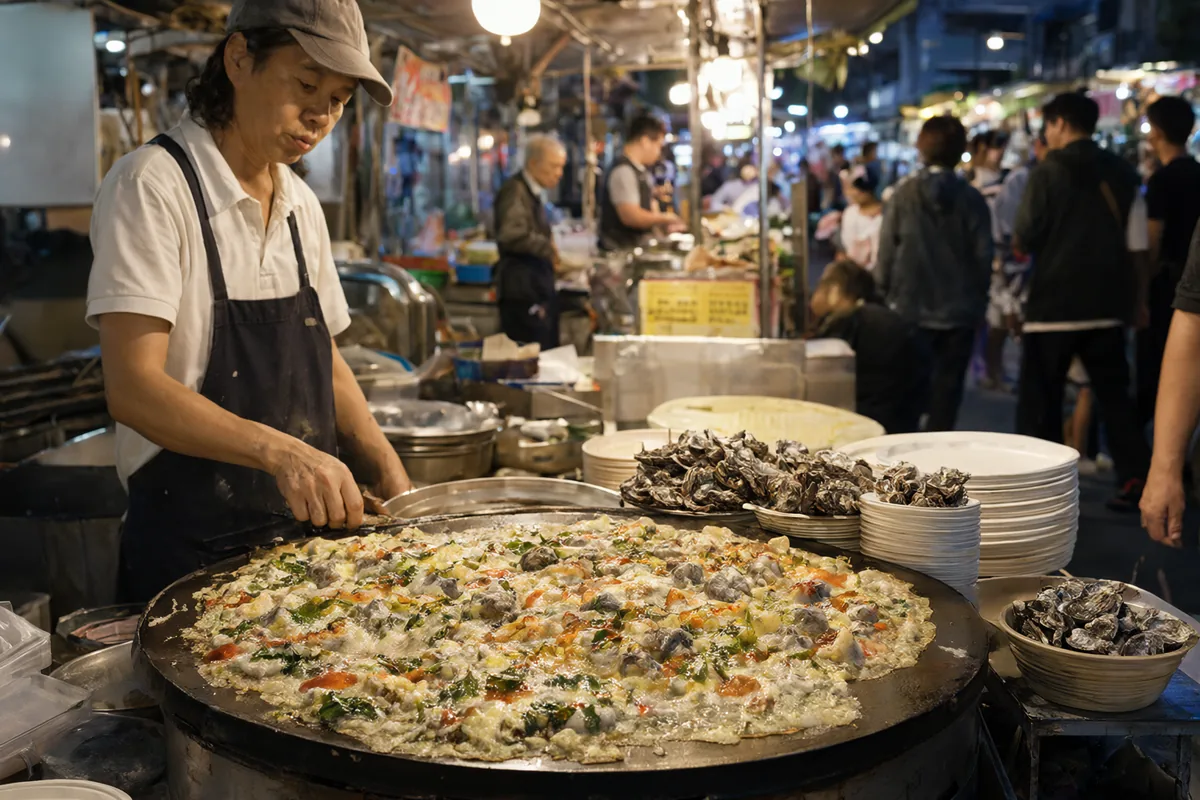
- Oyster omelette (ô-á-tsian in Taiwanese, hézǎi jiān in Mandarin): small oysters, egg and greens fried in a sticky sweet potato starch batter, topped with a sweet red sauce.
- Stinky tofu (chòu dòufu): fermented tofu, usually deep-fried and served with pickled cabbage and chilli sauce. It smells strong and tastes mild.
- Bubble tea (zhēnzhū nǎichá, Taichung and Tainan): milk tea with chewy tapioca pearls. Both cities claim to have invented it in the 1980s.
- Danzai noodles (Tainan): a small bowl of noodles in shrimp broth topped with minced pork and a single prawn, traditionally sold by street vendors with a shoulder pole.
- Fried chicken cutlet (jīpái): a huge, flattened chicken breast fried crisp and dusted with pepper and chilli powder, a night market classic.
- Turkey rice (huǒjī ròu fàn, Chiayi): shredded turkey over rice, dressed with savoury chicken fat and fried shallots.
- Shaved ice (bàobīng): a mountain of fluffy shaved ice topped with fresh mango in summer, or with red beans, taro balls and condensed milk.
- Pineapple cake (fènglí sū): buttery shortbread filled with pineapple jam, the classic gift to bring home.
How to read a Chinese menu in Taiwan
Taiwan uses traditional Chinese characters and Mandarin is the main language, though many older people also speak Taiwanese Hokkien, and some dish names come from it. Larger restaurants in Taipei often have English or picture menus, but small noodle and rice shops usually have a printed order sheet (diǎncài dān): you tick boxes or write how many of each dish you want, then hand it to the counter. These are the words that matter most.
| Chinese | Pinyin | Meaning |
|---|---|---|
| 內用 / 外帶 | nèiyòng / wàidài | Eat in / takeaway, often the first box on an order sheet |
| 小吃 | xiǎochī | Small eats: snacks and small dishes |
| 麵 / 飯 / 粥 | miàn / fàn / zhōu | Noodles / rice / congee |
| 湯 / 乾 | tāng / gān | Soup / dry (noodles tossed in sauce, no broth) |
| 大 / 小 | dà / xiǎo | Large / small portion, usually priced separately |
| 豬 / 雞 / 牛 / 魚 | zhū / jī / niú / yú | Pork / chicken / beef / fish |
| 滷 | lǔ | Braised in soy and spices |
| 燙青菜 | tàng qīngcài | Blanched greens, the standard side dish |
| 加蛋 | jiā dàn | Add an egg (加 means "add") |
| 辣 / 不辣 | là / bú là | Spicy / not spicy |
| 全糖 / 半糖 / 微糖 / 無糖 | quán táng / bàn táng / wéi táng / wú táng | Full / half / light / no sugar, for tea drinks |
| 正常冰 / 少冰 / 去冰 | zhèngcháng bīng / shǎo bīng / qù bīng | Normal ice / less ice / no ice |
| 素食 | sùshí | Vegetarian food |
| 時價 | shíjià | Market price, ask before ordering |
An order sheet in a Taiwanese noodle shop can list 40 items in Chinese with three prices each. Photograph it with swap.menu and you see every line in your language with the price converted, so you can tick the right boxes, write your numbers and hand it over like a local.
Japanese rule left a lasting mark on Taiwanese food, from bento boxes to sushi and ramen. If you are heading on to Japan or South Korea, our guides on how to read a Japanese menu and how to read a Korean menu cover the next steps.
Tipping, paying and meal times in Taiwan
Tipping is not expected in Taiwan. Many sit-down restaurants, and nearly all hotel restaurants, add a 10 percent service charge, which is shown on the menu. Small shops, food courts and night market stalls never add one. Menu prices already include Taiwan's 5 percent business tax. Our guide to tax and service charges on menus explains how these lines work around the world.
The currency is the New Taiwan dollar (TWD, written NT$). Cash is still essential at night markets, breakfast shops and small restaurants. Larger restaurants, department store food courts and convenience stores take cards, and the EasyCard transport card pays at convenience stores and many chain cafés. Taiwanese receipts double as tickets in a government lottery, so do not be surprised if you are offered a printed receipt with a number on it. When a card machine offers to charge you in your home currency, choose New Taiwan dollars: our guide to paying in local currency explains why.
Breakfast is a big meal eaten out at breakfast shops: soy milk (dòujiāng), egg crêpes (dàn bǐng), sticky rice rolls and fried dough sticks. Lunch runs from about 11:30am to 1:30pm, many restaurants close in the afternoon, and dinner starts early, around 5:30 to 6pm. Night markets open in the late afternoon and run until around midnight. Taiwan has few public rubbish bins, so keep a bag for skewers and cups.
Where to eat in Taiwan, city by city
Every Taiwanese city has a night market or three and its own signature snack. Jump to a city:
Where to eat in Taipei
Taipei has the widest range of food in Taiwan, from beef noodle shops and soup dumpling houses to Japanese-style izakaya and modern Taiwanese restaurants. Its night markets are the main event. Raohe Street Night Market in Songshan is long and lively, known for hújiāo bǐng (pepper buns baked against the walls of a clay oven) and herbal pork rib soup. Ningxia Night Market is compact and food-focused, good for oyster omelettes, taro balls and braised pork rice. Shilin Night Market is the largest and best known, with a food court underground and a lot of fried chicken above it.
By day, Yongkang Street in Da'an is famous for soup dumplings, beef noodles, scallion pancakes and mango shaved ice. Dihua Street in the old Dadaocheng district is lined with shops selling dried mushrooms, herbs, fruit and tea, with cafés in restored shophouses. For breakfast, find a busy soy milk shop and order hot salty soy milk (xián dòujiāng), which curdles slightly with vinegar and is topped with chilli oil and fried dough. Taipei's MRT makes it easy to hop between markets in one evening.
Where to eat in Tainan
Tainan is Taiwan's oldest city and, for many Taiwanese, its food capital. Cooking here is noticeably sweeter, and the snack culture is the richest on the island. The day starts early with beef soup: raw slices of local beef in a bowl, cooked at the table by a ladle of boiling broth, served from before dawn. Breakfast is also milkfish (shīmùyú), in congee or as a belly soup. Later in the day, eat danzai noodles, shrimp rolls, rice cakes steamed in small bowls (wǎn guǒ) and coffin bread (guāncai bǎn), a thick slab of fried toast hollowed out and filled with creamy seafood chowder.
Guohua Street and the lanes around it are packed with long-running snack stalls, and Shennong Street is a restored old lane of bars and cafés that is prettiest at night. The Garden Night Market (Huāyuán yèshì), one of the biggest in southern Taiwan, opens on Thursdays, Saturdays and Sundays. Out in the old port district of Anping, look for shrimp crackers, oyster fritters and bean jelly. Tainan is best explored by scooter or on foot, and a day of small bowls beats a single big meal.
Where to eat in Taichung
Taichung, in the centre of the west coast, is the city most often credited as the birthplace of bubble tea, and tea shops here take their drinks seriously. It is also known for sun cakes (tàiyáng bǐng), flaky round pastries filled with a malt sugar paste, sold by the box in bakeries all over town. Local favourites include dà miàn gēng, a thick noodle soup, and the city's many hotpot and teppanyaki restaurants.
Feng Chia Night Market, next to Feng Chia University, is one of the largest night markets in Taiwan and a testing ground for new snacks, so expect queues for whatever is in fashion. Yizhong Street, near a big high school, is cheaper and full of students. For something older, the Second Market, a market hall dating from the Japanese era, has breakfast and lunch stalls serving braised pork rice, radish cakes and noodles. Taichung's newer districts around the National Theater have smart cafés and restaurants.
Where to eat in Kaohsiung
Kaohsiung is Taiwan's big southern port, warmer and more relaxed than Taipei, and it is a seafood city. Take the short ferry to Cijin Island, where a seafood street near the ferry pier lets you choose fish, squid, prawns and shellfish from the display and have them grilled, steamed or stir-fried. Kaohsiung is also famous for papaya milk, a thick blended drink sold at fruit stalls, and for duck rice and seafood congee.
Liuhe Night Market in the city centre is the best known but has become touristy. Locals prefer Ruifeng Night Market, a dense grid of stalls near Kaohsiung Arena that opens on most evenings except Mondays and Wednesdays. The old Yancheng district near the Love River has traditional bakeries and long-running snack shops, and the converted warehouses of the Pier-2 Art Center host cafés and weekend markets. Kaohsiung's metro and light rail link most of these, so it is easy to get around without a car.
Where to eat in Chiayi
Chiayi is a small, unhurried city on the plains of southwest Taiwan, and most visitors pass through on the way to the tea and forest railway of Alishan. Stop to eat. The city is famous for turkey rice, shredded turkey over rice with savoury fat and crispy shallots, and you will find shops serving it on almost every block in the centre. Order a bowl with a side of blanched greens and a soup, and it is one of the cheapest good lunches in Taiwan.
The Wenhua Road Night Market, a long street of stalls that runs through the centre of Chiayi, is the place for dinner: look for dòuhuā (silky tofu pudding), grilled squid, fried rice cakes and fruit juices. Up in the mountains, Alishan's tea farms produce some of Taiwan's best high-mountain oolong, and small guesthouses and tea shops along the road offer tastings. Railway bento boxes, sold at stations across Taiwan, make a good lunch for the train.
Where to eat in Hualien
Hualien, on the east coast between the mountains and the Pacific, is the base for Taroko Gorge and the place to try Taiwan's Indigenous food. The Amis people and other Indigenous groups living along the east coast cook with wild greens, river fish, millet and mountain pork. Look for bamboo tube rice (zhútǒng fàn), sticky rice cooked inside a length of bamboo, salted pork, grilled wild boar and millet wine (xiǎomǐ jiǔ).
Dongdamen Night Market in central Hualien is a large, organised night market with a section devoted to Indigenous dishes and grilled meats, alongside Taiwanese snacks from around the island. Hualien is also known for wontons (called biǎnshí here) in clear broth and for its soft mochi, sold in gift boxes all over town. The east coast is less crowded than the west, and Hualien restaurants close earlier, so do not leave dinner too late.
Where to eat in Jiufen
Jiufen is an old gold-mining town clinging to a mountainside above the sea, about an hour from Taipei. Its main lane, Jishan Street (Jiufen Old Street), is a narrow covered alley of snack stalls, and the speciality is taro balls (yùyuán), chewy balls of taro and sweet potato served in sweet soup, hot or iced. Also try fish ball soup, herbal jelly and the peanut ice cream roll: shaved peanut brittle and ice cream wrapped in a thin crêpe, traditionally with coriander.
The town's teahouses, in old wooden buildings on the hillside, are the reason many people visit, with tea served in clay pots and a view over the coast. Jiufen gets very crowded at weekends and in the late afternoon, so go on a weekday morning, or stay into the evening when the lanterns are lit and the tour groups have gone. On the way back, the Miaokou Night Market in the port city of Keelung is one of the best in northern Taiwan for seafood.
Vegetarian, vegan and allergy tips
Taiwan is one of the easiest countries in Asia for vegetarians, thanks to a large Buddhist community. Vegetarian restaurants and buffets are common, often marked with the 卍 symbol, and convenience stores label vegetarian products. The labels are precise: 全素 or 純素 (quán sù, chún sù) means vegan, and in the Buddhist tradition also excludes onion, garlic and other pungent plants; 蛋奶素 (dàn nǎi sù) allows egg and dairy; and 五辛素 (wǔ xīn sù) is vegetarian but allows garlic and onion. Saying 我吃素 (wǒ chī sù) means "I am vegetarian".
In ordinary restaurants, watch for pork in broths and braised dishes, dried shrimp and fish in stir-fries, and lard in pastries. Peanuts are everywhere in Taiwan: crushed on gua bao, in sauces and in desserts. Sesame, shellfish and wheat in soy sauce are also common. Our guide to eating abroad with food allergies explains how to explain an allergy clearly.
Useful Mandarin phrases for ordering
你好 nǐ hǎo, "Hello"
請給我菜單 qǐng gěi wǒ càidān, "The menu, please"
我要這個 wǒ yào zhège, "I want this one" (pointing)
內用 / 外帶 nèiyòng / wàidài, "Eat in / takeaway", the first thing staff will ask
不要辣 bú yào là, "Not spicy"
我吃素 wǒ chī sù, "I am vegetarian"
請問多少錢? qǐngwèn duōshǎo qián?, "How much is it?"
謝謝,很好吃 xièxie, hěn hǎochī, "Thank you, it was delicious"
How swap.menu helps you eat in Taiwan
The best small restaurants in Taiwan rarely have English: there is a wall menu, an order sheet with tick boxes, and no time to ask questions at lunch. Photograph it with swap.menu and every item appears in your language with the Chinese name beside it and a short explanation, so you know that zhū xiě gāo is pig's blood rice cake on a stick, that sān bēi jī, "three cup chicken", is chicken braised with sesame oil, rice wine, soy and basil, and which drink sizes and sugar levels you are choosing. Every price is converted from New Taiwan dollars to your home currency.
Tap the dishes you want, add a note such as "no peanuts" or "half sugar, less ice", typed or spoken, and swap.menu translates your order into Chinese. Show the staff your phone, or let them scan the QR code and read your order on their own screen. Try it on a sample menu with the free demo, or see travel pass prices.
Off to Taiwan? Your first 3 menu scans are free, and a travel pass starts from $4.99 with nothing that renews.
Start free with 3 scansTaiwan food FAQ
Do you tip in restaurants in Taiwan?
No, tipping is not expected in Taiwan. Many sit-down and hotel restaurants add a 10 percent service charge, while small shops, food courts and night market stalls do not.
What food is Taiwan famous for?
Beef noodle soup, braised pork rice, xiaolongbao, bubble tea, gua bao, oyster omelettes, stinky tofu, fried chicken cutlets and mango shaved ice. Night markets are the best place to try many of them in one evening.
Which city in Taiwan is best for food?
Tainan is often called Taiwan's food capital for its traditional snacks and breakfast dishes, while Taipei has the widest choice and the best-known night markets. Each city in this guide has its own section on where to eat.
Is Taiwan expensive to eat out?
No. Night market snacks, noodle shops and rice shops are very cheap, and you can eat well on a small budget. Hotel restaurants and imported foods cost more, and seafood priced at market rate can add up.
Is tap water safe to drink in Taiwan?
Locals boil tap water before drinking it, and filtered water dispensers are common in hotels, stations and public buildings. Bottled water is cheap at convenience stores.
How can I order in Taiwan if I do not read Chinese?
Look for picture menus, or photograph the menu or order sheet with swap.menu. It translates every item into your language, explains what it is, converts prices from New Taiwan dollars and translates your order into Chinese for the staff.
Travelling further in Asia? Read our food guides for nearby destinations:
- Hong Kong food guide
- China food guide
- Macau food guide
- Philippines food guide
- How to order food in Japan
- How to read a Korean menu
Or browse every travel food guide.