Khmer food is less famous than the cooking of its neighbours, Thailand and Vietnam, and that is a shame. It is built on freshwater fish from the Tonle Sap lake and the Mekong, rice, fresh herbs, lime and a pounded spice paste called kroeung, and it tends to be less fiery than Thai food, with more sour and savoury notes. This Cambodia food guide covers the dishes to know, how to read a Khmer menu, how paying in US dollars and riel works, and where to eat in Phnom Penh, Siem Reap, Battambang, Kampot, Kep and Sihanoukville. Cambodia also kept a French legacy of baguettes, coffee and pâté, and you will see it at breakfast stalls across the country.
What to eat in Cambodia: 12 dishes to know
These are the dishes worth seeking out, from the national dish to the breakfast stalls. The Khmer names are given in romanised form, which varies a lot on menus.
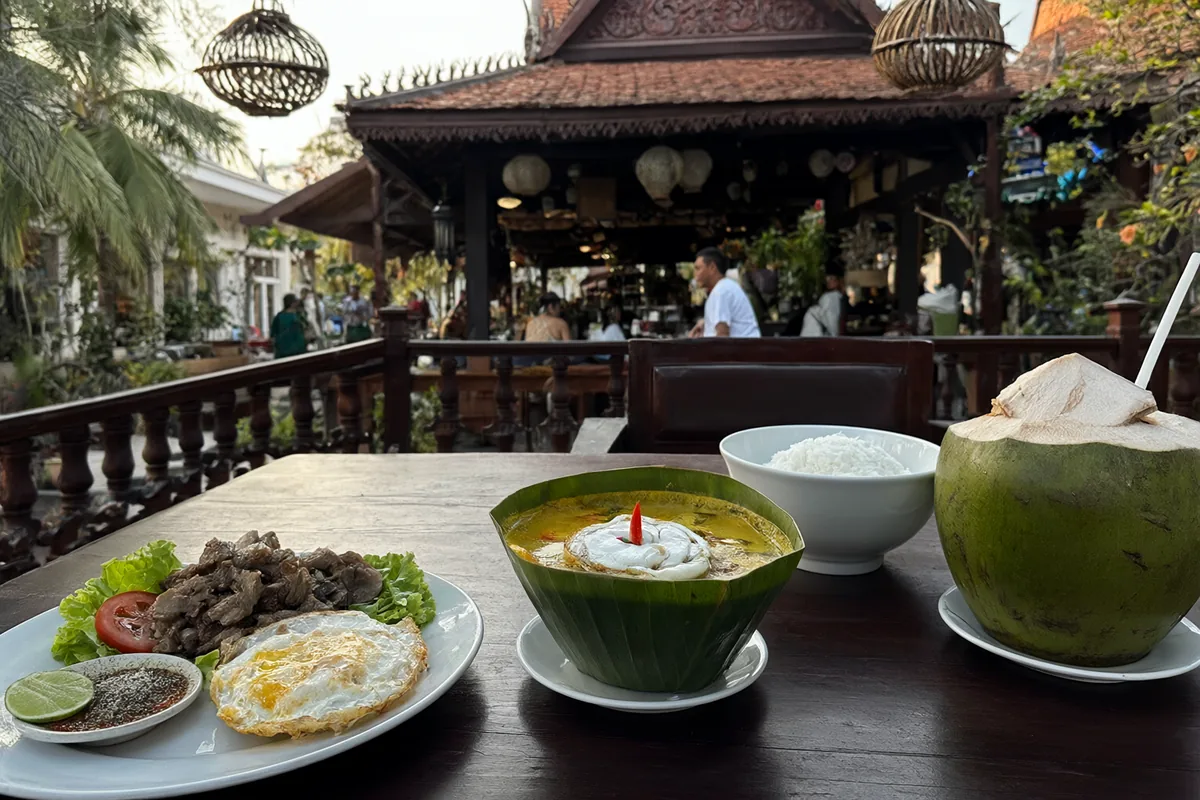
- Fish amok (amok trei): fish steamed in banana leaf cups with coconut milk, egg and kroeung until it sets into a soft, fragrant curry custard. Cambodia's best-known dish.
- Beef lok lak: stir-fried cubes of beef in a savoury sauce, served on lettuce and tomato with rice, often a fried egg, and a dip of lime juice and Kampot pepper.
- Num banh chok: fresh rice noodles with a green fish curry gravy, raw vegetables, banana flower and herbs. Sold in the morning by street vendors and markets, and sometimes called Khmer noodles.
- Bai sach chrouk: thinly sliced pork marinated in garlic and palm sugar, grilled over charcoal and served with broken rice, pickles and a clear soup. The classic Cambodian breakfast.
- Kuy teav: rice noodle soup with a clear pork broth, minced pork, offal or seafood, and plenty of herbs, lime and fried garlic. Another breakfast favourite.
- Samlor korko: a thick "stirred soup" of vegetables, green papaya, pumpkin, fish or pork and roasted ground rice, often described as a national dish.
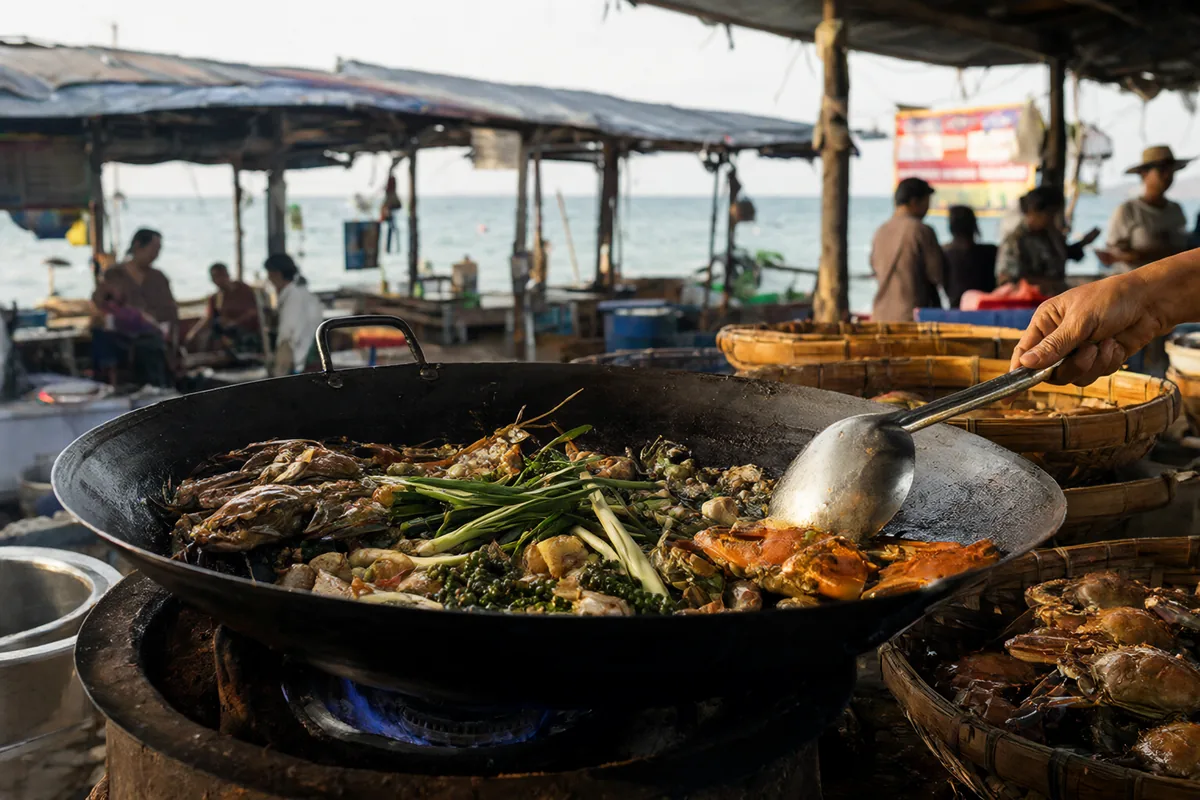
- Kampot pepper crab (Kep): crab stir-fried with fresh green Kampot peppercorns still on the stem.
- Prahok: fermented fish paste, the backbone of Khmer cooking. Try it as prahok ktis, a dip with minced pork and coconut milk, eaten with raw vegetables.
- Khmer red curry (kari sach moan): a mild, coconut-based chicken curry with sweet potato and green beans, often served with bread or noodles at celebrations.
- Num pang: a baguette sandwich with pâté, cold cuts or grilled meat, pickles and chilli, sold from street carts.
- Lort cha: short, fat rice noodles stir-fried with bean sprouts, greens and beef, topped with a fried egg. A cheap market lunch.
- Kralan: sticky rice, black beans, coconut milk and sugar roasted inside a length of bamboo over a fire, sold at roadside stalls.
How to read a Khmer menu
Khmer has its own script, written without spaces between words, and the romanised spellings on menus are inconsistent: kuy teav may appear as kuyteav or kuy tiew, and samlor as somlor. Restaurants in Phnom Penh, Siem Reap and Kampot usually have English menus, but markets and breakfast stalls often have only Khmer signs, if anything. If you know Thai dishes, many will look familiar, and our guide on how to read a Thai menu is a useful companion for a trip that crosses the border.
| Khmer | Romanised | Meaning |
|---|---|---|
| ម្ហូប | mhob | Food, a dish |
| បាយ | bai | Rice, and a meal (bai plus a topping is a rice plate) |
| គុយទាវ / មី | kuy teav / mi | Rice noodle soup / egg noodles |
| សម្ល | samlor | Soup or stew eaten with rice |
| ឆា | chha | Stir-fried |
| ចៀន | chien | Fried |
| អាំង | ang | Grilled over charcoal |
| សាច់មាន់ / សាច់ជ្រូក / សាច់គោ | sach moan / sach chrouk / sach ko | Chicken / pork / beef (sach means meat) |
| ត្រី / បង្គា / ក្តាម | trei / bangkea / kdam | Fish / prawn / crab |
| បន្លែ | banlae | Vegetables |
| ប្រហុក | prahok | Fermented fish paste |
| ហឹរ / មិនហឹរ | hel / min hel | Spicy / not spicy |
| បួស | buos | Vegetarian (as in food for monks) |
| ទឹកកក | tuk kak | Ice |
Many Cambodian menus list prices in US dollars, some list them in riel, and some show both. swap.menu reads the menu in Khmer or English, explains each dish and converts every price, whichever currency it is in, into your home currency, so you can compare a dollar dish with a riel one at a glance.
Tipping, paying and meal times in Cambodia
Tipping is not a traditional custom in Cambodia, but it has become common in tourist areas, and wages are low, so a small tip for good service at a sit-down restaurant is appreciated. Many places have a tip box by the till. Mid-range and upmarket restaurants and hotels may add 10 percent VAT and a service charge, and some menus show prices with "++" to say these are added at the end. Our guide to tax and service charges on menus explains these lines.
Cambodia uses two currencies at once. The riel (KHR, written ៛) is the national currency, but US dollars are used everywhere for larger amounts, and ATMs usually dispense dollars. You will often pay in dollars and get change under a dollar in riel. Bring clean, untorn dollar notes, as damaged ones are often refused. Street food and market stalls want cash, while restaurants in the cities increasingly accept cards and local QR payments, sometimes with a surcharge for cards. When a card machine offers to charge you in your home currency, decline: our guide to paying in local currency explains why.
Cambodians eat early. Breakfast stalls selling num banh chok, kuy teav and bai sach chrouk are busiest from about 6am to 8am. Lunch is around 11am to 1pm, and dinner from 6pm to 8pm. Outside Phnom Penh and Siem Reap, many places close by 9 or 10pm. Shared dishes are normal, and rice comes with almost everything.
Where to eat in Cambodia, city by city
From the capital's markets to the crab shacks of the south coast, every stop has something different. Jump to a city:
Where to eat in Phnom Penh
Phnom Penh, the capital, has the best range of food in Cambodia, from noodle stalls at dawn to modern Khmer restaurants. The markets are the place to start. The Russian Market (Psar Toul Tom Poung) has a food section in the middle where you can sit at a counter for kuy teav, num banh chok, iced coffee and desserts. The Central Market (Psar Thmei), under a large Art Deco dome, has food stalls around its edges, and Orussey Market is bigger, busier and more local.
In the morning, look for bai sach chrouk vendors grilling pork on street corners all over Phnom Penh. In the evening, the riverside along Sisowath Quay has restaurants facing the Tonle Sap river, and the streets of BKK1 and around Street 308 have cafés, bars and a mix of Khmer and international food. Phnom Penh also has stalls selling fried insects, crickets and tarantulas among them, if you are curious. Use a tuk-tuk or ride-hailing app to get between areas, as the city is spread out and hot.
Where to eat in Siem Reap
Siem Reap is the gateway to the temples of Angkor, and its food scene caters to visitors more than anywhere else in Cambodia. That has an upside: Siem Reap has many restaurants serving carefully made Khmer dishes, and it is the best place in the country for a cooking class, many of which start with a market visit. Order fish amok, lok lak, samlor korko and prahok ktis, and look for freshwater fish from the nearby Tonle Sap lake.
The area around the Old Market (Psar Chas) and Pub Street is busy with restaurants and bars, but it is noisy and prices are higher. For local food, walk to Psar Leu, the main market used by residents, or the streets around Wat Bo on the east bank of the river. If you start the temples at sunrise, buy num pang or kralan the evening before, and expect stalls outside the main temples selling noodles, fruit and fresh coconuts. Siem Reap is quietest, and cheapest, in the wet season from June to October.
Where to eat in Battambang
Battambang, in the northwest, is Cambodia's second city and the centre of its rice-growing region, sometimes called the country's rice bowl. It is relaxed and far less touristy than Siem Reap, with well-preserved French colonial shophouses along the Sangker River. The food is simple and good: num banh chok in the morning, rice plates, grilled fish and prahok dishes, and plenty of fruit from the surrounding farms.
Psar Nat, the central market in a striking 1930s building, is the place for breakfast and snacks. Around the market and along the riverside, small Khmer restaurants and cafés serve lunch and dinner, and a few run cooking classes. On the road out to the countryside, look for kralan roasting in bamboo at roadside stalls. Battambang restaurants close early, so plan dinner for around 6 or 7pm.
Where to eat in Kampot
Kampot is a sleepy riverside town in the south, best known for Kampot pepper, which has protected geographical status and is grown on small farms in the countryside nearby. It comes black, red, white and fresh green on the stem, and you will find it in nearly every dish here, from lok lak dipping sauce to stir-fried seafood. Visiting a pepper farm is one of the best things to do around Kampot.
The town is known for its durian, celebrated with a giant durian statue at a roundabout in the centre, and for the salt fields on the road to Kep. The riverside is lined with restaurants and guesthouses serving Khmer food, seafood and Western dishes, and the old market area has noodle and rice stalls. Kampot attracts long-stay travellers, so there are also bakeries and cafés. It is an easy base for day trips to Kep and Bokor Mountain.
Where to eat in Kep
Kep is a small seaside town near the Vietnamese border, and almost everyone comes here for one dish: crab with green Kampot pepper. At the Kep crab market, crabs are kept alive in bamboo baskets in the sea and pulled out to order. You can buy crab, prawns, squid and fish by weight at the market and have it cooked by stalls nearby, or eat at one of the open-sided restaurants on stilts along the water.
Also look for grilled squid, prawns with garlic, and dried fish and seafood sold by the market stalls. Kep's seafood is priced by the kilo, so ask the weight and the cooking price before you commit. The market is busiest in the late afternoon and at weekends, when families come down from Phnom Penh. Stay for the sunset over the water, and take a boat to nearby Rabbit Island for a simple seafood lunch on the beach.
Where to eat in Sihanoukville
Sihanoukville is Cambodia's main beach town and port, and it has changed a great deal over the past decade, with large casino and construction projects reshaping the town centre. Many travellers now pass through on the way to the islands of Koh Rong and Koh Rong Samloem. The food highlight is seafood: grilled squid, prawns, crab and fish served at beachside restaurants, especially along Otres Beach, and sold by vendors on the sand.
The local market in Sihanoukville has noodle and rice stalls, and the town has many Chinese restaurants serving its newer residents. On the islands, food is simpler, with guesthouse kitchens serving fresh fish, Khmer curries and fried rice, and prices higher because supplies come by boat. Bring cash to the islands, as ATMs and card machines are limited.
Vegetarian, vegan and allergy tips
Being vegetarian in Cambodia takes some effort. Almost every Khmer dish is seasoned with prahok (fermented fish paste) or fish sauce (tuk trei), and soups are often made with pork or fish stock. Tourist restaurants in Phnom Penh, Siem Reap and Kampot usually offer vegetarian versions of amok, curries and stir-fries with tofu, and Buddhist vegetarian restaurants exist in the cities. The word for vegetarian food is ម្ហូបបួស (mhob buos), and you can say khnhom nham buos, "I eat vegetarian". Ask for no fish sauce as well.
Peanuts appear in some salads, dips and noodle dishes, and dried shrimp is common in snacks. Shellfish, fish and fermented fish are central to the cuisine, so a fish or shellfish allergy needs careful explaining. Coconut milk is used in amok and curries. Our guide to eating abroad with food allergies explains how to explain an allergy clearly when you do not share a language.
Useful Khmer phrases for ordering
សួស្តី suostei, "Hello" (informal); ជម្រាបសួរ chumreap suor is the polite greeting
សុំមើលម៉ឺនុយ som mel menu, "Can I see the menu?"
ខ្ញុំចង់បានមួយនេះ khnhom chang ban muoy nih, "I would like this one" (pointing)
កុំដាក់ម្ទេស kom dak mtes, "No chilli, please"
ខ្ញុំញ៉ាំបួស khnhom nham buos, "I eat vegetarian"
សុំគិតលុយ som kit luy, "The bill, please"
ឆ្ងាញ់ណាស់ អរគុណ chhnganh nas, arkun, "Very delicious, thank you"
How swap.menu helps you eat in Cambodia
Cambodian menus can be in Khmer script, in creative English, or a mix of both, with prices in dollars, riel or both. Photograph the menu with swap.menu and every dish appears in your language with its Khmer name beside it and a short explanation, so you know that samlor machu is a sour soup flavoured with tamarind or lemongrass, and that pong tia koon is a fertilised duck egg. Every price is converted from dollars or riel to your home currency, and any VAT or service charge is pointed out before the bill arrives.
Tap the dishes you want, add a note such as "no fish sauce" or "not spicy, please", typed or spoken, and swap.menu translates your order into Khmer. Show the cook your phone, or let them scan the QR code and read your order on their own screen. Try it on a sample menu with the free demo, or see travel pass prices.
Off to Cambodia? Your first 3 menu scans are free, and a travel pass starts from $4.99 with nothing that renews.
Start free with 3 scansCambodia food FAQ
Do you tip in restaurants in Cambodia?
Tipping is not traditional, but it is common and appreciated in tourist areas, where wages are low. Leaving a small amount at a sit-down restaurant or using the tip box is enough. Check the bill first, as some places add VAT and a service charge.
What food is Cambodia famous for?
Fish amok, beef lok lak, num banh chok noodles, bai sach chrouk pork and rice, kuy teav noodle soup and crab with Kampot pepper. Prahok, a fermented fish paste, flavours much of the cooking.
Should I pay in dollars or riel in Cambodia?
Both are used. Larger prices are often in US dollars, while small purchases and change under a dollar are in riel. Carry clean dollar notes and some riel for street food and tuk-tuks.
Is Cambodian food spicy?
Khmer food is generally milder than Thai food. Chilli is usually served on the side so you can add your own, and the main flavours are sour, salty and herby rather than hot.
Is tap water safe to drink in Cambodia?
No, drink bottled or filtered water. Many guesthouses and cafés offer refills of filtered water, and ice in city restaurants is usually made from treated water.
How can I read a menu in Cambodia?
Restaurants in tourist areas usually have English menus, but markets and local stalls may not. Photograph the menu with swap.menu and it translates every dish into your language, explains it, converts dollar or riel prices to your currency and translates your order into Khmer.
Travelling further in Southeast Asia? Read our food guides for nearby countries:
Or browse every travel food guide.