Uzbekistan is the heart of Silk Road cooking: plov cooked in giant cauldrons, round tandir bread stamped with patterns, flaky samsa, hand-pulled noodles, skewers of lamb over charcoal, and endless pots of tea under the shade of a vine. This Uzbekistan food guide covers the dishes to know, how to read menus in Uzbek and Russian, tipping and plov etiquette, then goes city by city through where to eat in Tashkent, Samarkand, Bukhara, Khiva, Nukus and the Fergana Valley. Every region claims its own plov, and tasting the differences is one of the great pleasures of a trip here.
What to eat in Uzbekistan: 12 dishes to know
Uzbek food is built on lamb, rice, wheat, onions, carrots, cumin and fresh bread, with brilliant fruit and vegetables in summer. These are the dishes to look for, with the region they belong to where it matters.
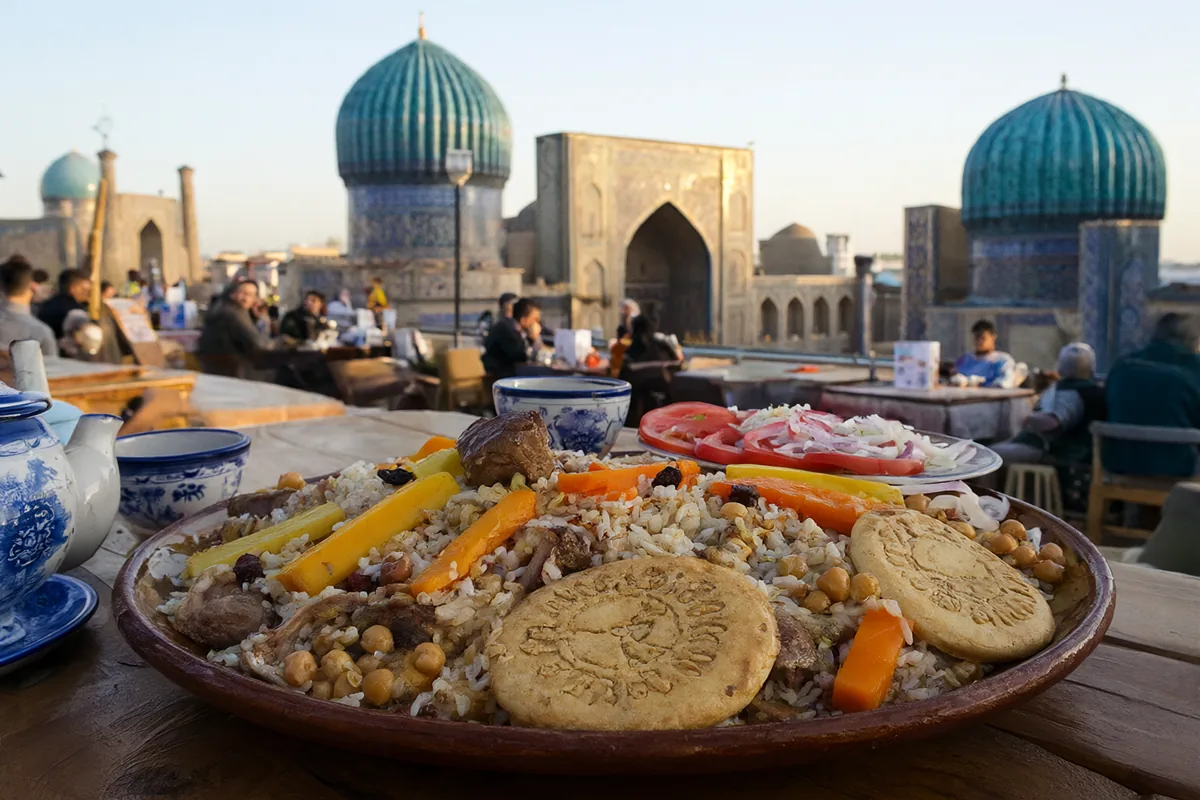
- Plov (everywhere): rice cooked with lamb, onions, yellow and orange carrots and cumin in a wide cast-iron cauldron called a kazan, often topped with chickpeas, raisins, quail eggs or slices of horse sausage. Uzbek plov culture is on UNESCO's intangible heritage list, and every city has its own style.
- Non (everywhere): round flatbread baked on the wall of a clay tandir oven, with a thin, stamped centre and a thick rim. Samarkand's heavy, glossy non is the most famous. Bread is sacred: break it by hand and never put it upside down.
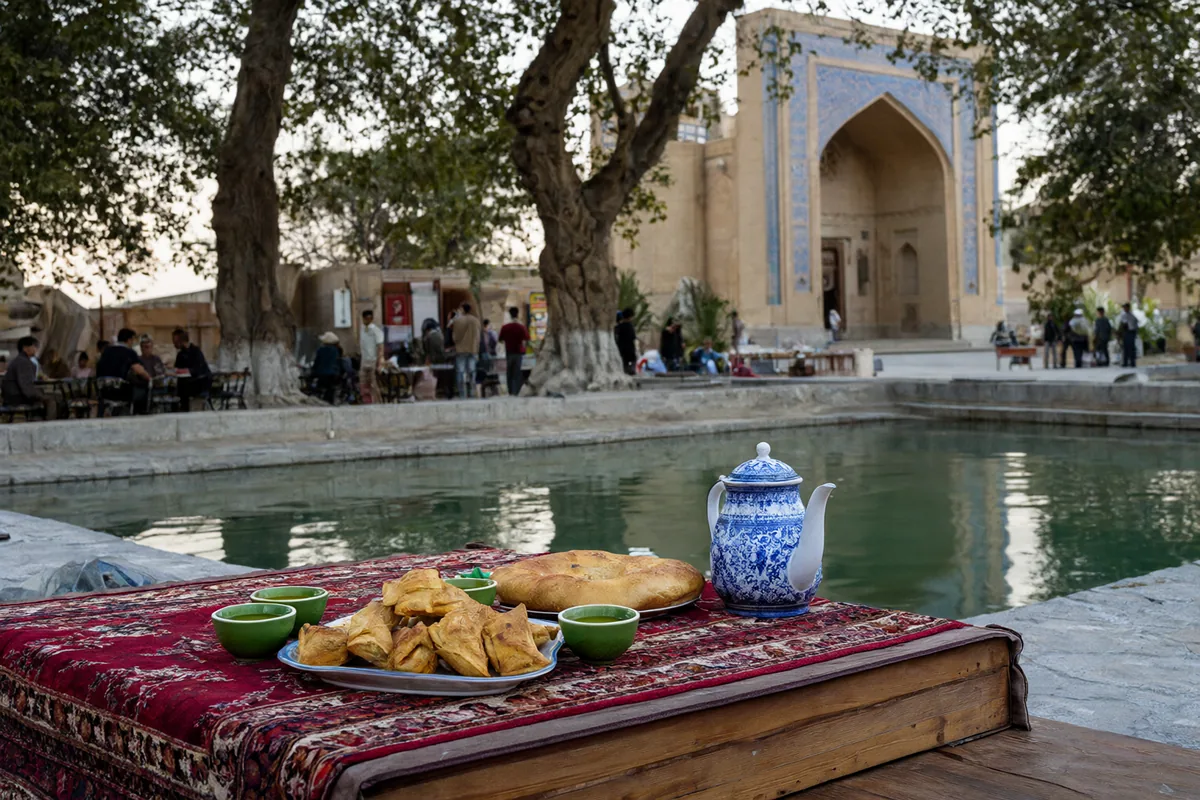
- Somsa (everywhere): flaky pastry triangles filled with lamb and onion and baked in a tandir. In autumn, look for pumpkin somsa.
- Lag'mon (everywhere): thick hand-pulled noodles, a dish brought by the Uyghur and Dungan peoples, served in a soupy broth or stir-fried with lamb, peppers and tomato.
- Shashlik (everywhere): skewers of lamb, beef, chicken or liver grilled over charcoal, often with a cube of lamb fat between the pieces, served with raw onion and bread.
- Manti (everywhere): large steamed dumplings filled with lamb and onion, or pumpkin, served with yoghurt or sour cream.
- Sho'rva (everywhere): a clear soup of lamb, potato, carrot and chickpeas, simple and restoring.
- Dimlama (everywhere): meat and vegetables layered in a kazan and slowly braised in their own juices.
- Norin (Tashkent): fine, cold chopped noodles mixed with boiled horse meat, served with broth on the side.
- Shivit oshi (Khiva): bright green dill noodles topped with a meat and vegetable stew and yoghurt, the signature dish of Khorezm.
- Tuxum barak (Khiva): delicate boiled dumplings filled with egg, served with butter or yoghurt.
- Achichuk (everywhere): a salad of thinly sliced tomato and onion, served with plov to cut the richness.
Tea (choy) comes with every meal, served in small bowls called piyola. Hosts pour a bowl and return it to the pot two or three times to brew it, and they fill your bowl only part way, which is a sign of respect, not stinginess. In summer, Uzbek melons, grapes, apricots and pomegranates are exceptional. Sweet stalls sell halva, dried fruit and nuts, and in spring nisholda, a whipped egg white and sugar cream eaten with bread.
How to read Uzbek and Russian menus
Uzbek is officially written in the Latin alphabet, but older signs and some menus still use the Cyrillic alphabet, and many restaurant menus are in Russian, the common language of business and cities. In Tashkent and the tourist areas of Samarkand and Bukhara you will often find English too, but bazaar canteens and plov centres usually have no menu at all. These are the words worth knowing in both languages.
| Uzbek | Russian (romanised) | Meaning |
|---|---|---|
| Palov / osh | плов (plov) | Plov, rice with lamb and carrots |
| Non | лепёшка (lepyoshka) | Round tandir flatbread |
| Somsa | самса (samsa) | Baked pastry with meat |
| Shashlik | шашлык (shashlyk) | Grilled skewers |
| Lag'mon | лагман (lagman) | Pulled noodles in broth or sauce |
| Manti | манты (manty) | Steamed dumplings |
| Sho'rva | шурпа (shurpa) | Meat and vegetable soup |
| Qo'y go'shti | баранина (baranina) | Lamb or mutton |
| Mol go'shti | говядина (govyadina) | Beef |
| Tovuq | курица (kuritsa) | Chicken |
| Baliq | рыба (ryba) | Fish |
| Ko'k choy / qora choy | зелёный чай / чёрный чай (zelyony / chorny chay) | Green tea / black tea |
| Hisob | счёт (schyot) | The bill |
| Xizmat haqi | обслуживание (obsluzhivaniye) | Service charge |
Russian-language menus in Uzbekistan often price shashlik per skewer and salads or meat by weight, and bread and tea may be charged separately. swap.menu reads Uzbek and Russian menus, in Latin or Cyrillic script, explains each dish in your language and converts the so'm price, so the long row of zeros on the bill makes sense.
Tipping, plov etiquette and paying the bill
Many restaurants in Tashkent, Samarkand and Bukhara add a service charge to the bill, usually around 10 to 15 percent, shown as xizmat haqi or обслуживание. If it is included, no tip is expected. If not, leaving around 10 percent in a sit-down restaurant is appreciated, while bazaar canteens and plov centres do not expect tips. Our guide to tax and service charges on menus explains how these lines work elsewhere.
The currency is the Uzbek so'm (UZS). Prices run into the tens and hundreds of thousands, which takes some getting used to. Cards are increasingly accepted in hotels and restaurants in Tashkent and the main tourist cities, but cash is still essential at bazaars, plov centres, small cafés and in the regions. If a card machine offers to charge you in your home currency, choose so'm: our guide to paying in local currency explains why.
Plov is a lunch dish. Plov centres cook it in the morning and serve it from late morning until the cauldrons are empty, often by early afternoon, so do not plan on plov for dinner at a specialist. Dinner in restaurants is usually from 7pm. In tea houses (choyxona), you may sit with your shoes off on a tapchan, a raised wooden platform covered with cushions around a low table. Bread is always placed the right way up and shared by hand at the start of the meal.
Where to eat in Uzbekistan, city by city
Most trips follow the Silk Road cities from Tashkent to Samarkand, Bukhara and Khiva, by fast train and then road, and each city has its own bread, its own plov and its own pace. Jump to a destination:
Where to eat in Tashkent
Tashkent is a big, green Soviet-planned city, and the place to start is the Chorsu Bazaar in the old town, under its huge blue dome. Inside are spices, dried fruit, nuts, cheese and the Korean carrot salads brought by the city's Korean community; outside and around it are bread sellers, somsa ovens and canteens. The newer Alay Bazaar in the centre is smaller and calmer. For plov, Tashkent has plov centres, vast canteens where cooks work rows of giant kazans every morning; the best known is near the Tashkent TV Tower, and it is a sight as much as a meal.
Tashkent plov, known as wedding plov, is often topped with quail eggs and horse sausage. The city also has the widest choice of restaurants in the country, from Uzbek and Uyghur noodle houses to Russian, Georgian, Korean and modern cafés around the centre and the pedestrian Sayilgoh street, often called Broadway. Look for norin, a Tashkent speciality, and eat shashlik at one of the open-air grills that set up in the evenings around the parks.
Where to eat in Samarkand
Samarkand is the city of the Registan, three tiled madrasas around a square, and of the most famous bread in Central Asia. Samarkand non is dense, glossy and heavy, and it keeps for days; travellers carry it home as a gift. The Siab Bazaar, beside the Bibi-Khanym Mosque, is the place to buy it warm, along with dried apricots, raisins, almonds, halva and spices. The pedestrian street between the Registan and the mosque is lined with cafés and restaurants with terraces.
Samarkand plov is cooked and served in layers rather than mixed: rice on the bottom, then carrots, then meat on top. Order it at lunchtime and you will see the difference. Samarkand restaurants with rooftop terraces near the Registan are popular at sunset, while the old neighbourhoods behind the main sights have simple choyxonas serving somsa, shashlik and tea. The Samarkand region also makes wine, and tastings are easy to arrange.
Where to eat in Bukhara
Bukhara's old town is compact and walkable, and its centre is Lyabi-Hauz, a stone-lined pool shaded by ancient mulberry trees, ringed with tea houses and restaurant terraces. Sitting there over a pot of green tea and a plate of somsa as the evening cools is one of the classic moments of a trip to Uzbekistan. Restaurants around Lyabi-Hauz and the covered trading domes serve plov, shashlik, lamb baked in the tandir and soups.
Bukhara is quieter than Samarkand, and many visitors eat at their guesthouse, where breakfast spreads of bread, jam, fruit, eggs and pastries can be generous. Walk into the residential lanes to find bakeries and small canteens where Bukhara residents eat. In summer, the heat in Bukhara is intense in the middle of the day, so eat a long lunch in the shade and save sightseeing for the evening, when restaurant terraces fill up.
Where to eat in Khiva
Khiva's walled inner town, the Itchan Kala, is a preserved museum city of mud-brick walls, minarets and madrasas, and its food belongs to the Khorezm region, which differs from the rest of the country. Order shivit oshi, the green dill noodles with stew and yoghurt, tuxum barak, the egg-filled dumplings, and gumma, fried pastries with meat. Restaurants and guesthouses inside the walls, some with rooftop terraces facing the minarets, serve these alongside plov and shashlik.
Khiva is small and quiet after dark, when most tour groups have left, so dinner choice inside the walls is limited and many visitors eat at their guesthouse. The bazaar just outside the east gate is good for bread, fruit and snacks. Urgench, the nearby regional city, is where the trains and flights arrive and has more ordinary local restaurants.
Where to eat in Nukus
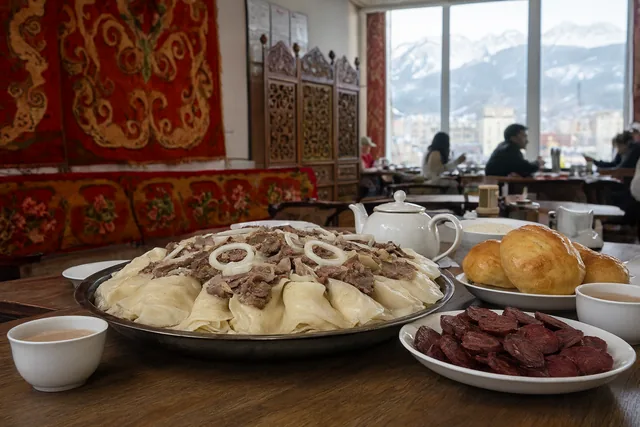
Nukus is the capital of Karakalpakstan, an autonomous region in the far west, and most visitors come for the Savitsky Museum and its remarkable collection of Soviet avant-garde art, or to travel on to the stranded ships of Moynaq on the dried-up Aral Sea. The Karakalpak people are closer in language and cooking to the Kazakhs than to the Uzbeks, so boiled meat dishes served over noodle sheets, similar to Kazakh beshbarmak, appear alongside Uzbek plov, shashlik and lag'mon.
Restaurants in Nukus are simple and mostly serve Uzbek, Russian and Karakalpak food to locals, at low prices. The central bazaar is the place for bread, fruit and dried fish. Nukus is not a food destination in itself, but a dinner here and supplies from the bazaar are useful before the long desert drives in either direction.
Where to eat in the Fergana Valley
The Fergana Valley in the east is Uzbekistan's most fertile and populous region, ringed by mountains and full of orchards, cotton fields and bazaars. Its main towns are Fergana, Margilan, famous for silk weaving, Kokand, the old capital of a khanate with a grand palace, and Rishtan, known for its blue and green ceramics. Fergana plov is a rich, deep-coloured version, and the valley's apricots, cherries, grapes and melons are some of the best in the country.
The Fergana Valley is more conservative and less visited than the Silk Road cities, and the food scene is local: choyxonas, plov houses, bakeries and lively bazaars rather than tourist restaurants. Eating here means following locals to the busiest plov kazan at lunchtime. English is rare, and menus, where they exist, are in Uzbek or Russian, so a translation app is especially useful in the Fergana Valley.
Vegetarian, vegan and allergy tips
Uzbekistan is a challenge for vegetarians. Plov is cooked with lamb and its fat, most soups are made with meat stock, and somsa and manti are usually filled with lamb. Look instead for pumpkin somsa and pumpkin manti in autumn, vegetable salads, bread, yoghurt and fruit, and ask whether a lag'mon can be made without meat. Cottonseed oil, used in plov, has a strong flavour that some visitors find heavy. The word for vegetarian is vegetarian in both Uzbek and Russian, and "I don't eat meat" is go'sht yemayman.
Nuts are common in sweets, halva and pastries, and sesame appears on bread. Wheat is in bread, noodles, dumplings and pastries, which makes gluten-free eating difficult. Water and ice are best avoided unless bottled. Our guide to eating abroad with food allergies explains how to communicate an allergy clearly when you do not speak the language.
Useful Uzbek and Russian phrases for ordering
Assalomu alaykum "Hello", the respectful Uzbek greeting (Russian: Здравствуйте, zdravstvuyte)
Nima tavsiya qilasiz? / Что посоветуете? Chto posovetuyete?: "What do you recommend?"
Shuni olaman / Вот это, пожалуйста Vot eto, pozhaluysta: "I'll have this, please" (pointing)
Go'sht yemayman / Я не ем мясо Ya ne yem myaso: "I don't eat meat"
У меня аллергия на орехи U menya allergiya na orekhi: "I am allergic to nuts" (Russian)
Hisobni bering / Счёт, пожалуйста Schyot, pozhaluysta: "The bill, please"
Rahmat, juda mazali / Спасибо, очень вкусно Spasibo, ochen vkusno: "Thank you, very tasty"
Yoqimli ishtaha "Enjoy your meal", in Uzbek
How swap.menu helps you eat in Uzbekistan
Uzbek menus switch between Uzbek in Latin letters, Uzbek in Cyrillic and Russian, sometimes on the same page, and dish names like qozon kabob or tandir go'sht tell a visitor very little. Photograph the menu with swap.menu and every dish appears in your language with the original name beside it and a short explanation, so you know that qozon kabob is meat and potatoes fried in a kazan and tandir go'sht is lamb slow-roasted in the clay oven. Every price is converted from so'm to your home currency, and the service charge is pointed out.
Tap the dishes you want, add a note such as "no meat" or "no nuts, please", typed or spoken, and swap.menu translates your order into Uzbek or Russian. Show the waiter your phone, or let them scan the QR code and read the order on their own screen. Try it on a sample menu with the free demo, or see travel pass prices.
Off to Uzbekistan? Your first 3 menu scans are free, and a travel pass starts from $4.99 with nothing that renews.
Start free with 3 scansUzbekistan food FAQ
Do you tip in restaurants in Uzbekistan?
Check the bill first, because many restaurants in the main cities add a service charge of around 10 to 15 percent. If it is included, no tip is expected. If not, around 10 percent is appreciated in sit-down restaurants, while canteens and plov centres do not expect tips.
What food is Uzbekistan famous for?
Plov above all, followed by tandir bread (non), samsa pastries, lag'mon noodles, shashlik and manti dumplings. Uzbekistan is also known for its melons, grapes and dried fruit, and for green tea served in small bowls.
Is Uzbekistan expensive to eat out?
Uzbekistan is one of the cheapest countries in the region to eat out. A plate of plov, bread and tea at a plov centre or bazaar canteen costs very little, and even restaurants with terraces near the main sights are inexpensive by European standards.
Is tap water safe to drink in Uzbekistan?
No, tap water is not considered safe to drink in Uzbekistan. Drink bottled water, which is cheap and sold everywhere, and be careful with ice and raw salads washed in tap water if you have a sensitive stomach.
When is the best time to eat plov in Uzbekistan?
Plov is a lunchtime dish. Plov centres cook it in the morning and serve it from late morning until it runs out, usually by early afternoon. Restaurants serve it in the evening too, but the best plov is eaten at midday.
How can I read a menu in Uzbekistan if I do not speak Uzbek or Russian?
Learn a few dish names such as plov, somsa and lag'mon, ask for an English menu in tourist areas, or photograph the menu with swap.menu. It reads Uzbek and Russian in Latin or Cyrillic script, translates every dish into your language, converts so'm prices and translates your order back for the waiter.
Travelling further in Central Asia and the Caucasus? Read our food guides for nearby countries:
Or browse every travel food guide.