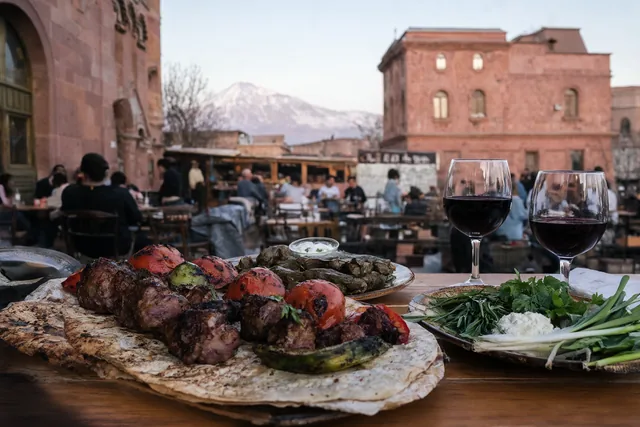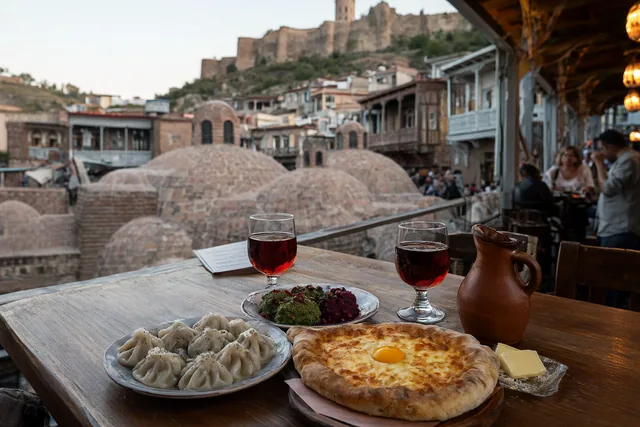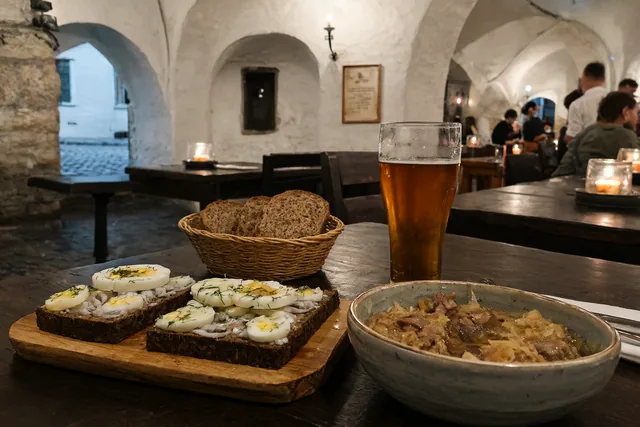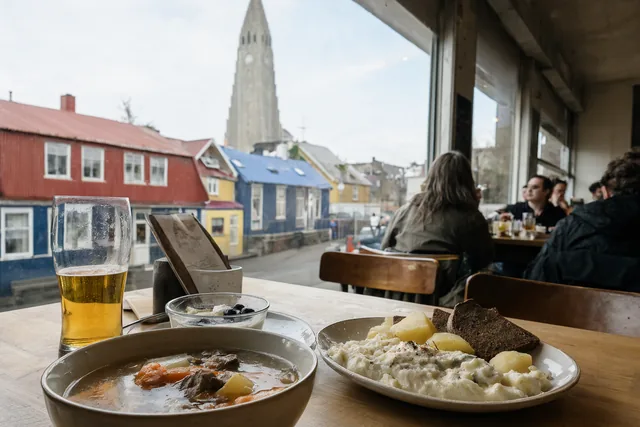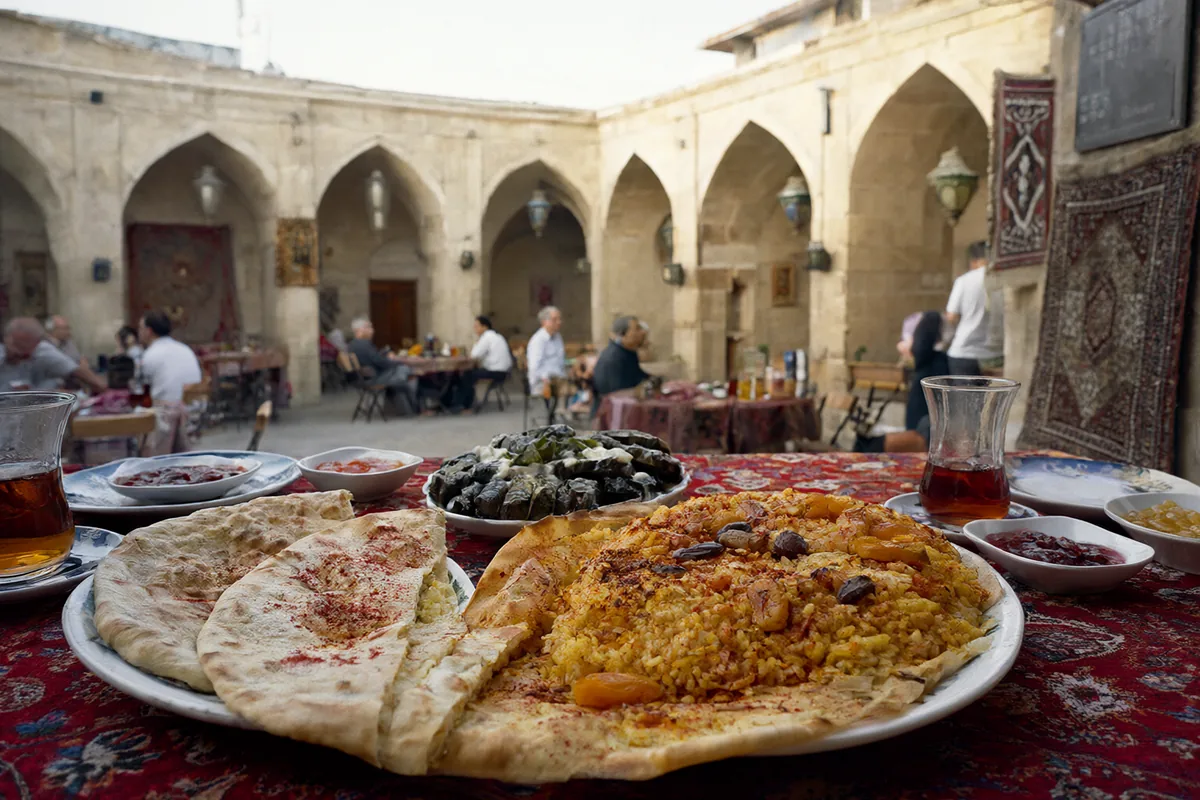
Azerbaijani food sits where Persian, Turkish, Russian and Caucasian cooking meet: saffron plov, stuffed vine leaves, lamb kebabs, herb-filled flatbreads, Caspian fish, and black tea poured all day from a pot with jam on the side. This Azerbaijan food guide covers the dishes to know, how to read an Azerbaijani menu, tipping and tea house customs, then goes city by city through where to eat in Baku, Quba, Shamakhi, Gabala, Sheki and Lankaran. Baku has the widest choice, but the regions are where the local specialities, from Sheki's piti to Lankaran's walnut-stuffed lavangi, are cooked best.
What to eat in Azerbaijan: 12 dishes to know
Azerbaijani cooking uses plenty of lamb, fresh herbs, saffron, sumac, chestnuts and fruit such as pomegranate, quince and sour plums. These are the dishes to look for, with the region they belong to where it matters.
- Plov (everywhere): saffron rice cooked so the grains stay separate, served with its topping (qara) of lamb, chicken or fish with dried fruit and chestnuts, often on a separate plate. There are dozens of regional versions.
- Şah plov (everywhere, for celebrations): "shah's plov", rice, meat and dried fruit baked inside a golden crust of thin lavash, cut open at the table.
- Dolma (everywhere): vine leaves (yarpaq dolması) or cabbage leaves stuffed with minced lamb, rice and herbs, served with garlic yoghurt. Üç bacı, "three sisters", is a stuffed aubergine, tomato and pepper together. Dolma making is on UNESCO's intangible heritage list.
- Qutab (everywhere): thin half-moon flatbreads cooked on a griddle and filled with herbs, minced meat or pumpkin, dusted with sumac and eaten with yoghurt.
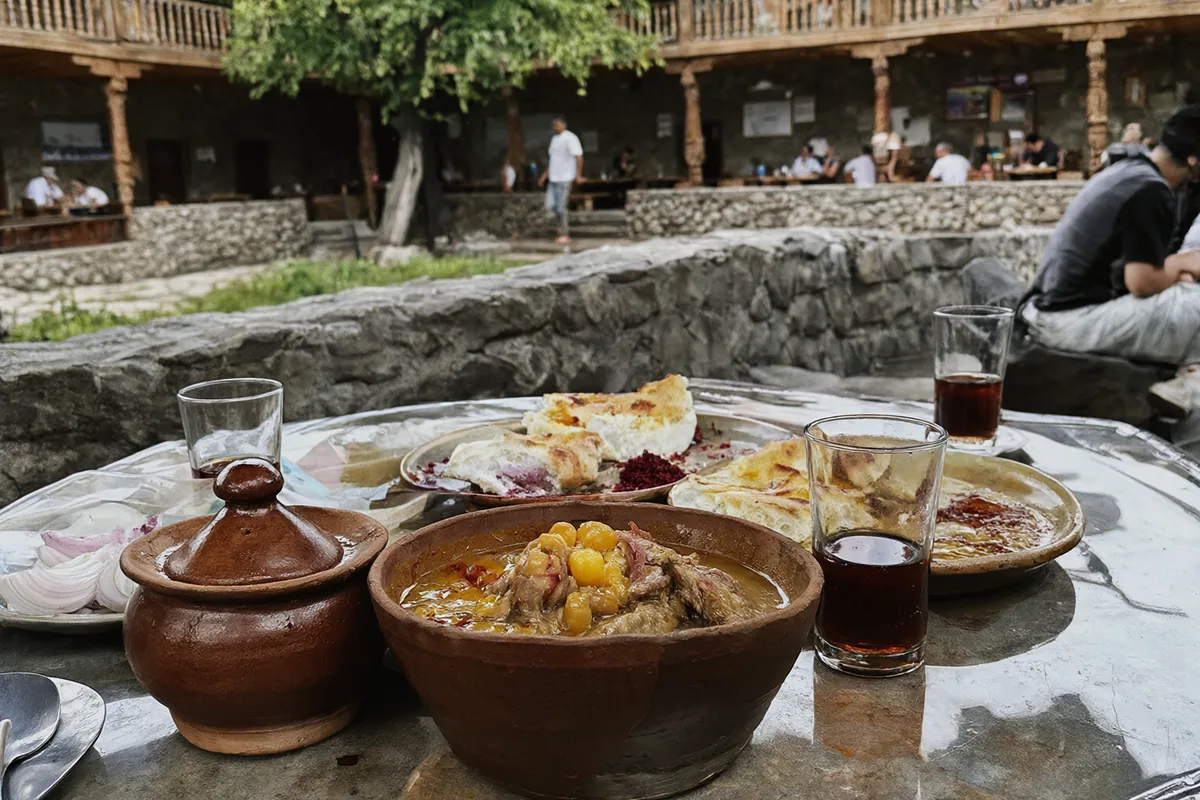
- Piti (Sheki): a stew of mutton, chickpeas, chestnuts and saffron cooked in an individual clay pot. You tear bread into a bowl, pour the broth over it and eat that first, then eat the meat and chickpeas as a second course.
- Kabab (everywhere): lülə kabab is minced lamb on a flat skewer, tikə kabab is chunks of meat, both served on lavash with sumac onions and grilled tomatoes. Sturgeon kebab is a Caspian speciality.
- Düşbərə (everywhere): tiny lamb dumplings in a clear broth, flavoured with dried mint and served with garlic vinegar.
- Lavangi (Lankaran): chicken or fish stuffed with a paste of walnuts, onion and sour plum, then baked.
- Dovğa (everywhere): a yoghurt soup with rice, chickpeas and lots of herbs, served warm in winter and chilled in summer.
- Kükü (everywhere): a thick baked omelette packed with green herbs, a common starter.
- Şəki halvası (Sheki): Sheki halva, layers of a fine net of rice-flour batter filled with crushed hazelnuts and soaked in saffron syrup.
- Paxlava and şəkərbura (everywhere, at Novruz): diamond-shaped layered nut pastry and crescent pastries filled with nuts and sugar, baked for the spring new year in March.
Tea (çay) is the national drink, served black in small pear-shaped armudu glasses with sugar cubes, lemon and fruit jam (mürəbbə) eaten from a spoon. Also try ayran, a salty yoghurt drink, şərbət, fruit and herb syrups mixed with water, and local wines from the Shamakhi and Ganja regions. Pomegranate sauce (narşərab) is served with grilled meat and fish.
How to read an Azerbaijani menu
Azerbaijani is a Turkic language close to Turkish, written in a Latin alphabet with some extra letters such as ə, ğ, ı, ş and ç. Russian is still widely spoken in Baku and many menus are printed in Azerbaijani, Russian and English. In the regions, menus are often Azerbaijani only, or there is no menu at all and staff tell you what is cooking. These are the words to know.
| Azerbaijani | Meaning |
|---|---|
| Soyuq qəlyanaltılar | Cold starters |
| İsti yeməklər | Hot dishes, mains |
| Şorbalar | Soups |
| Salatlar | Salads |
| Kabablar | Grilled kebabs (lülə, minced; tikə, chunks) |
| Plov / aş | Pilaf |
| Şirniyyat | Sweets and desserts |
| İçkilər | Drinks |
| Quzu əti / mal əti / toyuq | Lamb / beef / chicken |
| Balıq / nərə | Fish / sturgeon |
| Göyərti | Fresh herbs, served as a plate on the table |
| Çörək / təndir çörəyi | Bread / bread from the clay oven |
| Çay dəsti | Tea set: a pot of tea with jam, sweets and lemon |
| Xidmət haqqı | Service charge |
Ordering "tea" in Azerbaijan often means a whole çay dəsti, a pot with several jams, sweets and lemon, priced as a set rather than by the glass. Photograph the menu with swap.menu and you will see what each tea set includes, what qara is on the plov line, and the manat price in your own currency before you order.
Tipping, tea houses and paying the bill
Many restaurants in Baku add a service charge of around 10 percent, shown as xidmət haqqı on the bill. If it is there, no further tip is needed, though rounding up is appreciated. If it is not, leaving 5 to 10 percent in a restaurant is normal, while tea houses and cafés do not expect a tip. Our guide to tax and service charges on menus explains how these lines appear in different countries.
The currency is the Azerbaijani manat (AZN, ₼). Cards are accepted in most restaurants, hotels and shops in Baku, but carry cash in the regions, at markets and in small tea houses. When a card machine offers to charge you in your home currency, choose manat: our guide to paying in local currency explains why.
Tea houses (çayxana) are a central part of life, especially for men, who sit for hours over tea and backgammon; visitors of any gender are welcome, though some neighbourhood tea houses are male spaces in practice. Lunch is from about 1pm, dinner from 7pm and often late. Meals are shared, with a spread of herbs, cheese, salads and starters before the kebabs or plov, and alcohol is widely available in restaurants.
Where to eat in Azerbaijan, city by city
Most visitors start in Baku and then travel north into the Caucasus foothills, where the towns are greener, cooler and known for their own dishes. Lankaran, in the subtropical south, is a different world again. Jump to a city:
Where to eat in Baku
Baku's walled Old City (İçərişəhər), a UNESCO World Heritage site, is the most atmospheric place to eat, and several of its old stone caravanserais, built as inns for traders on the Silk Road, now house restaurants with dining rooms in their arched galleries and courtyards. Order a full Azerbaijani spread here: herbs and cheese, qutab, dolma, kebabs, şah plov and a tea set to finish. Just outside the walls, Fountain Square and Nizami Street are the main restaurant and café streets of central Baku.
For markets, Təzə Bazar is the city's busy central market, with piles of herbs, pomegranates, dried fruit, nuts, pickles and cheeses, including motal, sheep's cheese aged in a sheepskin. Locals also shop at Yaşıl Bazar, the green market. Along the seafront Baku Boulevard are cafés and tea terraces facing the Caspian, a good place for an evening walk and a pot of tea. Baku also has a wide choice of Russian, Georgian, Turkish and international restaurants.
Where to eat in Quba
Quba, about two and a half hours north of Baku in the foothills of the Caucasus, is famous across Azerbaijan for its apples and orchards, and its markets fill with fruit in autumn. Across the river is Qırmızı Qəsəbə, the Red Settlement, one of the largest communities of Mountain Jews in the world, with its own synagogues and food traditions. The roads around Quba are lined with restaurants in wooded valleys, often with private dining huts by a stream, serving lamb kebabs, qutab, plov and dovğa.
Quba is the base for trips to Khinaliq, a high mountain village with its own language, where guesthouses serve simple home cooking of lamb, bread, cheese and herb dishes. In the town, look for fruit preserves, dried apples and local honey to take home. Quba is busy at weekends in summer, when Baku families escape the city heat.
Where to eat in Shamakhi
Shamakhi, about two hours west of Baku on the road towards Gabala and Sheki, was once the capital of the Shirvan region, and its large Juma Mosque is one of the oldest in the Caucasus. Today Shamakhi is also one of Azerbaijan's main wine regions, with vineyards growing native grapes such as Madrasa, and several wineries in the area offer tastings with food.
Roadside restaurants along the Shamakhi road are a classic lunch stop: lamb and chicken kebabs grilled over wood, fresh tandir bread, piles of herbs, tomato and cucumber salad, and tea. The hill country around Shamakhi is also good for honey and fruit. Shamakhi is cooler than Baku, and in summer its restaurants with garden seating are a pleasant break on the drive north.
Where to eat in Gabala
Gabala is a mountain resort town in a green valley below the Caucasus, popular with Azerbaijani families for its forests, waterfalls and lakes. Restaurants around Gabala are mostly casual places with gardens or riverside terraces, cooking kebabs, plov, qutab and piti. The region grows hazelnuts and chestnuts, which appear in sweets and plov toppings.
Nearby Göyçay is known as Azerbaijan's pomegranate capital, and its pomegranate festival in autumn celebrates the harvest with fresh juice, narşərab sauce and fruit stalls. Gabala is busiest in summer and on winter ski weekends, and has hotels with restaurants open all year. It works well as an overnight stop between Shamakhi and Sheki.
Where to eat in Sheki
Sheki, a silk-weaving town in the forested foothills of the Caucasus, is the best food town in Azerbaijan for many visitors. Its historic centre is on the UNESCO World Heritage list, and the reason most come is the Palace of the Sheki Khans, with its stained-glass windows. Two things must be eaten in Sheki: piti, the mutton and chickpea stew cooked in individual clay pots and eaten in two stages, and Sheki halva, the saffron-soaked hazelnut sweet, sold from shops all along the main street.
Restaurants and tea houses in the old town, around the restored caravanserais and the streets leading up to the palace, serve piti at lunchtime, and some sell out by mid-afternoon, so do not leave it too late. Sheki also has fine tea houses where you can sit over a pot of tea with jam and halva. Buy halva in Sheki to take back, but ask for it boxed, as the syrup drips.
Where to eat in Lankaran
Lankaran, near the Iranian border in the far south, has a warm, humid climate, tea plantations, citrus groves, rice paddies and ancient Hyrcanian forest, and its cooking is distinct from the rest of the country. The local speciality is lavangi, chicken or Caspian fish stuffed with walnuts, onion and sour plum paste and baked in a tandir. Lankaran is also known for rice, used in local plovs, and for its tea, which you will drink everywhere in the town.
Restaurants in Lankaran are mainly local, family-style places, with fish from the Caspian and rivers on most menus. Look out too for Lənkəran külçəsi, a small sweet saffron pastry. Lankaran is a long drive or a short flight from Baku, and it is worth a night for the food and the countryside, especially in late spring and early autumn.
Vegetarian, vegan and allergy tips
Vegetarians eat well from the starter spread alone: fresh herbs, cheese, salads, kükü (herb omelette), aubergine dishes, herb and pumpkin qutab and dovğa. Main courses are mostly meat, though plov can be ordered with a dried fruit and chestnut topping instead of meat in some places. Watch for meat stock in soups, lamb fat in plov and qutab, and yoghurt and butter almost everywhere, which makes vegan eating harder. The word for vegetarian is vegetarian, and "I don't eat meat" is mən ət yemirəm.
Nuts are a real risk: walnuts go into lavangi and some stuffings, hazelnuts are in Sheki halva and paxlava, and almonds appear in sweets. Wheat is in qutab, düşbərə and all pastries. Our guide to eating abroad with food allergies explains how to communicate an allergy clearly when you do not speak the language.
Useful Azerbaijani phrases for ordering
Salam "Hello", the everyday greeting
Nə məsləhət görürsünüz? "What do you recommend?"
Bunu istəyirəm "I would like this" (pointing)
Mən ət yemirəm "I don't eat meat"
Mənim qoza allergiyam var "I am allergic to walnuts"
Hesabı gətirin, zəhmət olmasa "Please bring the bill"
Çox sağ olun, çox dadlı idi "Thank you very much, it was very tasty"
Nuş olsun "Enjoy your meal", what staff and hosts say as food arrives
How swap.menu helps you eat in Azerbaijan
Azerbaijani menus list plov, kebabs and soups by their regional names, often with Russian beside them, and few visitors know that kəllə-paça is a soup of sheep's head and feet or that buğlama is meat steamed with vegetables in its own juices. Photograph the menu with swap.menu and every dish appears in your language with the Azerbaijani name and a short explanation. Every price is converted from manat to your home currency, and the service charge line is pointed out.
Tap the dishes you want, add a note such as "no lamb fat" or "no nuts, please", typed or spoken, and swap.menu translates your order into Azerbaijani. Show the waiter your phone, or let them scan the QR code and read the order on their own screen. Try it on a sample menu with the free demo, or see travel pass prices.
Off to Azerbaijan? Your first 3 menu scans are free, and a travel pass starts from $4.99 with nothing that renews.
Start free with 3 scansAzerbaijan food FAQ
Do you tip in restaurants in Azerbaijan?
Many Baku restaurants add a service charge of around 10 percent to the bill. If it is included, no extra tip is needed. If it is not, 5 to 10 percent is normal in restaurants, while tea houses and cafés do not expect a tip.
What food is Azerbaijan famous for?
Saffron plov, including the crusted şah plov, dolma, qutab flatbreads, lamb kebabs, piti stew from Sheki and Sheki halva. Black tea with jam, served in pear-shaped glasses, is the national drink.
Is Azerbaijan expensive to eat out?
Eating out in Azerbaijan is good value by European standards. Restaurants in Baku's Old City and on the boulevard cost more, while tea houses, qutab stalls and regional restaurants are cheap.
Is tap water safe to drink in Azerbaijan?
Most visitors and many locals in Baku drink bottled or filtered water rather than tap water. Bottled water is cheap and served everywhere, and Azerbaijan's mineral waters are popular.
Which city in Azerbaijan is best for food?
Baku has the widest choice and the best restaurants, Sheki is the place for piti and halva, Lankaran for lavangi and southern cooking, and Quba and Gabala for kebabs and mountain food by the river.
How can I read an Azerbaijani menu if I do not speak Azerbaijani?
Ask for an English or Russian menu in Baku, learn a few words such as plov, kabab and şorba, or photograph the menu with swap.menu. It translates every dish into your language, explains it, converts manat prices and translates your order back into Azerbaijani.
Travelling further in the Caucasus and Central Asia? Read our food guides for nearby countries:
Or browse every travel food guide.