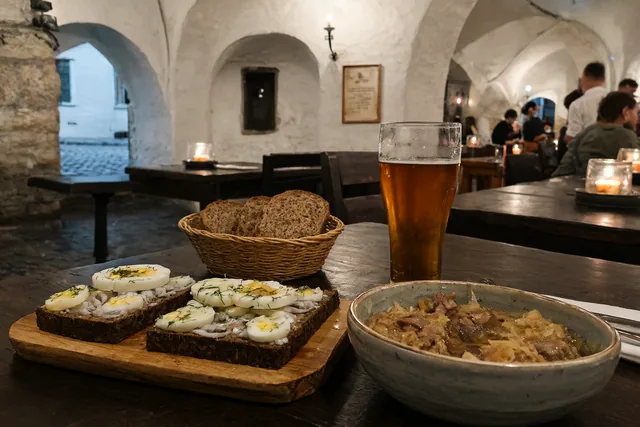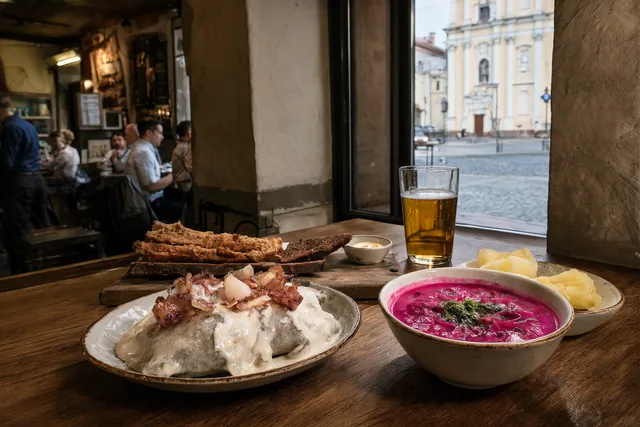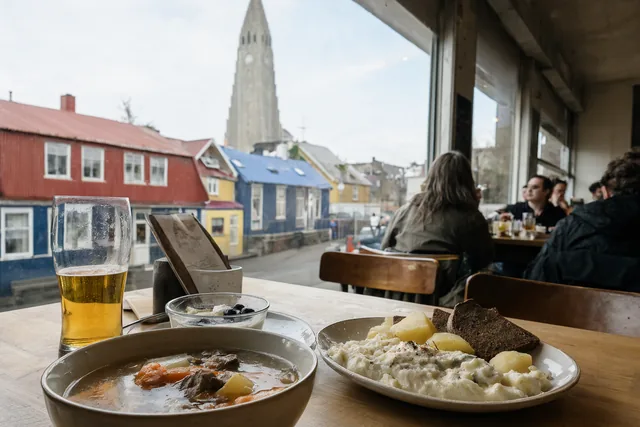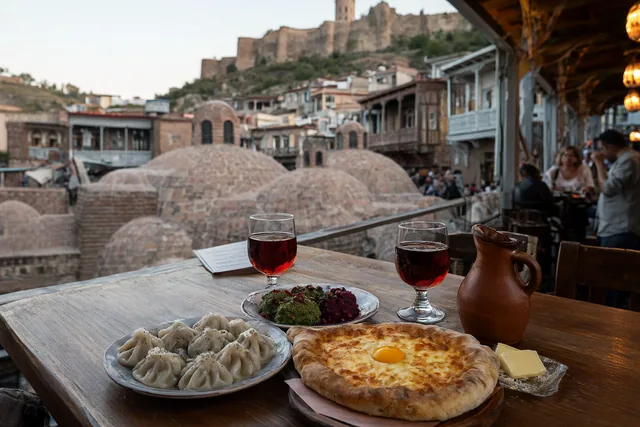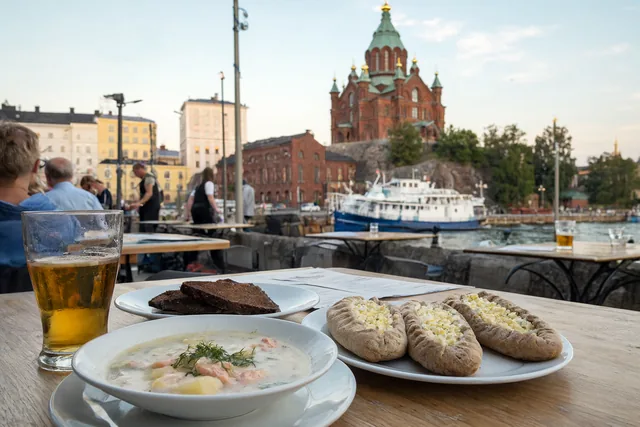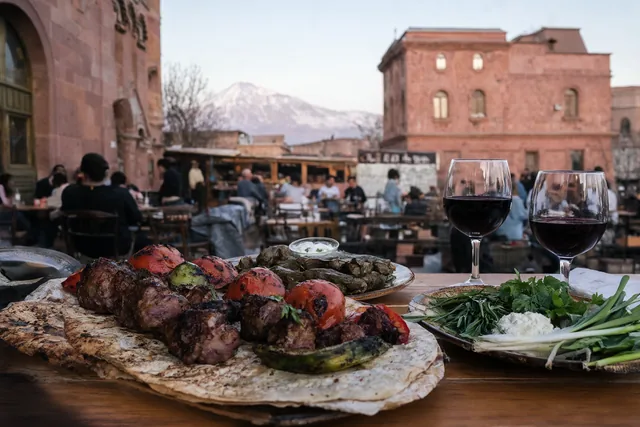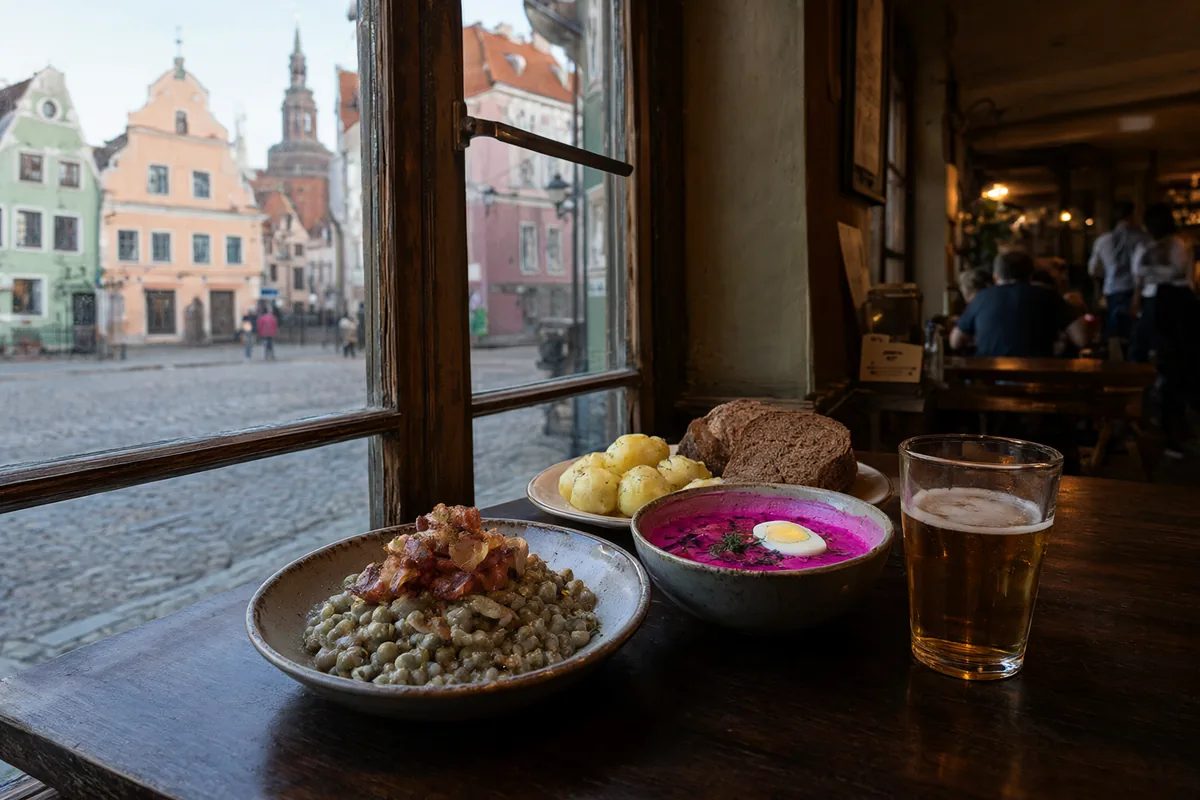
Latvian food is hearty country cooking from a land of forests, rye fields and a long Baltic coast: dark bread, smoked fish, pork, potatoes, curd cheese and sour cream, with a short, intense summer of berries and wild mushrooms. This Latvia food guide covers the dishes to know, how to read a Latvian menu, tipping and the lunch deal, then goes town by town through where to eat in Riga, Jūrmala, Liepāja, Kuldīga, Cēsis and Sigulda. Riga, the largest city in the Baltics, has a busy modern restaurant scene and one of the biggest food markets in Europe, while the smaller towns are where the old dishes survive best.
What to eat in Latvia: 12 dishes to know
Latvians eat with the seasons and keep the old festivals, so some dishes are tied to a time of year. These are the ones you will see most often, with the region they come from where it matters.
- Pelēkie zirņi ar speķi (everywhere): grey peas with fried bacon and onion, the unofficial national dish. Traditionally eaten at Christmas, it is also a pub snack, often with a glass of kefir.
- Rupjmaize (everywhere): dark, dense rye bread, slightly sweet and sour, baked in long loaves. Latvians miss it more than anything when they live abroad.
- Rupjmaizes kārtojums (everywhere): a layered dessert of grated rye bread crumbs, whipped cream and lingonberry or cranberry jam. It tastes far better than it sounds.
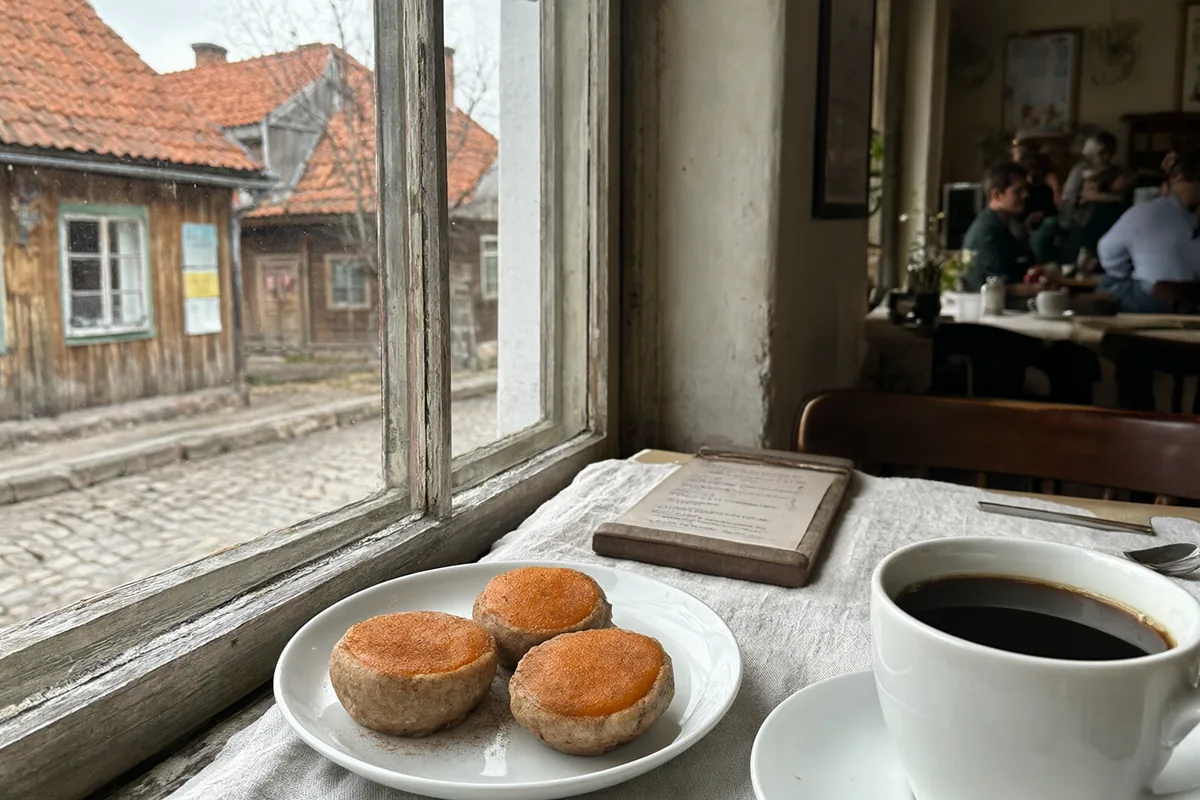
- Sklandrausis (Kurzeme): a small open rye pastry filled with mashed potato and sweet carrot, spiced with cinnamon. It comes from the Livonian people of the Kurzeme coast and is protected as a traditional EU speciality.
- Speķa pīrāgi (everywhere): soft crescent-shaped buns filled with diced bacon and onion, sold in bakeries and served with soup.
- Aukstā zupa (summer): cold, bright pink soup of beetroot, cucumber, dill and egg in kefir or buttermilk, served with hot boiled potatoes on the side.
- Skābeņu zupa (spring and summer): a sour soup of sorrel leaves, potato and egg, often finished with sour cream.
- Karbonāde (everywhere): a breaded, pan-fried pork chop, the default main course at a canteen lunch.
- Kartupeļu pankūkas (everywhere): crisp potato pancakes, served with sour cream or lingonberry jam.
- Kūpināta zivs (the coast): smoked fish, from flounder and herring to eel and the smoked sprats that Riga is famous for. In Carnikava, north of Riga, smoked lamprey (nēģi) is the local speciality.
- Jāņu siers (Midsummer): a mild, round curd cheese with caraway seeds, made for the Jāņi midsummer festival in late June and eaten with beer.
- Biezpiena sieriņš (supermarkets): a small chocolate-coated bar of sweetened curd cheese, sold chilled and eaten as a snack by every age.
To drink, Latvia has a strong beer culture (alus) with many small breweries, kvass (kvass), a lightly fermented bread drink, birch sap (bērzu sula) in spring, and Riga Black Balsam, a dark, bitter herbal liqueur that locals usually mix with blackcurrant juice, coffee or hot drinks.
How to read a Latvian menu
Latvian is a Baltic language, related to Lithuanian but not to Estonian or Russian, and it uses the Latin alphabet with long vowels marked by a line (ā, ē, ī, ū). In Riga, Russian is also widely spoken and some menus are printed in Latvian, Russian and English. Smaller towns may have Latvian only. These are the words you will see most.
| Latvian | Meaning |
|---|---|
| Uzkodas | Starters, snacks |
| Zupas | Soups |
| Pamatēdieni / otrie ēdieni | Main courses |
| Deserti | Desserts |
| Dzērieni | Drinks |
| Dienas piedāvājums / pusdienu piedāvājums | Daily offer / lunch offer |
| Cūkgaļa / liellopa gaļa / jēra gaļa / vista | Pork / beef / lamb / chicken |
| Zivis / lasis / reņģes | Fish / salmon / Baltic herring |
| Kartupeļi / dārzeņi | Potatoes / vegetables |
| Skābais krējums / skābēti kāposti | Sour cream / sauerkraut |
| Cepts / grilēts / kūpināts | Fried or roasted / grilled / smoked |
| Sēnes / gailenes | Mushrooms / chanterelles |
| Rupjmaize / baltmaize | Rye bread / white bread |
| Veģetārs / vegānisks | Vegetarian / vegan |
Self-service canteens are one of the cheapest ways to eat in Latvia, but the dishes sit in trays with small handwritten labels, and you pay by the portion or by weight. Photograph the labels with swap.menu and you will know which tray is pork in gravy and which is herring under a fur coat before you reach the till.
Tipping, lunch deals and paying the bill
Tipping in Latvia is appreciated but not obligatory. In Riga restaurants with table service, leaving around 10 percent for good service is common, and some places add a service charge, which should be stated on the menu and the bill. In cafés and bars, rounding up is enough. Menu prices include VAT. Our guide to tax and service charges on menus explains how to read these lines on any bill.
Latvia uses the euro. Cards and contactless payments are accepted almost everywhere in Riga and the larger towns, though a few market stalls and country cafés still prefer cash. If a card machine offers to charge you in your home currency, choose euros instead: our guide to paying in local currency explains why that saves you money.
The best value meal is the weekday lunch, advertised as dienas piedāvājums or pusdienu piedāvājums, usually soup plus a main at a fixed price, served from about noon to 3pm. Dinner starts from around 6pm and kitchens in smaller towns often close by 10pm. In summer, when the evenings stay light until very late, terraces in Riga and Jūrmala stay busy long after that.
Where to eat in Latvia, town by town
Most visitors base themselves in Riga and make trips to the coast and the Gauja valley. The western region of Kurzeme has its own dishes and a slower pace. Jump to a town:
Where to eat in Riga
Start at the Riga Central Market (Rīgas Centrāltirgus), housed in five huge former Zeppelin hangars beside the old town. Each hangar has its own trade: one for fish, one for meat, one for dairy and so on, with smoked fish, rye bread, sauerkraut, honey, curd cheese and, in summer, buckets of berries and wild mushrooms. There are small food stalls inside and around it where you can try smoked fish, pīrāgi and pancakes. Riga's market is busiest in the morning and is the best introduction to Latvian food there is.
Old Riga (Vecrīga) is full of restaurants, but those on the main squares are aimed at visitors. Walk into the Art Nouveau district around Alberta iela and Elizabetes iela, or to Miera iela, a street of cafés, bakeries and bars, to eat where Riga residents do. Across the river, the Kalnciema Quarter, a cluster of restored wooden houses, holds a weekend market with farm produce and street food, and the renovated Āgenskalns Market has a food hall. For a cheap, filling lunch in Riga, look for a self-service canteen serving grey peas, karbonāde and cold beetroot soup.
Where to eat in Jūrmala
Jūrmala is a long string of beach towns on the Gulf of Riga, about half an hour from the capital by train, with pine forests, white sand and old wooden summer villas. The centre of the action is Jomas iela in Majori, a pedestrian street lined with restaurants, cafés and ice cream shops. In summer the beach cafés and terraces fill up with Riga families, and menus lean towards grilled fish, salads and cold beetroot soup.
Smoked fish is the thing to buy in Jūrmala and along the coast. The fishing villages to the west, such as Ragaciems and Lapmežciems, have smokehouses and stalls selling flounder, herring and eel straight out of the smoke, and a paper parcel of warm smoked flounder eaten on the beach is a classic Latvian summer meal. Jūrmala is much quieter outside June to August, when the spa hotels and a handful of year-round restaurants carry the town.
Where to eat in Liepāja
Liepāja, on the open Baltic coast in the far west, is known as the windy city and as Latvia's music city, and it has a laid-back, slightly faded charm. The Pētertirgus market, a covered market in the centre, is the place for smoked fish, rye bread and local produce. Around Rožu laukums (Rose Square) and the old streets near the market there are cafés, music bars and restaurants serving Kurzeme dishes, fresh Baltic fish and sklandrausis.
Liepāja has a long beach and seaside park, and a short trip north takes you to Karosta, the former Russian and Soviet naval port, which is more about history than food but worth the visit. Restaurants in Liepāja are generally cheaper and less crowded than in Riga, and the fish is as good as it gets in Latvia. In summer, the city's music festivals fill the bars and terraces.
Where to eat in Kuldīga
Kuldīga is one of the prettiest small towns in Latvia, with wooden houses, red-tiled roofs, an old brick bridge and the Venta Rapid, a low waterfall that is the widest in Europe. Its old town is on the UNESCO World Heritage list. Kuldīga is the place to try sklandrausis and other Kurzeme baking, along with smoked fish and simple country dishes in cafés along the little Alekšupīte stream that runs between the houses.
In spring, the vimba fish that swim up the Venta leap the waterfall, and Kuldīga has long been known for "flying fish". Look for vimba on menus around that time. The town is small and its cafés are mostly casual, family-run places, so it is a lunch stop more than a dinner destination; outside summer, check opening hours before you go and carry a little cash.
Where to eat in Cēsis
Cēsis is a medieval town on the edge of the Gauja National Park, about an hour and a half from Riga, built around the ruins of a stone castle with a handsome old town around it. Cēsis has a long brewing history, and local beer is the natural thing to order with lunch. The cafés and restaurants around the castle park and the main square serve Latvian classics such as karbonāde, potato pancakes and rye bread desserts, with a few more modern kitchens using produce from nearby farms.
Vidzeme, the surrounding region, is farm country, and the weekend market in Cēsis is a good place to buy rye bread, honey, smoked meats and seasonal berries. In summer Cēsis hosts an arts festival and the old town fills up, while in autumn the forests around it are full of mushroom pickers, and chanterelles and boletes appear on menus all over town.
Where to eat in Sigulda
Sigulda sits on the steep, wooded banks of the Gauja river, about an hour from Riga, and most visitors come for the castles, the cable car across the valley and the walking trails rather than for the food. That shapes the restaurants: cafés near Turaida Castle and Sigulda's old castle serve soups, pancakes, grilled meat and cakes to hungry walkers, and there are a few guesthouse restaurants with more ambitious menus built on local game, fish and wild mushrooms.
The Gauja valley is good picnic country, so it can make sense to buy rye bread, smoked fish and curd cheese in Riga and eat by the river. In summer, roadside stalls around Sigulda sell strawberries, blueberries and honey, and in autumn wild mushrooms. Sigulda works well combined with Cēsis in a single day, with lunch in one town and an early dinner in the other.
Vegetarian, vegan and allergy tips
Riga has a good number of vegetarian and vegan cafés, and most modern menus mark plant-based dishes. Traditional Latvian food is harder: grey peas and many soups are cooked with bacon (speķis), pīrāgi are filled with bacon, sauerkraut is often stewed with pork, and sour cream comes with almost everything. Cold beetroot soup is vegetarian but made with kefir and egg. The words to know are veģetārs (vegetarian, for a dish), vegānisks (vegan) and es esmu veģetārietis or veģetāriete (I am a vegetarian, for a man or a woman).
Gluten-free is marked as bez glutēna, and lactose-free dairy is easy to find in supermarkets. Rye bread contains gluten and often barley malt, and caraway seeds turn up in cheese and bread. Our guide to eating abroad with food allergies explains how to communicate an allergy clearly in any language.
Useful Latvian phrases for ordering
Labdien "Good day", the polite greeting when you walk in
Galdiņu diviem, lūdzu "A table for two, please"
Ko jūs iesakāt? "What do you recommend?"
Es vēlētos šo "I would like this" (pointing)
Man ir alerģija pret... "I have an allergy to..." followed by the ingredient
Rēķinu, lūdzu "The bill, please"
Paldies, bija ļoti garšīgi "Thank you, it was very tasty"
Priekā! "Cheers!"
How swap.menu helps you eat in Latvia
Riga's restaurants usually have an English menu, but canteen labels, market stalls and cafés in Kuldīga or Cēsis often do not, and Latvian dish names give few clues. Photograph the menu with swap.menu and every dish appears in your language with the Latvian name beside it and a short explanation, so you know that siļķe kažokā is herring under layers of beetroot and potato, and that pelmeņi are dumplings, before you order. Prices are shown in euros and converted to your home currency.
Tap the dishes you want, add a note such as "no bacon" or "without sour cream", typed or spoken, and swap.menu translates your order into Latvian. Show the server your phone, or let them scan the QR code and read the order on their own screen. Try it on a sample menu with the free demo, or see travel pass prices.
Off to Latvia? Your first 3 menu scans are free, and a travel pass starts from $4.99 with nothing that renews.
Start free with 3 scansLatvia food FAQ
Do you tip in restaurants in Latvia?
Tipping is not required in Latvia, but around 10 percent for good table service is common in Riga. Check the bill first, because some restaurants add a service charge. In cafés and bars, rounding up is enough.
What food is Latvia famous for?
Grey peas with bacon, dark rye bread, smoked fish and Riga sprats, sklandrausis carrot and potato pastries, cold pink beetroot soup and caraway cheese at Midsummer. Riga Black Balsam, a herbal liqueur, is the best-known drink.
Is Latvia expensive to eat out?
Latvia is cheaper than western Europe and the Nordic countries. Restaurants in Old Riga cost more than elsewhere, but the weekday lunch offer and self-service canteens make it easy to eat well on a small budget.
Is tap water safe to drink in Latvia?
Tap water in Riga and other towns is treated and generally considered safe to drink, though some people dislike its taste and drink bottled or filtered water. Restaurants will usually bring tap water if you ask.
Where is the best place to eat in Riga?
Start at Riga Central Market for smoked fish, rye bread and seasonal produce, then eat in the Art Nouveau district, along Miera iela or at the Kalnciema Quarter weekend market rather than on the main squares of Old Riga.
How can I read a Latvian menu if I do not speak Latvian?
Learn a few headings such as zupas (soups), pamatēdieni (mains) and dienas piedāvājums (daily offer), or photograph the menu with swap.menu. It translates every dish into your language, explains what it is, converts euro prices and translates your order back into Latvian.
Travelling further in the Baltics? Read our food guides for neighbouring countries:
Or browse every travel food guide.