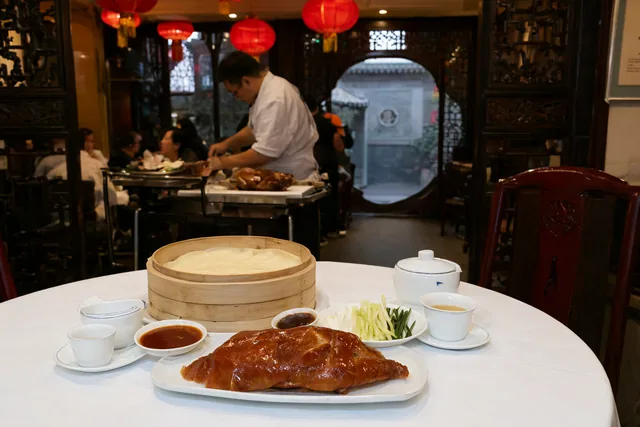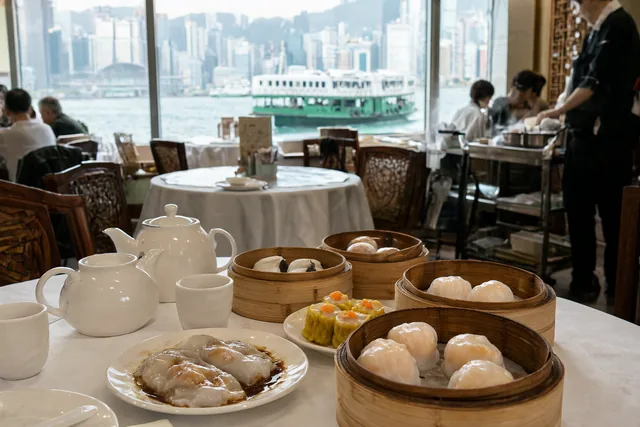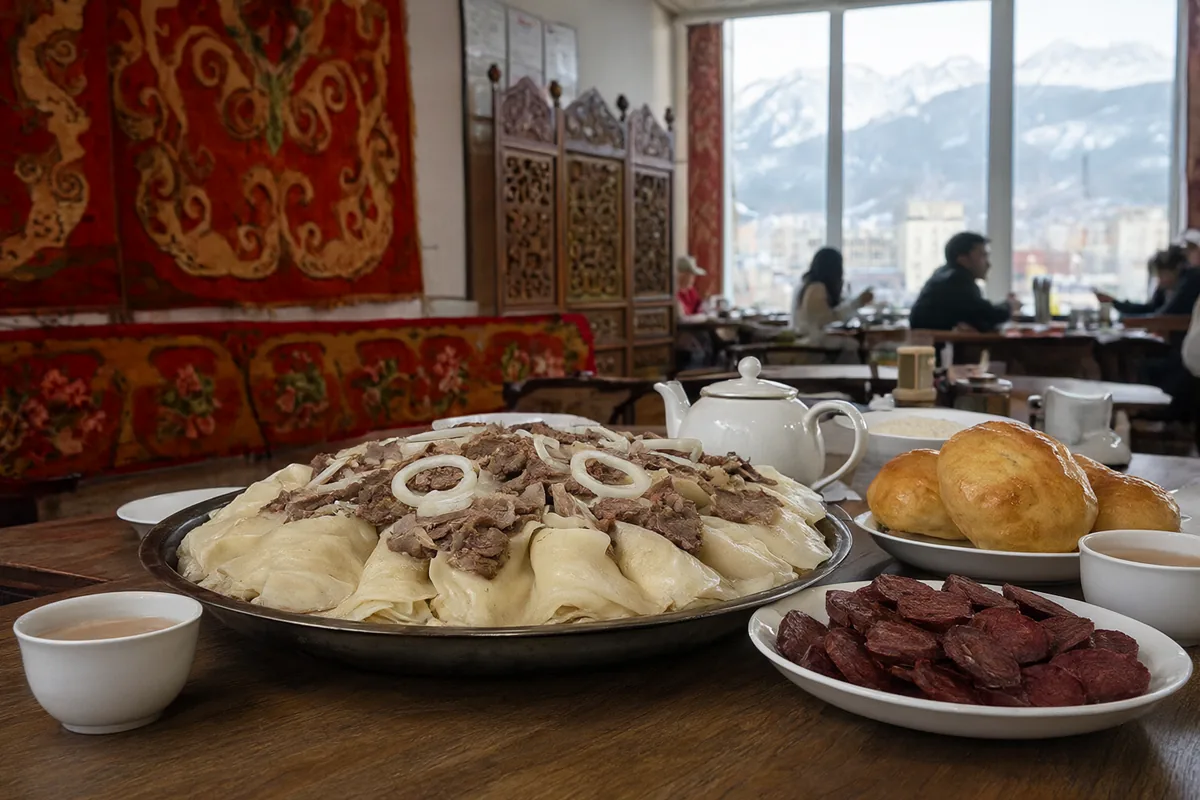
Kazakh food comes from the nomadic life of the steppe: boiled meat, horse sausage, fermented mare's and camel's milk, fried dough and endless bowls of tea, with the plov, noodles and dumplings of neighbouring Uzbek, Uyghur and Russian kitchens on almost every menu. This Kazakhstan food guide covers the dishes to know, how to read menus in Kazakh and Russian, tipping and service charges, then goes city by city through where to eat in Almaty, Astana, Karaganda, Shymkent, Turkistan and Aktau. Kazakhstan is huge, and its cities eat differently, from cosmopolitan Almaty to the hot, Uzbek-influenced south.
What to eat in Kazakhstan: 12 dishes to know
Meat is the centre of Kazakh cooking, especially mutton and horse, and a proper feast is a long table called a dastarkhan, covered in plates before anyone sits down. These are the dishes and drinks to look for.
- Beshbarmak (everywhere): the national dish, boiled horse meat or mutton served on wide sheets of boiled noodle dough with onions softened in broth. The name means "five fingers", because it was traditionally eaten by hand. It comes with a bowl of broth, sorpa, on the side.
- Kazy (everywhere): rich horse meat sausage made with rib meat and fat, served sliced and cold as a starter or on top of beshbarmak and plov.
- Shuzhuk, karta and zhaya (everywhere): other prized horse meat cuts and sausages, often served together on a cold meat platter.
- Kuyrdak (everywhere): liver, heart, kidneys and meat fried with onions, sometimes with potatoes, a dish made on the day an animal is slaughtered.
- Baursak (everywhere): small puffs or squares of fried dough, served with tea, soup and at every celebration.
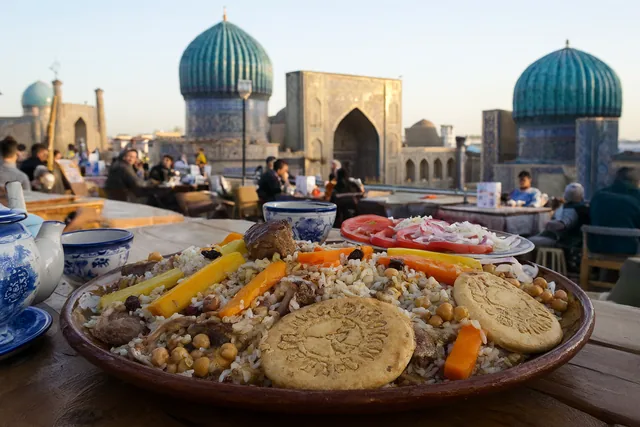
- Plov (everywhere, especially the south): rice cooked with lamb, carrots and onions in a kazan, shared with Uzbekistan and usually served at lunch.
- Lagman (everywhere, especially Almaty): hand-pulled noodles with a sauce of meat and vegetables, from the Uyghur kitchen.
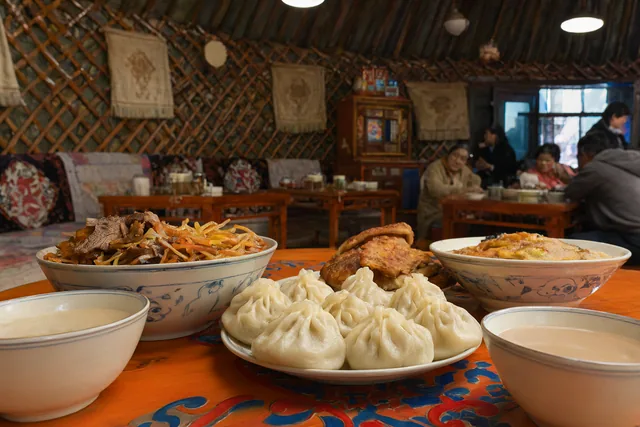
- Manty (everywhere): large steamed dumplings filled with minced lamb or beef and onion, sometimes with pumpkin.
- Samsa (everywhere, especially Shymkent): pastries with lamb and onion baked on the walls of a tandyr oven.
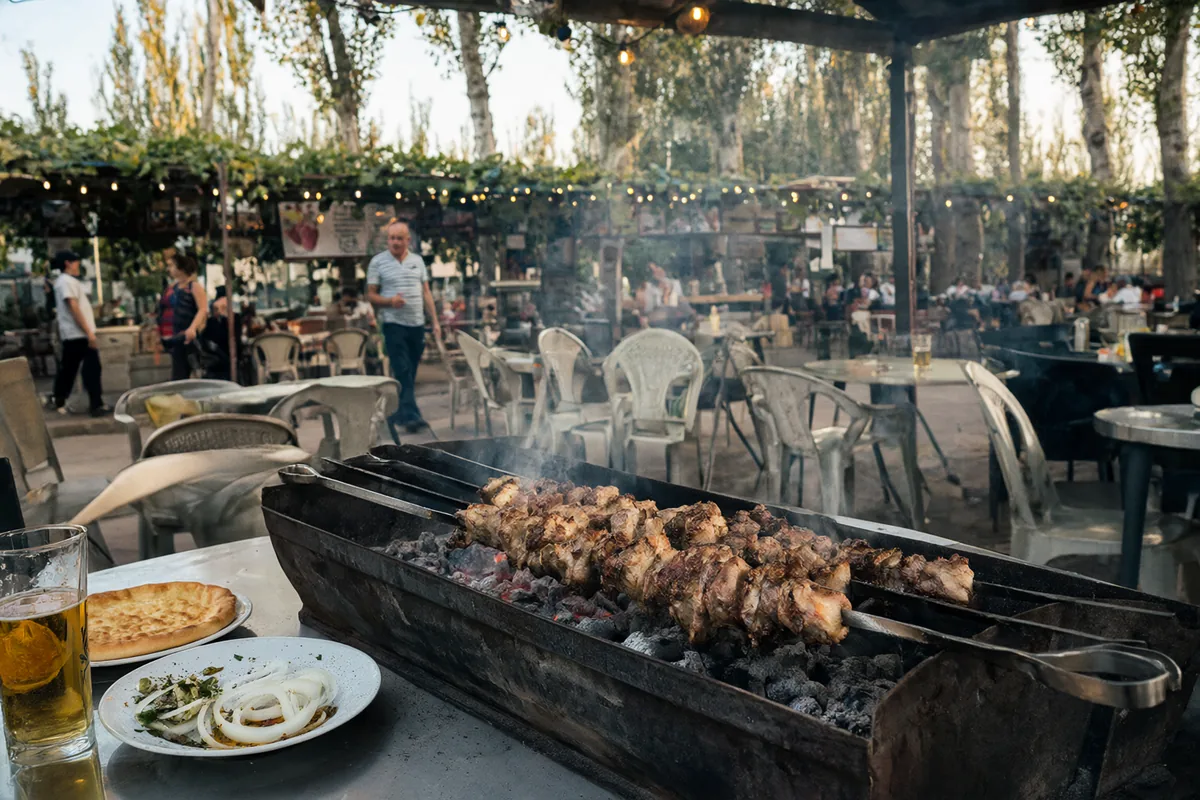
- Shashlyk (everywhere): skewers of lamb, beef or chicken grilled over charcoal, served with raw onion and vinegar.
- Kurt (everywhere): small, hard, very salty balls of dried sour milk cheese, sold at markets and eaten as a snack.
- Korean salads (markets everywhere): spicy marinated carrot, aubergine and fish salads, brought by Koreans deported to Kazakhstan in the 1930s and now part of everyday food.
The national drinks are kumys, fermented mare's milk that is sour, fizzy and slightly alcoholic, and shubat, fermented camel's milk, thicker and common in the south and west. Tea is drunk strong and black with milk, poured into small bowls (kese) that are filled only part way and topped up again and again. Almaty is also known for its apples: the wild apple trees of the Tian Shan foothills are thought to be the ancestors of the apples we eat today.
How to read Kazakh and Russian menus
Kazakh is a Turkic language currently written in the Cyrillic alphabet, with extra letters such as ә, қ, ң, ө and ұ. Russian is the everyday language of most cities, especially in the north and in Almaty, and many menus are printed in Russian first, with Kazakh and sometimes English. Here are the words you will see most, in both languages.
| Kazakh | Russian | Meaning |
|---|---|---|
| Мәзір (mäzir) | Меню (menyu) | Menu |
| Бешбармақ (beshbarmaq) | Бешбармак (beshbarmak) | Boiled meat on noodle sheets |
| Ет (et) | Мясо (myaso) | Meat |
| Жылқы еті (zhylqy eti) | Конина (konina) | Horse meat |
| Қой еті (qoy eti) | Баранина (baranina) | Mutton, lamb |
| Сиыр еті (siyr eti) | Говядина (govyadina) | Beef |
| Тауық еті (tauyq eti) | Курица (kuritsa) | Chicken |
| Балық (balyq) | Рыба (ryba) | Fish |
| Нан (nan) | Хлеб (khleb) | Bread |
| Сорпа (sorpa) | Бульон (bulyon) | Meat broth |
| Шай (shay) | Чай (chay) | Tea |
| Қымыз (qymyz) | Кумыс (kumys) | Fermented mare's milk |
| Есеп (esep) | Счёт (schyot) | The bill |
| Қызмет көрсету (qyzmet körsetu) | Обслуживание (obsluzhivaniye) | Service, the service charge line |
Russian menus in Kazakhstan often list meat platters and salads by weight, in grams, and charge separately for bread and tea, and horse meat is easy to order without realising it. swap.menu reads Kazakh and Russian Cyrillic menus, explains each dish in your language, flags horse meat and priced-by-weight items, and converts the tenge price before you order.
Tipping, service charges and paying the bill
Most sit-down restaurants in Almaty and Astana add a service charge of around 10 to 15 percent, shown on the bill as обслуживание. When it is there, no tip is needed, though leaving small change for good service is welcome. In cafés and canteens without a service charge, rounding up is fine, and in restaurants without one, around 10 percent is a generous tip. Our guide to tax and service charges on menus explains how these lines appear around the world.
The currency is the tenge (KZT, ₸). Kazakhstan is very card-friendly: cards and contactless payments are accepted in almost all restaurants, cafés and shops in the cities, and locals pay with QR codes through their banking apps. Carry some cash for bazaars, small towns and taxis. If a card machine offers to charge you in your home currency, choose tenge: our guide to paying in local currency explains why.
Lunch is usually from 12pm to 2pm, and many restaurants offer a weekday business lunch (бизнес-ланч), a set menu of soup, main and drink at a fixed price, which is the best value meal in the city. Dinner is from about 7pm. At a Kazakh feast, the most honoured guest may be presented with a boiled sheep's head and asked to share it out; if it happens, follow your host's lead.
Where to eat in Kazakhstan, city by city
Distances in Kazakhstan are vast, and most visitors fly between cities. Almaty is the food capital, Astana the political one, and the south around Shymkent and Turkistan has the strongest Central Asian flavours. Jump to a city:
Where to eat in Almaty
Almaty, the largest city and the old capital, sits at the foot of the snow-capped Trans-Ili Alatau mountains and has the best restaurants in Kazakhstan. Start at the Green Bazaar (Zelyony Bazar), the covered central market, where the meat hall has long rows of horse meat and kazy, and other stalls sell kurt, dried fruit, nuts, honey and Korean salads, with tastings offered freely. The streets around Panfilov Park and the pedestrian Zhibek Zholy street, known locally as the Arbat, are full of cafés and restaurants.
Almaty's restaurant scene is cosmopolitan, with excellent Uyghur restaurants serving lagman, manty and grilled meat, Kazakh restaurants for beshbarmak and horse meat platters, plus Georgian, Korean and modern cafés. On weekends, Almaty residents drive up to the mountain restaurants on the road to Medeu and Shymbulak for shashlyk and tea with a view, or ride the cable car up Kok Tobe hill. Try the local apples in autumn, when the markets of Almaty are full of them.
Where to eat in Astana
Astana, the capital since 1997, is a city of bold modern architecture on the open steppe, from the Bayterek tower to the giant tent of the Khan Shatyr shopping centre. Its restaurant scene is newer than Almaty's but has grown fast, with smart Kazakh restaurants serving beshbarmak, kazy and baursak in modern dining rooms, and a wide range of international places for the many diplomats and business visitors.
The older right bank of the Ishim river has the more relaxed local cafés, canteens and the central market, while the left bank around the government buildings has hotels and expensive restaurants. Astana winters are among the coldest of any capital in the world, so hearty soups, sorpa and hot tea are what everyone eats from November to March, and most of the city's social life moves indoors into shopping centres and food courts.
Where to eat in Karaganda
Karaganda, in the middle of the steppe, grew up as a Soviet coal-mining city and a centre of the Gulag labour camp system, whose history is told at the museum in nearby Dolinka. The people sent here, including Germans, Koreans, Poles and many others, left a mixed food culture that you can still taste at the central market, with Korean salads, German-style sausages and pastries sold next to horse meat and kurt.
Restaurants in Karaganda are mostly practical: Kazakh and Russian food, shashlyk houses, Soviet-style canteens (столовая, stolovaya) where you point at trays of soup, salads and cutlets, and a growing number of modern cafés. It is not a destination for food alone, but if you are passing through, a canteen lunch here is cheap and very local, and prices are lower than in Almaty or Astana.
Where to eat in Shymkent
Shymkent, Kazakhstan's third city, is the capital of the south, a hot, busy city close to the Uzbek border with a large Uzbek population. Its food reflects that: plov, tandyr samsa, lagman and above all shashlyk, grilled on long charcoal braziers at open-air cafés all over the city. Shymkent is also known for its beer, and a cold glass with a plate of shashlyk on a summer evening is the local ritual.
The central bazaar in Shymkent is one of the largest in the country, with fruit, vegetables, spices, bread and samsa ovens, and prices are lower than in the north. Summers are very hot, so Shymkent eats late, with cafés and parks busy well into the night. It is also the base for visits to Turkistan and the Aksu-Zhabagly nature reserve in the mountains.
Where to eat in Turkistan
Turkistan is the spiritual centre of Kazakhstan, home to the turquoise-domed Mausoleum of Khoja Ahmed Yasawi, a UNESCO World Heritage site and an important pilgrimage destination. The city has been extensively developed for visitors in recent years, with a new tourist quarter of hotels, restaurants and cafés near the mausoleum, alongside the local canteens and bazaar of the old town.
Food in Turkistan is southern Kazakh and Uzbek: plov, samsa, shashlyk, lagman and manty, with shubat, fermented camel's milk, sold widely in this camel-herding region. Pilgrims often eat in simple canteens near the shrine, where the food is cheap and filling. As a holy city, Turkistan is more conservative than Almaty, and alcohol is less visible in its restaurants.
Where to eat in Aktau
Aktau, on the Caspian Sea in the far west, is an oil city built in the Soviet era on a desert coast, with a long seafront promenade and beaches. It is the gateway to the Mangystau region, a landscape of white cliffs, canyons and underground mosques. Restaurants along Aktau's seafront serve Caspian fish, shashlyk and Kazakh and Russian dishes, and the city's markets sell smoked and dried fish.
Mangystau is camel country, so shubat is the drink to try in Aktau, sold at markets and roadside stops. Food on trips into the desert is simple, usually packed by your guide or served at basic guesthouses, so bring snacks and water. In summer, Aktau's beach cafés are busy with visitors from across Kazakhstan.
Vegetarian, vegan and allergy tips
Kazakhstan is one of the harder countries for vegetarians. Most traditional dishes are built on meat, broth or animal fat, and even salads may include sausage or meat. In Almaty and Astana there are vegetarian and vegan cafés, and international restaurants have plenty of choice. Elsewhere, look for Korean vegetable salads, pumpkin manty, vegetable soups, bread, baursak and dairy, and ask whether a soup is made with meat broth. The phrase to use is the Russian я не ем мясо (ya ne yem myaso), "I don't eat meat".
Horse meat is common and is not always obvious on a menu, so check if you prefer to avoid it. Dairy is everywhere, including in tea, and kumys and shubat are fermented milks. Nuts appear in sweets and dried fruit mixes. Our guide to eating abroad with food allergies explains how to communicate an allergy clearly when you do not speak the language.
Useful Kazakh and Russian phrases for ordering
Сәлеметсіз бе Sälemetsiz be: "Hello", the polite Kazakh greeting (Russian: Здравствуйте, zdravstvuyte)
Что посоветуете? Chto posovetuyete?: "What do you recommend?" (Russian)
Мне вот это, пожалуйста Mne vot eto, pozhaluysta: "This one for me, please" (pointing)
Я не ем мясо Ya ne yem myaso: "I don't eat meat"
У меня аллергия на орехи U menya allergiya na orekhi: "I am allergic to nuts"
Счёт, пожалуйста Schyot, pozhaluysta: "The bill, please"
Рақмет, өте дәмді Raqmet, öte dämdi: "Thank you, it is very tasty" (Kazakh)
Ас болсын As bolsyn: "Enjoy your meal", said by hosts as food is served
How swap.menu helps you eat in Kazakhstan
Most menus in Kazakhstan are in Russian and Kazakh Cyrillic, and English versions are rare outside the smarter places in Almaty and Astana. Photograph the menu with swap.menu and every dish appears in your language with the original name beside it and a short explanation, so you know that куырдак (kuyrdak) is fried offal and конина is horse meat before you order. Every price is converted from tenge to your home currency, items priced by the 100 grams are flagged, and the service charge line is pointed out.
Tap the dishes you want, add a note such as "no horse meat" or "no nuts, please", typed or spoken, and swap.menu translates your order into Russian or Kazakh. Show the waiter your phone, or let them scan the QR code and read your order on their own screen. Try it on a sample menu with the free demo, or see travel pass prices.
Off to Kazakhstan? Your first 3 menu scans are free, and a travel pass starts from $4.99 with nothing that renews.
Start free with 3 scansKazakhstan food FAQ
Do you tip in restaurants in Kazakhstan?
Most sit-down restaurants in Almaty and Astana add a service charge of around 10 to 15 percent. If it is on the bill, no tip is needed. Where there is no service charge, rounding up or leaving around 10 percent is appreciated.
What food is Kazakhstan famous for?
Beshbarmak, boiled horse meat or mutton on noodle sheets, is the national dish. Kazakhstan is also known for horse sausage (kazy), baursak fried dough, kurt cheese balls, kumys fermented mare's milk and Almaty apples.
Do people eat horse meat in Kazakhstan?
Yes, horse meat is a prized part of Kazakh cuisine, served boiled, as sausages such as kazy and shuzhuk, and in beshbarmak. It is especially important at celebrations and in winter. Menus usually list it as zhylqy eti in Kazakh or konina in Russian.
Is tap water safe to drink in Kazakhstan?
Most visitors drink bottled or filtered water, and many locals boil or filter tap water before drinking it. Bottled water is cheap and available everywhere.
Is Kazakhstan expensive to eat out?
Eating out is good value compared with Europe. Business lunches, canteens and bazaar food are cheap, while smart restaurants in Almaty and Astana cost more but are still reasonable by international standards.
How can I read a menu in Kazakhstan if I do not speak Russian or Kazakh?
Learn to recognise a few words such as мясо (meat), конина (horse) and счёт (bill), or photograph the menu with swap.menu. It reads the Cyrillic text, translates every dish into your language, converts tenge prices and translates your order back into Russian or Kazakh.
Travelling further in Central Asia? Read our food guides for nearby countries:
Or browse every travel food guide.