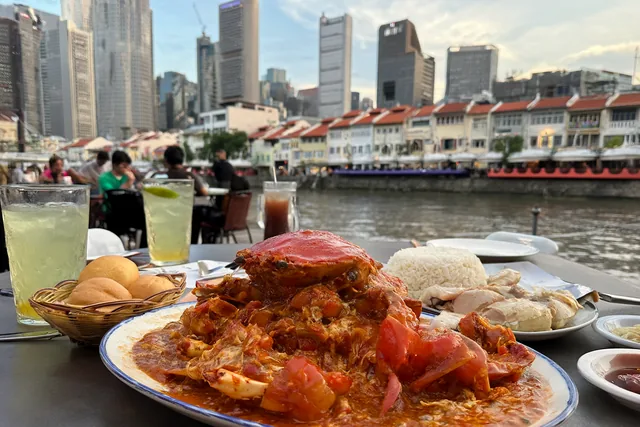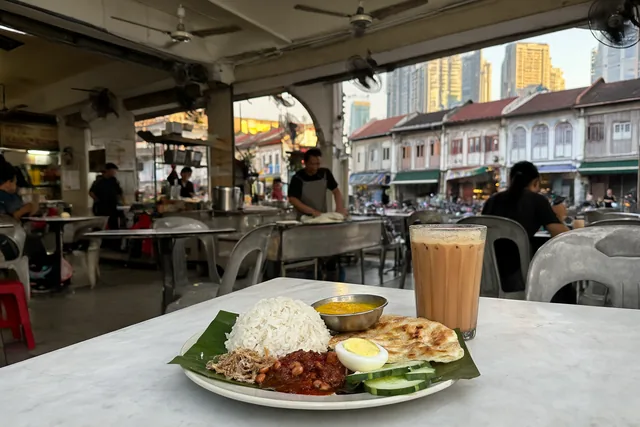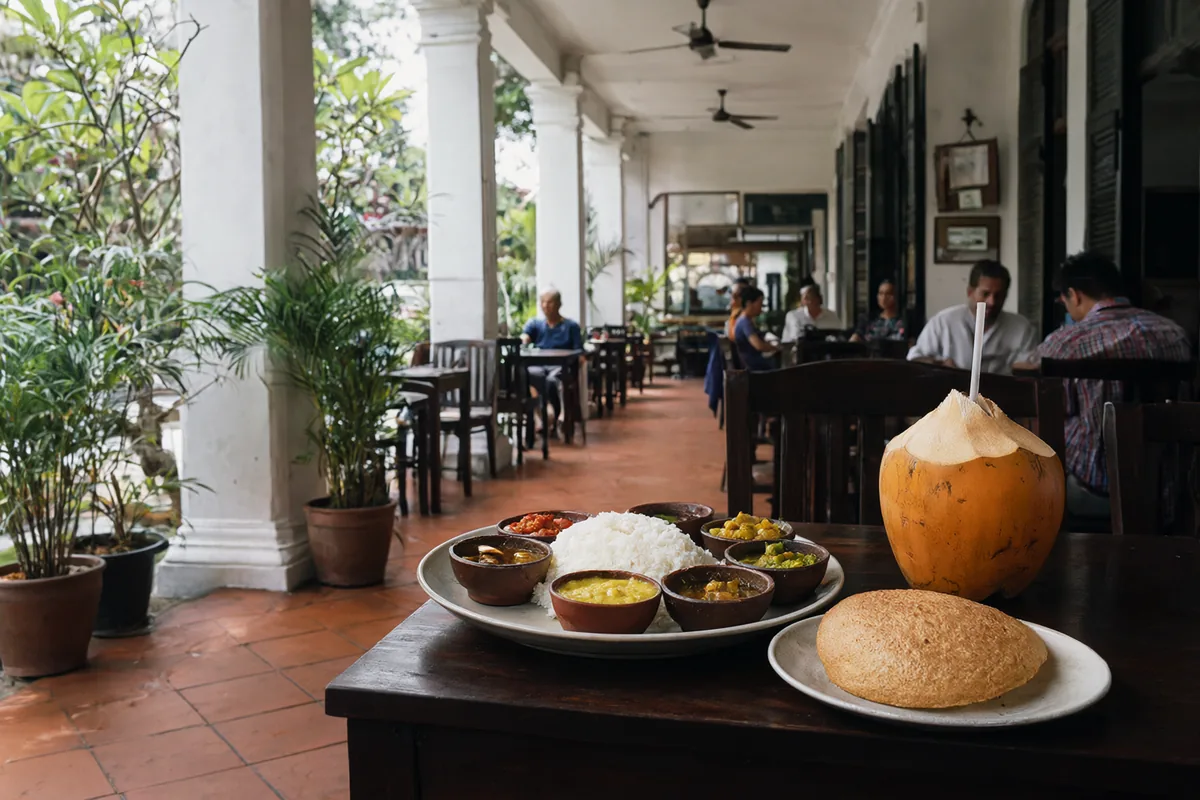
Sri Lankan food is often lumped in with Indian, and visitors are surprised by how different it is: more coconut, more fish, more sourness and a heat that builds through the meal. This Sri Lanka food guide covers the dishes to know, the Sinhala and Tamil words you will see on menus and boards, the service charge on your bill and whether to tip, then goes town by town through where to eat in Colombo, Kandy, Galle, Ella, Jaffna and Negombo. The everyday meal is rice and curry, and the best version is almost always the one cooked at home or in a small local "hotel".
What to eat in Sri Lanka: 12 dishes to know
These are the dishes worth seeking out, with the region they belong to where it matters. Most are cheap, and many are eaten at breakfast or in the evening rather than at lunch.
- Rice and curry (everywhere): a plate of rice with a fish, chicken or meat curry and four or more small vegetable curries, plus dhal and a sambol. It is the national lunch.
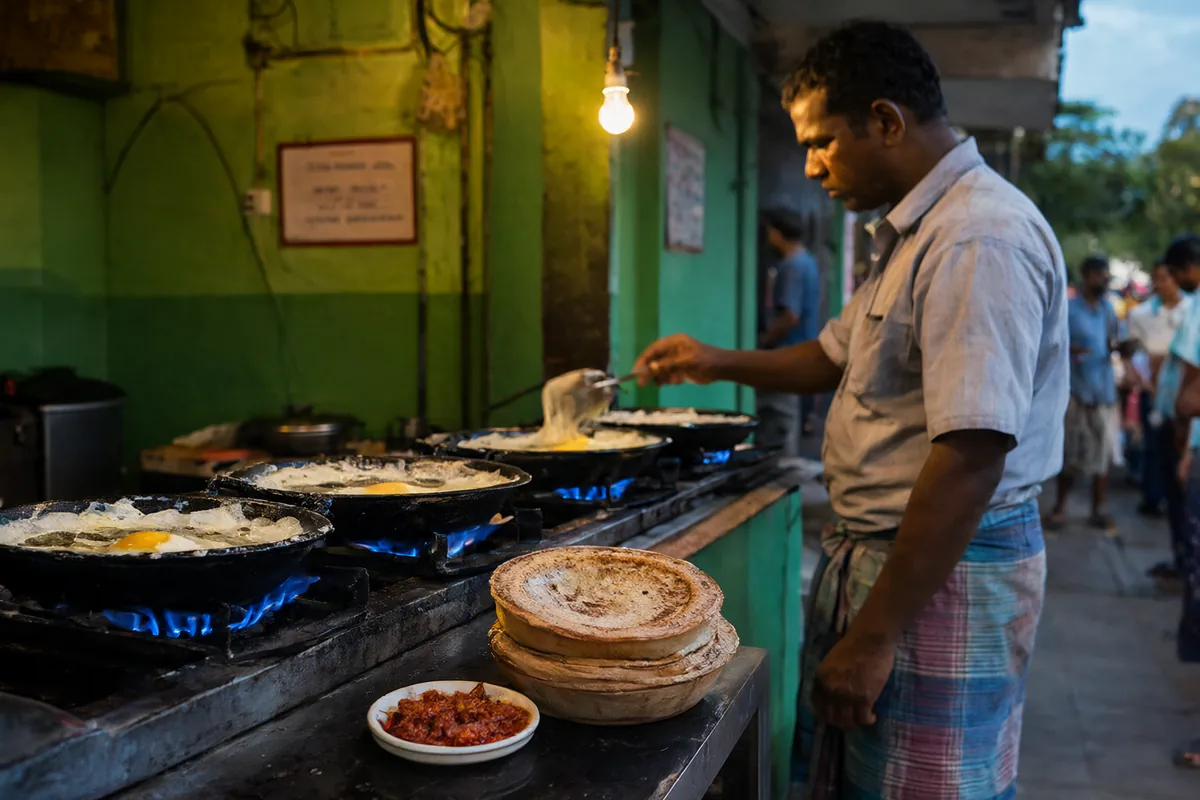
- Hoppers (appa / appam): bowl-shaped pancakes of fermented rice flour and coconut milk, crisp at the edges and soft in the centre. An egg hopper has an egg cooked in the middle.
- String hoppers (indi appa / idiyappam): nests of steamed rice noodles, eaten for breakfast or dinner with curry and pol sambol.
- Kottu roti (everywhere): chopped flatbread stir-fried on a griddle with vegetables, egg and meat, chopped with two steel blades. You will hear the clatter before you see the stall.
- Pol sambol: freshly grated coconut pounded with chilli, red onion, lime and salt. It comes with almost everything.
- Parippu (dhal curry): red lentils cooked in coconut milk with turmeric and curry leaves, mild and comforting.
- Fish ambul thiyal (the south): a dry, sour fish curry made with goraka, a dried fruit that preserves the fish. Traditionally made with tuna.
- Lamprais (Colombo): a Dutch Burgher dish of rice cooked in stock, curries, a frikkadel (meatball) and sambol, wrapped in a banana leaf and baked.
- Jaffna crab curry (the north): a fiery, dark curry of lagoon crab, made with Jaffna curry powder and tamarind.
- Kiribath: milk rice cooked in coconut milk and cut into diamonds, eaten for breakfast, on the first of the month and at New Year in April.
- Short eats: fish rolls, patties, cutlets and vadai (lentil fritters), sold from glass cases in bakeries and cafés.
- Watalappam: a steamed coconut milk custard with kithul jaggery, cardamom and cashews, from the island's Muslim community.
To drink, Ceylon tea is served strong and sweet with milk, king coconut (thambili) is sold from roadside stalls, and the local spirit is arrack, distilled from coconut palm sap.
How to read a menu in Sri Lanka
Sri Lanka has two national languages, Sinhala and Tamil, each with its own script, and English is widely used. Tourist restaurants print menus in English, but local eateries, bakeries and roadside "hotels" often write prices and specials in Sinhala, or in Tamil in the north and east and in parts of Colombo. These are the words you will meet most often.
| Sinhala | Tamil | Romanised (Sinhala / Tamil) | Meaning |
|---|---|---|---|
| බත් | சோறு | bath / soru | Rice, and by extension "rice and curry" |
| කරි | கறி | kari / kari | Curry |
| මාළු | மீன் | maalu / meen | Fish |
| කුකුළු මස් | கோழி | kukul mas / kozhi | Chicken |
| මස් | இறைச்சி | mas / iraichchi | Meat |
| ඉස්සෝ | இறால் | isso / iraal | Prawns |
| කකුළුවා | நண்டு | kakuluwa / nandu | Crab |
| බිත්තර | முட்டை | biththara / muttai | Egg |
| එළවළු | காய்கறி | elavalu / kaaykari | Vegetables |
| පොල් | தேங்காய் | pol / thengai | Coconut |
| ආප්ප | அப்பம் | appa / appam | Hoppers |
| ඉඳිආප්ප | இடியப்பம் | indiappa / idiyappam | String hoppers |
| සැර | காரம் | sera / kaaram | Spicy hot |
| තේ | தேநீர் | the / theneer | Tea |
In local eateries, rice and curry is ordered by its main item: "fish rice", "chicken rice" or "vegetable rice". Short eats work differently: a plate of mixed items is put on your table and you pay only for what you eat, so leave the rest alone if you do not want it.
Many "vegetable" dishes in Sri Lanka contain Maldive fish, dried and flaked tuna used like a seasoning, and pol sambol nearly always does. swap.menu explains each dish as it reads the menu and flags common hidden ingredients like this one, so a vegetarian order stays vegetarian.
Service charge, tipping and paying
Most hotels and sit-down restaurants add a 10 percent service charge to the bill, and menus in tourist areas often show prices "plus taxes and service charge", with VAT and other government levies added at the end. These extras can add a substantial share to the menu price, so check the small print at the bottom of the menu. Our guide to tax and service charges on menus explains how to read these lines.
Tipping on top of the service charge is not expected, but leaving some small notes for good service is common, because the service charge is not always passed on in full to staff. In small local eateries there is no service charge and no tipping, though rounding up is appreciated. Drivers and guides usually expect a tip.
The currency is the Sri Lankan rupee (Rs, LKR). Cards are accepted in hotels, upmarket restaurants and supermarkets, but rice and curry shops, bakeries, tuk-tuks and markets are cash only, and small notes are always useful. If a card machine offers to charge you in your home currency, decline and pay in rupees: our guide to paying in local currency explains why.
Breakfast is eaten early, lunch is the main rice and curry meal between noon and 2pm, and dinner is around 7pm to 9pm, often lighter, with hoppers, string hoppers or kottu. On Poya days, the Buddhist full moon holiday each month, the sale of alcohol is banned and many bars close, so plan around them if you want a drink.
Where to eat in Sri Lanka, town by town
Sri Lankan cooking changes from the coast to the hill country and from the Sinhala south to the Tamil north. Jump to a destination:
Where to eat in Colombo
Colombo is the one place in Sri Lanka where you can eat the whole country's food in a few days. The classic evening is a walk along Galle Face Green, the seafront lawn where stalls fry isso vadei, lentil fritters topped with whole prawns, and cook kottu and grilled seafood at sunset. In Pettah, the crowded old market district, small eateries serve rice and curry, short eats and sweet milk tea to traders, and the streets are organised by what they sell, from spices to fruit.
For Tamil and Jaffna-style cooking in Colombo, go to Wellawatte, where vegetarian restaurants serve dosa, thosai, vadai and set meals. Colombo is also the place to try lamprais, the Burgher community's banana-leaf parcel, which many bakeries sell on particular days of the week. The restored colonial buildings of the Dutch Hospital precinct in Fort and the cafés of Colombo 7 offer more polished dining. Colombo is known for its crab, especially lagoon crab cooked with pepper or chilli, and the city's restaurants charge accordingly, so ask the price per kilo before it is cooked.
Where to eat in Kandy
Kandy, the old royal capital in the hills, is a good place to eat a proper Sinhala rice and curry. Many restaurants in the centre lay out a lunchtime buffet of 10 or more curries: jackfruit (polos), beetroot, green beans, aubergine (wambatu), pumpkin, mushroom, dhal and a fish or chicken curry, with papadums and sambols. In the evening, small roadside stalls and family eateries make hoppers to order, and an egg hopper with lunu miris (a red onion and chilli relish) is the best cheap dinner in Kandy.
The Kandy Municipal Central Market, near the clock tower, is the place to see the island's fruit, vegetables, spices and dried fish, and to try fruit you may not know, such as rambutan, mangosteen and wood apple. The streets around the lake and the Temple of the Tooth are popular, but walk a few blocks into the town centre and prices fall. If you are in Kandy in July or August for the Esala Perahera festival, the town fills up and restaurants get busy, so eat early.
Where to eat in Galle
Galle's walled Fort, built by the Portuguese and Dutch, is now full of cafés, boutique hotels and seafood restaurants in old colonial houses. The food of the south coast is the reason to come: fish ambul thiyal, fresh tuna and seer fish, prawns and cuttlefish curries, and devilled seafood stir-fried with chilli, onion and peppers. Inside the Fort, prices are high for Sri Lanka, while the small rice and curry shops in Galle town, outside the walls, serve the same dishes for much less.
All along the south coast, from Unawatuna to Mirissa, beach restaurants put the day's catch on ice in the evening and grill whatever you choose. Agree the price and weight first. Look also for curd and treacle, thick buffalo milk curd sold in clay pots and eaten with kithul palm treacle, a southern speciality sold at roadside stalls on the way east. Galle Fort is at its best in the late afternoon, when you can walk the ramparts before dinner.
Where to eat in Ella
Ella is a small hill country town surrounded by tea estates, and its food scene is mostly guesthouses and cafés along the main street. The highlight is a home-cooked rice and curry dinner at a guesthouse, where a family may cook a dozen dishes from their garden and the market. Many guesthouses in Ella also run cooking classes, a good way to learn how pol sambol, dhal and a coconut-based curry are made, often with a visit to the spice garden.
This is tea country, so drink it fresh: estates around Ella and nearby Haputale offer factory tours and tastings, and the tea you buy here is the best you will find in Sri Lanka. The cool climate means Ella's cafés serve more Western dishes than most places, but roti, kottu and hoppers are always available. Bring cash, as small places in Ella rarely take cards.
Where to eat in Jaffna
Jaffna, at the northern tip of the island, is the heart of Sri Lankan Tamil culture, and its food is spicier, darker and quite different from the south. The two dishes to order are Jaffna crab curry, made with lagoon crab and the region's own curry powder, and odiyal kool, a thick seafood soup of crab, prawns, fish and vegetables thickened with palmyra root flour and eaten as a feast. Jaffna goat curry is also excellent, and the region is known for palmyra palm products, from toddy to jaggery and sweets.
Much of Jaffna eats vegetarian on temple days, and the streets near the Nallur Kandaswamy Temple have simple vegetarian restaurants serving thosai, vadai, idiyappam and set meals on a banana leaf. Jaffna is also famous across Sri Lanka for its ice cream parlours, a local institution. The Jaffna market sells mangoes, lagoon seafood and dried fish. Fewer visitors make it this far north, so Jaffna's prices are low and the welcome is warm.
Where to eat in Negombo
Negombo is the town closest to Colombo's international airport, so most visitors spend a first or last night here. It is a fishing town on a lagoon, with a large Catholic community, and the food is all about seafood: lagoon prawns, crab, squid and fresh fish curries. Beach road restaurants in Negombo display the day's catch on ice in the evening and grill it to order, and devilled prawns with a cold beer is the standard holiday dinner.
Go early in the morning to see the Negombo fish market near the lagoon, where the catch is landed and auctioned, and the nearby beach where fish are split, salted and dried in the sun. Dried fish (karawala) is a staple across Sri Lanka, fried with onions and chilli as a side to rice and curry. Away from the beach strip, local bakeries in Negombo town sell fish buns, patties and sweet buns for very little.
Vegetarian, vegan and allergy tips
Sri Lanka is a good country for vegetarians. Rice and curry always includes several vegetable curries, and many dishes are naturally vegan because they are cooked with coconut milk rather than dairy. The catch is Maldive fish (umbalakada), dried tuna flakes added to pol sambol, many vegetable curries and even some dhal. Ask for food without it. The Sinhala word for vegetarian is nirmaansha (නිර්මාංශ), and in Tamil areas look for saivam (சைவம்) restaurants, which serve no meat or fish.
For allergies, the ingredients to watch are coconut, which is in almost everything, cashews, which are used in curries and sweets, prawns and dried fish in sambols and curries, and gluten in roti and kottu. Hoppers and string hoppers are made from rice flour, but check what else is in the batter. Our guide to eating abroad with food allergies explains how to describe an allergy clearly when you do not share a language.
Useful Sinhala and Tamil phrases for ordering
English is widely understood in restaurants, but a word or two of Sinhala, or Tamil in the north and east, always gets a smile.
ආයුබෝවන් / வணக்கம் Ayubowan (Sinhala) / Vanakkam (Tamil): "Hello"
මට මේක දෙන්න Mata meka denna: "Please give me this" (pointing)
සැර අඩුවෙන් Sera aduwen: "Less spicy"
උම්බලකඩ නැතුව Umbalakada nathuwa: "Without Maldive fish"
මම මස් මාළු කන්නේ නැහැ Mama mas maalu kanne naha: "I do not eat meat or fish"
බිල දෙන්න Bila denna: "The bill, please"
හරිම රසයි Harima rasai: "Very tasty"
ස්තූතියි / நன்றி Sthuthi (Sinhala) / Nandri (Tamil): "Thank you"
How swap.menu helps you eat in Sri Lanka
Local eateries in Sri Lanka often have a menu board in Sinhala or Tamil, and even English menus use names like polos curry, kiri hodi and devilled cuttlefish that do not explain themselves. Photograph the menu with swap.menu and each dish appears in your language with a short description, so you know that polos is young jackfruit and kiri hodi is a mild coconut milk gravy. Every price is converted from rupees to your home currency, and we point out the service charge and taxes so the final bill is no surprise.
Tap the dishes you want, add a note such as "not spicy" or "no Maldive fish, please", typed or spoken, and swap.menu translates your order into Sinhala or Tamil. Show the waiter your phone, or let them scan the QR code and read your order on their own screen. You can try it now on a sample menu with the free demo, or see travel pass prices.
Off to Sri Lanka? Your first 3 menu scans are free, and a travel pass starts from $4.99 with nothing that renews.
Start free with 3 scansSri Lanka food FAQ
Do you tip in restaurants in Sri Lanka?
Most hotels and restaurants add a 10 percent service charge, so an extra tip is not required. Leaving some small notes for good service is common and appreciated. Local eateries without a service charge do not expect a tip.
What food is Sri Lanka famous for?
Rice and curry, hoppers, string hoppers, kottu roti, pol sambol and Ceylon tea are the best known. The south is known for sour fish curries and the north for Jaffna crab curry.
Is Sri Lankan food very spicy?
It can be hotter than many visitors expect, especially sambols, devilled dishes and northern curries. Restaurants in tourist areas usually tone it down, and you can ask for less spice. Dhal, kiri hodi and rice help cool things down.
Is tap water safe to drink in Sri Lanka?
No, drink bottled or filtered water. Many guesthouses and hotels provide filtered water for refilling bottles. King coconut water is a safe and refreshing alternative.
Is it expensive to eat out in Sri Lanka?
Local food is cheap: rice and curry, kottu and short eats cost very little. Tourist restaurants in places like Galle Fort and Colombo cost much more, and taxes and service charge add a noticeable amount to the menu price.
How can I read a menu in Sri Lanka if it is in Sinhala or Tamil?
Learn a few words such as bath, maalu and kukul mas, or photograph the menu with swap.menu. It translates every dish into your language, explains what it contains, converts rupee prices to your currency and translates your order back for the staff.
Travelling further in Asia? Read our food guides for nearby countries:
Or browse every travel food guide.