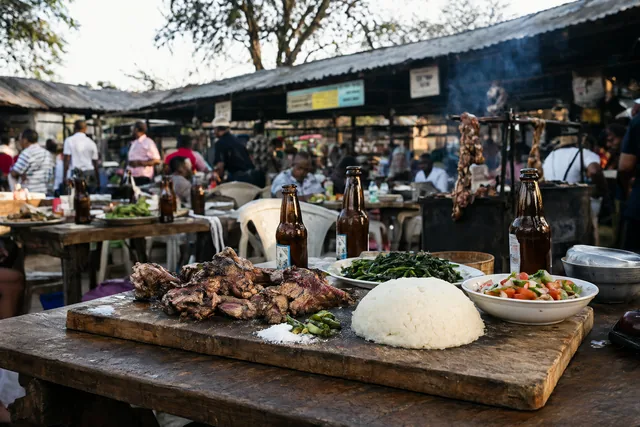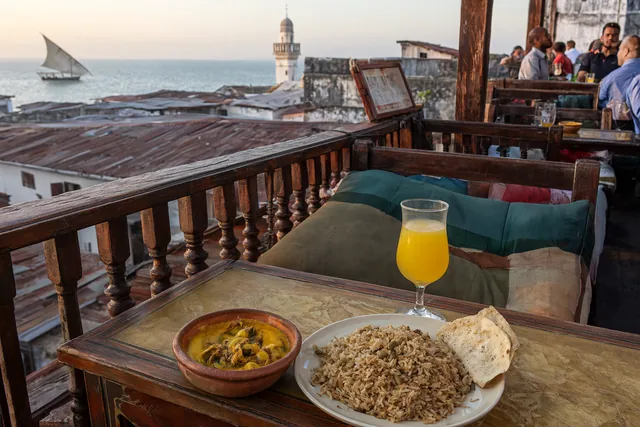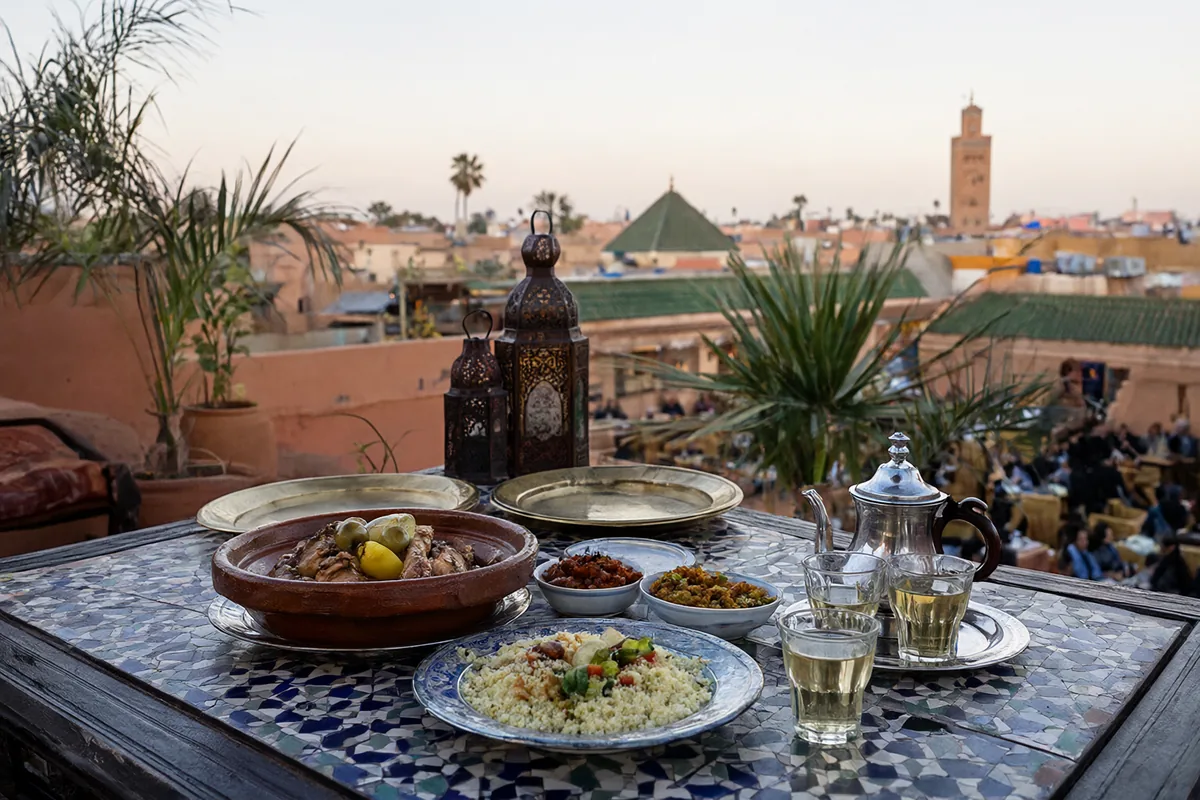
Morocco feeds you well from the first glass of mint tea, and most of its best cooking happens in places with no menu at all: a medina stall, a family kitchen, a grill on a market corner. This Morocco food guide covers the dishes worth ordering, how to read a menu written in Arabic and French, how tipping and paying in dirhams works, and then goes city by city through where to eat in Marrakech, Fes, Casablanca, Rabat, Tangier, Essaouira and Chefchaouen. Moroccan food is built on slow cooking, warm spices rather than hot ones, and a sweet and savoury balance you will taste in everything from a lamb tagine with prunes to a pigeon pie dusted with cinnamon and sugar.
What to eat in Morocco: 12 dishes to know
Moroccan home cooking and restaurant cooking are close relatives, and a few dishes turn up everywhere. These are the ones to know, with the city or region where they are best.
- Tagine (everywhere): the slow-cooked stew named after the conical clay pot it cooks in. Classic versions are chicken with preserved lemon and olives, lamb or beef with prunes and almonds, and kefta (spiced meatballs) in tomato sauce with eggs cracked on top.
- Couscous (everywhere, especially on Fridays): steamed semolina piled with a seven-vegetable stew and meat. Families eat it after Friday prayers, and many local restaurants only make it that day. Couscous tfaya adds caramelised onions and raisins.
- Pastilla or bastila (Fes): a flaky pie of thin warqa pastry filled with pigeon or chicken, almonds and egg, finished with icing sugar and cinnamon. A seafood version is common on the coast.
- Harira (everywhere): a tomato, lentil and chickpea soup with herbs and a little meat, eaten with dates and chebakia (sesame and honey biscuits) to break the fast during Ramadan, and sold year round in cheap eateries.
- Tanjia (Marrakech): beef or lamb cooked with preserved lemon, cumin and saffron in a tall clay urn, which is left for hours in the embers of the fire that heats a public bathhouse. Marrakech's signature dish.
- Mechoui (Marrakech and the south): whole lamb slow-roasted in a pit oven until it falls apart, eaten with cumin and salt.
- Bissara or b'ssara (Fes and the north): a thick split broad bean soup with olive oil, cumin and paprika, a cheap and filling breakfast.
- Zaalouk (everywhere): a cooked salad of aubergine and tomato with garlic and spices, part of the spread of small salads that starts many meals, alongside taktouka (peppers and tomato).
- Rfissa (everywhere, at home and in local places): shredded flatbread soaked in a chicken, lentil and fenugreek broth. A dish for celebrations and new mothers.
- Msemen and baghrir (breakfast everywhere): msemen is a square, flaky, layered flatbread; baghrir is a spongy semolina pancake full of holes. Both are eaten with honey and butter or amlou, a paste of argan oil, almonds and honey from the south west.
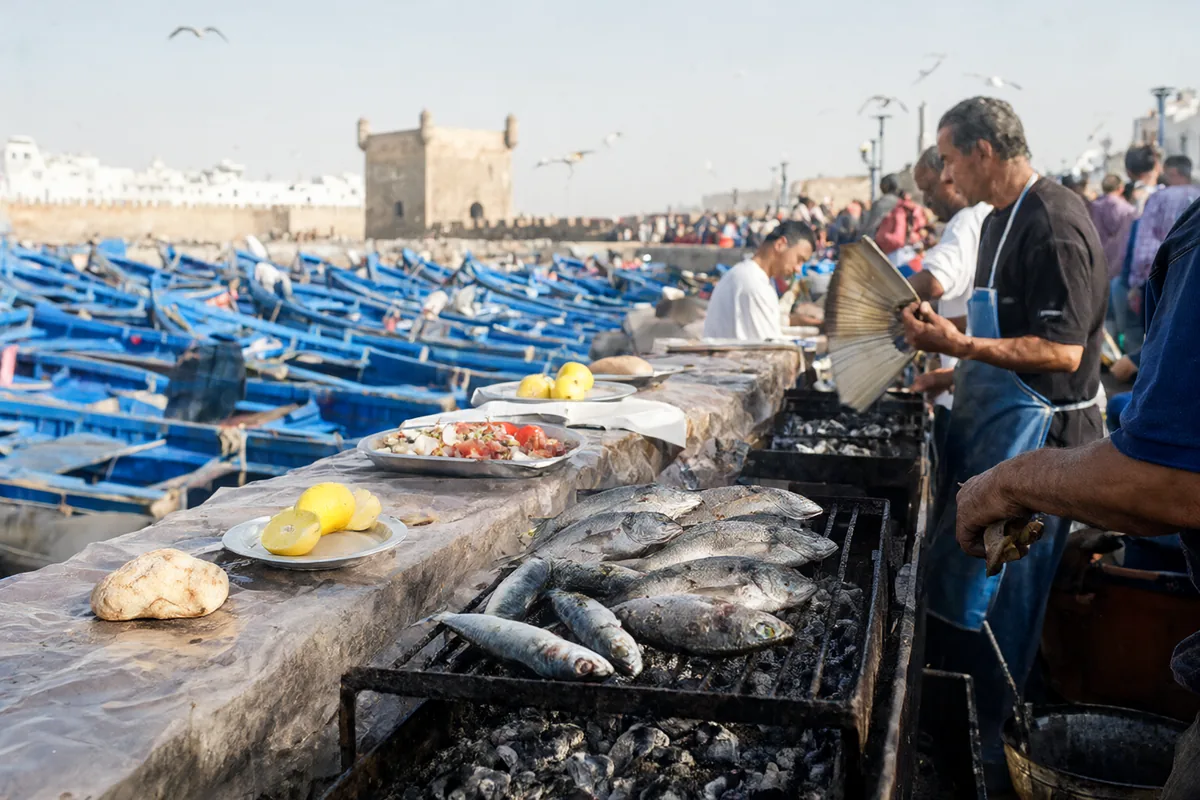
- Grilled sardines (Essaouira and the Atlantic coast): fresh sardines grilled at the port, or mashed with herbs and spices into kefta balls and fried.
- Atay, mint tea (everywhere): green tea brewed with fresh mint and plenty of sugar, poured from height to raise a foam. Turning it down is possible, but you will be offered it constantly.
How to read a Moroccan menu in Arabic and French
Moroccans speak Darija, a Moroccan form of Arabic, and French is the second language of business and of most printed menus. In a medina café you may get a handwritten board in Arabic, a French menu, or no menu at all; in the newer parts of town menus are usually French with an English column in places used to visitors. French menus follow the usual order: entrées (starters), plats (mains) and desserts, with a menu or formule meaning a fixed-price set meal. These are the words you will meet most often.
| Arabic | Romanised (Darija) | French | Meaning |
|---|---|---|---|
| طاجين | tajine | tajine | Slow-cooked stew in a conical clay pot |
| كسكس | seksu / kuskus | couscous | Steamed semolina with vegetables and meat |
| حريرة | harira | harira / soupe | Tomato, lentil and chickpea soup |
| بسطيلة | bastila | pastilla | Sweet and savoury filled pastry pie |
| كفتة | kefta | kefta / boulettes | Spiced minced meat, as meatballs or skewers |
| دجاج | djaj | poulet | Chicken |
| لحم | lham | viande / agneau / boeuf | Meat, usually lamb or beef |
| حوت | hout | poisson | Fish |
| مشوي | mechoui | grillé / rôti | Grilled or roasted |
| خبز | khobz | pain | Bread, the round flat loaf served with every meal |
| أتاي | atay | thé à la menthe | Mint tea |
| حار | har | piquant | Spicy (hot) |
| بلا | bla | sans | Without (bla sukkar, without sugar) |
| الحساب | l-hsab | l'addition | The bill |
Many medina restaurants hand visitors a short "tourist menu" with fixed prices while locals order from the board. Ask for the price before you order anything that is not listed, especially grilled fish sold by weight. swap.menu reads Arabic and French menus, including handwritten boards, so you can see what is on offer and what it costs in your own currency.
Tipping, tax and paying the bill in Morocco
Tipping is part of daily life in Morocco. In sit-down restaurants, around 10 percent is normal if service has not already been added. In cafés, leave a few dirhams or round up. Upmarket restaurants and riads sometimes add a service line to the bill, and in that case anything extra is up to you. Value added tax (TVA) is included in menu prices. Our guide to tax and service charges on menus explains how to spot these lines.
The currency is the Moroccan dirham (MAD), written DH or Dhs on menus and price boards. Cash is king in the medinas, at food stalls and in most small restaurants, so carry plenty of small notes and coins. Cards are taken in hotels, modern restaurants and supermarkets in the new towns. If a card machine offers to charge you in your home currency, decline and pay in dirhams: our guide to paying in local currency explains why.
Lunch is the main meal for many families, roughly 1pm to 3pm, and dinner starts from about 8pm and often runs late. Alcohol is served only in licensed restaurants, bars and hotels, so many traditional places in the medinas do not serve it. During Ramadan most local cafés and restaurants close in daylight hours and come alive at sunset for ftour, the meal that breaks the fast; tourist restaurants and hotels usually stay open.
Where to eat in Morocco, city by city
Each Moroccan city has its own specialities, from Marrakech's tanjia to the grilled fish of Essaouira. Jump to a city:
Where to eat in Marrakech
Marrakech is where most visitors start, and the place to begin eating is Jemaa el-Fnaa, the main square, which fills with numbered food stalls every evening. Smoke rises from grills of kefta and lamb skewers, cooks ladle harira and bowls of snails in a peppery broth, and men sell sheep's heads and fresh orange juice. Prices at the stalls are posted but touts will try to steer you to their bench; sit where locals are sitting and check the price of each plate before you eat. Off the square, near the olive and spice sellers, is a short lane known as Mechoui Alley, where lamb is pulled from underground ovens and sold by weight with bread, cumin and salt.
Marrakech's own dish is tanjia, and you can try it in simple places around the souks, often ordered by the half kilo. For a calmer meal, the rooftop terraces above the medina serve tagines, couscous and salads with views of the Koutoubia minaret, and many riads cook dinner for guests on request. Gueliz, the French-built new town, has modern cafés, bakeries and wine-serving restaurants, and the Mellah, the old Jewish quarter, and the spice square of Rahba Kedima are good for grazing during the day. Restaurants on the square's edges are pricier than their food deserves; walk a few minutes into the souks and you will eat better in Marrakech for less.
Where to eat in Fes
Fes el-Bali, the old medina, is one of the largest car-free urban areas in the world, and it is still a working city with butchers, bakeries and communal ovens where families send their bread to be baked. Fes is the home of refined Moroccan cooking: pastilla is its signature, along with tagine mrouzia (lamb with raisins, almonds and honey, traditionally made after Eid). Breakfast in Fes means a bowl of bissara drizzled with olive oil at a hole-in-the-wall counter, or eggs fried with khlii, dried preserved beef.
The streets around Bab Boujloud, the Blue Gate, are lined with grills and snack stalls, and the two main lanes through the medina, Talaa Kebira and Talaa Seghira, have bakeries, nougat sellers and fried pastry stands all the way down. Fes is one of the few places you will see camel meat on sale at medina butchers, and a few stalls make it into burgers or kefta. Food in Fes is cheaper than in Marrakech, but the medina is a maze, so ask your riad for a recommendation and directions before you go out for dinner. The Ville Nouvelle has cafés and restaurants that serve alcohol.
Where to eat in Casablanca
Casablanca is Morocco's largest city and its business capital, and it eats more like a Mediterranean port than a medina town. Seafood is the reason to come. The Marché Central on Boulevard Mohammed V, a covered market built in the French era, has fishmongers selling prawns, sea bream, sole and oysters from Oualidia, and small grills around the market will cook what you buy. Along the Ain Diab corniche, seafront restaurants serve grilled fish and seafood platters at sunset.
Casablanca's French past shows in its café culture: pavement cafés serving café crème and croissants, and art deco streets around the centre. The Quartier Habous, the "new medina" built in the 1930s, is known for its pastry shops selling cornes de gazelle (almond-filled crescents) and other Moroccan sweets. The Maarif district is where Casablanca's office workers eat, with everything from rotisserie chicken to sushi. Casablanca is spread out and taxis are cheap, so do not try to walk between neighbourhoods.
Where to eat in Rabat
Rabat, the capital, is calmer and more orderly than Marrakech or Fes, and its medina is a pleasant place to eat without the hard sell. The covered market streets of the old medina sell msemen, sfenj (ring doughnuts fried to order in the morning), olives and grilled sardine sandwiches. The Kasbah of the Udayas, the walled citadel above the river mouth, has a café garden where you can sit over mint tea and almond pastries looking out over the Bou Regreg river.
Rabat's Ville Nouvelle, around Avenue Mohammed V and the Agdal district, has French-style brasseries, modern Moroccan restaurants and the city's best coffee. Across the river, Salé has a large traditional medina with its own food markets. Rabat is a good place to try a full Moroccan Friday couscous in a local restaurant, as many places put it on only that day.
Where to eat in Tangier
Tangier sits on the Strait of Gibraltar, within sight of Spain, and its food shows it. Spanish words appear on menus, tapas-style plates of olives and fish turn up with drinks, and the city's street snack is kalinti, a baked chickpea flan sold warm in squares from carts and small shops, a cousin of the Gibraltar calentita. Breakfast is bissara or a bowl of soup with bread, and the fish is excellent: grilled sardines, fried calamari and fish tagine.
The Petit Socco, a small square in the medina, is ringed with old cafés where Tangier men sit for hours over mint tea, and the larger Grand Socco just outside the medina walls is the gateway to the food markets, where Rif mountain women in striped cloth and straw hats sell fresh goat's cheese, herbs and vegetables. Tangier's cafés are an attraction in themselves; the city has been a stop for writers and artists for a century, and its terraces over the strait are best in the late afternoon.
Where to eat in Essaouira
Essaouira is a walled fishing town on the Atlantic, windy, relaxed and much gentler than Marrakech, three hours inland. The thing to do is eat at the port. Next to the harbour, where the blue wooden boats unload, a row of grill stalls displays the day's catch on ice: sardines, sea bream, prawns, squid, crab and spider crab. You choose your fish, agree the price by weight before it goes on the grill, and eat it at a plastic table with bread, salad and lemon. Check the total in advance, as this is where visitors most often get an unpleasant surprise.
Inside the medina, the fish and spice market off the main street sells fish that small grills nearby will cook for a fee. Essaouira is in argan country, so look for amlou and argan oil at breakfast, and stalls selling sfenj and msemen in the morning. Fish tagine, cooked with tomato, peppers and potato, is the local version of the classic. In the evening, small restaurants in the medina lanes serve grilled fish and tagines at a fraction of Marrakech prices, and Essaouira is generally relaxed about where you can buy a beer.
Where to eat in Chefchaouen
Chefchaouen, the blue-washed town in the Rif mountains, is famous for its photographs, but it has a few good food reasons to stay too. The mountains around it produce fresh goat's cheese (jben), sold wrapped in leaves in the market and served with olive oil and honey at breakfast. Mountain cooking means tagines of goat and lamb, bean soups and plenty of fresh bread baked in the medina's wood-fired communal ovens.
Most of Chefchaouen's restaurants are around Plaza Outa el-Hammam, the main square beneath the red-walled kasbah, and in the lanes leading off it. The terraces there are pleasant but aimed at visitors, and the food is simple: tagines, couscous, soups and salads at reasonable prices. For something more local, the market just outside the medina has bakeries, juice stands and small grills. Chefchaouen is a conservative town, and alcohol is hard to find.
Vegetarian, vegan and allergy tips
Morocco is easier for vegetarians than it first looks. Vegetable tagines, vegetable couscous, the spread of cooked salads (zaalouk, taktouka, carrot and cumin, beetroot), bissara, lentil dishes, omelettes and breakfast breads are all widely available. The catch is stock: harira usually contains a little meat, couscous vegetables are often cooked in meat broth, and a "vegetable" tagine may have been simmered with a piece of lamb. Ask for nabati (vegetarian) in Darija or végétarien in French, and say "bla lham" (without meat). Vegans should watch for smen, a preserved butter used in couscous and some tagines.
Almonds, peanuts, walnuts and sesame are everywhere: in pastilla, in sweets and pastries, in amlou, and as a garnish on tagines. Gluten is hard to avoid, as bread is served with every meal and couscous and pastry are wheat-based. Our guide to eating abroad with food allergies explains how to communicate a serious allergy clearly when you do not speak Arabic or French.
Useful Darija and French phrases for ordering
السلام عليكم As-salamu alaykum: "Peace be upon you", the standard greeting as you walk in
بشحال؟ Bshhal? "How much?" (the most useful word in any souk)
بغيت هادي Bghit hadi: "I want this one" (pointing)
بلا سكر Bla sukkar: "Without sugar", for mint tea or coffee
شكرا Shukran: "Thank you" (the French "merci" is used just as often)
L'addition, s'il vous plaît "The bill, please" in French
Je suis végétarien / végétarienne "I am vegetarian" (végétarien for a man, végétarienne for a woman)
بنين بزاف Bnin bezzaf: "Very delicious"
How swap.menu helps you eat in Morocco
Moroccan menus switch between Arabic, French and sometimes Spanish, often on the same page, and the best places in the medina may have nothing more than a board on the wall. Photograph it with swap.menu and every dish appears in your language with its original name beside it and a short explanation, so you know that tanjia is slow-cooked urn beef, that mrouzia is lamb with honey and raisins, and that babbouche on a stall board means snails. Every price is converted from dirhams to your home currency, and service lines or priced-by-weight fish are flagged before you order.
Tap the dishes you want, add a note such as "no nuts" or "vegetarian, no meat stock", typed or spoken, and swap.menu translates your order into French or Arabic for the waiter. Show them your phone, or let them scan the QR code and read your order on their own screen. Try it now on a sample menu with the free demo, or see travel pass prices.
Off to Morocco? Your first 3 menu scans are free, and a travel pass starts from $4.99 with nothing that renews.
Start free with 3 scansMorocco food FAQ
Do you tip in restaurants in Morocco?
Yes, tipping is customary. Around 10 percent is normal in sit-down restaurants when service is not already on the bill, and a few dirhams or rounding up is fine in cafés and at food stalls. Carry small change, as staff rarely have it.
What food is Morocco famous for?
Tagine, couscous, pastilla, harira soup and mint tea are the best known. Marrakech is famous for tanjia and slow-roasted mechoui lamb, Fes for pastilla, and the Atlantic coast for grilled sardines and seafood.
Is it expensive to eat out in Morocco?
Eating local food in Morocco is cheap, especially at market stalls, snack bars and small medina restaurants. Rooftop terraces, riad dinners and restaurants serving alcohol cost much more, and Marrakech is the most expensive city for visitors.
Is tap water safe to drink in Morocco?
Tap water in the big cities is treated, but most visitors stick to bottled water to avoid stomach upsets, and it is cheap and sold everywhere. Be careful with ice and raw salads at the cheapest stalls if you have a sensitive stomach.
Which city in Morocco is best for food?
Fes has the most refined traditional cooking, Marrakech has the famous night food stalls of Jemaa el-Fnaa and tanjia, and Essaouira is best for fresh grilled fish. Casablanca and Tangier are good for seafood and café culture.
How can I read a Moroccan menu if I do not speak Arabic or French?
Learn a few key words such as tajine, poulet, poisson and l'addition, or photograph the menu with swap.menu. It translates Arabic and French menus into your language, explains each dish, converts dirham prices to your currency and translates your order back for the waiter.
Travelling further in North Africa? Read our food guides for nearby countries:
Or browse every travel food guide.