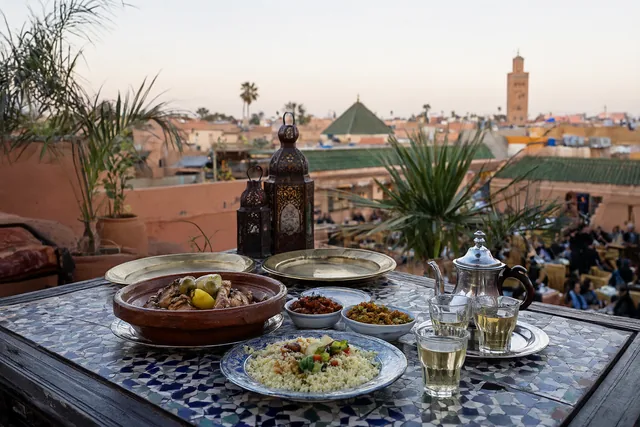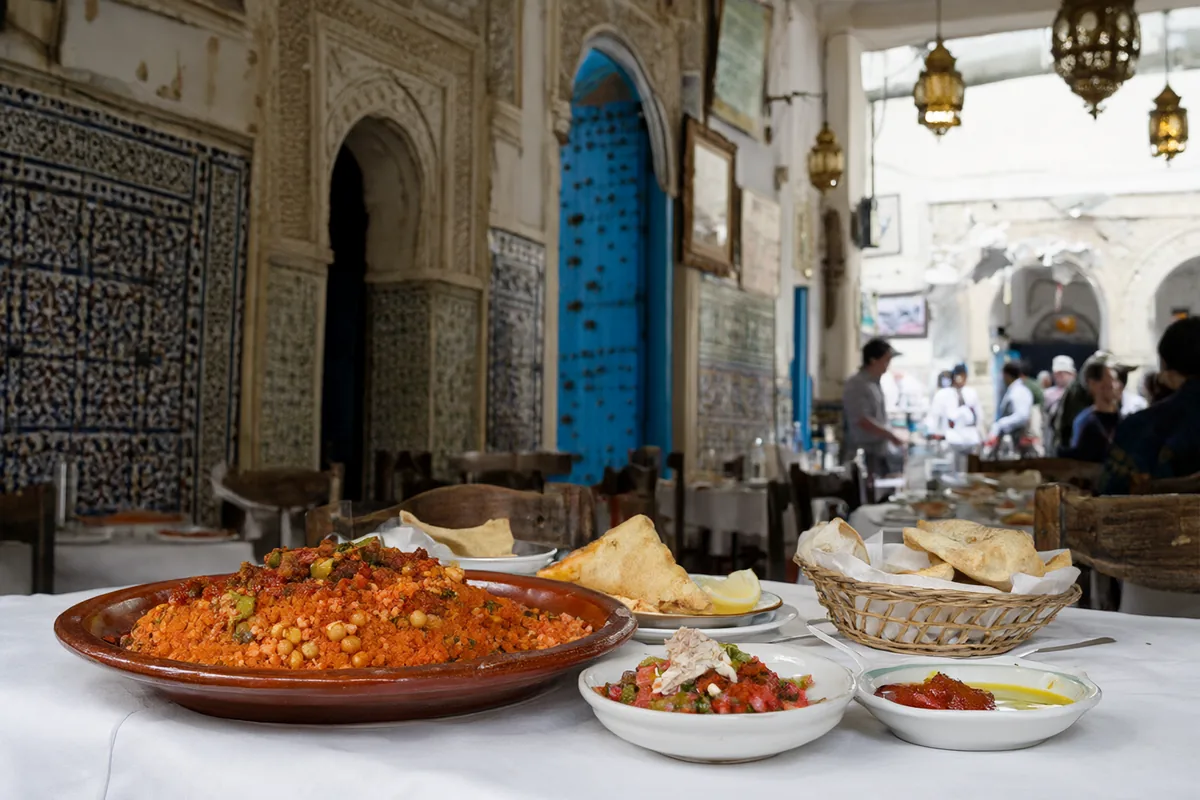
Tunisian food is the spiciest in North Africa, built on olive oil, seafood, semolina and harissa, the red chilli paste that goes into almost everything. This Tunisia food guide covers the dishes to order, how to read a menu in Arabic and French, how tipping and paying in dinars works, and then goes city by city through where to eat in Tunis, Sidi Bou Said, Nabeul and Hammamet, Sousse, Kairouan, Sfax and Djerba. Expect couscous made with fish on the coast and lamb inland, fried pastry parcels with a runny egg inside, and a breakfast soup of chickpeas that working Tunisians swear by.
What to eat in Tunisia: 12 dishes to know
Tunisian cooking shares a base with Morocco and Algeria, but it is hotter, more Mediterranean and heavier on fish. These are the dishes to know, with the place they are best where it matters.
- Couscous (everywhere): the national dish, usually red with tomato and harissa rather than the pale Moroccan style. Lamb, chicken and merguez versions are common inland, while couscous au poisson, made with grouper or other firm fish, is the pride of Sfax and the coast.
- Brik (everywhere): a triangle of very thin malsouka pastry folded around an egg, tuna, capers and parsley, then deep-fried so the white sets and the yolk stays runny. Eat it with your hands, carefully.
- Lablabi (Tunis and everywhere): a bowl of torn stale bread covered with chickpeas in a garlicky cumin broth, finished with harissa, olive oil, capers, tuna and a soft egg. The classic cheap breakfast.
- Ojja (everywhere): eggs poached in a spicy sauce of tomato, peppers and harissa, usually with merguez sausage or prawns, mopped up with bread.
- Salade méchouia (everywhere): grilled peppers, tomatoes, onion and garlic chopped together with olive oil, topped with tuna and egg. Smoky and often hot.
- Tajine (everywhere): not the Moroccan stew. A Tunisian tajine is a thick baked egg dish, like a frittata, set with meat, cheese, parsley and sometimes potato, cut into squares and often served cold as a starter.
- Fricassé (everywhere): a small fried bread roll split and stuffed with tuna, potato, egg, olives and harissa. Cheap, filling and sold in snack shops.
- Kafteji (Tunis and everywhere): fried peppers, tomato, pumpkin and potato chopped together with a fried egg, served in a sandwich or on a plate.
- Mloukhia (everywhere, especially at Islamic New Year): beef slow-cooked for hours in a near-black sauce of powdered jute leaves and olive oil. It looks alarming and tastes deep and earthy.
- Makroudh (Kairouan): diamond-shaped semolina pastries stuffed with date paste, fried and soaked in honey syrup.
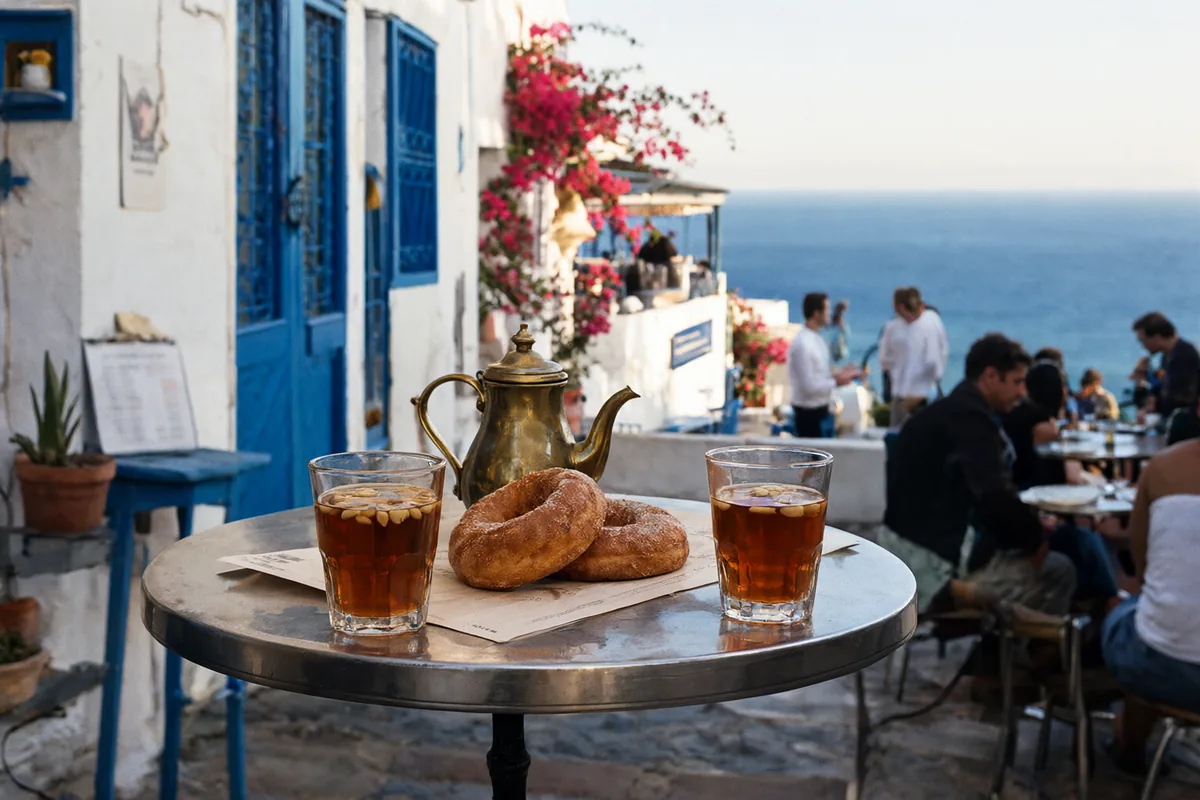
- Bambalouni (Sidi Bou Said): a ring doughnut fried to order and dusted with sugar, eaten hot while you walk.
- Thé aux pignons (everywhere): sweet mint tea served with a layer of pine nuts floating on top. Coffee, often strong and Turkish-style, is just as popular.
How to read a Tunisian menu in Arabic and French
Tunisians speak Derja, a Tunisian form of Arabic with a lot of French, Italian and Berber mixed in. Most printed menus are in French, sometimes with Arabic beside it, and small local places may have only a board in Arabic or no menu at all. French menus run in the usual order: entrées (starters, often salads and brik), plats (mains) and desserts. A menu or formule is a set meal at a fixed price. These are the words that matter.
| Arabic | Romanised (Derja) | French | Meaning |
|---|---|---|---|
| كسكسي | kosksi | couscous | Steamed semolina with a spicy stew |
| بريك | brik | brick à l'oeuf | Fried pastry parcel with egg |
| لبلابي | lablabi | lablabi | Chickpea and bread soup |
| عجة | ojja | ojja | Eggs in spicy tomato sauce |
| سلاطة مشوية | slata mechouia | salade méchouia | Grilled pepper and tomato salad |
| هريسة | harissa | harissa | Red chilli paste |
| حوت | hout | poisson | Fish |
| علوش | allouch | agneau | Lamb |
| دجاج | djej | poulet | Chicken |
| مرقاز | merguez | merguez | Spicy lamb or beef sausage |
| مشوي | mechoui | grillé | Grilled |
| خبز | khobz | pain | Bread |
| حار | har | piquant | Spicy |
| الحساب | el-hsab | l'addition | The bill |
Fish in Tunisian restaurants is often displayed on ice and priced by the kilo (le kilo or prix au kg). Choose your fish, then ask what it weighs and what it will cost before it is cooked. swap.menu reads French and Arabic menus and flags priced-by-weight items, so you know what the dinar figure actually means.
Tipping, tax and paying the bill in Tunisia
Tipping is not compulsory in Tunisia, but it is appreciated. In sit-down restaurants, leaving around 10 percent is normal in tourist areas, and in local places rounding up or leaving a few coins is enough. In cafés, leave the small change. Value added tax (TVA) is included in menu prices, and a separate service charge is unusual outside hotels. Our guide to tax and service charges on menus explains these lines in more detail.
Prices are in Tunisian dinars (TND), written DT on menus, and each dinar is divided into 1,000 millimes, so you may see prices written with three decimal places, such as 12,500 for twelve and a half dinars. The dinar is a closed currency and cannot legally be taken out of the country, so change only what you need and keep exchange receipts. Hotels, larger restaurants and supermarkets take cards, but medina eateries, snack shops and markets are cash only. When a card machine offers to bill you in your home currency, choose dinars: our guide to paying in local currency explains why.
Lunch is typically 12:30 to 3pm, and dinner from about 7:30pm, running later in summer. Alcohol is legal and served in licensed restaurants, bars and hotels; look out for local wine from Cap Bon and boukha, a fig spirit. During Ramadan many local eateries close in daylight and open for ftour at sunset.
Where to eat in Tunisia, city by city
Tunisia is small enough to cross in a day, but its food changes from the capital to the Sahel coast and the southern islands. Jump to a destination:
Where to eat in Tunis
Tunis is the best place in the country to eat cheaply and well. Start in the Medina, a UNESCO-listed maze of souks around the Zitouna Mosque, where small eateries serve lablabi from early morning, ladled into bowls over bread you tear yourself. Lunch counters sell kafteji, ojja and couscous by the plate, and the perfume and spice stalls of Souk el-Attarine make a good route through. The Marché Central, the covered central market just outside the medina, is the place to see Tunisian produce at its best: fish, olives, harissa, dates, cheese and dried chillies.
Along Avenue Habib Bourguiba, the tree-lined boulevard of the French-built new town, pavement cafés serve espresso, mint tea and pastries, and snack shops sell fricassé and Tunisian chapati, a filled flatbread sandwich. For seafood, go to La Goulette, the old port suburb on the TGM suburban train line, long known for its fish restaurants and for a Tunisian Jewish cooking heritage that gave the city dishes like bkaila, a dark spinach and bean stew. Tunis is also the base for visiting Carthage, a short ride away.
Where to eat in Sidi Bou Said
Sidi Bou Said is the blue and white clifftop village above the Gulf of Tunis, a short ride from the capital on the TGM suburban train. It is not a place for a big meal so much as a place for tea and something sweet. The steep main street is lined with stalls frying bambalouni, ring doughnuts dusted with sugar, and the cafés on the terraces above the sea serve mint tea with pine nuts and Turkish-style coffee. Sit, order a pot, and watch the light change over the bay.
For lunch or dinner, Sidi Bou Said has a handful of seafood restaurants with views, priced for the location. Many Tunisians prefer neighbouring La Marsa, a seaside suburb a short walk or taxi ride away, for grilled fish, brik and ice cream along the corniche, and for its weekend crowds of local families. Both places are busiest on weekend afternoons, so come early on a weekday if you want a terrace seat in Sidi Bou Said.
Where to eat in Nabeul and Hammamet
Nabeul and Hammamet sit side by side on the Cap Bon peninsula, an hour south of Tunis. Nabeul is Tunisia's harissa country: in late summer, strings of red chillies dry on rooftops and walls, and shops sell harissa by the jar along with dried spices and the town's famous pottery. Its weekly market, held on Fridays, is a good place to see Cap Bon produce, from citrus and strawberries to olive oil. Cap Bon is also Tunisia's main wine region, and local reds and rosés turn up on many restaurant lists.
Hammamet is a beach resort town with a small walled medina by the sea. The resort strip of Yasmine Hammamet is full of international restaurants, but the better local meals are near the medina and the fishing harbour, where grilled fish, seafood couscous and brik are the dishes to order. In Hammamet, check whether prices on a menu are per plate or per kilo before you choose a fish.
Where to eat in Sousse
Sousse is Tunisia's third city and one of its busiest resort areas, but its walled medina, a UNESCO site with a fortified ribat and a great mosque, is very much a working town. Cheap eateries in and around the medina serve couscous, lablabi and plates of the day to local workers at lunch, and stalls sell fricassé, bambalouni and sweet pastries. The souks are a good place to buy harissa, olives and dates to take home.
Along the seafront and at Port El Kantaoui, the purpose-built marina north of town, restaurants aim at holidaymakers with grilled fish, seafood platters and pizza. They are pleasant for an evening by the water but more expensive than the medina. For a more local meal in Sousse, look for small grills near the port and the old town walls, and try the ojja with seafood.
Where to eat in Kairouan
Kairouan, inland from Sousse, is one of the holy cities of Islam and the spiritual centre of Tunisia. It is also the capital of makroudh. Pastry shops along the main street of the medina fry trays of these date-filled semolina diamonds and stack them in syrup, and the smell carries down the street. Buy a box by weight; they keep well and are the classic gift to bring back from Kairouan.
Food in Kairouan is simple and traditional: couscous, grilled meat, lamb stews and salads in small restaurants around the medina gates. As a holy city it is more conservative than the coast, and alcohol is not served in the old town. Most visitors come on a day trip from Sousse or Monastir, so plan lunch around the Great Mosque and the medina, and leave room for a glass of tea and a makroudh or two.
Where to eat in Sfax
Sfax, Tunisia's second city and a busy industrial port, sees few tourists, which is exactly why it is interesting to eat in. Its walled medina is a working one, full of locals rather than souvenir shops, and the central fish market is one of the best in the country. Sfax is known for couscous au poisson, made with grouper or other firm white fish, and for a Sfaxian love of seafood in general, from octopus to cuttlefish.
A dish to look for during the Eid that ends Ramadan is charmoula, a sweet and spicy sauce of onions and raisins served with salted fish, a Sfax tradition. The city is surrounded by olive groves and produces much of Tunisia's olive oil. From Sfax, ferries cross to the Kerkennah Islands, where octopus is dried in the sun and traditional fixed-trap fishing still goes on.
Where to eat in Djerba
Djerba, the flat island in the south, has its own cooking. The dish to try is riz djerbien, rice steamed in a couscoussier with greens, herbs, spices and pieces of lamb, liver or fish, so that every grain takes on the flavour. Djerbian cooks also make their own versions of couscous with fish and octopus, and breakfast may include bsissa, a roasted grain and legume flour mixed with olive oil or water.
In Houmt Souk, the island's main town, the fish market holds a morning auction, and restaurants around the town squares serve the day's catch, brik and grilled meat. The village of Erriadh, known for the open-air street art project called Djerbahood and for the El Ghriba synagogue, has small cafés and guesthouses. Most hotels are along the eastern beaches, where buffets are the norm, so take a taxi into Houmt Souk to eat Djerba's own food.
Vegetarian, vegan and allergy tips
Vegetarians can eat well in Tunisia with a little care. Salade méchouia, salade tunisienne (chopped tomato, cucumber and onion), kafteji, ojja without merguez, chickpea dishes and vegetable couscous are all common. The problems are tuna and stock: tuna is added to salads, brik, fricassé and lablabi almost by reflex, and couscous sauces are often made with meat broth. Ask for végétarien in French, and say "sans thon" (without tuna) and "sans viande" (without meat). Vegans should note that egg is in many dishes, from brik to tajine and lablabi.
Harissa is everywhere, so if you do not like heat, say "sans harissa" or "mouch har" (not spicy). Pine nuts, almonds, pistachios and sesame turn up in tea and pastries, and wheat is in bread, couscous, malsouka pastry and most sweets. Our guide to eating abroad with food allergies explains how to explain a serious allergy in a language you do not speak.
Useful Tunisian Arabic and French phrases for ordering
عسلامة Aslema: "Hello", the friendly Tunisian greeting
نحب هذا Nheb hedha: "I would like this one" (pointing)
قداش؟ Qaddech? "How much?"
موش حار Mouch har: "Not spicy"
Sans harissa, s'il vous plaît "Without harissa, please" in French
L'addition, s'il vous plaît "The bill, please"
يعطيك الصحة Yaatik saha: "Thank you", literally "may God give you health" (merci is also used everywhere)
بنين برشا Bnin barcha: "Very delicious"
How swap.menu helps you eat in Tunisia
Tunisian menus are usually in French, sometimes in Arabic, and the dish names often make sense only if you already know them. Photograph the menu with swap.menu and every dish appears in your language with its original name beside it and a short explanation, so you know that a Tunisian tajine is a baked egg dish and not a stew, that mloukhia is beef in jute leaf sauce, and that kafteji is a fry-up of chopped vegetables. Prices are converted from dinars to your home currency, including those three-decimal millime figures, and priced-by-weight fish is flagged.
Tap the dishes you want, add a note such as "no tuna" or "not spicy", typed or spoken, and swap.menu translates your order into French or Arabic. Show the waiter your phone, or let them scan the QR code and read your order on their own screen. Try it on a sample menu with the free demo, or see travel pass prices.
Off to Tunisia? Your first 3 menu scans are free, and a travel pass starts from $4.99 with nothing that renews.
Start free with 3 scansTunisia food FAQ
Do you tip in restaurants in Tunisia?
Tipping is not required but is appreciated. Around 10 percent is normal in sit-down restaurants in tourist areas, while in local eateries and cafés rounding up or leaving small coins is enough.
What food is Tunisia famous for?
Couscous, brik, harissa, lablabi, ojja and salade méchouia are the best-known Tunisian dishes. Sfax is famous for fish couscous, Kairouan for makroudh pastries, and Djerba for its steamed rice dish, riz djerbien.
Is Tunisian food spicy?
Yes, Tunisian food is the spiciest in North Africa because harissa goes into soups, stews, salads and sandwiches. If you prefer milder food, ask for your dish without harissa, and most kitchens will happily oblige.
Is it expensive to eat out in Tunisia?
Eating out in Tunisia is cheap by European standards, especially in medina eateries and snack shops. Resort restaurants, marina restaurants and anywhere serving fish by the kilo cost more, so check prices before you order.
Is tap water safe to drink in Tunisia?
Tap water is treated in the main cities, but it can taste strongly of minerals and most visitors drink bottled water, which is cheap and sold everywhere. Bottled water is the safer choice in rural areas and the south.
How can I read a Tunisian menu if I do not speak French or Arabic?
Learn a few key words such as poisson, agneau, piquant and l'addition, or photograph the menu with swap.menu. It translates French and Arabic menus into your language, explains each dish, converts dinar prices to your currency and translates your order back for the waiter.
Travelling further around the Mediterranean? Read our food guides for nearby countries:
Or browse every travel food guide.