South Africa eats from many kitchens at once: Cape Malay curries, Afrikaner farm cooking, Zulu and Xhosa staples, the Indian curries of Durban, Portuguese peri-peri and world-class wine. This South Africa food guide covers the dishes to order, the local food words you will meet on menus (braai, bobotie, bunny chow, pap), how tipping and paying in rand works, and then goes destination by destination through where to eat in Cape Town, the Cape Winelands, Johannesburg, Soweto, Durban and the Garden Route. Menus are in English, but the food vocabulary is all South African.
What to eat in South Africa: 12 dishes to know
Most of these dishes are eaten across the country, but several belong to a particular city or community. These are the ones to know.
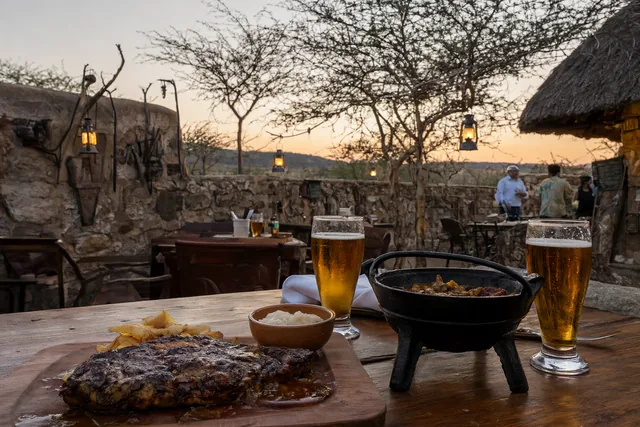
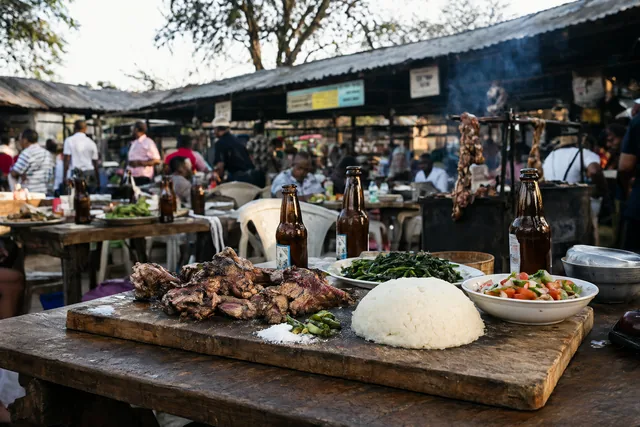
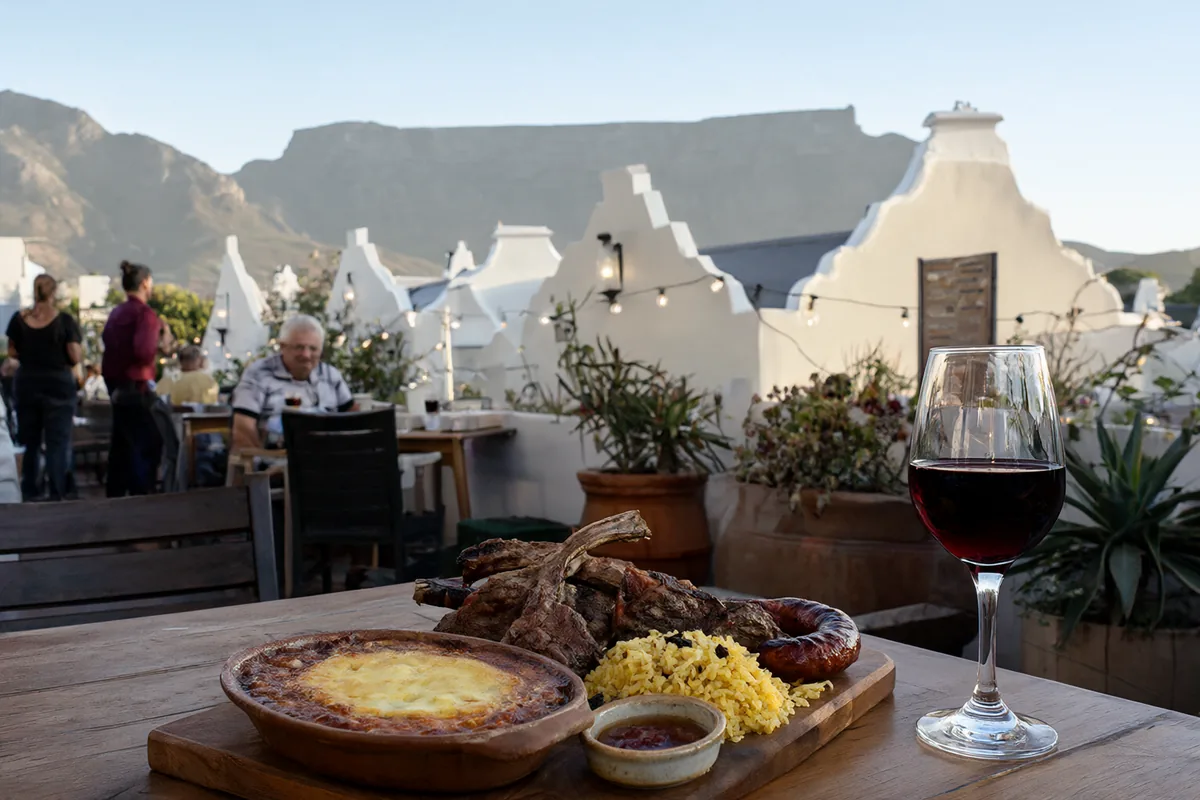
- Braai (everywhere): the South African barbecue, cooked over wood or charcoal and treated as a social event. Expect lamb chops, boerewors (a thick coiled beef and pork sausage spiced with coriander), sosaties (marinated skewers) and braaibroodjies (toasted cheese, tomato and onion sandwiches done on the grill).
- Bobotie (Cape Town and the Western Cape): spiced minced meat baked with an egg custard top, served with yellow rice with raisins and a fruit chutney. A Cape Malay dish and the closest thing to a national dish.
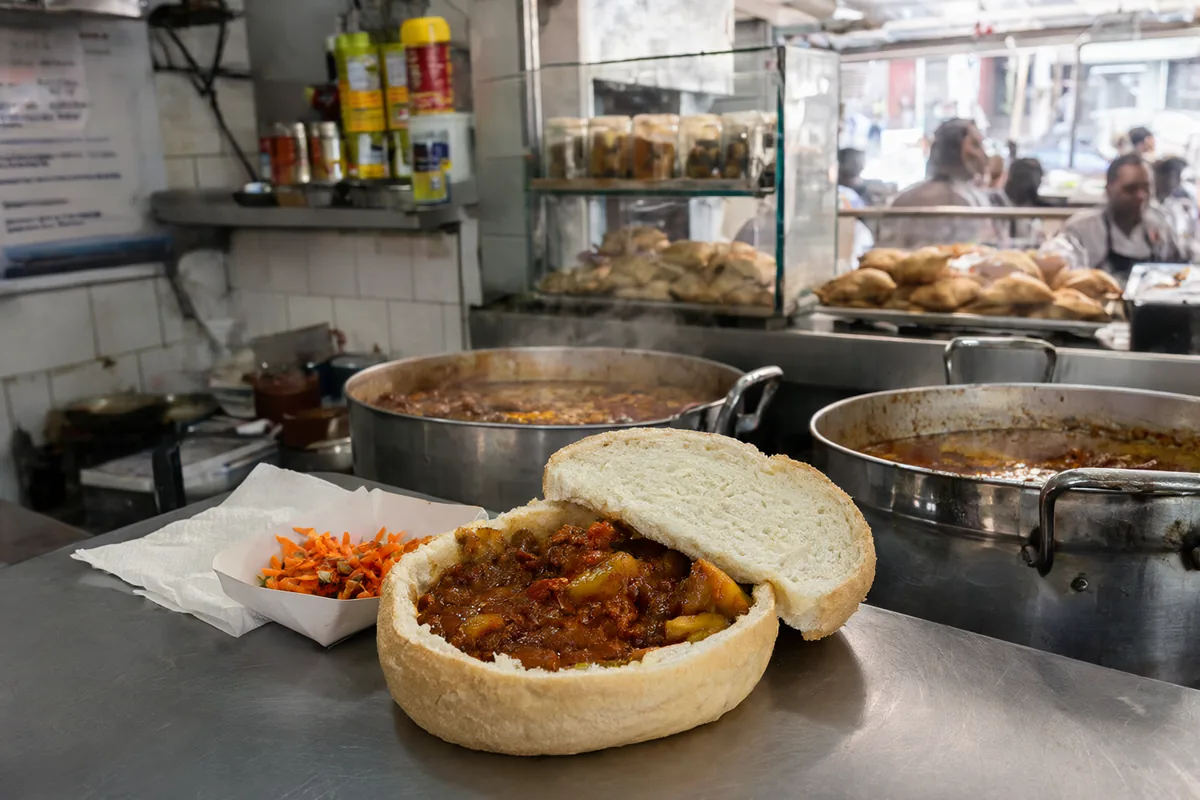
- Bunny chow (Durban): a hollowed-out loaf of white bread filled with curry, usually mutton, chicken or bean. Ordered as a quarter, half or full loaf.
- Biltong and droëwors (everywhere): air-dried spiced meat, usually beef or game, sliced into strips or sold as dried sausage. The national snack.
- Pap and chakalaka (everywhere): pap is maize porridge, stiff enough to eat with your hands (stywe pap) or crumbly (krummelpap), served with braaied meat and chakalaka, a spicy relish of beans, tomato, peppers and carrot.
- Cape Malay curry (Cape Town): milder and sweeter than Indian curry, fragrant with cinnamon, cardamom and turmeric, often served with roti and sambals.
- Bredie (Western Cape): a slow-cooked lamb stew, most famously tomato bredie, or waterblommetjie bredie made with the flowers of a Cape water plant in winter and spring.
- Potjiekos (everywhere): a layered stew of meat and vegetables cooked slowly in a three-legged cast iron pot over coals.
- Gatsby (Cape Town): a long bread roll stuffed with hot chips, sauce and a filling such as polony, steak or masala steak, cut into pieces and shared.
- Kota (Johannesburg and Soweto): a quarter loaf of bread filled with chips, atchar (pickle), polony, cheese, egg and a sausage, the township cousin of the bunny chow.
- Snoek (Western Cape): a firm, oily local fish, braaied with an apricot jam glaze or smoked and made into pâté.
- Malva pudding and melktert (everywhere): malva is a warm, sticky sponge pudding with apricot jam, served with custard; melktert (milk tart) is a cinnamon-dusted custard tart. Look for koeksisters too: Afrikaner ones are plaited and syrupy, while the Cape Malay koesister is spiced and coated in coconut.
How to read a menu in South Africa
South African menus are in English, but they are full of Afrikaans, Cape Malay, Zulu and Indian words that even other English speakers will not know. The table below covers the terms you will meet most often. Steaks are cooked to order with the usual rare, medium and well done, and "a starter" means an entrée in the Australian and British sense.
| Term | Origin | Meaning |
|---|---|---|
| Braai | Afrikaans | Barbecue, the meal and the grill itself |
| Boerewors, boerie | Afrikaans | "Farmer's sausage", coiled, spiced beef and pork. A boerie roll is one in a bun |
| Sosatie | Afrikaans, Cape Malay | Marinated meat skewer, often with dried apricot |
| Pap, mieliepap | Afrikaans | Maize porridge; mielie means corn |
| Shisa nyama | isiZulu | "Burn the meat": a butcher with a braai where you buy meat and have it grilled |
| Potjiekos | Afrikaans | "Little pot food", stew in a cast iron pot |
| Bobotie | Cape Malay | Baked spiced mince with an egg topping |
| Bredie | Cape Malay, Afrikaans | Slow-cooked meat and vegetable stew |
| Biltong, droëwors | Afrikaans | Dried meat strips, dried sausage |
| Bunny chow, bunny | Durban | Curry served in a hollowed loaf |
| Slap chips | Afrikaans and English | Soft, thick, vinegary hot chips ("slap" means limp) |
| Vetkoek | Afrikaans | "Fat cake", fried bread dough filled with mince or jam |
| Rooibos | Afrikaans | "Red bush", a caffeine-free herbal tea |
| Padstal | Afrikaans | Roadside farm stall selling pies, rusks, jams and biltong |
Many South African restaurants let you bring your own wine and charge corkage per bottle, which is printed on the menu or available on request. Ask before you arrive. swap.menu explains unfamiliar dish names and converts every rand price to your home currency, so you can compare the wine list with the corkage fee.
Tipping, tax and paying the bill in South Africa
Tipping is expected in South Africa. In sit-down restaurants the standard is 10 to 15 percent, and waiters often depend on tips for most of their income, so leaving nothing is a strong statement. Some restaurants add a service charge automatically for larger groups, which should be shown on the menu; check the bill so you do not tip twice. Car guards in restaurant car parks and petrol station attendants who fill your tank also expect a few rand. VAT is 15 percent and is included in menu prices. Our guide to tax and service charges on menus explains these lines around the world.
The currency is the South African rand (ZAR), shown as R on menus, as in R95. Cards, including contactless, are accepted almost everywhere, and the waiter usually brings the card machine to your table, where you can add the tip before you pay. Keep some cash for car guards, markets and township food stalls. When the machine offers to charge you in your home currency, choose rand: our guide to paying in local currency explains why.
South Africans eat earlier than Europeans. Lunch runs from about midday to 2:30pm, and dinner from 6:30pm, with many kitchens in smaller towns closing by 9pm. Weekend lunches, especially in the Winelands, can last all afternoon, and Sunday is a day for a family braai or a long lunch out.
Where to eat in South Africa, destination by destination
South Africa is big, and its food changes from the Cape Malay kitchens of Cape Town to the curry houses of Durban. Jump to a destination:
Where to eat in Cape Town
Cape Town has the best restaurant culture in Africa and some of the best value fine dining in the world, but its most distinctive food is Cape Malay. The Bo-Kaap, the hillside neighbourhood of brightly painted houses above the city centre, is the place to try bobotie, denningvleis (a sweet and sour lamb stew with tamarind), samoosas, curries with roti and, on Sunday mornings, spiced koesisters sold from home kitchens. In the city centre, Bree Street and Kloof Street are lined with restaurants, wine bars and cafés, and the V&A Waterfront has a large food market alongside its harbourside restaurants.
On Saturdays, the weekly market at the Old Biscuit Mill in Woodstock has been drawing crowds for well over a decade with stalls of local produce, street food and coffee. For fish and chips, take the train or drive down the False Bay coast to Kalk Bay harbour, where snoek and hake come straight off the boats, or go to Hout Bay harbour on the Atlantic side. The gatsby is a Cape Flats institution, especially in Athlone, and one is easily enough for three people. Cape Town's best restaurants book out weeks ahead in summer, so reserve early.
Where to eat in the Cape Winelands
Less than an hour from Cape Town, the valleys around Stellenbosch, Franschhoek and Paarl are lined with wine estates, and many of them have restaurants where lunch is the main event. Expect seasonal, produce-driven cooking, cheese and charcuterie platters, Karoo lamb and long tasting menus matched to the estate's wines. Order the local grapes: Chenin Blanc, the country's signature white, and Pinotage, a red grape created in South Africa.
Franschhoek, founded by French Huguenot refugees, has the highest concentration of serious restaurants, and a hop-on hop-off wine tram links many of its estates. Stellenbosch is a university town with oak-lined streets, pubs and student-friendly cafés alongside the wine farms. Weekend lunches at popular estates book up, and South Africa's drink-driving laws are strictly enforced, so use the tram, a tour or a driver rather than driving between tastings in the Winelands.
Where to eat in Johannesburg
Johannesburg, or Joburg, is South Africa's biggest city and its most diverse food city, drawing people and recipes from all over the continent. On Saturdays the Neighbourgoods Market in Braamfontein fills a rooftop with street food and local producers, and Maboneng, a regenerated warehouse district east of the centre, has restaurants, bars and street food from across Africa. Northern suburbs like Parkhurst, with its restaurant strip along 4th Avenue, and Melville, with bars and cafés on 7th Street, are where many locals go out.
Fordsburg and nearby Mayfair are the place for Indian and Pakistani food, from samoosas to biryani, and Joburg's Chinatown has moved to Cyrildene, where Derrick Avenue is full of Chinese restaurants and shops. For a braai Joburg style, find a shisa nyama, where you choose meat at the butcher's counter and it is grilled for you with pap and chakalaka. Johannesburg is spread out and best explored by car or ride-hailing app rather than on foot after dark.
Where to eat in Soweto
Soweto, south west of central Johannesburg, is the country's best-known township and a place where food is part of the visit. Vilakazi Street in Orlando West, the only street in the world to have been home to two Nobel Peace Prize winners, Nelson Mandela and Desmond Tutu, is lined with restaurants serving township classics: braaied meat, pap, chakalaka, mogodu (tripe) and umngqusho (samp and beans). Shisa nyamas across Soweto are packed on weekend afternoons, with music, beer and meat cooked over coals.
The kota is Soweto's street food, a quarter loaf loaded with chips, polony, cheese, sausage and atchar, and you will find it at takeaway windows all over the township. Sunday lunch in many Soweto homes is known as "seven colours", a plate of rice or pap with several brightly coloured sides such as beetroot, butternut, coleslaw and spinach. Many visitors come on a guided tour, which is the easiest way to eat at local spots and try home-brewed sorghum beer, umqombothi.
Where to eat in Durban
Durban is home to the largest Indian community in Africa, descended largely from workers brought to the sugar plantations from 1860 onwards, and its food is built on curry. Durban curry is red, hot and rich, and the city's signature is the bunny chow, ordered by size (a quarter, half or full loaf) and filling (mutton, chicken, beans or prawn). Eat it with your hands, starting with the bread "lid", and expect a side of grated carrot and chilli salad. Roti rolls, curry wrapped in a flatbread, are the other lunch staple.
The streets around the old Grey Street area, now Dr Yusuf Dadoo Street, and the Victoria Street Market, packed with spice traders selling masala blends with names like "mother-in-law exterminator", are the heart of Indian Durban. Florida Road in Morningside is the city's restaurant and bar strip, and the beachfront promenade has takeaways and seafood places. Prawns, often Mozambican style with peri-peri, are another Durban favourite. Summer in Durban is hot and humid, so lunch is the time for the heaviest curry.
Where to eat on the Garden Route
The Garden Route runs along the southern coast between Mossel Bay and Plettenberg Bay, and it is a road trip best taken slowly, stopping to eat. Knysna is known for oysters, farmed and harvested in its lagoon, and the town holds an oyster festival every winter. Restaurants along the Knysna waterfront and on Thesen Island serve them fresh, with seafood platters and line fish. Mossel Bay and Plettenberg Bay have beach restaurants and fish and chip shops, and Wilderness is a small, relaxed village between them.
Inland, over the Outeniqua mountains, Oudtshoorn in the Little Karoo is South Africa's ostrich capital, and ostrich steak, lean and red like beef, is on most menus there along with Karoo lamb. Along the N2 highway, stop at a padstal, a roadside farm stall, for pies, rusks, biltong, jams and roosterkoek, bread rolls cooked on a braai grid. On the Garden Route, many restaurants close early outside the summer holidays, so check opening hours before you set off for dinner.
Vegetarian, vegan and allergy tips
South Africa is a meat-loving country, but vegetarians do well in the cities, where most restaurant menus have meat-free options and the Indian food of Durban and Johannesburg offers plenty of vegetable and bean curries. At a braai, ask about halloumi, mielies (corn on the cob), braaibroodjies and roosterkoek. Watch for hidden meat: chakalaka and pap are usually meat-free, but gravies, potjies and some vegetable dishes are cooked with meat stock or fat. "Vegetarian" and "vegan" are understood everywhere, and labelling is good in supermarkets.
Peanuts appear in some sauces and sweets, coconut is common in Cape Malay cooking and koesisters, and dried fruit (apricot, raisin) shows up in savoury dishes like bobotie and sosaties. Allergies are generally well understood in city restaurants. Our guide to eating abroad with food allergies has tips for explaining a serious allergy clearly.
South African food slang and ordering terms
Howzit "Hello, how are you?", the all-purpose South African greeting
Lekker "Great" or "delicious" (Afrikaans): "that braai was lekker"
A boerie roll, please A boerewors sausage in a bread roll, often with tomato and onion relish
Just now / now now "Just now" means later, possibly much later; "now now" means soon. Useful for understanding waiting times
Do you charge corkage? Ask before bringing your own bottle of wine
Can you bring the card machine? The normal way to ask to pay at the table
Sarmie A sandwich; you may see it on café menus and school lunch boxes
Ngiyabonga "Thank you" in isiZulu, widely appreciated in Durban and Johannesburg (dankie in Afrikaans)
How swap.menu helps you eat in South Africa
South African menus are in English, but they assume you know what bobotie, bredie, slap chips and a gatsby are. Photograph the menu with swap.menu and every dish gets a short explanation, so you know that waterblommetjie bredie is a lamb stew with Cape pondweed flowers and that mogodu is tripe before you order it. Every rand price is converted to your home currency, any service charge for groups is flagged, and you can save the menus from the wine farms and restaurants you liked.
For visitors from non-English-speaking countries, swap.menu translates the whole menu into your own language, from French and German to Chinese and Japanese, in any of 29 languages, and you can add notes such as "no pork" or "well done, please" that appear on the waiter's screen in English. Try it on a sample menu with the free demo, or see travel pass prices.
Off to South Africa? Your first 3 menu scans are free, and a travel pass starts from $4.99 with nothing that renews.
Start free with 3 scansSouth Africa food FAQ
Do you tip in restaurants in South Africa?
Yes. Tipping 10 to 15 percent is standard in South African restaurants, and waiters rely on tips for much of their income. Check whether a service charge has been added for a large group, and keep small change for car guards and petrol attendants.
What food is South Africa famous for?
The braai, bobotie, biltong, boerewors and bunny chow are the best-known South African foods. Cape Town is famous for Cape Malay cooking, Durban for its curries, and the Winelands for some of the best wine in the southern hemisphere.
Is South Africa expensive to eat out?
For many visitors South Africa is good value, with high-quality restaurants and wine estates often costing much less than similar places in Europe, Australia or the US. Street food, shisa nyamas and curry takeaways are very cheap.
Is tap water safe to drink in South Africa?
Tap water in the major cities is generally safe to drink. In rural areas and small towns, ask locally or drink bottled water, as supply quality can vary.
Which city in South Africa is best for food?
Cape Town has the best restaurants, the Cape Malay food of the Bo-Kaap and the Winelands on its doorstep. Durban is best for curry and the bunny chow, and Johannesburg for diversity, shisa nyamas and township food in Soweto.
Can swap.menu help with South African menus if they are already in English?
Yes. It explains local dishes and terms such as bobotie, pap and slap chips, converts rand prices to your home currency and saves the menus you scan. Visitors who do not speak English can read the whole menu in their own language.
Travelling further in southern Africa? Read our food guides for nearby countries:
Or browse every travel food guide.