Australian food is easy to underestimate from overseas: a few icons like the meat pie and the pavlova, and a reputation for barbecues. The reality is a country with superb seafood, a serious coffee culture and some of the best Asian, Middle Eastern and Mediterranean food outside those regions, brought by generations of migrants. This Australia food guide is for international visitors and for Australians travelling interstate. It covers the dishes to know, the menu slang that confuses newcomers, how tipping, GST and surcharges work, and then where to eat in Sydney, Melbourne, Brisbane, Adelaide, Perth, Hobart and Darwin.
What to eat in Australia: 12 dishes to know
These are the foods most Australians grew up with, plus the produce the country does best. Some are humble, but all of them are worth trying at least once.
- Meat pie (everywhere): a hand-sized pie of minced or chunky beef in gravy, eaten with tomato sauce, at bakeries, servos and every football match. Adelaide's pie floater sits upside down in a bowl of thick pea soup.
- Sausage roll (everywhere): seasoned sausage meat in flaky pastry, the bakery staple alongside the pie.
- Sausage sizzle (everywhere): a grilled sausage (a snag) on a slice of white bread with fried onions and sauce, sold for charity outside hardware stores and at polling places on election day, where it is known as a "democracy sausage".
- Chicken parma (everywhere, called a parmi in South Australia): a crumbed chicken schnitzel topped with tomato sauce, ham and melted cheese, served with chips and salad. The great Australian pub meal.
- Fish and chips (the coast): eaten on the beach out of the paper. On the menu you may see flake (gummy shark), whiting, snapper or barramundi.
- Barramundi (northern Australia): a native fish with firm white flesh, best grilled or pan-fried with crisp skin, and a good choice in Darwin and Queensland.
- Seafood (everywhere): Sydney rock oysters, Moreton Bay and Balmain bugs (a kind of slipper lobster), king prawns, Western Australian rock lobster, South Australian King George whiting and Tasmanian scallops. Prawns are the classic Christmas lunch.
- Lamb (everywhere): roast lamb is the traditional Sunday dinner, and lamb chops are a barbecue staple.
- Kangaroo (everywhere): a lean, rich red meat sold in supermarkets and served in some restaurants. It is best cooked rare to medium-rare.
- Native ingredients (everywhere): wattleseed, lemon myrtle, finger lime, Davidson plum, quandong, saltbush and the macadamia nut, used by Aboriginal and Torres Strait Islander communities for thousands of years and now on many restaurant menus.
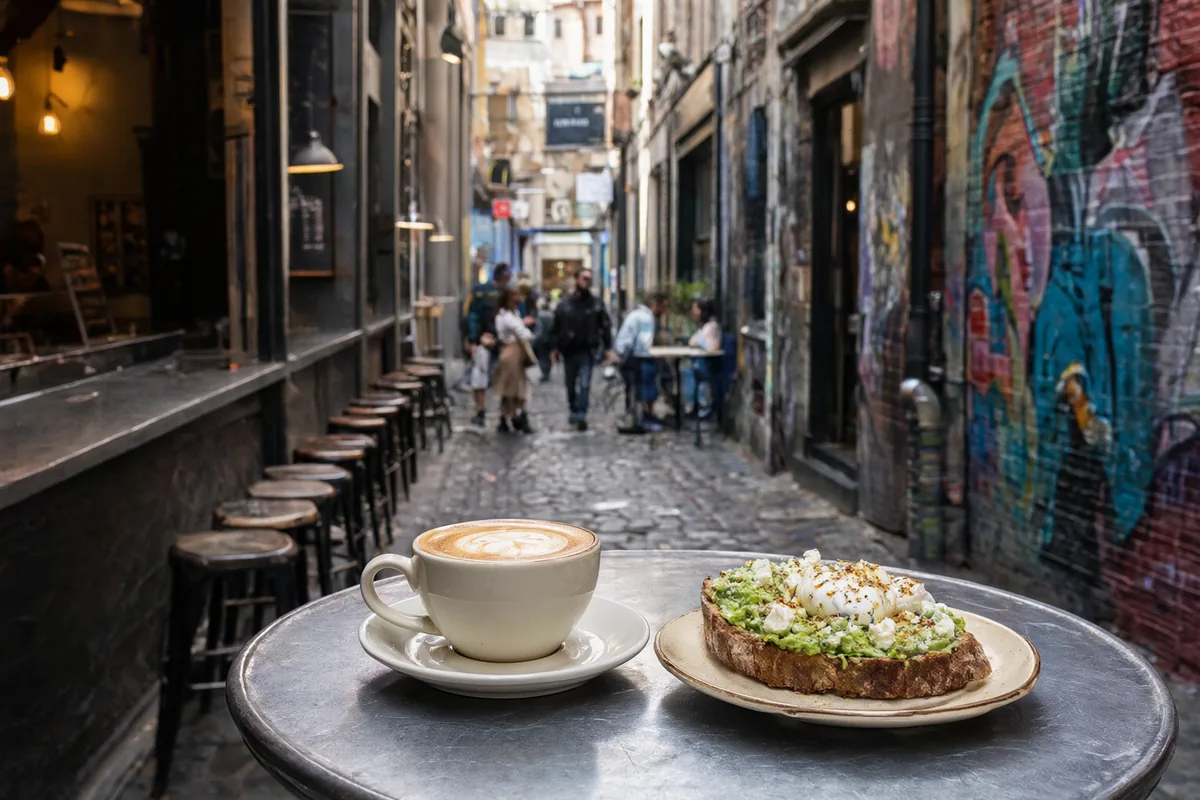
- Café brunch (everywhere): Australian cafés turned breakfast into an art form: smashed avocado on sourdough, corn fritters, eggs any way, and toast with Vegemite, the salty yeast spread most visitors find a shock.
- Pavlova, lamingtons and Anzac biscuits (everywhere): pavlova is a meringue cake with cream and fruit (New Zealand also claims it), lamingtons are sponge squares dipped in chocolate and coconut, and Anzac biscuits are chewy oat, coconut and golden syrup biscuits.
How to read a menu in Australia
Australian menus are in English, but not always the English visitors expect. Coffee orders, beer sizes and shortened words like "barra" and "parma" can puzzle Americans and Europeans as much as anyone. Here are the terms you will see most often.
| Term | Meaning |
|---|---|
| Entrée / mains | Starter / main course (an "entrée" is not the main, as it is in the US) |
| Flat white | Espresso with steamed milk and a thin layer of microfoam, the standard Australian coffee |
| Long black / short black | Espresso poured over hot water / a single espresso |
| Piccolo / magic | A ristretto with milk in a small glass / a double ristretto flat white in a small cup (Melbourne) |
| Parma / parmi | Chicken parmigiana |
| Snag / sanga | Sausage / sandwich |
| Chips / hot chips | "Chips" can mean French fries or packet crisps; "hot chips" are always fries |
| Barra / flake / bugs | Barramundi / gummy shark / slipper lobster |
| Potato cake / scallop | A battered, deep-fried slice of potato (called a scallop in New South Wales and Queensland) |
| Pot / middy / schooner / pint | Beer glass sizes, whose names and volumes change from state to state |
| Counter meal | A pub meal ordered and paid for at the bar |
| BYO / corkage | Bring your own wine / the fee charged per person or per bottle for opening it |
| Tomato sauce | Ketchup |
| Sunday / public holiday surcharge | An extra percentage added to the bill on those days |
A note at the bottom of an Australian menu such as "10% surcharge on Sundays, 15% on public holidays" applies to the whole bill, and a card surcharge may be added on top. swap.menu picks up these lines when it reads the menu and shows you the real total in your own currency.
Tipping, GST, surcharges and paying the bill
Tipping is not expected in Australia. Hospitality staff are paid award wages, and nobody will be offended if you pay exactly the bill. In nicer restaurants, around 10 percent for very good service is appreciated, and many card terminals now prompt you with tip options, which you can skip. In cafés, pubs and takeaways, a tip jar on the counter is purely optional.
The GST (Goods and Services Tax) of 10 percent is already included in menu prices, so the price you see is the price you pay, apart from surcharges. Many cafés and restaurants add a Sunday surcharge (often around 10 percent) and a public holiday surcharge (often around 15 percent) to cover higher weekend and holiday wages, and these should be shown clearly on the menu. Some places also add a small card surcharge, which should be signposted at the counter. Our guide to tax and service charges on menus explains how these lines work around the world.
The currency is the Australian dollar (A$). Contactless card and phone payments are accepted almost everywhere, and some cafés no longer take cash at all. If you are visiting from overseas and a terminal offers to charge you in your home currency, choose Australian dollars: our guide to paying in local currency explains why. In pubs and many casual places you order and pay at the bar or counter, take a number to your table, and the food is brought out. A BYO restaurant lets you bring your own wine for a corkage fee; check whether it is "BYO wine only" before you bring beer.
Australians eat early. Cafés open around 7am and often close by 3pm, lunch is from about noon to 2pm, and dinner is usually 6 to 9pm. In regional towns many kitchens close by 8:30pm, and some restaurants close on Mondays and Tuesdays, so check before you set out. Tap water is safe and free, and restaurants will bring a jug if you ask.
Where to eat in Australia, city by city
Every Australian capital has its own food personality, shaped by its climate, its seafood and the communities that settled there. Jump to a city:
Where to eat in Sydney
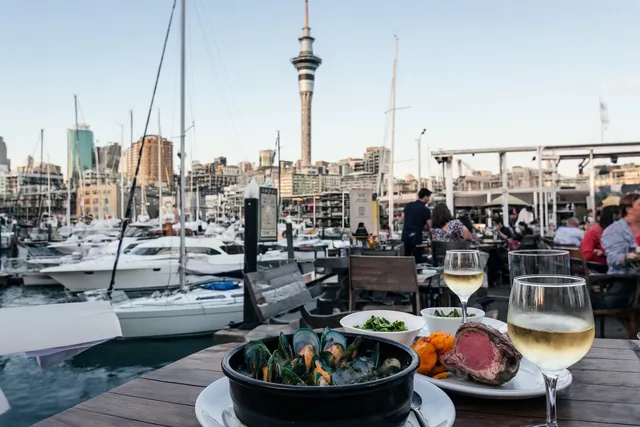
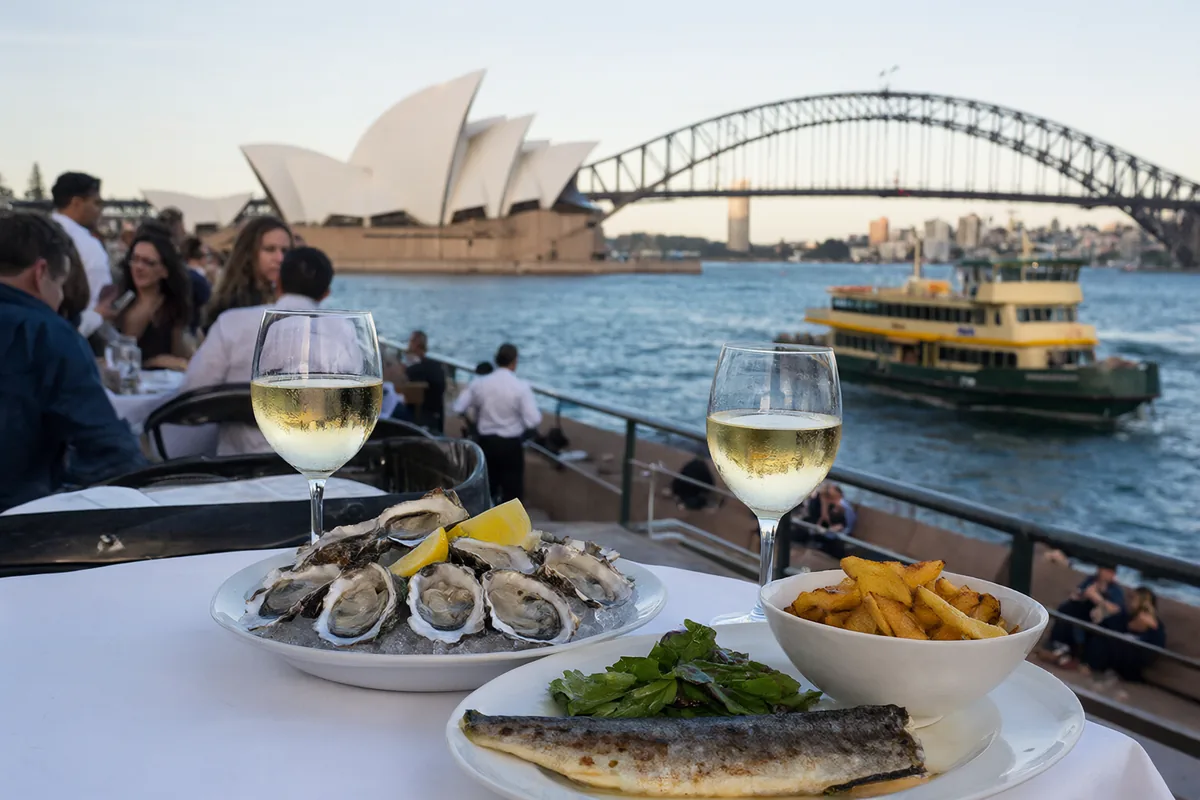
Sydney's big draw is seafood with a view. Restaurants around Circular Quay and the harbour serve Sydney rock oysters, prawns and grilled fish in sight of the Opera House and the Harbour Bridge, at a price. For the same seafood more cheaply, go to the Sydney Fish Market on Blackwattle Bay, where you can buy oysters, sashimi and fish and chips and eat by the water. Beach suburbs such as Bondi, Coogee and Manly are known for their café brunches and fish and chips on the sand.
Much of Sydney's best eating is in its migrant neighbourhoods. Haymarket has Chinatown's yum cha halls and food courts and, along Campbell Street, Sydney's Thai Town (our guide on how to read a Thai menu helps there). Cabramatta is the place for Vietnamese pho and banh mi, Harris Park for Indian food, Marrickville for Vietnamese bakeries and Greek cafés, and Strathfield and Eastwood for Korean barbecue (see how to read a Korean menu). During Ramadan, the streets of Lakemba fill with night-time food stalls. For pubs and restaurants, Surry Hills and Newtown's King Street are Sydney's liveliest strips.
Where to eat in Melbourne
Melbourne considers itself Australia's food and coffee capital, and many Australians agree. The city centre's narrow laneways, such as Degraves Street, Centre Place and Hardware Lane, are lined with tiny cafés and bars, and Melbourne coffee is the reason the flat white and the "magic" became famous. The Queen Victoria Market has been trading since the 1870s, with produce halls, delis and a summer night market, and the South Melbourne Market is famous for its dim sims.
Melbourne's food map follows its communities: Italian on Lygon Street in Carlton, Vietnamese on Victoria Street in Richmond and in Footscray, which also has Ethiopian and other African restaurants, Lebanese and Turkish along Sydney Road in Brunswick, Greek in Oakleigh, and Chinese in Chinatown on Little Bourke Street and in Box Hill. Fitzroy and Collingwood are where Melbourne goes for restaurants and bars. Pubs here take the chicken parma seriously, and many have a weekly parma night. The Yarra Valley and the Mornington Peninsula, both about an hour from Melbourne, are excellent for winery lunches.
Where to eat in Brisbane
Brisbane's warm subtropical climate means outdoor dining all year, and its seafood comes from nearby Moreton Bay. Order Moreton Bay bugs, grilled with garlic butter, mud crab and local prawns, and in summer eat the Queensland mangoes. The riverside precinct of South Bank has restaurants and bars facing the city, and Fortitude Valley, "the Valley", has Brisbane's Chinatown and much of its nightlife.
West End is the bohemian inner suburb, with cafés, Greek and Vietnamese restaurants and the Saturday Davies Park Market. On weekend evenings, Eat Street Northshore at Hamilton is a large night market of food stalls built from shipping containers. For Asian food, Brisbane locals head south to Sunnybank, a suburb packed with Chinese, Taiwanese, Korean and Malaysian restaurants. Brisbane is also a short drive from the Gold Coast and Sunshine Coast, both known for beachside cafés.
Where to eat in Adelaide
Adelaide has some of Australia's best wine regions on its doorstep and a relaxed, affordable food scene. The Adelaide Central Market, open since 1869, is one of the largest covered produce markets in the southern hemisphere, and next to it Gouger Street has Chinatown and a long row of Asian and seafood restaurants. Try South Australian King George whiting, oysters from Coffin Bay, and the late-night pie floater. Rundle Street in the East End is the place for bars and restaurants.
The Barossa Valley, settled by German-speaking Lutherans in the 19th century, is famous for Shiraz, smoked meats and German baking. McLaren Vale to the south and the Adelaide Hills to the east are each less than an hour from the city, and the Hills town of Hahndorf has German-style pubs and bakeries. Adelaide also has its own food words: devon is called fritz, and the chicken parma is a parmi.
Where to eat in Perth
Perth is one of the most isolated cities in the world, and it has a sunny, outdoorsy food scene built on Indian Ocean seafood. Western Australian rock lobster (crayfish) is the prized catch, alongside dhufish, prawns and oysters. The port city of Fremantle is the classic outing: fish and chips at the Fishing Boat Harbour, the weekend Fremantle Markets, and pubs and breweries in old limestone buildings.
In the city, Northbridge has Perth's densest cluster of Asian restaurants and bars, while Leederville and Mount Lawley have cafés and restaurant strips. The Swan Valley, half an hour from Perth, has wineries, breweries, chocolate and cheese makers. The Margaret River region, about three hours south, is one of Australia's top wine regions and is worth a weekend for its winery restaurants and produce.
Where to eat in Hobart
Hobart is Tasmania's capital, and the island's cool climate and clean waters produce some of Australia's best ingredients: oysters, salmon, scallops, cheese, apples, berries, whisky, cider and cool-climate wine. The Saturday Salamanca Market along the waterfront is the city's great weekly event, with food stalls among the crafts. Look for the Tasmanian scallop pie, scallops in a curry sauce inside pastry, sold at bakeries across the state.
On the docks, floating fish and chip punts at Constitution Dock sell fish straight from the boats. Day trips from Hobart go to Bruny Island for oysters and cheese, the Huon Valley for apples and cider, and the Coal River Valley for wine. In June, the Dark Mofo winter festival brings a large night-time feast to the waterfront, and Hobart's restaurants are busy year-round with visitors who come for the food.
Where to eat in Darwin
Darwin is closer to Southeast Asia than to most Australian cities, and its food reflects that. The famous Mindil Beach Sunset Market, held on Thursday and Sunday evenings in the dry season (roughly late April to October), has dozens of stalls selling laksa, satay, Thai salads, Indonesian food, barramundi and crocodile, and locals bring picnic rugs to watch the sunset over the Timor Sea. The Saturday morning Parap Village Market is famous for its laksa, which many locals consider Darwin's signature dish.
Restaurants on the waterfront and in the city centre serve barramundi, mud crab, buffalo and crocodile, and Darwin has a long-established Greek community with its own festival. In the wet season, roughly November to April, some markets stop and opening hours change, so check before you go. Darwin is the gateway to Kakadu and Litchfield, where Aboriginal-led tours often include tastings of bush foods.
Vegetarian, vegan and allergy tips
Australia is one of the easiest countries in the world for vegetarians, vegans and people with allergies. Most cafés and restaurants mark dishes with symbols such as V, VG and GF (vegetarian, vegan, gluten-free), plant-based milk is standard in every café, and the big cities have many fully vegetarian and vegan restaurants. Watch for gravy and stock in pies and soups, and fish sauce and shrimp paste in Southeast Asian dishes, which can be hidden in vegetarian-looking curries and salads.
Allergy awareness is high: staff are used to questions about nuts, gluten, dairy, shellfish and sesame, and many menus ask you to tell staff about allergies before ordering. Macadamias and other nuts appear in desserts and salads, and coconut is common in Asian dishes. If English is not your first language, our guide to eating abroad with food allergies explains how to explain an allergy clearly.
Australian food slang for ordering
Australians shorten almost everything and say "thanks" a lot. These are the words and phrases you will hear at the café counter, the pub and the barbecue.
Can I grab a flat white, thanks? The normal, polite way to order coffee; "grab" is not rude
Brekkie / arvo "Breakfast" / "afternoon", as in "see you this arvo"
Is it BYO? "Can we bring our own wine?" Ask about corkage too
It's my shout "I'm paying" or "it's my turn to buy the round"
Bring a plate An invitation that means bring a dish of food to share, not an empty plate
Bottle-o A bottle shop; in most states alcohol is sold in separate liquor stores, not in supermarket aisles
Ta / cheers "Thanks"
No worries "You're welcome", "that's fine" or "no problem"
How swap.menu helps you eat in Australia
Even in English, an Australian menu can be a puzzle if you are from overseas: flake, bugs, barra, saltbush, wattleseed and a parmi all need explaining. Photograph the menu with swap.menu and every dish appears in your own language with a short explanation, so a visitor from China, Japan, Germany or Brazil can read it in any of 29 languages. Every price is converted from Australian dollars to your home currency, and we point out Sunday and public holiday surcharges and card fees so the total holds no surprises. Your scanned menus are saved, so you can come back to them later or share them with the people you are travelling with.
For Australians, the same app goes with you when you leave the country, whether you are ordering at a Bali warung or reading a Japanese menu: tap the dishes you want, add a note such as "no peanuts", and swap.menu translates your order into the local language for the waiter. You can try it right now on a sample menu with the free demo, or see travel pass prices.
Off to Australia? Your first 3 menu scans are free, and a travel pass starts from $4.99 with nothing that renews.
Start free with 3 scansAustralia food FAQ
Do you tip in restaurants in Australia?
Tipping is not expected in Australia, because hospitality staff are paid award wages. Around 10 percent for very good service in a nicer restaurant is appreciated, and card terminals may offer tip options, but paying exactly the bill is completely normal.
What food is Australia famous for?
Australia is known for meat pies, sausage sizzles, chicken parmas, fish and chips, lamb, barramundi, Sydney rock oysters and Moreton Bay bugs, as well as pavlova, lamingtons and Vegemite. Its café brunch and coffee culture, especially the flat white, are also world famous.
Is Australia expensive to eat out?
Eating out in Australia is expensive compared with much of Asia and similar to Western Europe. Pub meals, bakery pies, food courts and the many Asian restaurants in the suburbs are the best value, and BYO restaurants save on drinks.
What is a Sunday or public holiday surcharge?
Many Australian cafés and restaurants add a percentage to the bill on Sundays and public holidays to cover higher wages on those days, often around 10 percent on Sundays and 15 percent on public holidays. The surcharge should be shown on the menu.
Is tap water safe to drink in Australia?
Yes. Tap water is safe to drink throughout Australia's cities and towns, and restaurants and bars will give you tap water for free if you ask. In remote areas, follow any local signs about bore water.
How can I understand an Australian menu if English is not my first language?
Photograph the menu with swap.menu. It translates every dish into your language, explains Australian terms such as parma, flake and bugs, converts prices from Australian dollars to your currency and shows any surcharges, and it can translate your questions for the staff.
Travelling further in Oceania and Asia? Read our food guides for nearby countries:
- New Zealand food guide
- Fiji food guide
- French Polynesia food guide
- Indonesia food guide
- Singapore food guide
- Vietnam food guide
Or browse every travel food guide.