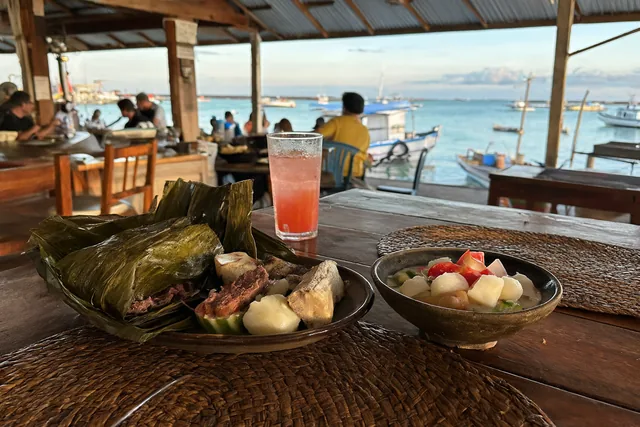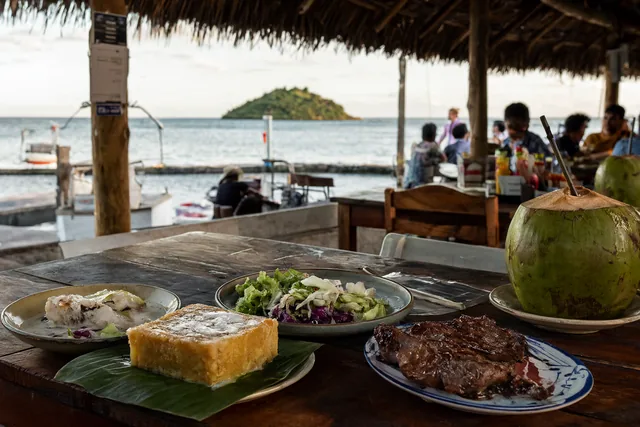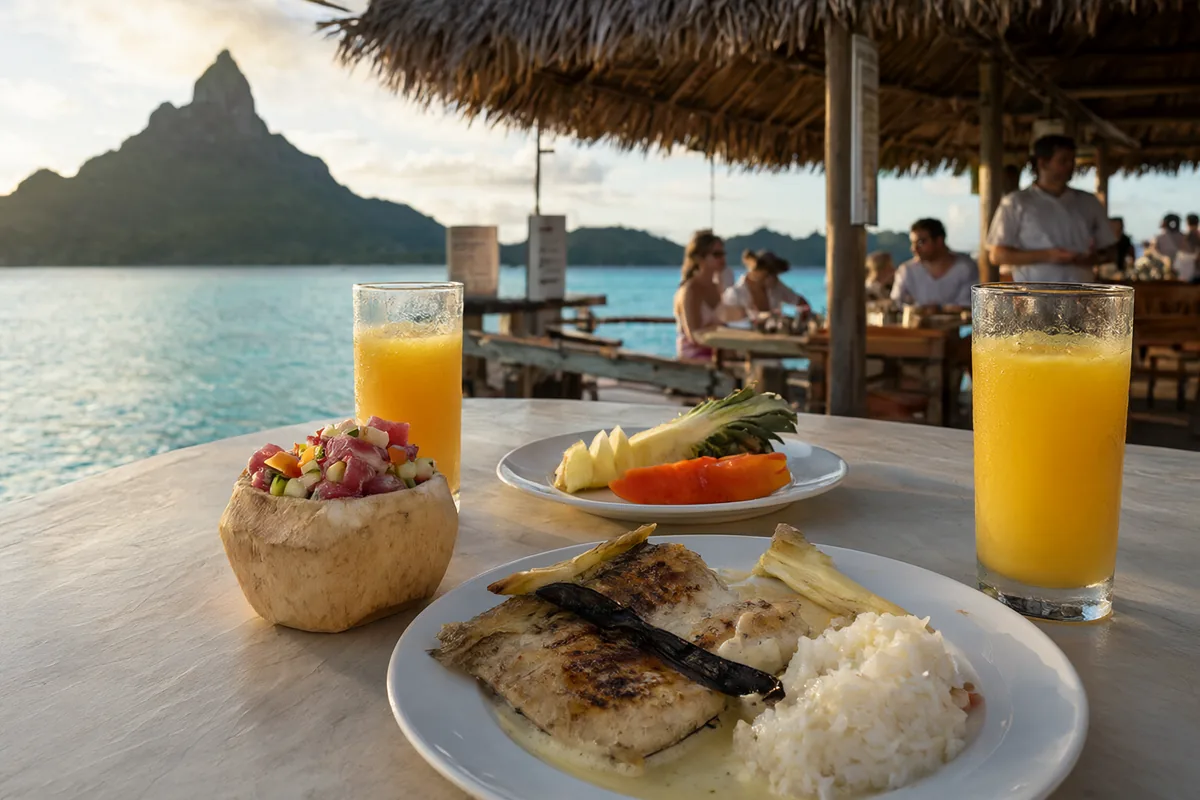
French Polynesia is famous for overwater bungalows and turquoise lagoons, and its food is just as distinctive: Polynesian cooking based on fish, coconut, breadfruit and taro, French bakeries and brasseries, and a long-established Chinese community whose dishes are now everyday Tahitian food. This French Polynesia food guide covers the dishes to know, the French and Tahitian words on menus, the food trucks called roulottes, tipping and paying in CFP francs, and then where to eat in Papeete, Moorea, Bora Bora, Huahine, Raiatea and Taha'a, Rangiroa and the Marquesas Islands. Eating well here does not have to mean eating only at your resort.
What to eat in French Polynesia: 12 dishes to know
These are the dishes you will see on menus, at roulottes and at Sunday family tables across the islands.
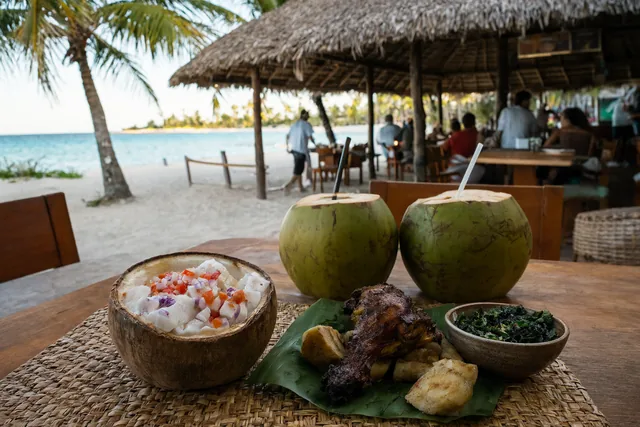
- Poisson cru à la tahitienne (everywhere): the national dish, called ʻiʻa ota in Tahitian. Cubes of raw tuna marinated briefly in lime juice, then mixed with coconut milk, cucumber, tomato, carrot and onion, served with rice or chips.
- Ma'a Tahiti (everywhere, on Sundays): a traditional Tahitian feast cooked in the ahima'a, an underground oven of hot stones, with pork, chicken, fish, breadfruit, taro, sweet potato and puddings, eaten with the fingers.
- Poulet fafa (everywhere): chicken cooked with young taro leaves (fafa) in coconut milk, a soft, green, comforting dish.
- Chevrettes au lait de coco (Tahiti and the high islands): freshwater prawns cooked in coconut milk, sometimes with curry spices.
- Mahi mahi à la vanille (everywhere): grilled dolphinfish with a creamy sauce made with local vanilla, a resort and restaurant favourite.
- Sashimi and thon rouge (everywhere): yellowfin tuna is caught all around the islands, and very fresh sashimi, often served with soy and a lime and ginger sauce, is on most menus.
- Fāfaru (traditional): fish marinated in seawater fermented with crushed shellfish or fish, with a smell so strong that few visitors get past the first sniff. Polynesians love it.
- Uru (everywhere): breadfruit, roasted whole over a fire or in the ahima'a until the skin blackens and the inside turns soft and starchy.
- Po'e (everywhere): a sticky baked pudding of banana, papaya, pumpkin or taro with starch, served warm with coconut milk poured over it.
- Chao men and maa tinito (everywhere): Tahitian chow mein, and maa tinito, a stew of red beans, pork, macaroni and Chinese cabbage. Both come from the Hakka Chinese community.
- Casse-croûte (everywhere): a French baguette sandwich filled with tuna, ham, steak and chips or even chao men, the classic cheap lunch.
- Firi firi and pain coco (everywhere): firi firi are figure-of-eight coconut doughnuts eaten for Sunday breakfast with coffee, and pain coco is a sweet coconut bread.
How to read a French and Tahitian menu
Menus in French Polynesia are written in French, often with Tahitian dish names, and resorts usually add English. Snacks and roulottes may have a handwritten board in French only. Here are the words you will see most often.
| Word | Language | Meaning |
|---|---|---|
| Poisson cru / ʻiʻa ota | French / Tahitian | Raw fish in lime and coconut milk |
| Ma'a Tahiti | Tahitian | Traditional Tahitian food, a feast from the earth oven |
| Ahima'a | Tahitian | Underground oven of hot stones |
| Miti ha'ari | Tahitian | Coconut milk |
| Fafa | Tahitian | Young taro leaves |
| Uru / taro / fe'i | Tahitian | Breadfruit / taro / mountain plantain |
| Pua'a | Tahitian | Pork |
| Chevrettes | French | Freshwater prawns |
| Thon / mahi mahi / perroquet | French | Tuna / dolphinfish / parrotfish |
| Casse-croûte | French | Baguette sandwich |
| Roulotte / snack | French | Food truck / simple casual eatery |
| Plat du jour | French | Dish of the day |
| Demi-pension / pension complète | French | Half board / full board at a guesthouse or resort |
| Chao men / maa tinito | Tahitian Chinese | Chow mein / red bean, pork and macaroni stew |
On many islands the evening meal is part of a demi-pension package at your guesthouse, and snacks often close by mid-afternoon, so the menu you see at lunch may be your only chance to choose. swap.menu translates French and Tahitian menus into your language and shows prices in your home currency, so you can compare quickly.
Tipping, prices and paying the bill
Tipping is not a traditional part of Polynesian culture, and it is not expected in restaurants, snacks or roulottes. At resorts and in smarter restaurants, a tip for very good service is appreciated and increasingly common, but never required. Menu prices include tax, and there is no separate service charge in most places. Our guide to tax and service charges on menus explains how these lines work around the world.
The currency is the CFP franc (XPF), written "F", "CFP" or "XPF" on menus, and pegged to the euro. Prices are in the hundreds and thousands, with no decimals. French Polynesia is expensive, as most food apart from fish and fruit is imported, and resort restaurants on Bora Bora are among the priciest in the world. Cards are accepted at hotels, resorts and most restaurants in Papeete and on the main islands, but roulottes, snacks, markets and family guesthouses often take cash only, and ATMs are few on the smaller islands. If a card terminal offers to charge you in your home currency, choose CFP francs: our guide to paying in local currency explains why.
Polynesians eat early. Lunch runs from about 11:30am to 1:30pm, many snacks close by mid-afternoon, and dinner is from about 6:30pm. Sunday is a day for church and the family ma'a Tahiti, and many places close; the Papeete market is busiest before dawn on Sunday, when families buy food for the Sunday meal.
Where to eat in French Polynesia, island by island
Most visitors fly into Papeete on Tahiti and combine it with Moorea, Bora Bora and perhaps an atoll in the Tuamotus. Jump to an island:
Where to eat in Papeete
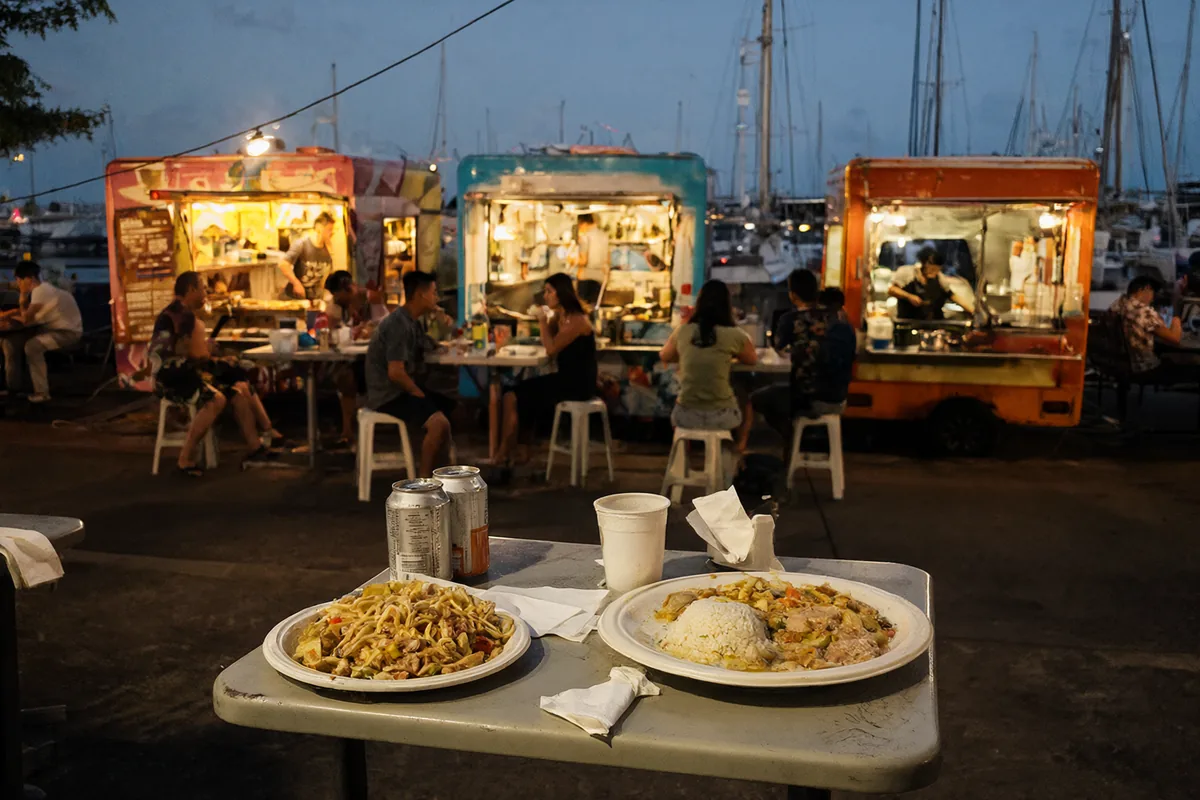
Papeete, the capital on Tahiti, is where the islands' food cultures meet, and the best place to eat cheaply. In the evening, the roulottes, food trucks with stools and tables around them, set up on the waterfront, traditionally at Place Vai'ete, and serve poisson cru, chao men, steak frites, grilled fish, crêpes and pizza at prices far below the restaurants. Eating at a roulotte by the harbour is one of the essential experiences in Papeete.
The Papeete Municipal Market (Marché de Papeete) sells fish, fruit, vanilla, flowers and ready-made Tahitian food, and the upstairs cafés are good for breakfast. Go very early on a Sunday to see families buying ma'a Tahiti for lunch. Around the town, Chinese snacks serve chao men and maa tinito, French bakeries sell baguettes, croissants and firi firi, and there are brasseries and smart French restaurants for a special dinner. Outside Papeete, restaurants around the island of Tahiti serve Sunday ma'a Tahiti buffets, and in July the Heiva festival brings traditional food to the capital.
Where to eat in Moorea
Moorea, half an hour from Papeete by ferry, is greener and quieter, with dramatic peaks above two deep bays, Cook's Bay and Opunohu Bay. Pineapples grow in the valleys, and Moorea's small, sweet pineapples are sold at roadside stalls with bananas, pomelos and coconuts. The island's snacks and family restaurants around the coast road serve poisson cru, grilled fish and casse-croûtes at much lower prices than the resorts.
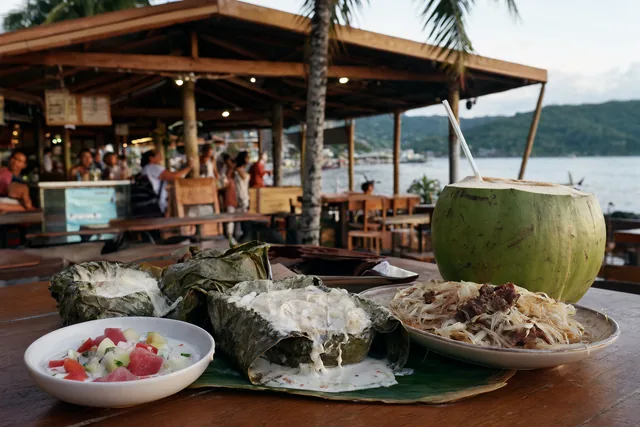
Many lagoon tours from Moorea stop on a motu, a small islet on the reef, for a picnic of poisson cru, grilled fish, breadfruit and fruit served on banana leaves, often with a demonstration of how to open a coconut. Resorts hold Polynesian evenings with dance shows and buffets, and a few restaurants in Moorea serve a traditional ma'a Tahiti on Sundays.
Where to eat in Bora Bora
Bora Bora's resorts sit on the motu around one of the world's most beautiful lagoons, facing the peak of Mount Otemanu, and most visitors eat there, often on a half-board or full-board plan. Resort restaurants serve French and Polynesian cooking, with excellent tuna, mahi mahi and lagoon fish, and prices to match. Book special dinners ahead, especially overwater tables at sunset.
For a change, take the resort boat to Vaitape, the main village on the island, where snacks and roulottes serve poisson cru, chao men and casse-croûtes, and the supermarket sells snacks and drinks at normal island prices. Restaurants around Matira Beach on the south of the island are good for lunch with your feet in the sand, and some restaurants in Bora Bora offer transfers for dinner guests. Lagoon tours usually include a motu picnic of poisson cru and grilled fish.
Where to eat on Huahine
Huahine, sometimes called the garden island, is one of the quietest and most traditional of the Society Islands, with few large resorts. The main village of Fare has a waterfront row of snacks and a few roulottes in the evening, and family guesthouses serve home-cooked Polynesian meals. Poisson cru, poulet fafa, grilled fish and fresh fruit are the staples.
At Maeva, ancient V-shaped stone fish traps in the lagoon channel are still used today, beside some of the most important archaeological sites in French Polynesia. Huahine also has small vanilla farms that welcome visitors and sell vanilla pods. Many places on Huahine are cash only and close early, so plan your evening meals in advance.
Where to eat on Raiatea and Taha'a
Raiatea and Taha'a share a single lagoon. Raiatea is the sacred island of Polynesian culture, home to the UNESCO-listed marae of Taputapuātea, and its main town, Uturoa, has a market, Chinese snacks and casual restaurants that serve locals more than tourists. It is also the sailing centre of French Polynesia, so you will find yachting crews stocking up at the market.
Taha'a is known as the vanilla island, and its plantations of Tahitian vanilla, one of the most fragrant in the world, can be visited on tours, along with pearl farms and a small rum distillery. Day trips around Taha'a by boat usually end with a motu picnic and snorkelling in the coral garden. Restaurants on Raiatea and Taha'a are few and often attached to guesthouses, so ask your accommodation about dinner.
Where to eat on Rangiroa
Rangiroa, in the Tuamotu archipelago, is one of the largest coral atolls in the world, famous for diving with sharks and dolphins in its passes. Most visitors stay in family guesthouses on half board, eating whatever was caught that day: reef fish grilled or in poisson cru, tuna, and coconut in many forms. The village of Avatoru has a few snacks and small shops.
Rangiroa is also home to one of the most unusual vineyards in the world, planted on coral among the coconut palms, and its wines can be tasted on the atoll. Black pearl farms on the lagoon offer visits. Fresh fruit and vegetables have to come by boat or plane, so meals on Rangiroa are simple, and it is worth bringing any snacks you rely on from Papeete.
Where to eat in the Marquesas Islands
The Marquesas Islands, far to the northeast, are rugged, remote and very different from the lagoon islands, with steep green valleys and no fringing reefs. The food is hearty: goat and wild pig cooked in coconut milk, river prawns, fish, and breadfruit, prepared as popoi, a fermented paste, and kaaku, pounded with coconut milk. Fruit grows wild, including huge pomelos.
There are very few restaurants in the Marquesas Islands. Most visitors eat at their guesthouse or on board the passenger-carrying cargo ship that tours the islands, and the main villages, such as Taiohae on Nuku Hiva and Atuona on Hiva Oa, have a few snacks and shops. During festivals, communities prepare large feasts from the earth oven, and visitors are often welcome.
Vegetarian, vegan and allergy tips
Vegetarians can manage in French Polynesia, especially in Papeete, with French bakeries, crêpes, pizza, salads and plenty of tropical fruit, breadfruit, taro and po'e. On the smaller islands, guesthouse meals are built around fish, so tell your host when you book. Watch for fish or meat in stews and stocks, and pork in many Chinese dishes. The French word for vegetarian is végétarien (or végétarienne for a woman), and vegan is végan or végétalien.
Fish, shellfish and coconut are in a great many dishes, which matters for allergies, and French pastry means wheat, butter and eggs in most baked goods. On remote islands, kitchens have limited alternatives, so warn your guesthouse or resort before you arrive. Our guide to eating abroad with food allergies explains how to explain an allergy clearly when you do not speak the language.
Useful French and Tahitian phrases for ordering
Ia ora na "Hello" (Tahitian), said "yo-rah-nah"
Māuruuru / Māuruuru roa "Thank you" / "Thank you very much" (Tahitian)
Une table pour deux, s'il vous plaît "A table for two, please" (French)
Qu'est-ce que vous me conseillez ? "What do you recommend?" (French)
Je voudrais ceci, s'il vous plaît "I would like this, please" (French, pointing)
Je suis allergique à... "I am allergic to..." (French)
L'addition, s'il vous plaît "The bill, please" (French)
Maita'i "Good" or "fine" (Tahitian), as in "it was good"
How swap.menu helps you eat in French Polynesia
Away from the big resorts, menus in French Polynesia are often in French only, with Tahitian dish names that even French visitors do not know. Photograph the menu with swap.menu and every dish appears in your language with the original name beside it and a short explanation, so you know that fāfaru is fermented fish before you order it, that chevrettes are freshwater prawns and that maa tinito is a pork and bean stew. Every price is converted from CFP francs to your home currency, which helps a lot when a plate costs several thousand francs.
Tap the dishes you want, add a note such as "no coconut" or "well done, please", typed or spoken, and swap.menu translates your order into French. Show the waiter your phone, or let them scan the QR code and read your order on their own screen. You can try it right now on a sample menu with the free demo, or see travel pass prices.
Off to French Polynesia? Your first 3 menu scans are free, and a travel pass starts from $4.99 with nothing that renews.
Start free with 3 scansFrench Polynesia food FAQ
Do you tip in French Polynesia?
Tipping is not a traditional part of Polynesian culture and is not expected. Menu prices include tax, and there is usually no service charge. A tip for very good service at a resort or smart restaurant is appreciated but never required.
What food is French Polynesia famous for?
Poisson cru, raw tuna in lime and coconut milk, is the national dish. French Polynesia is also known for ma'a Tahiti feasts from the earth oven, poulet fafa, mahi mahi with vanilla sauce, breadfruit, po'e and Tahitian vanilla, plus French bakeries and Chinese-Tahitian dishes like chao men.
Is French Polynesia expensive to eat out?
Yes, French Polynesia is one of the most expensive destinations in the Pacific, as most food is imported. Roulottes, snacks, casse-croûtes and markets are the best value, while resort restaurants on Bora Bora are very expensive.
What are roulottes in Tahiti?
Roulottes are food trucks that set up in the evening with tables and stools around them, most famously on the Papeete waterfront. They serve poisson cru, chao men, grilled fish, steak frites and crêpes at much lower prices than restaurants, and usually take cash.
Is tap water safe to drink in French Polynesia?
Tap water is treated in Papeete and on Bora Bora and is generally drinkable, but quality varies between islands and districts. On the atolls, drinking water often comes from rainwater tanks, so bottled water is the easy choice.
How can I read a menu in French Polynesia if I do not speak French?
Learn a few words such as poisson cru, plat du jour, chevrettes and casse-croûte, or photograph the menu with swap.menu. It translates every dish into your language, explains Tahitian dish names, converts prices from CFP francs to your currency and translates your order into French for the waiter.
Travelling further in Oceania? Read our food guides for nearby countries:
Or browse every travel food guide.