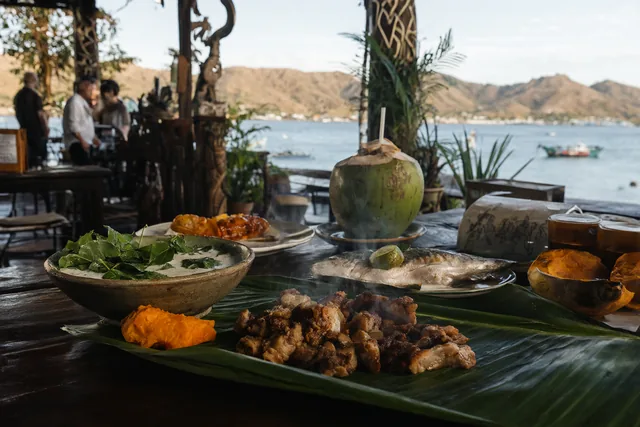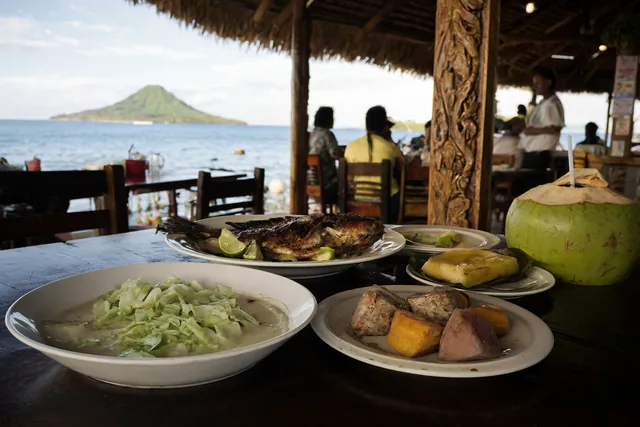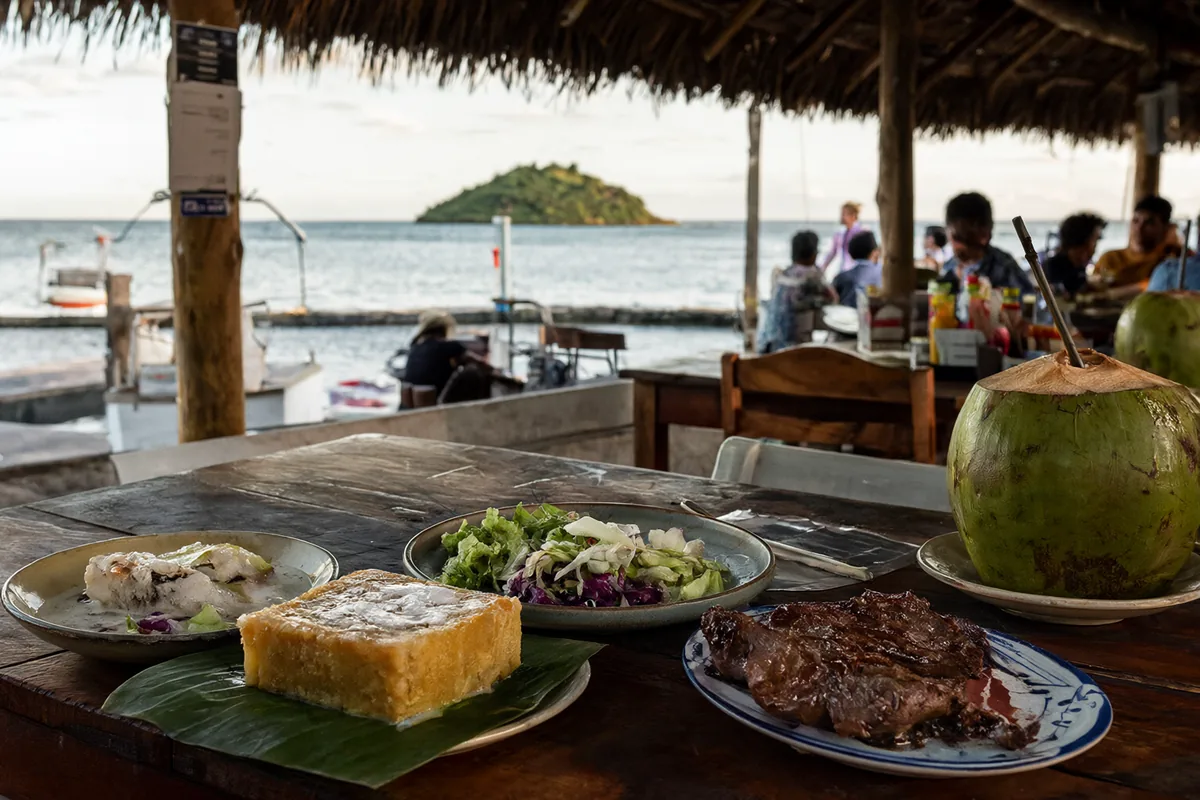
Vanuatu is a nation of more than 80 islands and over 100 local languages, held together by Bislama, a creole of English words with Melanesian grammar, and by a shared love of root crops, coconut cream and kava. Its food mixes village cooking in earth ovens with a French and British colonial past, so you can eat laplap at the market for breakfast, a baguette at lunch and a steak of famous Santo beef for dinner. This Vanuatu food guide covers the dishes to know, the Bislama and French words on menus, how a nakamal (kava bar) works, tipping and paying, and then where to eat in Port Vila, around Efate, in Luganville, on the east coast of Santo and on Tanna.
What to eat in Vanuatu: 12 dishes to know
These are the dishes you will meet at markets, village feasts, island bungalows and restaurant menus. The Bislama name comes first, as that is what everyone uses.
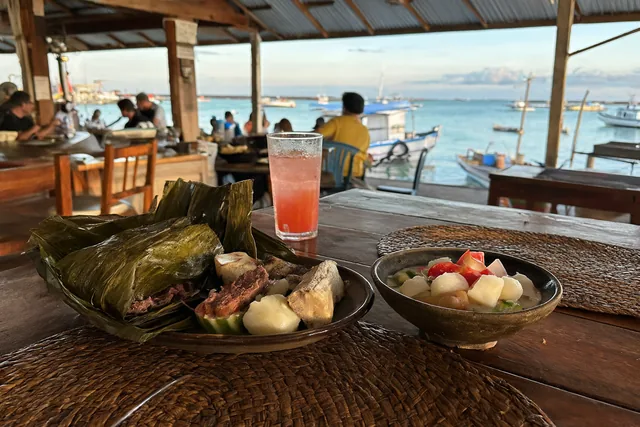
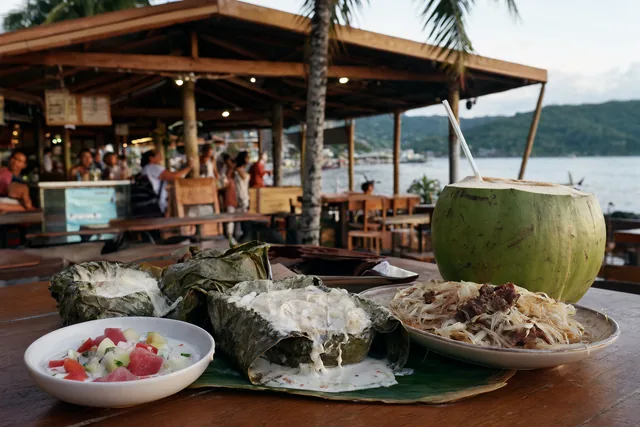
- Laplap (everywhere): the national dish. Yam, taro, manioc (cassava) or banana is grated and pounded into a paste, spread on leaves, topped with coconut cream and often chicken, pork, fish or greens, then wrapped and baked for hours in an earth oven of hot stones. It sets into a dense, chewy, savoury cake.
- Simboro (everywhere): grated manioc or banana rolled in island cabbage leaves like small cigars and simmered in coconut cream. Softer and richer than laplap.
- Tuluk (Port Vila market): a parcel of manioc dough with a filling of seasoned pork mince, wrapped in leaves and steamed or baked. It is the Vanuatu answer to a pie, and a market breakfast favourite.
- Nalot (everywhere): roasted breadfruit, taro or banana pounded with coconut cream into a smooth, filling mash.
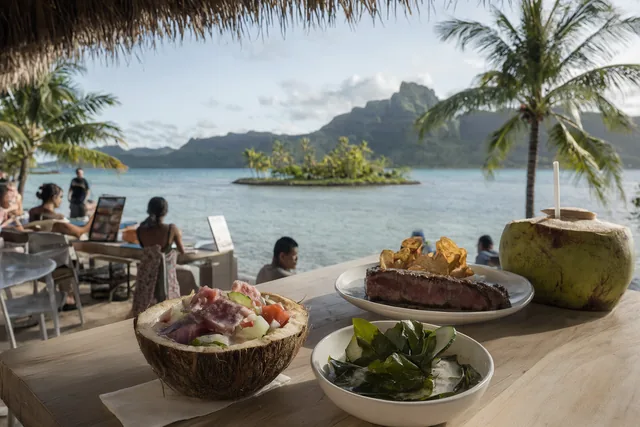
- Santo beef (Santo and Port Vila): beef from cattle raised on Espiritu Santo, many of them grazing under coconut plantations. It is grass-fed, lean and tender, and Vanuatu's restaurants are proud of it. Order a steak or a beef burger.
- Aelan kabis (everywhere): island cabbage, a soft, dark green leaf eaten cooked in coconut cream or used to wrap simboro and laplap.
- Fish in coconut (everywhere): reef fish or tuna cooked in coconut cream, or served raw and cured with lime and coconut in resort restaurants.
- Naura (rivers and markets): freshwater prawns, cooked in coconut cream or grilled, a prized dish in the islands.
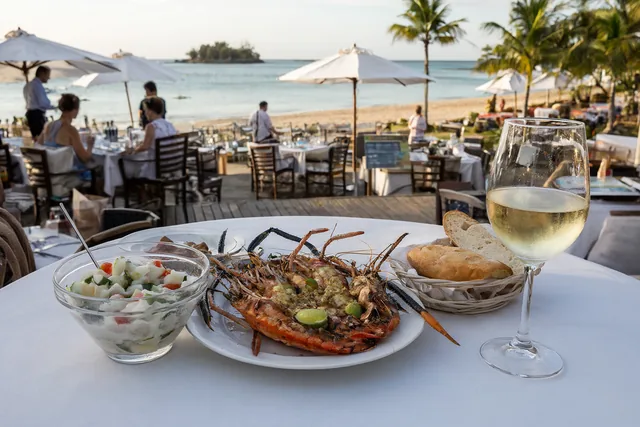
- Lobster and crabs (the coast): spiny lobster, mud crab and, in some islands, coconut crab. Coconut crab numbers have fallen and harvesting is limited in many areas, so many travellers choose not to order it.
- Nangae and natapoa (markets, in season): nangae (canarium nuts) and natapoa (tropical almonds), sold in bundles or shelled and eaten as snacks.
- French bread and pastries (Port Vila and Luganville): baguettes, croissants and pain au chocolat from bakeries, a legacy of the joint British and French colonial government before independence in 1980.
- Kava (everywhere): Vanuatu's kava is among the strongest in the Pacific, made from the fresh root mixed with water and drunk from a coconut shell at a nakamal in the evening. It is bitter, numbs the mouth and relaxes the body.
How to read a menu in Vanuatu
Restaurant menus in Port Vila and Luganville are usually in English, French or both, while market stalls and island kitchens use Bislama names. Bislama is easy to puzzle out once you say it aloud: many words come from English spelled as they sound, so fis is fish and kokonas is coconut. On French menus, remember that entrée is the starter, not the main course. These are the words you will see most often.
| Local term | Language | Meaning |
|---|---|---|
| Kakae | Bislama | Food, or to eat |
| Laplap | Bislama | Pounded root crop pudding baked in an earth oven |
| Simboro / tuluk / nalot | Bislama | Leaf rolls in coconut cream / pork-filled manioc parcel / pounded root crop mash |
| Fis / naura | Bislama | Fish / freshwater prawns |
| Faol / pig / bulumakau | Bislama | Chicken / pork / beef |
| Maniok / taro / yam | Bislama | Cassava / taro / yam |
| Aelan kabis | Bislama | Island cabbage, a cooked leafy green |
| Kokonas | Bislama | Coconut, and dishes cooked in coconut cream |
| Nangae / natapoa | Bislama | Canarium nuts / tropical almonds |
| Kava / nakamal | Bislama | Kava / kava bar or village meeting ground; kava is sold by the "shell" |
| Plat du jour | French | Dish of the day |
| Entrée / plat principal | French | Starter / main course |
| Steak frites / entrecôte | French | Steak with chips / rib steak |
| Poisson cru | French | Raw fish cured in lime with coconut cream |
Menus in Port Vila often switch between English, French and Bislama on the same page, and dishes like tuluk or simboro rarely come with an explanation. swap.menu reads all three, explains each dish in your language and converts the vatu prices, so a mixed-language menu is no harder than one in English.
Tipping, tax and paying the bill
Tipping and bargaining are not part of ni-Vanuatu custom, and neither is expected in restaurants, cafés, markets or bungalows. Prices at the market are fixed, and a friendly smile and a "tangkyu tumas" is the best thanks you can give. Some resorts have a staff fund for guests who want to leave something at the end of a stay. Our guide to tax and service charges on menus explains how tax and service lines work around the world.
Vanuatu charges value added tax (VAT), and it is normally included in menu prices. A few resorts quote room and meal prices before tax, so read the small print. The currency is the vatu (VUV), written VT, and it has no smaller unit, so prices are in whole numbers, often in the hundreds or thousands. Cards are accepted at hotels, resorts, supermarkets and many restaurants in Port Vila and Luganville, but the markets, buses, taxis, nakamals, island bungalows and village shops need cash. ATMs are in Port Vila and Luganville and at a few other towns, and are scarce or absent on most outer islands. If a card machine offers to charge you in your home currency, choose vatu: our guide to paying in local currency explains why.
Meal times are similar to Australia: lunch from about noon, dinner from 6:30pm. Many ni-Vanuatu eat their main meal after kava in the evening. Sunday is a quiet day of church and family, and many shops and local eateries close, though resorts, hotels and some cafés in Port Vila stay open.
Kava and nakamal etiquette: a nakamal is both a traditional meeting ground and, in town, a simple kava bar, often marked by a single coloured light at the entrance and opening around sunset. You buy kava by the shell, a half coconut shell, and there are usually small and large sizes. Drink it in one go, away from the bar, and it is normal to rinse your mouth with water afterwards and to spit discreetly outside. Nakamals are quiet places, so speak softly and avoid bright phone screens. Kava works best on an empty stomach, and food stalls near the nakamals sell plates of rice, meat and laplap for afterwards. In villages, some nakamals are traditionally for men only, so ask before joining in.
Where to eat in Vanuatu, island by island
Most visitors arrive in Port Vila on the island of Efate, and many add Espiritu Santo in the north for beaches and diving, or Tanna in the south for its active volcano. Jump to a destination:
Where to eat in Port Vila
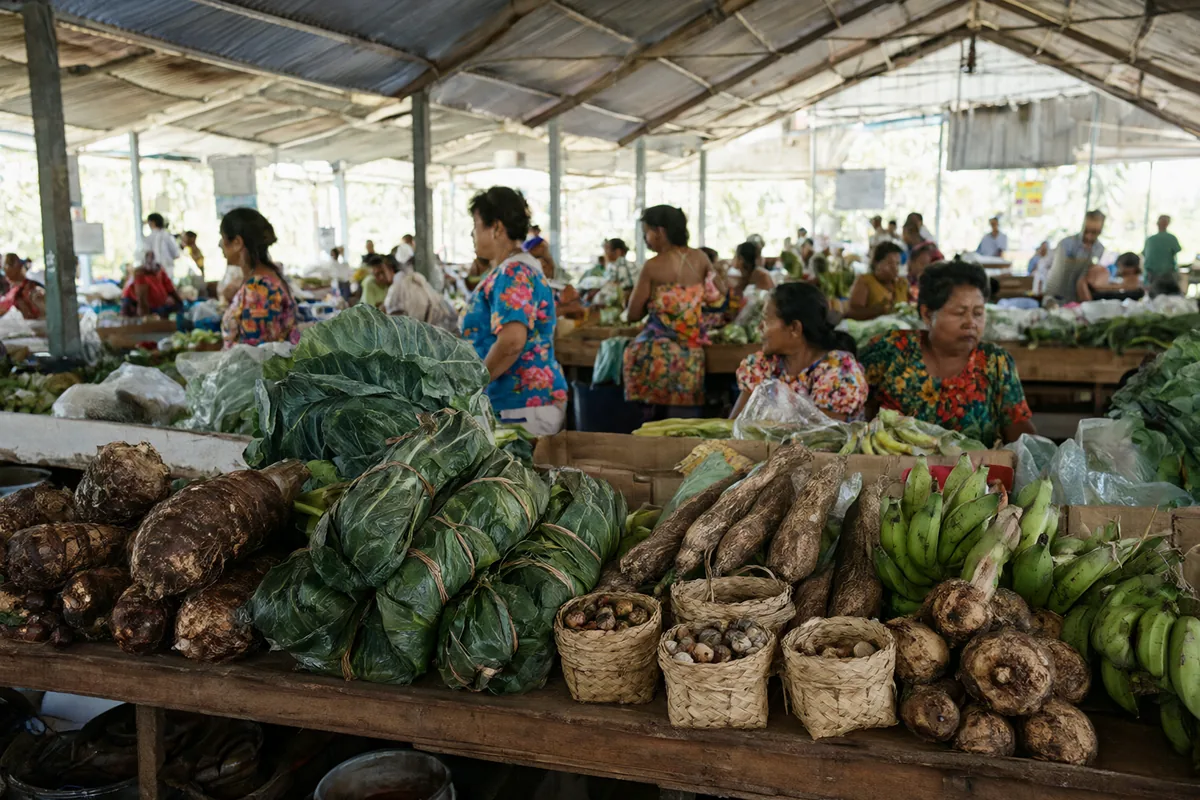
Port Vila, the capital, has by far the widest choice of food in Vanuatu, from French bistros and bakeries to Chinese restaurants, waterfront bars and simple local kitchens. Start at the Port Vila Municipal Market on the seafront, the island's main market house, where women from villages around Efate and nearby islands sell taro, yams, manioc, bananas, island cabbage, nangae nuts, fruit and flowers, many staying with their stalls through the week. A row of food stalls inside serves plates of rice with beef, chicken or fish, laplap, simboro and tuluk at very local prices. It is the best value meal in Port Vila.
The waterfront along the main road has cafés and restaurants with views across the harbour to Iririki Island, and in the evening the seawall is a popular place for an ice cream or a drink at sunset. French-style bakeries all over Port Vila sell baguettes and croissants from early morning, and you will find steak frites made with Santo beef on many menus. For kava, ask locally for a well-known nakamal, go around dusk and pay cash. Port Vila is also a cruise ship port, so the waterfront is busier on ship days, and the quieter local spots are a street or two back from the harbour.
Where to eat around Efate
A sealed ring road runs around Efate, and many visitors spend a day driving it, stopping at beaches, blue holes and villages. Food stops are simple: village kiosks with drinking coconuts, fruit and grilled fish, small beach restaurants, and a few resorts that welcome day visitors for lunch. Around Havannah Harbour on the northwest coast and at Mele just outside Port Vila, there are resort and beach restaurants with seafood, Santo beef and island salads, and the Erakor lagoon resorts near town are popular for a long lunch.
On the east and north sides of Efate, choices are few, so pack water and snacks from Port Vila and carry vatu in cash, as roadside stalls and village beach entry fees are paid that way. Some villages offer custom tours with a meal of laplap, simboro and fruit cooked in the earth oven, which is the best chance outside the market to taste home cooking. Resort menus around Efate change with the catch, so ask what came in that day.
Where to eat in Luganville
Luganville, on Espiritu Santo, is Vanuatu's second town, a long, wide main street built when tens of thousands of American troops were based here in the Second World War. It is the place to eat Santo beef close to the source, grilled as steak or served in burgers and stews in the town's restaurants and hotel dining rooms. Chinese-run stores and restaurants line the main street, and there are a couple of French-style bakeries and cafés.
The Luganville market is smaller than Port Vila's but just as good for local food, with laplap, simboro, root crops, island cabbage and fruit, and food stalls serving cheap lunches. Luganville is the base for wreck dives on the SS President Coolidge and trips to Million Dollar Point, so restaurants open early for divers and serve dinner early too. Kava on Santo is famously strong, and the town has several nakamals; ask your accommodation which ones are welcoming to visitors.
Where to eat on the east coast of Santo
The road north from Luganville runs along the east coast of Espiritu Santo past blue holes, white sand beaches such as Champagne Beach and small villages, ending near Port Olry, a French-speaking village with a long beach. Accommodation here is mostly small resorts and family-run bungalows, and they usually serve meals: fresh fish, lobster when the season allows, laplap, island cabbage and fruit from the garden, sometimes with French touches.
Beach kiosks on the east coast of Santo sell drinking coconuts and grilled fish, and at Port Olry a few simple beachfront places cook the day's catch. There are no supermarkets once you leave Luganville, so stock up on water, snacks and cash before heading north. Meals here are relaxed and unhurried, so order early and enjoy the wait with a swim.
Where to eat on Tanna
Tanna, a short flight south of Port Vila, is visited for Mount Yasur, one of the most accessible active volcanoes in the world, and for its strongly traditional villages. Most accommodation is in bungalows run by local families near the volcano or on the west coast, and meals are almost always included: laplap, simboro, root crops, island cabbage, chicken and fruit, often cooked in an earth oven. Tanna also grows coffee, and a cup of local coffee is worth seeking out.
The main town, Lenakel, has a market, a few stores and basic eateries, and little else, so bring cash and any snacks or special foods from Port Vila. Kava on Tanna is part of daily life and custom, drunk at nakamals under large banyan trees at dusk, and in many villages it is for men only. Ask your hosts before joining, and accept that some things here are for the community rather than for visitors.
Vegetarian, vegan and allergy tips
Vanuatu's village cooking is built on root crops, greens, coconut and fruit, so vegetarians do well once they ask about the extras. Simboro, nalot and island cabbage in coconut cream are often meat free, and laplap can be made plain, but many versions include chicken, pork or fish, and tuluk always contains pork. Port Vila's restaurants, especially the French and Asian ones, are used to vegetarian requests. In Bislama, "mi no kakae mit" means "I don't eat meat", and "vegetarian" is understood in hotels and restaurants. Add "mi no kakae fis" if you also avoid fish.
Coconut cream is in almost every local dish, which matters for anyone with a coconut allergy, and canarium nuts and tropical almonds appear in snacks and some desserts. Seafood is common, and shellfish may share pans and grills. On outer islands, supplies are limited, so tell your bungalow about any allergy before you arrive. Our guide to eating abroad with food allergies explains how to explain an allergy clearly.
Useful Bislama phrases for ordering
English and French are widely spoken in Port Vila and Luganville, but Bislama is the language you will hear everywhere, and a few words go a long way.
Halo / Gud moning "Hello" / "Good morning"
Plis "Please"
Mi wantem kakae ia "I would like this food" (pointing)
Hamas long hem? "How much is it?"
Mi no kakae mit "I don't eat meat"
Hem i gud tumas "It is very good", a compliment for the cook
Tangkyu tumas "Thank you very much"
Lukim yu "See you", a friendly goodbye
How swap.menu helps you eat in Vanuatu
A menu in Port Vila might switch from English to French halfway down, and a market food stall may simply list tuluk, simboro and nalot. Photograph it with swap.menu and every dish appears in your own language with a short explanation, so you know that tuluk hides pork mince inside its manioc wrapper and that an entrée on a French menu is a starter. Visitors from China, Japan, Korea or Europe can read any menu in Vanuatu in their own language, choosing from 29. Every price is converted from vatu to your home currency, which helps when prices run into the thousands.
Tap the dishes you want, add a note such as "no meat" or "no coconut", typed or spoken, and swap.menu translates your order into French or shows it clearly in English for the staff. Your scanned menus are saved, so you can look back at what you ate in Port Vila when you are on Santo. You can try it right now on a sample menu with the free demo, or see travel pass prices.
Off to Vanuatu? Your first 3 menu scans are free, and a travel pass starts from $4.99 with nothing that renews.
Start free with 3 scansVanuatu food FAQ
Do you tip in Vanuatu?
Tipping is not part of ni-Vanuatu custom and is not expected in restaurants, cafés or markets, and bargaining is not done either. Some resorts have a staff fund if you would like to leave something at the end of a stay.
What is the national dish of Vanuatu?
Laplap is the national dish: grated yam, taro, manioc or banana pounded into a paste, topped with coconut cream and often meat or fish, wrapped in leaves and baked in an earth oven. Simboro, tuluk, Santo beef and kava are also central to the food of Vanuatu.
Is it safe to drink kava in Vanuatu?
Kava is drunk every evening across Vanuatu, and for most healthy adults a few shells are fine. It is strong here, so start with a small shell, do not mix it with alcohol, and do not drive afterwards.
Is Vanuatu expensive to eat out?
Resort and restaurant meals in Port Vila are priced similarly to Australia, especially for imported food. Market food stalls, bakeries and local kitchens are very cheap, and island bungalows usually include meals in the price.
Is tap water safe to drink in Vanuatu?
Tap water in Port Vila and Luganville is treated, but many visitors still drink bottled or filtered water to be safe. On outer islands and after cyclones or heavy rain, drink bottled water or water treated by your accommodation.
How can I read a menu in Vanuatu?
Most menus are in English, French or both, with Bislama names for local dishes. Photograph the menu with swap.menu and it translates every dish into your language, explains Bislama and French names and converts prices from vatu to your currency.
Travelling further in the Pacific? Read our food guides for nearby islands:
- New Caledonia food guide
- Solomon Islands food guide
- Fiji food guide
- Australia food guide
- New Zealand food guide
Or browse every travel food guide.