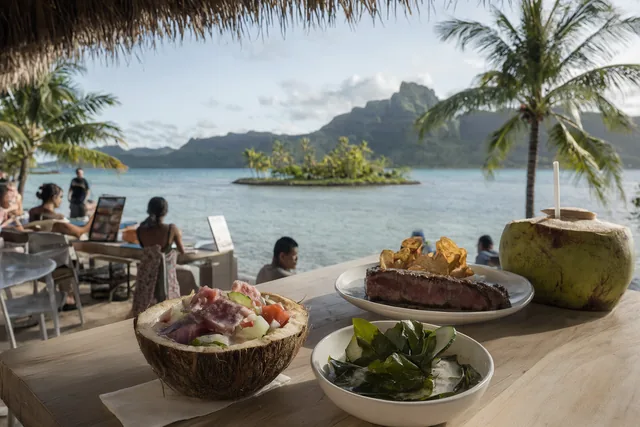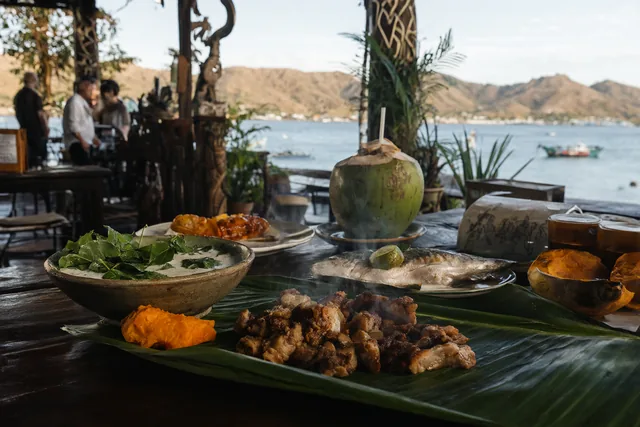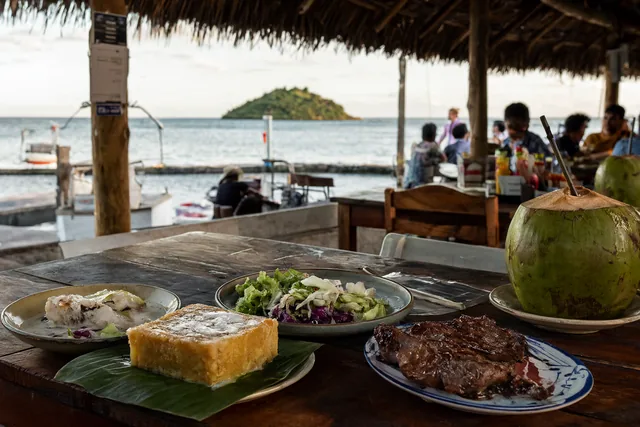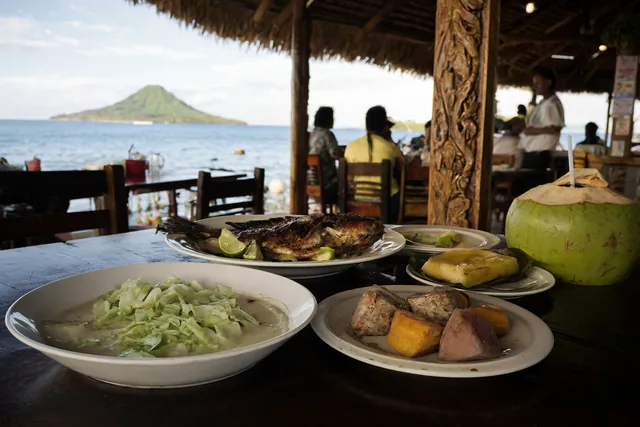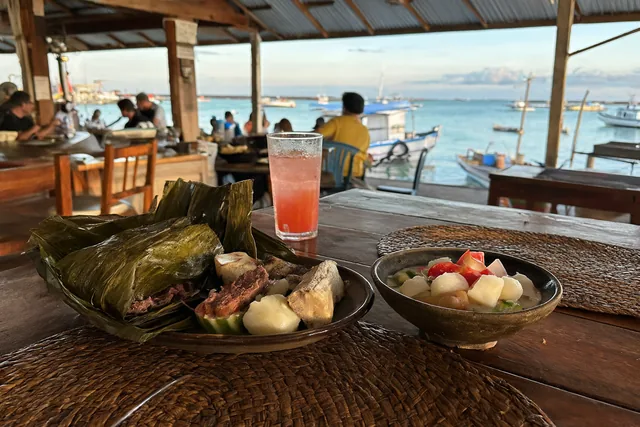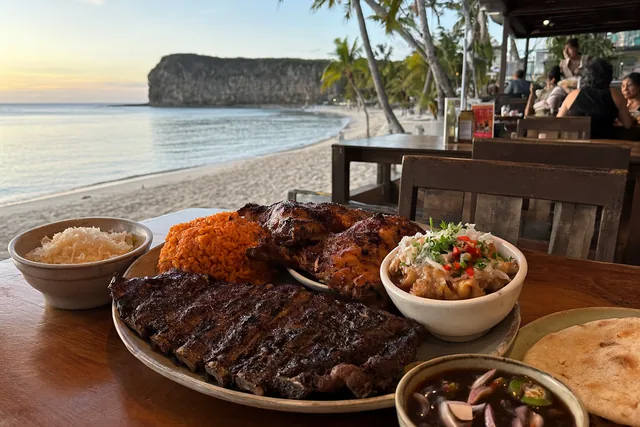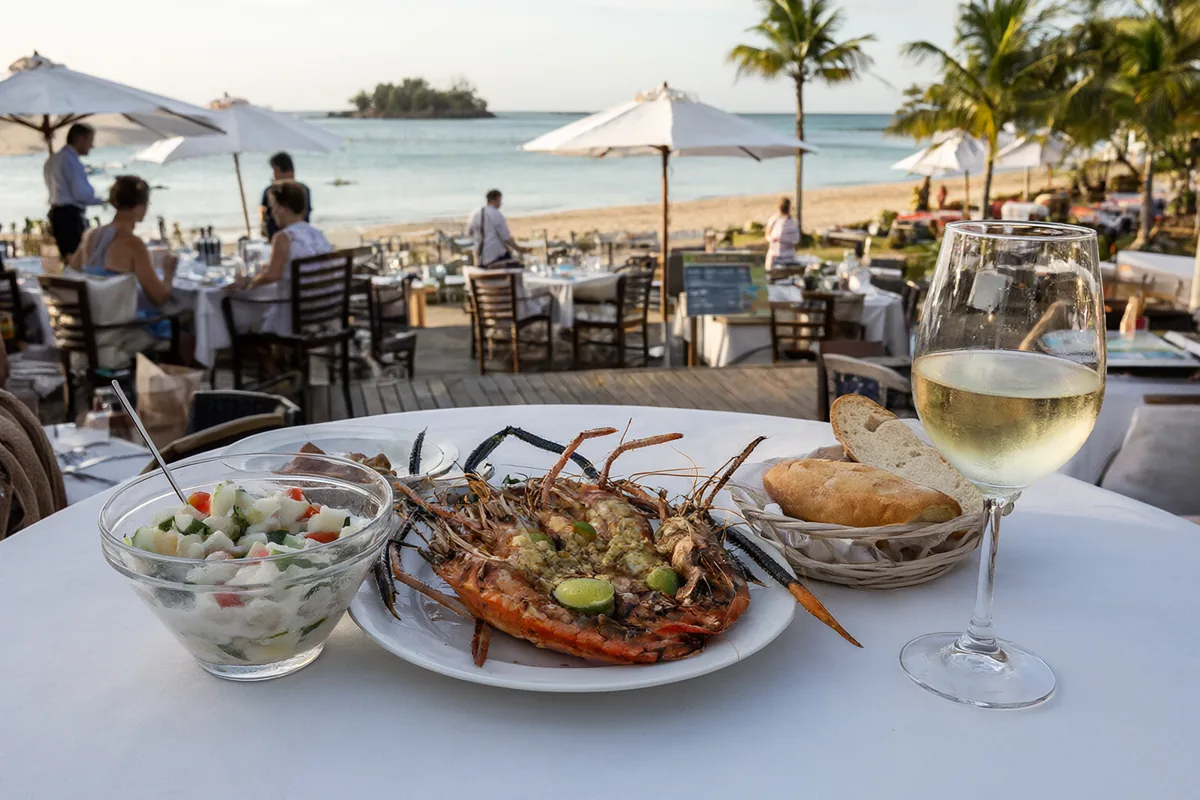
New Caledonia is the Pacific with a French accent. In Nouméa you can start the day with a croissant and a café crème, lunch on Vietnamese nems or Indonesian bami, and finish with grilled blue prawns and a glass of French wine by the beach. Beyond the capital, Kanak culture shapes the food: yams, taro, coconut and fish slow-cooked in banana leaves as bougna, the dish every visitor should try. This New Caledonia food guide covers the dishes to know, the French and Kanak words on menus, tipping and paying in Pacific francs, and then where to eat in Nouméa, in Bourail on the west coast, in Hienghène in the northeast, on the Isle of Pines and on Lifou in the Loyalty Islands.
What to eat in New Caledonia: 12 dishes to know
New Caledonian food draws on Kanak traditions, French settler cooking from the countryside (the Brousse), and the Vietnamese, Indonesian, Wallisian, Tahitian and Chinese communities who have made the islands home. These are the dishes worth seeking out.
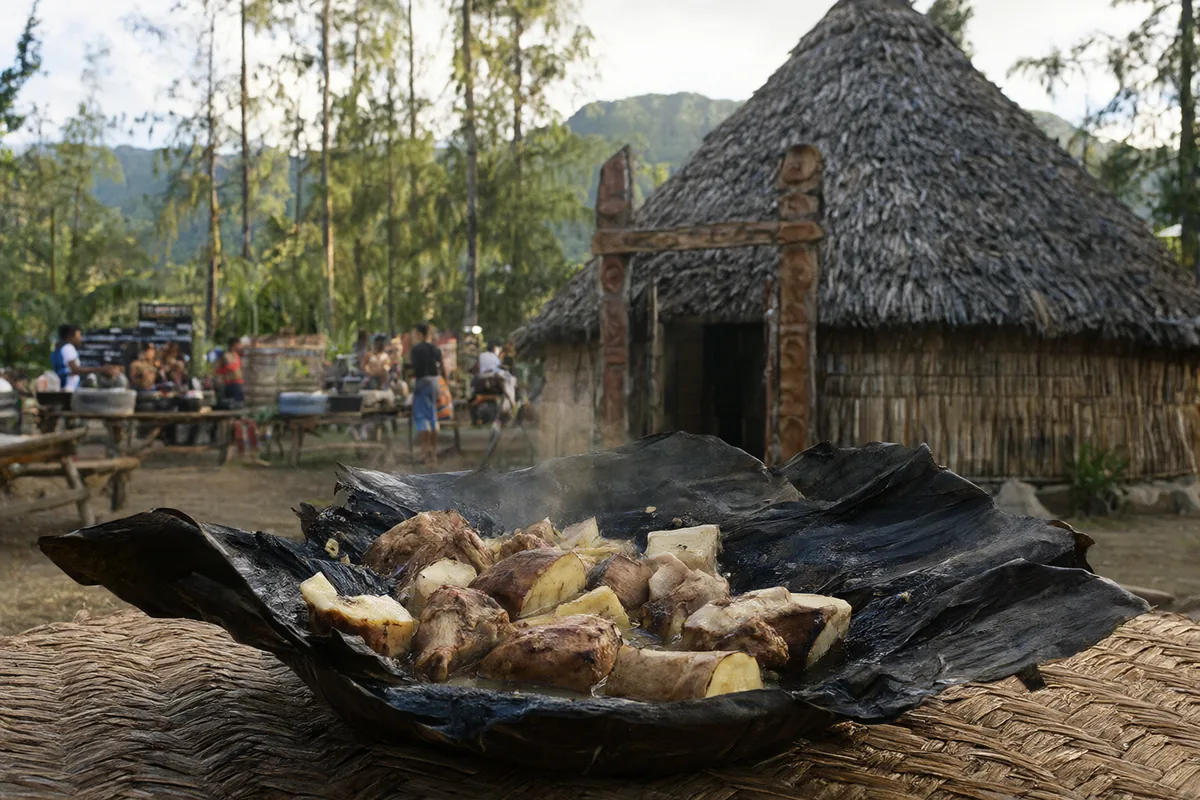
- Bougna (everywhere, best in tribal stays and the islands): the emblematic Kanak dish. Yam, taro, sweet potato and plantain are layered with chicken, fish, crab or lobster, soaked in coconut milk, wrapped tightly in banana leaves and cooked for hours on hot stones in an earth oven, or in a pot at home. It usually has to be ordered a day ahead.
- Crevettes bleues (everywhere): the blue prawns of New Caledonia, farmed on the west coast and famous for their sweet, delicate flesh. Order them grilled, flambéed or in a curry.
- Poisson cru au lait de coco (everywhere): raw fish cured in lime and mixed with coconut milk, cucumber, tomato and onion, brought by the Tahitian and Wallisian communities and now on menus everywhere.
- Cerf (the Brousse, especially Bourail): venison from rusa deer, introduced in the nineteenth century and now hunted widely. You will find steak de cerf, civet de cerf (venison stew) and saucisson de cerf (venison sausage).
- Langouste (the coast and islands): spiny lobster, grilled with garlic butter or added to bougna. It is the treat of a trip to the Isle of Pines or the Loyalty Islands.
- Escargots de l'Île des Pins (Isle of Pines): large native land snails from the Isle of Pines, cooked in garlic and parsley butter in the French style.
- Crabe de palétuvier (the coast): mangrove crab, cooked in curry, coconut milk or simply boiled, a favourite in Kanak and Caldoche (settler) households.
- Bami and nasi goreng (Nouméa and towns): fried noodles and fried rice brought by the Javanese community, who arrived from Indonesia from 1896 and are now part of everyday Caledonian food.
- Nems and pho (Nouméa): Vietnamese fried spring rolls and noodle soup, cooked by the long-established Vietnamese community and sold everywhere from restaurants to market stalls.
- Igname (everywhere): yam, the most important crop in Kanak culture, with a sacred place in ceremonies. The new yam harvest is celebrated each year around March, and nobody eats the new crop before the ceremony.
- Roussette (the Brousse and tribes): flying fox, cooked in a rich stew called civet de roussette at some Kanak and Caldoche gatherings during the limited hunting season. Many visitors prefer not to eat it, but you may see it.
- French bread and pastries (everywhere): baguettes, croissants and pain au chocolat from bakeries in every town, and a proper café crème to go with them.
How to read a menu in New Caledonia
Menus in New Caledonia are in French, and many restaurants outside the tourist areas of Nouméa have no English version. French menus follow a familiar order: entrée (starter, not main course), plat (main) and dessert, often with a set formule or menu at lunch. Local fish names are a puzzle even for French speakers, and Kanak words appear on menus in tribal stays and the islands. These are the words you will see most often.
| Local term | Language | Meaning |
|---|---|---|
| Entrée / plat / dessert | French | Starter / main course / dessert |
| Plat du jour / formule | French | Dish of the day / set menu at a fixed price |
| Poisson cru | French | Raw fish in lime and coconut milk |
| Bec de cane / picot / loche | French (local) | Spangled emperor / rabbitfish / grouper, common local fish |
| Crevettes / langouste | French | Prawns / spiny lobster |
| Crabe de palétuvier | French | Mangrove crab |
| Bénitier | French | Giant clam, often served raw or in salads |
| Cerf / roussette | French | Venison / flying fox |
| Igname / taro / patate douce | French | Yam / taro / sweet potato |
| Lait de coco | French | Coconut milk |
| Bougna (sur commande) | Kanak | Earth oven dish in banana leaves (order in advance) |
| Snack | French (local) | A casual café or takeaway, not just a snack |
| Accueil en tribu | French | A stay with a Kanak tribe, usually with meals |
| Service compris | French | Service included |
"Bec de cane" and "picot" mean nothing to most visitors, and even French travellers have to ask. Photograph the menu with swap.menu and local fish names are translated and explained alongside every other dish, and the prices are converted from Pacific francs.
Tipping, tax and paying the bill
Check your government's current travel advice before planning a trip. Tipping is not customary in New Caledonia. As in France, service is included in the price, and staff do not expect a tip, though leaving small change for good service is fine. Menu prices include the local consumption tax, known as the TGC, so the price you see is the price you pay. Our guide to tax and service charges on menus explains how these lines work around the world.
The currency is the CFP franc, often called the Pacific franc and written XPF or F CFP. It is pegged to the euro, and one franc is worth very little, so restaurant prices run into the thousands. Cards are widely accepted in Nouméa at restaurants, supermarkets and hotels, and in larger towns, but markets, roadside stalls, tribal stays, small snacks and many places on the islands need cash. ATMs are in Nouméa and the main towns, and few on the islands. If a card machine offers to charge you in your home currency, pay in francs: our guide to paying in local currency explains why.
Meal times follow French habits. Lunch is from about 11:30am to 1:30pm and is the main meal for many people, often with a good-value formule. Dinner starts around 7pm. Many restaurants close on Sunday evening and on Monday, and shops in smaller towns may close for a long lunch break, so plan ahead outside Nouméa. Book bougna at least a day in advance, as it takes hours to prepare.
Visiting a tribe: when you stay with or visit a Kanak tribe, it is customary to make the coutume, a small gesture of respect to the chief or your hosts, usually a length of fabric and a small amount of money, presented when you arrive. Your hosts or the person who arranged the stay will tell you what is appropriate. Ask before taking photos, and dress modestly in villages.
Where to eat in New Caledonia, region by region
New Caledonia is made up of the long main island, Grande Terre, the Isle of Pines to its south, and the Loyalty Islands to the east. Most visitors base themselves in Nouméa and take short trips to the countryside and islands. Jump to a destination:
Where to eat in Nouméa
Nouméa is home to most of New Caledonia's restaurants, and it eats like a small French city on a lagoon. The Port Moselle market, in its blue-roofed pavilions next to the marina, is the place to start: a fish hall with the morning's catch, blue prawns and crabs, stalls of tropical fruit, yams and vegetables, flowers, bakery stands and a café where locals linger over coffee. It opens early in the morning and is busiest at weekends. The streets around Place des Cocotiers, the central square, and the Quartier Latin have bakeries, Vietnamese and Indonesian restaurants and French bistros serving a lunchtime formule.
The beach suburbs of Anse Vata and Baie des Citrons are where Nouméa goes out in the evening, with a long row of restaurants and bars on the waterfront serving grilled fish, blue prawns, poisson cru, pizza and French classics. For cheap eats, look for a snack, a casual café selling sandwiches on baguette, bami, nems, steak frites and plates of the day, and the food trucks that park near the beaches at night. To try bougna in Nouméa, ask your hotel or a restaurant serving Kanak food to order it a day ahead.
Where to eat in Bourail
Bourail, about two hours' drive north of Nouméa on the west coast, is the heart of the Brousse, New Caledonia's cattle country, where descendants of French settlers known as Caldoches run stations, ride horses and hunt deer. This is the place to eat cerf: venison steak, civet de cerf and saucisson de cerf appear on most menus in Bourail, alongside beef from local cattle. Every August the town hosts the Foire de Bourail, a large agricultural fair with a rodeo, livestock and stalls of local food that draws people from across the country.
The coast near Bourail has the beaches of Roche Percée and Poé, with a few beach restaurants and a resort, and turtles nest on the beaches in season. In the town, small restaurants, a bakery and snacks serve simple country food. The blue prawn farms of the west coast are nearby, so prawns are often fresher here than in the capital. Outside Bourail, restaurants are scarce, so plan lunch stops along the road.
Where to eat in Hienghène
Hienghène, on the wild and green northeast coast of Grande Terre, is one of the most beautiful places in New Caledonia, with towering black limestone rocks rising from the bay and mountains dropping steeply to the sea. It is also a centre of Kanak culture, and the best way to eat here is through an accueil en tribu, a stay with a local tribe. Hosts cook bougna in the traditional way on hot stones, along with fish from the river or reef, yams, taro, fruit and coconut, and meals are shared with the family.
In Hienghène village, a few small restaurants and snacks serve fish, prawns and plates of the day, and the general stores stock basics. Tribal stays are usually booked through local tourism offices or directly, and you should make the coutume on arrival. The drive from Nouméa takes most of a day, so Hienghène is best for a stay of two or three nights. Bring cash, as cards are rarely accepted outside the village shops.
Where to eat on the Isle of Pines
The Isle of Pines (Île des Pins), a short flight or ferry from Nouméa, has white sand bays lined with tall column pines, a natural swimming pool at Oro Bay and some of the clearest water in the Pacific. It is the place to try escargots de l'Île des Pins, the island's large native snails, and fresh langouste, both served at the resorts and at small family-run places around Kuto and Kanumera bays and in the village of Vao. Many visitors take a trip in a traditional sailing outrigger, a pirogue, across Upi Bay, often followed by a lunch of grilled fish or lobster.
Small snacks and campsites on the Isle of Pines serve set meals of fish, lobster, bougna (order ahead), rice and salad, at prices well below the resorts. When cruise ships call, Kuto bay gets busy, so eat early or move away from the beach. Bring cash, as many smaller places do not take cards, and book dinner ahead in the evening, when the island is very quiet.
Where to eat on Lifou
Lifou is the largest of the Loyalty Islands, a raised coral island with high cliffs, caves and beaches such as Luengoni and the bay at Jokin. Kanak custom is strong here, the main language is Drehu, and most of the island's land belongs to its tribes. Lifou is known for its vanilla, grown in small plots and sold dried in pods, and you can visit vanilla growers to learn how it is pollinated by hand and cured.
The main town, Wé, has a few shops, snacks and restaurants, and the island's small hotels serve fish, lobster and bougna. Tribal stays on Lifou are the best way to eat local food, with bougna, yams, fish and coconut cooked by your hosts. When cruise ships visit, tribes near the landing point set up stalls selling food and crafts. As on the other islands, carry cash, order bougna in advance, and remember that the land and beaches belong to the tribes, so ask before entering.
Vegetarian, vegan and allergy tips
Vegetarians eat reasonably well in Nouméa, where Vietnamese, Indonesian and French restaurants have vegetable dishes and salads, and bakeries sell plenty of meat-free food. Outside the capital it is harder, as bougna is usually made with chicken or seafood, and many set meals centre on fish or meat. A vegetable bougna can sometimes be ordered in advance. The French word for vegetarian is végétarien (végétarienne for a woman), and vegan is végétalien or vegan. Watch for lardons (bacon) in salads, fish sauce in Vietnamese dishes, and shrimp paste in Indonesian sambal.
Coconut milk is in bougna, poisson cru and many island dishes, which matters for anyone with a coconut allergy. Shellfish is everywhere, from prawns to crab and lobster, and peanuts appear in Indonesian and Vietnamese sauces. Our guide to eating abroad with food allergies explains how to explain an allergy clearly in another language.
Useful French and Kanak phrases for ordering
French is the language of daily life, and English is spoken in tourist areas of Nouméa but much less elsewhere. A few words of a Kanak language are warmly received in the tribes.
Bonjour / Bonsoir "Good morning" / "Good evening", always said as you walk in
Une table pour deux, s'il vous plaît "A table for two, please"
Qu'est-ce que vous me conseillez ? "What do you recommend?"
Je voudrais ça "I would like this" (pointing)
Je suis allergique à... "I am allergic to..."
L'addition, s'il vous plaît "The bill, please"
Merci, c'était délicieux "Thank you, it was delicious"
Bozu / Olea "Hello" / "Thank you" in Drehu, the language of Lifou
How swap.menu helps you eat in New Caledonia
Most menus in New Caledonia are in French only, and even French speakers get stuck on local fish names like bec de cane and picot, or on dishes like civet de roussette. Photograph the menu with swap.menu and every dish appears in your language with the French name beside it and a short explanation, so you know that roussette is flying fox and that bénitier is giant clam before you order. Every price is converted from Pacific francs to your home currency, so a bill in the thousands of francs makes sense at a glance.
Tap the dishes you want, add a note such as "no shellfish" or "vegetarian, please", typed or spoken, and swap.menu translates your order into French. Show the waiter your phone, or let them scan the QR code and read your order on their own screen. You can try it right now on a sample menu with the free demo, or see travel pass prices.
Off to New Caledonia? Your first 3 menu scans are free, and a travel pass starts from $4.99 with nothing that renews.
Start free with 3 scansNew Caledonia food FAQ
Do you tip in New Caledonia?
Tipping is not customary in New Caledonia. Service is included in menu prices, as in France, and staff do not expect a tip, though leaving small change for good service is fine.
What food is New Caledonia famous for?
New Caledonia is famous for bougna, the Kanak dish of root crops, meat or seafood and coconut milk cooked in banana leaves, and for its blue prawns. Venison from the Brousse, lobster, Isle of Pines snails, poisson cru and French bread and pastries are also part of everyday eating.
Is New Caledonia expensive to eat out?
Yes, eating out in New Caledonia is expensive, with restaurant prices higher than in Australia or New Zealand for many dishes. Lunchtime set menus, snacks, food trucks and markets are the best value, and self-catering from supermarkets saves money.
Is tap water safe to drink in New Caledonia?
Tap water in Nouméa is treated and safe to drink. In remote areas and on the islands, where some water comes from rain tanks, ask your hosts or drink bottled water.
What time do people eat dinner in New Caledonia?
Dinner usually starts around 7pm, and lunch from about 11:30am to 1:30pm, following French habits. Many restaurants close on Sunday evening and Monday, so book ahead.
Do I need to speak French to eat in New Caledonia?
English menus are rare outside the tourist areas of Nouméa. Photograph the menu with swap.menu and it translates every dish into your language, explains local fish and Kanak names, converts prices from Pacific francs and translates your order into French.
Travelling further in the Pacific? Read our food guides for nearby countries:
- Vanuatu food guide
- French Polynesia food guide
- Fiji food guide
- Australia food guide
- New Zealand food guide
- France food guide
Or browse every travel food guide.