Tanzania has two food worlds. On the mainland you eat roast meat, rice and beans, chips cooked into an omelette and plantains stewed in the shadow of Kilimanjaro; on Zanzibar, centuries of Indian Ocean trade have produced a spice-island cuisine of coconut curries, pilau and seafood grilled on the waterfront at night. This Tanzania food guide covers the dishes to order, how to read a Swahili menu, how tipping and paying works with shillings and dollars, and then goes destination by destination through where to eat in Stone Town, on Zanzibar's beaches, in Dar es Salaam, Arusha, Moshi, the Serengeti and Ngorongoro, and Mwanza on Lake Victoria.
What to eat in Tanzania: 12 dishes to know
These are the dishes worth seeking out, with the place they belong to where it matters.
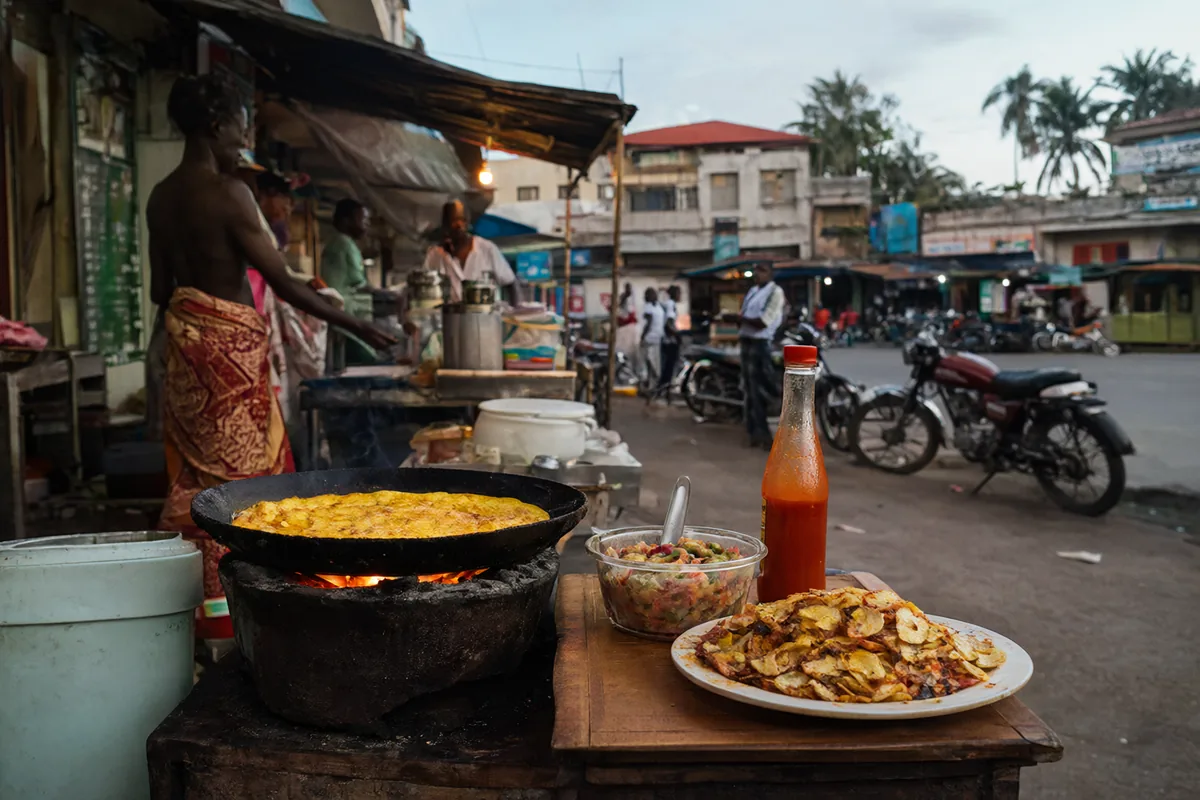
- Chipsi mayai (everywhere, especially Dar es Salaam): hot chips cooked into an omelette in a small pan, served with kachumbari salad and chilli or tomato sauce. Tanzania's favourite street food.
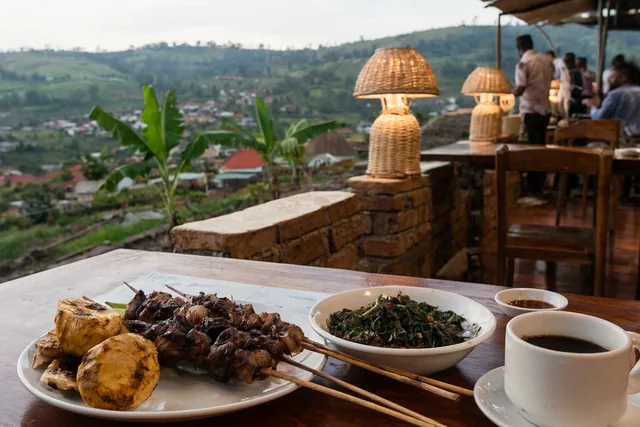
- Mishkaki (everywhere): marinated beef, goat or chicken skewers grilled over charcoal, sold at street grills and bars every evening.
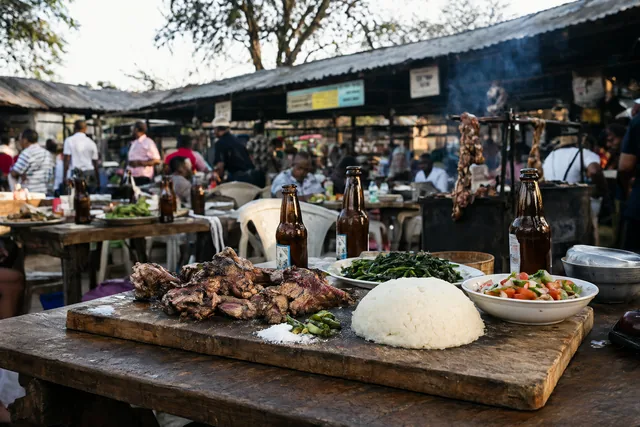
- Nyama choma (everywhere): roast goat or beef, grilled slowly over charcoal and eaten with salt, chilli, kachumbari and ugali.
- Ugali (everywhere): stiff maize porridge, eaten with your hand with stews, fish and greens. Sometimes called sembe, after the flour.
- Wali na maharage (everywhere): rice and beans, often cooked in coconut milk, the everyday lunch at local eateries.
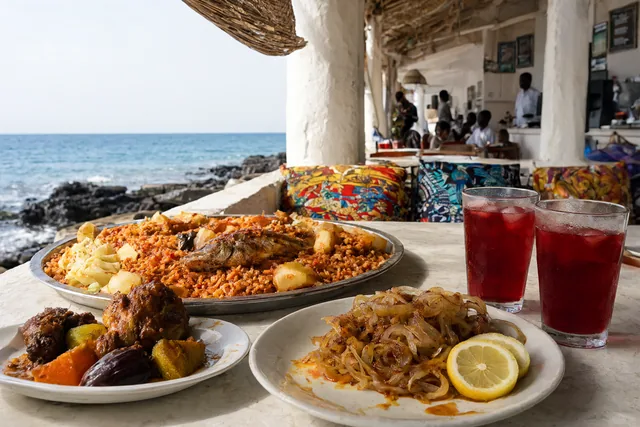
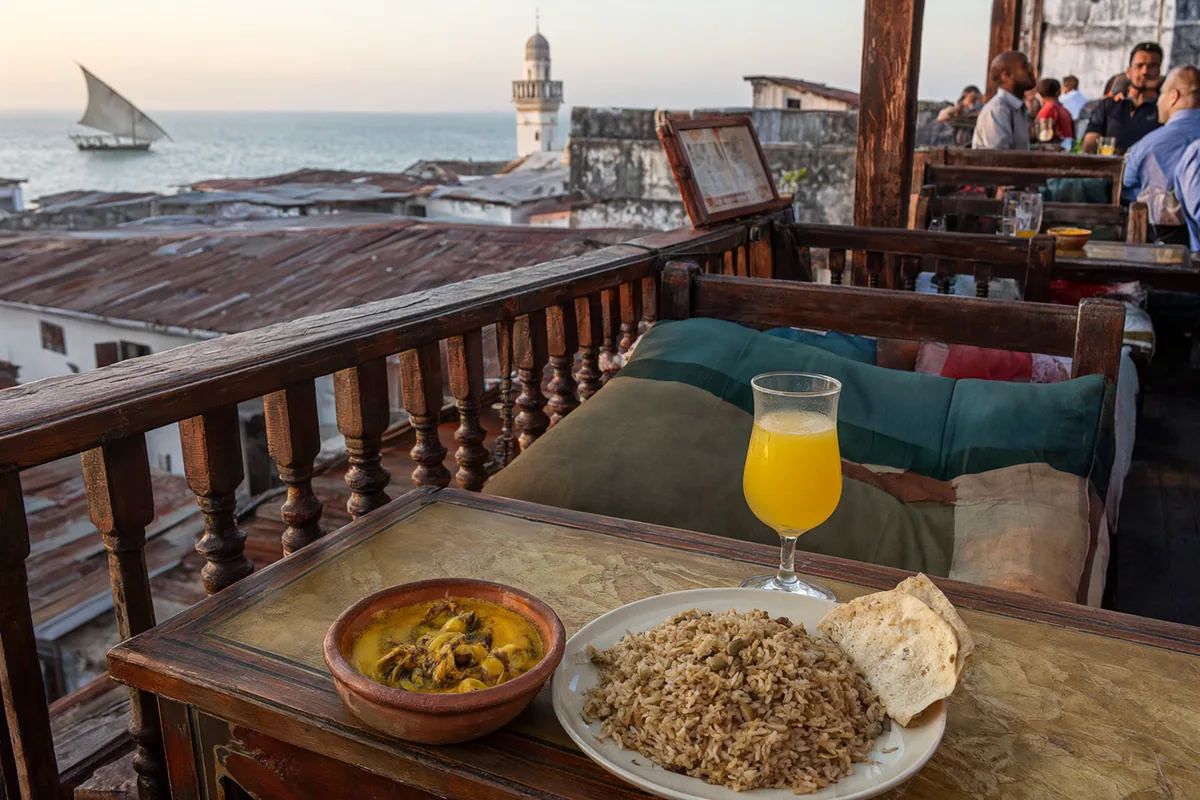
- Pilau (Zanzibar and the coast): rice cooked with cardamom, cloves, cumin, cinnamon and black pepper, usually with beef or chicken.
- Urojo (Stone Town): also called "Zanzibar mix", a tangy, turmeric-yellow soup of mango and lime poured over bhajia fritters, potatoes, crisp fried bits, coconut chutney and mishkaki.
- Zanzibar pizza (Stone Town): not a pizza at all, but a thin dough parcel filled with egg, minced meat, onion and cheese, or banana and chocolate for a sweet version, folded and fried on a griddle.
- Pweza wa nazi (Zanzibar and the coast): octopus simmered in coconut milk with spices, served with rice or chapati.
- Ndizi nyama and mtori (Kilimanjaro region): cooking bananas stewed with beef, and mtori, a smooth soup of banana and beef, staples of the Chagga people who live on Kilimanjaro's slopes.
- Vitumbua (everywhere, especially the coast): small, round coconut rice pancakes, crisp outside and soft inside, sold at breakfast with chai.
- Kahawa and kashata (Stone Town and the coast): strong black coffee poured into tiny cups from brass pots by street coffee sellers, eaten with kashata, a coconut or peanut brittle.
How to read a Swahili menu
Swahili is Tanzania's national language and is used far more widely than in Kenya, so outside hotels and tourist restaurants, menus and price boards are often in Swahili only. Local eateries are often called hoteli (a "hotel" here may be a simple café), and the women who cook cheap lunches at roadside stalls are known as mama lishe. These are the words that matter.
| Swahili | Meaning |
|---|---|
| Nyama (ya mbuzi / ya ng'ombe) | Meat (goat / beef) |
| Kuku | Chicken |
| Samaki | Fish |
| Pweza / kamba / ngisi | Octopus / prawns / squid |
| Wali | Cooked rice |
| Maharage | Beans |
| Ndizi | Bananas, including cooking bananas and plantains |
| Mboga za majani | Leafy greens |
| Mchuzi | Sauce, curry or stew |
| Supu | Soup, often a goat or beef broth eaten at breakfast |
| Chipsi | Chips |
| Ya kuchoma / ya kukaanga | Grilled / fried |
| Chai / maji / juisi | Tea / water / juice |
| Bila | Without (bila pilipili, without chilli; bila sukari, without sugar) |
Some tourist restaurants, especially on Zanzibar, price their menus in US dollars while local places use shillings. Check which currency a menu is in before you order. swap.menu reads Swahili and English menus and converts prices in either shillings or dollars to your home currency.
Tipping, tax and paying the bill in Tanzania
Tipping is appreciated in Tanzania but not expected at local eateries. In sit-down restaurants, around 10 percent is a good tip if no service charge has been added, and many hotels and lodges add one. Safari guides, cooks and Kilimanjaro trekking crews are tipped separately and generously, usually at the end of the trip. VAT is 18 percent on the mainland and is normally included in menu prices; Zanzibar sets its own, slightly lower rate. Our guide to tax and service charges on menus explains how these lines work.
The currency is the Tanzanian shilling (TZS), written TSh or simply /= after the number, as in 15,000/=. US dollars are widely used for safaris, park fees and some hotels, but older or damaged dollar notes are often refused. Mobile money such as M-Pesa is common for local payments. Cards are accepted in hotels, lodges and upmarket restaurants, often with a surcharge, so carry shillings for markets, street food and small eateries. When a card machine offers to charge you in your home currency, decline: our guide to paying in local currency explains why.
Lunch is the main meal for many Tanzanians, eaten around 1pm, and dinner runs from about 7pm. Street grills come alive after dark. Zanzibar is mostly Muslim, and during Ramadan many local cafés close in daylight hours, while the Forodhani night market and tourist restaurants keep going in the evening.
Where to eat in Tanzania, destination by destination
Most visitors combine a safari in the north with a beach stay on Zanzibar, and the food changes completely between them. Jump to a destination:
Where to eat in Stone Town, Zanzibar
Stone Town, the old heart of Zanzibar City and a UNESCO World Heritage Site, is the best place to eat in Tanzania. Every evening, Forodhani Gardens on the waterfront fills with food stalls: grilled lobster, octopus, kingfish and prawn skewers, Zanzibar pizza made to order, urojo ladled into bowls, and fresh sugarcane juice pressed with ginger and lime. Seafood at the stalls has often been sitting out since early evening, so choose stalls with a steady turnover, ask for it grilled hot, and agree the price of each skewer before it goes on the fire.
By day, Darajani Market is the place to see Zanzibar's spices, fruit and fish, and spice farm tours outside town show you cloves, nutmeg, cinnamon and vanilla growing, often with a Swahili lunch included. In the lanes of the old town, small cafés serve pilau, biryani, fish curry and chapati, and at Jaws Corner, a small square in the heart of Stone Town, men gather on stone benches around coffee sellers pouring kahawa from brass pots. Rooftop restaurants serve coconut curries with views over the tin roofs to the Indian Ocean, the best way to spend sunset in Stone Town.
Where to eat on Zanzibar's beaches
Most of Zanzibar's beach restaurants belong to hotels, but each part of the island has its own character. In the north, Nungwi and Kendwa face west for sunsets and have beachfront restaurants serving grilled fish, lobster and seafood curries, and Nungwi is also a traditional dhow-building village with a fish market on the beach. On the east coast, Paje, Jambiani and Michamvi are quieter, with kitesurf cafés, guesthouses and small restaurants along the sand.
The east coast is also where women farm seaweed in the shallow lagoon at low tide, and you may see it drying in the villages. To eat local on Zanzibar's beaches, walk into the village behind the resorts, where small cafés serve chipsi mayai, pilau and fish with rice for a fraction of hotel prices. Tides on the east coast are dramatic, so check them if you plan to walk along the shore to dinner.
Where to eat in Dar es Salaam
Dar es Salaam is Tanzania's largest city and its commercial capital, hot, busy and full of street food. Chipsi mayai is everywhere, cooked at small stalls with a charcoal stove and a pan, and in the evening mishkaki grills appear on corners across the city. The Kivukoni fish market, known locally as the Feri market after the ferry terminal next door, is the place to see the morning catch being auctioned; stalls around it fry fish and serve it with ugali and chilli.
Kariakoo is Dar's huge, crowded market district, good for spices, fruit and cheap local lunches. The city centre around India Street has a long history of Indian restaurants and sweet shops, a legacy of Dar es Salaam's South Asian community. For a more relaxed evening, Coco Beach on the Msasani Peninsula has street vendors selling grilled maize, roasted cassava and mishkaki, while Masaki and Oyster Bay nearby have the city's upmarket restaurants and seafront bars. Traffic in Dar es Salaam is heavy, so plan dinner close to where you are staying.
Where to eat in Arusha
Arusha, at the foot of Mount Meru, is the starting point for safaris in the Serengeti, Ngorongoro and Tarangire, and many visitors spend a night or two here. Its Central Market is a good place to see local produce, from bananas of a dozen kinds to dried fish and spices, and local eateries nearby serve rice, beans, ugali and stew at lunch. Nyama choma bars are scattered across town, especially busy on weekends.
The hills around Arusha grow coffee, and several farms on the slopes of Mount Meru offer tours that show the process from cherry to cup, ending with a fresh brew. Arusha also has a good range of cafés and restaurants catering to safari travellers, with international menus. Pick up snacks and drinks here before a long safari drive; Arusha supermarkets are much better stocked than anything you will find in the parks.
Where to eat in Moshi
Moshi is the base for climbing Kilimanjaro, and the town and its surrounding villages are home to the Chagga people, whose food is built around the banana. Look for mtori, a creamy banana and beef soup, ndizi nyama, cooking bananas stewed with beef, and machalari, a banana stew. The Chagga also brew mbege, a cloudy traditional beer made from bananas and millet, served at celebrations and in village bars.
Kilimanjaro coffee is grown on the mountain's lower slopes, and coffee tours from Moshi visit villages such as Materuni, where you roast, pound and brew the beans yourself, often combined with a walk to a waterfall. In town, Mbuyuni Market is the main food market, and cafés serve climbers big breakfasts and post-climb meals. Moshi is smaller and calmer than Arusha, and an easy place to eat local food on foot.
Where to eat in the Serengeti and Ngorongoro
On safari in the Serengeti, the Ngorongoro Crater and the other northern parks, you eat at your lodge or camp, with full board almost always included. Breakfast is early, lunch is often a packed box eaten in the vehicle or at a picnic site, and dinner is a buffet or set menu, sometimes served around a campfire under the stars. Many lodges serve a mix of international and Tanzanian dishes, including pilau, stews, chapati and grilled meat.
The small town of Karatu, between Lake Manyara and the Ngorongoro Crater, has coffee farm lodges set among fields, which grow some of their own food. If you have dietary needs, tell your safari company well in advance, as camps in the Serengeti are hours from the nearest shop.
Where to eat in Mwanza
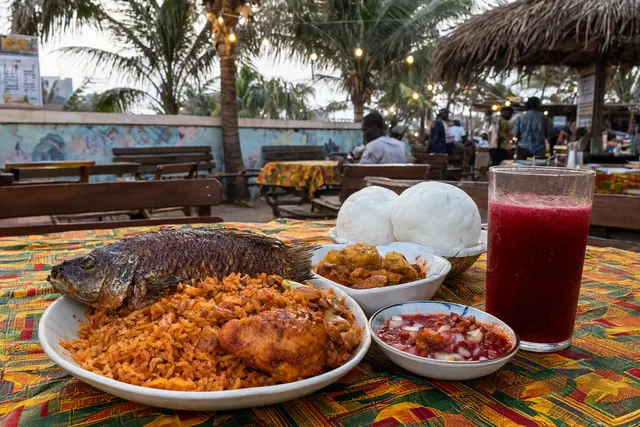
Mwanza, one of Tanzania's largest cities, sits on the southern shore of Lake Victoria among huge granite boulders, which give it the nickname "Rock City". It is the place to eat lake fish: sato (tilapia), fried or grilled whole, and sangara (Nile perch), a large white fish served in steaks, both with ugali and greens. Dagaa, tiny silver fish dried in the sun, are fried or stewed with tomatoes and eaten everywhere around the lake.
The fish market and lakeside eateries in Mwanza are busiest in the late afternoon, when the catch comes in. Mwanza is also a gateway to the western Serengeti and to Rubondo Island National Park, so it is a useful stop on longer overland trips, and a good place to eat simple, fresh food at local prices.
Vegetarian, vegan and allergy tips
Vegetarians can eat reasonably well in Tanzania. Wali na maharage (rice and beans), ugali with greens, chapati, chipsi mayai, vitumbua, bhajia and vegetable curries are widely available, and Dar es Salaam and Stone Town have Indian restaurants with large vegetarian menus. Say "Sili nyama" ("I don't eat meat"), and check that beans and greens have not been cooked with meat stock. Vegans should ask about ghee, milk in chai, and egg in chipsi mayai and Zanzibar pizza.
Coconut is in a great many coastal dishes, peanuts appear in kashata and some sauces, and seafood is everywhere on Zanzibar, so take care at the Forodhani stalls if you have a shellfish allergy. Our guide to eating abroad with food allergies explains how to communicate a serious allergy clearly.
Useful Swahili phrases for ordering
Mambo? / Habari? "How's it going?" / "How are you?" (reply "Poa" or "Nzuri", fine)
Karibu "Welcome", which you will hear constantly; also used to say "you're welcome"
Naomba hii, tafadhali "May I have this one, please" (pointing)
Bei gani? "What is the price?"
Bila pilipili "Without chilli"
Sili nyama "I don't eat meat"
Naomba bili "Could I have the bill, please?"
Asante sana, chakula kitamu "Thank you very much, the food is delicious"
How swap.menu helps you eat in Tanzania
Tanzanian menus are often in Swahili only, especially at the local hoteli and mama lishe stalls where food is best value, and the boards at Forodhani list dishes like urojo and mkate wa kumimina (a coconut rice bread) that no phrasebook covers. Photograph the menu with swap.menu and every dish appears in your language with its Swahili name and a short explanation. Prices are converted from shillings or US dollars to your home currency, and service charges are flagged.
Tap the dishes you want, add a note such as "no chilli" or "no shellfish", typed or spoken, and swap.menu translates your order into Swahili. Show the cook your phone, or let them scan the QR code and read your order on their own screen. Try it on a sample menu with the free demo, or see travel pass prices.
Off to Tanzania? Your first 3 menu scans are free, and a travel pass starts from $4.99 with nothing that renews.
Start free with 3 scansTanzania food FAQ
Do you tip in restaurants in Tanzania?
Tipping around 10 percent is appreciated in sit-down restaurants when no service charge has been added. It is not expected at street stalls and local eateries, but safari guides, cooks and trekking crews are always tipped at the end of a trip.
What food is Tanzania famous for?
Chipsi mayai, nyama choma, mishkaki, ugali and pilau are the best-known Tanzanian dishes. Zanzibar is famous for its spices, seafood, urojo and the Forodhani night market, and the Kilimanjaro region for banana dishes like mtori.
What should I eat in Zanzibar?
Try urojo (Zanzibar mix), Zanzibar pizza and grilled seafood at Forodhani Gardens, octopus in coconut curry, pilau, and strong kahawa coffee with kashata. A spice farm tour with a Swahili lunch is a good way to understand the island's cooking.
Is it expensive to eat out in Tanzania?
Local food is very cheap, from chipsi mayai to rice and beans at a mama lishe stall. Tourist restaurants on Zanzibar and safari lodges are much more expensive, and some price their menus in US dollars.
Is tap water safe to drink in Tanzania?
No, visitors should drink bottled or filtered water in Tanzania, including on Zanzibar. Lodges and safari vehicles usually provide drinking water, and bottled water is sold everywhere.
How can I read a Swahili menu if I do not speak Swahili?
Learn a few key words such as kuku, samaki, wali and bila, or photograph the menu with swap.menu. It translates Swahili menus into your language, explains each dish, converts shilling or dollar prices to your currency and translates your order back into Swahili.
Travelling further in East Africa? Read our food guides for nearby countries:
- Kenya food guide
- Rwanda food guide
- Seychelles food guide
- Mauritius food guide
- South Africa food guide
Or browse every travel food guide.