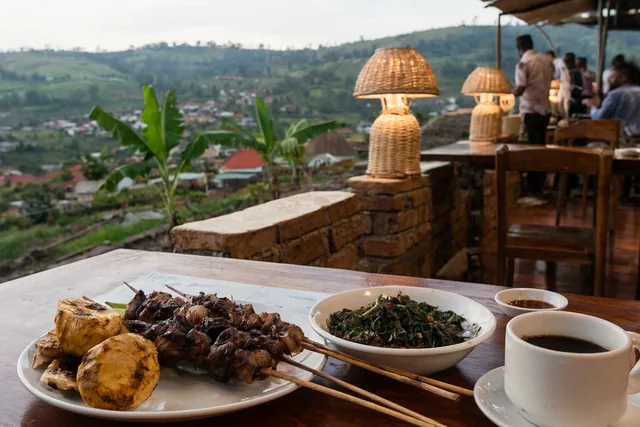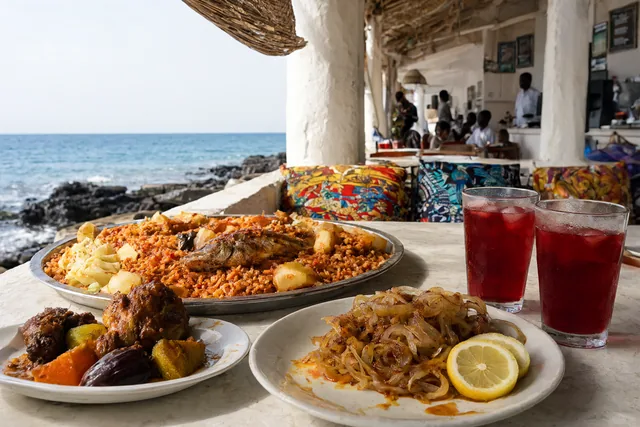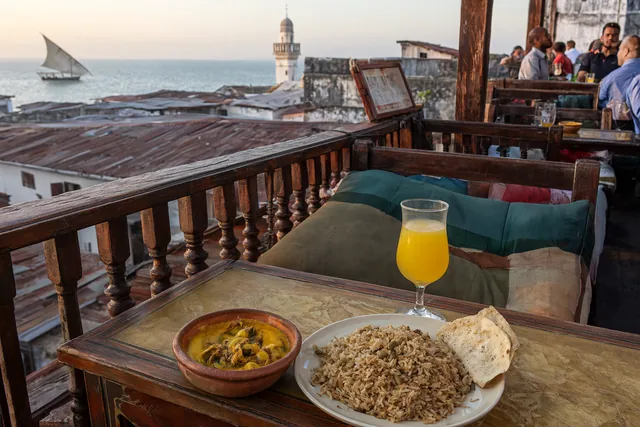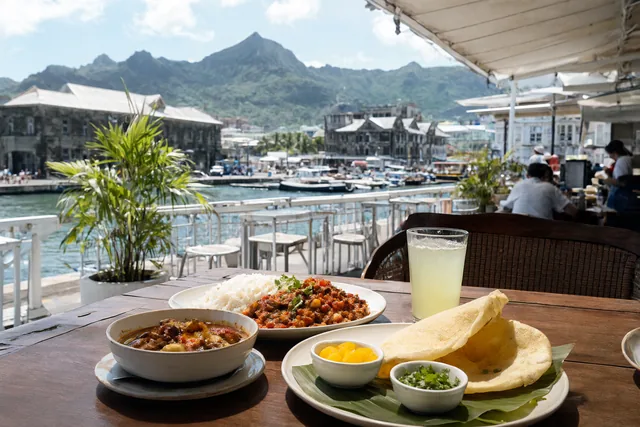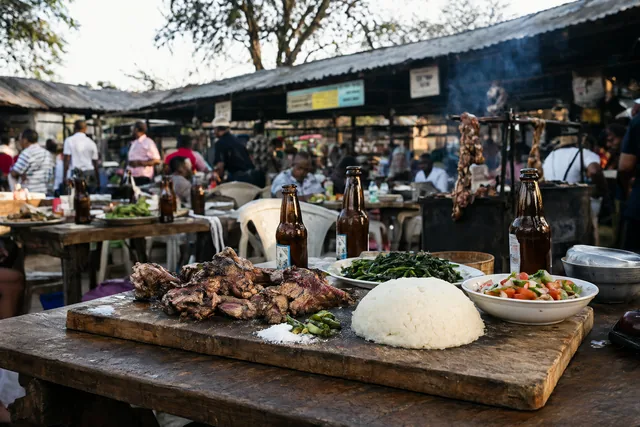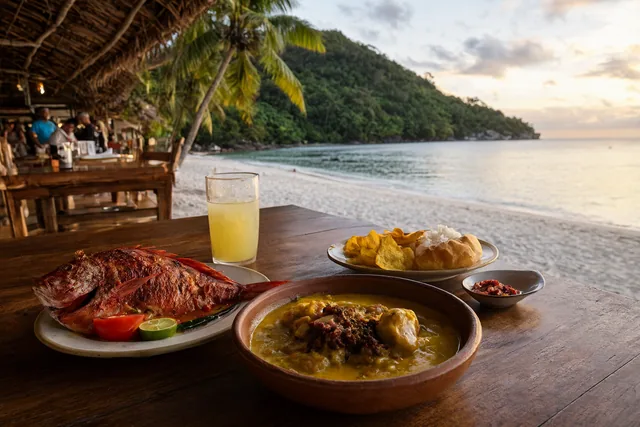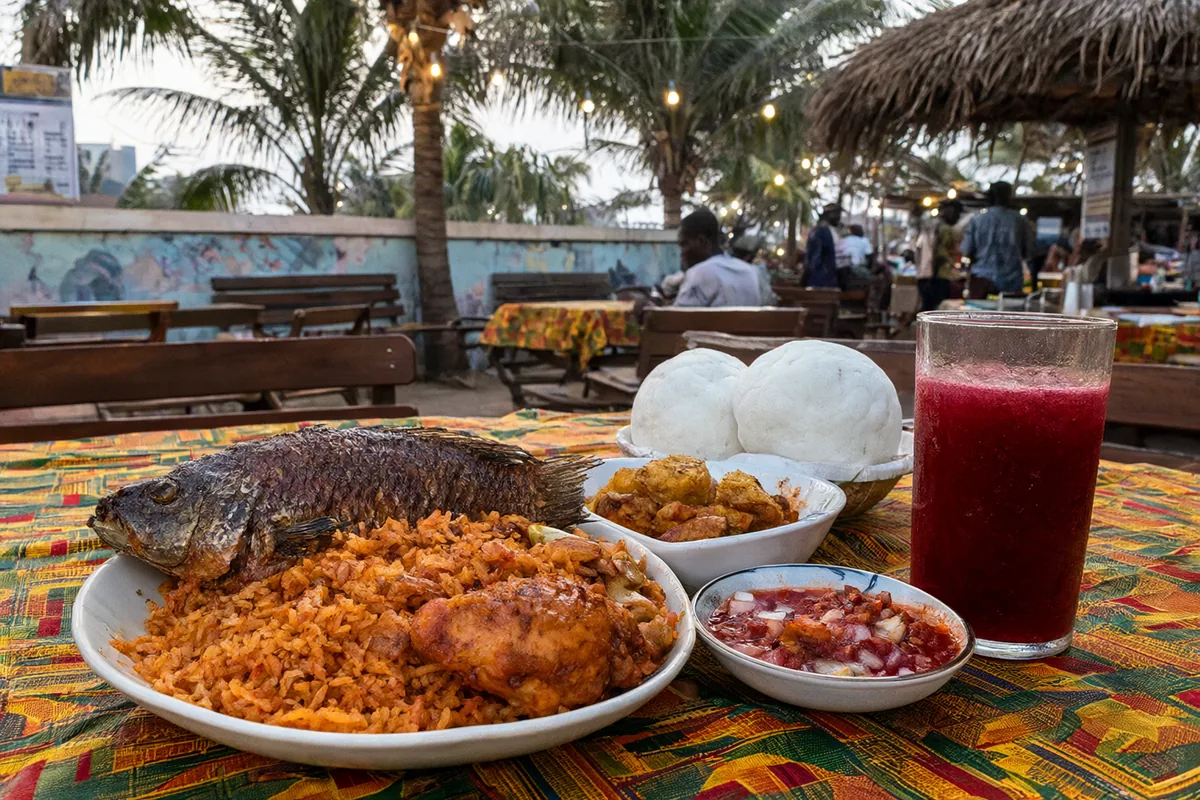
Ghanaian food is hearty, spicy and made to be eaten with your hand: soft balls of fufu sunk in pepper soup, fermented corn dough with fried fish, and the jollof rice that Ghanaians will defend against all comers. This Ghana food guide covers the dishes to order, the chop bar and street food words you will hear (light soup, shito, waakye, kelewele), how tipping and paying in cedis works, and then goes city by city through where to eat in Accra, Kumasi, Cape Coast and Elmina, Busua, Tamale and the Volta Region. English is the official language, but the food vocabulary comes from Twi, Ga, Ewe, Hausa and Dagbani.
What to eat in Ghana: 12 dishes to know
These are the dishes worth knowing before you sit down at a chop bar or join a queue at a street stall.
- Jollof rice (everywhere): rice cooked in a spicy tomato, onion and pepper sauce, usually served with fried or grilled chicken and a little salad. West Africa argues endlessly about whose jollof is best; in Ghana, the answer is Ghana's.
- Waakye (everywhere, especially at breakfast): rice and beans cooked with dried sorghum leaves that turn them a deep reddish brown, served with shito, gari, spaghetti, boiled egg, fried fish, fried plantain and sometimes wele (cow skin). A morning queue at a waakye seller is one of the sights of urban Ghana.
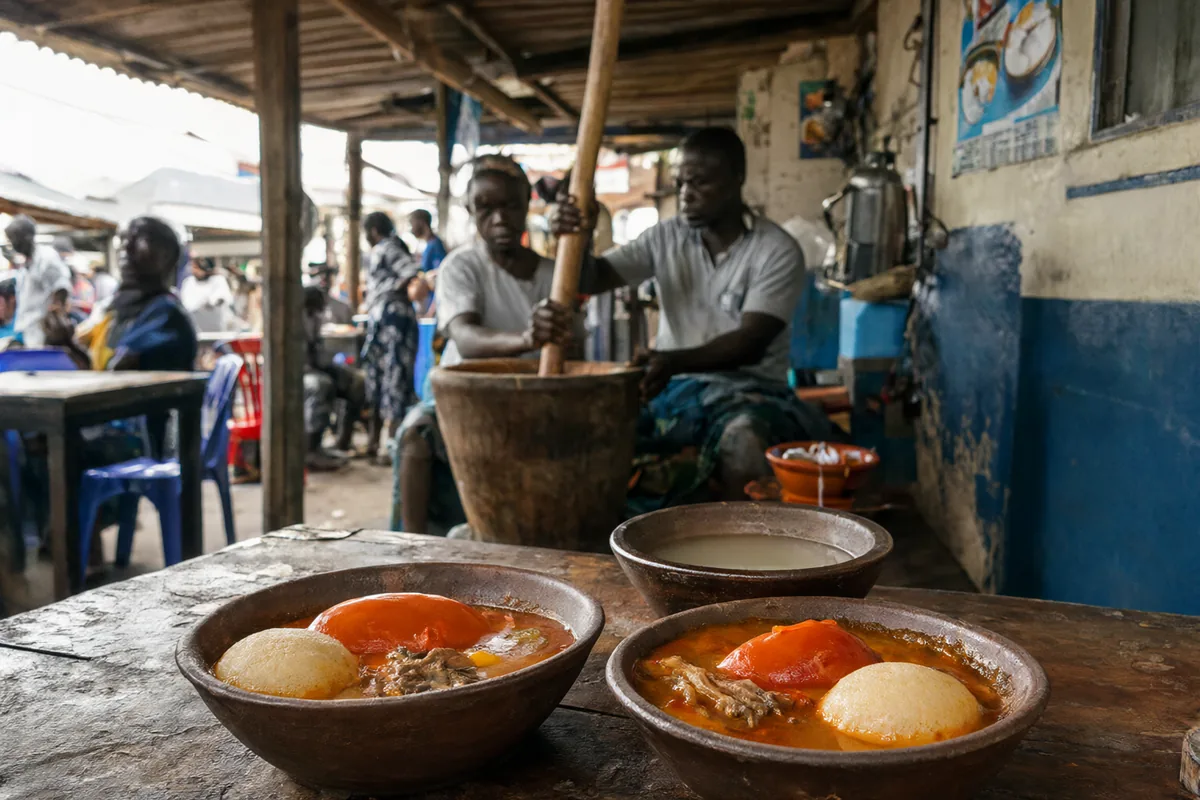
- Fufu and soup (everywhere, especially the Ashanti Region): boiled cassava and plantain pounded into a soft, stretchy dough and served in a bowl of soup: light soup (a spicy tomato and pepper broth with goat or fish), nkatenkwan (groundnut soup) or abenkwan (palm nut soup). You do not chew fufu; you swallow it.
- Banku and tilapia (everywhere, especially the coast): banku is a smooth, slightly sour ball of fermented corn and cassava dough, served with a whole grilled tilapia and a fiery raw pepper sauce of chilli, onion and tomato.
- Kenkey and fried fish (Accra and the coast): fermented corn dough wrapped in corn husks or plantain leaves and steamed, eaten with fried fish, shito and fresh pepper sauce.
- Red red (everywhere): black-eyed beans stewed in red palm oil with tomato and onion, served with fried ripe plantain. The name comes from the colour of both.
- Kelewele (everywhere, at night): cubes of ripe plantain spiced with ginger, chilli and other spices and deep-fried, sold from street stalls in the evening, often with roasted peanuts.
- Kontomire stew (everywhere): cocoyam leaves cooked with palm oil, tomato, egg and fish, eaten with boiled yam or plantain in a dish called ampesi.
- Omo tuo (everywhere, often on Sundays): soft rice balls served in groundnut or palm nut soup.
- Tuo zaafi (Tamale and the north): known as TZ, a soft millet or maize porridge served with a green ayoyo (jute leaf) soup or okra soup.
- Chichinga (everywhere): spicy grilled meat kebabs dusted with a ground peanut and pepper mix, sold at street grills in the evening.
- Sobolo (everywhere): a chilled drink of hibiscus flowers with ginger, cloves and sometimes pineapple, sold in bottles and bags.
How to read a menu in Ghana
Ghanaian menus are in English, but at a chop bar, the traditional local eatery serving fufu, banku and soups, there may be no menu at all: you ask what is cooking and choose your starch, your soup and your meat or fish. "Chop" means to eat, and a "chop bar" is simply a place to eat. "Pepper" in Ghana means chilli, and "small pepper" means less of it. These are the terms worth knowing.
| Term | Origin | Meaning |
|---|---|---|
| Chop bar | Ghanaian English | Local eatery serving fufu, banku and soups |
| Light soup | Ghanaian English | Spicy tomato and pepper broth with meat or fish |
| Nkatenkwan / abenkwan | Twi | Groundnut (peanut) soup / palm nut soup |
| Fufu | Twi | Pounded cassava and plantain dough |
| Banku | Ga, Ewe | Fermented corn and cassava dough |
| Kenkey (komi, dokono) | Ga, Fante | Steamed fermented corn dough in husks or leaves |
| Waakye | Hausa | Rice and beans with sorghum leaves |
| Shito | Ga | Dark, oily chilli sauce with dried fish and shrimp |
| Gari | West African | Toasted grated cassava granules |
| Wele | Local name | Cow skin, boiled until soft |
| TZ, tuo zaafi | Hausa | Millet or maize porridge from the north |
| One man thousand | Ghanaian English | Small fried fish, like anchovies, eaten whole |
| Talia | Ghanaian English | Spaghetti, served as a side with waakye |
| Pure water | Ghanaian English | Drinking water sold in sealed plastic sachets |
At a chop bar or waakye stall, you build your plate item by item, and each extra (egg, fish, meat, wele) adds to the price. Ask for the total before you eat. swap.menu explains Ghanaian dish names and converts every cedi price to your home currency, so the bill is never a surprise.
Tipping, tax and paying the bill in Ghana
Tipping is not expected at chop bars or street stalls, but in sit-down restaurants a tip of around 10 percent is appreciated if no service charge has been added. Hotels and upmarket restaurants often add VAT and other government levies to the bill, sometimes on top of the menu price, and a service charge may also appear. Check whether menu prices are listed as inclusive. Our guide to tax and service charges on menus explains how these lines work.
The currency is the Ghana cedi (GHS), written GH₵ or simply GHS. Mobile money, known as MoMo, is used everywhere, from market stalls to taxis, and cards are accepted in hotels, malls and many restaurants in Accra and Kumasi. Carry cash in small notes for chop bars, street food and the countryside. When a card machine offers to charge you in your home currency, choose cedis: our guide to paying in local currency explains why.
Breakfast is often waakye, kenkey or Hausa koko, a spiced millet porridge, with koose (bean fritters). Lunch is around midday to 2pm, and dinner from about 7pm, when the kelewele and kebab sellers set up. Ghanaians eat fufu, banku and kenkey with the right hand, and a bowl of water to wash your hand is brought before and after.
Where to eat in Ghana, city by city
Ghana's food changes from the fish-loving coast to the Ashanti heartland and the dry north. Jump to a destination:
Where to eat in Accra
Accra, the capital, is the best place in Ghana to eat across the country's regions in a few days. Start in Osu, the busy district around Oxford Street, where restaurants serve jollof, banku and tilapia and grilled chicken, and the pavements fill at night with kelewele sellers and kebab grills. For kenkey and fried fish in the city's oldest Ga neighbourhood, go to Jamestown, by the lighthouse and the fishing harbour, where boats land their catch on the beach. Makola Market, in the city centre, is huge, crowded and the place to see Ghanaian produce, from smoked fish to palm oil and fresh pepper.
Waakye sellers set up all over Accra in the early morning, serving it wrapped in leaves or in takeaway boxes, and the best ones have queues. In the evening, Labadi Beach has bars, grilled fish and music, especially on weekends. The upmarket areas of Labone, Cantonments, Airport Residential and East Legon have modern Ghanaian restaurants, cafés and international food. Accra traffic is notorious, so try to eat near where you are staying at rush hour.
Where to eat in Kumasi
Kumasi, the capital of the Ashanti Region and Ghana's second city, is the home of fufu. At the city's chop bars, two people pound boiled cassava and plantain in a large wooden mortar, one with a long pestle and one turning the dough between strokes, and the fufu is served in a bowl of light soup, palm nut soup or groundnut soup with goat, chicken, beef or snails. Kumasi's chop bars are busiest at lunchtime and are the most authentic places to eat in the city.
Kejetia Market, in the centre of Kumasi, is one of the largest markets in West Africa, a maze of stalls selling everything from spices and dried fish to cloth and household goods. Street food in Kumasi includes kelewele, roasted plantain and groundnuts, and fried yam with pepper. The villages around Kumasi are famous for crafts, including Bonwire for kente cloth weaving. Eat fufu with your right hand, and do not try to chew it.
Where to eat in Cape Coast and Elmina
Cape Coast and Elmina, a few kilometres apart on the central coast, are visited mainly for their castles, built for the gold trade and later the transatlantic slave trade, and now UNESCO World Heritage Sites. They are also fishing towns, and the food is all about the sea. Elmina has one of Ghana's busiest fishing harbours, where hundreds of brightly painted wooden canoes land their catch below the castle walls, and fish is smoked and fried along the waterfront.
This is Fante country, and the local kenkey, Fante kenkey, is wrapped in dried plantain leaves rather than corn husks. Look for fante fante, a stew of fresh fish in palm oil, and banku with grilled fish and pepper in the simple restaurants around Cape Coast. Many visitors combine the castles with Kakum National Park and its canopy walkway inland, and beach hotels along the coast serve grilled lobster and seafood.
Where to eat in Busua
Busua, in the Western Region, is a small surf village with a long sandy beach, and it is one of the most relaxed places in Ghana to spend a few days. Local fishermen sell lobster, barracuda, red snapper and prawns straight from their canoes, and beach shacks and guesthouses grill them over charcoal with banku, rice or chips. Surf schools and beach bars line the sand, and coconut sellers walk the shore.
Nearby, the old fort at Dixcove overlooks a fishing harbour, and the coast west towards Axim has quiet beach lodges with seafood menus. Busua is small, and many places have only a handful of dishes, cooked to order, so order dinner early and expect it to take a while.
Where to eat in Tamale
Tamale, the main city of northern Ghana, has a completely different food culture from the south. The staple is TZ (tuo zaafi), a soft millet or maize porridge served with green ayoyo soup or okra soup, and the north is famous for guinea fowl, grilled or fried and served with pepper. Street grills sell spicy kebabs, and breakfast is often Hausa koko with koose or bread.
The local drink is pito, a home-brewed sorghum beer served in calabashes at small bars, though Tamale is predominantly Muslim and alcohol is less visible than in the south. The central market sells shea butter, dried okra and baobab, and Tamale is the gateway to Mole National Park, where the lodge serves simple food with views of elephants at the waterhole. Tamale is hot and dry, so eat early in the morning or after sunset.
Where to eat in the Volta Region
The Volta Region, east of Accra along the border with Togo, is the land of the Ewe people and some of Ghana's best scenery, from the Wli waterfalls near Hohoe to the mountains around Amedzofe and the shores of Lake Volta. Ewe food has its own specialities: akple, a corn and cassava dough, served with fetri detsi (okra soup) with fish or crab, and abolo, a steamed, slightly sweet corn cake eaten with grilled fish, shrimp and pepper.
On the coast around Keta, the lagoon and the sea supply fish, crab and shrimp, and in Ho, the regional capital, chop bars serve akple and banku with fish from Lake Volta. Guesthouses in the hill villages often cook dinner for guests on request, so tell your host in the morning what you would like to eat in the Volta Region.
Vegetarian, vegan and allergy tips
Ghanaian food is built on starches and vegetables, but most soups and stews contain meat, fish, dried fish or shrimp, even when they look vegetable-based. Shito is made with dried fish and shrimp, and light soup and kontomire stew are often cooked with fish. Red red, kelewele, fried yam, boiled plantain and jollof without the chicken are the easiest vegetarian options, and Accra has a growing number of restaurants with vegetarian dishes. Say "I am vegetarian, no meat, no fish", as "vegetarian" alone may be taken to mean no meat but fish is fine.
Peanuts (groundnuts) are everywhere in Ghana: in groundnut soup, kebab spice, sweets and street snacks, so people with peanut allergies must ask about every dish. Palm oil and chilli are in most stews. Our guide to eating abroad with food allergies explains how to communicate a serious allergy clearly.
Ghanaian food slang and ordering terms
Akwaaba "Welcome" in Twi; you will hear it everywhere
Chale "Friend" or "mate", the most Ghanaian word there is: "Chale, how much?"
Small pepper, please "Not too spicy, please"; "no pepper" means no chilli at all
I beg, ... "Please", as in "I beg, give me waakye with egg"
Ɛyɛ sɛn? "How much is it?" in Twi
Ɛyɛ dɛ "It is sweet" in Twi, meaning tasty
Medaase "Thank you" in Twi
Let's go and chop "Let's go and eat"
How swap.menu helps you eat in Ghana
Ghanaian menus are in English, but they assume you know what abenkwan, ampesi, omo tuo and wele are, and the board at a chop bar may list nothing but soup names. Photograph the menu with swap.menu and every dish gets a short explanation, so you know that nkatenkwan is groundnut soup and that a gizzard kebab is exactly what it sounds like. Every cedi price is converted to your home currency, VAT, levies and service charges are flagged, and you can save the menus of the places you liked.
Visitors from non-English-speaking countries can read the whole menu in their own language, in any of 29 languages, and add notes such as "small pepper" or "no fish" that appear on the waiter's screen in English. Try it on a sample menu with the free demo, or see travel pass prices.
Off to Ghana? Your first 3 menu scans are free, and a travel pass starts from $4.99 with nothing that renews.
Start free with 3 scansGhana food FAQ
Do you tip in restaurants in Ghana?
Tipping is not expected at chop bars or street stalls, but around 10 percent is appreciated in sit-down restaurants when no service charge is on the bill. Check the bill first, as hotels and upmarket restaurants often add a service charge and taxes.
What food is Ghana famous for?
Jollof rice, waakye, fufu with light soup, banku and tilapia, kenkey and fried fish, red red and kelewele are Ghana's best-known foods. The north is known for TZ and guinea fowl, and the coast for fresh fish.
What is a chop bar in Ghana?
A chop bar is a traditional Ghanaian eatery serving local food such as fufu, banku, kenkey and soups, often at simple tables and for low prices. "Chop" means to eat in Ghanaian English.
Is Ghanaian food spicy?
Yes, much Ghanaian food is spicy, especially the fresh pepper sauces, shito, light soup and kelewele. Ask for "small pepper" if you want less heat, and the sauce can often be served on the side.
Is tap water safe to drink in Ghana?
Visitors should not drink tap water in Ghana. Bottled water and sealed sachets of "pure water" are sold everywhere, and many visitors stick to bottled water to be safe.
Can swap.menu help with Ghanaian menus if they are in English?
Yes. It explains Ghanaian dishes and terms such as abenkwan, waakye and shito, converts cedi prices to your home currency, flags taxes and service charges, and saves the menus you scan. Visitors who do not read English can see the menu in their own language.
Travelling further in West Africa? Read our food guides for nearby countries:
Or browse every travel food guide.