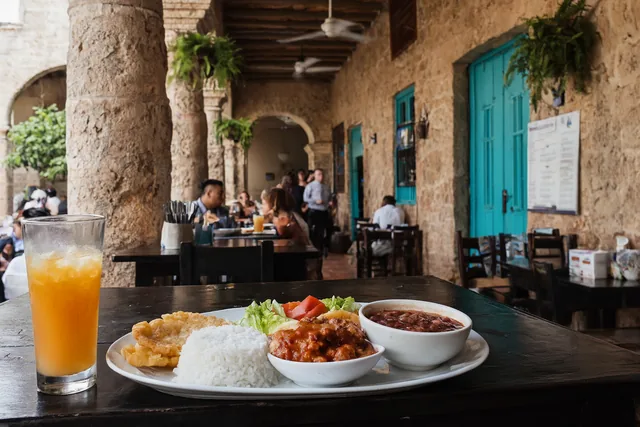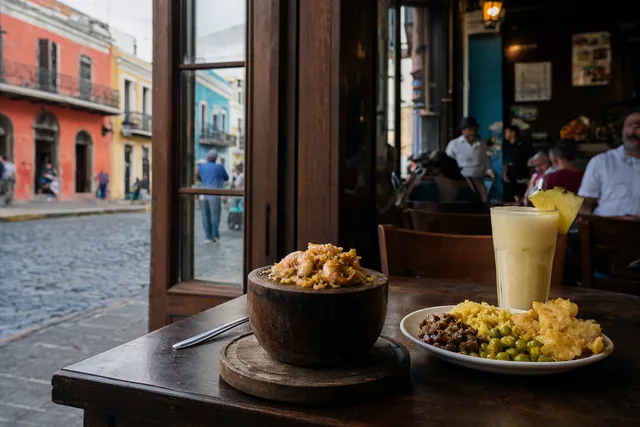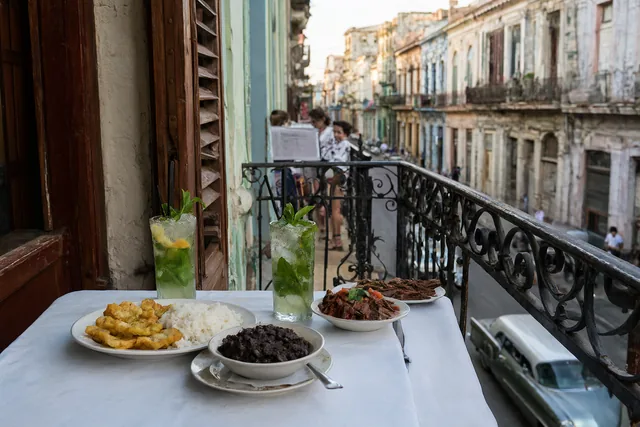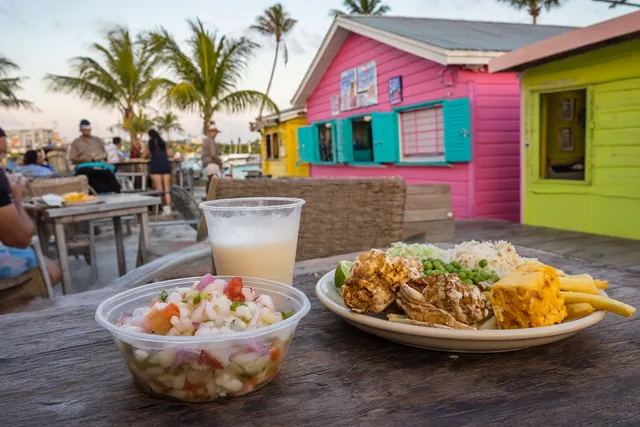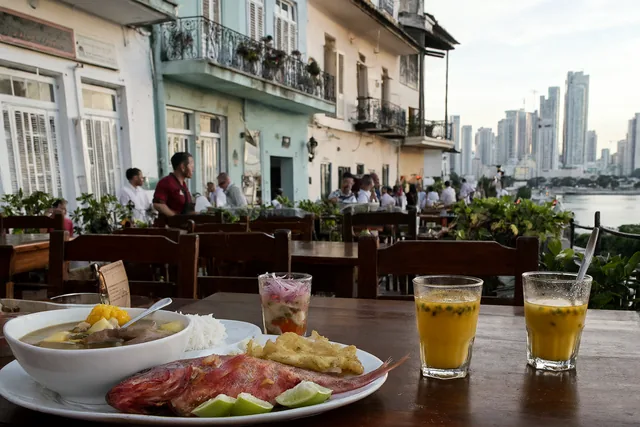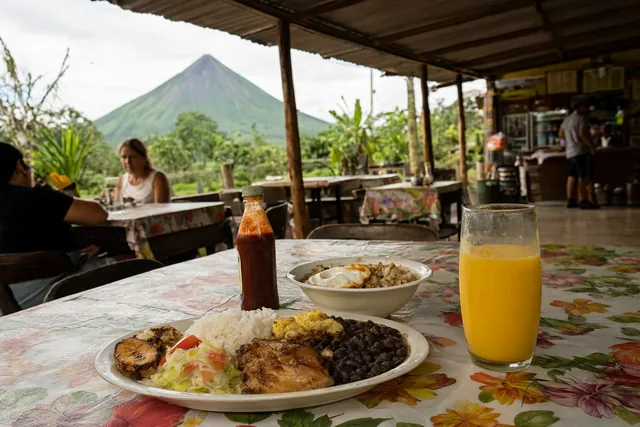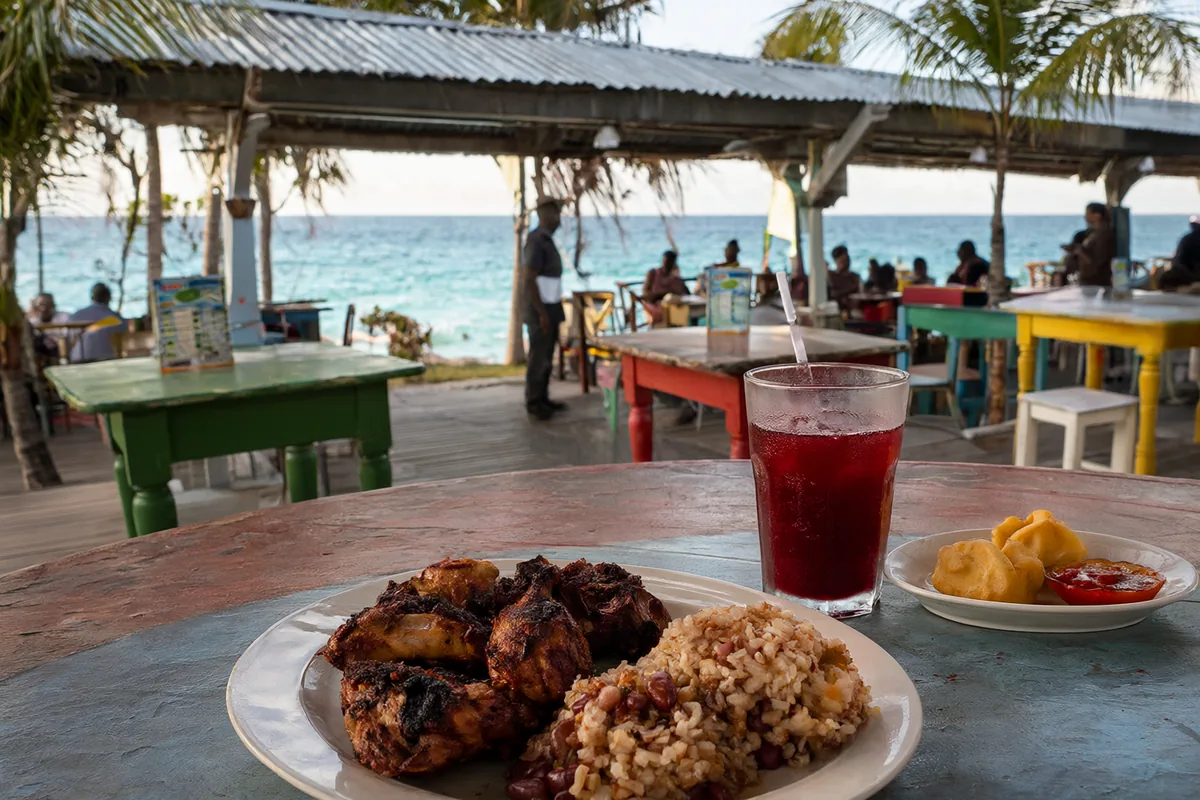
Jamaican food is bold, smoky and deeply seasoned, built on allspice (called pimento here), Scotch bonnet chillies, thyme and spring onion, with roots in West Africa, Britain, India and China. This Jamaica food guide covers the dishes to order, the Jamaican menu terms that confuse even English-speaking visitors, how tipping, GCT and service charges work, then goes town by town through where to eat in Montego Bay, Kingston, Negril, Ocho Rios, Port Antonio and Treasure Beach. Get out of the resort at least once: the best jerk in Jamaica is cooked over pimento wood at a roadside stand, and the best patty comes wrapped in paper from a bakery.
What to eat in Jamaica: 12 dishes to know
These are the dishes Jamaicans eat every week, plus a few regional specialities worth travelling for.
- Ackee and saltfish (everywhere): the national dish, salt cod sautéed with ackee, a fruit that cooks to a soft, buttery texture like scrambled egg, with onion, tomato and Scotch bonnet. Eaten for breakfast with fried dumplings or boiled green banana.
- Jerk chicken and jerk pork (everywhere, especially Portland): meat rubbed with a paste of pimento, Scotch bonnet, thyme and spring onion, then cooked slowly over pimento wood.
- Curry goat (everywhere): goat curried with Jamaican curry powder, a dish brought by Indian indentured workers, served with rice and peas.
- Oxtail (everywhere): oxtail stewed until it falls off the bone, with butter beans and a rich gravy.
- Brown stew chicken or fish (everywhere): meat or fish browned in caramelised sugar, then stewed with onions, peppers and tomato.
- Escovitch fish (the coasts): whole fried fish topped with a sharp pickle of vinegar, onions, carrot and Scotch bonnet.
- Rice and peas (everywhere): rice cooked with red kidney beans, coconut milk, thyme and pimento. The "peas" are beans.
- Jamaican patty (everywhere): a flaky, turmeric-yellow pastry filled with spiced beef, chicken or vegetables, often eaten inside a soft coco bread.
- Festival and bammy (the coasts): festival is a sweet, fried cornmeal dumpling; bammy is a flat cassava bread, soaked and fried, served with fish.
- Peppered shrimp (St Elizabeth): river shrimp cooked with Scotch bonnet and sold in bags by roadside vendors at Middle Quarters.
- Mannish water and pepperpot soup (everywhere): goat soup, said to give strength, and a thick soup of callaloo and meat.
- Blue Mountain coffee and rum (the Blue Mountains and everywhere): some of the world's most prized coffee, grown in the mountains above Kingston, and strong Jamaican rum, drunk neat or in rum punch.
How to read a menu in Jamaica
Jamaican menus are in English, but many dishes and words are particular to the island, and a menu at a cookshop or roadside stand may be a hand-painted board. These are the terms worth knowing.
| Jamaican term | What it means |
|---|---|
| Jerk | Meat or fish marinated in a spicy pimento and Scotch bonnet paste and smoked over pimento wood |
| Brown stew | Browned in caramelised sugar and stewed in gravy |
| Escovitch | Fried, then topped with a spicy vinegar pickle |
| Run down | Fish or saltfish cooked down in coconut milk |
| Rice and peas | Rice with red kidney beans and coconut |
| Hard food / food | Boiled yam, green banana, dumplings and other starchy sides |
| Callaloo | A leafy green, similar to spinach, steamed with onion and tomato |
| Festival / bammy | Sweet fried cornmeal dumpling / fried cassava flatbread |
| Patty and coco bread | A spiced meat pastry inside a soft, slightly sweet bread |
| Ital | Rastafarian cooking: natural, usually vegetarian or vegan, often without salt |
| Pepper | Hot chilli, usually Scotch bonnet. "No pepper" means no chilli |
| Box food | A takeaway meal in a foam or paper box, sold in small, medium or large |
| Sorrel | A deep red drink made from hibiscus flowers, ginger and spice, popular at Christmas |
| Plus GCT and service charge | Tax and a service charge will be added to the menu price |
Many Jamaican menus show prices before the 15 percent GCT and any service charge, and some quote in US dollars while others use Jamaican dollars with the same $ sign. swap.menu reads the menu, flags tax and service lines, shows which currency is used and converts every price to your home currency, so you know what lunch really costs.
Tipping, GCT and paying the bill
Jamaica's sales tax is the GCT (General Consumption Tax), 15 percent on most restaurant meals. Many restaurants, especially in tourist areas, show prices before tax and add it to the bill, often with a 10 percent service charge as well. If a service charge is on the bill, an extra tip is not needed, though rounding up for good service is appreciated. If there is no service charge, tip 10 to 15 percent at sit-down restaurants. Jerk stands, cookshops and patty counters do not expect a tip. Our guide to tax and service charges on menus explains how these lines work around the world.
The currency is the Jamaican dollar (J$, JMD). US dollars are widely accepted in Montego Bay, Negril and Ocho Rios, and many tourist restaurants and tours quote in US dollars, but change usually comes in Jamaican dollars and the rate is rarely in your favour. Away from the resorts, pay in Jamaican dollars. Cards are accepted in hotels, larger restaurants and supermarkets, but jerk centres, roadside stalls, markets and route taxis need cash. If a card machine offers to charge you in your home currency, decline: our guide to paying in local currency explains why.
Jamaicans eat a big breakfast, often ackee and saltfish or callaloo, lunch from about noon to 2pm and dinner from 6pm to 9pm. Sunday dinner, eaten in the afternoon, is a family tradition of rice and peas with chicken, oxtail or curry goat. Many jerk stands fire up in the late afternoon and evening, while patty shops are busiest at lunchtime.
Where to eat in Jamaica, town by town
Each part of Jamaica has its own speciality, from the jerk of Portland to the pepper shrimp of St Elizabeth. Jump to a town:
Where to eat in Montego Bay
Montego Bay, where most visitors land, is Jamaica's tourist capital, with resorts stretching east and west along the coast. The Hip Strip along Gloucester Avenue is the busiest area for restaurants and bars, mostly aimed at visitors, with seafood, jerk and cocktails by the water. For the real thing, look for the jerk centres around town, where chicken and pork are cooked over pimento wood on grills covered with zinc sheets, and sold by the pound with festival, bread or hard food.
Downtown Montego Bay, around Sam Sharpe Square, is where locals eat: patty shops, cookshops serving box food of curry goat, oxtail and brown stew chicken, and fruit vendors selling mango, jackfruit and sugarcane. Montego Bay restaurants on the Hip Strip often quote in US dollars and add GCT and service, so read the menu carefully. Day trips east to Falmouth, a Georgian port town, give a quieter side of the north coast.
Where to eat in Kingston
Kingston, the capital, is where Jamaican food culture is most alive, and it sees far fewer tourists than the north coast. Devon House, a restored 19th-century mansion in the centre of the city, has gardens, shops and a famous ice cream stand, and is a pleasant place for a patty and a cold drink. New Kingston and Half Way Tree have restaurants of every kind, from Jamaican Chinese to ital cafés, and Kingston is the best place in Jamaica for vegetarian Rastafarian cooking.
At weekends, Kingston families drive out to Hellshire Beach, where shacks on the sand fry fresh fish, lobster and festival to order: choose your fish, say how you want it cooked, and eat it with your feet in the sand. Port Royal, the old pirate town at the tip of the Palisadoes peninsula, is known for fried and escovitch fish. Coronation Market downtown is one of the biggest markets in the Caribbean. Above Kingston, the Blue Mountains have coffee farms where you can taste the beans where they grow.
Where to eat in Negril
Negril, on the western tip of the island, is all about the beach and the sunset. Seven Mile Beach is lined with resorts, beach bars and restaurants, and vendors walk the sand selling patties, coconut water and fruit. The West End, where the beach gives way to limestone cliffs, has restaurants and bars perched on the rocks, crowded at sunset. Order grilled lobster (in season, from July to March), escovitch fish, jerk chicken and a rum punch.
Negril has a relaxed, Rastafarian-influenced side, and some of the best food in Negril comes from small ital shacks serving vegetable stews, steamed callaloo, coconut curries and fresh juices. Jerk stands along the road behind the beach are often better and cheaper than the beach restaurants. Lobster has a closed season from April to June, so avoid it on menus at that time.
Where to eat in Ocho Rios
Ocho Rios, on the north coast, is a cruise port and resort town best known for the terraced waterfalls of Dunn's River Falls. Restaurants near the cruise terminal are aimed at day visitors, but the jerk centres and cookshops in town and along the main road are where Ocho Rios locals eat, serving jerk chicken, curry goat, brown stew fish and patties.
The road south from Ocho Rios through the rainforest of Fern Gully leads inland, and on the main road towards Kingston the roadside village of Faith's Pen has a row of food stalls famous for roast yam, roast breadfruit, saltfish, mannish water, corn soup and jerk. It is a classic stop for drivers crossing the island. Along the coast to the west, the town of Runaway Bay and the fishing beaches have simple places serving the catch of the day.
Where to eat in Port Antonio
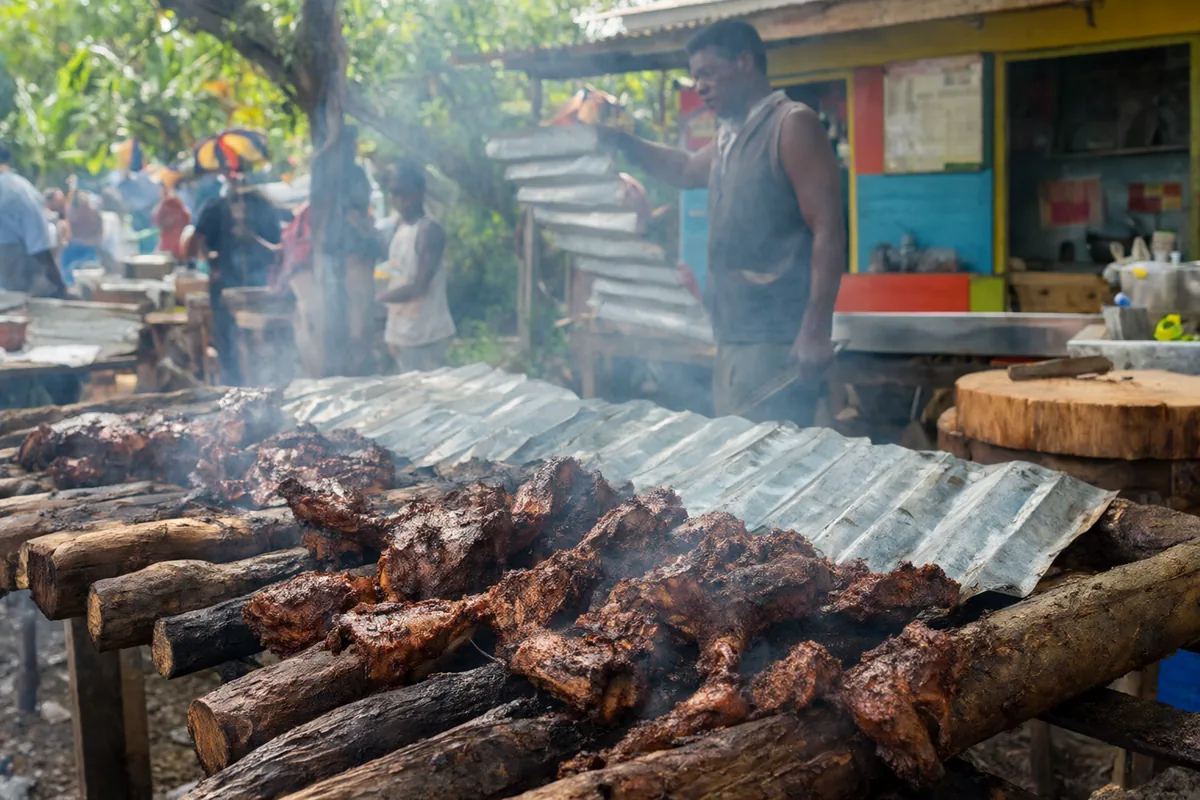
Port Antonio, in the lush north-eastern parish of Portland, is the quietest and most beautiful corner of Jamaica, with rainforest, rivers, the Blue Lagoon and beaches like Frenchman's Cove. It is also the home of jerk. The Maroons, communities of escaped enslaved Africans who lived in the mountains, developed the method of slow-cooking spiced meat over pimento wood, and the roadside stands of Boston Bay, east of Port Antonio, are considered the birthplace of jerk.
At Boston Bay, jerk pork and chicken are cooked over pimento logs under zinc sheets and served chopped with festival, roast breadfruit and hot pepper sauce. In Port Antonio town, the Musgrave Market sells fresh produce, and small restaurants serve seafood, ital food and Jamaican classics. Portland gets more rain than the rest of the island, which is why it is so green, so be ready for a shower with your lunch.
Where to eat in Treasure Beach
Treasure Beach, on the dry south coast in the parish of St Elizabeth, is a string of fishing villages known for community tourism and a slower pace. There are no big resorts, and the food in Treasure Beach is simple and fresh: fish and lobster brought in by the local fishermen, cooked on the beach or at small family restaurants, with bammy, festival and rice and peas.
On the road between Treasure Beach and Mandeville, the town of Middle Quarters is famous for its roadside sellers of peppered shrimp, spicy river shrimp sold in small bags. The area also has the Black River, where boat tours run through the wetlands, and the YS Falls, with picnic areas by the water. St Elizabeth is known as the breadbasket of Jamaica, growing much of the island's vegetables, so look for fresh produce at roadside stands.
Vegetarian, vegan and allergy tips
Jamaica is easier for vegetarians and vegans than many Caribbean islands, thanks to the Rastafarian ital tradition, which avoids meat, salt and processed food. Look for ital shacks and cafés, especially in Kingston and Negril, serving vegetable stews, steamed callaloo, ackee without saltfish, coconut curries and fresh juices. Elsewhere, watch for hidden meat: rice and peas may be cooked with a piece of pork or salted meat, soups are usually made with meat or fish, and callaloo is sometimes steamed with saltfish. The word to use is simply "vegetarian" or "ital".
Unripe ackee is toxic, but it is always prepared properly in restaurants, where only the ripe, opened fruit is used. Scotch bonnet chillies are very hot, so ask for "no pepper" or "likkle pepper" if you are sensitive. Shellfish is common on the coasts. Our guide to eating abroad with food allergies explains how to describe an allergy clearly.
Jamaican food slang and ordering terms
Jamaicans speak English and Jamaican Patois, and you will hear Patois at every cookshop and jerk stand. These are the words and phrases worth knowing.
Wah gwaan? "What's going on?", a friendly greeting
Mi waan a small curry goat "I want a small curry goat", ordering a box food by size
A pound a jerk pork, please Jerk is sold by weight, by the pound or half pound
Likkle pepper / no pepper "A little chilli / no chilli"
Wid hard food or rice and peas? "With boiled yam, banana and dumplings, or with rice and peas?"
Nuff "Plenty" or "a lot", as in "nuff gravy"
Irie "Good", "great" or "all is well"
Respect / bless Common ways to say thanks or goodbye
How swap.menu helps you eat in Jamaica
Jamaican menus are in English, but terms like hard food, run down, bammy and mannish water are not in any phrasebook. Photograph the menu with swap.menu and every dish is explained, so you know what comes with your box food before you order. Visitors from Germany, Japan, Brazil or anywhere else can read the whole menu in their own language, in 29 languages, with the Jamaican name kept beside it.
Every price is converted to your home currency, whether the menu is in Jamaican or US dollars, and we flag GCT and service charge lines so the total holds no surprises. Menus you scan are saved, so you can go back to that jerk centre you liked. Add a note such as "no pepper" or "no pork, please", typed or spoken, and show the cook your phone. Try it now on a sample menu with the free demo, or see travel pass prices.
Off to Jamaica? Your first 3 menu scans are free, and a travel pass starts from $4.99 with nothing that renews.
Start free with 3 scansJamaica food FAQ
Do you tip in restaurants in Jamaica?
If the bill includes a service charge, usually 10 percent, an extra tip is not needed. If it does not, tip 10 to 15 percent at sit-down restaurants. Jerk stands and patty shops do not expect a tip.
What is the national dish of Jamaica?
Ackee and saltfish is the national dish, usually eaten for breakfast with fried dumplings, boiled green banana or breadfruit. Jerk chicken and pork, curry goat and oxtail are the other dishes Jamaica is best known for.
Where is the best jerk in Jamaica?
Boston Bay, near Port Antonio in Portland, is considered the birthplace of jerk and has a row of roadside jerk stands. Jerk centres in Montego Bay, Ocho Rios and along the main roads are also good, especially those cooking over pimento wood.
Is tap water safe to drink in Jamaica?
Tap water in the main towns and resorts is treated and generally safe, though many visitors prefer bottled water. In rural areas, drink bottled or filtered water.
Should I pay in US or Jamaican dollars?
US dollars are widely accepted in tourist areas, but paying in Jamaican dollars usually gives you a better price. Away from the resorts, Jamaican dollars are the norm.
Can swap.menu help with Jamaican menus?
Yes. swap.menu explains Jamaican dishes and terms such as hard food, bammy and run down, translates the menu into 29 languages, converts prices from Jamaican or US dollars to your home currency and flags GCT and service charges.
Travelling further in the Caribbean? Read our food guides for nearby islands:
- Bahamas food guide
- Cuba food guide
- Dominican Republic food guide
- Puerto Rico food guide
- Costa Rica food guide
Or browse every travel food guide.