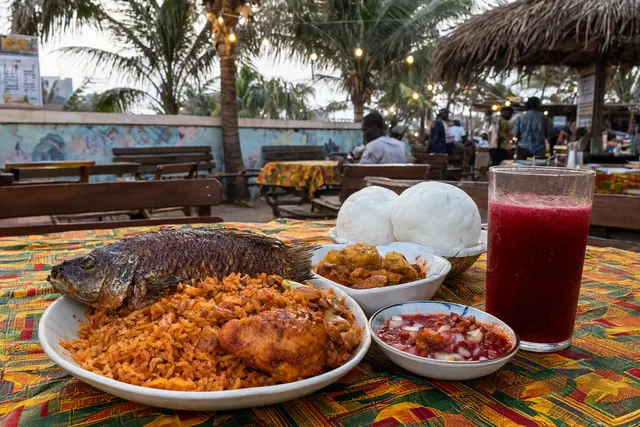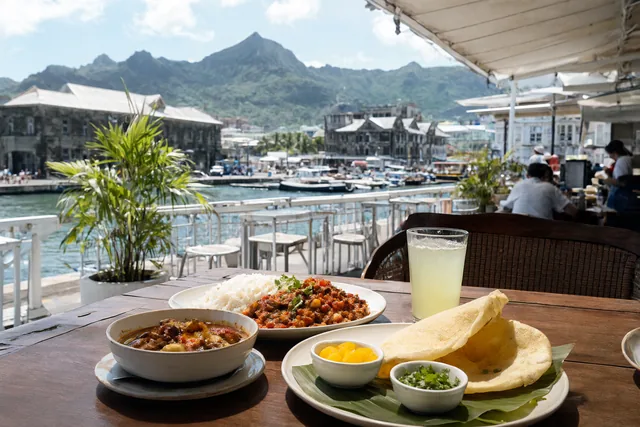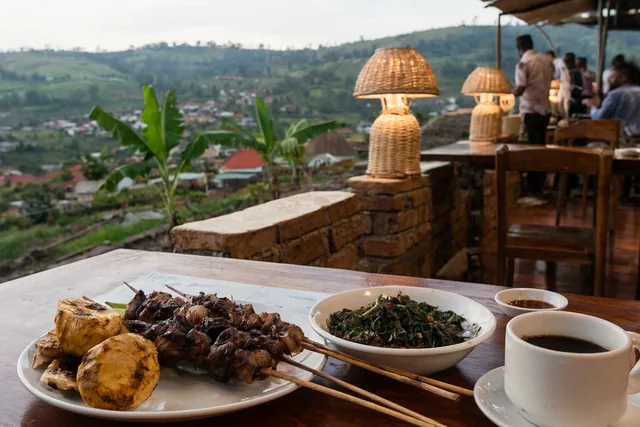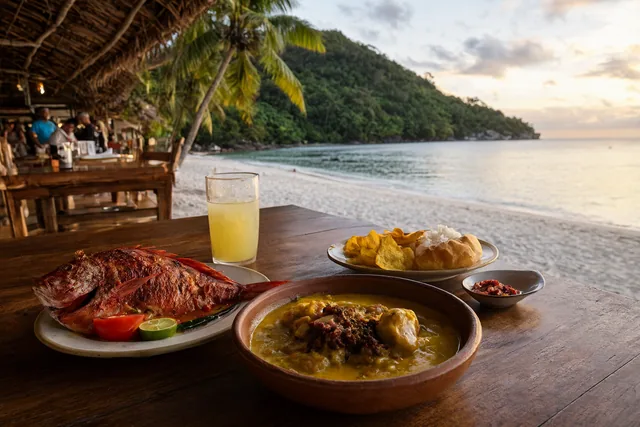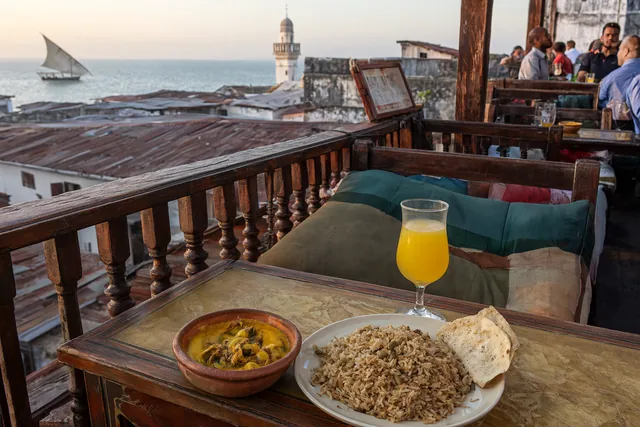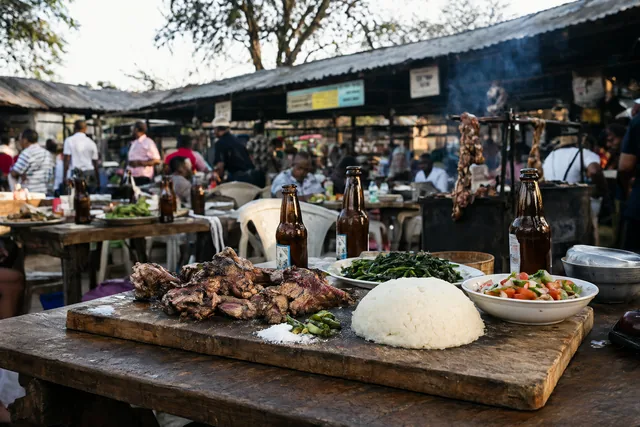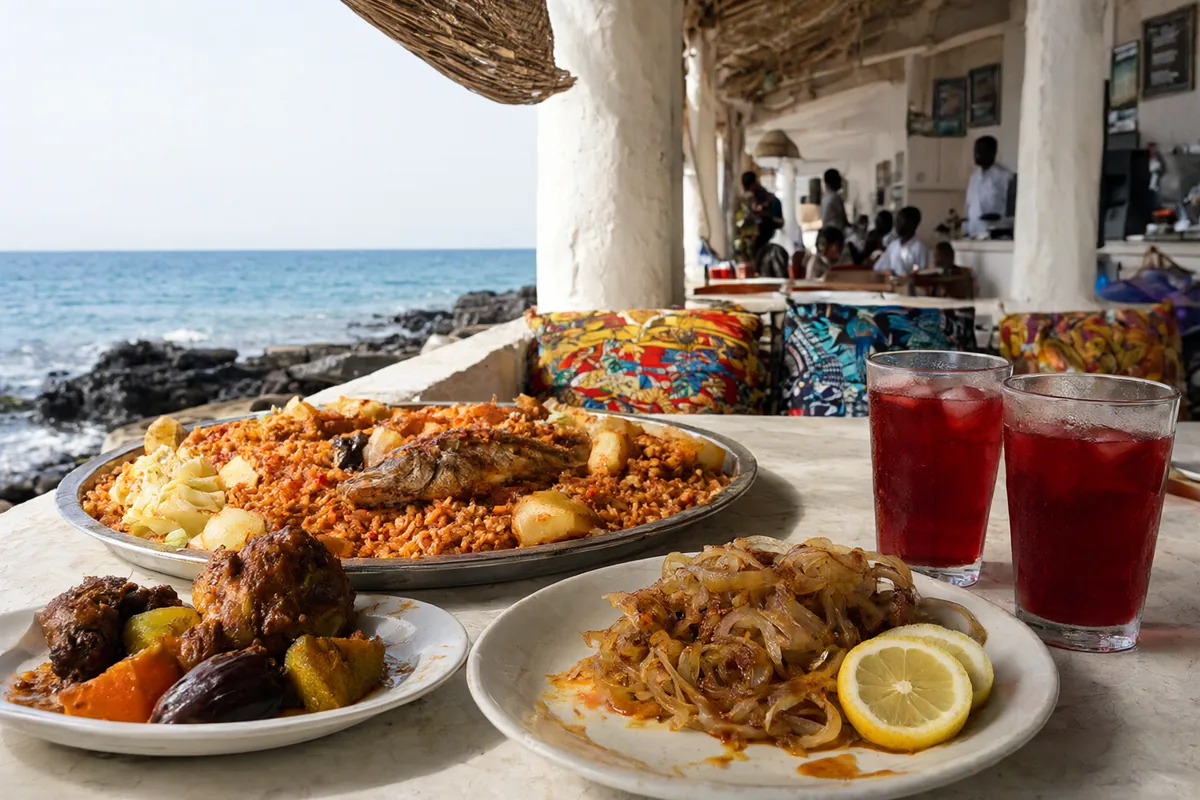
Senegal's food is built around a shared bowl: a great platter of rice cooked in a rich fish and tomato sauce, set on a mat or table and eaten by the whole family with their right hands. This Senegal food guide covers the dishes to order, how to read a menu in French with dish names in Wolof, how tipping and paying in CFA francs works, and then goes destination by destination through where to eat in Dakar, Gorée, Saint-Louis, the Petite Côte, the Sine-Saloum Delta and Casamance. Senegalese hospitality has its own word, teranga, and you will feel it most at the table.
What to eat in Senegal: 12 dishes to know
Senegalese cooking is one of the most respected in West Africa, built on rice, fish, onions, peanuts, lemon and slow-cooked sauces. These are the dishes to know.
- Thiéboudienne (everywhere): spelt ceebu jën in Wolof, the national dish. Fish, often stuffed with a parsley, garlic and chilli paste called rof, is cooked in a tomato sauce with cassava, carrot, cabbage, aubergine and pumpkin, and broken rice is then cooked in the same broth. The crispy rice from the bottom of the pot, xoon, is the prized part.
- Yassa (everywhere, originally Casamance): chicken or fish marinated in lemon juice and onions, grilled, then simmered in a sauce of caramelised onions, lemon and mustard, served with white rice.
- Mafé (everywhere): a thick, rich stew of lamb, beef or chicken in a peanut and tomato sauce, served with rice.
- Thiébou yapp (everywhere): the meat version of thiéboudienne, with lamb or beef and rice cooked in a spiced onion sauce.
- Dibi (everywhere, especially Dakar): grilled lamb or mutton, cooked in a dibiterie, chopped and served on paper with raw onions, mustard and chilli. An evening and late-night food.
- Soupou kandja (everywhere): a dark, thick okra stew with palm oil, fish, meat and seafood, served over rice.
- Caldou (Casamance): a light, lemony fish stew with onions and chilli, served with rice.
- Accara (everywhere): fritters of black-eyed bean paste, sold on the street with a spicy onion and tomato sauce, often in a piece of baguette.
- Fataya and pastels (everywhere): fried pastries filled with spiced fish or meat, sold as snacks at street stalls and parties. Fataya are the larger, Lebanese-influenced version.
- Ndambé (everywhere, at breakfast): a spicy stew of black-eyed beans or white beans served in half a baguette, the cheap Senegalese breakfast.
- Thiakry (everywhere): a dessert of millet couscous mixed with sweetened curdled milk or yoghurt, sometimes with raisins and nutmeg.
- Bissap, bouye and café Touba (everywhere): bissap is a chilled hibiscus drink, bouye a thick, creamy baobab fruit juice, and café Touba a coffee spiced with djar (grains of Selim) and cloves, sold from street carts. After meals, Senegalese make attaya, strong sweet green tea with mint, served in three rounds.
How to read a Senegalese menu in French and Wolof
French is Senegal's official language and the language of most printed menus, but Wolof is spoken by most people and many dish names come from it, often spelt in a French way: ceebu jën becomes thiéboudienne, and ceebu yàpp becomes thiébou yapp. Small local restaurants, called gargotes, may have a handwritten board with just two or three dishes of the day (plat du jour), and the national dish is usually cooked for lunch only. These are the words worth knowing.
| Wolof | French | Meaning |
|---|---|---|
| Ceebu jën | Thiéboudienne, riz au poisson | Fish and rice in tomato sauce |
| Ceebu yàpp | Thiébou yapp, riz à la viande | Meat and rice |
| Yassa | Yassa poulet / poisson | Chicken or fish in onion, lemon and mustard sauce |
| Mafé | Mafé, sauce arachide | Peanut stew |
| Dibi | Viande grillée | Grilled lamb or mutton |
| Jën | Poisson | Fish |
| Ganaar | Poulet | Chicken |
| Yàpp | Viande | Meat |
| Ceeb | Riz | Rice |
| Mburu | Pain | Bread, usually a baguette |
| Kaani | Piment | Chilli |
| Ndox | Eau | Water |
| Bissap | Jus de bissap | Chilled hibiscus drink |
| Attaya | Thé à la menthe | Strong, sweet green tea with mint |
Thiéboudienne is a lunch dish, cooked in big pots in the morning and often sold out by mid-afternoon. If you want to try it at a gargote, arrive between about 1pm and 2:30pm. swap.menu reads French menus and handwritten boards, explains Wolof dish names and converts CFA franc prices to your home currency.
Tipping, tax and paying the bill in Senegal
Tipping is not obligatory in Senegal, but it is appreciated. In restaurants used to visitors, leaving around 5 to 10 percent is normal for good service, while at gargotes and street stalls rounding up is enough. Value added tax (TVA) is included in menu prices in most places, though some hotels and upmarket restaurants show it separately or add a service charge. Our guide to tax and service charges on menus explains how these lines work.
The currency is the West African CFA franc (XOF), written FCFA or simply CFA on menus. Cash is king, especially outside Dakar, and small notes and coins are often in short supply, so break large notes at supermarkets and petrol stations when you can. Mobile money services are widely used by locals. Cards are accepted in hotels, larger restaurants and supermarkets in Dakar and the resorts. When a card machine offers to charge you in your home currency, choose CFA francs: our guide to paying in local currency explains why.
Lunch is the main meal, eaten from about 1:30pm to 3pm, and dinner is late, often from 8pm or 9pm. Senegal is a mostly Muslim country, but alcohol is served in bars, hotels and many restaurants in Dakar and the tourist areas. During Ramadan many local eateries close by day and serve food after sunset.
Where to eat in Senegal, city by city
Senegal's coast runs from the desert edge at Saint-Louis to the green rice fields and mangroves of Casamance. Jump to a destination:
Where to eat in Dakar
Dakar, on the Cap-Vert peninsula at the westernmost point of mainland Africa, is one of the most exciting food cities in West Africa. The city centre, the Plateau, has gargotes serving thiéboudienne and yassa to office workers at lunchtime, Lebanese snack shops selling shawarma and fataya, and the covered Marché Kermel, a market hall dating from the colonial era, with fish, fruit and vegetable stalls. Marché Sandaga nearby is larger, louder and more chaotic.
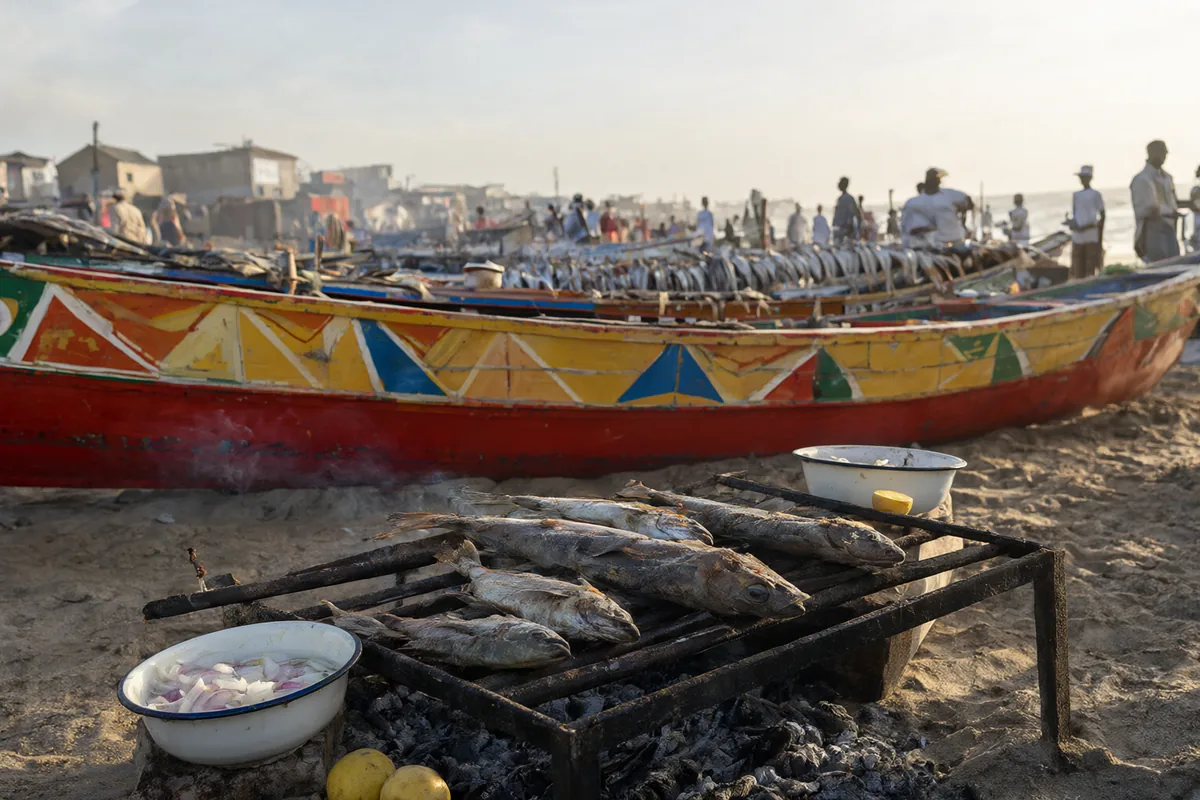
In the late afternoon, go to Soumbédioune on the corniche, where fishing pirogues come in with the catch and stalls on the beach grill fish to order. For seafood with a view, the Pointe des Almadies and the beaches of Ngor and Yoff have simple seafront places serving grilled fish, prawns and oysters. In the evening, look for a dibiterie, where lamb is grilled and chopped with onions and mustard, and street carts selling café Touba. Dakar eats late, and its music venues and bars keep going well past midnight.
Where to eat on Gorée
Gorée is a small, car-free island a short ferry ride from Dakar's port, with colourful colonial houses, bougainvillea and the House of Slaves, a memorial to the Atlantic slave trade and part of a UNESCO World Heritage Site. Most visitors come for half a day, and lunch is the meal to plan. Restaurants by the jetty and the small beach serve grilled fish, thiéboudienne, yassa and fresh juices, with tables looking back across the water to Dakar.
The island is quiet once the day visitors leave, and a few guesthouses serve dinner for overnight guests. Prices on Gorée are higher than in Dakar, and choice is limited, so check menus before you sit down. Ferries run throughout the day, but check the last return time before you settle in for a long lunch.
Where to eat in Saint-Louis
Saint-Louis, in the far north near the border with Mauritania, was the first capital of French West Africa, and its island old town, reached by the iron Faidherbe Bridge across the Senegal River, is a UNESCO World Heritage Site of faded colonial houses with wooden balconies. Saint-Louis claims to be the birthplace of thiéboudienne, and many Senegalese say it is still made best here. Small restaurants on the island serve it at lunch, along with yassa, grilled fish and capitaine (Nile perch) from the river.
Across a second bridge, on the narrow sand spit of the Langue de Barbarie, is Guet Ndar, one of the most densely populated fishing quarters in West Africa. Hundreds of painted pirogues line the beach, fish is smoked and dried in the open air, and simple stalls grill the catch. Visit Guet Ndar with a local guide, and ask before taking photographs. Saint-Louis is a relaxed town to wander, with guesthouses and terrace restaurants along the river.
Where to eat on the Petite Côte
The Petite Côte, the coast south of Dakar, is Senegal's main beach area, with the resort town of Saly at its centre. Saly's restaurants serve grilled fish, seafood and French and international dishes to holidaymakers. For a more local experience, go to the beach at Mbour, one of Senegal's biggest fishing ports, in the late afternoon, when hundreds of pirogues land their catch and the fish market fills with buyers, sellers and cooks.
Further south, Joal-Fadiouth is two villages joined by a long wooden footbridge: Joal on the mainland and Fadiouth on an island built up from millions of seashells, with granaries on stilts in the lagoon. Fadiouth has a large Christian population, and you may find pork on menus here, which is rare in Senegal. Smaller villages such as Somone and Toubab Dialaw have guesthouses and beach restaurants serving fish caught that day on the Petite Côte.
Where to eat in the Sine-Saloum Delta
The Sine-Saloum Delta, south of the Petite Côte, is a maze of mangrove channels, islands and lagoons, a UNESCO-listed landscape best explored by pirogue. It is known for oysters, harvested by women from the roots of the mangroves at low tide and eaten grilled, raw or cooked in a sauce, and for fish and shrimp caught in the channels. Villages such as Ndangane, Palmarin and Toubacouta are the main bases.
Most visitors stay in eco-lodges and campements, which serve set meals of grilled fish, yassa, thiéboudienne and seasonal fruit. Many organise pirogue trips with a picnic lunch of fish grilled on an island. The Saloum is remote, so bring cash and tell your lodge about any dietary needs in advance.
Where to eat in Casamance
Casamance, the green southern region cut off from the rest of Senegal by the Gambia, has a different landscape and food culture from the north. It is rice country, with paddies around Diola villages, and the home of yassa, which spread from here across the country. The local speciality is caldou, a light fish stew with lemon and chilli, and the region produces mangoes, oranges, cashew nuts and palm wine, known locally as bunuk.
Ziguinchor, the regional capital on the Casamance River, has a lively market and riverside restaurants serving fish, oysters and yassa. Cap Skirring, on the coast, is a beach resort with seafood restaurants and campements. Many travellers reach Casamance on the overnight ferry from Dakar to Ziguinchor, and the region's slower pace and village guesthouses make it one of the most rewarding places to eat in Senegal.
Vegetarian, vegan and allergy tips
Senegal is not an easy country for vegetarians. Almost every main dish is built on fish or meat, and even vegetable sauces are often cooked with fish, dried fish or stock cubes. The best options are accara, ndambé (bean sandwiches), salads, omelettes, rice with onion yassa sauce made without the chicken, and fruit. In French, say "Je suis végétarien" (or végétarienne for a woman) and add "pas de viande, pas de poisson" (no meat, no fish), as many people assume vegetarians eat fish. Dakar has a few restaurants with vegetarian dishes.
Peanuts are central to Senegalese cooking, in mafé, sauces, snacks and street food, so anyone with a peanut allergy must ask about every dish. Stock cubes, which can contain gluten and MSG, are used in almost all sauces. Our guide to eating abroad with food allergies explains how to communicate a serious allergy clearly.
Useful Wolof and French phrases for ordering
Salaam aleekum "Peace be with you", the standard greeting (reply "Maalekum salaam")
Nanga def? "How are you?" (reply "Maa ngi fi", I am fine)
Dama bëgg lii "I want this one" (pointing)
Ñaata la? "How much is it?"
Pas trop pimenté, s'il vous plaît "Not too spicy, please" in French
L'addition, s'il vous plaît "The bill, please" in French
Neex na lool "It is very tasty"
Jërëjëf "Thank you"
How swap.menu helps you eat in Senegal
Senegalese menus are in French, but the dish names are Wolof words in French spelling, and the board outside a gargote may list nothing more than thiou, domoda or soupou kandja. Photograph it with swap.menu and every dish appears in your language with its original name beside it and a short explanation, so you know that thiou is a tomato stew, that domoda is a meat stew thickened with flour or peanut, and that soupou kandja is okra. Prices are converted from CFA francs to your home currency, and any service or tax line is flagged.
Tap the dishes you want, add a note such as "no peanuts" or "not spicy", typed or spoken, and swap.menu translates your order into French. Show the waiter your phone, or let them scan the QR code and read your order on their own screen. Try it on a sample menu with the free demo, or see travel pass prices.
Off to Senegal? Your first 3 menu scans are free, and a travel pass starts from $4.99 with nothing that renews.
Start free with 3 scansSenegal food FAQ
Do you tip in restaurants in Senegal?
Tipping is not required in Senegal, but around 5 to 10 percent is appreciated in restaurants used to visitors. At gargotes and street stalls, rounding up the bill is enough.
What is the national dish of Senegal?
Thiéboudienne, or ceebu jën in Wolof, is the national dish: fish and broken rice cooked in a rich tomato sauce with vegetables. It is traditionally eaten at lunch from a shared bowl.
What food is Senegal famous for?
Senegal is famous for thiéboudienne, yassa, mafé, dibi grilled lamb, accara fritters and drinks such as bissap and bouye. The coast is known for fresh fish, and the Sine-Saloum and Casamance for mangrove oysters.
Is it expensive to eat out in Senegal?
Eating at gargotes, dibiteries and street stalls is cheap. Restaurants in Dakar's upmarket areas, on Gorée and in the resorts of Saly and Cap Skirring cost considerably more.
Is tap water safe to drink in Senegal?
Tap water in Dakar is treated, but most visitors drink bottled water to avoid stomach problems. Bottled water is sold everywhere and is the safer choice outside the capital.
How can I read a Senegalese menu if I do not speak French or Wolof?
Learn a few key words such as poisson, poulet, riz and plat du jour, or photograph the menu with swap.menu. It translates French menus, explains Wolof dish names, converts CFA franc prices to your currency and translates your order back into French.
Travelling further in Africa? Read our food guides for other countries:
Or browse every travel food guide.