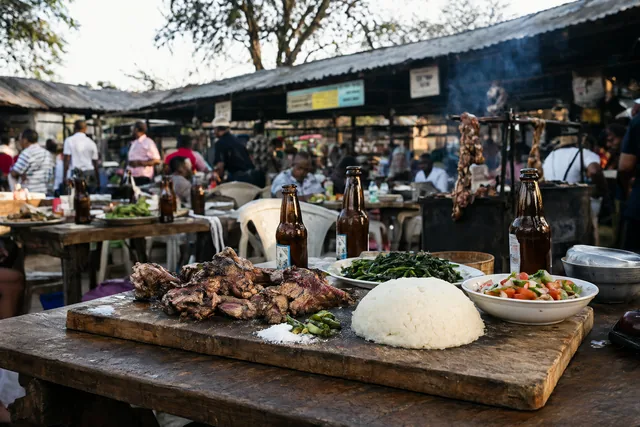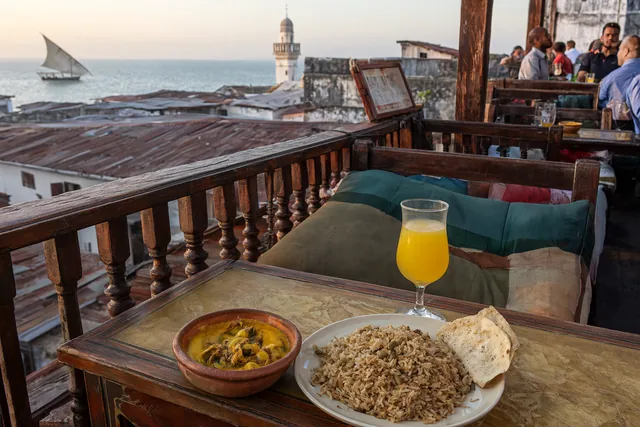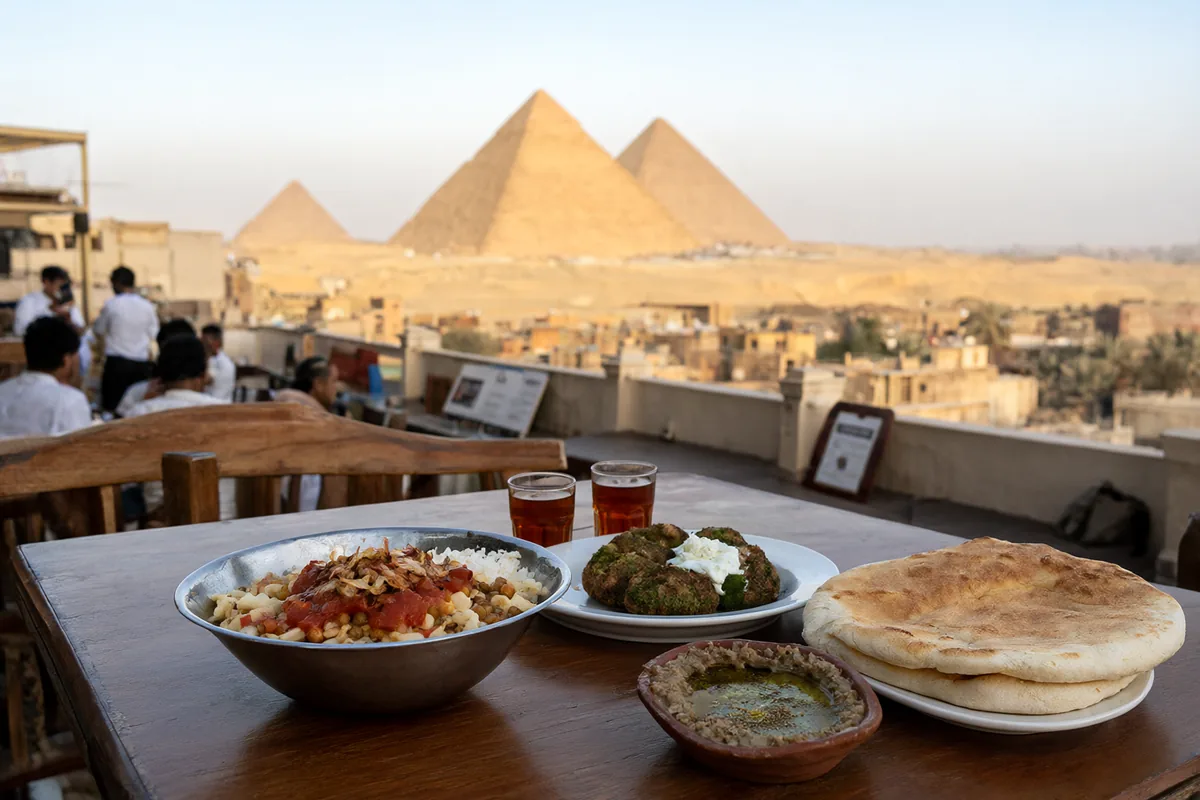
Egyptian food is cheap, filling and mostly vegetarian at heart: beans, lentils, rice, bread and vegetables cooked the way they have been for generations. Many visitors eat only at hotel buffets and miss it, which is a mistake, because a breakfast of ful and ta'ameya or a bowl of koshari is one of the great pleasures of a trip to Egypt. This Egypt food guide covers the dishes to know, the Arabic words on a menu, the service charge and tipping, Ramadan customs, then goes city by city through where to eat in Cairo, Alexandria, Luxor, Aswan, Hurghada, Sharm El Sheikh and Dahab.
What to eat in Egypt: 12 dishes to know
These are the dishes worth ordering, from street breakfasts to family feasts. Most are served with aish baladi, the round, puffy wholewheat flatbread eaten at every meal.
- Koshari: the national street dish, a bowl of rice, lentils, macaroni and chickpeas topped with spiced tomato sauce, garlic vinegar and crisp fried onions. Cheap, vegan and very filling.
- Ful medames: fava beans slow-cooked until soft and served with oil, cumin, lemon and sometimes tahini or egg. The Egyptian breakfast, sold from carts across the country.
- Ta'ameya: Egyptian falafel, made with fava beans instead of chickpeas, so it is green inside, with herbs.
- Molokhia: a green soup of finely chopped jute leaves cooked in stock with garlic and coriander, eaten with rice, bread and chicken or rabbit.
- Fattah: layers of crisp bread, rice and meat with a garlic and vinegar tomato sauce, a festive dish served at Eid.
- Hamam mahshi: pigeon stuffed with rice or freekeh (green wheat) and roasted or grilled. A speciality worth trying at least once.
- Mahshi: vegetables such as courgettes, peppers, aubergines and vine leaves stuffed with herby rice and cooked in tomato sauce.
- Feteer meshaltet: a flaky, buttery layered pastry eaten plain with honey or cheese, or filled with meat or cheese.
- Hawawshi: flatbread stuffed with spiced minced meat and baked until crisp.
- Kofta and kebab: grilled minced meat and lamb pieces, sold by weight at grill restaurants and served with bread, salads and tahini.
- Sayadeya (Alexandria): fish cooked with rice made brown with caramelised onions and spices.
- Om ali: a warm bread or pastry pudding baked with milk, cream, nuts and raisins. Egypt's favourite dessert, alongside basbousa, a syrup-soaked semolina cake.
To drink, try fresh sugarcane juice (asab) from juice shops, chilled or hot karkade (hibiscus tea), mint tea and thick Turkish-style coffee in a traditional coffeehouse, or ahwa.
How to read an Arabic menu
Hotel and tourist restaurants in Egypt have English menus, but koshari shops, ful carts, bakeries and local restaurants often post their menus and prices in Arabic only. Egyptian Arabic has its own words for some foods, so a menu here does not always match one in the Gulf. These are the words you will see most often.
| Arabic | Romanised | Meaning |
|---|---|---|
| عيش | eish | Bread (in Egypt; it means rice in the Gulf) |
| فول | fuul | Fava beans |
| طعمية | ta'ameya | Egyptian falafel |
| فراخ | firakh | Chicken |
| لحمة | lahma | Meat, usually beef or lamb |
| كبدة | kebda | Liver |
| سمك | samak | Fish |
| جمبري | gambari | Prawns |
| مشوي | mashwi | Grilled |
| محشي | mahshi | Stuffed |
| سلطة | salata | Salad |
| حلويات | halawiyat | Sweets, desserts |
| عصير | aseer | Juice |
| نباتي | nabati | Vegetarian |
Grill restaurants often price kofta and kebab by the kilo or quarter kilo, and fish restaurants by weight, so the figure on the menu may not be the price of your plate. In koshari shops, bowls come in sizes, usually small, medium and large, and a small is enough for most people.
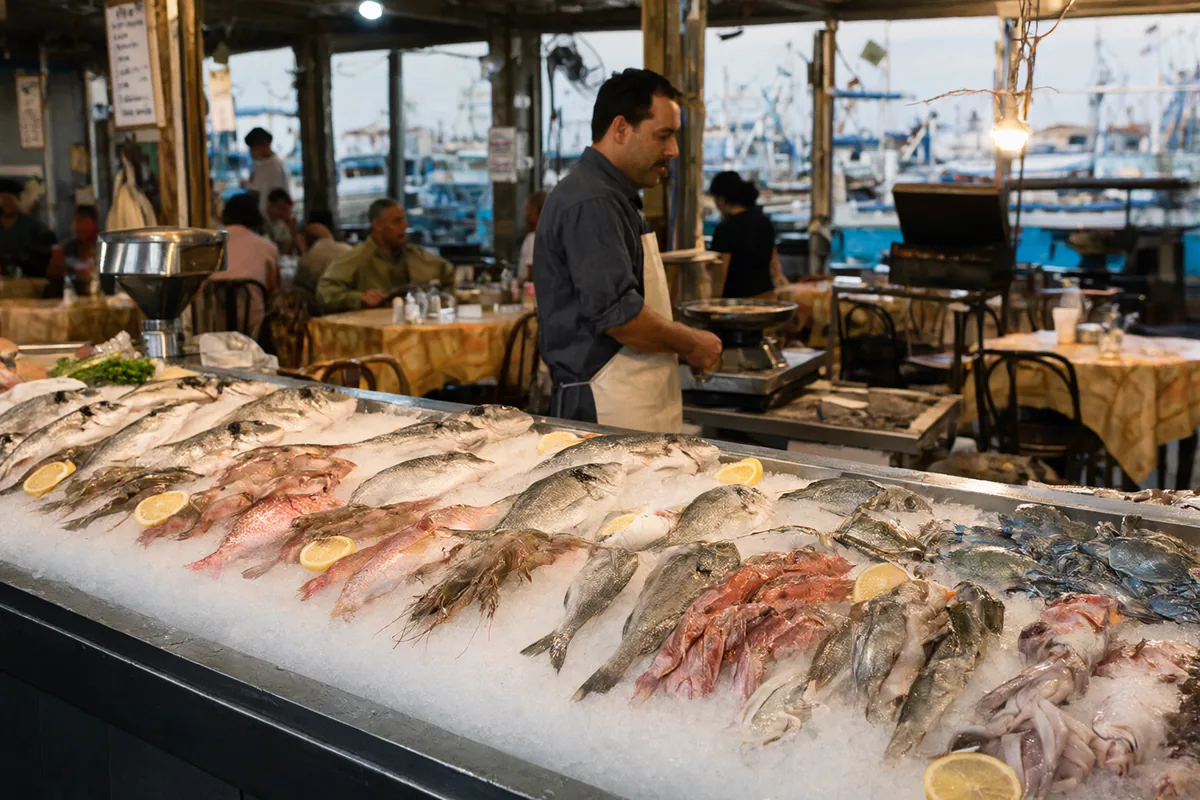
At a fish restaurant in Egypt, you usually choose your fish from the display, it is weighed, and you are charged by the kilo plus the cooking. swap.menu flags priced-by-weight items and converts every price from Egyptian pounds to your home currency, so you can agree the price before the fish goes on the grill.
Service charge, tipping and paying the bill
Most sit-down restaurants in Egypt add a service charge, commonly 12 percent, and VAT of 14 percent to the bill, and menus usually say "prices subject to service and tax". Koshari shops, ful carts and bakeries charge the price shown. Our guide to tax and service charges on menus explains how these lines work.
Tipping, or baksheesh, is part of daily life in Egypt. The service charge does not usually go to the waiter, so leave an extra 5 to 10 percent in cash for good service. Small tips are also expected by toilet attendants, porters, guides and drivers, so carry plenty of small notes.
The currency is the Egyptian pound (EGP, E£, often written LE). Cards are accepted in hotels, malls, upmarket restaurants and many places in the Red Sea resorts, but street food, local restaurants, taxis and markets are cash only, and change for large notes can be hard to find. If a card machine offers to charge you in your home currency, decline and pay in pounds: our guide to paying in local currency explains why.
Egyptians eat late. Breakfast is often ful and ta'ameya on the way to work, lunch, the main meal, is from about 2pm to 5pm, and dinner rarely starts before 9pm. Cairo restaurants and cafés are busy past midnight.
Alcohol is served in hotels, tourist restaurants, bars and some licensed restaurants, and Egypt produces its own beer and wine, but most local restaurants do not serve it. During Ramadan, many local restaurants close during the day or serve takeaway only, eating, drinking or smoking in the street in daylight is impolite, and alcohol is generally sold only to foreign visitors, usually in hotels. Hotels and Red Sea resorts carry on much as normal. After sunset, the streets fill with people, Ramadan tents and sweet stalls selling kunafa and qatayef, stuffed pancakes.
Where to eat in Egypt, city by city
From Cairo's street food to Alexandria's fish and the Nubian cooking of Aswan, each stop on an Egypt trip has its own food. Jump to a city:
Where to eat in Cairo
Cairo is the best place in Egypt to eat street food. Downtown (Wust el-Balad) has long-established koshari shops, sugarcane juice bars and cheap restaurants serving ful, ta'ameya and grilled meats, and in the morning, ful carts on street corners across Cairo serve beans in bread to commuters. The old city of Islamic Cairo, around Khan el-Khalili and Al-Muizz Street, has traditional coffeehouses where you can sit with mint tea or coffee and watch the crowds, as well as grill restaurants and sweet shops. During Ramadan, the area around the Hussein Mosque is one of the liveliest places in the city after sunset.
For sit-down meals, Cairo's restaurants serving Egyptian home cooking are the place to try molokhia, mahshi, hamam mahshi and fattah. Zamalek, on an island in the Nile, has cafés, bars and restaurants popular with Cairenes and visitors, and the riverbanks have floating restaurants. Near the pyramids in Giza, some restaurants and hotel rooftops have views of the pyramids, best at sunset. Cairo traffic is slow, so eat near where you are sightseeing.
Where to eat in Alexandria
Alexandria, on the Mediterranean, is Egypt's seafood city. In the old fishing district of Anfushi and along the Corniche, fish restaurants display the day's catch on ice: you choose sea bream, sea bass, red mullet, prawns or squid, it is weighed, and you choose how it is cooked, grilled, fried or baked. It comes with salads, tahini and bread, and often with sayadeya rice. Alexandria is also known for kebda iskandarani, liver fried with garlic, chilli and peppers and served in bread, sold from small street shops.
Alexandria had large Greek and Italian communities in the 20th century, and some of their old cafés and patisseries still operate around Raml Station and Mansheya, serving coffee, cakes and pastries in faded grand interiors. In summer, vendors walk the Alexandria beaches selling freska, thin wafers sandwiched with honey or sesame. The city is about three hours from Cairo by train, and a day trip is possible, but staying a night lets you eat dinner by the sea.
Where to eat in Luxor
Luxor, on the Nile in Upper Egypt, has the temples of Karnak and Luxor on the East Bank and the Valley of the Kings on the West Bank. On the East Bank, the souq street near Luxor Temple has cheap restaurants serving koshari, grills and Egyptian dishes, and rooftop restaurants offer views of the temple lit up at night. The Corniche along the Nile has cafés and restaurants where you can watch the feluccas and cruise boats.
On the West Bank, life is more rural, and family-run guesthouses and restaurants serve Egyptian home cooking: molokhia, mahshi, okra stew (bamya), grilled chicken, tagines baked in clay pots and fresh bread. Many visitors in Luxor start the day with a hot-air balloon flight at dawn and return for a late breakfast. Luxor is very hot in summer, so eat early or late and drink plenty of water.
Where to eat in Aswan
Aswan, in the far south, is the most relaxed city on the Nile and the heart of Nubian culture. The best food experience is a meal in a Nubian village, on the West Bank or on Elephantine Island, where families serve home-cooked stews, lentils, okra, grilled fish, salads and bread, often in brightly painted houses. Many boat trips on the Nile include a stop for lunch or tea in a Nubian home.
The Aswan souq, a long market street parallel to the river, sells dried hibiscus for karkade, spices, dates and other local products, with small restaurants and juice shops along the way. Restaurants on the Corniche and on boats moored on the Nile in Aswan serve grilled fish, kofta and Egyptian dishes with views of the river and the desert hills at sunset. Aswan is also the starting point for trips to Abu Simbel, which involve a very early start, so buy breakfast supplies the night before.
Where to eat in Hurghada
Hurghada, on the Red Sea coast, is one of Egypt's biggest beach resorts, and most visitors stay at all-inclusive hotels. To eat like a local, head to El Dahar, the old town, where small restaurants serve koshari, ful, ta'ameya, grills and fresh fish at local prices, and the fish market sells the morning catch. Sakkala, the central district, has a mix of local and tourist restaurants and cafés.
The Hurghada Marina has waterfront restaurants and cafés with international menus, popular in the evening. Seafood restaurants across Hurghada price fish by weight, so ask for the price per kilo before choosing. If you are on an all-inclusive package, one evening out in El Dahar is the easiest way to taste real Egyptian food.
Where to eat in Sharm El Sheikh
Sharm El Sheikh, at the southern tip of the Sinai Peninsula, is a resort town built for diving and beach holidays, and much of its food is in hotels. Naama Bay, the main resort strip, has restaurants, cafés and bars serving everything from Egyptian grills to Italian and Asian food. The Old Market (Sharm El Maya) is where to find cheaper local restaurants, seafood places, koshari and spice shops.
Bedouin culture is strong in Sinai, and some excursions from Sharm El Sheikh include a desert dinner at a Bedouin camp, with bread baked over a fire, grilled meat and sweet tea. As in Hurghada, seafood is priced by weight, so check before ordering. Alcohol is easy to find in Sharm's hotels and bars.
Where to eat in Dahab
Dahab, north of Sharm on the Gulf of Aqaba, is a laid-back town of divers, climbers and backpackers. Its seafront, especially around the Lighthouse and the Masbat promenade, is lined with restaurants with low cushioned seating on the water's edge, where fish and seafood are displayed on ice in the evening and grilled to order. Many also serve Egyptian and Bedouin dishes, pizza and fresh juices.
Dahab is cheap, relaxed and good for long meals. Small local restaurants in the town centre, away from the seafront, serve koshari, ful and ta'ameya for very little. Fresh mango and guava juices are a highlight in season. Dahab is also the base for trips to Mount Sinai and the Blue Hole, so many visitors eat a big breakfast before heading out.
Vegetarian, vegan and allergy tips
Egypt is a good country for vegetarians, and much of its everyday food is vegan: koshari, ful, ta'ameya and many vegetable stews contain no meat or dairy. The Coptic Christian community observes long fasting periods during which they eat no animal products, so vegan food, called siyami (fasting food), is well understood. The Arabic word for vegetarian is nabati, and "without meat" is min gheir lahma. Watch for meat stock in molokhia, rice and stuffed vegetables, and for ghee in pastries.
For allergies, the main risks are sesame in tahini, bread and sweets, nuts in om ali, basbousa and other desserts, dairy and ghee in feteer and sweets, and gluten in koshari (the macaroni), bread and pastries. Small local restaurants may not be used to allergy requests, so be clear. Our guide to eating abroad with food allergies explains how to describe an allergy clearly when you do not share a language.
Useful Egyptian Arabic phrases for ordering
Egyptian Arabic is the most widely understood dialect in the Arab world, thanks to Egyptian films and television. English is spoken in tourist areas, but a few words of Arabic make a big difference elsewhere.
السلام عليكم As-salaam alaikum: "Peace be upon you", the standard greeting
ممكن المنيو؟ Mumkin el-menu?: "Could I have the menu?"
عايز ده / عايزة ده Ayez da / ayza da: "I want this" (man / woman, pointing)
من غير شطة Min gheir shatta: "Without chilli"
أنا نباتي / نباتية Ana nabati / nabatiya: "I am vegetarian" (man / woman)
عندي حساسية من... Andi hasasiya min...: "I am allergic to..."
الحساب لو سمحت El-hisab law samaht: "The bill, please"
تسلم إيدك Teslam eedak: "Bless your hand", said to compliment the cook
How swap.menu helps you eat in Egypt
The best cheap food in Egypt is in koshari shops, grill houses and bakeries whose menus are on the wall in Arabic only, with dishes like hawawshi, kebda and feteer and prices by weight. Photograph the menu with swap.menu and every dish appears in your language with a short description, so you know that hamam is pigeon and molokhia is a green leaf soup before you order. Every price is converted from Egyptian pounds to your home currency, and we flag the service charge and tax lines and any priced-by-weight items.
Tap the dishes you want, add a note such as "no chilli" or "no meat stock, please", typed or spoken, and swap.menu translates your order into Arabic. Show the waiter your phone, or let them scan the QR code and read your order on their own screen. You can try it now on a sample menu with the free demo, or see travel pass prices.
Off to Egypt? Your first 3 menu scans are free, and a travel pass starts from $4.99 with nothing that renews.
Start free with 3 scansEgypt food FAQ
Do you tip in restaurants in Egypt?
Yes. Most restaurants add a service charge, but it rarely reaches the waiter, so leave an extra 5 to 10 percent in cash. Small tips, or baksheesh, are also expected by guides, drivers, porters and attendants.
What food is Egypt famous for?
Koshari, ful medames and ta'ameya (Egyptian falafel) are the best-known Egyptian foods. Molokhia, stuffed pigeon, mahshi, feteer and desserts such as om ali and basbousa are also classics.
Is tap water safe to drink in Egypt?
No, visitors should drink bottled water and check that the seal is intact. Be careful with ice and raw salads at street stalls, though hotels and good restaurants are usually safe.
Is it expensive to eat out in Egypt?
Local food in Egypt is very cheap: koshari, ful and ta'ameya cost very little. Hotel restaurants, Nile cruises and tourist restaurants cost much more, and service charge and VAT are added to the bill.
Can you drink alcohol in Egypt?
Yes, in hotels, tourist restaurants, bars and some licensed restaurants, and Egypt makes its own beer and wine. Most local restaurants do not serve alcohol, and during Ramadan it is generally sold only to foreign visitors.
How can I read an Arabic menu in Egypt?
Learn a few words such as eish, fuul, firakh and lahma, or photograph the menu with swap.menu. It explains every dish in your language, converts Egyptian pound prices to your currency and translates your order into Arabic for the staff.
Travelling further in North Africa and the Middle East? Read our food guides for nearby countries:
- Morocco food guide
- Tunisia food guide
- Jordan food guide
- Israel food guide
- Saudi Arabia food guide
- Turkey food guide
Or browse every travel food guide.