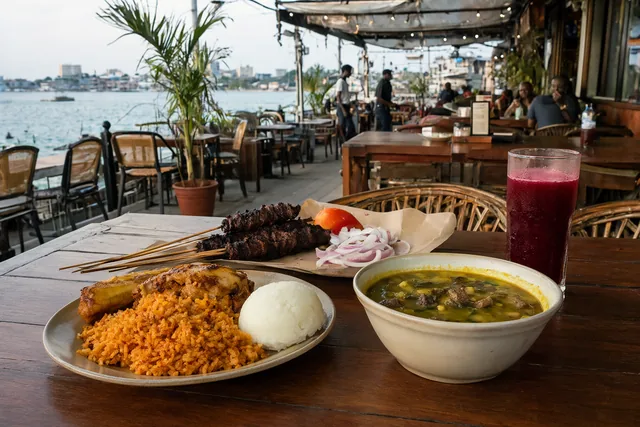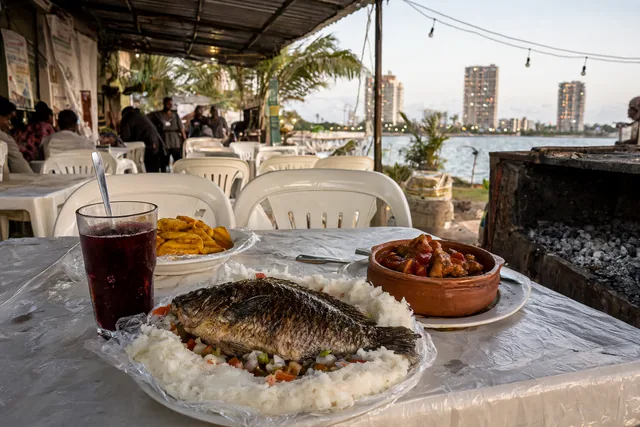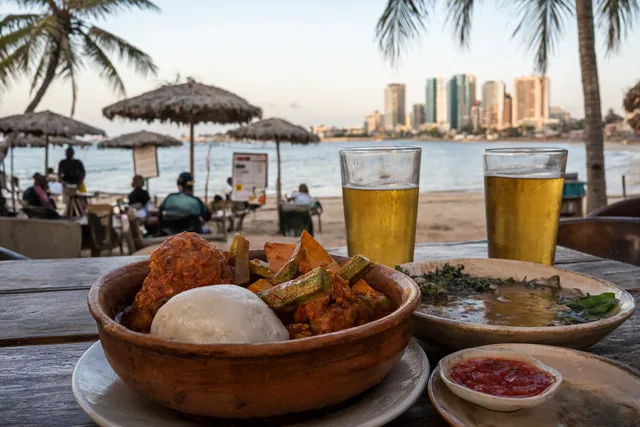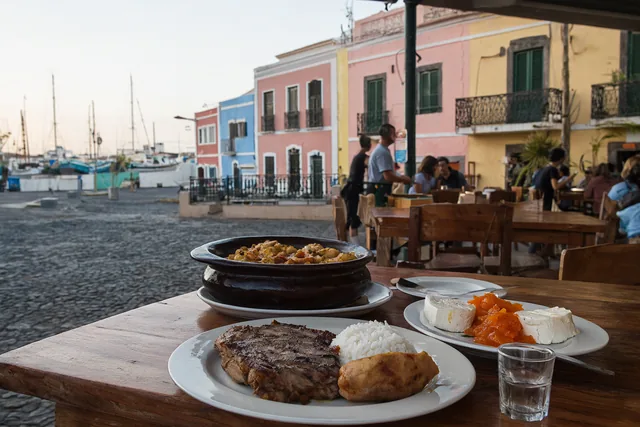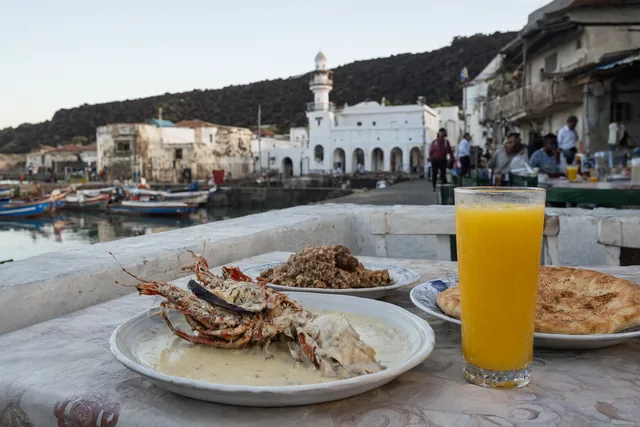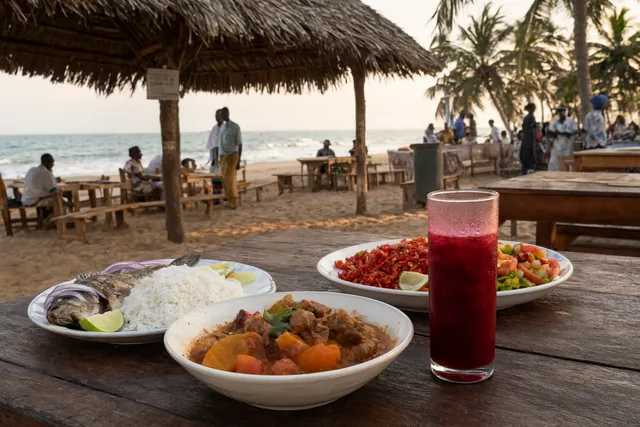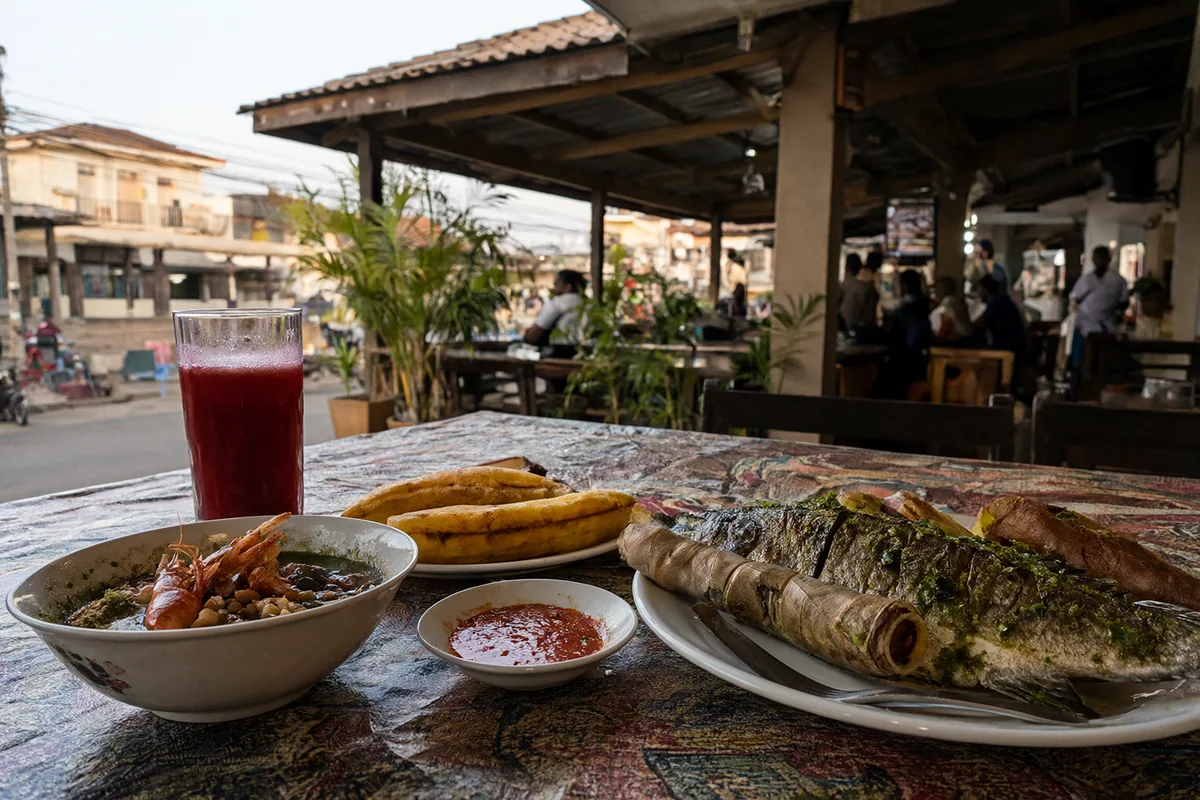
Cameroon is often called "Africa in miniature", and its food covers the same ground: bitterleaf and peanut stews on the coast, palm nut and cocoyam dishes in the western highlands, grilled meat and millet in the north, and charcoal-grilled fish everywhere there is water. This Cameroon food guide covers the dishes to order, the French and English words you will meet on menus and at roadside grills, how tipping and paying in CFA francs works, and then goes through where to eat in Douala, Yaoundé, Kribi, Limbe, Buea and the West Region. Cameroon has two official languages, French and English, and more than 200 local languages, so a single dish can have three names depending on where you order it.
What to eat in Cameroon: 12 dishes to know
These are the dishes worth seeking out, with the region they belong to. Most meals pair a stew or sauce with a starch: plantain, cassava, cocoyam, rice or maize.
- Ndolé (Douala and the Littoral): the national dish, a stew of washed and boiled bitterleaf with ground peanuts, garlic and onion, cooked with beef, smoked fish or prawns. Served with fried ripe plantain (plantain mûr), boiled green plantain or miondo.
- Poisson braisé (everywhere): a whole fish, often bar (sea bass) or maquereau (mackerel), scored, rubbed with a spice and herb paste and grilled over charcoal. Eaten with your fingers, with chilli sauce and a cassava stick.
- Poulet DG (everywhere): "director general's chicken", chicken sautéed with ripe plantain, carrots, green beans and peppers. Once a dish for special occasions, now on every restaurant menu.
- Eru and water fufu (the Southwest): finely shredded eru leaves (wild gnetum) cooked with waterleaf, palm oil, cow skin, smoked fish and crayfish, eaten with fermented cassava fufu.
- Achu and yellow soup (the Northwest, also eaten across the country): pounded cocoyam shaped into a bowl and filled with a bright yellow soup of palm oil and limestone, with beef, tripe and cow skin.
- Koki (the coast and the West): a steamed pudding of ground black-eyed peas and red palm oil, wrapped in banana leaves, eaten with boiled plantain or cocoyam.
- Mbongo tchobi (the Bassa people, Centre and Littoral): a black stew of fish or meat, coloured and flavoured by charred and ground spices.
- Okok (the Centre and South): pounded gnetum leaves cooked with peanut paste, sometimes sweetened, served with cassava sticks.
- Taro and sauce jaune (the West): pounded taro with a yellow palm oil and spice sauce, the Bamiléké cousin of achu.
- Soya (the north, now everywhere): beef skewers coated in a spicy peanut rub and grilled at night, served on paper with raw onion and chilli. The same thing Nigerians call suya.
- Beignets, haricots, bouillie (everywhere): the classic street breakfast, known by its initials "BHB": puffy fried doughnuts, red beans in sauce and a sweet maize or rice porridge.
- Sanga (the Centre): fresh maize and cassava leaves cooked with palm nut juice, a seasonal dish of the Beti people.
Staple starches you will see again and again are bâton de manioc (fermented cassava rolled in leaves and boiled into a dense, sour stick), miondo (thinner cassava sticks, typical of Douala), couscous (in Cameroon, a firm maize or cassava dough, not North African grains) and plantain in every form. To drink, try folere (chilled hibiscus, called foléré in French and bissap in parts of the country), fresh ginger juice and matango, palm wine, best on the day it is tapped. Cameroon's national beers are drunk in large bottles at any time of day, and the country grows coffee and cocoa in the West.
How to read a menu in Cameroon in French and English
Most of Cameroon is French-speaking, and menus in Douala, Yaoundé and Kribi are in French. In the English-speaking Northwest and Southwest, including Limbe and Buea, menus are in English with Pidgin and local names. Small roadside eateries, called tourne-dos (literally "turn your back", because you sit with your back to the street), may have no menu at all: a few pots of the day's dishes and a price per plate. Fish grilled on the street is the domain of the braiseuses, the women who run charcoal grills in the evening. These are the words worth knowing.
| French | English | Meaning |
|---|---|---|
| Plat du jour | Dish of the day | The day's cooked dish, often the best value |
| Poisson braisé | Roasted fish | Whole fish grilled over charcoal |
| Bar / maquereau / carpe | Sea bass / mackerel / tilapia | The fish you will see most often |
| Crevettes / gambas | Shrimps / prawns | Often grilled or in ndolé |
| Poulet / boeuf / porc / chèvre | Chicken / beef / pork / goat | Meats on most menus |
| Plantain mûr / plantain vert | Ripe / green plantain | Sweet fried plantain / boiled starchy plantain |
| Bâton de manioc, miondo | Cassava stick | Fermented cassava, boiled in leaves |
| Couscous | Fufu, corn fufu | Stiff maize or cassava dough |
| Brochettes | Kebabs | Skewers of meat, often with soya spice |
| Sauce arachide | Groundnut soup | Peanut sauce |
| Piment | Pepper | Chilli; "pimenté" means spicy |
| Tourne-dos | Chop house | Simple roadside eatery |
| Jus de foléré / gingembre | Folere / ginger juice | Chilled hibiscus / ginger drink |
At a grill, braised fish is often priced by the fish, and the price depends on its size. Point at the one you want and agree the price before it goes on the charcoal. swap.menu reads French and English menus and handwritten boards, explains dish names like ndolé and eru, and converts CFA franc prices to your home currency.
Tipping, tax and paying the bill in Cameroon
Check your government's current travel advice before planning a trip. Tipping is not obligatory in Cameroon, but it is appreciated. In restaurants used to visitors, leaving around 5 to 10 percent for good service is generous, and at tourne-dos, grills and street stalls rounding up is enough. Value added tax (TVA) is included in menu prices in most places, though hotels and some upmarket restaurants show taxes separately on the bill. Our guide to tax and service charges on menus explains how these lines work.
The currency is the Central African CFA franc (XAF), written FCFA or simply CFA on menus. Cameroonians use mobile money for many everyday payments, and cards are accepted mainly in hotels, supermarkets and larger restaurants in Douala and Yaoundé. Carry cash in small notes for everything else, because street sellers often cannot break large ones. When a card machine offers to charge you in your home currency, choose CFA francs: our guide to paying in local currency explains why.
Breakfast is often beignets, beans and bouillie from a street stall, or bread and an omelette. Lunch is usually from about noon to 2pm, and dinner from about 7pm, when the grills and soya sellers light their charcoal. Many local dishes are eaten with the right hand, and a bowl of water is often brought to wash your fingers. The north is mostly Muslim, while the south and west are mainly Christian, and alcohol is widely available in the south.
Where to eat in Cameroon, city by city
Cameroon's cities each have their own dishes and their own way of eating out, from the grilled fish ports of the coast to the market towns of the highlands. Jump to a destination:
Where to eat in Douala
Douala is Cameroon's largest city and its main port, on the estuary of the Wouri River, which Portuguese sailors named Rio dos Camarões, "river of prawns", giving the country its name. This is the home of ndolé, cooked by the Sawa people of the coast, usually with prawns or smoked fish and served with miondo or fried plantain. Douala is also the city for poisson braisé: in the evening, grills appear on street corners and in open-air bars, and the fish comes with chilli, onions and a cold beer. The fishing port of Youpwe is known across the city for its grilled fish, eaten at simple tables by the water.
The central districts of Akwa and Bonanjo have the hotels, French-style bakeries and business lunch restaurants, while Bonapriso and Bali are where the smarter restaurants and bars are. Deido and Bonaberi, across the bridge, are livelier and more local, with tourne-dos and grills. Douala is hot and humid, and the food matches: lots of fish, lots of pepper and lots of cold drinks. Taxis are shared and cheap, and the best grilled fish is usually found where the locals are already queuing.
Where to eat in Yaoundé
Yaoundé, the capital, sits on seven hills in the green Centre region, and its food is the cooking of the Beti and Ewondo peoples: okok, sanga, koki, bâton de manioc and stews of fish or meat wrapped in leaves and steamed, called mets (for example mets de pistache, a steamed pudding of ground white melon seeds). Grilled pork and chicken are popular in the evening, as is soya bought from roadside sellers. Yaoundé is also where you will find restaurants from every region of the country, so it is easy to try ndolé, eru and achu in one city.
Bastos is the diplomatic quarter, with international and upmarket Cameroonian restaurants, while the city centre around the Marché Central and the Mokolo market is where to see produce, spices and cheap cooked food. The area around Mvog-Mbi is known for its markets and evening grills. Yaoundé is cooler than Douala, and the evenings are pleasant for eating outside at a grill or a bar with plastic chairs and a few tables under a tree.
Where to eat in Kribi
Kribi is Cameroon's best-known beach town, on the Atlantic coast south of Douala, with palm-lined beaches and white sand. Kribi is the place for seafood: grilled gambas (prawns), lobster in season, bar and other fish caught that morning, served on the beach with fried plantain, miondo and chilli sauce. Look for the grills along the beach road and near the fishing harbour, where pirogues land their catch and the fish is cooked within sight of the boats.
A short drive south, the Lobé Falls, where a river falls straight into the sea, have simple restaurants serving grilled fish and prawns by the water, and are a popular lunch outing from Kribi. Kribi fills up at weekends and holidays with visitors from Douala and Yaoundé, and prices for lobster and prawns rise accordingly. Ask the price of seafood by the piece or by the kilo before ordering, and expect cash only at the smaller beach grills.
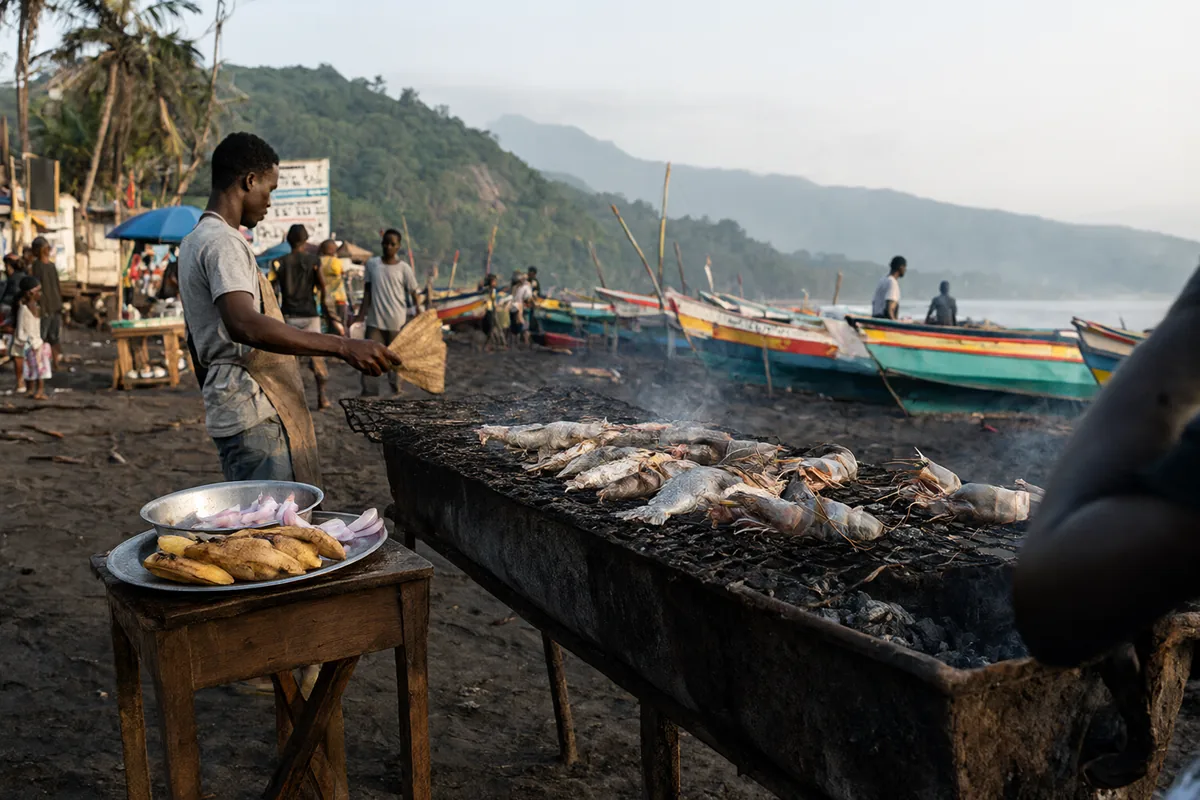
Where to eat in Limbe
Limbe is an English-speaking seaside town at the foot of Mount Cameroon, with black volcanic sand beaches and a relaxed pace. The famous place to eat in Limbe is Down Beach, where fishing boats land their catch and grills cook it on the spot: pick a fish, agree the price, and it is grilled and served with plantain, bobolo (a cassava stick) or chips and a hot pepper sauce. In the evening, Down Beach is one of the most popular spots in the region for fish and a cold drink.
Limbe is also a good place to try the food of the Southwest: eru and water fufu, ekwang (grated cocoyam wrapped in leaves and cooked in palm oil with smoked fish) and pepper soup. Menus and conversations are in English and Pidgin, which makes ordering easier for English speakers. The Limbe Botanic Garden and the Limbe Wildlife Centre are both close to the town centre, and the town's restaurants cluster near the seafront.
Where to eat in Buea
Buea sits on the slopes of Mount Cameroon, the highest mountain in West Africa, and is the starting point for climbs. It is a university town with a cooler climate and simple, hearty food. The everyday dishes here are eru, achu and yellow soup, ekwang, koki and roasted plantain and corn from the roadside. Students keep the food cheap, and the local chop houses (the English equivalent of a tourne-dos) serve big plates of rice and stew, fufu and soup, or plantain and beans.
Buea's small restaurants and bars are concentrated around Molyko, the student area, and along the main road through the town. Hikers heading up the mountain should stock up on bread, fruit, groundnuts and water in Buea, as there is little food on the trail. Evenings in Buea are cool, and a bowl of pepper soup or a plate of grilled fish with plantain is the local way to warm up.
Where to eat in the West Region
The West Region, with the towns of Bafoussam, Dschang and Foumban, is the green highland home of the Bamiléké and Bamoun peoples, and one of Cameroon's farming heartlands, with coffee, potatoes, maize, vegetables and fruit. The food is distinctive: taro and sauce jaune, nkui (a slippery, spiced soup eaten with maize couscous, traditionally prepared for new mothers), kondré (a stew of green plantain with goat or beef and spices) and koki. Market days are the best time to eat, when cooked food stalls serve local dishes alongside the produce.
Bafoussam is the regional capital and a busy market town, Dschang has a cooler climate and a lakeside centre, and Foumban, seat of the Bamoun sultans, has a royal palace and a long artisan street. In all three, the best food is in markets and simple local restaurants rather than in hotels. Bamiléké weddings and funerals are famous for their feasts, and kondré is the dish served at the biggest celebrations. Roads between the towns are winding, so plan to eat where you stop.
Vegetarian, vegan and allergy tips
Vegetarians need to ask questions in Cameroon. Ndolé, eru, okok and most sauces are cooked with meat, smoked fish, crayfish or cow skin, even when they look like a dish of leaves, and stock cubes are in almost everything. The easiest vegetarian dishes are koki, beignets and beans, fried or boiled plantain, roasted corn, avocado (very good in Cameroon) and rice with a vegetable sauce made to order. The word for vegetarian is végétarien (or végétarienne for a woman), and it helps to add "sans viande, sans poisson" (no meat, no fish).
Peanuts are everywhere: in ndolé, okok, soya spice, sauce arachide and street snacks, so people with peanut allergies need to ask about every dish. Palm oil and chilli are in most stews, and crayfish (ground dried shrimp) is a common hidden ingredient for shellfish allergies. Most starches (cassava, plantain, taro, rice) are naturally gluten-free, but beignets and bread are not. Our guide to eating abroad with food allergies explains how to communicate a serious allergy clearly.
Useful French and Pidgin phrases for ordering
Bonjour / Bonsoir "Good morning / Good evening", the polite greeting in French-speaking Cameroon
Je voudrais ça, s'il vous plaît "I would like this, please" (pointing)
C'est combien? "How much is it?"
Pas trop pimenté, s'il vous plaît "Not too spicy, please"
L'addition, s'il vous plaît "The bill, please"
How much for dis one? "How much is this one?" in Cameroonian Pidgin, used in Limbe and Buea
I beg, no put too much pepper "Please do not add too much chilli" in Pidgin
Merci, c'était très bon "Thank you, it was delicious"
How swap.menu helps you eat in Cameroon
Cameroonian menus switch between French, English and local names, often on the same page, and the board outside a tourne-dos might list only ndolé-miondo, eru, mbongo and kondré. Photograph it with swap.menu and every dish appears in your language with its original name beside it and a short explanation, so you know that mbongo is a black spiced fish stew, that kondré is plantain cooked with goat, and that miondo is a cassava stick. Prices are converted from CFA francs to your home currency, and any tax or service line is flagged.
Tap the dishes you want, add a note such as "no peanuts" or "pas trop pimenté", typed or spoken, and swap.menu translates your order into French. Show the waiter your phone, or let them scan the QR code and read your order on their own screen. Try it on a sample menu with the free demo, or see travel pass prices.
Off to Cameroon? Your first 3 menu scans are free, and a travel pass starts from $4.99 with nothing that renews.
Start free with 3 scansCameroon food FAQ
Do you tip in restaurants in Cameroon?
Tipping is not required in Cameroon, but around 5 to 10 percent is appreciated in restaurants used to visitors. At roadside eateries, grills and street stalls, rounding up the bill is enough.
What is the national dish of Cameroon?
Ndolé is usually called the national dish: a stew of bitterleaf, ground peanuts and meat, fish or prawns, served with plantain or cassava sticks. It comes from the Sawa people of the Douala coast.
What food is Cameroon famous for?
Cameroon is famous for ndolé, poisson braisé, poulet DG, eru, achu with yellow soup, koki and soya beef skewers. The coast is known for grilled fish and prawns, and the West for taro, kondré and nkui.
Is it expensive to eat out in Cameroon?
Street food, grills and tourne-dos are cheap. Restaurants in Douala's Bonapriso, Yaoundé's Bastos and hotel restaurants cost much more, and seafood like lobster and prawns is priced higher in beach towns such as Kribi.
Is tap water safe to drink in Cameroon?
No, visitors should drink bottled water in Cameroon. Bottled water is sold everywhere, and it is wise to avoid ice and raw salads washed in tap water at simple places.
How can I read a Cameroonian menu if I do not speak French?
Learn a few words such as poisson, poulet, plantain and plat du jour, or photograph the menu with swap.menu. It translates French menus, explains local dish names, converts CFA franc prices to your currency and translates your order back into French.
Travelling further in Central and West Africa? Read our food guides for neighbouring countries:
- Nigeria food guide
- Gabon food guide
- Republic of the Congo food guide
- São Tomé and Príncipe food guide
- Ghana food guide
Or browse every travel food guide.