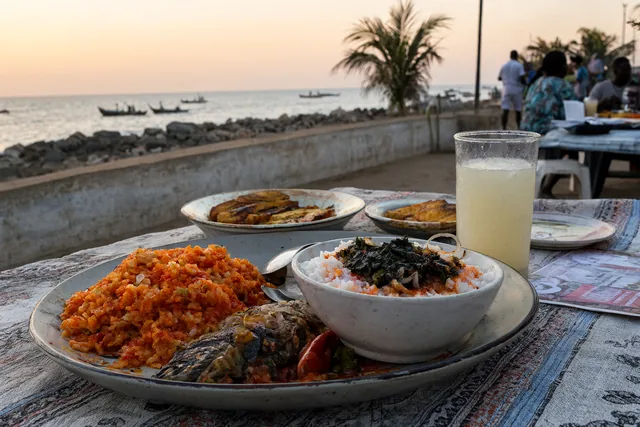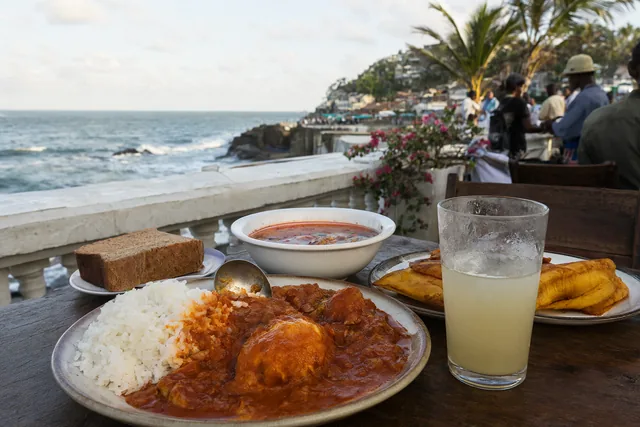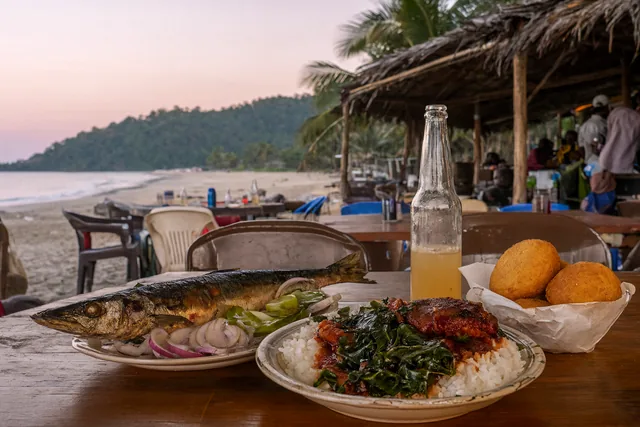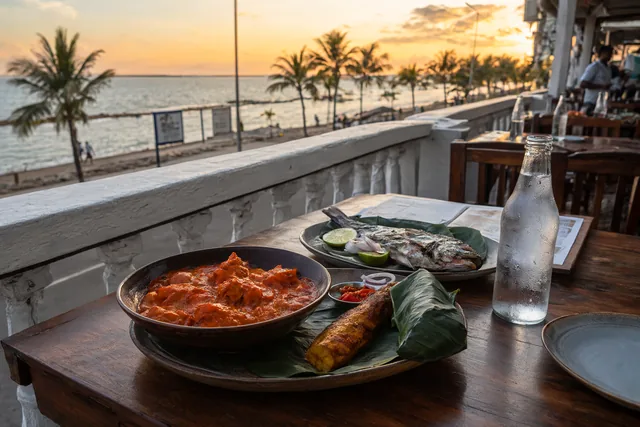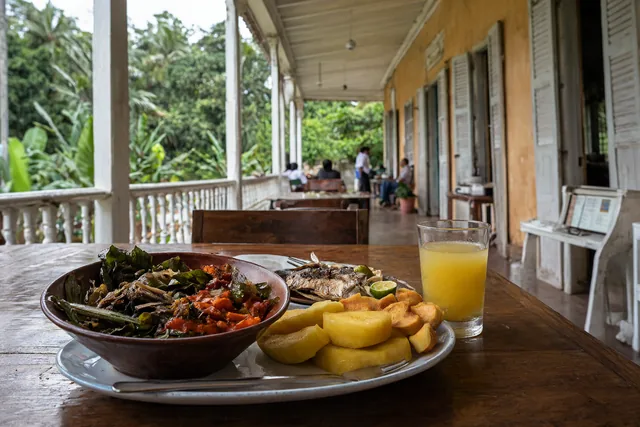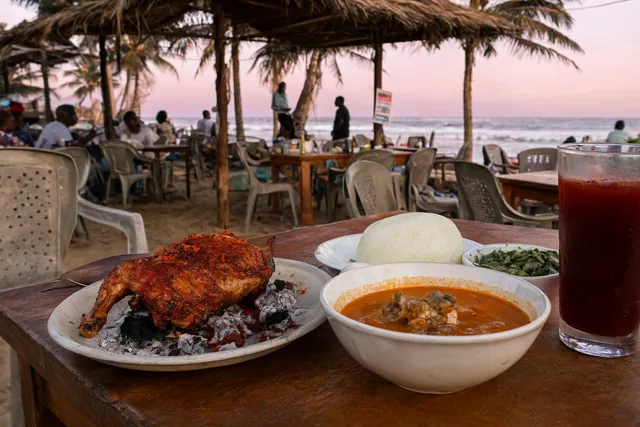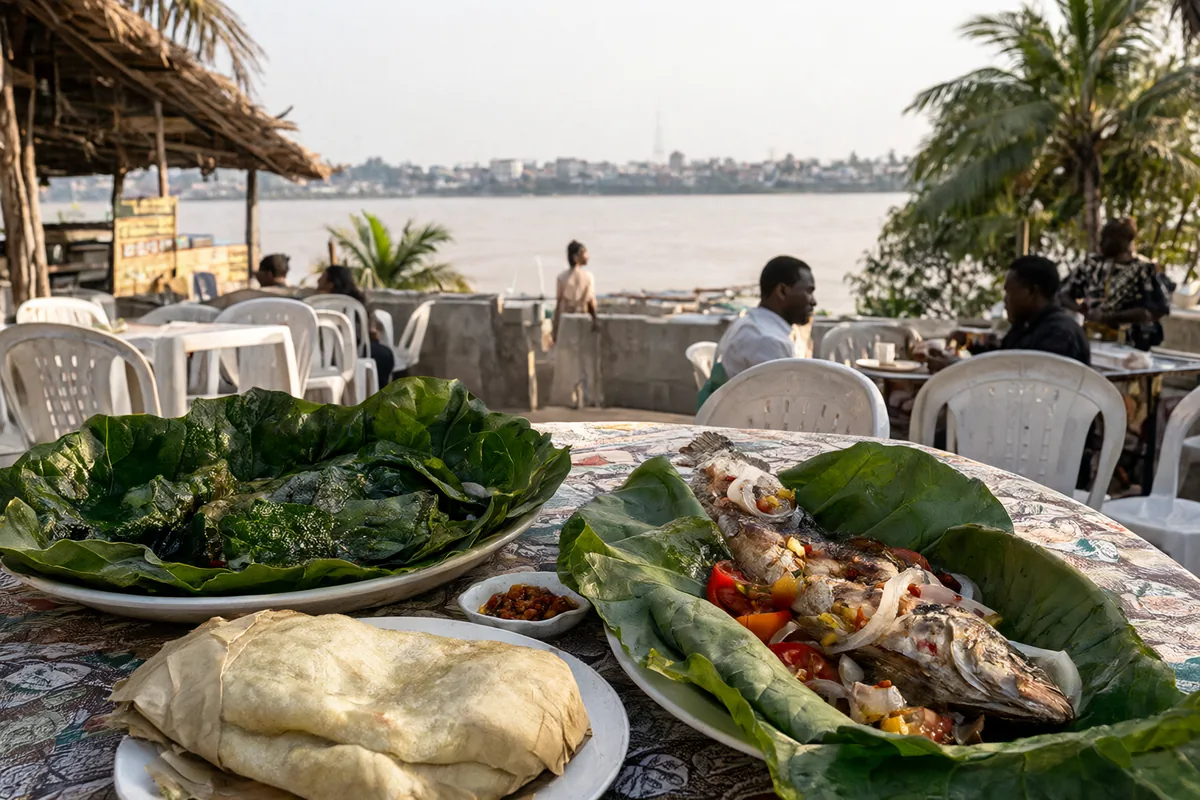
The food of the Republic of the Congo comes from the river and the forest: fish steamed in leaves with chilli, pounded cassava leaves cooked in palm oil, chicken in red palm nut sauce, and chikwangue, a dense fermented cassava bread wrapped in leaves, sold at every market. This Republic of the Congo food guide covers the dishes to order, the French and Lingala words you will meet on menus and at riverside terraces, how tipping and paying in CFA francs works, and then goes through where to eat in Brazzaville, Pointe-Noire, Loango and the Kouilou coast, Dolisie, Ouesso and Odzala-Kokoua National Park. The country is often called Congo-Brazzaville to distinguish it from its larger neighbour, the Democratic Republic of the Congo, across the river. French is the official language, Lingala is spoken in Brazzaville and the north, and Kituba in Pointe-Noire and the south.
What to eat in the Republic of the Congo: 12 dishes to know
These are the dishes worth seeking out. Congolese meals pair a starch, usually cassava in some form, with a stew of leaves, palm nut or fish, and plenty of chilli on the side.
- Saka-saka: the national dish, cassava leaves pounded and slow-cooked for hours with palm oil, onions, garlic, often peanut paste, and smoked or salted fish. The same dish is called pondu across the river in Kinshasa.
- Poulet à la moambé: chicken simmered in a rich red sauce of palm nut pulp (moambé), served with rice, cassava or plantain. Fish moambé is also common.
- Maboké: fish, usually capitaine or another river fish, or chicken, seasoned with chilli, onion and tomato and steamed or grilled in a parcel of large forest leaves. Opening the parcel at the table is part of the meal.
- Chikwangue: fermented cassava pounded, wrapped in leaves and steamed into a dense, sour, rubbery loaf, the everyday staple. Called kwanga in Lingala.
- Foufou: a stiff dough of cassava flour, eaten with saka-saka, fish stews or moambé.
- Poisson braisé: whole fish, often capitaine (Nile perch), tilapia or catfish from the river, or sea fish in Pointe-Noire, grilled over charcoal with chilli and onions.
- Ntaba: grilled goat, a favourite at riverside terraces and bars in the evening, often served with chikwangue, chilli and onions.
- Mbika: a paste of ground squash or pumpkin seeds, cooked with fish or meat into a thick, nutty stew or steamed in leaves.
- Koko: finely shredded leaves of a forest vine (gnetum), cooked with palm oil, peanuts and smoked fish.
- Ngaï-ngaï: sour leaves of the roselle plant cooked with fish or meat, giving a tangy stew.
- Poisson salé and poisson fumé: salted and smoked fish, cooked into stews with tomatoes, onions and leaves. Salted fish is called makayabu in Lingala.
- Brochettes: skewers of beef, goat or chicken grilled at street stalls, with chilli and chikwangue or bread.
Street snacks include beignets (fried doughnuts, also called mikaté), roasted peanuts, fried plantain and safou, the purple African plum, boiled or roasted and eaten with chikwangue in season. To drink, try fresh palm wine (malafu), jus de gingembre (ginger juice), and the country's local beers, drunk in large bottles at riverside terraces. Bush meat (viande de brousse) is sold in markets and on some menus, but many forest species are protected, and conservation groups ask visitors not to buy or order it.
How to read a Congolese menu in French and Lingala
Menus in the Republic of the Congo are in French, and local dishes are written in French, Lingala or Kituba. Much of Brazzaville's eating out happens at open-air terrasses and bars called nganda, where grilled fish, goat and chicken are served with chikwangue and cold beer, often with music. Women sell saka-saka, fish stews and foufou from big pots at lunchtime, often with no menu at all. These are the words worth knowing.
| French or Lingala | Meaning |
|---|---|
| Saka-saka | Pounded cassava leaves in palm oil |
| Moambé | Red palm nut sauce |
| Maboké | Fish or chicken steamed in leaves |
| Chikwangue / kwanga | Fermented cassava bread in leaves |
| Foufou | Stiff cassava flour dough |
| Poisson braisé / fumé / salé | Grilled / smoked / salted fish |
| Capitaine | Nile perch, the prized river fish |
| Ntaba | Goat, usually grilled |
| Poulet / boeuf / porc | Chicken / beef / pork |
| Pili-pili / piment | Chilli; "pimenté" means spicy |
| Nganda / terrasse | Open-air bar or eatery |
| Viande de brousse | Bush meat; many species are protected |
| Vin de palme / malafu | Palm wine |
Grilled fish and goat at a terrasse are usually priced by the fish or by the portion, and chikwangue, plantain and drinks are extra. Agree the price before it goes on the grill. swap.menu reads French menus and handwritten boards, explains Lingala and Kituba dish names and converts CFA franc prices to your home currency.
Tipping, tax and paying the bill in the Republic of the Congo
Tipping is not obligatory in the Republic of the Congo, but it is appreciated. In restaurants used to visitors, leaving around 5 to 10 percent for good service is normal, and at terrasses and street stalls rounding up is enough. Value added tax (TVA) is included in menu prices in most places, though hotels and upmarket restaurants may show it separately or add a service charge. Our guide to tax and service charges on menus explains how these lines work.
The currency is the Central African CFA franc (XAF), written FCFA or simply CFA on menus. Cash is used for almost everything: cards are accepted only in larger hotels, some restaurants and supermarkets in Brazzaville and Pointe-Noire, and ATMs are found mainly in those two cities. Bring enough cash before travelling inland. Imported food and wine are expensive, and restaurants aimed at expats in Pointe-Noire, the oil capital, charge high prices. When a card machine offers to charge you in your home currency, choose CFA francs: our guide to paying in local currency explains why.
Lunch is eaten from about noon to 2pm, and dinner from about 7:30pm. Terrasses and nganda are busiest in the evening and at weekends, when they become places to eat, drink and listen to music. Chikwangue, foufou and saka-saka are often eaten with the right hand, with a bowl of water for washing. The country is mostly Christian, and alcohol is widely available.
Where to eat in the Republic of the Congo, place by place
Most of the country's restaurants are in Brazzaville and Pointe-Noire, while the coast, the interior and the northern forests have a small, local food scene and a few lodges. Jump to a destination:
Where to eat in Brazzaville
Brazzaville, the capital, sits on the north bank of the Congo River, directly facing Kinshasa, capital of the Democratic Republic of the Congo, on the opposite shore. The river is at the centre of Brazzaville life and food: riverside terraces serve poisson braisé, maboké and grilled ntaba with chikwangue and cold beer, with views across the water to Kinshasa. The Corniche, the riverfront road, has restaurants and bars, and the area around Le Djoué and the rapids of the Congo River, just outside the city, is a popular weekend spot for grilled fish by the water.
The district of Poto-Poto is the heart of popular Brazzaville, with its large market, its famous school of painting and streets full of terrasses, music and food. In Bacongo, the Marché Total is one of the city's biggest markets, with chikwangue, smoked fish, saka-saka leaves, safou and chillies, and women cooking lunch for traders. The city centre and the area around the Plateau have French-style bakeries, cafés and restaurants with Congolese, French and Lebanese food. Brazzaville terrasses are at their liveliest on Friday and Saturday nights.
Where to eat in Pointe-Noire
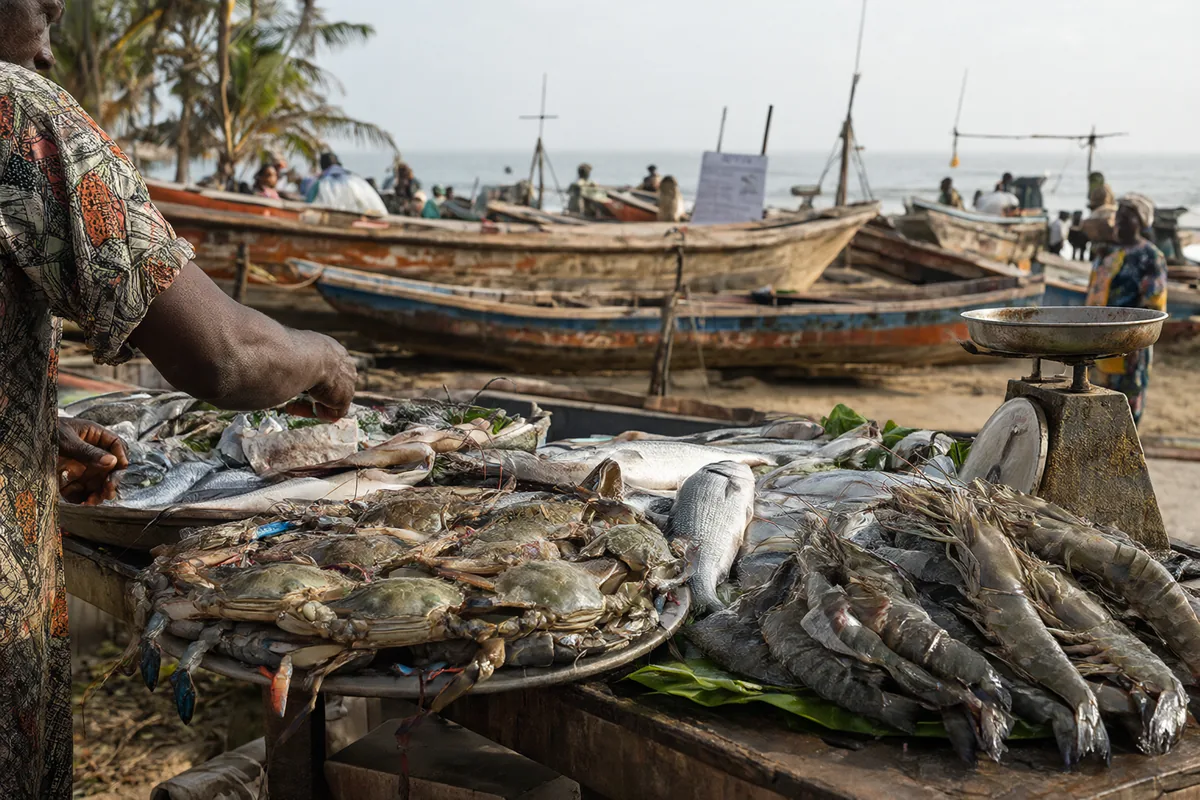
Pointe-Noire, on the Atlantic coast, is the country's economic capital and oil city, and its food is built on the sea: grilled bar (sea bass), capitaine, prawns, crab and lobster, alongside saka-saka, moambé and chikwangue. Fishermen land their catch on the beaches, and the city's markets, including the Grand Marché and the Tié-Tié market, sell fresh and smoked fish, cassava, plantains and fruit, with food stalls cooking for traders.
The seafront and the beaches of Pointe-Noire, including the long Côte Sauvage, have beach bars and restaurants serving grilled fish and seafood, busy at weekends. The oil industry has brought French, Lebanese, Italian and other international restaurants to the city centre, often at high prices. For local food, look for terrasses serving grilled fish and ntaba in the popular districts, and women selling saka-saka and foufou at lunchtime. Kituba is the main local language here, alongside French.
Where to eat in Loango and the Kouilou coast
North of Pointe-Noire, the Kouilou coast has the historic site of Loango, once the capital of the Kingdom of Loango and a major port of the Atlantic slave trade, with a memorial and museum at nearby Diosso. The Gorges de Diosso, a dramatic canyon of red cliffs, is a short drive away. Food on the Kouilou coast is simple: village eateries serving grilled fish, saka-saka and chikwangue, and fish bought directly from fishermen on the beaches.
Further north, Conkouati-Douli National Park protects coastal forest, lagoons and beaches, with simple accommodation where meals are arranged. Most visitors explore the Kouilou coast on a day trip from Pointe-Noire and eat lunch at a beach or village restaurant, or bring a picnic. Bring cash and water, as facilities are limited.
Where to eat in Dolisie
Dolisie, the country's third city, is a crossroads town in the south, on the Congo-Océan railway between Brazzaville and Pointe-Noire. It is a busy market and transport town rather than a destination, and its food is everyday Congolese cooking: saka-saka, moambé, smoked fish stews, foufou and chikwangue at local eateries and markets, and grilled meat at evening terrasses.
Dolisie's central market is the best place to eat and to see the produce of the region, and food sellers gather at the railway station and bus stops to sell chikwangue, safou, peanuts and fried fish to passengers. Dolisie has a handful of hotels and restaurants. Bring cash, as cards are rarely accepted.
Where to eat in Ouesso
Ouesso, in the far north on the Sangha River, is the main town of the northern forests and a gateway to Nouabalé-Ndoki National Park and the shared Sangha Trinational forest, a UNESCO World Heritage Site. The food here is forest and river cooking: river fish, fresh and smoked, cassava in all its forms, koko leaves, palm oil and plantain. The market by the river is busy with boats bringing in fish and produce.
Ouesso's food scene is small, built around the market, simple local eateries and a few hotels. Bush meat is sold openly in markets in this region, but many species are protected and visitors are asked not to buy it. Most visitors pass through Ouesso on the way to national parks, where meals are arranged by lodges and camps.
Where to eat at Odzala-Kokoua
Odzala-Kokoua National Park, in the northwest, is one of the oldest national parks in Africa and one of the best places on the continent to see western lowland gorillas, forest elephants and forest wildlife. There are no towns or restaurants inside the park, and the eating is done at a small number of lodges and camps, where meals are included in the stay.
Lodge menus are usually international with Congolese touches, such as river fish cooked in leaves in the style of maboké, saka-saka, plantain and tropical fruit. Supplies come from far away, so mention any dietary needs well in advance when booking. Visits are usually arranged as packages with flights, and the lodges handle all meals.
Vegetarian, vegan and allergy tips
Vegetarians need to ask questions in the Republic of the Congo. Saka-saka, koko and most stews are cooked with smoked or salted fish, meat or stock cubes, even when they look like vegetable dishes. The easiest vegetarian options are chikwangue, foufou, fried or boiled plantain, safou, beignets, roasted peanuts, rice, avocado and fruit, and a saka-saka or vegetable stew made to order without fish (ask). The word for vegetarian is végétarien (végétarienne for a woman), and "sans viande, sans poisson" means no meat, no fish.
Peanuts are used in saka-saka, koko and many snacks, and squash seeds in mbika, so people with nut and seed allergies should ask about every dish. Palm oil and chilli are in most sauces, and smoked and salted fish are common hidden ingredients. Cassava, plantain and rice are naturally gluten-free, but bread and beignets are not. Our guide to eating abroad with food allergies explains how to communicate a serious allergy clearly.
Useful French and Lingala phrases for ordering
Bonjour / Bonsoir "Good morning / Good evening" in French; always greet before ordering
Mbote "Hello" in Lingala
Je voudrais un poisson braisé, s'il vous plaît "I would like a grilled fish, please"
C'est combien? / Ntalo boni? "How much is it?" in French / Lingala
Pas trop pimenté, s'il vous plaît "Not too spicy, please"
L'addition, s'il vous plaît "The bill, please"
Elengi mingi "Very tasty" in Lingala
Merci / Matondo "Thank you" in French / Lingala and Kituba
How swap.menu helps you eat in the Republic of the Congo
Congolese menus are in French, but many of the dishes have Lingala or Kituba names, and the board at a terrasse might list only maboké, ntaba, mbika and saka-saka. Photograph it with swap.menu and every dish appears in your language with its original name beside it and a short explanation, so you know that maboké is fish steamed in leaves, that ntaba is goat and that mbika is a squash seed paste. Prices are converted from CFA francs to your home currency, and any tax or service line is flagged.
Tap the dishes you want, add a note such as "no peanuts" or "pas trop pimenté", typed or spoken, and swap.menu translates your order into French. Show the waiter your phone, or let them scan the QR code and read your order on their own screen. Try it on a sample menu with the free demo, or see travel pass prices.
Off to the Republic of the Congo? Your first 3 menu scans are free, and a travel pass starts from $4.99 with nothing that renews.
Start free with 3 scansRepublic of the Congo food FAQ
Do you tip in restaurants in the Republic of the Congo?
Tipping is not required, but around 5 to 10 percent is appreciated in restaurants used to visitors. At terrasses and street stalls, rounding up is enough.
What is the national dish of the Republic of the Congo?
Saka-saka, pounded cassava leaves slow-cooked with palm oil and smoked or salted fish, is usually called the national dish. Poulet à la moambé and maboké are close favourites.
What food is the Republic of the Congo famous for?
The country is famous for saka-saka, moambé, maboké, chikwangue, grilled capitaine from the Congo River and grilled goat. Safou, the African plum, is a much-loved seasonal snack.
Is it expensive to eat out in the Republic of the Congo?
Local food at markets, terrasses and street stalls is cheap. Restaurants aimed at expats and visitors in Brazzaville and especially Pointe-Noire are expensive, and imported food and wine cost a lot.
Is tap water safe to drink in the Republic of the Congo?
No, visitors should drink bottled water. Bottled water is sold in the cities, and it is wise to carry some when travelling inland and to avoid ice and raw salads at simple places.
How can I read a Congolese menu if I do not speak French?
Learn a few words such as poisson, poulet, chikwangue and plat du jour, or photograph the menu with swap.menu. It translates French menus, explains Lingala and Kituba dish names, converts CFA franc prices to your currency and translates your order back into French.
Travelling further in Central Africa? Read our food guides for neighbouring countries:
- Gabon food guide
- Cameroon food guide
- Angola food guide
- São Tomé and Príncipe food guide
- Rwanda food guide
Or browse every travel food guide.