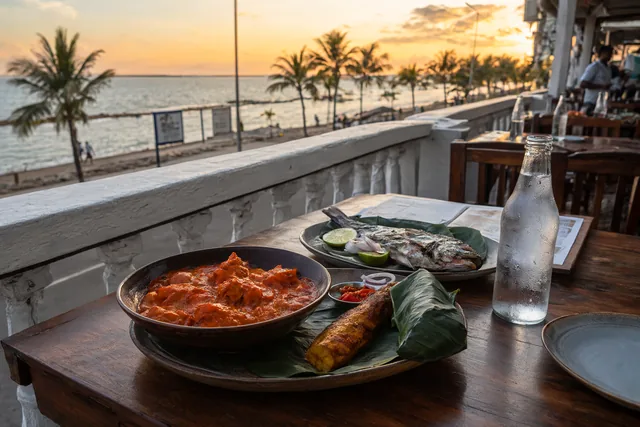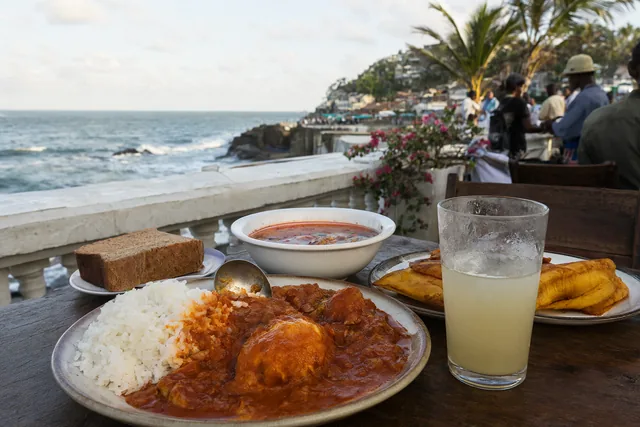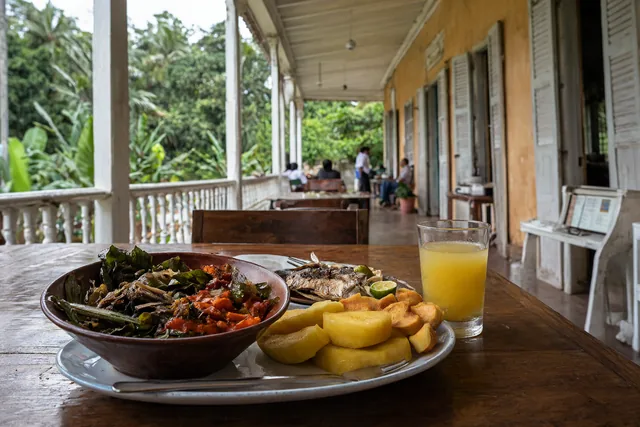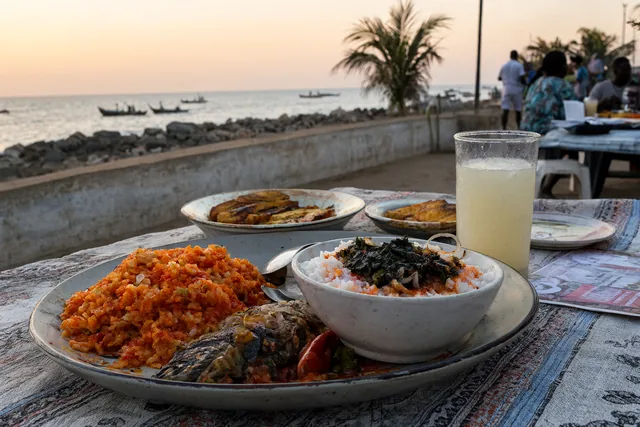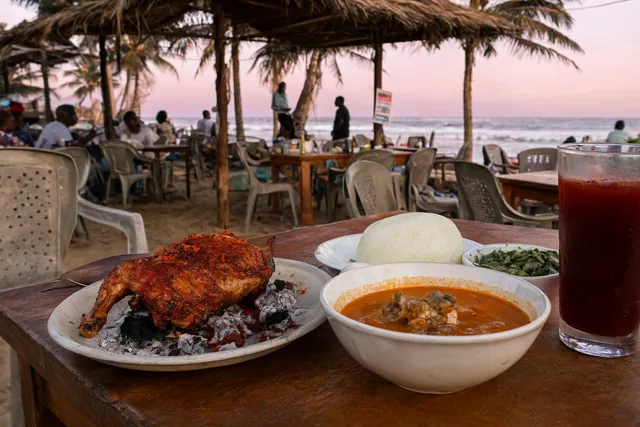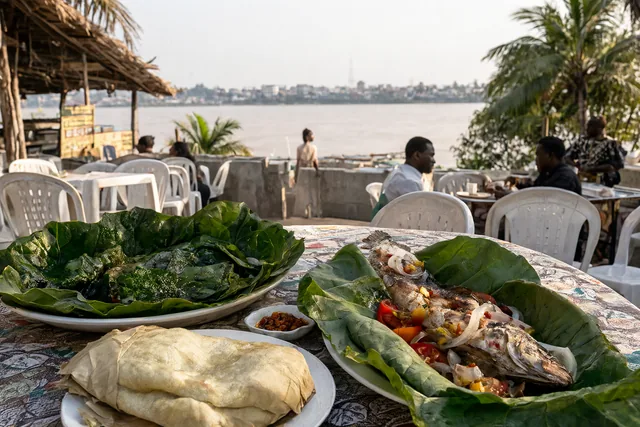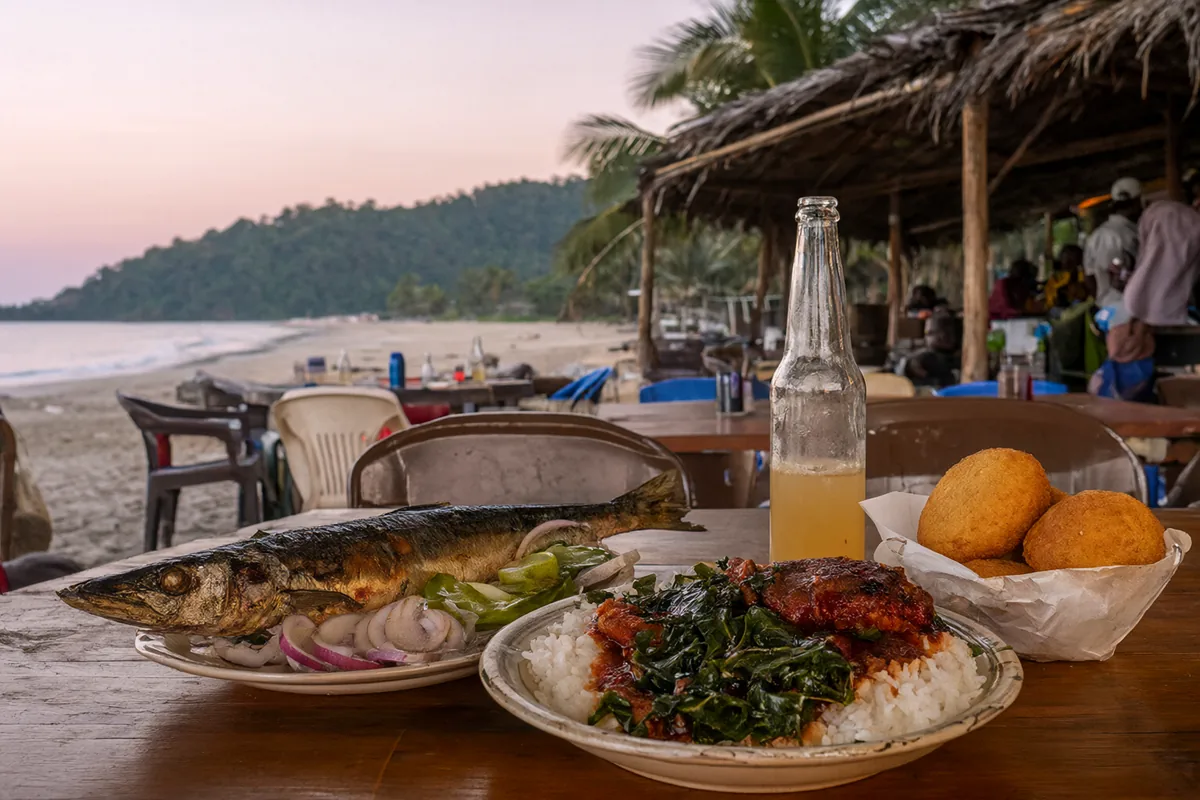
In Sierra Leone, if you have not eaten rice today, you have not eaten: almost every meal is a mound of rice under a leaf stew, a groundnut soup or an okra sauce, cooked with palm oil, fish and plenty of pepper. This Sierra Leone food guide covers the dishes to order (cassava leaves, potato leaves, groundnut soup and krain krain), the cookery and Krio words you will hear, how tipping and paying in leones works, and then goes through where to eat in Freetown, Lumley and Aberdeen, the peninsula beaches, the Banana Islands, Bo and Makeni. English is the official language, but Krio is the language of the street and the market, and Mende and Temne are spoken across the provinces.
What to eat in Sierra Leone: 12 dishes to know
These are the dishes worth seeking out. Sierra Leonean cooking is built on rice and leaf stews, known together as plasas, with fish from the Atlantic and plenty of red palm oil and chilli.
- Cassava leaves: the national dish, cassava leaves pounded or finely chopped and slow-cooked with palm oil, onions, chilli, and fish, beef or chicken, sometimes with groundnut paste. Served over rice.
- Potato leaves: sweet potato leaves, finely chopped and cooked with palm oil, fish and meat, lighter and sweeter than cassava leaves. Served over rice.
- Groundnut soup: a rich stew of groundnut (peanut) paste with chicken, beef or fish and tomato, eaten with rice or fufu.
- Okra soup: a slippery okra stew with palm oil, fish and meat, served with rice or fufu.
- Krain krain: jute leaves cooked into a slippery stew with palm oil and fish, a close cousin of okra soup.
- Jollof rice: rice cooked in a tomato sauce with chicken or fish, a party dish in Sierra Leone as elsewhere in West Africa.
- Fufu: fermented cassava dough, smooth and slightly sour, eaten with okra soup, groundnut soup or pepper soup.
- Pepper soup: a thin, spicy broth of fish, chicken or goat, a favourite snack in bars and a cure for colds.
- Grilled fish (the coast): barracuda, snapper, grouper, ladyfish and bonga, grilled whole on beach grills and served with rice, fried plantain or chips.
- Binch akara: black-eyed bean fritters, deep-fried, sold in the morning and eaten with bread or on their own.
- Fry-fry: a popular breakfast of bread filled with fried beans, fried plantain, akara, eggs or spaghetti, sold from street stalls.
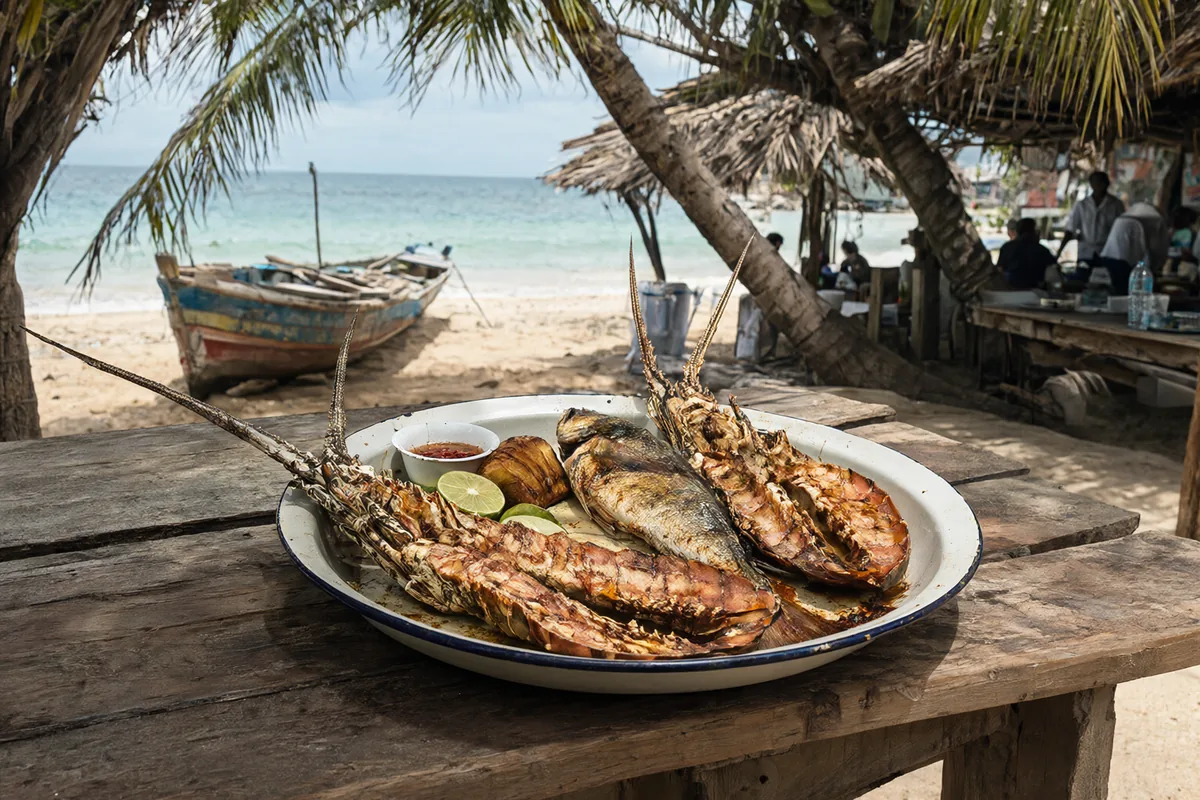
- Lobster (the Banana Islands and peninsula): spiny lobster, grilled at beach lodges and restaurants, often cheaper here than in many countries.
Snacks include roasted groundnuts, kanya (a sweet of pounded groundnuts, rice flour and sugar), fried plantain chips, coconut cakes and fresh fruit such as mangoes and pineapples. To drink, try homemade ginger beer, fiery and sweet, sold in recycled bottles, poyo (palm wine), fresh coconut water and baobab or hibiscus juices. Sierra Leone also has a strong green tea culture: young men gather at an attaya base to brew strong, sweet attaya tea for hours.
How to read a menu in Sierra Leone
Menus in Sierra Leone are in English, but many local eateries have no menu at all. A cookery is the local word for a simple restaurant, usually serving rice with two or three stews of the day, and you choose your stew and your meat or fish. Women also sell rice and plasas from big pots on the street at lunchtime, and beach bars in Freetown list the day's fish on a board. Krio words appear on boards and in conversation. These are the terms worth knowing.
| Term | Origin | Meaning |
|---|---|---|
| Cookery | Krio | Simple local restaurant serving rice and stews |
| Plasas | Krio | Leaf stew with palm oil, served over rice |
| Chop | Krio | Food, or to eat |
| Pepe | Krio | Chilli; "small pepe" means a little chilli |
| Palm oil | Sierra Leonean English | Red palm oil, the base of most stews |
| Fufu | Krio | Fermented cassava dough |
| Krain krain | Krio | Jute leaf stew |
| Binch akara | Krio | Black-eyed bean fritters |
| Fry-fry | Krio | Breakfast sandwich of fried fillings |
| Bonga | Krio | Small oily fish, often smoked |
| Poyo | Krio | Palm wine |
| Attaya base | Krio | A spot where friends brew and drink green tea |
| Pure water | Sierra Leonean English | Drinking water sold in sealed plastic sachets |
At a cookery or a beach grill, the price of a plate depends on the meat or fish you choose, and fish and lobster are priced by size. Ask the price before ordering. swap.menu explains Sierra Leonean dish names and converts leone prices to your home currency, so you know what you are paying.
Tipping, tax and paying the bill in Sierra Leone
Tipping is not obligatory in Sierra Leone, but it is appreciated, and wages are low. In restaurants and beach bars used to visitors, around 10 percent is a generous tip if no service charge has been added, and at cookeries and street stalls rounding up is enough. Hotels and upmarket restaurants add goods and services tax (GST) and sometimes a service charge to the bill, which can be on top of the menu prices. Our guide to tax and service charges on menus explains how these lines work.
The currency is the leone (SLE). In 2022 the leone was redenominated, removing three zeros, so you may still hear prices quoted in old leones, which are a thousand times larger: if a price sounds very high, ask whether it is old or new money. Cash is used for almost everything, and cards are accepted only in larger hotels, some restaurants and supermarkets in Freetown. ATMs are found in Freetown and larger towns. Some hotels and tour operators quote prices in US dollars. When a card machine offers to charge you in your home currency, choose leones: our guide to paying in local currency explains why.
Breakfast is often fry-fry, akara or porridge from a street stall. Lunch, the main meal of rice and plasas, is eaten from about 1pm to 3pm, and many cookeries sell out of the best stews by mid-afternoon. Dinner is from about 7pm, and Freetown's beach bars are busy in the evening and at weekends. Sierra Leone has a mixed Muslim and Christian population, and alcohol is widely available.
Where to eat in Sierra Leone, place by place
Most visitors base themselves in Freetown and on the beaches of the peninsula, and travel inland to the provincial cities and nature reserves. Jump to a destination:
Where to eat in Freetown
Freetown, the capital, spreads along hills above a huge natural harbour, and its food scene ranges from street pots to restaurants with harbour views. The heart of local food is the city's markets and cookeries, where you will find cassava leaves, potato leaves, groundnut soup and okra soup served over rice at lunchtime. The Big Market on Wallace Johnson Street is best known for crafts, but the streets around it and the central markets are full of food sellers, and the downtown area is busy with women selling fry-fry, akara and roasted groundnuts.
Freetown has a growing number of restaurants serving Sierra Leonean food alongside Lebanese, Indian, Chinese and international dishes, reflecting the city's long-established Lebanese and Indian communities. The hillside districts of Wilberforce and Hill Station are quieter and more upmarket, while the central and east end districts are more local. Freetown traffic is heavy, so plan meals near where you are staying, and remember that most of the city's restaurants aimed at visitors are near the western beaches.
Where to eat in Lumley and Aberdeen
Lumley Beach, on Freetown's western edge, is the city's favourite place to eat and drink, a long stretch of sand lined with beach bars, restaurants and grills. In the evening and at weekends, it fills up with Freetonians eating grilled fish, chicken and lobster with chips or fried plantain, and drinking cold beer, palm wine or ginger beer. Many beach bars have a board of the day's fish and simple Sierra Leonean dishes such as jollof and cassava leaves.
Aberdeen, at the northern end of Lumley Beach, has hotels, restaurants and bars, and the area around the Aberdeen bridge and the creek is known for seafood. This is where you will find the most choice of restaurants in Freetown, including Lebanese, Indian and international menus. Prices here are higher than in the city centre, so if you want local prices, eat at the simpler grills and cookeries just back from the beach.
Where to eat on the peninsula beaches
South of Freetown, the Freetown Peninsula is lined with some of the most beautiful beaches in West Africa, backed by forested hills: Lakka, Tokeh, River Number Two, Bureh Beach and Kent at the southern tip. Many of these beaches have community-run guesthouses and beach restaurants, where the menu is grilled fish, lobster, prawns, jollof and fried plantain, cooked to order. River Number Two, where a river meets the sea under the hills, is the most photographed, and Bureh Beach is known for surfing.
Food on the peninsula is simple and fresh: fish caught that morning by local fishermen, grilled over charcoal and served with rice or chips. Lobster is often a highlight, at prices well below those in many countries. Order early, as cooking from scratch takes time, and bring cash, as cards are not accepted. Weekends bring day-trippers from Freetown, and weekdays are very quiet.
Where to eat on the Banana Islands
The Banana Islands, a small group of islands off the southern tip of the peninsula, are reached by boat from Kent. The main island, Dublin, has a fishing village, old colonial ruins and a small number of guesthouses and lodges, and the food is what the sea provides: grilled fish, lobster, prawns and octopus, served with rice, plantain or chips and fresh fruit. Many visitors come for the snorkelling, diving and fishing.
The Banana Islands have no restaurants in the usual sense, just the kitchens of the guesthouses and lodges, which cook for their guests and day visitors. Meals are often included or arranged in advance, and the menu depends on the day's catch. Bring cash and any snacks or supplies you need, as there is little to buy on the islands.
Where to eat in Bo
Bo, in the south, is Sierra Leone's second city, the heart of the Mende people and a centre of trade, education and diamond dealing. The food here is home cooking: cassava leaves, potato leaves, groundnut soup and okra soup with rice, at cookeries and street pots across the town. Bo's central market is busy and well stocked with rice, palm oil, smoked fish, cassava, plantains and fruit from the surrounding farms.
Bo has a handful of hotels and restaurants, and its cookeries are cheaper than those in Freetown. Bo is also the base for visiting Tiwai Island, a wildlife sanctuary on the Moa River known for its primates, where meals are simple and served at the island's camp. Bring cash, as cards are rarely accepted outside Freetown.
Where to eat in Makeni
Makeni, in the north, is the main city of the Temne heartland and a busy university and market town on the road to Guinea. The food is northern Sierra Leonean cooking: rice with plasas, groundnut soup and okra soup, along with grilled meat and roasted corn at roadside stalls. The town's market is a good place to see the produce of the north, including rice, groundnuts, cassava and peppers.
Makeni has a few hotels and restaurants, and simple cookeries around the market and the main roads. It is also a base for trips to the Outamba-Kilimi National Park and the hills of the north. Makeni's food is cheap and filling, and the best plates are found at busy cookeries at lunchtime.
Vegetarian, vegan and allergy tips
Vegetarians need to ask questions in Sierra Leone. Almost all stews, including cassava leaves and potato leaves, are cooked with fish, meat, dried fish or stock cubes, even when they look like vegetables. The easiest vegetarian dishes are binch akara, fried plantain, rice with a vegetable stew made to order, roasted groundnuts, fry-fry with beans and fresh fruit. Say "I am vegetarian, no meat, no fish", as "vegetarian" alone may be taken to mean no meat but fish is fine.
Groundnuts are central to Sierra Leonean food, in groundnut soup, snacks, kanya and some leaf stews, so people with peanut allergies need to ask about every dish. Palm oil and chilli are in most stews, and dried fish and shrimp are common hidden ingredients. Rice and cassava are naturally gluten-free, but bread and fried snacks are not. Our guide to eating abroad with food allergies explains how to communicate a serious allergy clearly.
Krio food words and ordering phrases
Kushe "Hello", the all-purpose Krio greeting
Aw di bodi? "How are you?" (reply "Di bodi fine")
Ow mos? "How much?", the question to ask before you order
A wan dis wan "I want this one" (pointing)
Small pepe, ya "Not too spicy, please"
Di chop sweet "The food is tasty"
Tenki "Thank you"
How swap.menu helps you eat in Sierra Leone
Sierra Leonean menus are in English, but the dishes on them are not explained. A cookery board might list cassava leaf, krain krain, plasas and fufu and okra, and a beach bar might list barracuda, ladyfish and bonga with prices in old or new leones. Photograph the menu with swap.menu and every dish is explained in plain language, so you know that krain krain is jute leaf stew and that bonga is a small smoked fish. Every price is converted from leones to your home currency, and GST or service charge lines are flagged.
For visitors whose first language is not English, swap.menu translates the whole menu into any of 29 languages, keeping the Sierra Leonean dish name beside each translation. Tap the dishes you want, add a note such as "no groundnuts" or "small pepper", and show your order on screen. Saved menus let you look back at what you ate and order it again. Try it on a sample menu with the free demo, or see travel pass prices.
Off to Sierra Leone? Your first 3 menu scans are free, and a travel pass starts from $4.99 with nothing that renews.
Start free with 3 scansSierra Leone food FAQ
Do you tip in restaurants in Sierra Leone?
Tipping is not required in Sierra Leone, but around 10 percent is appreciated in restaurants and beach bars used to visitors. At cookeries and street stalls, rounding up is enough.
What is the national dish of Sierra Leone?
Cassava leaves, slow-cooked with palm oil, chilli and fish or meat and served over rice, is the national dish. Potato leaves and groundnut soup are close favourites.
What food is Sierra Leone famous for?
Sierra Leone is famous for cassava leaves, potato leaves, groundnut soup, okra soup, jollof rice, grilled fish and lobster from the peninsula and Banana Islands. Homemade ginger beer and palm wine are the classic drinks.
Is it expensive to eat out in Sierra Leone?
Cookeries and street food are cheap. Restaurants on Lumley Beach, in Aberdeen and in hotels cost much more, and lobster is good value compared with many other countries.
Is tap water safe to drink in Sierra Leone?
No, visitors should drink bottled water in Sierra Leone. Bottled water and sealed sachets are sold everywhere, and it is wise to avoid ice and raw salads at simple places.
How can I understand Sierra Leonean menus and dish names?
Learn a few words such as plasas, cookery and pepe, or photograph the menu with swap.menu. It explains Sierra Leonean dish names, converts leone prices to your currency and can translate the menu into 29 languages.
Travelling further in West Africa? Read our food guides for neighbouring countries:
Or browse every travel food guide.