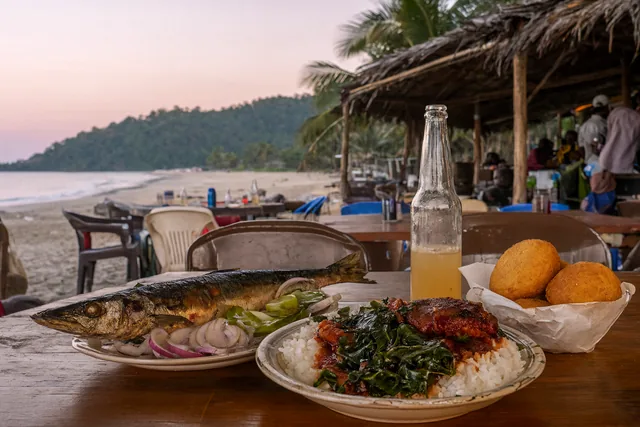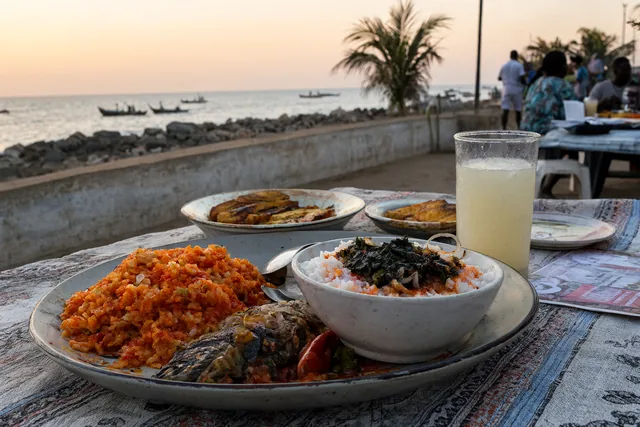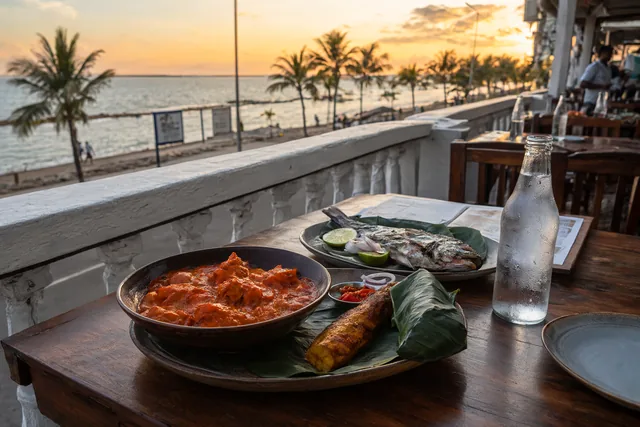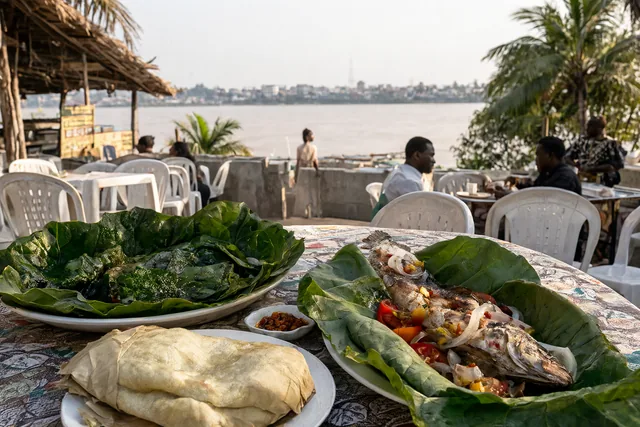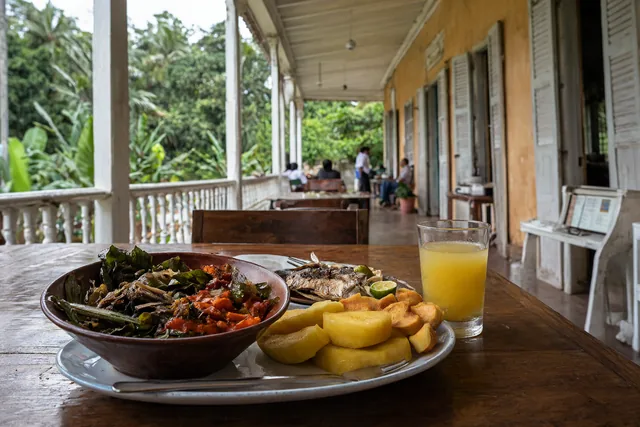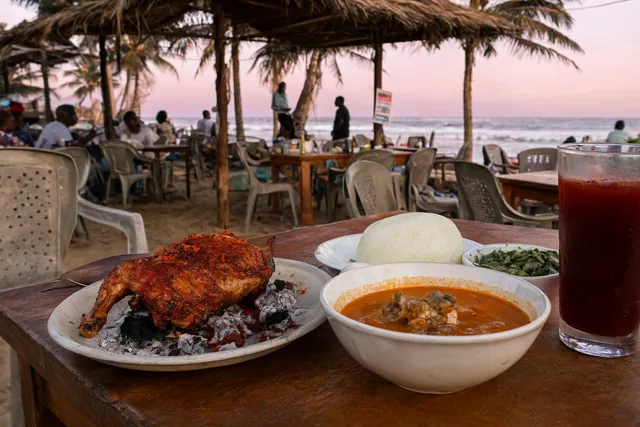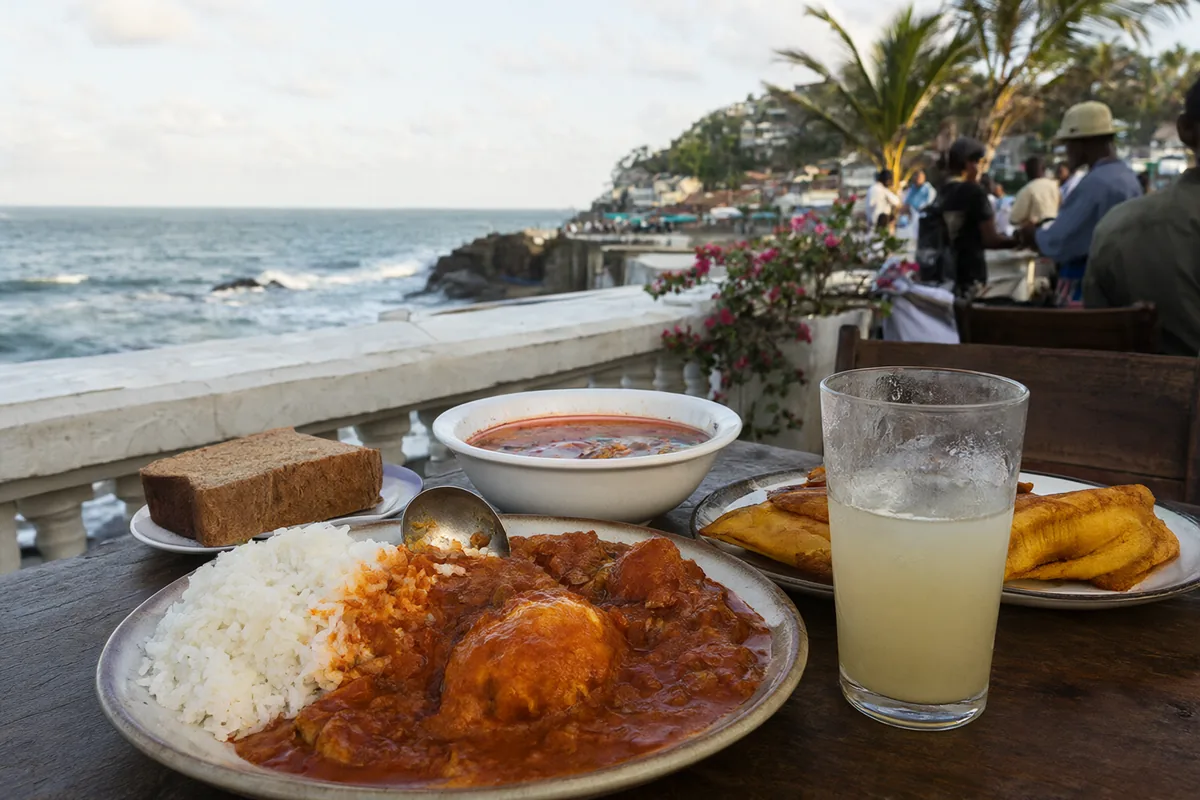
Liberians say that if you have not eaten rice, you have not eaten, and Liberian food is built around a plate of rice with a rich, peppery soup: palm butter, cassava leaf, potato greens or torbogee, cooked with palm oil, fish and meat. This Liberia food guide covers the dishes to order, the cookshop and Liberian English words you will hear, how tipping and paying in Liberian and US dollars works, and then goes through where to eat in Monrovia, Robertsport, Buchanan, Kakata, Gbarnga and Harper. English is the official language, and Liberian English (sometimes called Kolokwa) is spoken everywhere, alongside Kpelle, Bassa, Kru, Vai and more than a dozen other languages. Liberia was founded by freed slaves from the United States, and American touches such as rice bread, sweet potato pie and cornbread still appear on tables.
What to eat in Liberia: 12 dishes to know
These are the dishes worth seeking out. In Liberia a "soup" is usually a thick stew served over rice, and most are cooked with red palm oil, hot pepper and a mix of meat and fish.
- Palm butter: a rich, deep orange stew of palm nut pulp cooked with chicken, beef or fish, served over rice. Often called the national dish.
- Cassava leaf: pounded cassava leaves slow-cooked with palm oil, meat, fish and pepper, eaten with rice.
- Potato greens: sweet potato leaves, chopped and cooked with palm oil, meat and fish, lighter and smoother than cassava leaf.
- Torbogee: a stew of bitter balls (small, bitter garden eggs) cooked with palm oil, fish and meat, often thickened, from the Kpelle and Bassa traditions.
- Jollof rice: rice cooked in a tomato sauce with chicken, meat or shrimp, served at parties and Sunday lunches.
- Check rice: rice cooked with jute leaves (palava sauce greens) and okra, so the greens are mixed through the rice, often with fish and palm oil.
- Pepper soup: a thin, very spicy broth of fish, chicken or goat, a bar snack and a cure-all.
- Fufu and soup: fermented cassava dough eaten with pepper soup or palm butter.
- Dumboy: boiled cassava pounded into a smooth, sticky dough and swallowed with soup, a Liberian favourite, especially in the countryside.
- Country chop: a hearty dish of mixed meats and fish cooked with greens in palm oil, served with rice.
- Fried plantain and fried fish: sold at roadside stalls and markets with hot pepper sauce.
- Rice bread: a moist, sweet bread made from cream of rice and mashed bananas, a Liberian speciality, sold at bakeries and markets.
Snacks include kala (fried dough balls), plantain chips, roasted groundnuts, coconut candy and short bread (a Liberian sweet bread). Sweet potato pie, cornbread and pound cake are part of the Americo-Liberian tradition and appear at celebrations. To drink, try palm wine, ginger beer (homemade, very strong on ginger), fresh coconut water and cane juice, a strong local sugar cane spirit. Liberians like their food hot: "pepper" means chilli, and a lot of it.
How to read a menu in Liberia
Menus in Liberia are in English, but most local food is sold at a cookshop, a simple eatery or roadside kitchen serving rice and two or three soups of the day, and many have no menu at all. You choose your soup and your meat or fish, and each extra piece adds to the price. Restaurants in Monrovia print menus, often with Liberian dishes alongside Lebanese, Chinese and international food. These are the terms worth knowing.
| Term | Origin | Meaning |
|---|---|---|
| Cookshop | Liberian English | Simple local eatery serving rice and soups |
| Soup | Liberian English | A thick stew, usually served over rice |
| Palm butter | Liberian English | Palm nut stew |
| Potato greens | Liberian English | Sweet potato leaf stew |
| Bitter ball | Liberian English | Small, bitter garden egg (aubergine) |
| Torbogee | Kpelle | Bitter ball stew with palm oil and fish |
| Check rice | Liberian English | Rice cooked with jute leaves and okra |
| Dumboy | Liberian | Pounded cassava swallow |
| GB | Liberian | Fermented cassava dough, like fufu |
| Country chop | Liberian English | Mixed meat and fish with greens in palm oil |
| Pepper | Liberian English | Chilli; "small pepper" means a little |
| Kala | Liberian | Fried dough balls |
| Cane juice | Liberian English | Strong sugar cane spirit |
Liberian prices can be in Liberian dollars or US dollars, sometimes on the same menu, and the "$" sign is used for both. Always ask which one you are paying in. swap.menu explains Liberian dish names and converts prices to your home currency, so a "$" never leaves you guessing.
Tipping, tax and paying the bill in Liberia
Tipping is not obligatory in Liberia, but it is appreciated, and wages are low. In restaurants used to visitors, around 10 percent is a generous tip if no service charge has been added, and at cookshops and street stalls rounding up is enough. Hotels and upmarket restaurants add goods and services tax (GST) and sometimes a service charge to the bill. Our guide to tax and service charges on menus explains how these lines work.
Liberia uses two currencies: the Liberian dollar (LRD) and the US dollar (USD), both legal tender. Restaurants, hotels and larger shops often price in US dollars, while markets, cookshops and taxis use Liberian dollars. Both are written with a "$", so check which is meant. Bring clean, undamaged US dollar notes, as worn or old notes may be refused. Mobile money is widely used, and cards are accepted only in a few hotels, supermarkets and restaurants in Monrovia. When a card machine offers to charge you in your home currency, choose the local currency: our guide to paying in local currency explains why.
Lunch is the main meal, eaten from about noon to 3pm, and many cookshops sell out by late afternoon. Dinner is from about 7pm. Liberians often eat rice and soup with a spoon, though fufu and dumboy are eaten with the right hand. Liberia is mostly Christian with a significant Muslim minority, and alcohol is widely available.
Where to eat in Liberia, town by town
Most of Liberia's restaurants are in Monrovia, while the coast and the interior have simpler cookshops, markets and a few beach lodges. Jump to a destination:
Where to eat in Monrovia
Monrovia, the capital, stretches along a peninsula between the Atlantic and the Mesurado River, and it is where most of the country's restaurants are. Local food is found at cookshops across the city, serving palm butter, cassava leaf, potato greens and torbogee with rice at lunchtime, and at the city's markets. Waterside Market, near the river in the centre, is the oldest and busiest, and the huge Red Light Market in Paynesville, on the eastern edge of the city, is the place to see produce, smoked fish, palm oil and peppers in bulk, with food sellers serving traders.
Sinkor, the long district along Tubman Boulevard, has many of Monrovia's hotels, restaurants and bars, with Liberian, Lebanese, Chinese, Indian and international food. Mamba Point, on the hill at the tip of the peninsula, is the diplomatic area with more upmarket restaurants and ocean views. Monrovia's beaches, along the Sinkor coast and further east, have beach bars serving grilled fish, chicken and cold drinks, busy on weekends. Expect Monrovia restaurants aimed at visitors to charge in US dollars at international prices.
Where to eat in Robertsport
Robertsport, about three hours northwest of Monrovia near the Sierra Leone border, is Liberia's surf town, with long point breaks, beaches and the lagoon of Lake Piso. It is a small, quiet town with a fishing community, a few beach lodges and simple local eateries. The food is fresh from the sea: grilled fish, lobster and shrimp, served with rice, fried plantain or chips, and palm butter or cassava leaf at local cookshops.
Most visitors eat at their lodge or guesthouse, where meals are cooked to order and based on the day's catch. Local fishermen land their catch on the beach, and it is often possible to buy fish directly and have it cooked. Bring cash in both Liberian and US dollars, as there are no reliable ATMs and cards are not accepted.
Where to eat in Buchanan
Buchanan, the main town of Grand Bassa County, is a port city about two hours southeast of Monrovia, and the heartland of the Bassa people. Buchanan has beaches, a fishing community and a busy market, and its food is coastal Liberian cooking: grilled and fried fish, palm butter, torbogee and dumboy with soup, a Bassa favourite.
Buchanan's food scene is small, built around cookshops, the market and a few guesthouses and hotels. Beach bars along the coast serve grilled fish and cold drinks at weekends. Buchanan is a good place to try dumboy, the pounded cassava swallow, which is more common here than in Monrovia.
Where to eat in Kakata
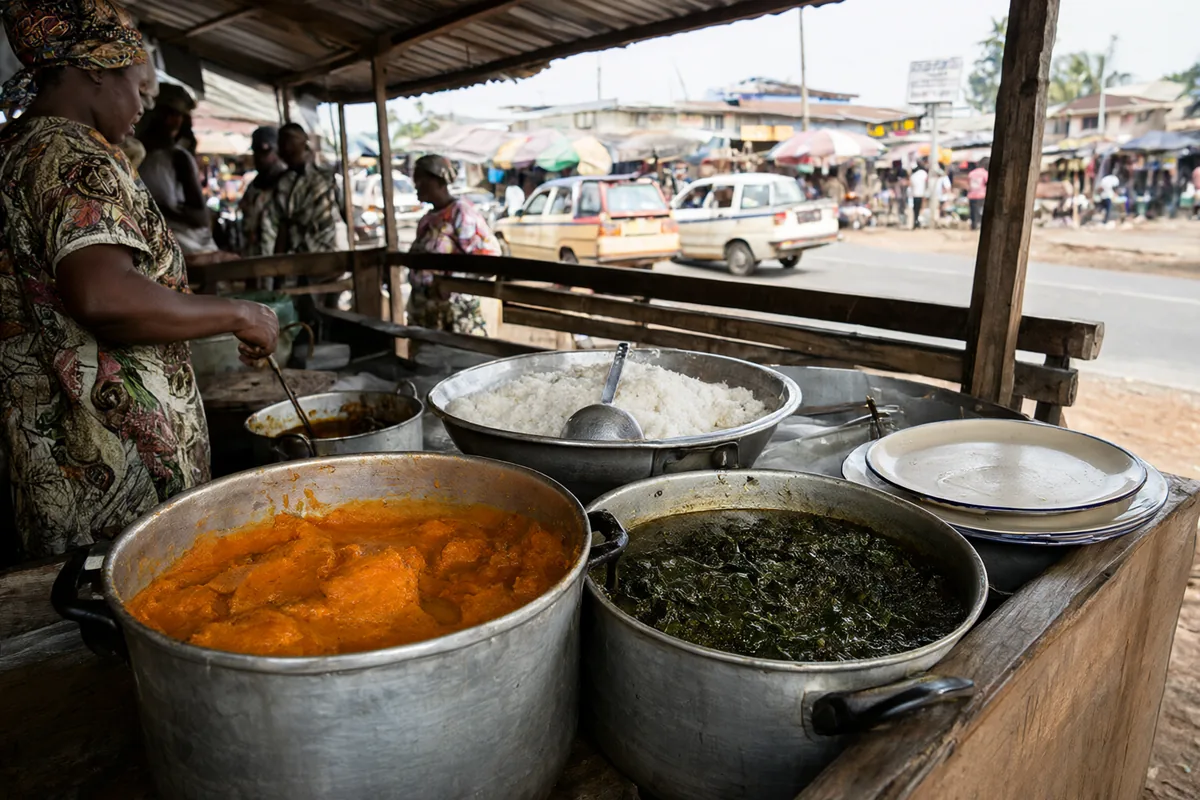
Kakata, the main town of Margibi County, is about an hour inland from Monrovia on the highway to the interior, in the country's rubber-growing belt. It is a busy market and transport town, and most travellers pass through rather than stay. Kakata's food is roadside cookshop cooking at its best: big pots of palm butter, cassava leaf, potato greens and pepper soup, with rice, and fried fish and plantain sold to passengers at the bus and taxi stops.
The market and the main road through Kakata are the places to eat, and the cookshops here are cheaper than those in Monrovia. Kakata is a good place to stop for lunch on the road to Gbarnga and the north. Bring Liberian dollars in small notes, as nobody will have change for large US notes.
Where to eat in Gbarnga
Gbarnga, the capital of Bong County, sits in the green, hilly centre of Liberia and is the heartland of the Kpelle, Liberia's largest ethnic group. The food here is rich in local produce: rice, cassava, plantains, palm oil, greens and bitter balls, and torbogee, a Kpelle dish, is a local favourite. Gbarnga's market is large and well stocked, and cookshops around it serve rice with palm butter, cassava leaf and torbogee.
Gbarnga has a few hotels and guesthouses, and simple restaurants serving Liberian food. It is also home to Cuttington University, one of the oldest private universities in sub-Saharan Africa, which brings students and cheap food stalls to the area. Gbarnga is a base for exploring the interior, including the waterfalls and forests of Bong County.
Where to eat in Harper
Harper, the capital of Maryland County in the far southeast near the Ivory Coast border, is a quiet coastal town at Cape Palmas, with crumbling Americo-Liberian mansions, beaches and a fishing community. It is far from Monrovia, reached by a long road journey or a domestic flight, and few visitors make it here. The food is coastal: fresh fish, shrimp and lobster, served with rice and palm butter or cassava leaf, and Kru and Grebo fishing traditions are strong.
Harper's food scene is very small: a few guesthouses, local cookshops and the market. Fishermen land their catch on the beaches, and fish is the thing to eat. Bring enough cash for your stay, as there are few banking services, and arrange meals with your guesthouse if you want something specific.
Vegetarian, vegan and allergy tips
Vegetarians will find Liberia difficult. Almost every soup, including potato greens and cassava leaf, is cooked with meat, fish, dried fish or stock cubes, even when it looks like a dish of greens. The easiest vegetarian options are fried plantain, rice, rice bread, kala, roasted groundnuts, roasted corn, fruit and a soup made to order without meat or fish. Say "I am vegetarian, no meat, no fish", as "vegetarian" alone may be taken to mean no meat but fish is fine. Monrovia has a few restaurants with vegetarian dishes.
Groundnuts appear in some soups and snacks, so people with peanut allergies should ask. Palm oil and very hot pepper are in almost every soup, and dried fish and shrimp are common hidden ingredients for seafood allergies. Rice and cassava are naturally gluten-free, but rice bread often contains wheat flour too. Our guide to eating abroad with food allergies explains how to communicate a serious allergy clearly.
Liberian English food words and ordering phrases
How you doing? / How the body? Friendly greetings; reply "I fine" or "The body fine"
My man / My people Friendly ways to address someone, used all the time
I beg you, give me palm butter and rice "Please", as Liberians say it
How much for this one? Ask before ordering, and ask whether it is Liberian or US dollars
Small pepper, ya "Not too spicy, please"; Liberian food is very hot
The soup sweet "The food is tasty"
Thank you, ya "Thank you", with the friendly Liberian "ya" on the end
How swap.menu helps you eat in Liberia
Liberian menus are in English, but they are full of words visitors do not know, and the "$" can mean Liberian or US dollars. A cookshop board might list palm butter, torbogee, dumboy and check rice without a word of explanation. Photograph the menu with swap.menu and every dish is explained in plain language, so you know that torbogee is a bitter ball stew, that dumboy is pounded cassava and that check rice is rice cooked with greens. Every price is converted to your home currency, and GST or service charge lines are flagged.
For visitors whose first language is not English, swap.menu translates the whole menu into any of 29 languages, keeping the Liberian dish name beside each translation. Tap the dishes you want, add a note such as "no fish" or "small pepper", and show your order on screen. Saved menus let you look back at what you ate and order it again. Try it on a sample menu with the free demo, or see travel pass prices.
Off to Liberia? Your first 3 menu scans are free, and a travel pass starts from $4.99 with nothing that renews.
Start free with 3 scansLiberia food FAQ
Do you tip in restaurants in Liberia?
Tipping is not required in Liberia, but around 10 percent is appreciated in restaurants used to visitors. At cookshops and street stalls, rounding up is enough.
What is the national dish of Liberia?
Palm butter, a rich palm nut stew with chicken, beef or fish served over rice, is often called the national dish. Cassava leaf, potato greens and jollof rice are just as popular.
What food is Liberia famous for?
Liberia is famous for palm butter, cassava leaf, potato greens, torbogee, pepper soup, dumboy and rice bread. Americo-Liberian dishes such as sweet potato pie and cornbread are also part of the country's food.
Is it expensive to eat out in Liberia?
Cookshops and street food are cheap. Restaurants and hotels in Monrovia's Sinkor and Mamba Point usually charge in US dollars at prices similar to those in Western countries.
Is tap water safe to drink in Liberia?
No, visitors should drink bottled water in Liberia. Bottled water and sealed sachets are sold everywhere, and it is wise to avoid ice and raw salads at simple places.
How can I understand Liberian menus and dish names?
Learn a few words such as cookshop, palm butter and pepper, or photograph the menu with swap.menu. It explains Liberian dish names, converts Liberian and US dollar prices to your currency and can translate the menu into 29 languages.
Travelling further in West Africa? Read our food guides for neighbouring countries:
- Sierra Leone food guide
- Ivory Coast food guide
- Guinea food guide
- Ghana food guide
- Nigeria food guide
Or browse every travel food guide.