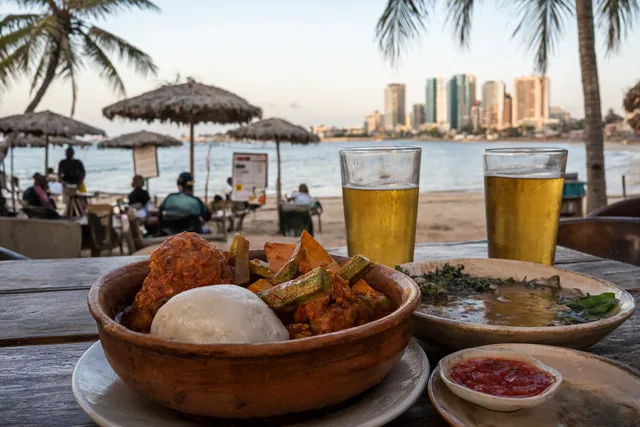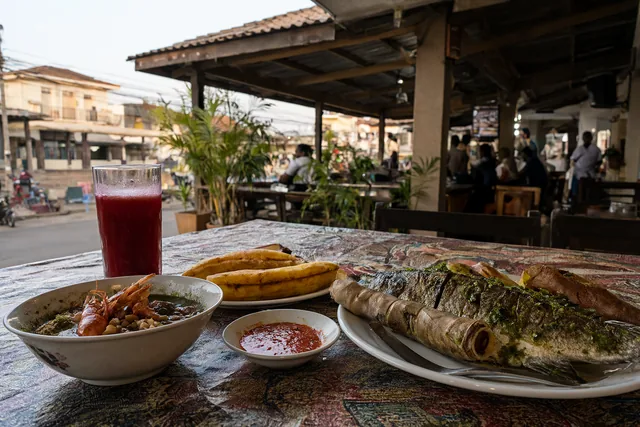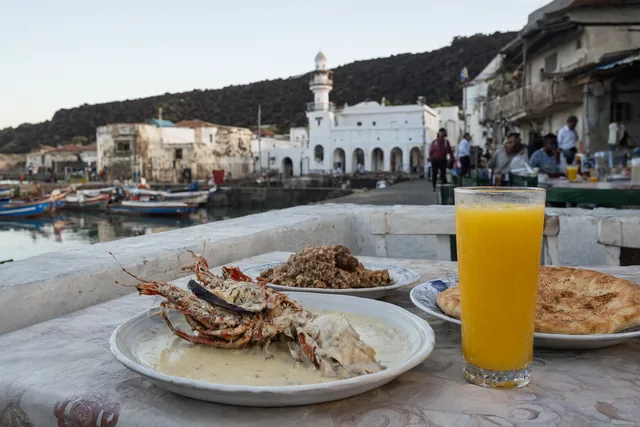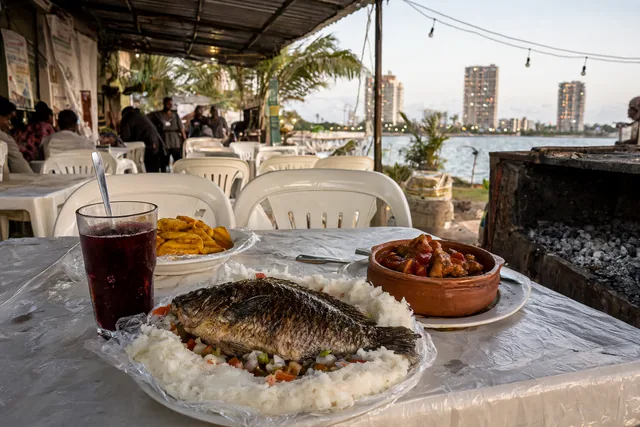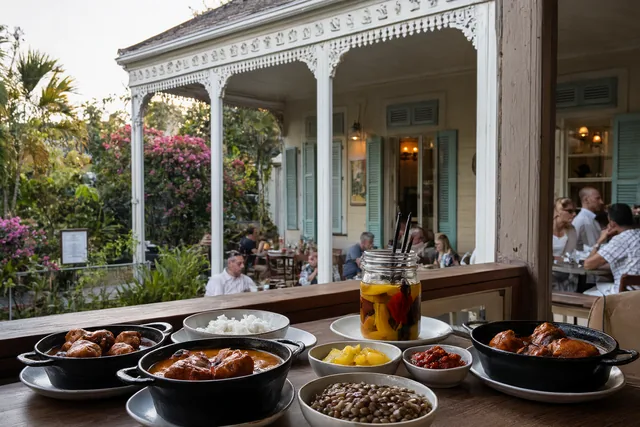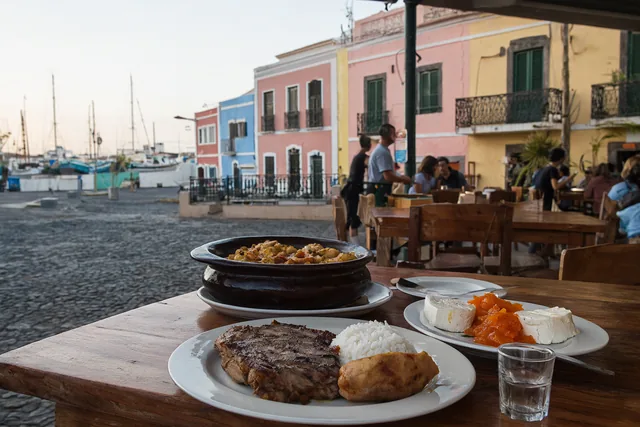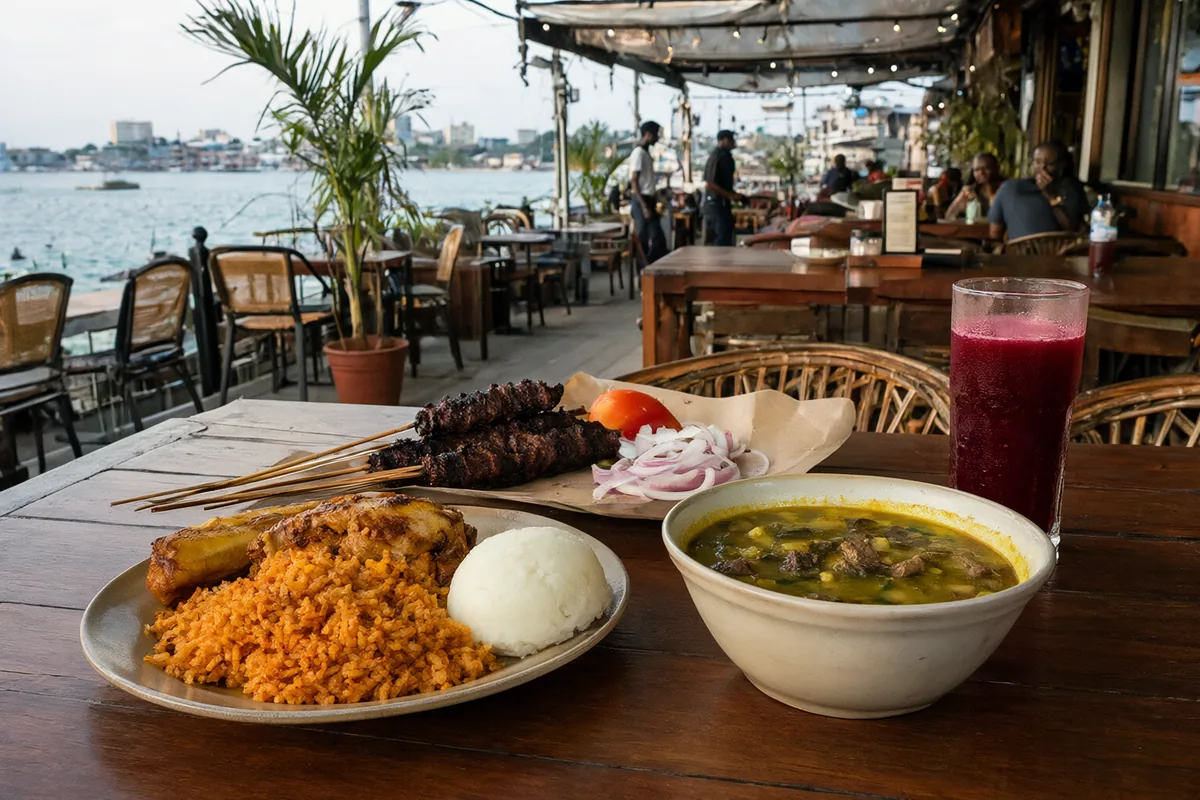
Nigerian food is big, bold and generous with pepper: smoky party jollof, pounded yam pulled by hand and dipped in egusi soup, and suya, spiced beef grilled over charcoal and eaten from newspaper late at night. This Nigeria food guide covers the dishes to order, the buka, mama put and suya spot words you will hear (swallow, assorted, small chops, point and kill), how tipping and paying in naira works, and then goes city by city through where to eat in Lagos, Abuja, Ibadan, Kano, Port Harcourt, Calabar and Enugu. English is the official language, but Nigeria has more than 250 ethnic groups, and the food changes as you move from the Yoruba southwest to the Hausa north, the Igbo southeast and the Efik and Ibibio kitchens of the south.
What to eat in Nigeria: 12 dishes to know
These are the dishes worth seeking out, with the region or city they are most closely tied to. Almost every Nigerian meal is built on a "swallow" (a soft starch you pinch and dip) and a soup, or on rice with a stew.
- Jollof rice (everywhere): rice cooked in a tomato, red pepper and onion base until each grain is orange. "Party jollof", cooked over firewood for weddings, has a smoky, slightly scorched bottom that Nigerians prize. Served with fried plantain (dodo) and chicken or beef.
- Pounded yam and egusi soup (everywhere): boiled yam pounded into a smooth, stretchy dough, eaten with a thick soup of ground melon seeds, leafy greens, palm oil and meat or fish.
- Suya (from the north, now everywhere): thin strips of beef, sometimes chicken, ram or liver, coated in yaji, a dry rub of ground peanuts, chilli, ginger and stock spices, and grilled on skewers. Served with sliced raw onion, tomato and extra yaji.
- Pepper soup (everywhere): a thin, fiercely spiced broth with goat meat, catfish or offal, flavoured with uziza and other local seeds. Bars serve it in the evening as a drinking snack.
- Amala and ewedu with gbegiri (Ibadan and the Yoruba southwest): dark, soft yam flour dough served with a slippery jute leaf soup and a bean soup, often mixed together and called abula, with a ladle of red stew and meat on top.
- Edikang ikong (Calabar and Akwa Ibom): a rich soup of fluted pumpkin leaves and waterleaf with palm oil, periwinkles, beef and stockfish. Afang soup, made with the chewy afang leaf, is its close cousin.
- Banga soup (the Niger Delta): palm nut soup cooked with fresh fish and local spices, eaten with starch, a cassava dough coloured with palm oil, or with rice.
- Ofada rice and ayamase (the southwest): unpolished local rice, served wrapped in leaves, with a green stew of green peppers, locust beans and assorted meat, known as "designer stew".
- Moi moi and akara (everywhere): steamed bean pudding with peppers, sometimes with egg or fish inside, and deep-fried bean fritters, often eaten for breakfast with pap (fermented corn porridge) or bread.
- Abacha (Enugu and the Igbo southeast): "African salad" of dried shredded cassava with palm oil sauce, ugba (fermented oil bean), garden egg leaves, fish and sometimes cow skin.
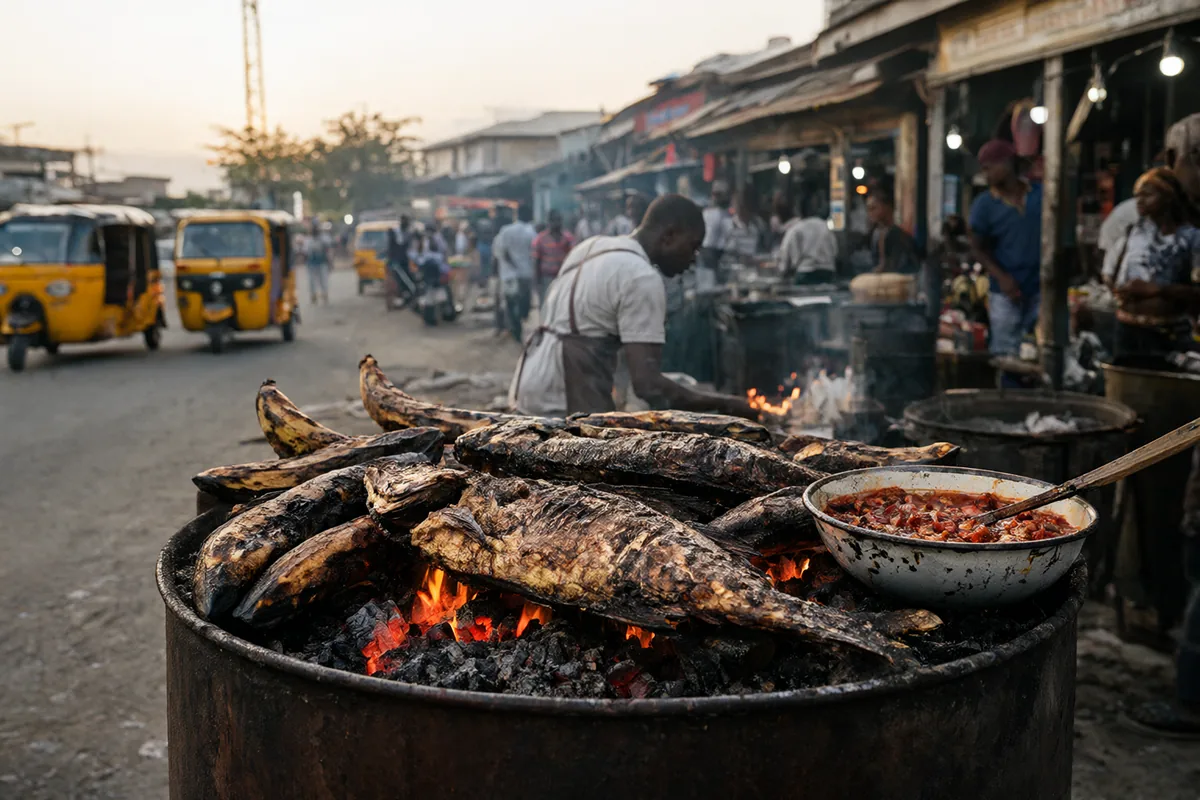
- Boli and fish (Port Harcourt): roasted plantain, split open and served with grilled fish and pepper sauce from the roadside.
- Masa and tuwo (Kano and the north): masa are soft, slightly sour rice cakes fried in a dimpled pan, and tuwo shinkafa is a soft rice swallow eaten with miyan kuka (baobab leaf soup).
To drink, try zobo (chilled hibiscus with ginger and pineapple), kunu (a millet or sorghum drink from the north), fresh palm wine in the south, and the Chapman, a sweet, fizzy fruit cocktail with bitters and a slice of cucumber that appears on almost every restaurant drinks list.
How to read a menu in Nigeria
Nigerian menus are written in English, but the words on them are Nigerian. At a buka (a local canteen, also called a bukateria) or a mama put (a roadside food stall run by a woman cook, named after customers saying "Mama, put more"), there may be no menu at all: pots and trays sit behind glass, and you point at your swallow, your soup and each piece of meat or fish. Every extra piece adds to the price. Restaurants in Lagos and Abuja print menus, often with Nigerian and international sections side by side. These are the terms worth knowing.
| Term | Origin | Meaning |
|---|---|---|
| Buka, bukateria | Yoruba | Local canteen serving swallow, soups and rice |
| Mama put | Nigerian English | Roadside food stall, usually with a bench |
| Suya spot | Nigerian English | Grill selling suya, usually from evening |
| Swallow | Nigerian English | Any soft starch dough: pounded yam, eba, amala, semo, fufu |
| Eba | Yoruba | Swallow made from gari (toasted cassava) and hot water |
| Assorted | Nigerian English | Mixed meats and offal, such as tripe, cow skin and liver |
| Ponmo, kpomo | Yoruba | Cow skin, boiled until soft and chewy |
| Shaki | Yoruba | Tripe |
| Orisirisi | Yoruba | "Assorted": mixed meats on a plate |
| Small chops | Nigerian English | Party finger food: puff-puff, samosas, spring rolls, gizzard skewers |
| Point and kill | Nigerian English | Pick a live catfish, which is cooked fresh in pepper soup |
| Pepper | Nigerian English | Chilli; "pepper" on a menu means hot |
| Nkwobi | Igbo | Cow foot in a thick, spiced palm oil sauce |
| Kilishi | Hausa | Thin, sun-dried spiced beef, like a spicy jerky |
At a buka the price is built piece by piece: the swallow, the soup, and every piece of meat, fish or "assorted" you add. Ask how much each piece costs before the server ladles it on. swap.menu explains Nigerian dish names and converts every naira price to your home currency, so the total does not catch you out.
Tipping, tax and paying the bill in Nigeria
Check your government's current travel advice before planning a trip. Tipping is not expected at bukas, mama puts or suya spots, though leaving the change is appreciated. In sit-down restaurants, a tip of around 10 percent is a kind gesture if no service charge appears on the bill. Upmarket restaurants and hotel restaurants commonly add value added tax (VAT, 7.5 percent), a state consumption tax (5 percent in Lagos) and a service charge, sometimes on top of the menu price, so the final bill can be noticeably higher than the total of the dishes. Our guide to tax and service charges on menus explains how these lines work.
The currency is the Nigerian naira (NGN), written with the symbol ₦. Nigerians pay for almost everything by instant bank transfer, even at small stalls, but that needs a local bank account. Card machines (called POS) are common in Lagos and Abuja restaurants, hotels and supermarkets, though foreign cards do not always work. Carry cash in smaller notes for bukas, markets, suya and taxis, and ask whether a place takes cards before you order. When a card machine offers to charge you in your home currency, choose naira: our guide to paying in local currency explains why.
Breakfast is often akara and pap, moi moi or bread and tea. Lunch is the main buka meal, from about noon to 3pm, and many bukas sell out of the best soups by mid-afternoon. Dinner runs from about 7pm, and suya spots and pepper soup joints stay busy late. Swallow is eaten with the right hand: pinch a piece, roll it, make a dent with your thumb and scoop the soup. A bowl of water is brought to wash your hand. The north is mostly Muslim and alcohol is restricted in several northern states, while in the south beer and palm wine flow freely.
Where to eat in Nigeria, city by city
Each Nigerian city has its own soups, its own street food and its own idea of a proper lunch. Jump to a city:
Where to eat in Lagos
Lagos is Nigeria's biggest city and its food capital, with dishes from every corner of the country and a fast-moving restaurant scene. The everyday food is Yoruba: ofada rice and ayamase, amala, ewedu, efo riro (a rich spinach stew) and jollof at every buka. For the full buka experience, eat lunch in the mainland districts of Surulere, Yaba and Ikeja, where office workers queue for pounded yam and a tray of assorted meats. On the islands, Victoria Island, Ikoyi and Lekki have the upmarket restaurants, lounges and modern Nigerian kitchens that reinvent jollof, suya and pepper soup for a dinner crowd.
Street food in Lagos is at its best after dark. Suya spots fire up their grills from early evening, and Obalende, by the bridges between the island and the mainland, is known for late-night suya and grilled food. Look for agege bread, a soft, sweet loaf that Lagosians eat with beans or fried eggs.
Where to eat in Abuja
Abuja is a planned capital, quieter and more spread out than Lagos, and its food scene mixes northern and southern Nigerian cooking with plenty of Lebanese, Chinese and international restaurants for the diplomats and civil servants. The districts with the most choice are Wuse 2, Maitama, Garki and the area around Jabi Lake. Abuja is known for its evening grilled fish: whole catfish or tilapia, peppered and grilled over charcoal, served at open-air joints with chips, plantain or a cold drink.
Because Abuja sits close to the north, suya here is excellent, and you will also find kilishi, masa and fura da nono (millet balls in fermented milk) at markets. Wuse Market is the biggest in the city for produce, spices and quick local meals.
Where to eat in Ibadan
Ibadan, a couple of hours inland from Lagos, is one of the largest cities in West Africa and the heartland of Yoruba home cooking. The dish to order is amala and abula: dark yam flour swallow with ewedu (jute leaf) and gbegiri (bean soup), finished with a spoon of red pepper stew and pieces of beef, ponmo or goat. Ibadan's amala joints are an institution, simple places with plastic chairs and huge pots, where the soup is free-flowing and you pay for the meat. Go at lunchtime, when everything is freshest.
Ibadan also does excellent ofada rice, ikokore (a water yam pottage from the Ijebu area), dodo ikire (spicy overripe plantain cakes from the town of Ikire nearby) and roadside roasted corn. Bodija Market is the city's big food market, with yams, peppers, beans and cooked food, and the old city around Dugbe is crowded with traders and snack sellers.
Where to eat in Kano
Kano is the great city of the Hausa north, with an old walled city, the centuries-old dye pits and one of the oldest markets in West Africa, Kurmi Market. The food is different from the south: grains such as millet, sorghum and rice replace yam and cassava, and grilled and dried meat is the pride of the city. Eat tuwo shinkafa with miyan kuka (baobab leaf soup) or miyan taushe (pumpkin and groundnut soup), fluffy masa with spicy sauce, and dambu nama, shredded, spiced and dried beef.
Kano is where the best suya and kilishi come from, and evening grills across the city sell skewers of beef, ram and kidney dusted with yaji. For breakfast, look for kosai (the northern name for bean fritters) with koko, a spiced millet porridge, and drink kunu or fura da nono during the day. Kano is a conservative Muslim city: dress modestly, do not expect alcohol on menus, and during Ramadan most food stalls open only after sunset.
Where to eat in Port Harcourt
Port Harcourt is the oil city of the Niger Delta, and its food is built on fish, shellfish and palm nuts from the creeks and rivers around it. The signature street food is boli and fish: plantain roasted over charcoal until the skin blackens, served split open with grilled fish and a hot pepper and onion sauce. Port Harcourt is also the place for native soup, a yellow, peppery seafood soup of the Kalabari and Okrika people, banga soup with starch, and dishes with periwinkles, crayfish and dried fish.
The Mile 1 Market and the busy roads around D-Line and Old GRA have plenty of local food spots and roadside boli sellers, while the newer areas of GRA Phase 2 and along Aba Road have the hotels and restaurants. Pepper soup with fresh catfish is a Port Harcourt evening habit, often ordered "point and kill" style.
Where to eat in Calabar
Calabar, in the far southeast near Cameroon, is famous across Nigeria for its cooking, and many Nigerians say the best soups in the country come from the Efik and Ibibio kitchens of Cross River and Akwa Ibom. Order edikang ikong and afang soup with pounded yam or garri, ekpang nkukwo (grated cocoyam wrapped in leaves and cooked in a spicy palm oil and seafood broth) and white soup (afia efere), a pale, peppery broth with goat or fish. Calabar cooking uses a lot of periwinkles, crayfish and smoked fish, and it is generous with leaves.
Calabar is calm and green compared with other Nigerian cities, and easy to explore. Watt Market and Marian Market are the places to see the leaves, snails, dried fish and spices that go into the soups, with cooked food stalls nearby. In December the city hosts the Calabar Carnival, with street parties and food everywhere, and hotels fill up.
Where to eat in Enugu
Enugu, the old coal city of the Igbo southeast, is the place to eat Igbo food at its source. Look for abacha (African salad) from street sellers and bars, ofe onugbu (bitterleaf soup) and ofe oha (oha leaf soup) with fufu or pounded yam, and okpa, a steamed pudding of Bambara nut flour and palm oil from the Nsukka area, sold warm in the morning. In the evening, bars serve nkwobi and isi ewu (spiced goat head) with cold beer or palm wine.
The central areas around Ogui and the Ogbete Main Market are full of traders and local food, while Independence Layout and GRA have the quieter hotels and restaurants. Enugu is a good base for trying ugba (fermented oil bean slices), garden eggs with groundnut paste and ji mmiri oku (yam pepper soup).
Vegetarian, vegan and allergy tips
Nigeria is challenging for strict vegetarians. Most soups and stews are cooked with meat or fish stock, crayfish (ground dried shrimp) is added to almost everything, and stockfish and dried fish are common even in leafy soups. The easiest vegetarian dishes are moi moi (check it has no fish or egg inside), akara, dodo (fried plantain), roasted corn, boli with groundnuts, ewa agoyin (mashed beans with a dark pepper sauce, though the sauce may contain crayfish) and plain swallow. Say "I am vegetarian, no meat, no fish, no crayfish", because "vegetarian" alone is often taken to mean no meat but fish is fine.
Peanuts (groundnuts) are in suya spice, kunu, snacks and some soups, and ground melon seeds are in egusi. Palm oil and chilli are in most stews, and locust beans (iru) and fermented seeds give many dishes their strong smell. Gluten-free eaters can rely on most swallows and rice, but check sauces and fried snacks. Our guide to eating abroad with food allergies explains how to communicate a serious allergy clearly.
Nigerian food slang and ordering terms
How far? "Hello, how are you?" in Pidgin; reply "I dey" or "I dey fine"
Abeg "Please", as in "Abeg, give me jollof and dodo"
How much be this one? "How much is this?" in Pidgin
Small pepper, abeg "Not too spicy, please"; "no pepper" means no chilli at all
Add one more meat Asking for an extra piece of meat at a buka (it adds to the price)
E sweet well well "It is very tasty" in Pidgin
E se / Na gode / Daalụ "Thank you" in Yoruba, Hausa and Igbo
Make we go chop "Let's go and eat" in Pidgin
How swap.menu helps you eat in Nigeria
Nigerian menus are in English, but that does not make them easy to read. A Lagos restaurant menu might list ofada with ayamase, asun, nkwobi, gizdodo and Chapman without a word of explanation. Photograph it with swap.menu and every dish is explained in plain language, so you know that asun is spicy grilled goat, that gizdodo is gizzards and fried plantain in pepper sauce, and that "assorted" means offal. Every price is converted from naira to your home currency, and VAT, consumption tax and service charge lines are flagged before you order.
For visitors whose first language is not English, swap.menu translates the whole menu into any of 29 languages, with the Nigerian dish name kept beside each translation. Tap the dishes you want, add a note such as "no crayfish" or "small pepper", and show your order on screen. Saved menus mean you can look up what you ate last night and order it again. Try it on a sample menu with the free demo, or see travel pass prices.
Off to Nigeria? Your first 3 menu scans are free, and a travel pass starts from $4.99 with nothing that renews.
Start free with 3 scansNigeria food FAQ
Do you tip in restaurants in Nigeria?
Tipping is not expected at bukas, mama puts or suya spots, though leaving the change is appreciated. In sit-down restaurants, around 10 percent is a kind gesture if the bill does not already include a service charge.
What food is Nigeria famous for?
Nigeria is famous for jollof rice, pounded yam with egusi soup, suya, pepper soup, moi moi, akara and puff-puff. Regional favourites include amala in Ibadan, edikang ikong in Calabar, banga soup in the Niger Delta and masa in Kano.
Is it expensive to eat out in Nigeria?
Bukas, mama puts and street food are cheap, and a filling plate of rice or swallow with soup costs little. Restaurants in Victoria Island, Ikoyi, Lekki and Abuja's smarter districts are much more expensive, and their bills often add VAT, consumption tax and a service charge.
Which city in Nigeria is best for food?
Lagos has the widest choice, from bukas to modern Nigerian restaurants. Calabar is famous for its soups, Ibadan for amala, Kano for suya and northern dishes, and Port Harcourt for seafood and boli and fish.
Is tap water safe to drink in Nigeria?
No, visitors should not drink tap water in Nigeria. Drink bottled water, or the sealed sachet water locals call "pure water" if you trust the brand, and be careful with ice from unknown sources.
How can I understand Nigerian menus and dish names?
Learn a few key words such as swallow, assorted, pepper and small chops, or photograph the menu with swap.menu. It explains Nigerian dish names, converts naira prices to your currency, flags tax and service lines and can translate the menu into 29 languages.
Travelling further in West Africa? Read our food guides for neighbouring countries:
Or browse every travel food guide.