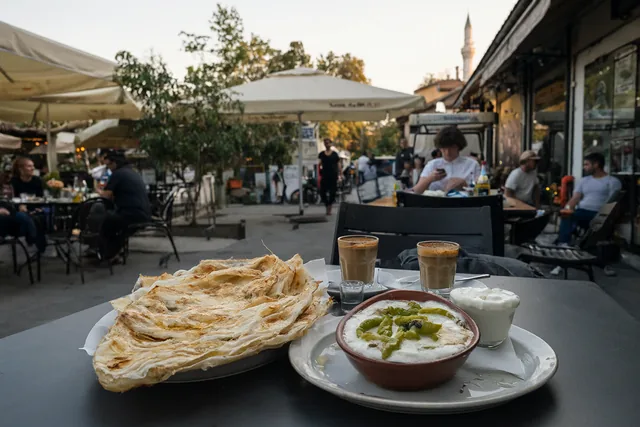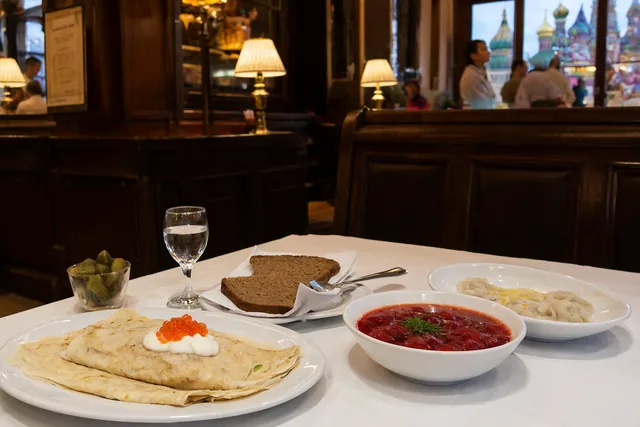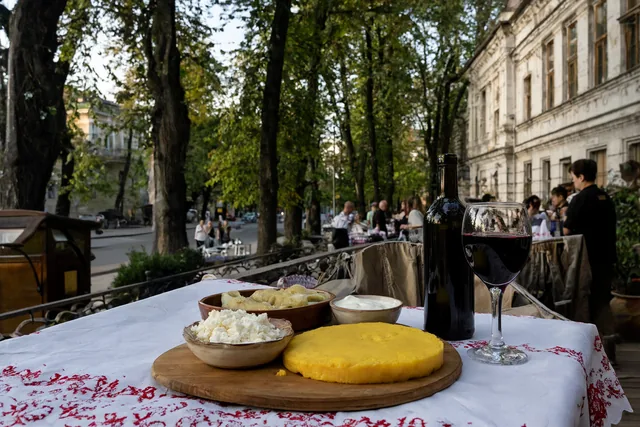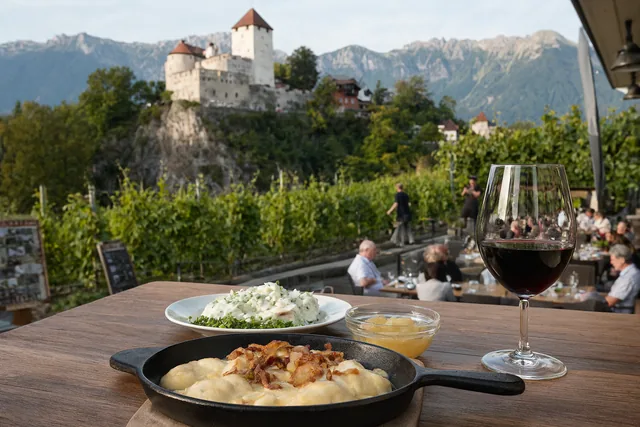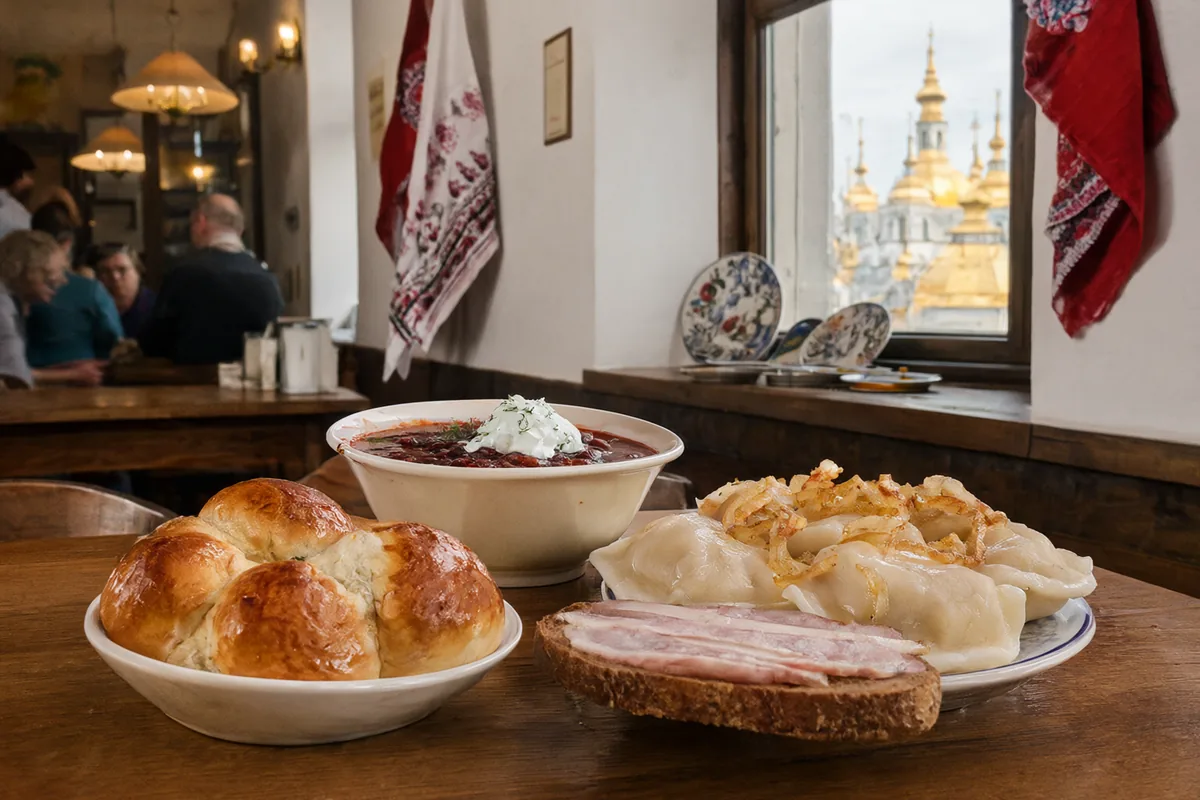
Ukraine has one of the great home-cooking traditions of Europe: deep red borshch, dumplings filled with potato, cherries or cheese, cabbage rolls, potato pancakes and sour cream on almost everything, all built on the black earth that has made the country a breadbasket for centuries. This Ukraine food guide covers the dishes to know, how to read a Ukrainian menu in Cyrillic, how tipping and paying in hryvnia work, then goes city by city through where to eat in Kyiv, Lviv, Odesa, Kharkiv, Ivano-Frankivsk and the Carpathians, Chernivtsi and Uzhhorod. Each region has its own accent: coffee and pastry in Lviv, Black Sea fish and Jewish dishes in Odesa, cornmeal and sheep's cheese in the mountains, and Hungarian paprika in Transcarpathia. Ukrainian cooking shares a lot with its neighbours, so see our Poland food guide and Moldova food guide too.
What to eat in Ukraine: 12 dishes to know
A Ukrainian meal often starts with a soup (the "first course"), then a main dish with a side, and it is almost always served with bread and sour cream. These are the dishes to look for, with the region in brackets where it matters.
- Borshch (everywhere): the national soup, made with beetroot, cabbage, potato, carrot and beans, usually on a meat stock, and served with a spoonful of smetana (sour cream). Every region and family has its own version, and in 2022 the culture of cooking Ukrainian borshch was added to UNESCO's list of intangible cultural heritage.
- Pampushky (everywhere): small soft bread rolls brushed with garlic, oil and herbs, the classic partner for borshch.
- Varenyky (everywhere): boiled dumplings filled with potato, cabbage, cottage cheese, mushrooms, meat or sour cherries, served with fried onions or sour cream. Cherry varenyky with sugar are a summer dessert.
- Holubtsi (everywhere): cabbage leaves rolled around rice and minced meat and stewed in a tomato and sour cream sauce.
- Deruny (everywhere): crisp grated potato pancakes, fried and served with sour cream, sometimes with a mushroom or meat sauce.
- Salo (everywhere): cured pork back fat, sliced thin and eaten on rye bread with garlic, raw onion or mustard, usually alongside a glass of horilka. It is a national symbol and a common starter.
- Banosh (Carpathians): cornmeal cooked slowly in sour cream or cream, topped with crumbled brynza (salty sheep's cheese), crisp pork crackling (shkvarky) and often wild mushrooms. A Hutsul mountain dish.
- Kotleta po-kyivsky (Kyiv and everywhere): chicken Kiev, a breaded chicken breast rolled around herb butter that spurts out when you cut it.
- Syrnyky (breakfast cafés): small fried pancakes of cottage cheese, served with sour cream, jam or honey. The standard Ukrainian breakfast.
- Kholodets (winter and holidays): meat set in a clear savoury jelly with garlic, eaten cold with horseradish or mustard.
- Kyivskyi tort (Kyiv): the Kyiv cake, layers of meringue with hazelnuts and buttercream, sold in round boxes as a souvenir.
- Uzvar, kvas and horilka (everywhere): uzvar is a drink of dried fruit, served warm or cold, especially at Christmas; kvas is a lightly fermented bread drink; and horilka is Ukrainian vodka, often flavoured with honey and chilli (z pertsem). Fruit liqueurs are called nalyvka.
How to read a Ukrainian menu
Ukrainian is the official language and the language of menus, written in the Cyrillic alphabet. Many people also speak Russian, and restaurants in Kyiv, Lviv and Odesa often print English menus too. Menus follow the post-Soviet layout: cold starters, salads, "first courses" (soups), "second courses" (mains) and sides, which are usually ordered and priced separately. Portion weights in grams are listed next to many dishes, and some items, such as grilled meat or fish, are priced per 100 grams.
| Script | Romanised | Meaning |
|---|---|---|
| Меню | Meniu | Menu |
| Закуски | Zakusky | Starters, cold snacks |
| Салати | Salaty | Salads |
| Перші страви | Pershi stravy | First courses: soups |
| Основні страви | Osnovni stravy | Main courses |
| Гарніри | Harniry | Side dishes, ordered separately |
| Десерти | Deserty | Desserts |
| Свинина / яловичина / курка | Svynyna / yalovychyna / kurka | Pork / beef / chicken |
| Риба | Ryba | Fish |
| Гриби | Hryby | Mushrooms |
| Сметана | Smetana | Sour cream |
| Домашній | Domashnii | Homemade |
| Напої | Napoi | Drinks |
| Рахунок | Rakhunok | The bill |
Ukrainian menus often show a weight such as "250/50 г", the grams of the main item and of the sauce or garnish, and a price "за 100 г" (per 100 grams) on grilled meat and fish. Sides like potatoes or salad cost extra. swap.menu reads Ukrainian and Russian menus in Cyrillic, explains every dish in your language and flags weight-based prices so the bill makes sense.
Tipping, paying in hryvnia and meal times
Check your government's current travel advice before planning a trip. Menu prices in Ukraine include VAT, and cover charges are rare. Some restaurants add a service charge, usually around 10 percent, which should be stated on the menu or the bill. Where there is no service charge, leaving about 10 percent in a sit-down restaurant is the norm, and rounding up is enough in cafés. Our guide to tax and service charges on menus explains how these lines work around the world.
The currency is the hryvnia (UAH, ₴), and prices are often written with "грн" (hrn) after the number. Ukraine has one of the highest rates of card and contactless use in Europe, and paying by card or phone is normal even in small cafés in the cities. Markets, village guesthouses and some kiosks still prefer cash. If a card machine offers to charge you in your home currency, choose hryvnia: our guide to paying in local currency explains why that saves you money.
Breakfast cafés open early and serve syrnyky, porridge and eggs. Lunch runs from about noon to 3pm, and many restaurants offer a cheap weekday set lunch, often called a business lunch. Dinner is from about 7pm, and opening hours can vary, so check locally. Eating out is good value by European standards, even in Kyiv. Most locals drink bottled or filtered water rather than tap water, and visitors should do the same.
Where to eat in Ukraine, city by city
Ukraine is a big country, and its cities have distinct food cultures shaped by their history: imperial Kyiv, Austro-Hungarian Lviv and Chernivtsi, cosmopolitan Odesa on the Black Sea, and the mountain villages of the Carpathians. Jump to a city:
Where to eat in Kyiv
Kyiv has the biggest and most varied food scene in Ukraine, from canteens serving borshch and varenyky to modern restaurants reworking Ukrainian ingredients such as buckwheat, fermented vegetables, river fish and sour cherries. The landmark food stop is the Bessarabskyi Market, a covered market hall from 1912 at the end of the main avenue, Khreshchatyk, with stalls of cured meats, salo, cheese, pickles, honey and fruit. In the old riverside quarter of Podil, the Zhytnii Market is more local, and the streets around Kontraktova Square are full of cafés, bars and restaurants.
The steep cobbled Andriivskyi Descent, which climbs from Podil to St Andrew's Church, has cafés and souvenir stalls, and the area around the Golden Gate in the centre of Kyiv has many of the city's better restaurants and coffee shops. Kyiv has a serious specialty coffee culture, with small cafés and coffee kiosks on almost every corner. Try chicken Kiev and Kyiv cake in the city that named them, and look for Georgian and Crimean Tatar restaurants, which are popular and good value.
Where to eat in Lviv
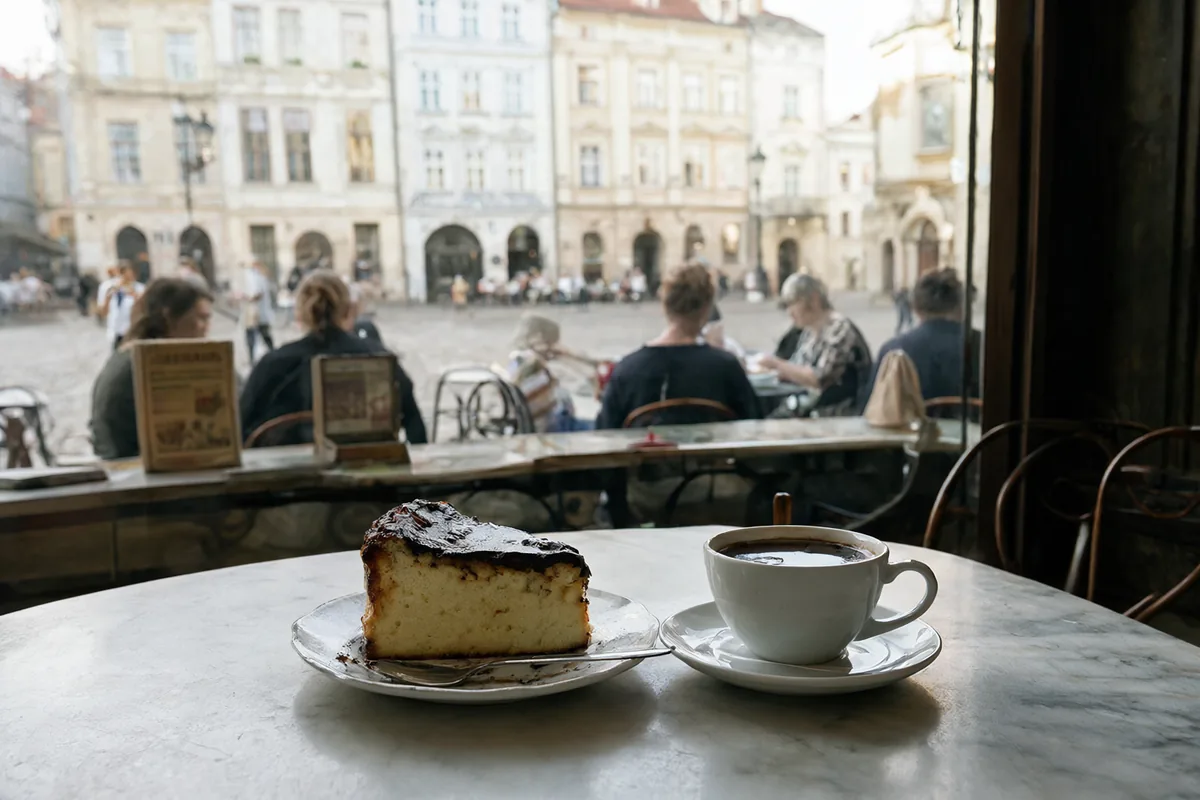
Lviv in western Ukraine is the country's café capital, a city of cobbled streets, baroque churches and old Austro-Hungarian coffee houses. Its cooking is Galician, shaped by Polish, Austrian, Jewish and Armenian influences, so alongside borshch and varenyky you find dumplings, schnitzel, strudel and the Lviv syrnyk, a baked cheesecake of soft curd cheese, often with raisins or a chocolate glaze. Coffee in Lviv is a ritual, and chocolate is a close second, with shops making pralines and hot chocolate by hand.
The old town around Rynok Square is the centre of eating out in Lviv, with restaurants, cafés and bars in the arcades and courtyards of the old merchants' houses. Lviv is also known for its themed restaurants, some of them elaborate tourist attractions, and for its beer, which has been brewed in the city for centuries. For local prices, eat a few streets from the square, or try the stalls at Krakivskyi Market for cheese, smoked meats and pickles. Christmas in Lviv brings markets with mulled wine, varenyky and kutia, the sweet wheat dish of Christmas Eve.
Where to eat in Odesa
Odesa, the big port on the Black Sea, has always been cosmopolitan, and its food mixes Ukrainian, Jewish, Greek, Moldovan and Bulgarian traditions. Odesa specialities include forshmak (a spread of chopped herring with apple and onion), stuffed fish, and "aubergine caviar", a dip of roasted aubergine with tomato and garlic. Locals call aubergines synenki, "the little blue ones". Black Sea fish is the other draw: fried bychky (gobies), barabulia (red mullet), sprats and mussels from the coast.
The famous Pryvoz Market is the largest and loudest market in Odesa, a maze of halls and stalls selling fish, smoked and dried fish, cheese, fruit and pickles, and it is the best place to understand how the city eats. Restaurants and cafés line Derybasivska Street and the leafy streets of the centre, and in summer the beaches around Arkadia fill with seafood terraces and bars. The surrounding region has a long winemaking history, and local wines from the Bessarabia area to the south-west are worth trying.
Where to eat in Kharkiv
Kharkiv, Ukraine's second largest city, is a university and industrial city in the north-east, with wide avenues, constructivist buildings and one of the largest city squares in Europe, Freedom Square. Its food scene is practical rather than famous: many cafés, coffee shops and casual restaurants aimed at students and young professionals, plus traditional Ukrainian restaurants and Georgian and Caucasian grills.
The main streets for eating out in Kharkiv are Sumska Street and the area around the Shevchenko Garden, a large park in the centre. The covered Blahovishchenskyi Market near the river is the city's main food market, with meat, dairy, pickles and produce from the surrounding farmland. Kharkiv prices are generally lower than in Kyiv, and portions of borshch, varenyky and deruny are generous.
Where to eat in Ivano-Frankivsk and the Carpathians
Ivano-Frankivsk is a compact, walkable city in the west and the usual gateway to the Ukrainian Carpathians. Its centre has a good café scene and restaurants serving Galician and Hutsul dishes at lower prices than Lviv. From here, roads and trains run south into the mountains, to towns and villages such as Yaremche, Vorokhta and Verkhovyna, and to the ski resort of Bukovel.
The Carpathians are home to the Hutsuls, highlanders with their own cooking: banosh with brynza and crackling, kulesha (a firmer cornmeal porridge), wild mushroom soup, grilled trout, smoked sheep's cheese and berries and honey from the hillsides. Roadside restaurants in wooden buildings, often with open grills, serve these dishes to hikers and skiers, and guesthouses in the villages cook for their guests. Markets in mountain towns sell cheese, honey and dried mushrooms, so bring cash and an appetite.
Where to eat in Chernivtsi
Chernivtsi, the main city of Bukovina in the south-west, was a multicultural Habsburg city, and it still feels like one, with Viennese-style architecture and a university residence that is a UNESCO World Heritage site. Bukovinian cooking mixes Ukrainian, Romanian, Jewish and Austrian traditions, so menus in Chernivtsi have cornmeal dishes and stuffed cabbage alongside schnitzel, strudel and cakes.
The pedestrian Olha Kobylianska Street is the main place to eat and drink in Chernivtsi, lined with cafés, pastry shops and restaurants in old buildings, and the streets around the central square have more. Try local holubtsi, banosh and Bukovinian sweets, and have coffee and cake in the Austrian style. Chernivtsi is a short trip from the Romanian and Moldovan borders, and some dishes will be familiar if you have eaten in either country.
Where to eat in Uzhhorod
Uzhhorod is the capital of Transcarpathia in the far west, on the borders of Slovakia and Hungary, and it eats differently from the rest of Ukraine. Hungarian influence is strong here, so restaurants serve bohrach (a spicy beef or pork goulash cooked in a cauldron), paprika chicken, and stuffed peppers, along with Carpathian banosh and mushrooms. Transcarpathia is also a wine region, especially around the Hungarian-speaking town of Berehove, and the local whites are good value.
Uzhhorod is a relaxed small city with a castle, an old centre and a long riverside embankment lined with linden trees. In spring the city is known for its cherry blossom, and the cafés along the river fill up. Restaurants and wine bars in Uzhhorod are clustered in the old centre, and the town's market sells local cheese, smoked meats and paprika. Our Hungary food guide and Slovakia food guide cover the neighbouring countries.
Vegetarian, vegan and allergy tips
Ukrainian food is meat-heavy, but it has a long tradition of meatless cooking because of Orthodox and Greek Catholic fasting periods. Dishes marked пісне (pisne, "fasting") contain no meat or dairy and are usually vegan, and on Christmas Eve the traditional meal has twelve meatless dishes. Varenyky with potato, cabbage or cherries, deruny, mushroom dishes and salads are easy vegetarian choices. The word for vegetarian is вегетаріанський (vehetarianskyi) for a dish, and you can ask for food без м'яса (bez miasa, without meat).
Watch for hidden ingredients. Borshch is usually made on meat stock and may contain pork, varenyky are often topped with fried onions and pork crackling, and many dishes are cooked in lard or butter. Sour cream comes with almost everything, so ask for it on the side if you avoid dairy. Nuts appear in Kyiv cake and other desserts, and poppy seed is common in pastries. Our guide to eating abroad with food allergies explains how to explain an allergy clearly when you do not speak the language.
Useful Ukrainian phrases for ordering
Добрий день Dobryi den: "Good day", the polite greeting
Столик на двох, будь ласка Stolyk na dvokh, bud laska: "A table for two, please"
Що ви порадите? Shcho vy poradyte?: "What do you recommend?"
Я б хотів / хотіла це Ya b khotiv / khotila tse: "I would like this" (khotiv for a man, khotila for a woman)
У мене алергія на... U mene alerhiia na...: "I am allergic to..."
Смачного! Smachnoho!: "Enjoy your meal!"
Рахунок, будь ласка Rakhunok, bud laska: "The bill, please"
Дякую, було дуже смачно Diakuiu, bulo duzhe smachno: "Thank you, it was very tasty"
How swap.menu helps you eat in Ukraine
Most Ukrainian menus are in Cyrillic, and outside the big cities there is often no English version. Photograph the menu with swap.menu and every dish appears in your language with the Ukrainian name beside it and a short explanation, so you know that вареники (varenyky) are dumplings and whether they are filled with potato or cherries, and that холодець (kholodets) is meat in jelly before you order. Every price is converted from hryvnia to your home currency, and swap.menu points out portion weights, prices per 100 grams and any service charge.
Tap the dishes you want, add a note such as "no meat" or "sour cream on the side", typed or spoken, and swap.menu translates your order into Ukrainian. Show the waiter your phone, or let them scan the QR code and read your order on their own screen. Try it on a sample menu with the free demo, or see travel pass prices.
Off to Ukraine? Your first 3 menu scans are free, and a travel pass starts from $4.99 with nothing that renews.
Start free with 3 scansUkraine food FAQ
Do you tip in restaurants in Ukraine?
Leaving about 10 percent is normal in sit-down restaurants in Ukraine, unless a service charge is already included on the bill. In cafés and coffee shops, rounding up is enough.
What food is Ukraine famous for?
Ukraine is famous for borshch, the beetroot soup served with sour cream and garlic rolls, and for varenyky dumplings, holubtsi cabbage rolls, deruny potato pancakes, salo, chicken Kiev and syrnyky. Each region adds its own dishes, such as banosh in the Carpathians and Black Sea fish in Odesa.
Is it expensive to eat out in Ukraine?
No, eating out in Ukraine is good value by European standards. Weekday set lunches, canteens and markets are especially cheap, and even restaurants in Kyiv and Lviv cost much less than in Western Europe.
Can you pay by card in Ukraine?
Yes, card and contactless payments are very widely used in Ukrainian cities, including in small cafés and shops. Carry some cash in hryvnia for markets, villages and small kiosks.
Is tap water safe to drink in Ukraine?
Most locals drink bottled or filtered water rather than tap water, and visitors should do the same. Bottled water is cheap and sold everywhere.
How can I read a Ukrainian menu if I cannot read Cyrillic?
Photograph the menu with swap.menu. It reads the Cyrillic text, translates every dish into your language with an explanation, converts prices from hryvnia to your currency and translates your order back into Ukrainian for the waiter.
Travelling further in Europe? Read our food guides for neighbouring countries:
- Poland food guide
- Moldova food guide
- Romania food guide
- Hungary food guide
- Slovakia food guide
- Georgia food guide
Or browse every travel food guide.