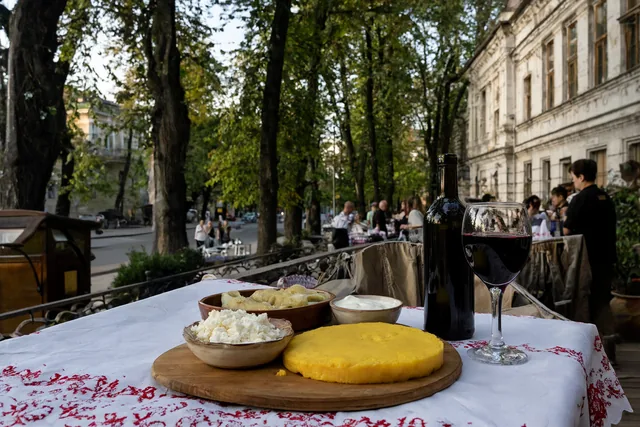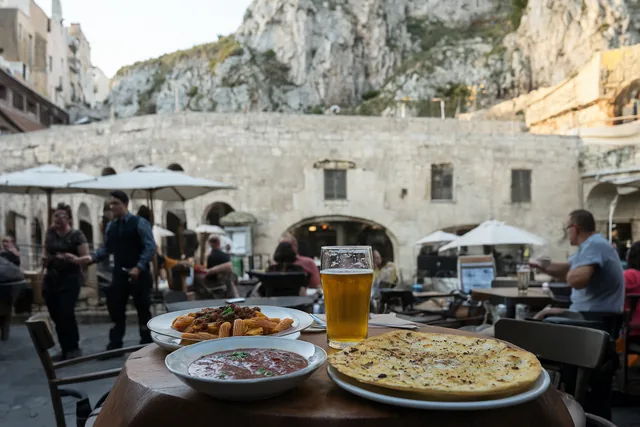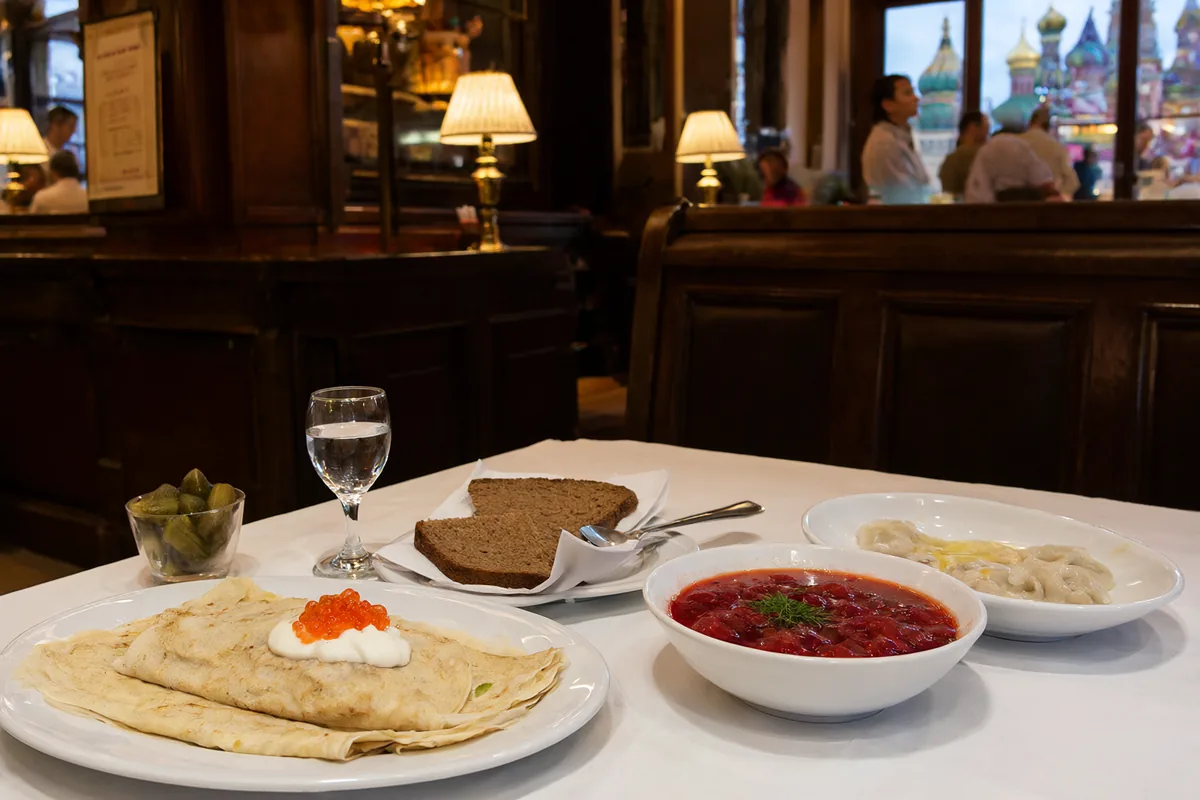
Russia stretches across eleven time zones, and its food changes as much as its landscape: rye bread, sour cream and soups in the west, Tatar pastries on the Volga, Caucasian grills on the Black Sea, smoked fish on Lake Baikal and king crab on the Pacific. This Russia food guide covers the dishes to know, how to read a Russian menu in Cyrillic, how tipping and paying work, then goes city by city through where to eat in Moscow, St Petersburg, Kazan, Sochi, Yekaterinburg, Irkutsk and Lake Baikal, and Vladivostok. Everyday Russian cooking is built on what keeps through a long winter: cabbage, beetroot, potatoes, buckwheat, pickles, mushrooms and dumplings. The big cities add Georgian, Uzbek, Armenian and Korean restaurants, which are often the best value meals you will find. For the cooking of the wider region, see our Georgia food guide and Uzbekistan food guide.
What to eat in Russia: 12 dishes to know
A traditional Russian meal starts with zakuski, cold starters such as pickles, herring and salads, then a soup, then a hot main course. These are the dishes to look for.
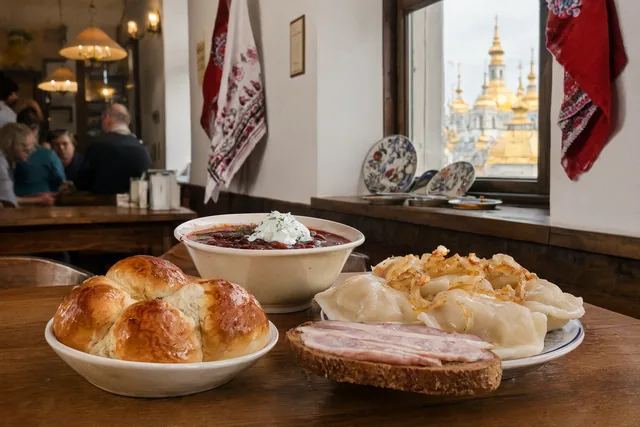
- Pelmeni (everywhere, especially Siberia and the Urals): small boiled dumplings filled with minced meat, served with sour cream, butter or vinegar. Siberians once froze them by the sackful for the winter.
- Blini (everywhere): thin pancakes served with sour cream, red salmon caviar, smoked fish, jam or condensed milk. They are the centre of Maslenitsa, the pancake festival before Lent.
- Borscht and shchi (everywhere): beetroot soup and cabbage soup, both served with a spoonful of smetana (sour cream) and dark rye bread.
- Solyanka (everywhere): a thick, sour and salty soup of mixed meats or fish with pickles, olives, capers and lemon.
- Okroshka (summer): a cold soup of chopped vegetables, herbs, egg and sometimes meat, topped up with kvass or kefir.
- Pirozhki (bakeries and kiosks): small baked or fried buns filled with cabbage, potato, meat, egg and onion, or jam.
- Beef Stroganoff (everywhere): strips of beef in a sour cream and mushroom sauce, usually served with mashed potatoes or buckwheat.
- Grechka (everywhere): buckwheat groats, the everyday side dish, served with butter, mushrooms or a meat stew.
- Olivier salad and herring under a fur coat (everywhere): two mayonnaise-dressed salads that appear at every celebration. Salat Olivye has potato, peas, pickles, egg and meat; selyodka pod shuboy layers herring with potato, carrot and grated beetroot.
- Syrniki (breakfast cafés): small fried cottage cheese pancakes with sour cream, jam or honey.
- Medovik (cafés and bakeries): a honey cake of many thin layers with a sour cream filling, the most popular Russian cake.
- Kvass, mors and vodka (everywhere): kvass is a lightly fermented rye bread drink, mors is a sweet-sour berry drink, often of cranberry or lingonberry, and vodka is drunk chilled in small glasses with a bite of pickle or herring after each toast.
How to read a Russian menu
Russian menus are written in the Cyrillic alphabet. In central Moscow and St Petersburg many restaurants have English menus, but outside the main tourist areas and in other cities you will often find Russian only. Menus follow a fixed order: cold starters, salads, soups, hot dishes, sides and desserts. Sides are usually priced separately, the weight of each portion is listed in grams, and some dishes, such as grilled meat, fish and crab, are priced per 100 grams.
| Script | Romanised | Meaning |
|---|---|---|
| Меню | Menyu | Menu |
| Холодные закуски | Kholodnye zakuski | Cold starters |
| Салаты | Salaty | Salads |
| Супы / первые блюда | Supy / pervye blyuda | Soups / first courses |
| Горячие блюда | Goryachiye blyuda | Hot dishes: main courses |
| Гарниры | Garniry | Side dishes, ordered separately |
| Десерты | Deserty | Desserts |
| Говядина / свинина / курица | Govyadina / svinina / kuritsa | Beef / pork / chicken |
| Рыба / икра | Ryba / ikra | Fish / caviar (red or black) |
| Грибы | Griby | Mushrooms |
| Сметана | Smetana | Sour cream |
| Бизнес-ланч | Biznes-lanch | Weekday set lunch |
| Напитки | Napitki | Drinks |
| Счёт | Schyot | The bill |
Look for small print such as "100 г" or "за 100 г" next to prices for crab, fish, shashlyk and caviar: the figure is per 100 grams, and a whole fish or a crab can cost several times more. swap.menu reads Russian menus in Cyrillic, explains every dish in your language and flags weight-based prices so you see the real cost before you order.
Tipping, paying in roubles and meal times
Check your government's current travel advice before planning a trip. Menu prices in Russia include VAT, and cover charges are rare. Some restaurants add a service charge, usually around 10 percent, which should be stated on the menu or bill. Where there is none, leaving about 10 percent in a sit-down restaurant is normal, and rounding up is enough in cafés. Our guide to tax and service charges on menus explains how these lines work around the world.
The currency is the rouble (RUB, ₽). Payment cards issued outside Russia generally do not work there, for card payments or at ATMs, and foreign phone payment apps are not accepted either. Visitors usually need to bring enough cash for the whole trip and exchange it at banks or exchange offices. Russians themselves pay by local card or phone almost everywhere, so cash is accepted but some smaller places may be surprised by it. Our guide to paying in local currency explains more about paying abroad.
Breakfast cafés open early, and many serve breakfast all day. On weekdays, most restaurants offer a business lunch from about noon to 4pm, a set soup, main and drink at a low price, and it is the best value way to eat in Russia. Dinner runs from about 7pm to 11pm, and in Moscow and St Petersburg many places stay open very late. Tap water is not usually drunk unfiltered, so buy bottled water, which is cheap and sold everywhere.
Where to eat in Russia, city by city
Russia's cities are far apart, and each region has its own dishes and its own neighbours' influences, from Tatar cooking on the Volga to Korean and Chinese food in the Far East. Jump to a city:
Where to eat in Moscow
Moscow has the largest and most varied restaurant scene in Russia, from canteens (stolovaya) serving soup and buckwheat to modern restaurants cooking with Russian ingredients such as river fish, game, berries and fermented vegetables. The city's covered markets have been reinvented as food halls: Danilovsky Market, in its round concrete hall, has stalls selling Dagestani pies, Uzbek plov, Georgian khachapuri, Vietnamese pho and fresh produce, and the Central Market on Tsvetnoy Boulevard is similar. Food halls like these are the easiest way to try many cuisines in one sitting.
For eating out in the evening, Moscow's centre has dense clusters of restaurants and bars around Patriarch's Ponds, along Pokrovka and Maroseyka streets, and on Nikolskaya Street near Red Square. The Arbat is lined with restaurants but aimed at tourists. Georgian restaurants are everywhere in Moscow and are a reliable choice for khachapuri, khinkali and grilled meat, while Uzbek places serve plov, lagman noodles and samsa. The weekday business lunch is the cheapest way to eat in central Moscow.
Where to eat in St Petersburg
St Petersburg, the old imperial capital on the Baltic, eats a little differently from Moscow, with more fish from the Gulf of Finland and the Neva. In spring the city celebrates koryushka, a small smelt that smells oddly of fresh cucumber, sold fried in markets and restaurants. The city's best-known snack is pyshki, ring doughnuts dusted with icing sugar, eaten with milky coffee in simple Soviet-style cafés. Locals insist they are called pyshki here, not ponchiki as in Moscow.
Rubinstein Street, just off Nevsky Prospekt, is the city's restaurant street, packed with bars, bistros and restaurants that stay open late. Kuznechny Market near Vladimirskaya metro is the classic produce market of St Petersburg, with honey, pickles, smoked fish, cheese and berries. The streets of the centre around Nevsky Prospekt and the Petrograd Side have many cafés, Georgian restaurants and bakeries. In the White Nights of June, when it barely gets dark, terraces stay busy until very late.
Where to eat in Kazan
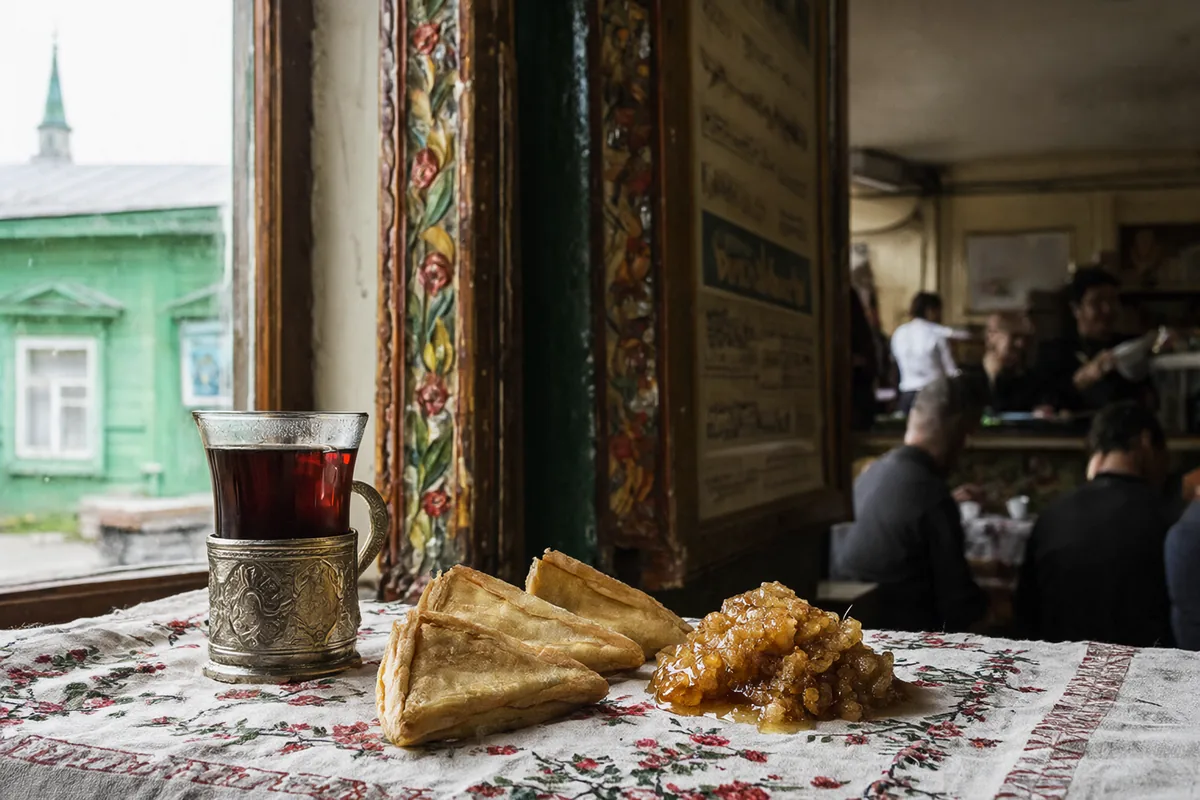
Kazan, on the Volga, is the capital of Tatarstan and the best place in Russia to try Tatar cooking, which is built on dough, beef, lamb, potatoes, butter and honey. The dishes to order are echpochmak, triangular baked pastries filled with meat, onion and potato, belish, a large round meat and potato pie, kystyby, a thin flatbread folded around mashed potato or millet, gubadia, a layered sweet pie of rice, dried fruit and sweet curd cheese, and chak-chak, small pieces of fried dough bound with honey into a mound.
The pedestrian Bauman Street is the main street for eating out in Kazan, with cafés, bakeries and Tatar restaurants, and the Old Tatar Quarter (Staro-Tatarskaya Sloboda) by Lake Kaban has wooden houses, mosques and teahouses where you can try Tatar pastries with tea. Tea is central to Tatar hospitality, served strong and often with milk. Kazan's restaurants also serve Tatar noodle soup and azu, a beef stew with pickled cucumbers and potatoes. Bakeries sell echpochmak hot from the oven for a cheap, filling lunch.
Where to eat in Sochi
Sochi is a subtropical resort on the Black Sea coast at the foot of the Caucasus mountains, and its food is shaped by its neighbours. Caucasian and Georgian restaurants dominate, serving khachapuri (cheese bread), khinkali (dumplings), grilled shashlyk and salads of tomato, cucumber and fresh herbs, and the local Adyghe cheese, a mild fresh cheese, turns up grilled or in salads. Black Sea fish such as red mullet and sprats are fried along the seafront.
The seafront promenade of Sochi is lined with restaurants and cafés, and the central market sells fruit, nuts, cheese, spices and churchkhela, strings of nuts dipped in thickened grape juice. Tea is grown in the hills around Sochi, among the most northerly tea plantations in the world, and you can visit tea farms with tastings. Up in the mountains, the ski resorts of Krasnaya Polyana have mountain restaurants that serve grilled meat and Caucasian dishes in winter and summer.
Where to eat in Yekaterinburg
Yekaterinburg, the largest city in the Urals, sits on the border between Europe and Asia and is a stop on the Trans-Siberian Railway. Ural cooking is hearty: pelmeni are a local point of pride, sometimes served in a small pot baked under a pastry lid, alongside posikunchiki, small fried meat pies, river fish, wild mushrooms and berries from the forests. Yekaterinburg has a young restaurant scene, with cafés, craft beer bars and modern Russian restaurants.
The pedestrian Vaynera Street and the streets around the city pond and its dam, known as the Plotinka, are the main places to eat and walk in Yekaterinburg. The city also has good Uzbek, Georgian and Tatar restaurants, and canteens for a cheap lunch. It is a sensible place to break a long train journey with a proper meal.
Where to eat in Irkutsk and Lake Baikal
Irkutsk, in eastern Siberia, is the gateway to Lake Baikal, the deepest lake in the world, and the food here is about the lake. The signature fish is omul, a Baikal whitefish sold hot-smoked, cold-smoked, salted or grilled. In the lakeside village of Listvyanka, about an hour from Irkutsk, market stalls sell smoked omul and other fish, and cafés serve fish soup (ukha). Siberian cooking also uses pine nuts, wild berries such as sea buckthorn and lingonberry, and game.
The Buryat people of the Baikal region have their own cooking, and the dish to try is buuzy (called pozy in Russian), large steamed dumplings filled with minced meat and onion, eaten by hand while you sip the hot juice from the top. In Irkutsk, the 130th Quarter (130-y Kvartal), an area of restored wooden houses, has many restaurants and cafés, and the central market sells pine nuts, berries, honey and smoked fish. Sea buckthorn tea and berry mors are the local drinks.
Where to eat in Vladivostok
Vladivostok, the Pacific port at the end of the Trans-Siberian Railway, has the best seafood in Russia. Look for king crab (kamchatsky krab), sea urchin, scallops, oysters, squid, sea cucumber and fresh fish, served raw, grilled, steamed or in salads, and often priced by weight. Seafood markets near the waterfront sell crab and fish to cook at home or to have prepared on the spot.
Vladivostok is closer to Seoul and Beijing than to Moscow, and its food shows it. Korean dishes, such as spicy carrot salad and steamed pyanse buns with cabbage and meat, are everyday food, and Chinese, Korean and Japanese restaurants are common. The pedestrian Admiral Fokin Street and the streets near the waterfront have the densest choice of cafés and restaurants in Vladivostok. Our guide to reading a Korean menu is useful in the Korean restaurants here.
Vegetarian, vegan and allergy tips
Russian food is meat and dairy heavy, but there is a long tradition of meatless cooking because of the Orthodox fasting calendar. During Lent and other fasts, many restaurants offer a постное меню (postnoye menyu, fasting menu) with dishes free of meat, dairy and eggs, which are usually vegan. Mushroom dishes, buckwheat, potato and cabbage pirozhki, vegetable salads and blini with jam are easy vegetarian choices, and Georgian restaurants have excellent vegetable dishes with walnuts and herbs. The word for vegetarian is вегетарианский (vegetarianskiy) for a dish, and you can ask for food без мяса (bez myasa, without meat).
Watch for hidden ingredients. Many soups are made on meat stock, salads are usually dressed with mayonnaise (which contains egg), and sour cream and butter are added to almost everything. Walnuts are common in Georgian and Caucasian dishes, and pine nuts in Siberia. Seafood and fish roe appear in many starters. Our guide to eating abroad with food allergies explains how to explain an allergy clearly when you do not speak the language.
Useful Russian phrases for ordering
Здравствуйте Zdravstvuyte: "Hello", the polite greeting
Столик на двоих, пожалуйста Stolik na dvoikh, pozhaluysta: "A table for two, please"
Что вы посоветуете? Chto vy posovetuyete?: "What do you recommend?"
Я буду это Ya budu eto: "I will have this" (pointing at the menu)
У меня аллергия на... U menya allergiya na...: "I am allergic to..."
Приятного аппетита! Priyatnogo appetita!: "Enjoy your meal!"
Счёт, пожалуйста Schyot, pozhaluysta: "The bill, please"
Спасибо, было очень вкусно Spasibo, bylo ochen vkusno: "Thank you, it was very tasty"
How swap.menu helps you eat in Russia
Outside the centres of Moscow and St Petersburg, menus in Russia are usually in Cyrillic only, and dish names such as селёдка под шубой (herring under a fur coat) or эчпочмак (echpochmak) give a visitor no clue. Photograph the menu with swap.menu and every dish appears in your language with the Russian name beside it and a short explanation, so you know what солянка (solyanka) and окрошка (okroshka) are before you order. Every price is converted from roubles to your home currency, which helps when you are budgeting cash, and swap.menu flags portion weights, prices per 100 grams and any service charge.
Tap the dishes you want, add a note such as "no meat" or "no mayonnaise, please", typed or spoken, and swap.menu translates your order into Russian. Show the waiter your phone, or let them scan the QR code and read your order on their own screen. Try it on a sample menu with the free demo, or see travel pass prices.
Off to Russia? Your first 3 menu scans are free, and a travel pass starts from $4.99 with nothing that renews.
Start free with 3 scansRussia food FAQ
Do you tip in restaurants in Russia?
Leaving about 10 percent is normal in sit-down restaurants in Russia, unless a service charge is already on the bill. In cafés and canteens, rounding up or leaving small change is enough.
What food is Russia famous for?
Russia is famous for pelmeni dumplings, blini with sour cream and caviar, borscht and shchi soups, beef Stroganoff, pirozhki and salads such as Olivier and herring under a fur coat. Regional cooking adds Tatar pastries in Kazan, smoked omul on Lake Baikal and king crab in Vladivostok.
Can foreign visitors pay by card in Russia?
Payment cards issued outside Russia generally do not work in Russia, either in shops or at cash machines. Visitors usually bring enough cash for their whole stay and exchange it locally.
What is a business lunch in Russia?
A business lunch is a weekday set meal, usually a soup or salad, a main course and a drink, served from around noon to 4pm at a low fixed price. It is the cheapest way to eat in a good restaurant in Russian cities.
Is tap water safe to drink in Russia?
Most people in Russia boil or filter tap water before drinking it, and visitors are advised to drink bottled water. It is cheap and sold everywhere.
How can I read a Russian menu if I cannot read Cyrillic?
Photograph the menu with swap.menu. It reads the Cyrillic text, translates every dish into your language with a short explanation, converts prices from roubles to your currency and translates your order back into Russian for the waiter.
Travelling further? Read our food guides for neighbouring countries:
- Georgia food guide
- Kazakhstan food guide
- Finland food guide
- Estonia food guide
- Mongolia food guide
- Azerbaijan food guide
Or browse every travel food guide.