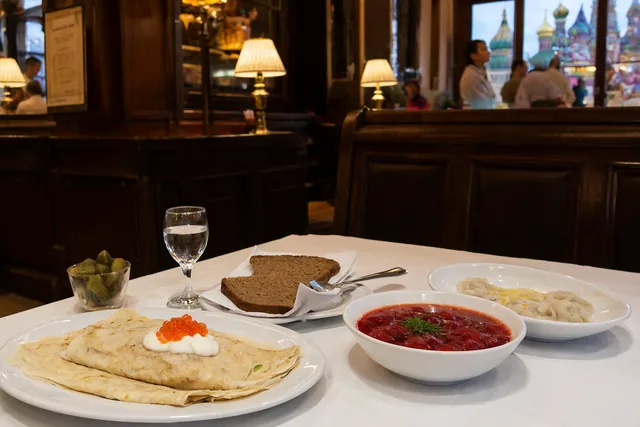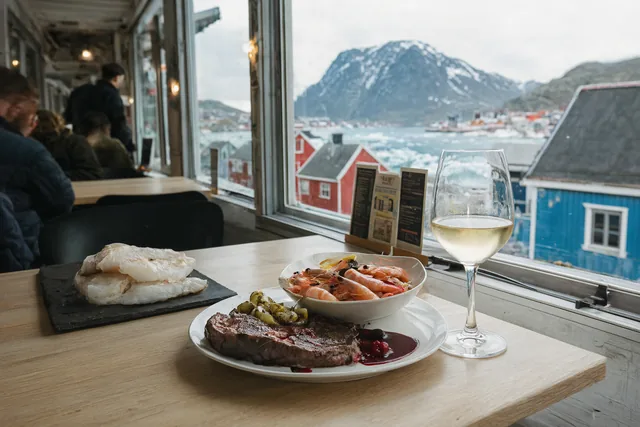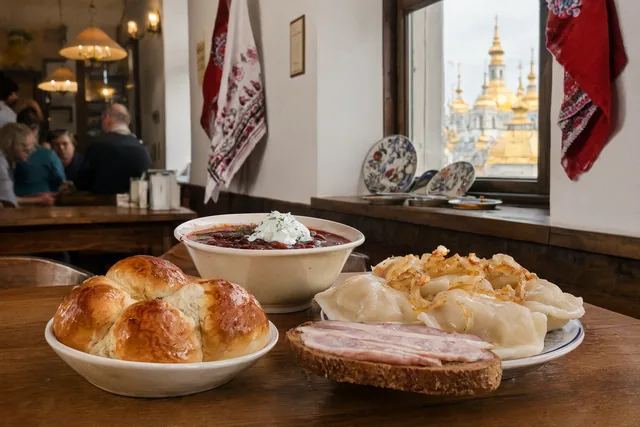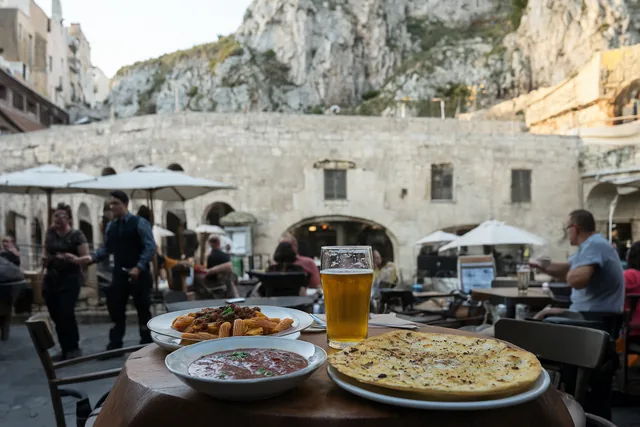
The Faroe Islands are eighteen steep green islands in the North Atlantic, halfway between Scotland and Iceland, with more sheep than people and some of the cleanest, coldest water in the world. Faroese food grew out of that setting: fish, lamb and mutton preserved by wind and salt air in slatted wooden sheds, plus superb fresh seafood. This Faroe Islands food guide covers the traditional dishes you will see under their Faroese names, how to read a Faroese menu, how tipping and paying in króna work, then goes island by island through where to eat in Tórshavn, Kirkjubøur, Gjógv and Eysturoy, Klaksvík and the northern isles, Vágar and Suðuroy. Restaurants are few outside the capital, so the Faroese custom of heimablídni, dinner in a local family's home, is one of the best ways to eat. For comparison with their Nordic neighbours, see our Iceland food guide and Denmark food guide.
What to eat in the Faroe Islands: 12 dishes to know
The key word in Faroese food is ræst, meaning meat or fish that has been hung to ferment and dry in the salty wind, which gives it a strong, distinctive flavour. Modern restaurants serve these traditions alongside fresh fish and lamb. Here are the dishes and ingredients to know, with English explanations.
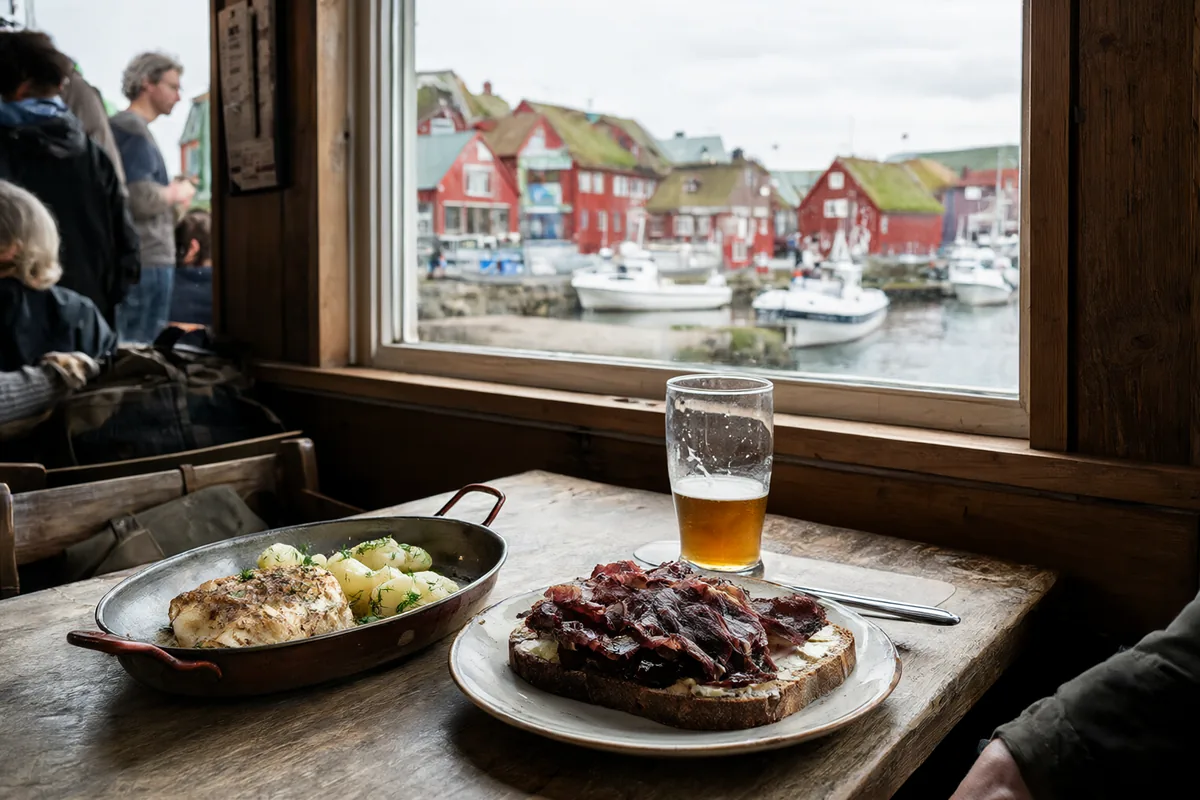
- Skerpikjøt (wind-dried mutton): leg of mutton hung for several months in a hjallur, a wooden drying shed with slatted walls, until it is dark, dry and intensely flavoured. It is sliced paper-thin and eaten on rye bread with butter, and it is the Faroese national delicacy.
- Ræst kjøt (fermented mutton): mutton hung for a shorter time so that it ferments rather than dries, then boiled or used in soup. The flavour is strong and slightly cheesy.
- Ræstur fiskur (fermented fish): usually cod, hung to ferment, then boiled and served with potatoes and melted mutton fat. Pungent and much loved by older Faroese.
- Garnatálg (fermented mutton tallow): fat from around the sheep's intestines, rolled, dried and fermented, then melted over boiled fish. Very much an acquired taste.
- Knetti (fish balls): balls of minced fish, often fermented, mixed with tallow and boiled, served with potatoes.
- Turrur fiskur (dried fish): wind-dried cod or other fish, torn into strips and eaten as a snack with butter.
- Fresh cod and haddock (everywhere): toskur and hýsa in Faroese, landed daily and served pan-fried, baked or in fish soup. Halibut and monkfish also appear.
- Faroese salmon (everywhere): salmon farming in the fjords is the islands' biggest export, and you will find it smoked, cured or seared on most menus.
- Langoustine, scallops and mussels (restaurants): cold-water shellfish from Faroese waters, often the highlight of a tasting menu.
- Lamb (autumn especially): Faroese sheep graze freely on the hillsides, and lamb is served roasted, braised or as soup, with the slaughter season in autumn.
- Tvøst og spik (home cooking): pilot whale meat and blubber, from the traditional community whale drive called the grind. It is rarely on restaurant menus, and Faroese health authorities advise eating it rarely, if at all, because of mercury.
- Rhubarb (desserts): one of the few plants that thrives in the cool climate, grown in gardens across the islands and made into compotes, jams and cakes, often served with cream.
How to read a Faroese menu
Faroese is the national language, a Nordic language related to Icelandic and Old Norse. Danish is also widely understood, and English is spoken very well, so you will rarely have trouble ordering. Many restaurant menus are printed in Faroese and English, but village cafés, bakeries and supermarket counters often use Faroese only, and traditional dishes keep their Faroese names even on English menus.
| Faroese | Meaning |
|---|---|
| Fiskur | Fish |
| Kjøt | Meat |
| Seyðakjøt | Mutton |
| Toskur | Cod |
| Hýsa | Haddock |
| Laksur | Salmon |
| Ræst | Fermented and wind-matured |
| Skerpikjøt | Wind-dried mutton |
| Ræstur fiskur | Fermented fish |
| Knetti | Fish balls |
| Tvøst og spik | Pilot whale meat and blubber |
| Hjallur | Wooden drying shed for meat and fish |
| Heimablídni | Home dining with a local family |
| Øl / vatn | Beer / water |
The word ræst on a menu means a dish has a strong fermented flavour, which surprises many visitors. If you want to try it, start with a small tasting plate rather than a full main course. swap.menu reads Faroese menus, explains every traditional dish in your language and converts króna prices to your home currency.
Tipping, paying in króna and meal times
Menu prices in the Faroe Islands include VAT and service, and there is no cover charge. Tipping is not expected. Some people round up or leave a little extra after an excellent meal, but nobody will expect it. Our guide to tax and service charges on menus explains how these lines work in other countries.
The currency is the Faroese króna (kr), which is equal in value to the Danish krone. Danish coins and notes are used side by side with Faroese notes, but Faroese notes are hard to exchange outside the islands, so spend them before you leave. Cards and contactless payment are accepted almost everywhere, even for small amounts at cafés and petrol stations. If a card machine offers to charge you in your home currency, choose króna: our guide to paying in local currency explains why.
Meal times are early, as in the rest of the Nordic countries. Lunch is from about 11:30am to 2pm, and dinner from about 6pm, with many kitchens closing by 9pm. There are only a handful of restaurants outside Tórshavn and Klaksvík, and many village cafés and heimablídni dinners run only from late spring to early autumn, so book ahead in summer. Eating out is expensive, at Scandinavian prices, and alcohol for takeaway is sold only in state-run shops. Tap water is excellent and safe to drink.
Where to eat in the Faroe Islands, island by island
The main islands are linked by roads, bridges and undersea tunnels, and the rest by ferries and helicopters, so you can reach most places from Tórshavn in an hour or two. Restaurants are concentrated in the capital, while villages offer cafés, guesthouses and home dining. Jump to a destination:
Where to eat in Tórshavn
Tórshavn is one of the smallest capitals in the world, and it has most of the Faroe Islands' restaurants. The old town of Tinganes, a rocky point between the two harbours with red-painted, turf-roofed government buildings, and the narrow lanes of Reyn behind it are the most attractive places to eat, with restaurants in old wooden houses serving modern Nordic menus built on local fish, shellfish, lamb and fermented specialities. Tasting menus here are a good way to try skerpikjøt and ræst dishes in small portions.
Around the harbour and the main shopping streets of Tórshavn you find cafés, bakeries, a few pizza and burger places, sushi made with Faroese salmon, and bars that serve local beer. For a cheaper lunch, cafés offer soup, open sandwiches and fish of the day, and supermarkets sell dried fish and skerpikjøt to take home. Book dinner well ahead in summer, as the best tables in Tórshavn fill quickly. Ólavsøka, the national festival at the end of July, fills the town with music, rowing races and chain dancing.
Where to eat in Kirkjubøur
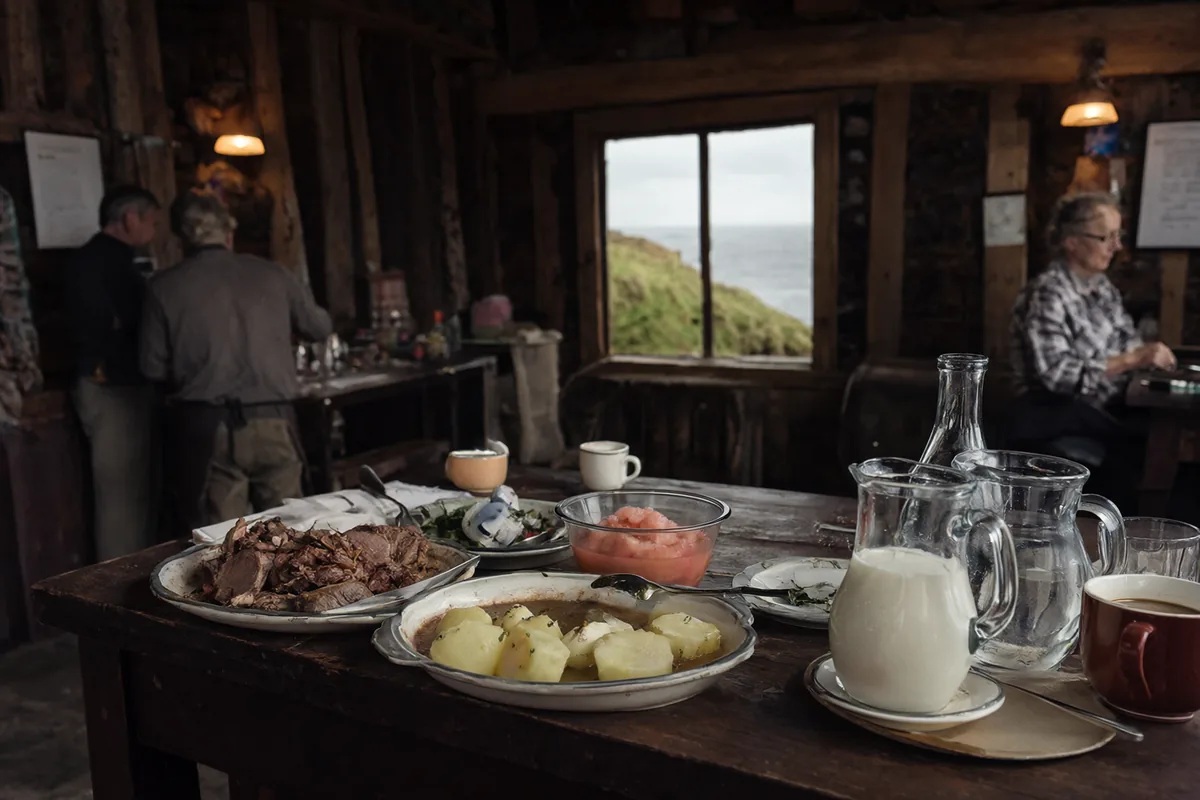
Kirkjubøur, a short drive south of Tórshavn on the island of Streymoy, was the religious centre of the Faroe Islands in the Middle Ages. Today it is a tiny village of black wooden houses on the shore, with the ruins of the unfinished St Magnus Cathedral, an old church still in use and one of the oldest inhabited wooden farmhouses in Europe, which has been in the same family for many generations.
Kirkjubøur is one of the best known places for heimablídni, home dining with a local family, where you eat traditional dishes such as lamb, fish, skerpikjøt and rhubarb desserts in a farmhouse setting. There is no restaurant scene in Kirkjubøur, so book a home dinner in advance, or bring a picnic. The walk over the hill from Tórshavn to Kirkjubøur takes a few hours and makes a good appetite.
Where to eat in Gjógv and Eysturoy
Eysturoy, the second largest island, is linked to Streymoy by bridge and undersea tunnel. At its northern tip, the village of Gjógv is named after the narrow sea gorge that serves as its harbour, and its guesthouse is known for serving Faroese home-style dinners to guests and visitors, often at a shared table. It is one of the most remote and atmospheric places to eat in the Faroe Islands, so book ahead.
Elsewhere on Eysturoy, villages along the Skálafjørður, the longest fjord in the islands, have cafés and a few restaurants, and some farms offer heimablídni meals. The village of Gøta hosts a music festival in July with food stalls. Eysturoy has few restaurants in total, so plan meals as you plan your route, and carry snacks from a supermarket for long walks.
Where to eat in Klaksvík and the northern isles
Klaksvík, on the island of Borðoy, is the second town of the Faroe Islands and its main fishing port. It has a working harbour, a handful of restaurants and cafés serving fresh fish, burgers and pizza, a bakery or two, and a brewery that has been making Faroese beer for more than a century. Restaurants in Klaksvík are more casual than in Tórshavn, and the fish is landed right in front of you.
From Klaksvík, roads and ferries reach the northern isles, including Kalsoy, with its lighthouse walk at Kallur, and Viðoy, with the northernmost village, Viðareiði. These islands have very little in the way of food, perhaps a café or a guesthouse, so eat in Klaksvík before you set out, and check ferry times so you are back for dinner.
Where to eat in Vágar
Vágar is the island with the airport, and for most visitors it is the first and last stop. It is also home to some of the most photographed sights in the Faroe Islands: the waterfall at Gásadalur, which drops straight into the sea, and the lake of Sørvágsvatn, which seems to hang above the ocean. The villages of Sørvágur and Miðvágur have a few hotel restaurants, cafés and guesthouses, and some farms run heimablídni dinners in season.
Vágar is also the departure point for boats to Mykines, the westernmost island, famous for its puffin colony in summer. Mykines has a tiny village with a café open in the season, but bring your own food and water in case of delays, as boats are often cancelled in bad weather. Vágar is only about 45 minutes by road from Tórshavn, so many visitors base themselves in the capital and come here for the day.
Where to eat in Suðuroy
Suðuroy, the southernmost island, is about two hours from Tórshavn by car ferry, and it is the least visited of the main islands. The towns of Tvøroyri and Vágur have a few cafés, a bakery, a pizza place or two and guesthouses that serve simple meals, but there is no restaurant scene to speak of.
What Suðuroy offers is a slower, more traditional Faroese way of life, with drying sheds behind many houses, dramatic sea cliffs and quiet villages. The ferry itself has a cafeteria serving hot food. Stay overnight in a guesthouse, and you are likely to be offered home cooking such as fish, lamb and potatoes. Buy supplies at a supermarket in Tvøroyri or Vágur for walks on the cliffs.
Vegetarian, vegan and allergy tips
Traditional Faroese food is almost entirely fish, lamb and mutton, and there are few vegetables in the old diet, so vegetarians rely on modern restaurants and cafés. Most restaurants in Tórshavn have at least one vegetarian dish, and tasting menus can usually be adapted if you warn them when you book. In villages and at heimablídni dinners, tell your host well in advance. The Faroese word for vegetarian is close to the Danish, and English is widely understood, so "vegetarian" and "vegan" in English work everywhere.
Watch for hidden ingredients: fish stock and fish sauce are common, mutton fat and tallow are used in traditional cooking, and many soups are made on meat or fish broth. Shellfish appear in many restaurant dishes, and cream and butter in most sauces. Restaurants generally handle allergies well if you explain clearly. Our guide to eating abroad with food allergies explains how to explain an allergy clearly when you do not speak the language.
Useful Faroese phrases for ordering
Almost everyone in the Faroe Islands speaks English, but a few words of Faroese are always appreciated.
Hey / Góðan dag "Hi / Good day", the everyday and the more formal greeting
Takk / Takk fyri "Thanks / Thank you"
Ja / Nei "Yes / No"
Eg vil fegin hava hetta "I would like this" (pointing at the menu)
Hvat kostar hetta? "How much does this cost?"
Skál! "Cheers!"
Takk fyri matin "Thank you for the food", said to your host after a meal
How swap.menu helps you eat in the Faroe Islands
Faroese menus use names that are not in any phrasebook, such as skerpikjøt, ræstur fiskur, garnatálg or knetti, and village cafés and bakery counters are often labelled in Faroese only. Photograph the menu with swap.menu and every dish appears in your language with the Faroese name beside it and a short explanation, so you know that ræst means fermented and that tvøst og spik is pilot whale before you order. Every price is converted from Faroese króna to your home currency, which helps in one of the more expensive places in Europe to eat out.
Tap the dishes you want, add a note such as "no shellfish" or "vegetarian, please", typed or spoken, and swap.menu shows your order in Faroese or Danish. Show your server your phone, or let them scan the QR code and read your order on their own screen. Try it on a sample menu with the free demo, or see travel pass prices.
Off to the Faroe Islands? Your first 3 menu scans are free, and a travel pass starts from $4.99 with nothing that renews.
Start free with 3 scansFaroe Islands food FAQ
Do you tip in the Faroe Islands?
No, tipping is not expected in the Faroe Islands, because service is included in menu prices. Rounding up after an excellent meal is a kind gesture, but it is never required.
What food are the Faroe Islands famous for?
The Faroe Islands are famous for skerpikjøt, wind-dried mutton, and for ræst dishes, meat and fish fermented in wooden drying sheds. Fresh cod, haddock, salmon, langoustine and lamb are the other highlights.
What is heimablídni?
Heimablídni means home hospitality: a meal of traditional food served by a local family in their own home or farmhouse. It is booked in advance and is one of the best ways to eat Faroese food, especially in villages with no restaurant.
Is it expensive to eat out in the Faroe Islands?
Yes, eating out costs about the same as in Denmark or Norway. Cafés, bakeries and supermarket food are the cheapest options, and lunch is usually better value than dinner.
Is tap water safe to drink in the Faroe Islands?
Yes, tap water in the Faroe Islands is excellent and safe to drink. There is no need to buy bottled water.
How can I read a Faroese menu?
Many restaurants have English menus, but traditional dishes keep their Faroese names. Photograph the menu with swap.menu to see every dish in your language with an explanation, prices converted from króna to your currency and your order translated for the server.
Travelling further in the North Atlantic? Read our food guides for nearby destinations:
- Iceland food guide
- Denmark food guide
- Norway food guide
- Greenland food guide
- United Kingdom food guide
Or browse every travel food guide.