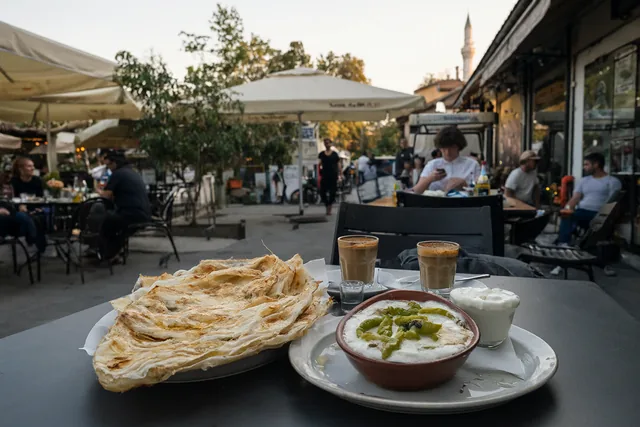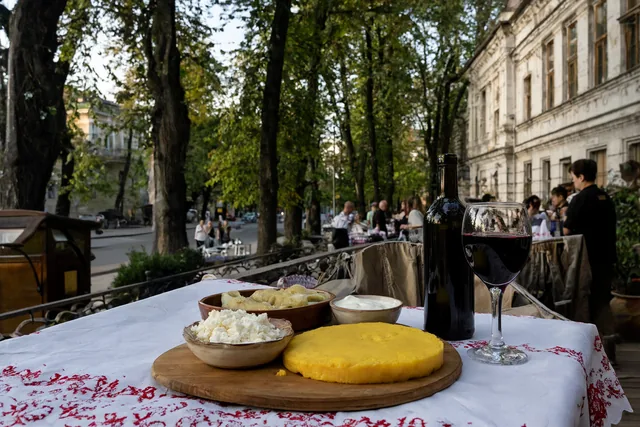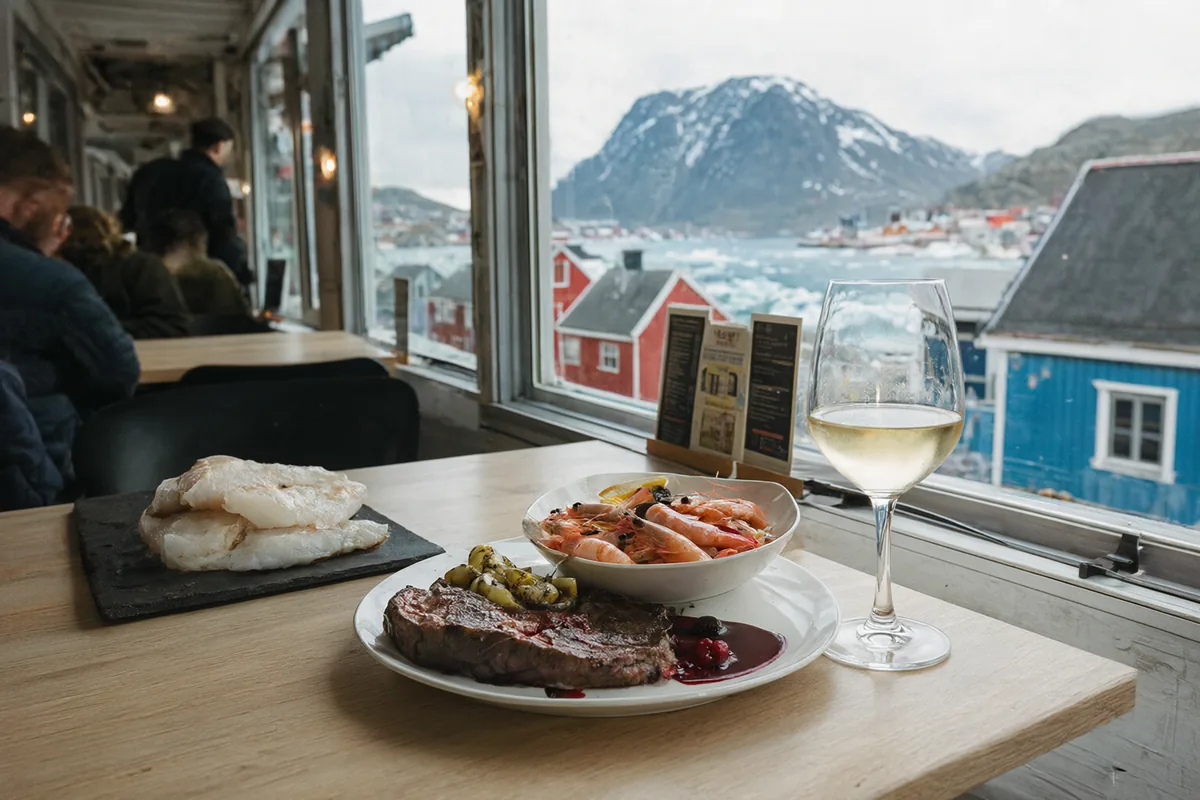
Greenland is the world's largest island, most of it covered by ice, with a population smaller than many suburbs living in towns and settlements along the coast. Its food comes from the sea and the tundra: seal, whale, musk ox, reindeer, Greenland halibut, Arctic char and some of the sweetest cold-water prawns in the world, eaten alongside Danish-style bread, cakes and coffee. This Greenland food guide covers the traditional dishes and their Greenlandic names, how to read menus in Greenlandic and Danish, how paying works, then goes town by town through where to eat in Nuuk, Ilulissat, Sisimiut, Kangerlussuaq, South Greenland and Tasiilaq. There are not many restaurants, and almost everything that cannot be hunted or fished is shipped in, so meals are expensive. The best food experiences are often the simplest: a bowl of suaasat, a plate of prawns by the harbour, or coffee and cake in a local home. Greenland's food has much in common with its North Atlantic neighbours, so see our Faroe Islands food guide and Iceland food guide too.
What to eat in Greenland: 11 dishes and foods to know
Traditional Greenlandic food, kalaalimernit, is built on what hunters and fishers bring home. Hotel and restaurant menus serve it in modern ways, and some offer a Greenlandic buffet where you can try several things in small portions. Here are the dishes to know, with their Greenlandic names and English explanations.
- Suaasat (traditional soup): the national dish, a thick soup of seal meat, or sometimes whale, reindeer or seabird, cooked with onion and rice or barley and seasoned simply with salt and pepper. It is served at celebrations and on National Day.
- Mattak (whale skin and blubber): raw skin of narwhal, beluga or minke whale with a thin layer of blubber, cut into small cubes and chewed slowly. It is rich in vitamin C and a prized traditional food.
- Umimmak (musk ox): lean, dark meat with a mild game flavour, served as steak, stew, burgers, smoked or as carpaccio. The area around Kangerlussuaq has a large wild population.
- Tuttu (reindeer or caribou): wild game from the tundra, roasted, dried, smoked or served as steak, often with berries.
- Puisi (seal): the most traditional meat, eaten boiled, in suaasat, dried or as steak. Seal liver is considered a delicacy.
- Qalerallit (Greenland halibut): the fish that drives much of the economy, especially around Ilulissat, eaten smoked, fried or as sashimi. It is oily and rich.
- Eqaluk (Arctic char): a pink-fleshed fish from rivers and fjords, smoked, salted or pan-fried.
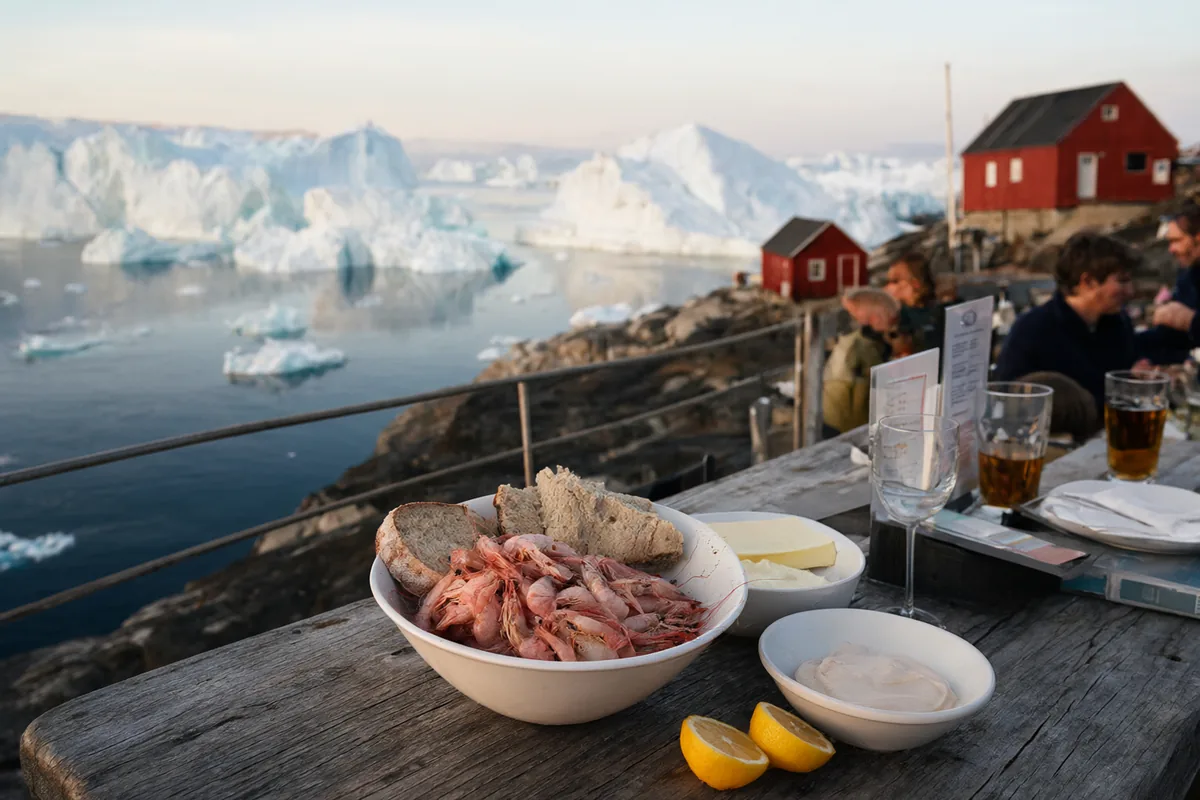
- Cold-water prawns (everywhere): small, sweet prawns from the deep cold waters off the west coast, eaten simply with bread, butter and lemon or mayonnaise. Called rejer on Danish menus.
- Snow crab and other seafood (restaurants): snow crab, scallops, cod and lumpfish roe appear on menus in the west coast towns.
- Ammassat (capelin): small fish caught in huge numbers when they come inshore to spawn in early summer, then dried on racks and eaten as a snack.
- Kaffemik and Greenlandic coffee (homes and bars): a kaffemik is a home gathering with coffee and many cakes, held for birthdays and celebrations, and some can be booked by visitors. "Greenlandic coffee" is a flaming after-dinner drink of coffee, whisky, coffee liqueur, orange liqueur and whipped cream, served in hotel bars.
How to read a menu in Greenland
Greenlandic (Kalaallisut) is the official language, and Danish is widely spoken, especially in Nuuk. Most restaurant menus are written in Danish and English, with Greenlandic names for traditional dishes and local animals. In small cafés, supermarkets and the local food markets, labels are often in Greenlandic and Danish only. These are the words you will see most often.
| Word | Language | Meaning |
|---|---|---|
| Suaasat | Greenlandic | Traditional thick soup, usually of seal |
| Puisi | Greenlandic | Seal (sæl in Danish) |
| Tuttu | Greenlandic | Reindeer or caribou (rensdyr in Danish) |
| Umimmak | Greenlandic | Musk ox (moskusokse in Danish) |
| Qalerallit | Greenlandic | Greenland halibut (hellefisk in Danish) |
| Eqaluk | Greenlandic | Arctic char (fjeldørred in Danish) |
| Mattak | Greenlandic | Whale skin with blubber |
| Kalaalimernit | Greenlandic | Greenlandic food, often a buffet of local dishes |
| Rejer / krabbe | Danish | Prawns / crab |
| Hval | Danish | Whale |
| Røget / tørret | Danish | Smoked / dried |
| Forret / hovedret / dessert | Danish | Starter / main course / dessert |
| Dagens ret | Danish | Dish of the day |
| Brættet | Danish | "The board", the local market where hunters and fishers sell their catch |
The same animal can appear under its Greenlandic name in one place and its Danish name in the next, so umimmak and moskusokse are both musk ox, and qalerallit and hellefisk are both Greenland halibut. swap.menu reads menus in Greenlandic, Danish and English, explains every dish in your language and converts kroner prices to your home currency.
Tipping, paying in kroner and meal times
Tipping is not expected in Greenland, and service is included in menu prices. Some visitors round up after a good meal or a guided food experience, but nobody will expect it. Greenland has no VAT, but menu prices are high because most food and drink is shipped in from Denmark, and alcohol is especially expensive. Our guide to tax and service charges on menus explains how these lines work elsewhere.
Greenland uses the Danish krone (DKK, kr). Cards and contactless payment are accepted in hotels, restaurants and supermarkets in the towns, but cash is still useful in small settlements, at local markets and for some tours. ATMs are found in the main towns. If a card machine offers to charge you in your home currency, choose kroner: our guide to paying in local currency explains why.
Meal times are early. Lunch is from about 11:30am to 1:30pm, and dinner from about 6pm, with many kitchens closing by 9pm. In smaller towns, the hotel restaurant may be the only place serving dinner, so book ahead, especially in the summer season and during the winter Northern Lights season. Tap water in the towns is clean and safe to drink.
Where to eat in Greenland, town by town
There are no roads between Greenland's towns, so you travel by plane, helicopter or boat, and each town is its own small world. Nuuk has the most choice, Ilulissat the best seafood, and the smaller towns rely on hotel restaurants, cafés and local markets. Jump to a destination:
Where to eat in Nuuk
Nuuk, the capital, is home to about a third of Greenland's population and has most of its restaurants. You can eat modern Greenlandic tasting menus built on musk ox, reindeer, halibut, seal and local herbs and berries, as well as Thai, Asian, Italian and Danish-style cafés, burger places and bakeries. Hotel restaurants in Nuuk are some of the best places to try traditional ingredients in a familiar format, and several offer Greenlandic buffets on certain evenings.
The most interesting food stop in Nuuk is the Kalaaliaraq, the local hunters' and fishers' market, where hunters and fishers sell seal, whale, fish, seabirds and reindeer straight from their boats. It is a working market for locals rather than a tourist attraction, so look respectfully and ask before taking photos. The colonial harbour (Kolonihavnen) area, with its old wooden houses, is pleasant for a walk before dinner. Supermarkets in Nuuk sell dried fish, smoked halibut and local meat if you want to self-cater.
Where to eat in Ilulissat
Ilulissat, on Disko Bay, is Greenland's most visited town, famous for the UNESCO-listed Icefjord, where giant icebergs calved from one of the world's fastest glaciers drift out to sea. It is also a major fishing town for Greenland halibut and prawns, so seafood here is as fresh as anywhere in the Arctic. The hotel restaurants of Ilulissat, several with terraces facing the icebergs, serve halibut, prawns, snow crab, musk ox and reindeer, and some offer Greenlandic tasting menus.
Ilulissat also has a few cafés, a bakery, casual places serving burgers and pizza, and a local brættet near the harbour where fishers sell their catch. In summer, boat trips among the icebergs sometimes include a meal or a tasting of local seafood on board. Ilulissat is busy in summer, with cruise visitors as well as independent travellers, so book dinner in advance and eat early to catch the evening light on the ice.
Where to eat in Sisimiut
Sisimiut is Greenland's second largest town, a lively fishing and education centre just north of the Arctic Circle and the northern end of the Arctic Circle Trail from Kangerlussuaq. The hinterland is reindeer and musk ox country, so game is common on local menus, along with fish from the town's harbour. Sisimiut has a small choice of restaurants and cafés, mostly in hotels and around the town centre, serving Greenlandic and Danish dishes.
Sisimiut's local market is a good place to see what the hunters and fishers have brought in, and the old part of town near the harbour has historic wooden buildings and a museum. In winter, Sisimiut is a base for dog sledding, and some tours include a meal of traditional food in a hut or a settlement. Book ahead, as there are few tables in town on busy evenings.
Where to eat in Kangerlussuaq
Kangerlussuaq, a former air base at the head of a long fjord, has long been Greenland's main airport hub and the starting point for trips to the edge of the Greenland ice sheet. It is not a town in the usual sense, more a cluster of airport buildings, a hotel and a few services, and the food scene is honest about that: a cafeteria at the airport, a hotel restaurant, and a supermarket.
What Kangerlussuaq does offer is musk ox, which live wild in large numbers in the valleys around it. Musk ox safaris are popular, and the hotel restaurant serves musk ox and reindeer, sometimes as burgers or steak, and occasionally as a full game menu. Some tours to the ice sheet include a meal in a camp. If you are passing through Kangerlussuaq between flights, this is a good place to try musk ox for the first time.
Where to eat in South Greenland
South Greenland is the greenest part of the country, with sheltered fjords, birch scrub and the sheep farms that supply Greenlandic lamb. It is also where the Norse settled a thousand years ago, and the ruins at Qassiarsuk and Igaliku sit beside working farms, some of which offer farm stays and home-cooked meals of lamb, fish and local vegetables. Qaqortoq, the largest town in the south, has a pretty harbour, a fountain square, a small market and a few restaurants and cafés.
Narsaq and Narsarsuaq, the airport settlement, have hotel restaurants and simple cafés. Restaurant choice in South Greenland is limited, so many visitors join tours that include meals, or self-cater from supermarkets. Lamb from the region, Arctic char from the rivers and berries in late summer are the local flavours to look for.
Where to eat in Tasiilaq
Tasiilaq is the main town of East Greenland, on Ammassalik Island, and it is reached by plane and helicopter, often via Iceland. It is far more remote than the west coast towns, with a traditional hunting culture, dramatic mountains and sea ice for much of the year. Tasiilaq has a hotel restaurant, a few small cafés and grocery stores, and that is about all.
Meals in Tasiilaq are usually taken at your hotel or guesthouse, and the menu depends on what is available: fish, seal, musk ox or reindeer, with imported vegetables when the supply ship has been. Some tours offer a meal or a coffee gathering with a local family. Bring snacks for hikes and be flexible, as weather often changes plans in East Greenland.
Vegetarian, vegan and allergy tips
Traditional Greenlandic food is almost entirely meat and fish, and fresh vegetables have to be shipped in, so vegetarians need to plan. In Nuuk and Ilulissat, restaurants usually have a vegetarian option, and hotels can often prepare one if you ask ahead. In smaller towns, tell your hotel or tour operator in advance. The Danish word for vegetarian is vegetar (for a person) and vegetarisk (for a dish), and vegan is vegansk, but English is widely understood in tourism.
Watch for hidden ingredients: fish stock and shellfish appear in many dishes, cream and butter are in most sauces, and Danish-style open sandwiches often include prawns, fish or meat. Prawn and shellfish allergies need special care, as prawns are everywhere on the west coast. Our guide to eating abroad with food allergies explains how to explain an allergy clearly when you do not speak the language.
Useful Greenlandic and Danish phrases for ordering
Most people working in tourism speak English and Danish, but a few words of Greenlandic are always appreciated.
Aluu "Hi", an informal Greenlandic greeting
Qujanaq "Thank you" in Greenlandic
Qujanarujussuaq "Thank you very much" in Greenlandic
Hvad kan du anbefale? "What do you recommend?" in Danish
Jeg vil gerne have det her "I would like this" in Danish (pointing at the menu)
Jeg er allergisk over for... "I am allergic to..." in Danish
Må jeg bede om regningen? "May I have the bill?" in Danish
How swap.menu helps you eat in Greenland
Menus in Greenland mix Greenlandic, Danish and English, and the local animals and dishes, from suaasat to mattak and umimmak, are rarely explained. Photograph the menu with swap.menu and every dish appears in your language with the original name beside it and a short explanation, so you know that qalerallit is Greenland halibut and tuttu is reindeer before you order. Every price is converted from Danish kroner to your home currency, which helps in a place where a simple dinner can cost more than you expect.
Tap the dishes you want, add a note such as "no shellfish" or "vegetarian, please", typed or spoken, and swap.menu translates your order into Danish. Show your server your phone, or let them scan the QR code and read your order on their own screen. Try it on a sample menu with the free demo, or see travel pass prices.
Off to Greenland? Your first 3 menu scans are free, and a travel pass starts from $4.99 with nothing that renews.
Start free with 3 scansGreenland food FAQ
Do you tip in Greenland?
No, tipping is not expected in Greenland, as service is included in prices. Rounding up after a good meal or tour is a kind gesture but not required.
What is the national dish of Greenland?
Suaasat, a thick soup of seal meat with onion and rice or barley, is the national dish. Other traditional foods include mattak (whale skin with blubber), musk ox, reindeer, Greenland halibut and dried capelin.
Is it expensive to eat out in Greenland?
Yes, eating out in Greenland is expensive because most food is shipped in and there are few restaurants. Lunch is usually better value than dinner, and supermarkets sell local smoked fish and meat for self-catering.
What currency is used in Greenland?
Greenland uses the Danish krone. Cards are widely accepted in towns, but cash is useful in small settlements, at local markets and for some tours.
Is tap water safe to drink in Greenland?
Yes, tap water in Greenland's towns is clean and safe to drink. There is no need to buy bottled water.
How can I read a menu in Greenland?
Most restaurant menus are in Danish and English, with Greenlandic names for traditional dishes. Photograph the menu with swap.menu to see every dish in your language with an explanation, prices converted from kroner to your currency and your order translated into Danish.
Travelling further in the North Atlantic? Read our food guides for nearby destinations:
Or browse every travel food guide.