Persian cooking is one of the great cuisines of the world, built on fragrant rice, slow-cooked stews, saffron, dried limes, pomegranate, fresh herbs and a balance of sweet and sour. Much of the best of it is cooked at home, but Iran's kebab houses, bazaar eateries, teahouses and old courtyard restaurants give visitors a very good way in. This Iran food guide covers the dishes to know, how to read a Persian menu and its numbers, why you need cash, how tipping works, and then goes city by city through where to eat in Tehran, Isfahan, Shiraz, Yazd, Kashan, Tabriz, Rasht and Mashhad.
What to eat in Iran: 12 dishes to know
Restaurant menus in Iran are dominated by kebabs, but the dishes Iranians are proudest of are the rice dishes and the stews, called khoresh. Look for them at lunch, when traditional restaurants serve the widest choice.
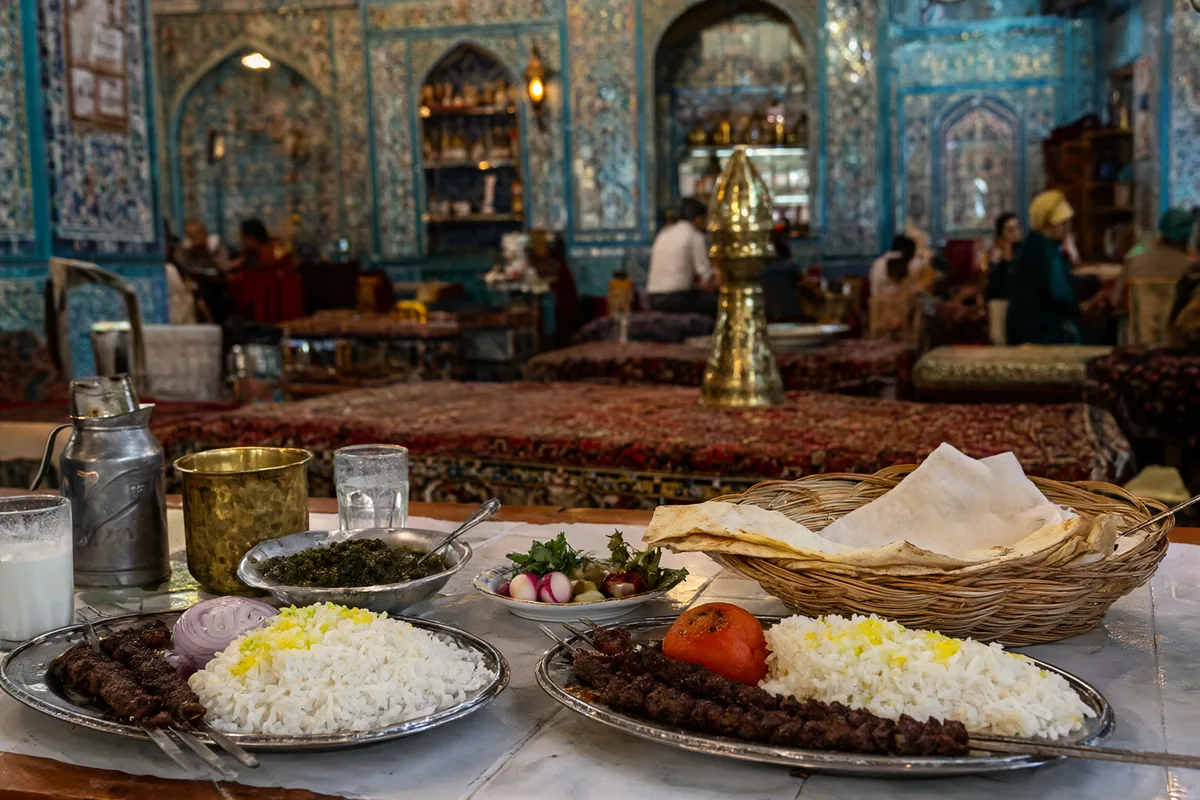
- Chelow kabab: the national restaurant meal, a mound of buttery saffron-topped rice with grilled kebab, a grilled tomato and raw onion. Koobideh is minced lamb or beef on a wide skewer, barg is thin fillet, and joojeh is saffron and lemon chicken.
- Ghormeh sabzi: a deep green stew of slow-fried herbs, kidney beans, lamb and dried limes, often called the national dish.
- Fesenjan: chicken or duck in a dark, sweet and sour sauce of ground walnuts and pomegranate molasses.
- Tahdig: the crisp golden crust from the bottom of the rice pot, sometimes made with potato or bread. Everyone wants the tahdig.
- Zereshk polo ba morgh: saffron rice studded with tart red barberries, served with braised chicken.
- Dizi or abgoosht: lamb, chickpeas, beans and potato cooked in a stone pot. You pour off the broth to eat with bread, then mash the rest into a paste called goosht-e koobideh.
- Ash reshteh: a thick soup of herbs, beans and noodles, topped with kashk (whey), fried onions and mint.
- Kashk-e bademjan: smoky fried aubergine mashed with kashk, walnuts and fried mint. A starter or a light meal with bread.
- Baghali polo ba mahicheh: rice with broad beans and dill, served with slow-cooked lamb shank.
- Mirza ghasemi (Gilan): smoked aubergine with garlic, tomato and egg, from the Caspian coast.
- Beryani (Isfahan): minced lamb, cooked with spices and pressed onto flatbread, served with basil and raw onion. Nothing like an Indian biryani.
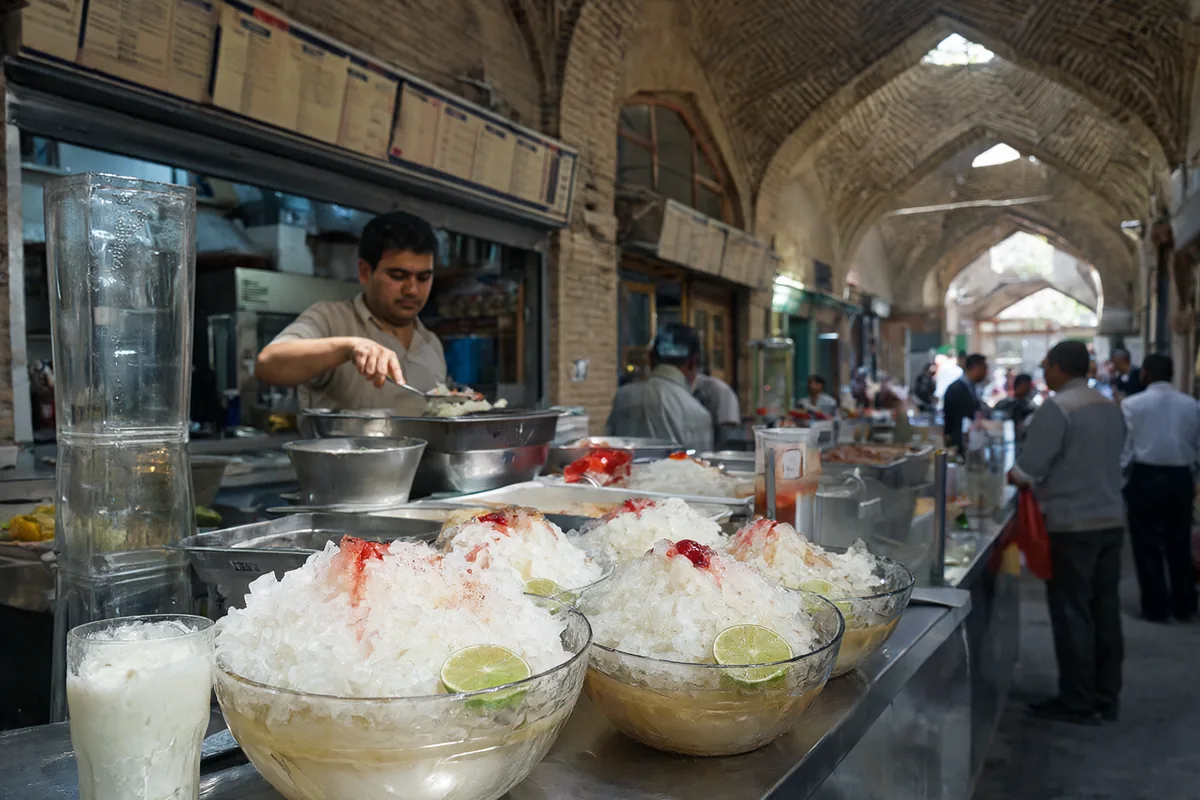
- Faloodeh and sholeh zard: faloodeh is a frozen dessert of thin rice noodles in rosewater syrup with lime juice; sholeh zard is a saffron rice pudding topped with cinnamon.
Bread matters too. Sangak is a long whole-wheat bread baked on hot pebbles, barbari is a thick, ridged loaf for breakfast, and lavash is thin and soft. Breakfast is bread with white cheese, walnuts, fresh herbs, butter, jam and sweet black tea. To drink, order doogh, a salted yoghurt drink often flavoured with dried mint, which is served with kebab almost everywhere.
How to read a Persian menu
Restaurants that see foreign visitors often have an English menu, but most bazaar eateries, kebab houses and teahouses list dishes and prices in Persian only. Persian (Farsi) uses an Arabic-based script written from right to left, and menus often use Persian numerals: ۰ ۱ ۲ ۳ ۴ ۵ ۶ ۷ ۸ ۹ for 0 to 9.
| Persian | Romanised | Meaning |
|---|---|---|
| پیش غذا | pish-ghaza | Starters |
| کباب | kabab | Kebab, grilled meat |
| خورش | khoresh | Stew, served with rice |
| چلو / پلو | chelow / polo | Plain steamed rice / mixed rice dish |
| گوشت | goosht | Meat, usually lamb or beef |
| مرغ / جوجه | morgh / joojeh | Chicken / young chicken pieces |
| ماهی | mahi | Fish |
| ماست | mast | Yoghurt |
| نان | nan | Bread |
| دوغ | doogh | Salted yoghurt drink |
| پرس / نیم پرس | pors / nim-pors | Portion / half portion |
| دسر | deser | Dessert |
| چای | chai | Tea |
| گیاهی | giyahi | Vegetarian |
Prices are the trickiest part. The official currency is the rial, but almost everyone, including many menus, counts in toman, which is ten rials. Menus sometimes also drop the last three zeros, so a kebab marked "450" may mean 450,000 toman. If in doubt, ask "toman?" before you pay.
Between Persian numerals, toman versus rial and dropped zeros, an Iranian menu price can be hard to read even when you know the dish. swap.menu reads Persian script and numerals, explains whether a price is in toman or rial and converts it to your home currency, so you know what a meal costs before you order.
Cash, tipping and paying the bill
Check your government's current travel advice before planning a trip. The most important practical fact for visitors is that foreign-issued cards do not work in Iran. International Visa, Mastercard and other foreign cards cannot be used in shops, restaurants or ATMs, so you need to bring enough cash for your whole trip, usually in euros or US dollars, and change it at official exchange offices (sarafi) in the cities. Some local travel agencies sell prepaid tourist debit cards loaded with rials, which can be useful for larger bills.
Some restaurants add a service charge and a tax line (maliat) to the bill, especially in hotels and upmarket places. Our guide to tax and service charges on menus explains how these lines work around the world. Tipping is not traditionally expected, but it is increasingly common in city restaurants: rounding up or leaving 5 to 10 percent for good service is appreciated where no service charge is added.
Iran has a famous etiquette called taarof, a ritual of politeness in which people offer and refuse. When you go to pay, a shopkeeper or waiter may say ghabel nadare, "it is not worth anything", which does not mean the meal is free. Offer to pay again and they will accept. The currency is the Iranian rial (IRR, ریال), with prices commonly quoted in toman (تومان). Because you are paying in cash, the question of paying in your home currency rarely comes up in Iran, but our guide to paying in local currency explains why it matters elsewhere.
Lunch is the main meal, from about 12:30pm to 3pm, and dinner runs from about 8pm to 10pm or later. Friday is the weekly day off and the day for family outings and picnics, a national passion in parks and on mountain paths.
Alcohol is illegal in Iran and not served anywhere, including hotels. Restaurants serve doogh, fresh juices, soft drinks, tea and non-alcoholic malt drinks that are sold everywhere. During Ramadan, eating, drinking and smoking in public in daylight hours is prohibited. Many restaurants close until iftar at sunset, and hotel restaurants usually serve guests during the day. Evenings bring special foods such as zoolbia and bamieh, fried sweets soaked in syrup, and ash and haleem for breaking the fast.
Where to eat in Iran, city by city
Iran is a large country, and its cities are far apart, but most visitors follow a route from Tehran through Kashan, Isfahan and Yazd to Shiraz. Jump to a city:
Where to eat in Tehran
Tehran is a huge city of more than nine million people, and it has the widest choice of food in Iran, from traditional kebab houses to modern cafés. In the south, the Grand Bazaar is a maze of covered lanes where small eateries serve dizi and chelow kabab to traders at lunch, and it is the most authentic and cheapest place in Tehran for a midday meal. In the north, Tajrish Bazaar is smaller and more manageable, with fruit, spices, sweets, pickles and stalls selling ash reshteh and steamed beetroot in winter.
On summer evenings and weekends, Tehranis walk up the mountain trail at Darband, at the foot of the Alborz mountains, which is lined with teahouses on terraces over a stream, serving tea, qalyan (water pipe), kebabs and ash, and stalls selling sour fruit leather (lavashak) and pomegranates. Tehran also has a strong café culture, especially along Valiasr Street and in the northern neighbourhoods, and in the evenings look for jigaraki, street stalls grilling skewers of lamb liver and heart.
Where to eat in Isfahan
Isfahan, with its grand Naqsh-e Jahan Square, blue-tiled mosques and old bridges, is the cultural highlight of most trips to Iran, and its food has a character of its own. The local dish is beryani, minced lamb and offal cooked and pressed onto flatbread, eaten with fresh basil and raw onion, and the old beryani shops near the bazaar serve little else. Isfahan is also the city of gaz, a soft nougat with pistachios or almonds sold in boxes all over town, and of khoresh mast, an unusual sweet dish of yoghurt, saffron and lamb served cold.
The Grand Bazaar runs north from Naqsh-e Jahan Square, with tea houses, sweet shops and lunch counters among the carpet and metalwork stalls. Across the river, the Armenian quarter of Jolfa has cafés, bakeries and a more relaxed evening scene around the Vank Cathedral. In Isfahan, as in most Iranian cities, many traditional restaurants are in restored historic buildings, with tiled courtyards, fountains and raised platforms (takht) covered in carpets where you sit cross-legged to eat.
Where to eat in Shiraz
Shiraz, the city of poets and gardens, is the place to try faloodeh shirazi, the frozen rice noodle dessert with rosewater syrup, sour lime juice and sometimes sour cherry syrup. It is sold at dessert shops all over Shiraz, together with saffron ice cream. The city's savoury speciality is kalam polo, rice with cabbage, herbs and small meatballs, and the simple salad shirazi of diced cucumber, tomato and onion with lime juice and dried mint is served with almost every meal across Iran.
The Vakil Bazaar, under high brick vaults in the old centre, is the place to graze on sweets, dried fruit, spices and herbs, and the restored caravanserais and courtyards around it house teahouses and traditional restaurants. Shiraz is also known for narenj, bitter oranges, whose blossom scents the city in spring and whose juice is used in local cooking.
Where to eat in Yazd
Yazd, a desert city of mud-brick lanes and wind towers, is best known for its sweets. The local specialities are qottab, small fried pastries filled with ground almonds and cardamom and dusted with sugar, Yazdi baklava, cardamom cookies and pashmak, a fine, silky Persian candy floss. The old sweet shops in Yazd sell them by weight, and a box makes a good gift.
Many visitors to Yazd stay in restored traditional houses in the old town, and many of these have courtyard restaurants open to non-guests, serving dizi, kebabs, stews and ash under the stars. Around the Amir Chakhmaq complex and the old bazaar there are simple lunch places and sweet shops. Yazd also has a historic Zoroastrian community, and you may find dishes cooked in the old Yazdi style, light on meat and heavy on herbs and pulses.
Where to eat in Kashan
Kashan, a small desert city between Tehran and Isfahan, is famous for its grand historic merchants' houses and for rosewater. In spring, usually in May, the villages around Kashan, especially Qamsar, distil rosewater from damask roses, and you can watch it being made and buy bottles of it fresh. Rosewater flavours Kashan's sweets, drinks and rice dishes.
Kashan's food scene is small but good. The Kashan bazaar, with its domed Timcheh-ye Amin od-Dowleh hall, has teahouses and lunch counters, and many of the restored houses in the old quarter have become hotels and courtyard restaurants serving kebab, stews and tea. Kashan is an easy overnight stop between Tehran and Isfahan, and a quiet dinner in a courtyard here is one of the nicest meals on the classic route.
Where to eat in Tabriz
Tabriz, in the north-west, is the main city of Iranian Azerbaijan, and Azerbaijani Turkish is the everyday language there. The city's signature dish is koofteh tabrizi, a giant meatball of minced meat, rice and split peas, stuffed with a boiled egg, walnuts, prunes and barberries and simmered in a tomato broth. Tabriz is also known for its pastries and biscuits, including ghorabieh, a soft almond cookie.
The Tabriz Bazaar is one of the largest and oldest covered bazaars in the world and a UNESCO World Heritage Site. Among its carpet halls and spice lanes you will find dried fruit and nut sellers, cheese and butter shops, sweet makers and traditional eateries serving dizi and kebab for lunch.
Where to eat in Rasht
Rasht, the capital of Gilan province on the green, rainy Caspian coast, was named a UNESCO Creative City of Gastronomy, and its food is unlike anything on the desert route. Gilani cooking is all about fresh herbs, garlic, sour flavours, rice and fish. Order mirza ghasemi (smoked aubergine with garlic, tomato and egg), baghala ghatogh (broad beans with dill and egg), torsh-e tareh (a sour herb stew), kal kabab (aubergine with walnuts and pomegranate) and morgh-e torsh (sour chicken with herbs).
The Rasht bazaar is one of the most interesting food markets in Iran, with Caspian fish, smoked fish, pickles, olives, herbs, local rice and garlic sold from crowded stalls. The pedestrianised square in the centre of Rasht has cafés and is busy in the evenings. Many Gilani restaurants in Rasht serve their dishes as a spread of small plates with rice, which is a good way to try several at once.
Where to eat in Mashhad
Mashhad, in the north-east, is Iran's holiest city and one of the largest pilgrimage destinations in the world, home to the shrine of Imam Reza. The surrounding Khorasan region grows most of Iran's saffron, and Mashhad is the best place to buy it, along with barberries, dried fruit and nuts. The city's signature kebab is shishlik, marinated lamb rib chops grilled over charcoal, and its pilgrims' dish is sholeh mashhadi, a thick stew of grains, pulses and meat.
The streets and bazaars around the shrine are full of restaurants and sweet shops catering to pilgrims, and the area gets very busy on religious holidays. Mashhad is a conservative city, so dress modestly and expect a family atmosphere in restaurants. Look for saffron ice cream and nabat, rock sugar crystals flavoured with saffron, often stirred into tea.
Vegetarian, vegan and allergy tips
Iran can be tricky for vegetarians, because restaurant menus focus on kebabs and most stews contain meat. The good news is that many traditional dishes are vegetarian or easy to make so: kashk-e bademjan, mirza ghasemi, ash reshteh, kuku sabzi (a thick herb omelette), baghala ghatogh, rice with broad beans and dill, and the bread, cheese, herbs and yoghurt that come with almost every meal. Ask for giyahi (vegetarian) or say you do not eat meat. All meat is halal, and pork is not available.
Vegans should know that butter is used generously in rice, kashk (whey) tops many dishes, and yoghurt is served on the side of almost everything. Walnuts are in fesenjan, kashk-e bademjan and many Gilani dishes, pistachios and almonds are in sweets, and saffron and rosewater are everywhere. Our guide to eating abroad with food allergies explains how to communicate an allergy clearly when you do not speak the language.
Useful Persian phrases for ordering
English is spoken in hotels and some restaurants in big cities, but much less elsewhere. Iranians are famously hospitable, and a few words of Persian are always welcomed.
سلام Salaam: "Hello"
منو لطفاً Menu lotfan: "The menu, please"
چی پیشنهاد میکنید؟ Chi pishnahad mikonid?: "What do you recommend?"
این رو میخوام In ro mikham: "I would like this" (pointing)
بدون گوشت Bedun-e goosht: "Without meat"
من به ... حساسیت دارم Man be ... hassasiyat daram: "I am allergic to..."
صورتحساب لطفاً Surat-hesab lotfan: "The bill, please"
ممنون، خیلی خوشمزه بود Mamnoon, kheyli khoshmazeh bood: "Thank you, it was delicious"
How swap.menu helps you eat in Iran
A menu board in a Tehran bazaar eatery is usually Persian only, with Persian numerals and prices that may be in toman, in rial, or with zeros dropped. Photograph it with swap.menu and every dish appears in your language with the Persian name beside it and a short explanation, so you know that kaleh pacheh is a breakfast of sheep's head and trotters, that khoresh gheymeh is a lamb and split pea stew, and that beryani in Isfahan is not a rice dish. Prices are converted to your home currency, so you can keep track of your cash.
Tap the dishes you want, add a note such as "no meat" or "no walnuts, please", typed or spoken, and swap.menu translates your order into Persian. Show the waiter your phone, or let them scan the QR code and read your order on their own screen. Try it now on a sample menu with the free demo, or see travel pass prices.
Off to Iran? Your first 3 menu scans are free, and a travel pass starts from $4.99 with nothing that renews.
Start free with 3 scansIran food FAQ
Can I use my credit card in Iran?
No. Foreign-issued cards do not work in Iran, in shops, restaurants or ATMs. Bring enough cash for your trip, usually euros or US dollars, and change it at official exchange offices, or ask a local travel agency about a prepaid tourist card.
Do you tip in restaurants in Iran?
Tipping is not traditionally expected, but rounding up or leaving 5 to 10 percent is appreciated in city restaurants where no service charge is added. When a waiter says "ghabel nadare" as you pay, it is politeness, and you should still pay.
What food is Iran famous for?
Iran is famous for chelow kabab, saffron rice with grilled kebab, and for stews such as ghormeh sabzi and fesenjan, crisp tahdig rice, dizi, ash reshteh and sweets such as gaz, faloodeh and saffron ice cream. Saffron, pistachios and barberries are typical ingredients.
What is the difference between rial and toman?
The rial is the official currency, but most prices are quoted in toman, which equals ten rials. Some menus also drop the last three zeros, so always check which unit is meant before paying.
Which city in Iran is best for food?
Rasht, on the Caspian coast, is a UNESCO Creative City of Gastronomy with a distinctive herb-rich cuisine. Isfahan, Shiraz and Tabriz have their own famous dishes, and Tehran has the widest range of restaurants. Each city in this guide has its own section on where to eat.
How can I read a Persian menu?
Learn a few words such as kabab, khoresh, polo and doogh, and the Persian numerals, or photograph the menu with swap.menu. It translates every dish into your language, explains it, converts prices to your currency and translates your order into Persian for the waiter.
Travelling further in the region? Read our food guides for neighbouring countries:
- Turkey food guide
- Armenia food guide
- Azerbaijan food guide
- Turkmenistan food guide
- Iraq food guide
- Pakistan food guide
Or browse every travel food guide.