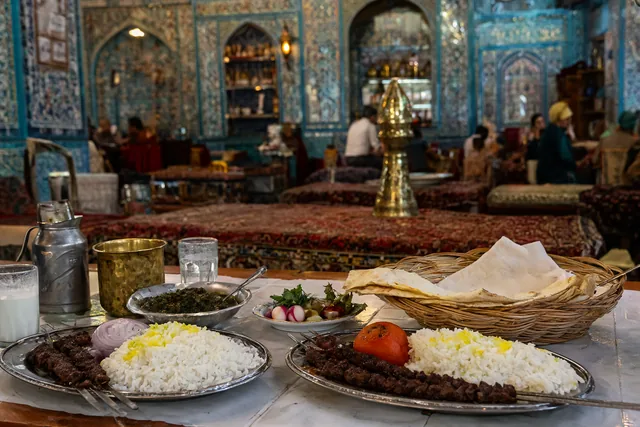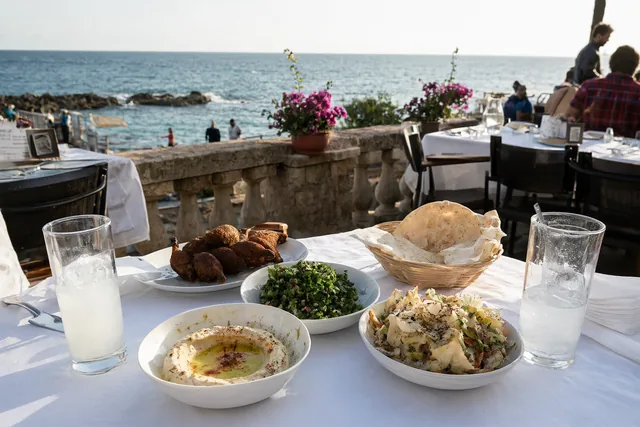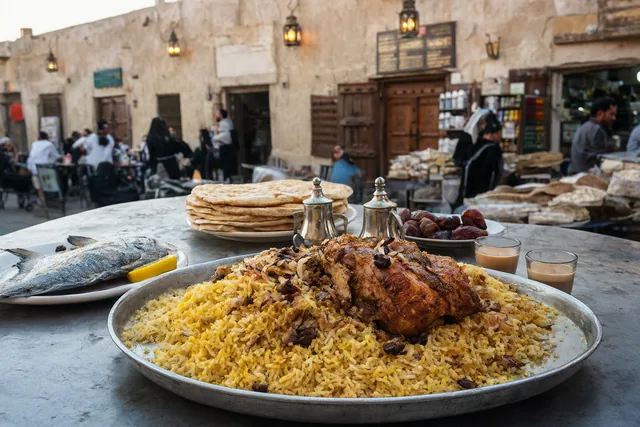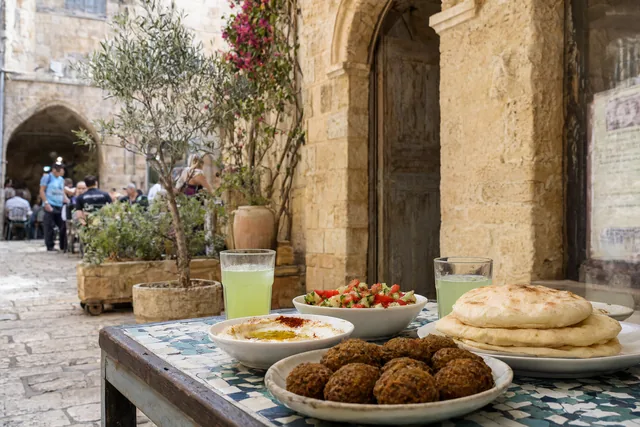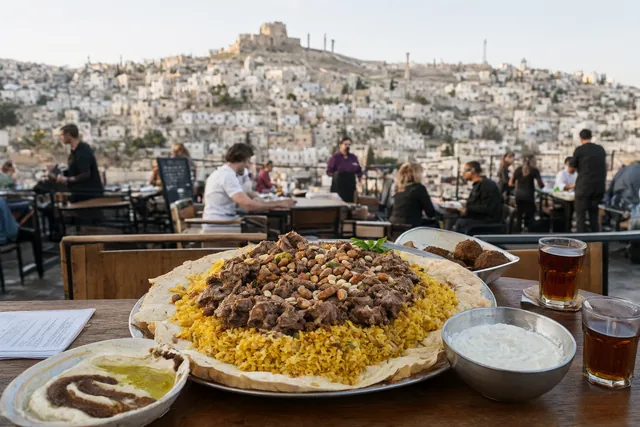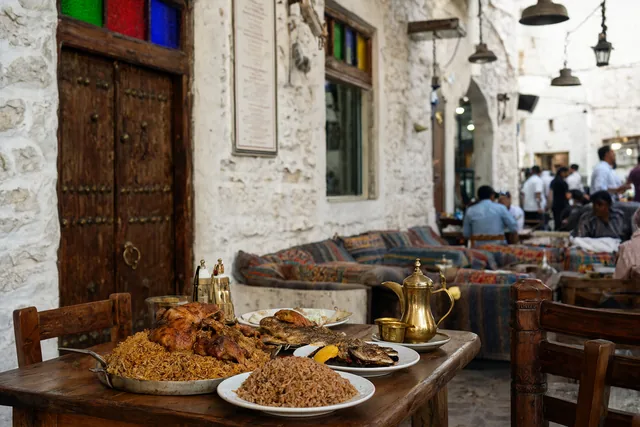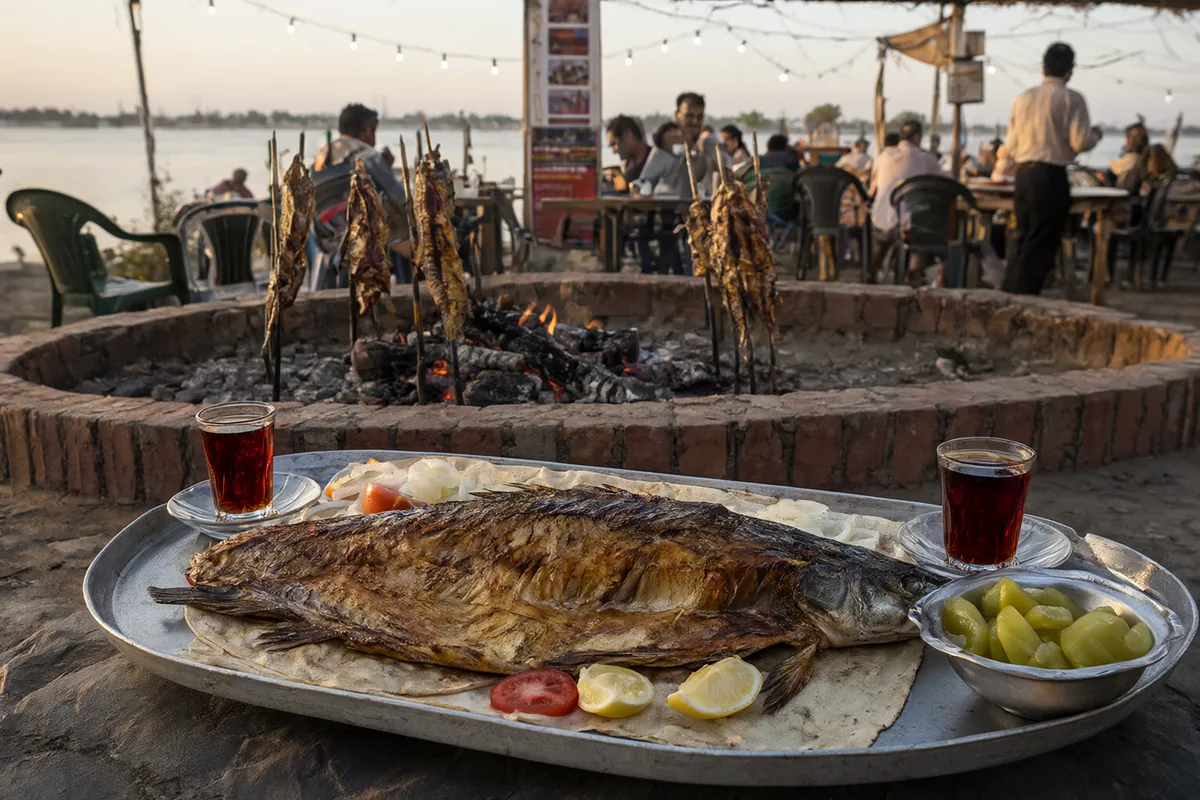
Iraqi food is the cooking of Mesopotamia: rice and stews, flatbreads from clay ovens, stuffed vegetables, dates from the palm groves and the famous masgouf, river fish grilled over an open fire. It shares dishes with Syria, Turkey, Iran and the Gulf, yet has its own flavours, from the sour tang of dried lime and tamarind to the mango pickle called amba. This Iraq food guide covers the dishes to know, how to read Arabic and Kurdish menus, how cash and tipping work, the rules on alcohol and Ramadan, and then goes city by city through where to eat in Baghdad, Basra, Najaf, Karbala, Erbil, Sulaymaniyah and Duhok. Iraqis are generous hosts, and a meal usually ends with more tea than you can drink.
What to eat in Iraq: 12 dishes to know
Everyday Iraqi food is timman w marag, rice and a stew, eaten at lunch. Restaurants add grills, fish and the dishes that families save for Fridays and holidays.
- Masgouf (Baghdad): the national dish, a whole carp split open, seasoned with salt, turmeric and sometimes tamarind, and staked upright beside a wood fire until smoky and tender. Served with flatbread, pickles, onion, tomato and lemon.
- Dolma: onions, peppers, aubergine, courgettes, tomatoes, chard and vine leaves stuffed with spiced rice and meat, cooked together in one pot with a sour sauce and turned out onto a platter.
- Kubba: shells of rice, bulgur or semolina filled with minced meat. Kubbat halab is made with rice, kubbat mosul is a large flat disc of bulgur, and kubbat hamudh are dumplings in a sour turnip and tomato soup.
- Quzi: a whole lamb or lamb shoulder roasted and served on spiced rice with almonds, raisins and vermicelli. A feast dish for weddings and guests.
- Tepsi baytinjan: a baked dish of fried aubergine, meatballs, tomato, potato and onion in a tomato sauce, served with rice.
- Bagilla bil dihin: a breakfast of bread soaked in broth with broad beans, topped with a fried or poached egg and hot ghee. A version of tashreeb, the family of bread-in-broth dishes.
- Geymar: thick clotted cream from buffalo milk, eaten for breakfast with flatbread and date syrup (dibis) or honey, often with kahi, a flaky syrupy pastry.
- Pacha: sheep's head, trotters and stuffed tripe in broth over bread, eaten early in the morning or late at night. Strictly for the adventurous.
- Iraqi biryani: rice cooked with vermicelli, potatoes, peas, nuts and chicken or meat, milder than its South Asian namesake.
- Samoon and amba: samoon is a diamond-shaped bread from the bakery oven, filled with falafel, egg, kebab or tikka, and amba is a tangy mango pickle sauce that goes on almost every sandwich.
- Kleicha: the national biscuit, cardamom-scented pastry filled with dates or walnuts, baked in huge numbers for Eid.
- Chai: strong, very sweet black tea in small waisted glasses (istikan), sometimes with cardamom. Also try noomi basra, a sour, amber tea made from dried limes.
In the Kurdistan Region in the north, you will also find parda plaw (rice, chicken and nuts baked in a pastry crust), dokhwa (a warm yoghurt soup with rice and herbs), Kurdish flatbreads, local cheeses and honey, and mastaw, a salted yoghurt drink.
How to read an Arabic menu in Iraq
Outside international hotels and some restaurants in Baghdad and Erbil, menus in Iraq are often in Arabic only, or there is no menu at all and the waiter lists what is cooking today. Arabic is written from right to left. Iraqi Arabic has some words of its own: rice is timman, not ruz, and the letter چ (ch), borrowed from Persian, appears in words like chai.
| Arabic | Romanised | Meaning |
|---|---|---|
| مقبلات | muqabbilat | Starters |
| مشويات | mashwiyat | Grills |
| كباب / تكة | kabab / tikka | Minced meat skewer / meat chunks on a skewer |
| تمن | timman | Rice |
| مرق | marag | Stew, eaten with rice |
| لحم | laham | Meat, usually lamb |
| دجاج | dijaj | Chicken |
| سمك | simach | Fish |
| خبز / صمون | khubz / samoon | Flatbread / diamond-shaped bread roll |
| لبن | laban | Salted yoghurt drink |
| قيمر | geymar | Clotted buffalo cream |
| حلويات | halawiyat | Sweets, desserts |
| چاي | chai | Tea |
| نباتي | nabati | Vegetarian |
In Erbil, Sulaymaniyah and Duhok, menus may be in Kurdish, which is also written in an Arabic-based script but is a different language. Useful Sorani Kurdish words are نان (nan, bread), گۆشت (gosht, meat), مریشک (mirishk, chicken), ماسی (masi, fish), برنج (birinj, rice), ماستاو (mastaw, yoghurt drink) and چا (cha, tea). Masgouf restaurants price fish by weight: you choose a live or fresh carp, it is weighed, and the price is per kilo.
A masgouf restaurant's price is per kilo of fish, not per plate, and an Iraqi menu may be in Arabic in Baghdad and Kurdish in Erbil. swap.menu reads both scripts, explains each dish, converts dinar prices to your home currency and flags priced-by-weight items, so you know what a whole carp will cost before it goes by the fire.
Cash, tipping and paying the bill
Check your government's current travel advice before planning a trip. Iraq is a cash economy. Foreign cards are accepted at some international hotels and upmarket restaurants in Baghdad and Erbil, and some foreign-issued cards may not work at all, while ATMs that accept them are limited. Bring enough cash, ideally US dollars in clean, recent notes, which are widely exchanged and sometimes accepted directly for larger bills, especially in the Kurdistan Region.
The currency is the Iraqi dinar (IQD, written ع.د or ID). Notes come in large denominations, and prices often run into the thousands or tens of thousands of dinars, so count your zeros. Some restaurants add a service charge to the bill, especially in hotels. Our guide to tax and service charges on menus explains how these lines work. If you do pay by card and the machine offers to charge you in your home currency, decline: our guide to paying in local currency explains why.
Tipping is not expected at cheap eateries, where rounding up is enough. In sit-down restaurants, 5 to 10 percent is appreciated if no service charge has been added. In many places you pay at the counter on the way out, and tea after the meal is often brought without being ordered and sometimes without charge. Iraqi hosts may insist on paying for a guest, and it is polite to offer more than once.
Lunch is the main meal, from about 1pm to 3pm, and dinner runs from about 8pm. The weekend is Friday and Saturday, and Friday is the day for a family outing or a masgouf by the river. In summer, when Baghdad and Basra regularly pass 45 degrees, life moves into the evening and restaurants stay busy late.
Alcohol is heavily restricted in federal Iraq and is not served in most restaurants, and the shrine cities of Najaf and Karbala are completely dry. The Kurdistan Region is more relaxed: bars and liquor shops operate in Erbil's Ankawa district and in parts of Sulaymaniyah and Duhok. During Ramadan, eating, drinking and smoking in public during daylight is not acceptable, and most restaurants close in the day and open at sunset for iftar. A few places serving non-fasting customers stay open behind curtains, especially in Erbil. Ramadan nights are busy, with sweets shops and cafés open late.
Where to eat in Iraq, city by city
These cities cover the south, the shrine cities of central Iraq and the Kurdistan Region in the north. Jump to a city:
Where to eat in Baghdad
Baghdad is the home of masgouf, and the place to eat it is Abu Nuwas Street, along the east bank of the Tigris, where restaurants keep carp in tanks or pools and grill them around open fires on the riverbank. An evening masgouf by the river, with bread, pickles and endless tea, is the classic Baghdad meal. The district of Karrada is the city's busiest dining area, with grill restaurants, falafel and shawarma counters, juice bars and ice cream shops open late, and Mansour in the west has more upmarket restaurants and cafés.
In the old centre, Mutanabbi Street is famous for its Friday book market and its old teahouses, where Baghdadis drink tea, read and talk about books and poetry. The nearby Shorja market, one of the oldest in Baghdad, is the place for spices, dried limes, dates, nuts and sweets. For breakfast, look for a geymar seller or a shop serving bagilla and kahi, and for lunch, a timman w marag restaurant where the stews are lined up in pots by the door. A Baghdad tip: masgouf takes time to cook, so order it as soon as you sit down and fill the wait with salads and tea.
Where to eat in Basra
Basra, in the far south where the Tigris and Euphrates meet as the Shatt al-Arab, was for centuries Iraq's great port, and its cooking shows it. Basra food uses more spices, dried lime and tamarind than the north, reflecting long trade with India and the Gulf. Fish and shrimp from the Gulf and the rivers are everywhere, and the dried limes used across the region are known as noomi basra. The marshes north of Basra supply buffalo milk for geymar.
The Corniche along the Shatt al-Arab is where Basrawis walk in the evening, with cafés, juice stands and fish restaurants. Basra is surrounded by date palms, and in late summer the markets are full of fresh dates such as soft barhi. The old market streets of Basra are the place for spices, sweets and Basra-style fish dishes. Expect Arabic-only menus and very hot summers, when Basra eats late into the night.
Where to eat in Najaf
Najaf, south of Baghdad, is one of the holiest cities in Shia Islam and home to the shrine of Imam Ali, and its food scene is built around pilgrims. The streets and covered markets around the shrine are lined with simple restaurants serving rice, stews, kebab and chicken, sweet shops, bakeries and teahouses, many of them open around the clock during major religious occasions. Najaf is known for qeema, a thick stew of minced meat and chickpeas with dried lime, served with rice, especially during the month of Muharram.
Najaf is conservative and completely alcohol-free, so dress modestly and expect segregated family sections in many restaurants. Prices are low, and the food is filling rather than fancy. The old market near the shrine is a good place to buy dates, sweets, prayer beads and dried fruit, and to sit with a glass of tea and watch the crowds.
Where to eat in Karbala
Karbala, home of the shrines of Imam Hussein and his brother Abbas, receives millions of pilgrims a year, and its food culture is shaped by hospitality. During the Arbaeen pilgrimage, when huge numbers of people walk from Najaf to Karbala, volunteers along the route set up tents called mawakib offering free food, tea, water and rest to every walker. Rice and stew, qeema, bread, dates and tea are served in vast quantities.
Outside the pilgrimage seasons, Karbala has the same kind of simple restaurants, sweet shops and teahouses as Najaf, concentrated in the streets between and around the two shrines. Karbala is also surrounded by date palm groves and orchards. Like Najaf, it is conservative and alcohol-free, and many restaurants have family sections. Visit early in the day or after evening prayers, when the area is calmer.
Where to eat in Erbil
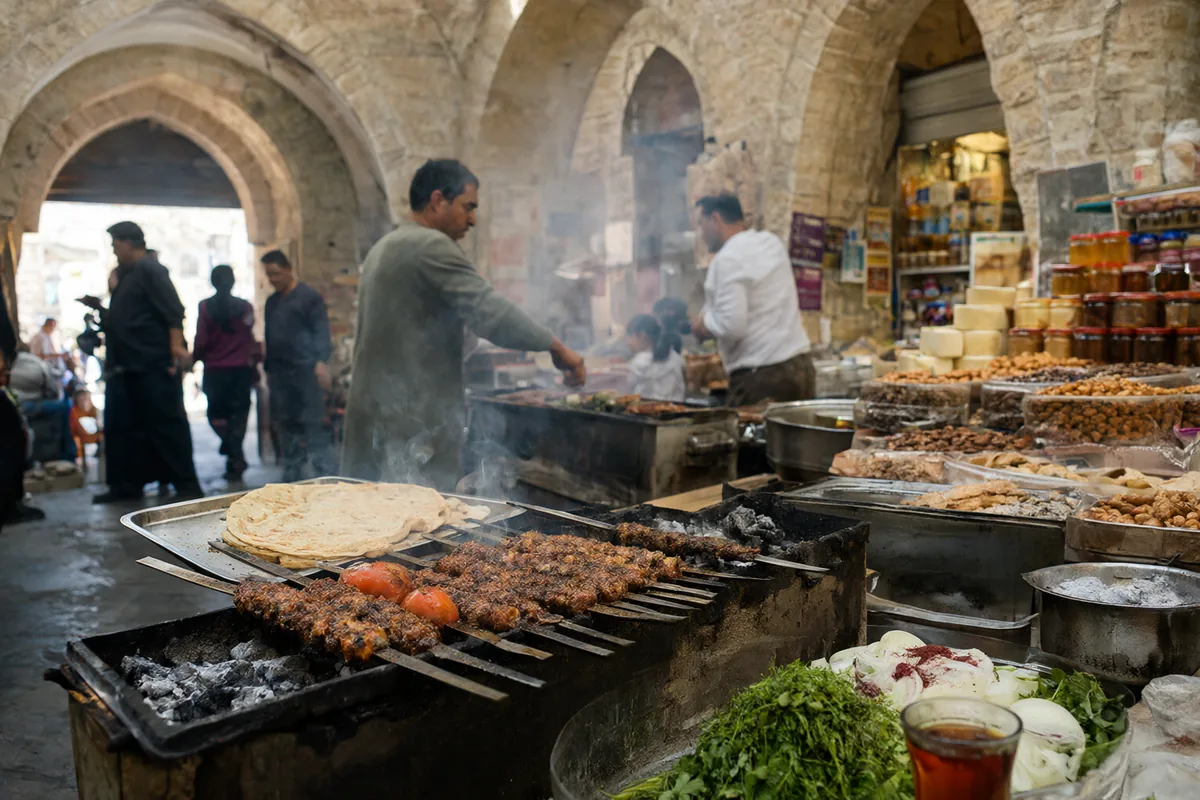
Erbil, the capital of the Kurdistan Region, is the easiest Iraqi city for most visitors, with the widest range of restaurants and hotels. The heart of old Erbil is the Citadel, one of the oldest continuously inhabited sites in the world, and below it the Qaysari Bazaar, a warren of covered lanes selling cheese, honey, dried fruit, nuts, spices and sweets, with kebab grills and old teahouses where men play dominoes over glasses of tea. The square in front of the Citadel, with its fountains, fills with families on summer evenings.
Kurdish restaurants in Erbil serve kebab and tikka with grilled vegetables, flatbread and a pile of fresh herbs, alongside dolma, kubba, parda plaw and dokhwa. The Christian suburb of Ankawa has the city's biggest concentration of international restaurants, cafés and bars, and is one of the few places in Iraq where alcohol is easy to find. Erbil's main ring roads, such as 60 Metre and 100 Metre Street, are lined with grill restaurants and bakeries. Menus in Erbil may be in Kurdish, Arabic and English.
Where to eat in Sulaymaniyah
Sulaymaniyah, in the mountains east of Erbil, is the cultural capital of Iraqi Kurdistan, with a reputation for poets, music and a relaxed café culture. Its bazaar is one of the largest in the region, a long network of streets selling produce, spices, cheese, sweets and clothes, with small restaurants serving kebab, rice and stews. Sulaymaniyah's teahouses and cafés are busy late into the evening, and the city has a younger, more open dining scene than most of Iraq.
In spring and summer, families from Sulaymaniyah drive into the surrounding hills and mountains for picnics and barbecues, a Kurdish tradition, especially during the Newroz new year celebrations in March. Local specialities include Kurdish breads, fresh cheeses, honey and mountain herbs. Sorani Kurdish is the main language in Sulaymaniyah, and English is spoken more widely among younger people here than in the south.
Where to eat in Duhok
Duhok, in the far north near the Turkish border, is a smaller city surrounded by mountains, with a food scene to match. Its bazaar in the centre has produce, nuts, cheese and sweet shops, and grill restaurants serve kebab, tikka, rice and dolma. The local Kurdish dialect in Duhok is Badini (Kurmanji), different from the Sorani spoken in Erbil and Sulaymaniyah.
Duhok's appeal is mostly outdoors. The hills and the area around the Duhok Dam lake fill with picnicking families at weekends, and the mountain villages and resorts north of the city have simple restaurants with river views serving grilled fish and meat. Duhok is a good base for exploring the mountains of the Kurdistan Region, and its restaurants are relaxed and inexpensive.
Vegetarian, vegan and allergy tips
Iraqi food is meat-heavy, and many dishes that look vegetarian, such as stews of okra, beans or aubergine, are cooked with meat or meat stock. Vegetarian options exist, though: falafel in samoon with amba and salad, hummus, bagilla without the egg, lentil soup (shorbat adas), vegetarian dolma if you ask, rice, salads, fresh bread and fruit. The word for vegetarian is nabati, and it helps to say clearly that you eat no meat and no meat stock. All meat is halal, and pork is not available.
Ghee and butter are used generously in rice, bread and pastries, and geymar, yoghurt and cheese are part of most breakfasts. Nuts, especially almonds, walnuts and pistachios, appear in rice dishes, quzi and sweets, and sesame is in bread and tahini. Our guide to eating abroad with food allergies explains how to communicate an allergy clearly when you do not speak the language.
Useful Arabic and Kurdish phrases for ordering
These phrases use Iraqi Arabic, with two Sorani Kurdish phrases at the end for Erbil and Sulaymaniyah. Iraqis are delighted by any attempt at their dialect.
السلام عليكم Assalamu alaykum: "Peace be upon you", the standard greeting
شلونك؟ Shlonak?: "How are you?" (shlonich to a woman)
شنو تنصحني؟ Shinu tinsahni?: "What do you recommend?"
أريد هذا Areed hatha: "I want this" (pointing)
بدون لحم Bidoon laham: "Without meat"
الحساب رجاءً Il-hsab rajaa'an: "The bill, please"
چۆنی؟ Choni? (Sorani Kurdish): "How are you?"
سوپاس Supas (Sorani Kurdish): "Thank you"
How swap.menu helps you eat in Iraq
In Iraq you may face an Arabic board in Baghdad, a Kurdish menu in Sulaymaniyah and a waiter reciting the day's dishes in Najaf. Photograph whatever there is with swap.menu and every dish appears in your language with the original name beside it and a short explanation, so you know that pacha is sheep's head and trotters, that kubbat hamudh is a sour soup with dumplings, and that geymar is cream, not cheese. Prices in Iraqi dinars, with all their zeros, are converted to your home currency, which helps when you are counting cash.
Tap the dishes you want, add a note such as "no meat stock" or "no nuts, please", typed or spoken, and swap.menu translates your order into Arabic or Kurdish. Show the waiter your phone, or let them scan the QR code and read your order on their own screen. Try it now on a sample menu with the free demo, or see travel pass prices.
Off to Iraq? Your first 3 menu scans are free, and a travel pass starts from $4.99 with nothing that renews.
Start free with 3 scansIraq food FAQ
What is the national dish of Iraq?
Masgouf, a whole carp split open, seasoned and grilled slowly beside a wood fire, is usually called Iraq's national dish. Dolma, kubba, quzi and timman w marag (rice and stew) are the other dishes most Iraqis would name.
Do you tip in restaurants in Iraq?
Tipping is not expected at cheap eateries, where rounding up is enough. In sit-down restaurants, 5 to 10 percent is appreciated if no service charge has been added to the bill.
Can I use a credit card in Iraq?
Only in some international hotels and upmarket restaurants, mainly in Baghdad and Erbil, and some foreign cards may not work at all. Iraq runs on cash, so bring enough US dollars in clean notes and change them into dinars as you go.
Is alcohol available in Iraq?
Alcohol is heavily restricted in federal Iraq and not served in most restaurants, and Najaf and Karbala are completely dry. In the Kurdistan Region it is easier to find, especially in Erbil's Ankawa district.
Is tap water safe to drink in Iraq?
No, drink bottled water, which is cheap and sold everywhere. Restaurants usually bring bottled water to the table.
How can I read a menu in Iraq?
Learn a few words such as timman (rice), marag (stew), laham (meat) and simach (fish), or photograph the menu with swap.menu. It reads Arabic and Kurdish, explains every dish, converts prices to your currency and translates your order for the waiter.
Travelling further in the region? Read our food guides for neighbouring countries:
- Jordan food guide
- Kuwait food guide
- Iran food guide
- Turkey food guide
- Saudi Arabia food guide
- Lebanon food guide
Or browse every travel food guide.